


Révisé par ThaiLawOnline, un cabinet d'avocats thaïlandais agréé exerçant en Thaïlande depuis 2006. Avocate thaïlandaise en charge du dossier : Wichuda Atthamethakon, LL.M., licence du barreau thaïlandais 3149/2556.
Dernière mise à jour :
TL;DR. Under the Civil and Commercial Code the longest lease of land or a house is thirty years (a separate 1999 Act allows up to fifty years, but only for commerce or industry). Any promise of automatic renewals to create a “30 + 30 + 30” or 90-year lease in Thailand is void. The Cour suprême has held such a pre-signed extension void (decision 4655/2566). If you want long-term security, you need a strong thirty-year lease today. You need useful tools. These include a Thailand droit de superficie, a usufruct agreement in Thailand, and a good succession clause. Be ready to negotiate new terms when it is time to renew.
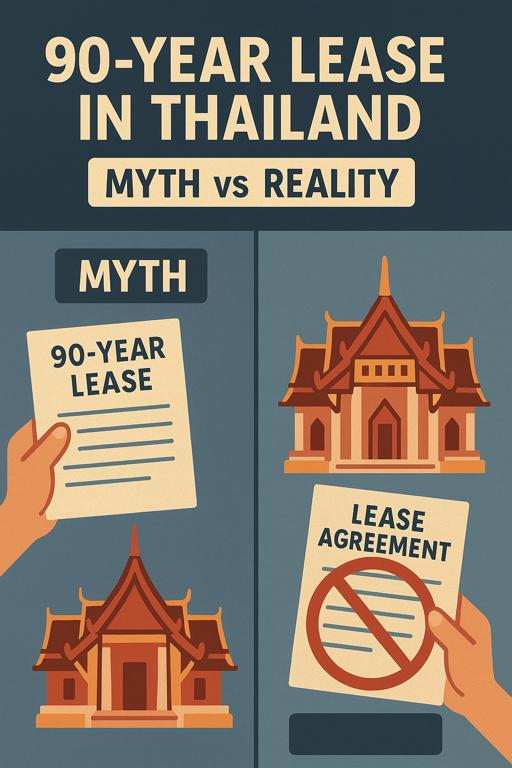
Table des matières
L'ARGUMENTAIRE DE VENTE 30 + 30 + 30
Resort-area agents often promise foreigners a guaranteed 90-year lease. You register thirty years now and sign two further leases “in compte séquestre.” The idea sounds perfect: three decades of effortless living three times in a row. It feels safer than propriété de l'entreprise désignée, et les supports marketing affirment que c'est légal.
PLAFOND LÉGAL : TRENTE ANS SEULEMENT
Article 540 du Code civil de Thaïlande says that a hire of immovable property cannot exceed thirty years, and that a longer term is cut down to thirty. The same section allows the term to be renewed once it has run out, but the renewed term cannot itself exceed thirty years counted from the date of renewal. Read it carefully, because the limit is on each term and on renewing in advance. The section does not cap how many times a lease may be renewed; what it refuses to allow is a renewal agreed before the current term has ended. Each new term has to be a fresh contract, signed and registered at the Land Department after the previous one expires. In décision 4655/2566 the Supreme Court struck down the standard workaround. A landowner had granted a thirty-year lease and, on the same day, promised two further thirty-year terms on the same rent and conditions. The Court found that the tenant had paid the rent for all ninety years at the outset: 1,500,000 baht for the first thirty and 600,000 baht for each further term, 2,700,000 baht in all. The Court held that the parties plainly intended to evade section 540, so the renewal part of the bargain was void. It then refused the tenant the fallback argument that the promise should at least bind the landlord personally, because if that worked section 540 would have no force at all. The tenant was evicted, its counterclaim to have a further thirty years registered was dismissed, and it was ordered to pay the landowner 30,000 baht a month in damages from the date of the suit until it left. The judgment orders nothing repaid for the void terms, because no refund was claimed; the Court counted the money already paid when it fixed the damages. The case came from Phuket, on a lease registered in 1990.
THE 99-YEAR LEASE AND THE 75 PERCENT CONDOMINIUM QUOTA
Two separate measures are quoted to foreign buyers as though they were already law: raising the maximum lease term to 99 years, and raising the foreign ownership quota in a condominium building from 49 percent to 75 percent. Neither has become law. Section 540 still reads as set out above, and the thirty-year ceiling is what a Thai court applies to a lease signed today. Status checked on 22 August 2026.
So treat a 99-year offer exactly as you would treat a 90-year one: thirty years of enforceable right, followed by a hope. If a change is ever enacted it will not retroactively validate a structure a court has already struck down. Our page on the Thailand condominium foreign ownership quota tracks both proposals and records the stage each one has actually reached.
LES RISQUES CACHÉS DERRIÈRE LE MYTHE DU BAIL DE 90 ANS EN THAÏLANDE
When the first thirty-year term expires the landowner, or whoever inherits the land, can simply refuse to renew. If the owner dies or sells, you lose leverage in the bail agreement. Without a succession clause, your lease can even end on your own death, leaving heirs with nothing in the case of a lease contract. Buyers who believe the 90-year promise often skip vérification préalable, forget to add protective rights and end up exposed.
DES ALTERNATIVES PLUS SÛRES À LONG TERME
Un droit de superficie enregistré vous permet d'être propriétaire de la villa ou de la maison tout en louant le terrain. Cela signifie que même si le bail prend fin, vous conservez le contrôle du bâtiment. concessions d'usufruit possession and use for the holder’s life or for a fixed term of up to thirty years (sections 1418 and 1403), and it always ends when the holder dies, which suits a retiree who wants security for life. Including a succession clause and writing bilingual Thai wills helps heirs inherit any remaining time on your lease easily.
COÛTS ET FRAIS D'INSCRIPTION TYPIQUES
Les frais d'enregistrement des baux gouvernementaux s'élèvent à 1,1 % du loyer déclaré. contrats de bail. La rédaction et la traduction d'un bail bilingue coûtent généralement entre vingt et trente mille bahts. Un professionnel recherche de titres ET ensemble de vérification préalable Les frais d'assurance pour les biens immobiliers varient de dix à vingt-cinq mille dollars. Comparés à la valeur des biens, ces frais représentent une assurance modeste.
PROPRIÉTÉ DE L'ENTREPRISE VS. LOCATION
Some advisers encourage Thai companies to pursue land ownership. However, prête-nom crack-downs and yearly compliance costs can often be more than the benefits. A thirty-year lease agreement can be beneficial. It may include superficies rights. This type of lease is often easier, cheaper, and better for a home.
FAQ sur le bail de 90 ans en Thaïlande
Quel est le statut juridique d'un bail de 90 ans en Thaïlande ?
A 90-year lease of land or a house cannot be registered as such. Section 540 of the Civil and Commercial Code caps a lease at thirty years and cuts any longer term down to thirty, so the lease is not void: it stands for thirty years. What the Supreme Court held void in decision 4655/2566 was a renewal for two more thirty-year terms fixed in advance to get around that limit.
Un étranger peut-il obtenir un bail de 30 ans en Thaïlande ?
Oui, les étrangers peuvent obtenir un Bail de 30 ans sur une propriété en Thaïlande. This type of leasehold is legally binding if it is made in writing and registered (section 538). It can contain a promise to renew, but that promise does not extend the registered term, and the Supreme Court held one void where it was used to get around section 540 (4655/2566). However, it is essential for foreign investors to consult legal advice to ensure compliance with Thai property laws.
Comment fonctionne l'option de renouvellement de bail en vertu du droit thaïlandais des baux ?
The parties can negotiate a new lease once the first thirty years have run out, and a renewed term may itself run up to thirty years from the date of renewal. What cannot be done is to fix that renewal in advance. A renewal promised at the start of the lease was held void in Supreme Court decision 4655/2566. A reciprocal contract with special consideration beyond an ordinary lease is a genuine and separate doctrine in Thai law, but it does not lift the thirty-year ceiling; it matters because it can bind the landlord’s heirs and can be enforced even where the ordinary writing and registration rule in section 538 was not met. What section 538 actually costs you if you skip it is the rest of the term. A hire of immovable property for more than three years is enforceable only for three years unless it is made in writing and registered with the competent official. So a signed thirty-year lease that never reaches the land office is not a thirty-year lease with a paperwork problem: it is a three-year lease. And under section 564 a lease ends at the close of its agreed term automatically, with no notice required from either side, which is why nothing about a renewal happens by default.
Que se passe-t-il à la fin d'un bail de 30 ans en Thaïlande ?
À l'issue d'un bail de 30 ans, celui-ci peut être renouvelé, mais ce renouvellement n'est pas automatique. Les parties doivent s'entendre sur les conditions et un nouveau contrat de bail doit être rédigé. Cela signifie que le bien ne peut être considéré comme restant sous le même bail sans le consentement des deux parties.
Existe-t-il des dispositions permettant de prolonger un bail en Thaïlande ?
A lease can be extended, but the extension has to be a new agreement made after the current term ends, registered at the Land Department, and no longer than thirty years from the date of renewal. A reciprocal contract carrying special consideration beyond an ordinary lease is a real category in Thai law, built by the courts rather than written into a single section, and it rests on the mutual obligation rules in sections 369 to 376 of the Civil and Commercial Code. It is worth knowing about, because such a contract can bind the landowner’s heirs and can be enforced even when the lease was never registered. It does not, however, buy a term longer than thirty years, and it will not rescue a renewal that was agreed up front to get around section 540.
Que doivent savoir les investisseurs étrangers concernant les baux immobiliers à Phuket ?
Les investisseurs étrangers souhaitant louer un bien immobilier à Phuket doivent savoir que la durée maximale du bail est de 30 ans. Il est possible de le renouveler. Il est conseillé de consulter un avocat afin de bien appréhender la complexité du droit immobilier thaïlandais.
Quelle est la procédure pour enregistrer un bail auprès du bureau foncier en Thaïlande ?
Pour enregistrer un bail auprès du bureau foncier en Thaïlande, les deux parties doivent préparer les documents requis. Elles doivent ensuite soumettre ces documents au service foncier compétent. contrat de location must clearly state how long it lasts. The registered term cannot exceed thirty years; a promise to renew written into the contract is not a registered further term.
Est-il possible de conclure un contrat de location pour une durée supérieure à 30 ans en Thaïlande ?
Not under the Civil and Commercial Code: section 540 reduces any longer term to thirty years, so the lease stands for thirty and the excess falls away. The one statutory exception is the Commercial and Industrial Property Lease Act B.E. 2542, which allows a lease of more than thirty and up to fifty years, renewable for up to fifty, but only for commerce or industry, only if registered (otherwise it is void), and not for a private home.
Quels conseils juridiques devrais-je solliciter avant de signer un bail en Thaïlande ?
Avant de signer un bail en Thaïlande, il est essentiel de consulter un avocat. Cet avis doit porter sur les conditions du bail, les options de renouvellement et la législation immobilière. Il est important de bien comprendre la durée du bail et de s'assurer de sa validité. Cela contribue à protéger votre investissement. Il est conseillé de consulter un cabinet d'avocats. Cela permettra de garantir la conformité de vos documents, notamment si vous investissez une somme importante.
Besoin d'un contrat de location en Thaïlande
Depuis 2006, ThaiLawOnline a rédigé et enregistré des centaines de baux, de droits de superficie et d'usufruits. Prenez rendez-vous pour une consultation avec nous.. Don’t rely on the 90-year myth. Secure your investment with a legally sound strategy today.
Essayez-le vous-même d'abord, gratuitement
Vous n'avez rien à réserver pour commencer. Ceux-ci s'exécutent dans votre navigateur, et vous ne nous payez que si vous décidez de faire appel à un avocat.
Last reviewed: 15 September 2026. Sections 538, 540, 541 and 564 of the Civil and Commercial Code were read in Thai and English from this site’s own statute library: section 540 for the thirty-year ceiling, for the reduction of any longer term to thirty, and for renewal not exceeding thirty years from the time of renewal; section 538 for the rule that a hire of more than three years is enforceable only for three years unless made in writing and registered; and section 564 for a lease ending at the close of its term without notice. Not verified in this review: the Supreme Court decisions cited above, the practical land office steps, and the commentary on structures marketed as ninety-year leases. Re-checked on 5 October 2026: Supreme Court decision 4655/2566 read in Thai to the disposition (Phuket lease of 1990; rent for all ninety years, 2,700,000 baht, found paid at the outset; same-day promise of two further thirty-year terms void as evading section 540, not enforceable as a personal undertaking; eviction affirmed, counterclaim dismissed, damages set at 30,000 baht a month), sections 1403 and 1418 and the Commercial and Industrial Property Lease Act B.E. 2542 (sections 3 and 4) read in Thai; the case facts, the FAQ answers that called a lease over thirty years void, and the usufruct line were corrected and the fifty-year commercial exception added. Still unverified: the land office steps, the fee figures and the status of the 99-year and 75 percent proposals after 22 August 2026.
Analyseur de bail Gratuit
Collez votre bail thaïlandais. Nous le vérifions au regard des cinq clauses qui posent le plus souvent problème.
Ouvrir l'outilInterroger notre assistant IA Gratuit
Entraîné sur le droit thaïlandais et plus de 77 000 arrêts de la Cour suprême. Posez vos questions, gratuitement.
Actualités juridiques thaïlandaises, gratuites par courriel
Des informations claires et concises sur les changements législatifs thaïlandais concernant les étrangers : propriété, visas, mariage, affaires et testaments. Un court courriel par mois, envoyé par un cabinet d’avocats établi depuis 2006. Zéro spam, désabonnement possible à tout moment.