


Dernière mise à jour :
Révisé par ThaiLawOnline, un cabinet d'avocats thaïlandais agréé exerçant en Thaïlande depuis 2006. Avocate thaïlandaise en charge du dossier : Wichuda Atthamethakon, LL.M., licence du barreau thaïlandais 3149/2556.
En bref. Les nouvelles règles du visa ED en Thaïlande que les gens recherchent sont en réalité trois instruments distincts, et la plupart des pages les fondent en une seule “ répression ”. Premièrement, la clause 2.9 du tableau annexé à l’ordonnance du Bureau de l’immigration n° 12/2568 fixe les plafonds de prolongation : jusqu’à un an par prolongation pour les étudiants d’université et d’établissements d’enseignement formel, et pour les écoles de langues, les salles de Muay Thai et toutes les autres écoles non formelles, 90 jours par prolongation et pas plus d’un an au total, à compter de la date de votre entrée en Thaïlande ou de la date à laquelle vous avez été autorisé à changer de type de visa dans le pays. Deuxièmement, l’annonce du ministère de l’Enseignement supérieur, en vigueur depuis 14 mai 2025 plafonne les cours universitaires de courte durée à 180 jours, nécessite au moins 60 % d’enseignement en présentiel et une déclaration mensuelle des présences, et a conduit à la révocation de l’autorisation de séjour de près de 10 000 étudiants en août 2025. Troisièmement, le visa ED Plus , issu de la résolution du Conseil des ministres du 28 mai 2024, permet aux étudiants en cursus diplômant de revenir sans permis de retour et d’obtenir une prolongation d’un an après l’obtention de leur diplôme. Le reste de ce guide explique lequel des trois régimes s’applique à vous, ce qu’il coûte et comment le visa prend fin.
Si les études ne représentent qu'une option parmi d'autres, notre outil de recherche de visa pour la Thaïlande affichera les alternatives.
Qu’est-ce qui a changé en 2025 et 2026, dans un tableau
| Date | Instrument ou événement | A qui cela s'applique | Ce qu'il fait |
|---|---|---|---|
| 28 mai 2024 | Résolution du Cabinet sur les mesures en matière de visas (proposition du ministère des Affaires étrangères) | Étudiants de niveau licence et au-delà | Création d’ED Plus : départ et retour sans permis de retour, prolongation d’un an après l’obtention du diplôme, changement de type de visa en Thaïlande en cas d’embauche. |
| 1er mai 2025 | Carte d'arrivée numérique de Thaïlande (TDAC) | Tous les voyageurs étrangers, y compris les titulaires d’un visa ED | Remplace la carte papier TM6. À remplir en ligne dans les 72 heures précédant l’arrivée. Voir notre guide TDAC. |
| 14 mai 2025 | Annonce du MHESI concernant les cours non diplômants de courte durée pour les étudiants étrangers, B.E. 2568 | Seuls les établissements d'enseignement supérieur (universités et leurs cours de courte durée) | Durée du cours de 180 jours au maximum, au moins 60 % en présentiel, chaque cours déclaré au ministère, l’étudiant signalé dans les 30 jours suivant l’octroi du séjour, rapports mensuels de présence versés dans une base de données partagée. |
| 22 août 2025 | Réunion conjointe du MHESI et du Bureau de l’immigration | Étudiants dans des cours courts non conformes | Le Bureau a indiqué avoir révoqué le permis de séjour de près de 10 000 étudiants en vertu de l’article 36 de la Loi sur l’immigration. |
| 7 août 2026 | Le MHESI ordonne une enquête sur l’admission internationale d’une université | Étudiants en cursus diplômant ou non diplômant de cette université | Il confirme que le ministère vérifie désormais l’inscription, les dossiers d’immigration et les dossiers de visa de manière intégrée, et non plus uniquement les documents relatifs aux cours. |
| 15 septembre 2026 | Exemption de visa de 30 jours (Journal officiel, 31 août 2026) | Toute personne qui envisage de convertir une entrée sans visa en visa ED en Thaïlande | L’exemption de 60 jours prend fin. Avec 30 jours, et 15 jours devant encore rester sur l’autorisation de séjour lors de la première visite à l’immigration, la fenêtre de conversion sur place est de deux semaines. Voir l’exemption de 30 jours expliquée. |
Aucune disposition de ce tableau ne change la règle qui régit les étudiants des écoles de langues depuis 2014, et qui n'est citée par aucune autre page anglaise sur ce sujet. Cette règle se trouve ensuite.
Quelles règles s’appliquent à vous : université, école formelle ou école de langue ?
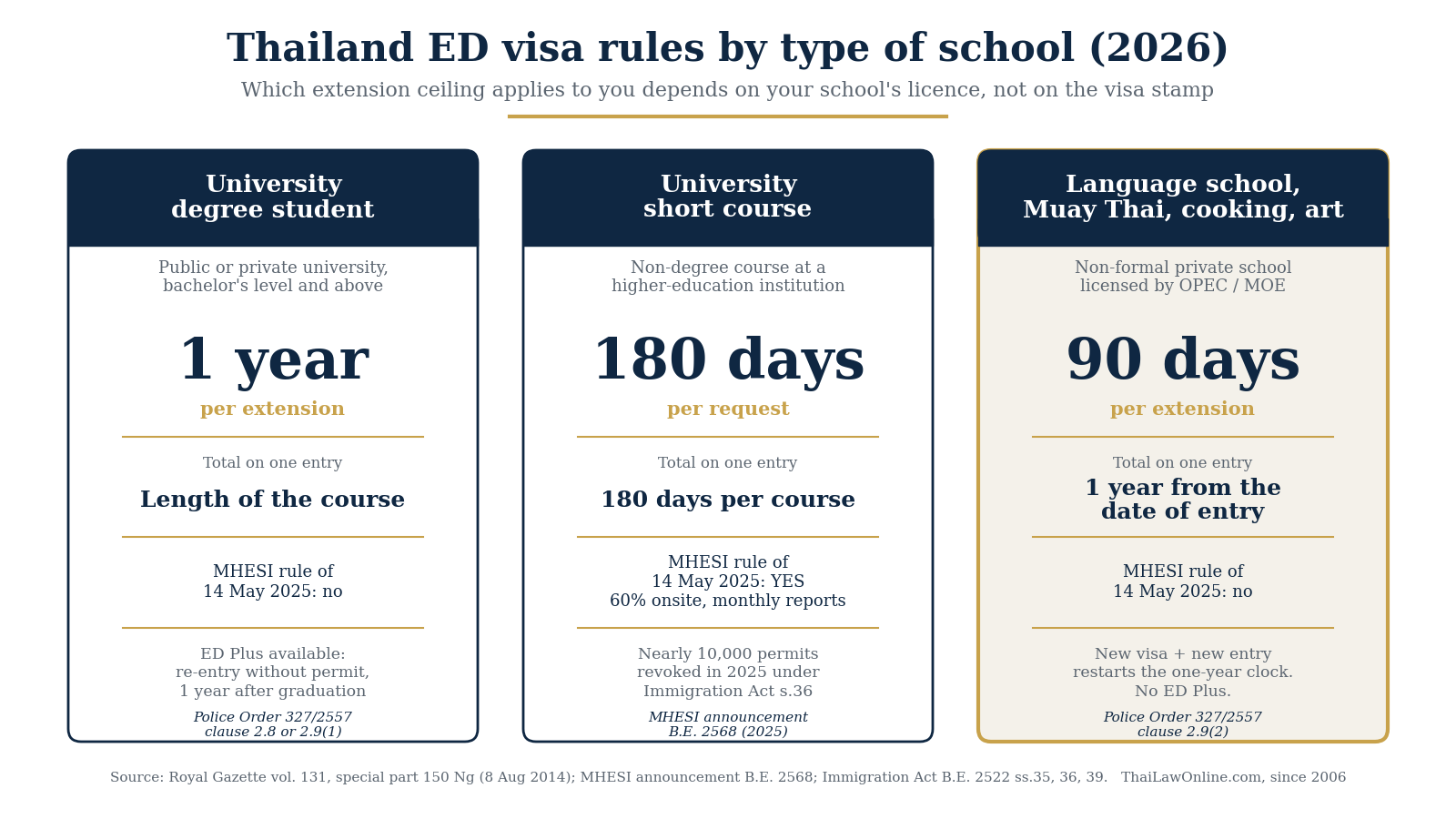
La législation thaïlandaise en matière d’immigration ne prévoit pas un “ visa étudiant ” unique. L’article 34(10) de la loi sur l’immigration B.E. 2522 (1979) admet un étranger pour des études, et l’article 35 permet au Bureau de l’immigration de prolonger ce séjour jusqu’à un an à la fois. La Police royale thaïlandaise fixe ensuite les plafonds effectifs dans un ordre fixant les critères, qui classe les étudiants selon la licence détenue par leur école.
| Où vous étudiez | Autorité de réglementation et licence | Clause du tableau annexé à l’ordonnance IB n° 12/2568 | Plafond par prolongation | Plafond total | Le règlement MHESI du 14 mai 2025 s'applique ? |
|---|---|---|---|---|---|
| Université d'État ou école publique | MHESI (universités) ou ministère de l'Éducation | 2.8 | 1 an | Durée du cours | Uniquement à ses cours non diplômants de courte durée (plafond de 180 jours) |
| Université privée, cursus diplômant | MHESI, Loi sur les établissements d'enseignement supérieur privés | 2.9(1) | 1 an | Durée du cours | no |
| Université privée, cours non diplômant de courte durée | MHESI | 2.9(1) | 1 an sur papier, 180 jours par demande selon l’annonce de 2025 | 180 jours par cours | Oui |
| École privée formelle (école internationale et similaires) | Ministère de l’Éducation, loi sur les écoles privées B.E. 2550, école “ du système formel ” | 2.9(1) | 1 an | Durée du cours | no |
| École de langue privée, salle de Muay Thai, école de cuisine, de massage ou d’art | Ministère de l’Éducation, par l’intermédiaire de l’Office de la Commission de l’enseignement privé (OPEC), loi sur les écoles privées B.E. 2550, école “ non formelle ” | 2.9(2) | 90 jours | 1 an à compter de la date d’entrée | Non. Une école de langue n'est pas une institution d'enseignement supérieur. |
La plupart des lecteurs de cette page se trouvent dans la dernière ligne. Si c’est votre cas, les deux chiffres qui régissent votre séjour sont 90 jours et un an, et l’année court à compter du jour de votre entrée en Thaïlande avec le visa, ou du jour où l’immigration a approuvé votre changement vers un visa ED si vous avez effectué la conversion en Thaïlande.
La prolongation de 90 jours et le délai d’un an : clause 2.9
Le document en vigueur est le tableau des critères et documents annexé à Ordonnance du Bureau de l'immigration n° 12/2568 du 23 janvier 2025, que nous avons lu en thaïlandais. Sa clause 2.9 concerne l’enseignement dans un établissement privé. Le numéro de la clause et les chiffres sont inchangés par rapport à l’Ordonnance n° 327/2557 de la Police royale thaïlandaise (Journal officiel, volume 131, partie spéciale 150 Ng, 8 août 2014), qui les a maintenus jusqu’à leur abrogation le 26 septembre 2023. La clause 2.9(2) concernant les écoles non formelles se lit comme suit :
๒.๙ กรณีเพื่อศึกษาในสถานศึกษาของเอกชน (๒) กรณีโรงเรียนนอกระบบให้อนุญาตตามระยะเวลาที่สถานศึกษารับรอง ครั้งละไม่เกิน ๙๐ วัน แต่รวมแล้วไม่เกิน ๑ ปี นับแต่วันที่เดินทางเข้ามาในราชอาณาจักร หรือนับแต่วันที่ได้รับอนุญาตให้เปลี่ยนประเภทการตรวจลงตราหรือได้รับการตรวจลงตรา แล้วแต่กรณี
En anglais : pour des études dans un établissement privé, dans le cas d’une école non formelle, une autorisation est accordée pour la période que certifie l’école, sans dépasser 90 jours à chaque fois, et sans dépasser un an au total, à compter de la date d’entrée dans le Royaume ou de la date où l’autorisation de modifier le type de visa, ou le visa lui-même, a été accordée, selon le cas. Dans une autre partie du même tableau, dans les lignes consacrées à l’enseignement dans les écoles privées, l’“ école non formelle ” est définie par référence à la notification du 12 février 2009 (B.E. 2552) du Conseil de la Commission de l’éducation privée : enseignement religieux, arts et sports, formation professionnelle, soutien scolaire, compétences de vie et deux types d’écoles islamiques (centres Tadika des mosquées et instituts Pondok). Une école de langue thaïlandaise, une salle de Muay Thai et une école de cuisine détiennent toutes ce type de licence.
La clause 2.9 fixe ensuite quatre conditions pour les deux types d’établissements privés, et ensemble elles constituent la liste des documents que chaque école vous envoie : le demandeur possède un visa non-immigrant ; l’établissement possède une licence délivrée par l’agence gouvernementale compétente ; l’établissement certifie l’inscription et demande la prolongation ; et l’agence gouvernementale compétente certifie l’établissement. Cette quatrième certification est la “ lettre d’agrément du ministère de l’Éducation ” que les pages concurrentes mentionnent sans préciser d’où elle provient. Pour les écoles de langue, elle provient de l’OPEC ou du Bureau provincial de l’éducation. La clause en dispense les écoles internationales et l’enseignement supérieur, raison pour laquelle les étudiants universitaires ne courent jamais après cette lettre.
Ce que la clause règle, et ce sur quoi les forums se trompent
Les agents d’immigration accordent souvent 60 jours, ou 30, au lieu de 90. Il s’agit d’un pouvoir discrétionnaire dans la limite du plafond de 90 jours, généralement parce que la lettre de l’école certifie une période plus courte. Ce n’est pas une règle distincte. Notre propre page indiquait auparavant que l’on prolonge “ tous les 60 à 90 jours, selon les documents de votre école ” ; la formulation exacte est que chaque prolongation peut durer jusqu’à 90 jours.
Le total d’un an est calculé à partir de la date de votre entrée (ou de votre changement de type de visa dans le pays), et non du jour où votre cours a commencé. Si vous êtes entré le 1er octobre 2026 et vous êtes inscrit en novembre, le délai a tout de même couru à partir du 1er octobre. Notre propre page indiquait autrefois qu’un cours de langue pouvait couvrir “ 12 à 15 mois ” ; quinze mois sur une seule entrée n’est pas possible en vertu de l’article 2.9(2).
La “ règle de la langue unique ” que l’on lit sur les forums, l’idée selon laquelle l’immigration vous oblige à passer du thaï à l’anglais après un an, ne figure pas dans l’ordre. Les écoles l’ont inventée pour pouvoir rédiger une nouvelle lettre de certification. L’ordre exige une nouvelle entrée. Un nouveau visa et une nouvelle entrée relancent le décompte d’un an, ce qui est, en termes juridiques, l’effet d’un aller-retour à la frontière (border run). La question de savoir si un agent consulaire délivrera un deuxième visa ED à quelqu’un qui vient de passer un an “ à étudier ” est une question distincte, et depuis 2025, la réponse est souvent non.
⚠️ Correction sur la vigueur du texte, le 15 septembre 2026 ; elle remplace le raisonnement qui figurait ici. Ce paragraphe soutenait précédemment que la clause 2.9 était toujours en vigueur car aucune ordonnance ultérieure que nous avions lue ne l’avait modifiée. Ce critère ne permet pas d’établir qu’un texte est en vigueur, et il était erroné ici : l’ordonnance 327/2557 et ses amendements ont été abrogés le 26 septembre 2023 par ordonnance de la Police royale thaïlandaise n° 542/2566, et selon les critères transmis au Commissaire du Bureau de l’immigration : d’abord l’ordonnance n° 242/2566 du Bureau de l’immigration, entrée en vigueur le 30 septembre 2023, puis Ordonnance du Bureau de l'immigration n° 12/2568 du 23 janvier 2025, dont la clause 2 contient les critères et le tableau des justificatifs qui s’appliquent aujourd’hui. Nous avons lu les deux. Nous avons maintenant lu la clause 2.9 du tableau actuel, et les plafonds indiqués ci-dessus restent inchangés: une école du système formel (dans le système) accorde jusqu'à un an par prolongation, selon la certification de l'école, et une école non formelle, comme c'est le cas pour les écoles de langue, accorde pas plus de 90 jours par prolongation et pas plus d’un an au total à compter du jour de votre entrée dans le Royaume ou, selon le cas, à partir du jour où l’autorisation de modifier la catégorie du visa a été accordée ou du jour où le visa a été délivré. Ainsi, ce qui était incorrect ici était la citation, et non la règle. Citons l’article 2.9 de l’Ordonnance du Bureau de l’immigration n° 12/2568.
L’annonce de MHESI du 14 mai 2025 : à quoi doit ressembler désormais un cours universitaire de courte durée
Le deuxième instrument est l’annonce du ministère de l’Enseignement supérieur, de la Science, de la Recherche et de l’Innovation concernant les critères et les directives pour l’enseignement de cours à court terme (non diplômants) aux étudiants étrangers dans les établissements d’enseignement supérieur, B.E. 2568, en vigueur à partir du 14 mai 2025. Le ministre l’a résumé dans six règles le lendemain, et le texte les confirme :
- L’établissement doit disposer d’une expertise réelle, d’enseignants et de résultats d’apprentissage pour le cours.
- Chaque cours est déposé auprès du Bureau du Secrétaire permanent : nom, unité responsable et enseignant, objectifs, structure, format de livraison avec au moins 60 % sur place et au maximum 40 % en ligne, et durée du cours n'excédant pas 180 jours, horaires quotidiens et hebdomadaires, relevés de présence, qualifications des étudiants, période d'admission, nombre d'étudiants étrangers, langue, lieu et évaluation.
- L’établissement certifie l’étudiant et demande le séjour “ dans la mesure appropriée et nécessaire pour le cours ”, sans dépasser 180 jours par demande, et vérifie si l’étudiant a déjà suivi un cours court dans une autre institution.
- Une fois que l’immigration a accordé le séjour, l’établissement déclare l’étudiant au ministère dans les 30 jours.
- L'établissement établit une procédure de contrôle de présence et dépose un rapport mensuel de progrès par l’intermédiaire de la base de données du ministère pour le suivi des étudiants étrangers : qui étudie, qui a été radié, qui a terminé ses études.
- Si l’établissement ne se conforme pas, le Bureau du Secrétaire permanent en informe le conseil de l’établissement afin qu’il envisage l’annulation du cours.
La règle des “ 80 % de présence ” ne figure pas dans l’annonce
Presque toutes les pages en anglais sur ce sujet, y compris une version antérieure de celle-ci, indiquent qu’il faut 80 % de présence. Ce chiffre n’apparaît dans aucun instrument que nous avons lu. Ce que le tableau du Bureau de l’immigration exige effectivement, pour les seules écoles non formelles, c’est que chaque demande de prolongation comprenne le descriptif du cours, l’emploi du temps et le nombre d’heures auxquelles vous avez assisté jusqu’à présent (document 7 de la clause 2.9). L’annonce fixe un minimum de 60 % en présentiel pour la conception du cours et une obligation de déclaration mensuelle ; le seuil de présence qui déclenche une déclaration relève de la procédure propre à l’établissement selon la règle 5. Votre école peut tout à fait fixer 80 %. Si elle le fait, c’est votre contrat avec l’école, et l’école vous signale dans la base de données lorsque vous passez en dessous. Le ministère dispose alors des données nécessaires pour demander à l’Immigration d’agir.
Cette annonce s'applique aux universités et non aux écoles de langues
Lisez à nouveau le titre : “ établissements d’enseignement supérieur ”. Une école privée de langue est agréée en vertu de la loi sur les écoles privées de 2007 et relève du ministère de l’Éducation par l’intermédiaire de l’OPEC. Elle n’est pas visée par l’annonce. Son plafond reste la règle des 90 jours et d’un an prévue à la clause 2.9(2). Si les deux régimes se confondent, c’est que l’action du Bureau de l’immigration en 2025 a touché les deux : le Bureau a déclaré avoir révoqué l’autorisation de séjour de près de 10 000 étudiants inscrits à des formations courtes qui ne répondaient pas aux critères du ministère, lors d’une réunion conjointe rapportée le 22 août 2025, et la même année il a renforcé en pratique son contrôle des prolongations accordées aux élèves des écoles de langues. Les fondements juridiques sont différents, et savoir sous lequel vous vous trouvez vous indique quels documents peuvent mettre fin à votre séjour.
L’application de la loi n’a pas diminué. Le 7 août 2026, le Vice-Premier ministre et Ministre de la MHESI a ordonné une enquête sur l’admission des étudiants internationaux dans une université, couvrant les programmes de diplômes et non diplômants, les données d’inscription, les dossiers d’immigration et les dossiers de visa.
ED Plus expliqué : qui en bénéficie et ce que doit faire l’université
Le visa Non-Immigrant ED Plus découle de la résolution du Cabinet du 28 mai 2024 relative aux mesures de visa proposées par le ministère des Affaires étrangères, le même paquet qui a donné lieu au visa Destination Thaïlande. Les ambassades thaïlandaises le décrivent de la même manière : il est accordé aux étudiants internationaux actuellement inscrits dans une université ou une institution en Thaïlande au niveau de la licence (bachelor) ou supérieur. Il s’agit d’un visa d’entrée unique valable 90 jours à compter de sa délivrance, avec un séjour initial pouvant aller jusqu’à 90 jours, après quoi l’université demande une prolongation.
Quatre éléments lui donnent de la valeur :
- Au cours de la formation, le titulaire peut quitter la Thaïlande et y revenir sans permis de retour. Selon l’article 39 de la loi sur l’immigration, le titulaire d’un visa ED ordinaire qui quitte le pays sans ce permis perd son autorisation de séjour ; il s’agit donc d’un véritable avantage et non d’une simple commodité.
- L’université soumet la demande de prolongation au nom de l’étudiant, afin qu’il n’ait pas à faire la queue à Chaeng Wattana chaque année.
- Après l'obtention du diplôme, le titulaire peut prolonger d'un an pour chercher un emploi, voyager ou participer à d'autres activités.
- Si recruté au cours de cette année, le titulaire peut changer le type de visa en Thaïlande, vers un Non-B, sans quitter le pays.
Trois limites sont tout aussi importantes. ED Plus n’autorise pas le travail pendant les études ; l’ordonnance d’urgence relative à la gestion du travail des étrangers s’applique sans changement. Il n’est pas ouvert aux étudiants en école de langues, en Muay Thai ou dans tout autre cursus non diplômant. Et l’année après l’obtention du diplôme est une prolongation que l’université doit demander, et non un droit attaché au visa. Si le bureau international de votre université ne la dépose pas, vous avez un problème de formalités et pas de visa.
Qui peut obtenir un visa d’études thaïlandais ?
Étudiants d'une école de langue
C’est la voie la plus courante pour les personnes de moins de 50 ans qui ne peuvent pas encore emprunter la voie de la retraite. Il n’existe pas de limite d’âge légale ; les écoles de langues fixent leur propre âge minimum, et 12 ans est la norme. Le cours doit être donné dans une école agréée ; l’école, et non vous, demande chaque prolongation. Conformément à l’article 2.9(2), le séjour pour une seule entrée ne peut pas dépasser un an.
Étudiants universitaires
Vous devez être admis dans une université reconnue. Les universités disposent d’un service des relations internationales qui traite les demandes de prolongation et, depuis le 14 mai 2025, ce service dépose également les rapports mensuels qui maintiennent votre séjour en vigueur. Les étudiants inscrits dans un cursus diplômant prolongent leur séjour en vertu des articles 2.8 ou 2.9(1), jusqu’à un an à la fois, et peuvent obtenir le visa ED Plus.
Contrôle du casier judiciaire
Depuis l’application de la loi en 2025, les demandeurs originaires de certaines régions doivent remplir des exigences supplémentaires. Les ambassades demandent généralement aux demandeurs originaires de pays africains deux vérifications de casier judiciaire (dans leur pays d’origine et en Thaïlande), et aux demandeurs originaires d’Inde, de Chine et de certaines régions du Moyen-Orient une vérification en Thaïlande. Cela ajoute trois à quatre semaines. Notre guide du certificat de casier judiciaire thaïlandais en couvre le coût, le délai et la durée de validité.
Comment demander un visa étudiant
Option A : présenter sa demande à l’extérieur de la Thaïlande (visa électronique ou ambassade)
- Inscription. Demandez votre inscription à l’école et payez les frais de scolarité. L’école envoie son dossier à l’autorité compétente en matière d’éducation pour obtenir la lettre de certification (entre une et trois semaines pour les écoles de langues ; les universités en sont exemptées en vertu de la condition 4 de la clause 2.9).
- Demande. Demandez votre visa électronique en ligne sur thaievisa.go.th si votre pays est concerné, ou auprès de l’ambassade. Transférez votre passeport, votre photo, la lettre de l’autorité compétente en matière d’éducation, la lettre d’acceptation de l’école et la preuve de votre capacité financière (souvent 20 000 THB ou l’équivalent).
- Traitement. En règle générale, entre trois et dix jours ouvrables. Le visa électronique vous sera envoyé par e-mail.
- Entrée. Présentez votre e-visa et votre confirmation de TDAC à la frontière. Votre délai d'un an prévu à l'article 2.9(2) commence à cette date.
Option B : conversion d’une exemption de visa ou d’un visa touristique au sein de la Thaïlande
De nombreux étudiants arrivent avec un visa touristique de 60 jours ou avec un visa d’exemption et effectuent la conversion auprès du Bureau de l'immigration (Chaeng Wattana à Bangkok, ou l’agence provinciale pour la localisation de votre école). À partir de 15 septembre 2026 l’exemption de visa pour la plupart des ressortissants occidentaux est de 30 jours, et vous devez encore avoir au moins 15 jours restants sur votre permis lors de votre première visite à l’immigration. Cela laisse deux semaines pour s’inscrire, payer, obtenir la lettre de l’école et se présenter au guichet. Planifiez-le avant votre départ, ou bien entrez plutôt avec un visa touristique.
- Inscrivez-vous et payez. L'école prépare le dossier pour l'autorité de l'éducation.
- Lettre de l’autorité. Dix à quinze jours pour une école de langues.
- Visite d'immigration 1. Documents vérifiés, frais de conversion de 2 000 THB payés. Il doit vous rester 15 jours sur votre permis.
- Visite d'immigration 2. Le séjour Non-Immigrant ED est tamponné, généralement pour une période initiale de 90 jours. Pour un étudiant dans une école de langue, la limite d’un an prévue à l’article 2.9(2) commence à courir à compter de la date de l’approbation de ce changement.
Un mot sur les agents. Un établissement scolaire qui promet un visa sans présence physique, ou un agent qui vous propose de “ gérer l’immigration ” moyennant des honoraires, vous expose aux révocations décrites ci-dessus. Notre guide des agents de visa explique où se situe la ligne juridique.
Peut-on travailler avec un visa ED ?
La règle : aucune forme d’emploi
L’emploi est interdit avec un visa ED. Cela inclut les travaux non rémunérés, le bénévolat qui ressemble à un travail salarié et le travail indépendant pour des clients thaïlandais. Conformément à l’article 101 du décret d’urgence sur la gestion du travail des étrangers B.E. 2560, tel que modifié en B.E. 2561, un étranger qui travaille sans permis est condamné à une amende de 5 000 à 50 000 bahts, est expulsé une fois l’amende payée et ne peut pas demander de permis de travail pendant deux ans. L’autorisation de séjour est annulée en même temps, et l’expulsion entraîne une interdiction de retour sans barème publié ; les praticiens signalent des inscriptions dans le système de l’immigration allant jusqu’à 100 ans. Le chiffre souvent cité de 100 000 bahts relève de l’article 102, la sanction visant l’ employeur, 10 000 à 100 000 bahts pour chaque étranger embauché, donc un client thaïlandais qui vous paie est également exposé. Notre page concernant les sanctions liées aux permis de travail passe en revue les deux articles.
Travail à distance
Travailler dans un condo thaïlandais pour un employeur étranger est du travail en Thaïlande sans permis. L’application de la loi contre les vrais étudiants qui servent discrètement des clients à l’étranger est inégale, et depuis 2025 le risque a changé : la base de données mensuelle de présence, et non une visite à la porte, est désormais ce qui expose l’“ étudiant ” qui n’assiste jamais aux cours. Si votre objectif est le travail à distance, le Visa Destination Thaïlande est la voie légale. Il est valable cinq ans et permet un séjour de 180 jours par entrée.
Comment expire le droit de séjour : articles 39, 36 et l’avis de 7 jours
Départ sans permis de retour (article 39). En vertu de l’article 39 de la loi sur l’immigration, une fois que vous quittez le Royaume, votre autorisation de séjour est réputée avoir expiré, à moins que vous n’ayez obtenu un permis de retour avant de partir. Un week-end à Penang sans ce permis met fin à votre séjour ED, et vous revenez comme touriste. Un permis de retour simple coûte 1 000 THB, un permis multiple 3 800 THB, à l’aéroport avant le contrôle des passeports ou à votre bureau de l’immigration. Les détenteurs d’ED Plus sont exemptés. Notre guide sur les permis de retour contient les formulaires et les délais.
Révocation (article 36). Lorsqu’il existe un motif légitime, le Directeur général ou la Commission de l’immigration peuvent révoquer une autorisation de séjour. L’article 4 de la loi sur l’immigration définit le “ directeur ” comme le directeur général du Département de la police ; ce corps est désormais la Police royale thaïlandaise, constituée en vertu de l’article 6 de la loi sur la Police royale thaïlandaise B.E. 2547 et dirigée par un commissaire général, et l’article 14 de cette loi confère au commissaire d’un Bureau les pouvoirs qu’une loi attribue au directeur général dans la mesure où la question relève de ce Bureau. Pour une révocation de séjour, ce Bureau est l’Immigration. C’est ce pouvoir qui sous-tend les révocations massives de 2025 : le ministère a fourni les données, le Bureau a signé les ordonnances. Lorsque le Directeur général ordonne la révocation, vous pouvez faire appel auprès de la Commission de l’immigration dans un délai de 48 heures de la notification, et l’ordonnance de la Commission est définitive. Lorsque la Commission prononce elle-même la révocation, la loi ne prévoit aucun autre recours. L’avis est signifié par écrit ; s’il ne peut pas être remis, un avis affiché à votre dernière adresse déclarée est réputé signifié après 48 heures. Ces 48 heures constituent tout le délai, donc un étudiant qui reçoit un avis de révocation a besoin d’un avocat le jour même, pas dans la semaine.
Refus d'une prolongation. Si une prolongation est refusée, l’agent appose un tampon accordant un court délai, en pratique sept jours, pour quitter le Royaume. Le dépassement de ce délai entraîne l’application de l’article 81 (jusqu’à deux ans d’emprisonnement, une amende allant jusqu’à 20 000 bahts, ou les deux, selon la loi ; en pratique, un règlement de 500 bahts par jour, plafonné à 20 000 bahts) et, au-delà de 90 jours, la mise sur liste noire. Notre page sur les dépassements de séjour énonce les interdictions, et les règles d’expulsion de 2026 expliquent ce qui se passe après une révocation.
Le coût réel d'un visa étudiant (décompte 2026)
| Poste de dépense | Coût (THB) | Notes |
|---|---|---|
| Frais de demande de visa | 2,000 | Payé à l’ambassade ou à l’Immigration lors d’une conversion sur place (une fois). |
| Frais de scolarité (école de langue) | 25 000 à 30 000 | Par semestre ou niveau ; varie selon l'école. |
| Frais de prolongation | 1 900 par prolongation | Chaque prolongation peut durer jusqu'à 90 jours conformément à l'article 2.9(2), donc jusqu'à quatre prolongations sont autorisées dans une année. Universités : une prolongation pouvant durer jusqu'à un an. |
| permis de retour | 1 000 (unitaire) ou 3 800 (multiple) | Nécessaire pour tout voyage à l'étranger, sauf si vous êtes titulaire d'un visa ED Plus. |
| déclaration de 90 jours | Gratuit | Déclaration tardive : article 76, jusqu'à 5 000 bahts plus jusqu'à 200 bahts par jour ; 2 000 bahts est le montant habituellement réglé. |
| Photos et copies | Environ 500 | Pour les formulaires. |
| Total annuel estimé | 45 000 à 60 000 | Frais de scolarité plus tous les frais gouvernementaux, programme de l'école de langue. |
Les frais gouvernementaux et les frais scolaires évoluent et ne sont pas revérifiés à chaque révision de cette page ; les chiffres légaux (articles 76, 81, 101 et 102) le sont.
Respect obligatoire : rapport de 90 jours, TM30, TDAC
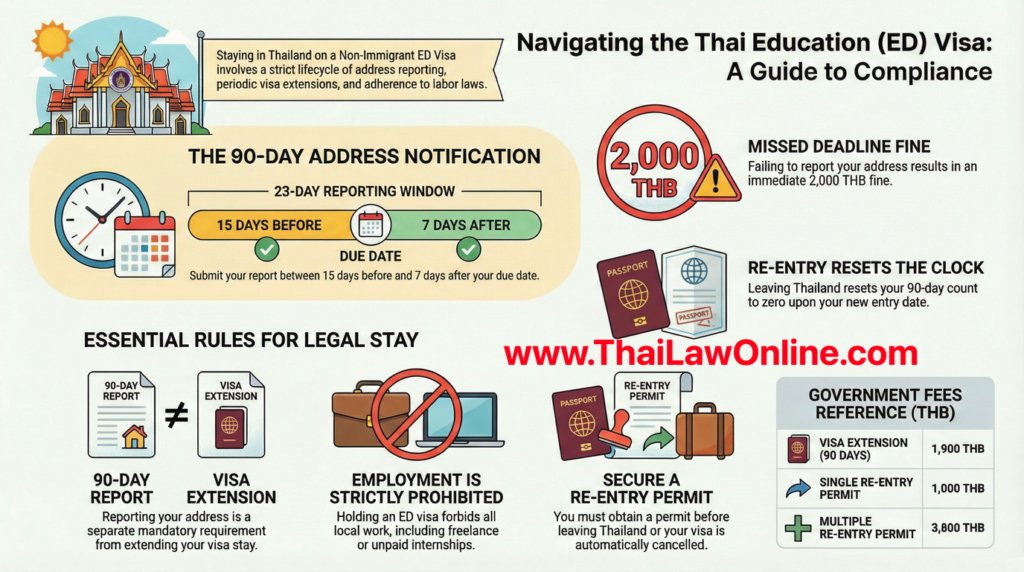
Rapport de 90 jours (TM47). L’article 37(5) de la loi sur l’immigration exige que tout étranger séjournant au-delà de 90 jours déclare son adresse, puis tous les 90 jours. Le délai court de 15 jours avant à 7 jours après la date d’échéance ; la déclaration peut être effectuée en ligne, en personne ou par courrier. L’article 76 fixe la peine à jusqu’à 5 000 bahts plus jusqu’à 200 bahts pour chaque jour supplémentaire jusqu’à la déclaration. En pratique, une déclaration tardive spontanée se règle à 2 000 bahts, et 5 000 bahts est courant lorsque le retard est constaté lors d’un contrôle ou lors d’une demande.
TM30. Votre propriétaire ou votre hôtel doit informer l’Immigration de votre arrivée à l’adresse dans les 24 heures (article 38). Demandez le reçu ; les agents le demandent lors de la prolongation.
TDAC. À compter du 1er mai 2025, tous les voyageurs remplissent en ligne la carte d’arrivée numérique dans un délai de 72 heures avant leur arrivée, gratuitement. L’application THIM, qui a circulé en 2026, est facultative et ne la remplace pas ; nous avons vérifié.
Prolongations. Les étudiants d'une école de langues prolongent leur séjour jusqu'à tous les 90 jours pour 1 900 THB ; les agents peuvent tester votre thaï au guichet. Les étudiants universitaires prolongent leur séjour une fois par an via le bureau international.
Le visa ED vs les alternatives (DTV, retraite)
ED vs Destination Thailand Visa (DTV)
Le visa DTV coûte environ 10 000 THB pour cinq ans contre environ 30 000 THB par an sur la voie ED, permet le travail à distance et exige un apport financier de 500 000 THB. Le visa ED n’impose aucune exigence financière fixe pour les étudiants en langue, mais interdit tout travail. Si vous disposez d’un montant forfaitaire et que votre objectif est un travail à distance, le visa DTV est le visa approprié. Si vous n’avez pas les moyens ou si votre objectif est d’étudier, le visa ED est la solution la plus accessible.
ED contre la retraite (Non-O)
Les conditions de retraite sont l’âge de 50 ans et un apport de 800 000 THB dans une banque thaïlandaise, un revenu mensuel de 65 000 THB ou une combinaison des deux ; ED n’a pas de plafond d’âge. De nombreuses personnes de moins de 50 ans utilisent un ou deux ans d’ED pour atteindre l’âge de 50 ans et ensuite passer à la prolongation de séjour pour retraite. Ce plan fonctionne encore, mais en vertu de l’article 2.9(2), chaque année d’ED nécessite une nouvelle entrée, et depuis 2025, un fonctionnaire consulaire peut refuser un deuxième ou troisième visa ED à un demandeur ayant déjà un an d’“ études ” derrière lui. Prévoyez cette éventualité dans votre budget.
Vous venez avec un conjoint ou des enfants ? L’article 2.11 du même tableau permet à la famille d’un étudiant relevant des articles 2.8 ou 2.9 (père, mère, conjoint, enfants, enfants adoptifs et enfants du conjoint) de prolonger son séjour jusqu’à un an à la fois ; un parent doit présenter un avoir de 500 000 THB détenu dans une banque thaïlandaise. Notre guide sur les visas pour personne à charge explique cette route.
Foire aux questions
Quelles sont les nouvelles règles relatives au visa ED en Thaïlande pour 2026 ?
Trois instruments : la clause 2.9 du tableau annexé à l’ordonnance du Bureau de l’immigration n° 12/2568 (90 jours par prolongation et un an au total à compter de l’entrée, ou d’un changement de type de visa dans le pays, pour les étudiants d’écoles de langue ; un an par prolongation pour les étudiants d’université et d’écoles formelles), l’annonce du MHESI en vigueur depuis le 14 mai 2025 (cours courts universitaires limités à 180 jours, au moins 60 % en présentiel, déclaration mensuelle de présence dans une base de données partagée), et le visa ED Plus découlant de la résolution du Cabinet du 28 mai 2024 (étudiants en cursus diplômant : retour sans permis de retour et prolongation d’un an après l’obtention du diplôme). À compter du 15 septembre 2026, l’exemption de visa de 30 jours raccourcit également le délai pour se convertir à un visa ED en Thaïlande.
Puis-je rester plus d'un an avec un visa ED pour une école de langue ?
Pas sur une seule entrée. L’article 2.9(2) limite le total à un an à compter de la date de votre entrée en Thaïlande ou de la date d’approbation d’un changement vers un visa ED dans le pays. Un nouveau visa et une nouvelle entrée relancent le décompte, sous réserve que le fonctionnaire consulaire accepte de délivrer ce visa.
Quelle est la durée de chaque prolongation du visa ED ?
Jusqu’à 90 jours pour une école de langue ou une autre école non formelle ; jusqu’à un an pour un établissement universitaire ou une école formelle telle qu’une école internationale. Les autorités peuvent accorder moins que le plafond si la lettre de l’établissement certifie une période plus courte.
La règle des 80 % de présence existe-t-elle réellement ?
Pas en tant que règle juridique. Aucun instrument que nous avons lu ne fixe 80 %. L’annonce du MHESI exige qu’au moins 60 % d’un cours court universitaire soient dispensés en présentiel et impose une déclaration mensuelle de présence ; le seuil qui déclenche une déclaration relève de la procédure propre à chaque établissement. Votre école peut fixer 80 % dans son propre règlement et vous signaler lorsque vous passez en dessous.
Qu’est-ce que le visa ED Plus et qui peut l’obtenir ?
Une catégorie créée en vertu de la résolution du Conseil des ministres du 28 mai 2024 pour les étudiants de niveau licence ou supérieur dans une université ou un établissement thaïlandais. Les titulaires peuvent quitter le pays et y revenir sans permis de retour, l’université dépose les demandes de prolongation et, après l’obtention du diplôme, le titulaire peut prolonger d’un an pour chercher un emploi et changer de type de visa en Thaïlande s’il est embauché. Les étudiants des écoles de langues et les autres étudiants hors cursus diplômant ne peuvent pas en bénéficier.
Puis-je travailler avec un visa ED ou un visa ED Plus ?
Non, ni l’un ni l’autre. Le travail sans permis relève de l’article 101 du décret d’urgence relatif à la gestion du travail des étrangers : une amende de 5 000 à 50 000 bahts, l’expulsion et une interdiction de deux ans de demander un permis de travail. L’ED Plus ajoute, après l’obtention du diplôme, une année pour trouver un employeur, qui demande ensuite votre permis de travail et votre visa Non-B.
Existe-t-il une limite d’âge pour un visa étudiant thaïlandais ?
Pas de limite légale. Les écoles de langue fixent leur propre minimum, généralement 12 ans, et il n’existe pas d’âge maximum. Les retraités qui souhaitent apprendre le thaï avant de passer à une prolongation de séjour pour retraite l’utilisent pour cette raison.
Que se passe-t-il si ma prolongation est refusée ou si mon visa est révoqué ?
Une demande de prolongation refusée est accompagnée d’un tampon de courte durée, généralement de sept jours, pour quitter le pays. Une révocation en vertu de l’article 36 est notifiée par écrit et, lorsque le Directeur général l’a ordonnée, elle peut faire l’objet d’un recours auprès de la Commission de l’immigration dans un délai de 48 heures ; la décision de la Commission est définitive. Un dépassement de séjour dans l’un ou l’autre cas vous soumet à l’article 81 et, au-delà de 90 jours, au barème de la liste noire.
Puis-je convertir une exemption de visa de 30 jours en visa ED en Thaïlande après le 15 septembre 2026 ?
Oui, mais les délais sont serrés. Vous devez disposer d’au moins 15 jours de validité de votre permis lors de votre première visite à l’immigration, donc vous disposez d’environ deux semaines après votre arrivée pour vous inscrire, payer, obtenir la lettre de l’école et rejoindre le guichet. Entrer avec un visa touristique de 60 jours ou demander le visa ED auprès d’une ambassade avant votre départ élimine cette pression.
Puis-je ouvrir un compte bancaire thaïlandais avec un visa ED ?
Généralement oui, une fois que vous détenez la première prolongation ou une lettre de votre école. C’est plus simple qu’avec un visa touristique ; chaque banque fixe sa propre liste.
Puis-je changer d'école sans annuler mon visa ?
En général, non. La prolongation est liée à l’école qui vous a certifié. Pour changer d’école, vous annulez votre séjour actuel et présentez une nouvelle demande, ce qui, pour un étudiant d’une école de langue, signifie généralement une nouvelle entrée.
Qu'est-ce que le visa ED ?
วีซ่า ED (Non-Immigrant ED) คือการตรวจลงตราประเภทคนอยู่ชั่วคราวเพื่อการศึกษาตามมาตรา 34(10) แห่งพระราชบัญญัติคนเข้าเมือง พ.ศ. 2522 ผู้ถือวีซ่านี้ที่เรียนในโรงเรียนนอกระบบ (เช่น โรงเรียนสอนภาษา) ขอขยายเวลาได้ครั้งละไม่เกิน 90 วัน แต่รวมแล้วไม่เกิน 1 ปีนับแต่วันที่เดินทางเข้ามาในราชอาณาจักรหรือนับแต่วันที่ได้รับอนุญาตให้เปลี่ยนประเภทการตรวจลงตรา ตามคำสั่ง สตม. ที่ 12/2568 ข้อ 2.9(2) อ่านฉบับภาษาไทยได้ที่ วีซ่านักเรียนในประเทศไทย
Conclusion
Le visa ED non-immigrant reste une manière légale de vivre en Thaïlande pendant un an tout en apprenant la langue, en suivant une formation ou en étudiant pour obtenir un diplôme. Ce qui a changé en 2025 et 2026, c’est que les documents administratifs communiquent désormais entre eux : le rapport mensuel de l’école, la base de données du ministère et le pouvoir du Bureau au titre de l’article 36 sont connectés, et près de 10 000 personnes l’ont découvert en un mois. Les règles elles-mêmes sont plus anciennes et plus simples que ne le suggèrent les résultats de recherche. Pour un étudiant d’une école de langues, ce sont 90 jours et un an à compter de l’entrée. Pour un étudiant en cursus diplômant, c’est un an à la fois, plus l’ED Plus. Sachez dans quelle ligne du tableau vous vous situez, assistez aux cours que vous avez payés et tenez à jour le rapport de 90 jours et le permis de retour.
Si votre demande d’extension a été refusée, si vous avez reçu un avis de article 36, ou si vous souhaitez passer d’un séjour dans un centre de détention à un permis de travail, une prolongation du mariage ou une prolongation de la retraite sans délai d’attente, réserver une consultation avec notre équipe. Planifiez toute demande au moins 45 jours avant l’expiration de votre permis actuel.
Dernière révision : 17 septembre 2026. Les règles d’immigration figurant sur cette page ont été lues en thaïlandais au regard de la loi sur l’immigration B.E. 2522 (articles 34, 35, 36, 37, 38, 39, 76 et 81) et des clauses 2.8, 2.9, 2.11 et 2.22 du tableau annexé à l’ordonnance du Bureau de l’immigration n° 12/2568. Non vérifiés lors de cette révision : le texte de l’annonce du MHESI et les rapports sur l’application, les frais gouvernementaux, les conditions du DTV, la pratique des ambassades et les sanctions liées aux permis de travail (vérifiées le 5 septembre 2026). Confirmez toujours les exigences actuelles auprès de l’Ambassade royale de Thaïlande ou du Bureau de l’immigration.
Actualités juridiques thaïlandaises, gratuites par courriel
Des mises à jour en anglais simple sur les changements législatifs thaïlandais concernant les étrangers : propriété, visas, mariage, affaires et testaments. Un court courriel par mois, envoyé par un cabinet d’avocats établi depuis 2006. Zéro spam, désabonnement possible à tout moment.