



Révisé par ThaiLawOnline, un cabinet d'avocats thaïlandais agréé exerçant en Thaïlande depuis 2006. Avocate thaïlandaise en charge du dossier : Wichuda Atthamethakon, LL.M., licence du barreau thaïlandais 3149/2556.
Dernière mise à jour :
Updated 2 September 2026. The US-Thailand Traité d'amitié and Economic Relations is the single biggest advantage an American investor has in Thailand. Signed on 29 May 1966 and in force since 8 June 1968, it lets US citizens and US-majority-owned companies own up to 100% of a Thai company and be treated, for most business purposes, as if they were Thai. Four separate DBD rule changes landed between January and August 2026, and every one of them makes the ordinary 49/51 structure harder to build. This guide covers what the treaty gives you, who does not qualify, how registration works now, and what quietly voids your certificate later.
Table des matières
Last reviewed: 2 September 2026, against the Treaty of Amity and Economic Relations itself (United Nations Treaty Series No. 9345, official English text, and the Thai Department of Trade Negotiations copy), the Loi sur les activités commerciales des étrangers B.E. 2542 in Thai, the Ministerial Regulation on Minimum Capital B.E. 2562 and the Fees Regulation B.E. 2544, Central Registrar Order No. 2/2569 from the primary PDF, the Code foncier, le Code civil et commercial, the Accounting Act B.E. 2543 and the three Cour suprême decisions cited below. The full list, and what was pas verified, is at the foot of the page.
The Treaty route is one of several structures compared in our guide to
Création d'entreprise en Thaïlande.
Ce qui a changé en 2026 et pourquoi c'est important pour les Américains
On 1 August 2026 the Department of Business Development brought Central Partnership and Company Registrar Order No. 2/2569 into force. If a foreign national holds under 50% of a Thai company, or holds no shares but signs as an authorised directeur, the registrar now asks for three documents, and
two of them are new. Three months of bank statements from each Thai actionnaire covering the period before they paid for their shares were already required. What the order adds is bank statements from the director’s account that received the money, and a prescribed
Lettre d'explication d'investissementtracing every transfer. A filing whose statements do not line up with the declared subscription gets turned away, though that is registry practice rather than the order speaking: clauses 1 to 6 prescribe documents and attach no consequence of their own to a mismatch. Note also what the order covers: not just incorporations, but amendments to
existingpartnerships and companies where a foreign national is introduced as a minority investor or an authorised signatory. On an amendment, clause 4 calls for an Investment
ConfirmationLetter, a different document from the Explanation Letter required on establishment, and clause 5 adds that a company filing such an amendment within a year of its own incorporation must also show a bank statement proving it received the full subscribed capital. An established Thai company that later appoints a foreign director is inside this regime. That order sits on top of three earlier moves in the same year. Order No. 2/2568 started the bank-statement requirement on 1 January. On 1 April the DBD added in-person verification for amendments involving foreign participation. On 1 July it closed the walk-in counter for new private société à responsabilité limitée incorporations and pushed them all through DBD Biz Regist. The DBD has prosecuted 852 companies, put THB 15.1 billion of economic damage on the record, and estimates that roughly 94,000 Thai companies carry prête-nom shareholders. Every one of those measures targets the 49/51 structure. An Amity company does not use one. You hold 100% of the shares in your own name, so the Thai shareholder requirement disappears and so does the paperwork trail the DBD built to test it. Nobody at the Ministry of Commerce has to satisfy themselves that your Thai partner funded their shares, because you have no Thai partner.
Ce que le traité vous donne réellement
En vertu de la
Loi sur les activités commerciales des étrangers BE 2542 (1999), a company is foreign if 50% or more of its shares are held by non-Thais, and foreign majority ownership of most service and trading businesses is restricted. The Treaty of Amity overrides that for Americans. A qualifying US company receives national treatment: it may be up to 100% American-owned and may operate in most sectors without a Foreign Business Licence. That right has an address. It is
Article IV paragraph 1of the Treaty of Amity and Economic Relations of 1966, which accords nationals and companies of either country national treatment in establishing, and in acquiring interests in, enterprises of all types for commercial, industrial, financial and other business activities.
Article IV paragraph 5adds the right to control and manage what you have established, which is the provision that makes an American-controlled board lawful in a country whose default rule is a Thai majority. Sections 10 and 11 of the Act carve out the treaty route. A foreigner operating under a treaty to which Thailand is a party notifies the Director-General under the prescribed ministerial regulation and receives a Foreign Business Certificate. Section 11 gives the Director-General 30 days from the date of the written notification to issue it. The word “certificate” carries more weight than most guides admit. A Foreign Business Licence under section 17 is a discretionary approval: a committee weighs your application, considers whether Thai nationals are ready to compete in your sector, and can say no. A certificate under section 11 records a right the treaty already conferred. The registrar checks that you qualify, then issues. Clients get ahead of themselves here. The treaty covers ownership of a business. It does not touch land, work permits, visas, or tax. Your corporate tax bill matches a Thai company’s. Anyone selling Amity as a shortcut past all four is selling you something the treaty never contained.
Qui est admissible et qui pense l'être mais ne l'est pas
The 51% rule and the ownership chain
US citizens or US-incorporated entities must hold at least 51% of the shares, and US persons must hold a majority of the directorships. A company owned through a chain of other companies can still qualify, but every layer has to trace back to US citizens or US-incorporated entities. A Delaware corporation that is 60% owned by a Japanese group fails, even though the immediate shareholder of the Thai company is unmistakably American on paper. That is not only certification practice:
Article XII paragraph 1(f)lets either country deny the advantages of the treaty to any company in whose ownership or direction nationals of a third country hold, directly or indirectly, the controlling interest.
The majority-directors rule
You can appoint directors from other countries, but plan the signing authority around them. Many firms require a US director to co-sign wherever a third-country director signs, so that operational control stays where the treaty needs it. Our note on
appointing and removing directorscovers the mechanics.
The preferred-share voting trap
Counting share certificates is not enough. If preferred shares carry weighted voting rights that hand effective control to non-American holders, the arithmetic that satisfied you fails the substance test. Check voting rights per share class before you file, not after the registrar queries it.
Citizens, green-card holders, LLCs and corporations
The treaty runs to US citizens and to entities incorporated in the United States. A green-card holder who has not naturalised is not a US national for treaty purposes, whatever their tax filing says. Both corporations and LLCs formed in a US state qualify, though LLCs draw closer scrutiny of the membership register because ownership sits in an operating agreement rather than share certificates. Bring the operating agreement and the full membership list.
Ce que le traité ne couvre pas : les Six Grands
Le traité est large mais non illimité. Six catégories sont exclues, et une entreprise américaine n'y bénéficie d'aucun avantage :
- Communications
- Transport. The treaty reserves “transport” without narrowing it to inland or domestic carriage, so read it more widely than the shorthand lists suggest
- Fiduciary functions, which covers managing money or property for someone else
- Activités bancaires impliquant des fonctions de dépôt
- L'exploitation des terres ou d'autres ressources naturelles
- Domestic trade in indigenous agricultural products, though export trade stays open
These six come from
Article IV paragraph 2, in which each country reserved the right to prohibit or limit foreign interests in enterprises engaged in those activities. Even inside the six the treaty sets a floor: an American company must still be treated no less favourably than a company of any third country.
There is a seventh exclusion and it is not on that list. Article IV paragraph 3provides that the national-treatment paragraph does not include the practice of professions, or callings reserved for the nationals of each country. That is why the treaty does not open law, accountancy, architecture, engineering or the other reserved professions to an American practitioner, however the company is owned. Readers who check their business against the Big Six, find it absent and conclude they are clear have skipped a step: if what you sell is a reserved profession, paragraph 3 has already excluded you before the Big Six is reached. Most American businesses in Thailand sit outside all of this. Consulting, software, marketing, manufacturing, import and export, restaurants and retail all fall inside the treaty. Test your revenue lines against the list before you file, because the registrar reads the objects clause you register, not your pitch deck.
Enregistrer une entreprise Amity étape par étape en 2026
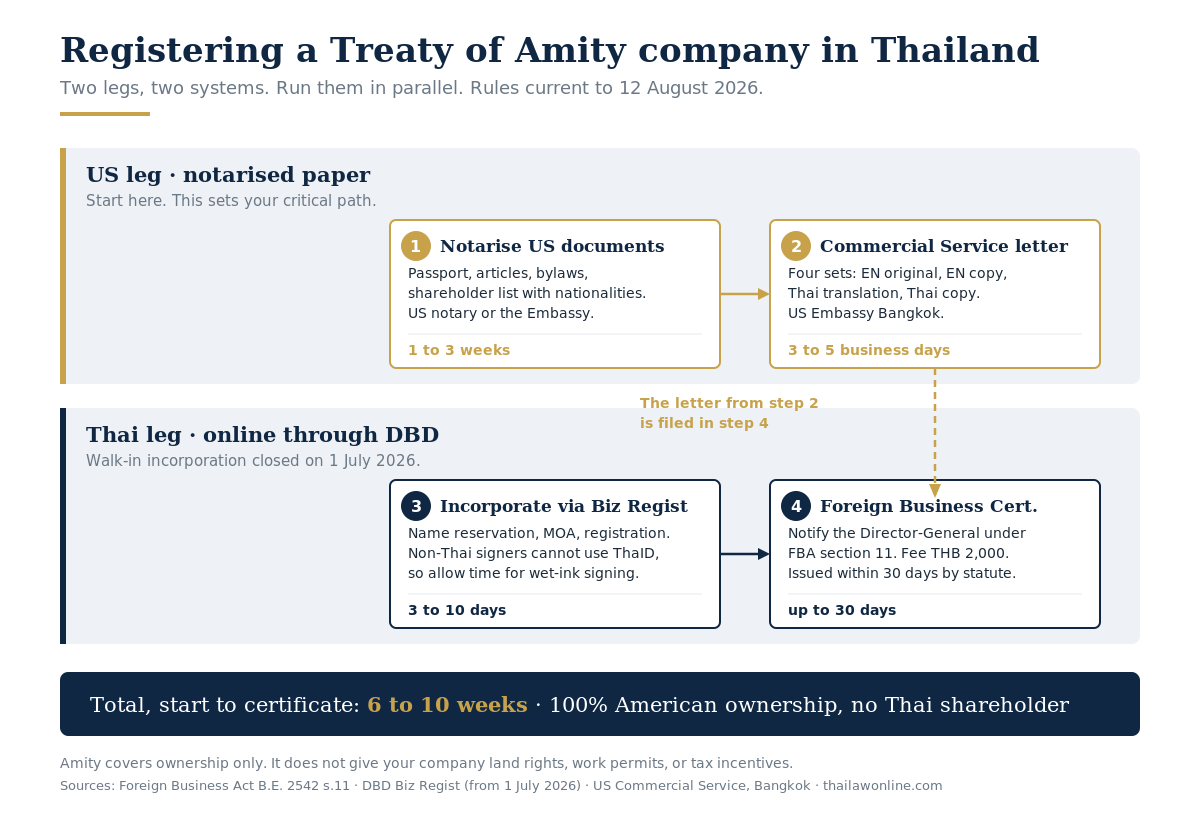
Registration splits into two legs running on different rails. The Thai leg is online and fast. The US leg is notarised paper moving through the Embassy. Start the paper leg first, because it sets your critical path.
Step 1: Assemble and notarise the US corporate documents
A US individual applying as sole shareholder needs a notarised copy of their passport or birth certificate. A US corporate shareholder needs articles of incorporation, corporate bylaws, a shareholder list showing each holder’s nationality, and notarised copies of the passports of the US shareholders and directors. A notary public in the United States must notarise these, or a consular officer at the US Embassy in Bangkok or the Consulate in Chiang Mai. Americans living in Thailand book that through American Citizen Services.
Step 2: Certification by the US Commercial Service
Submit the notarised set to the Commercial Service at the US Embassy in Bangkok. Prepare four sets: originals in English, English photocopies, Thai translations, and Thai photocopies. The certification letter follows within three to five business days once your file is complete. Most delays here trace back to a missing notarisation or a translation that does not match the original.
Step 3: Incorporate the Thai limited company through DBD Biz Regist
Since 1 July 2026 the DBD accepts new private limited company incorporations only through Biz Regist. Reserve the name, file the memorandum of association, register the company. Promoters and authorised directors still sign certain documents, either wet-ink or electronically through DBD e-Service or ThaID. Non-Thai signatories cannot use ThaID, so budget extra days for couriered signatures. One-day incorporation works for an all-Thai signatory group and not for yours. See
enregistrer une société en Thaïlandefor the general process.
Step 4: Apply to the DBD for the Foreign Business Certificate
File the Commercial Service letter and the section 11 notification with the DBD. Two fees are set by the Ministerial Regulation on Fees for the Business Operations of Aliens B.E. 2544:
THB 2,000 on applicationfor a certificate under section 11, and
THB 20,000 for the certificate itselfwhen it issues. The Director-General has 30 days to issue. Once the certificate lands, your company operates in restricted-list activities with 100% American ownership.
Realistic timeline and cost
| Leg | Working time | What drives it |
|---|---|---|
| US document preparation and notarisation | 1 to 3 weeks | Where your shareholders live and how fast they sign |
| US Commercial Service certification | 3 à 5 jours ouvrables | Completeness of the file |
| Thai incorporation via Biz Regist | 3 to 10 days | Signature logistics for non-Thai directors |
| DBD Foreign Business Certificate | Up to 30 days by statute | The section 11 deadline |
| Total, start to certificate | 6 to 10 weeks | Run the US leg in parallel to hit the short end |
Government fees are fixed by regulation: THB 22,000 in total for the Foreign Business Certificate, 2,000 on application and 20,000 on issue, plus the DBD’s published 5,000 THB company registration fee. Our fixed fee to register a Thai company is 45,000 THB, and the Amity certification is quoted on top depending on the ownership chain. See our
frais juridiquespage.
Amity, promotion BOI, une licence d'entreprise étrangère ou une société thaïlandaise à 49%
| Traité d'amitié | Promotion BOI | Licence d'exploitation pour entreprise étrangère | 49% Thai company | |
|---|---|---|---|---|
| Propriété étrangère | 100%, Americans only | Jusqu'à 100% | Jusqu'à 100% | 49% maximum |
| Decision type | Certificate, right-based | Discretionary | Discretionary | Registration only |
| Chronologie typique | 6 to 10 weeks | 3 à 6 mois | 3 à 6 mois | 2 to 4 weeks |
| Sector limits | The Big Six stay closed | Only promoted activities | Case by case | None beyond the FBA |
| Incitations fiscales | Aucun | Corporate tax holidays available | Aucun | Aucun |
| propriété foncière | Non | Possible for promoted projects | Non | Possible, and the DBD is auditing exactly this |
| 2026 nominee exposure | Aucun | Aucun | Aucun | Élevé |
Americans often ask whether to use the Treaty of Amity or apply for
Conseil d'investissement (BOI)promotion. They are different tools. Amity is the fastest way to 100% American ownership of an ordinary service or trading business, and it gives no tax break. BOI promotion is activity-specific and slower, but it adds corporate tax holidays, easier work permits, and in some cases the right to own land for the promoted project. For a straightforward consulting, trading, or service company, Amity is usually the right call. For manufacturing or a target BOI activity, BOI often wins. Some businesses use both. Our fuller breakdown sits at
BOI vs Foreign Business Licence.
Pourquoi Amity surclasse une structure de prête-nom en 2026
Thai law punishes both sides of a nominee arrangement. Under FBA section 36 a Thai national who holds shares on a foreigner’s behalf faces up to three years in prison or a fine of THB 100,000 to THB 1,000,000, or both, and the same section catches the foreigner who allows that to be done. Section 37 is the separate offence of a foreigner operating a restricted business in violation of sections 6, 7 or 8, that is without the licence or certificate, with the same range. In both cases the Act directs the court to order the arrangement or the business to cease, and a party who ignores that order pays THB 10,000 to THB 50,000 for every day the breach continues. Read section 37 before assuming the business survives the judgment: it directs the court to order the cessation of the operation,
or the winding up of the undertaking, or the ending of the shareholding or partnership, as the case may be. The Thai is
เลิกกิจการ, and what to plan for is the business being closed down rather than merely restructured. Thai courts look past the share register, and the decisions can be named rather than gestured at. In
l'arrêt n° 2252/2560a company incorporated in the British Virgin Islands appeared on a Thai company’s register holding
moins de la moitiéthe shares, exactly as a compliant structure should look, but the evidence showed that more than half of the real capital in that company was the foreigner’s money. The court treated the two together as carrying on a land trading business, which is closed to foreigners, and the consequence landed on the foreigner: because its own business was unlawful it was not a lawful injured party, and it lost the right to prosecute the directors it had charged. In
l'arrêt n° 17923/2557a document headed a lease was read as a contract of sale, and because foreign buyers were to hold the land through a Thai juristic person the contract offended section 86 of the Land Code and was void, so their claim to have the land transferred was dismissed. In
l'arrêt n° 5457/2560a loan agreement was found to be a sham concealing the sale of a business, structured so that Thai nationals held shares in name only to evade the Foreign Business Act, and the concealed contract was void under section 150 of the Civil and Commercial Code. The buyer also lost the money: the Court held that what he had paid was performance of an unlawful purpose and could not be recovered under section 411. Your Thai partner carries criminal exposure alongside you. Clients underestimate that, and it is what makes nominee structures fragile the moment a relationship sours. Amity removes the question. Read the enforcement detail at
actionnaires prête-noms thaïlandaisand the case analysis at
nominee crackdowns and court cases.
And the exposure does not stop at the company. Section 41 of the Foreign Business Act provides that where a juristic person commits an offence under section 34, 35, 36 or 37, the directors, partners or persons with authority to represent it who connive at the offence, or fail to take reasonable action to prevent it, are personally liable to up to three years in prison or a fine of THB 100,000 to THB 1,000,000, or both. That is worth reading twice next to Order 2/2569. The registrar now requires a named director to sign an Investment Explanation Letter tracing where every shareholder’s money came from, and signing it is the act that makes failing to look very hard to defend.
Capital, permis de travail et personnel thaïlandais
On minimum capital, the ordinary Foreign Business Act figures apply: at least THB 2 million for a business that is not otherwise restricted, and at least THB 3 million for each activity that would need a Foreign Business Licence for a non-American.
Article 14of the Act sets those floors, and the current Ministerial Regulation on Minimum Capital and the Period for Bringing In or Remitting It,
BE 2562, fills in the detail. Note what the 3 million figure actually is: clause 3 puts it at 25% of the average annual projected expenditure over three years, with 3 million as the floor for each business, so a capital-hungry plan needs more than the headline number.
The remittance timetable is where the treaty route differs, and it is a deadline, not a grace period.Under clause 4, an individual foreigner or a company registered outside Thailand must bring the minimum capital in within three years, at least 25% of it inside the first three months, half of it inside the first year, and the rest at not less than 25% a year. A foreigner carrying on business under a treaty to which Thailand is a party is treated differently, and the difference is a fixed date:
clause 5requires the minimum capital to be brought in in full
by 29 August 2029, and clause 7 sets the same date for treaty operators who were already trading when the regulation came into force. So an Amity company incorporating in 2026 has until that date, not fifteen years from its own incorporation. Whichever timetable applies,
clause 6requires evidence of each remittance to be filed with the DBD, converted at the reference rate of the day,
dans un délai de quinze joursof the money arriving. That filing is the step operators forget, and it is the one that leaves a documentary hole when the certificate is later questioned. Guidance that gives treaty companies fifteen years is reading a regulation that no longer exists. The B.E. 2545 regulation and its clauses 3/1 and 3/2 said that, and it was repealed along with its 2547 and 2552 amendments by the B.E. 2562 regulation published in the Royal Gazette on 28 August 2019 (volume 136, part 93 Kor, page 1). Work from the 2029 date. Work permits follow separate arithmetic that the treaty does not change. You need THB 2 million of registered and fully paid-up capital per foreign work permit, capped at ten, and Immigration expects four Thai employees per foreigner for the one-year extension of stay that goes with each permit. Below THB 3 million paid-up, work permits get difficult whatever your certificate says. Plan capital around the headcount you want. See
Non-B business visasfor the visa side and
impôt sur les sociétés en Thaïlandefor the tax side.
Votre entreprise Amity ne peut toujours pas posséder de terres
This is the hard limit that catches people out. Section 86 of the Land Code lets an alien acquire land only by virtue of a treaty that provides for ownership of immovable property, and the Treaty of Amity is not such a treaty: Article IV paragraph 2 reserves the exploitation of land to each country. Section 97 then gives a company whose shares are more than 49% foreign-held, or more than half of whose shareholders are foreign, rights in land as if it were an alien, which is where an Amity company sits by design. An Amity company can own the building on the land, but not the land itself. What works instead:
- A bail enregistré of up to 30 years, which is the standard commercial solution
- A condominium unit within the 49% foreign quota of the building
- A Usufruit or superficies where the structure suits your use of the land
Anyone proposing that your Amity company hold land through Thai shareholders is proposing the exact arrangement the DBD spent 2026 dismantling.
Conserver le certificat : ce qui annule la protection Amity
Amity status is not a one-time approval. The certificate reflects a structure and dies with it. Watch four events:
- US shareholding drops below 51%. The certificate becomes void and the FBA restrictions snap back.
- US directors stop holding the board majority. Same result.
- A share transfer moves control to non-Americans, including through the ownership chain above your immediate shareholder.
- A preferred-share reorganisation shifts voting rights to non-American holders while the certificate count still looks compliant.
Before you issue new shares, admit an investor, or restructure a US parent, run the Amity test. Notify the DBD when shareholding or directorship changes materially, and refresh the Embassy certification when your shareholder composition moves. Checking beforehand costs a conversation; discovering it afterwards costs the certificate.
Calendrier de conformité permanent
- Within 4 months of fiscal year end: hold the annual general meeting and adopt the audited financial statements. Section 1197 of the Civil and Commercial Code requires the auditor-examined balance sheet to reach a general meeting within four months of its date.
- Within 1 month of the AGM: file the approved financial statements and the meeting minutes with the DBD, electronically through the e-filing system. Two provisions sit behind that date and they are worth keeping apart: section 1199 of the Civil and Commercial Code makes it the directors’ duty to send a copy of every balance sheet to the Registrar not later than one month after the general meeting adopted it, and section 11 of the Accounting Act B.E. 2543 imposes the filing duty itself. The Accounting Act splits the deadline by entity: a Thai limited company files within one month of the AGM approval, while a registered partnership, a branch of a foreign company or a joint venture files within five months of the closing date, with no AGM in the calculation. If you chose a branch rather than an Amity company, that is your date.
- Within 14 days of the AGM: file the updated list of shareholders. Article 1139 of the Civil and Commercial Code makes it the directors’ duty to send the Registrar a copy of that list not later than the fourteenth day after the ordinary meeting.
- Monthly and annually: corporate income tax, withholding tax and VAT filings on the ordinary Thai schedule.
Comment ThaiLawOnline peut vous aider
We handle the whole Amity process: forming the Thai company, preparing the ownership evidence, obtaining the US Commercial Service certification, and filing for the Foreign Business Certificate at the DBD. We also advise on the sensible structure where an American holds the business and land needs are met through a lease or usufruct rather than ownership. Our fixed fee to register a Thai company is 45,000 THB; the Amity certification is quoted on top depending on the ownership chain. One practical warning from experience: the treaty protects genuine American ownership, not an American name on paper over a non-American business. If the real capital and control are not US, the certification will not hold up, and the exposure is the same as any other misrepresentation to the DBD. If you are American, use the treaty properly and it is one of the best deals in Thai corporate law.
Contactez-nouspour commencer.
Foire aux questions
Un Américain peut-il posséder 100% d'une entreprise en Thaïlande ?
Yes, through the Treaty of Amity, provided the business sits outside the six reserved sectors and you hold the Foreign Business Certificate. The route itself is not unique: section 10 of the Foreign Business Act is drafted for any treaty Thailand is party to, and Australians obtain a Foreign Business Certificate the same way under TAFTA. What no other nationality gets is national treatment this broad. TAFTA gives Australians 100 percent ownership in only a couple of sectors and caps most of the rest, while Amity reaches almost everything outside the six reserved sectors.
Le Traité d'amitié est-il toujours en vigueur en 2026 ?
Yes. It entered into force on 8 June 1968, and under Article XIV it ran for an initial ten years and continues in force after that until one country gives the other a year’s written notice to terminate. The 2026 US tariff round runs on a separate track.
Combien de temps prend l'enregistrement du Traité d'amitié ?
Six à dix semaines entre le début de la préparation des documents américains et l'obtention du certificat. Le Service commercial prend trois à cinq jours ouvrables une fois votre dossier complet, et l'article 11 donne au Directeur général de la DBD 30 jours pour délivrer.
Combien ça coûte?
The Foreign Business Certificate carries two government fees under the Fees Regulation B.E. 2544: THB 2,000 on application and THB 20,000 when the certificate issues. Company incorporation is charged separately by the DBD. Our fixed fee to register the Thai company is 45,000 THB, with the Amity certification quoted separately depending on the ownership chain.
Une entreprise régie par le Traité d'amitié peut-elle posséder des terres en Thaïlande ?
No. Section 86 of the Land Code allows an alien to acquire land only under a treaty that provides for ownership of immovable property, and the Treaty of Amity is not one: Article IV paragraph 2 reserves the exploitation of land. Section 97 puts a foreign-majority Thai company on the same side of that line. Use a registered lease of up to 30 years, a condominium unit within the foreign quota, or a usufruct.
Ai-je toujours besoin d'un permis de travail ?
Yes. Amity covers ownership, not immigration. You need THB 2 million of paid-up capital per work permit, and Immigration expects four Thai employees per foreigner for the one-year extension of stay.
Que se passe-t-il si je vends des actions à un non-Américain ?
If US ownership falls below 51% or US directors lose the board majority, the Foreign Business Certificate becomes void and the FBA restrictions apply again. Test any transfer before you execute it.
Does a green-card holder qualify?
No. The treaty runs to US nationals. Permanent residence is not nationality for this purpose.
Treaty of Amity or BOI promotion?
BOI wins where you qualify for a tax holiday and can wait three to six months. Amity wins on speed and certainty for service businesses, and it carries no tax incentive at all.
Can an Amity company run e-commerce, consulting or a restaurant?
Yes. All three sit outside the six reserved sectors. Match your registered objects to what you actually sell before filing.
What the 2 September 2026 review read. The Treaty of Amity and Economic Relations of 29 May 1966, official English text, from the United Nations Treaty Series (No. 9345, volume 652) and from the Thai Department of Trade Negotiations, with Articles IV, XII and XIV read in full. The Foreign Business Act B.E. 2542 in Thai, sections 5, 7, 8, 10, 11, 14, 16, 17, 34 to 37 and 41. The Ministerial Regulation on Minimum Capital and the Period for Bringing In or Remitting It B.E. 2562, Royal Gazette volume 136, part 93 Kor, page 1, 28 August 2019, together with the B.E. 2545 regulation and its 2547 and 2552 amendments that it repealed. The Ministerial Regulation on Fees for the Business Operations of Aliens B.E. 2544. Central Partnership and Company Registrar Order No. 2/2569, from the Department of Business Development’s own PDF. Land Code sections 86, 94, 96 and 97. Civil and Commercial Code sections 1096, 1139, 1197 and 1199. Accounting Act B.E. 2543 section 11. Supreme Court Decisions 2252/2560, 17923/2557 and 5457/2560, each read in Thai to its disposition.
What this review did not verify. The DBD enforcement figures quoted above are the department’s own published numbers and were not checked against a departmental primary. The closure of walk-in incorporation on 1 July 2026 is DBD operational policy announced by the department, not a statutory instrument. The work permit figures have since been traced to their sources: THB 2 million of paid-up capital per permit to the Department of Employment regulation of B.E. 2547, and four Thai employees per foreigner to item 2.1(5) of the criteria annexed to Immigration Bureau Order 12/2568. Neither appears in any provision of the Foreign Business Act. The US Commercial Service document list and its three to five day turnaround come from the Embassy’s own published guidance. Corporate tax and VAT deadlines are Revenue Code matters and were not read here. Re-checked on 6 October 2026: Foreign Business Act sections 10 to 12, 14, 36 and 37 re-read in Thai, and the nominee penalties, the daily fine for ignoring a cessation order and the winding-up wording all match; nothing changed.
Actualités juridiques thaïlandaises, gratuites par courriel
Des informations claires et concises sur les changements législatifs thaïlandais concernant les étrangers : propriété, visas, mariage, affaires et testaments. Un court courriel par mois, envoyé par un cabinet d’avocats établi depuis 2006. Zéro spam, désabonnement possible à tout moment.