


Révisé par ThaiLawOnline, un cabinet d'avocats thaïlandais agréé exerçant en Thaïlande depuis 2006. Avocate thaïlandaise en charge du dossier : Wichuda Atthamethakon, LL.M., licence du barreau thaïlandais 3149/2556.
Dernière mise à jour :
La Thaïlande a retiré le cannabis de la liste des stupéfiants de catégorie 5 en 2022, mais le marché de détail est désormais strictement réglementé. Depuis le 26 juin 2025, la fleur de cannabis (inflorescence) est réglementée en tant qu'herbe contrôlée en vertu de la loi sur la protection et la promotion de la sagesse de la médecine traditionnelle thaïlandaise, et non réinscrite comme stupéfiant de catégorie 5. Un magasin agréé ne peut pas effectuer de vente au détail ordinaire de fleurs sans l'ordonnance ou les conditions de licence requises par les règles relatives aux herbes contrôlées. La fumée ou l'odeur publique et les extraits de cannabis relèvent de régimes juridiques distincts, assortis d'infractions et de peines différentes. Lisez la règle liée au comportement avant de supposer qu'il s'agit d'une infraction liée aux stupéfiants.
Alors, le cannabis est-il légal en Thaïlande ?
Ce guide couvre tout ce que vous devez savoir sur Le cadre du droit pénal thaïlandais.Il montre comment cela s'applique au cannabis en 2026, y compris l'historique juridique. Nous parlons également des réglementations actuelles, des sanctions, Cour suprême décisions, et ce que ces règles signifient pour les étrangers.
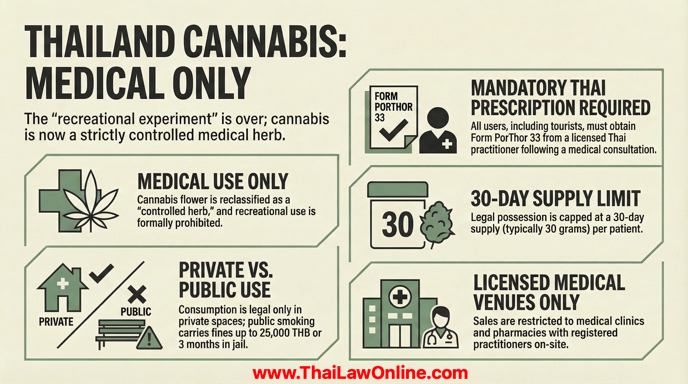
Table des matières
Dernière révision : 4 septembre 2026. Le contenu réglementaire de 2026 sur cette page a été vérifié par rapport à des textes primaires plutôt qu'à des résumés. Le Avis du ministère de la Santé publique concernant les herbes contrôlées (cannabis) de l'année bouddhique 2568 a été lu intégralement dans la Gazette officielle (volume 142, partie spéciale 229 Ngor, page 8, 25 juin 2025) : l'article 1 (en vigueur le lendemain de sa publication, soit le 26 juin 2025), l'article 2 (abrogation de la notification B.E. 2565), l'article 3 (seule l'inflorescence est l'herbe contrôlée) et tous les alinéas de l'article 4, qui comportent l'obligation pour le titulaire de licence de tenir des registres et de faire des rapports, la règle de la vente exclusive aux titulaires de licence et son exception sur ordonnance, l'exigence d'approvisionnement GACP, l'interdiction de la vente pour fumer sur place, l'interdiction des distributeurs automatiques et de la vente en ligne, l'interdiction de la publicité, la liste des lieux où la vente est interdite et la limite de trente jours pour une ordonnance. Le Règlement ministériel relatif à l'autorisation de la recherche, de l'exportation, de la vente ou de la transformation de plantes médicinales contrôlées à des fins commerciales de 2559 (2016), tel que modifié par le règlement ministériel (n° 2) de 2569 (2026) a été lu dans le propre texte consolidé du Département de la médecine traditionnelle et alternative thaïlandaise : la nouvelle liste d'éligibilité de l'article 8/1, l'article 4/1, l'article 10, deuxième alinéa (extraction des odeurs et de la fumée), l'article 11, deuxième et troisième alinéas (renouvellement et instruction de refus), l'article 14 (les licences de fleurs existantes courent jusqu'à leur propre expiration) et l'article 15. Le Loi sur la protection et la promotion du savoir en médecine traditionnelle thaïlandaise de l'ère bouddhiste 2542 fut lu section par section pour le tableau des sanctions : les sections 45, 46, 49, 52, 54 et tout le chapitre pénal, sections 77 à 82. Le Loi sur la santé publique BE 2535 ont été lus pour la règle sur le tabagisme public : les sections 25, 26, 27, 28 et 74. Les seuils de THC ont été vérifiés par rapport au Notification du ministère de la Santé publique spécifiant les stupéfiants de catégorie 5 de l'ère bouddhiste 2565, l'article 1, alinéa 3, et la disposition relative au chanvre par rapport à l'article 3 du Règlement ministériel sur les stupéfiants de catégorie 5, chanvre uniquement, de B.E. 2559 (2016) et à l'annonce du Comité de contrôle des stupéfiants en vigueur à compter du 29 janvier de B.E. 2564 (2021). Les quatre citations de la Cour suprême de la page ont été lues séparément quant à leurs décisions en thaï le 3 septembre 2026.
Ce que cette critique ne couvre pas : le Règlement ministériel sur les extraits de cannabis et de chanvre de l'ère bouddhiste 2569 lui-même. Il ne se trouve dans aucune bibliothèque juridique en notre possession et le Journal officiel ne peut pas faire l'objet d'une recherche par mot-clé, de sorte que sa date de publication du 26 mars 2026, son entrée en vigueur à trente jours, son abrogation des règlements B.E. 2563 et B.E. 2564 et l'expiration au 31 décembre 2026 des licences délivrées en vertu de ceux-ci sont tirées des reportages de la presse thaïlandaise sur le texte et du calcul de la clause d'entrée en vigueur, et non du texte. Considérez ces quatre points comme fiables mais non vérifiés à la source, et confirmez la date à laquelle vous allez agir auprès de la Food and Drug Administration.
Bref historique de la législation sur le cannabis en Thaïlande
Le cannabis possède une histoire juridique longue et complexe en Thaïlande. Comprendre l'évolution de cette loi permet de mieux appréhender le contexte réglementaire actuel.
Le cannabis en tant que stupéfiant de catégorie 5 (1979-2022)
En vertu de la Loi sur les stupéfiants BE 2522 (1979), le cannabis a été classé comme un stupéfiants de catégorie 5 ainsi que l'opium et les champignons psilocybes. La possession, la production, la vente et la consommation étaient toutes des infractions pénales passibles de lourdes peines, notamment une peine d'emprisonnement pouvant aller jusqu'à 15 ans pour possession en vue de la distribution.
La loi était appliquée avec rigueur. Décision de la Cour suprême n° 979/2538 (1995), la Cour a examiné une affaire concernant la possession de cannabis à des fins de vente. Le prévenu a été inculpé en vertu des articles 26 et 75 de la loi sur les stupéfiants B.E. 2522 (1979). La Cour a finalement acquitté le prévenu en raison de témoignages policiers contradictoires et de preuves circonstanciées, établissant un précédent important sur les normes de preuve en matière de stupéfiants, un rappel que, même sous le coup de lois strictes anti-cannabis, la charge de la preuve incombait à l'accusation.
Légalisation médicale (2018-2019)
En décembre 2018, la Thaïlande est devenue Premier pays asiatique à légaliser le cannabis médical à travers le Loi sur les stupéfiants (n° 7) BE 2562 (2019). Cet amendement a permis aux médecins agréés de prescrire des traitements à base de cannabis et a autorisé les institutions de recherche agréées à cultiver du cannabis à des fins médicales.
Décriminalisation totale (9 juin 2022)
Le 9 juin 2022, le ministère de la Santé publique a publié le Notification concernant la spécification des noms des stupéfiants de catégorie 5 BE 2565, Cette annonce, prise en application de l'article 29, paragraphe 2 du Code des stupéfiants, a de facto retiré le cannabis de la liste des stupéfiants de catégorie 5, faisant de la Thaïlande le premier pays d'Asie à dépénaliser totalement le cannabis.
Ce changement réglementaire a eu de profondes conséquences juridiques. Décision de la Cour suprême n° 1225/2567 (2024), la Cour a examiné une affaire dans laquelle un défendeur avait été reconnu coupable de production et de possession non autorisées de cannabis en vertu de la loi sur les stupéfiants B.E. 2522 (articles 26/2, 26/3, 75 et 76). La Cour a jugé qu'en raison de la notification de 2022 retirant le cannabis de la liste des stupéfiants de catégorie 5, les actions du défendeur étaient ne sont plus des infractions pénales.
Candidature Article 2, paragraphe 2 du Code pénal (le principe selon lequel une loi ultérieure décriminalisant une conduite s'applique rétroactivement), la Cour d'appel de la région 6 a été autorisée à annuler la condamnation d'office, car cela constituait une question juridique d'ordre public en vertu des articles 185(1) et 195(2) du Code de procédure pénale.
La fleur de cannabis devient une herbe contrôlée (26 juin 2025)
La période de large décriminalisation a été de courte durée. Les inquiétudes concernant l'usage récréatif non réglementé, en particulier chez les mineurs, ont entraîné un net retournement de politique. L'instrument juridique a été la notification du ministère de la Santé publique relative aux herbes contrôlées (cannabis) de l'ère bouddhiste 2568, signée par le ministre de la Santé publique le 23 juin 2025, publiée dans la Gazette royale le 25 juin 2025 et entrée en vigueur le 26 juin 2025. Elle a classé le cannabis fleur en tant qu'herbe contrôlée en vertu de la loi sur la protection et la promotion de la sagesse de la médecine traditionnelle thaïlandaise B.E. 2542, sa vente nécessite désormais une ordonnance de l'une des professions reconnues, et cela a durci les règles concernant la vente, la transformation et la publicité. Notez ce qu'il n'a pas fait : il n'a pas réinscrit le cannabis sur la liste des stupéfiants de catégorie 5. Le cannabis a été retiré de cette liste en 2022 et n'y a pas fait son retour, c'est pourquoi les décisions de la Cour suprême concernant la décriminalisation rétroactive présentées ci-dessous restent valables. Qualifier cela de recriminalisation, comme le font la plupart des médias anglophones, vous induit en erreur quant à votre niveau d'exposition : le risque réside dans les règles d'octroi de licences et de prescription, et non dans la classification des stupéfiants. Selon les chiffres rapportés, environ 7 300 des 18 433 boutiques de cannabis en Thaïlande auraient fermé leurs portes en raison du durcissement des règles, ce qui laisse environ 11 100 établissements en activité. Nous n'avons pas été en mesure de vérifier ces chiffres auprès d'une source officielle, il convient donc de les considérer comme un ordre de grandeur plutôt que comme un décompte exact.
Deux règlements ministériels en 2026, et ils ont des rôles différents
2026 a apporté deux instruments distincts, l'un publié le 26 mars et entré en vigueur le 26 avril, l'autre publié le 30 avril. La couverture en langue anglaise les confond régulièrement, ce qui amène les opérateurs à s'adresser au mauvais organisme de réglementation. L'un régit extraits, qui sont des stupéfiants ; l'autre régit le fleur, qui est une herbe réglementée.
Extraits, en vigueur le 26 avril 2026. Le Règlement ministériel relatif à l'autorisation de produire, d'importer, d'exporter, de céder ou de détenir des extraits de cannabis ou de chanvre de l'ère bouddhiste 2569 a été publié dans la Gazette royale le 26 mars 2026 et entre en vigueur trente jours après sa publication, soit 26 avril 2026. Il a abrogé et remplacé deux réglementations antérieures, le règlement sur le chanvre de 2563 et le règlement sur le cannabis de 2564, de sorte que l'octroi de licences d'extraction relève désormais d'un seul et même instrument administré par la Food and Drug Administration. Sa disposition transitoire est celle qu'il convient de noter : une licence délivrée en vertu de l'un ou l'autre règlement abrogé n'est valide que jusqu'au 31 décembre 2026, et un exploitant qui souhaite continuer doit faire une demande en vertu du nouveau règlement avant l'expiration de l'ancienne licence et doit effectivement détenir la nouvelle licence avant de continuer. Déposer une demande ne vaut pas autorisation. Les licences accordées en vertu du nouveau règlement courent jusqu'à 31 décembre de la troisième année à compter de l'année d'émission.
La fleur, publiée le 30 avril 2026. Le règlement ministériel (n° 2) de B.E. 2569 a modifié le règlement de B.E. 2559 émis en vertu de la loi sur la protection et la promotion du savoir de la médecine traditionnelle thaïlandaise de B.E. 2542, qui est la loi régissant la fleur de cannabis en tant qu'herbe contrôlée. Son nouveau clause 8/1 est le changement qui remodèle le marché de la vente au détail, car il décide qui peut détenir une licence pour vendre, transformer ou exporter la fleur. Outre les critères généraux, un demandeur doit :
- être propriétaire des lieux ou y détenir un droit de possession, ou joindre le consentement écrit du propriétaire ;
- disposer d'une zone de stockage d'une taille adaptée au volume traité, dotée d'équipements qui maintiennent la fleur en bon état, stockée séparément, sans être mélangée à autre chose et sans être en contact avec le sol;
- être l'un des suivants: le titulaire d'une licence d'exploitation d'un établissement de santé en vertu de la loi sur les établissements de santé ; un fabricant ou un vendeur agréé de produits à base de plantes ; un fabricant ou un vendeur agréé de médicaments ; le titulaire d'une licence de production de stupéfiants de catégorie 5 limitée aux extraits de cannabis ou de chanvre en vertu du Code des stupéfiants ; ou un guérisseur traditionnel agréé en vertu de la loi sur l'exercice de la médecine traditionnelle thaïlandaise. Alternativement, le demandeur peut être un cultivateur dont le site approvisionne les titulaires de licence en vertu de l'article 46 de la loi ;
- avoir au moins un travailleur formé par le Département de la médecine traditionnelle et alternative thaïlandaise présent dans l'établissement à tout moment où il est ouvert.
La même réglementation ajoute l'obligation d'installer un système efficace d'extraction des odeurs et des fumées, et dirige l'autorité de délivrance des licences de refuser le renouvellement lorsque le titulaire a été préalablement suspendu pour avoir omis de se conformer à un avis du ministère de la Santé publique concernant les herbes réglementées pris en vertu des articles 44 et 45 de la loi. Il s'agit de l'article 11, paragraphe trois, et il est rédigé comme une instruction pour le concédant de licence, et non comme un pouvoir discrétionnaire qu'il peut refuser d'exercer. Les licences de fleurs existantes délivrées en vertu du règlement B.E. 2559 ne sont pas annulées : l'article 14 leur permet d'arriver à leur propre expiration, ce qui, selon article 46 paragraphe 3 de la loi est le 31 décembre de la troisième année à compter de l'année de délivrance. L'effet pratique pour un dispensaire ordinaire est une date limite plutôt qu'une interdiction, et la question lors du renouvellement est de savoir s'il peut satisfaire à la clause 8/1.
Loi actuelle sur le cannabis en Thaïlande (2026)
Depuis 26 juin 2025, le cannabis fleur a été réglementé par le Loi sur la protection et la promotion du savoir en médecine traditionnelle thaïlandaise de l'ère bouddhiste 2542 (1999). Soyez précis sur ce qui a été désigné : la clause 3 de la notification du ministère de la Santé publique sur les herbes contrôlées (cannabis) de l'ère bouddhiste 2568 ne fait que inflorescence d'une plante du genre Cannabis “herbe contrôlée. Ainsi, la fleur est une herbe contrôlée et n'est pas un stupéfiant, tandis qu'une extraire peut toujours être un stupéfiant de catégorie 5 en vertu du Code des stupéfiants. Il s'agit d'une distinction juridique importante, et c'est celle qui est le plus souvent perdue dans la couverture de langue anglaise.
Usage médical : légal sur ordonnance
Le cannabis reste légal à des fins médicales. Pour acheter et consommer du cannabis légalement, vous devez :
- Obtenez un certificat valide prescription (bai sang chai). L'alinéa 2 de la clause 4 de la notification du 26 juin 2025 énumère les personnes habilitées à en rédiger un : un médecin, un praticien de médecine traditionnelle thaïlandaise, un praticien de médecine traditionnelle thaïlandaise appliquée, un guérisseur traditionnel, un praticien de l'art de guérir de la branche de la médecine chinoise, un pharmacien ou un dentiste. Cela doit être dans un but médical.
- L'ordonnance est ce qui rend la vente légale. La clause 4(3) exige par ailleurs qu'un vendeur agréé vende la fleur uniquement à un autre titulaire de licence, donc sans ordonnance, un acheteur ordinaire n'est pas du tout une personne à qui la boutique peut légitimement vendre.
- Le prescripteur fixe la quantité, et l'article 4, paragraphe trois, exige qu'elle corresponde aux besoins du traitement, pour l'usage personnel du patient, et un approvisionnement d'au plus trente jours.
- Il y a aucune limite de poids dans la notification. Des chiffres tels que “ 30 grammes par mois ” circulent largement et ne figurent pas dans l'instrument ; la quantité relève d'une évaluation clinique encadrée par la règle des trente jours.
- Il y a aussi aucun seuil d'âge dans la notification actuelle. La règle concernant les moins de 20 ans dont les gens se souviennent figurait dans l'avis de l'année 2565 de l'ère bouddhiste, que l'article 2 de l'avis de l'année 2568 a abrogé. La barrière actuelle est l'ordonnance, et le fait de prescrire ou non à une personne de moins de moins de 20 ans relève de la décision clinique du praticien.
- Un magasin peut pas vendre la fleur à fumer dans ses propres locaux. C'est l'article 4(5), et sa seule exception est une vente par l'un des praticiens figurant sur la liste utilisée pour traiter leur propre patient.
Vente au détail récréative : Restreint
La loi ne crée pas d’infraction distincte dénommée « consommation récréative de fleurs de cannabis ». La restriction pratique pèse principalement sur le vendeur agréé : l’article 4, paragraphe 3, interdit la vente au détail ordinaire de fleurs, sauf si le client est lui-même titulaire d’une licence ou d’une ordonnance valide. La sanction d’un an d’emprisonnement et d’une amende de 20 000 bahts prévue par la loi B.E. 2542 s’applique à certaines infractions liées aux licences, tandis que la consommation en public ou les odeurs sont régies par la loi sur la santé publique et que les extraits de cannabis restent soumis au Code des stupéfiants, le cas échéant.
Limites de THC
Un extrait de cannabis ou de chanvre est un stupéfiants de catégorie 5 à moins qu’il ne relève d’une exception. C’est l’arrêté du ministère de la Santé publique définissant les stupéfiants de catégorie 5 de l’an 2565 du B.E., pris en application de l’article 29, paragraphe 2, du Code des stupéfiants, qui le classe comme tel. La clause 1(3) de cette notification classe tout extrait provenant d’une partie quelconque d’une plante de cannabis ou de chanvre parmi les stupéfiants de catégorie 5, puis exempte les extraits contenant pas plus de 0,2 pour cent de THC en poids où la plante a été cultivée en Thaïlande et où l'extraction a fait l'objet d'une licence, et elle exclut les extraits de graines.
Deux mises en garde, car c'est là que les vendeurs de CBD ont des problèmes. Premièrement, ne pas relever de la catégorie 5 ne signifie pas ne pas être réglementé : un extrait à faible teneur en THC conforme reste un produit à base de plantes, un cosmétique ou un aliment, et il nécessite l'enregistrement requis par ces lois. Deuxièmement, le chiffre de 0,2 pour cent concerne le extraire. Ce n'est pas la définition du chanvre. Le chanvre est Cannabis sativa L. subsp. sativa, une sous-espèce de la plante de cannabis, contenant pas plus de 1,0 pour cent de THC en poids sec: il s'agit de l'article 3 du règlement ministériel sur les stupéfiants de catégorie 5, concernant uniquement le chanvre, de 2559 (B.E.), et l'annonce du Comité de contrôle des stupéfiants en vigueur à compter du 29 janvier de 2564 (B.E.) exige que ce test soit effectué sur les sommités fleuries, pas sur les feuilles. Citer le mauvais de ces deux chiffres à un douanier ou à un inspecteur est une erreur fréquente et coûteuse.
Interdiction de fumer dans les lieux publics
La consommation de cannabis en public est traitée dans le cadre du dispositif répressif prévu par la Loi sur la santé publique BE 2535 (1992), et il vaut la peine de savoir comment cela fonctionne réellement avant de vous fier au chiffre que tout le monde cite. Une annonce du ministère de la Santé publique de 2565 (2022) déclare que le fait de causer l'odeur ou la fumée du cannabis constitue un nuisance publique (Ramkhan) aux fins de l'article 25. Les articles 26 à 28 confèrent ensuite au fonctionnaire local le pouvoir d'ordonner la cessation de la nuisance. La peine de jusqu'à 3 mois d'emprisonnement ou une amende allant jusqu'à 25 000 bahts, ou les deux, est l'article 74, et l'article 74 punit le fait de ne pas se conformer à cet ordre ou entravant l'agent, et non l'acte de fumer en soi. En pratique, cela finit tout de même mal : on vous demande d'arrêter, et l'ignorer constitue le délit. Un dispensaire fait l'objet d'une règle distincte et plus stricte, car la clause 4(5) de la notification sur les herbes contrôlées interdit totalement la vente de la fleur destinée à être fumée dans les locaux.
Sanctions pour infractions liées au cannabis en 2026
Il est essentiel de comprendre les sanctions, notamment pour ressortissants étrangers qui pourraient faire face à des conséquences supplémentaires en matière d'immigration. Les sanctions actuelles prévues par le cadre réglementaire relatif aux plantes médicinales contrôlées sont les suivantes :
| Infraction | Peine | Base juridique |
|---|---|---|
| La vente, la transformation pour le commerce, la recherche ou l'exportation de la fleur sans licence | Jusqu'à 1 an d'emprisonnement ou une amende de 20 000 THB, ou les deux | Loi sur la protection et la promotion du savoir en médecine traditionnelle thaïlandaise de l'ère bouddhique 2542, section 46 pour l'exigence de licence et article 78 pour la peine. Notez ce que fait l'article 46 pas portée : l'achat ou la consommation de la fleur sans ordonnance ne constitue pas une infraction en vertu de la présente loi. Le risque incombe au vendeur |
| Ne pas tenir compte de l'ordre d'un fonctionnaire local de cesser la fumée ou l'odeur de cannabis, ou faire obstruction au fonctionnaire | Jusqu'à 3 mois d'emprisonnement ou une amende de 25 000 THB, ou les deux | Loi sur la santé publique B.E. 2535, article 74, lu conjointement avec l'article 25 et l'annonce sur les nuisances de B.E. 2565. La sanction s'applique au fait de défier l'ordre, et non à l'acte de fumer |
| Le titulaire de licence qui enfreint une condition de la notification relative aux herbes contrôlées, par exemple en vend sans ordonnance | Suspension pour une durée maximale de 90 jours à la fois, ou révocation en cas de manquement grave. Le fait de continuer à négocier après l'une ou l'autre de ces mesures est puni d'une peine pouvant aller jusqu'à 1 an d'emprisonnement ou d'une amende pouvant aller jusqu'à 20 000 THB, ou des deux. | Loi B.E. 2542, suspension article 52, révocation article 54, et article 78 pour exercice pendant une suspension ou après une révocation. Le renouvellement doit également être refusé lorsque le titulaire de licence a été préalablement suspendu pour infraction à l'obligation de notification |
| Vendre la fleur ou un produit transformé à partir de celle-ci par le biais d'un distributeur automatique, d'un canal électronique ou d'un réseau informatique | Violation d'une condition de licence : suspension ou révocation, puis article 78 si l'activité se poursuit | Notification du ministère de la Santé publique sur les herbes contrôlées (cannabis) de B.E. 2568 (2025), clause 4(6) |
| Vente de la fleur ou d'un produit transformé dans un temple ou un lieu de cérémonie religieuse, un dortoir, un parc public, un zoo ou un parc d'attractions | Violation d'une condition de licence, comme ci-dessus | Avis n° B.E. 2568, clause 4(8). C'est toute la liste, cela mord sur les ventes réalisées en ces endroits, et cela ne dit rien sur une distance par rapport à une école |
| La publicité de la substance réglementée par quelque canal que ce soit à des fins commerciales | Violation d'une condition de licence, comme ci-dessus | Avis n° B.E. 2568, clause 4(7) |
| Production, importation, exportation, vente ou possession d'un extrait de cannabis ou de chanvre qui est un stupéfiant de catégorie 5, sans licence | Jusqu'à 5 ans d'emprisonnement ET une amende pouvant aller jusqu'à 500 000 THB, assortie de peines plus lourdes lorsque l'acte est commis à des fins commerciales, qu'il propage la drogue auprès du public, ou qu'il s'agit d'une vente à une personne de moins de 18 ans ou dans une école, un lieu de culte ou un bureau gouvernemental | Code des stupéfiants, articles 93 et 148 |
| Posséder un tel extrait pour sa propre consommation | Jusqu'à 2 ans d'emprisonnement ou une amende pouvant aller jusqu'à 40 000 THB, ou les deux | Code des stupéfiants, articles 107 et 164 |
| La consommation d'un tel extrait | Jusqu'à 1 an d'emprisonnement ou une amende pouvant aller jusqu'à 20 000 THB, ou les deux | Code des stupéfiants, articles 104 et 162 |
Important pour les étrangers : Une condamnation pénale liée au cannabis en Thaïlande peut entraîner expulsion, révocation de visa et interdiction de retour. Cela peut également affecter votre capacité à obtenir un certificat de casier judiciaire à l'avenir.
Décisions de la Cour suprême sur le cannabis
Les décisions de la Cour suprême thaïlandaise (Dika) fournissent des indications essentielles sur l'interprétation et l'application des lois relatives au cannabis. Voici trois arrêts marquants qui ont façonné le paysage juridique actuel.
Décision n° 1225/2567 (2024) : Dépénalisation rétroactive
Cette décision capitale portait sur la question de savoir si une personne reconnue coupable de production et de possession de cannabis en vertu de l'ancienne Loi sur les stupéfiants pouvait obtenir l'annulation de sa condamnation après la décriminalisation de 2022. La Cour a statué que, conformément à la loi, Article 2, paragraphe 2 du Code pénal, lorsqu'une loi ultérieure déclare qu'un comportement n'est plus criminel, la personne qui a commis l'acte est absous de l'infraction. La Cour d'appel était autorisée à annuler de sa propre initiative les condamnations liées au cannabis, même si le défendeur n'avait pas interjeté appel de ces accusations spécifiques.
Importance pratique, et la partie généralement mal rapportée : le principe est réel, mais cet accusé n'a pas été libéré. À sa disposition, 1225/2567 est un affaire de méthamphétamine et d'armes à feu où les chefs d'accusation liés au cannabis n'étaient que deux parmi de nombreux autres. Le parquet a requis des peines en vertu des articles 32, 33, 80, 91, 138, 140, 289 et 371 du Code pénal, des articles 4, 7, 8, 15, 26/2, 26/3, 66, 75, 76, 100/1 et 102 de la loi sur les stupéfiants, ainsi que de la loi sur les armes à feu. La Cour suprême a modifié le jugement : 2 ans de résistance à agents avec une arme à feu (article 138 alinéa deux combiné avec l'article 140 alinéas un et trois, trois ans réduits d'un tiers), qui, s'ajoutant à la possession d'une arme à feu, au fait de la porter en public et vente de méthamphétamine pour échange est venu 7 ans et 6 mois et une amende de 300 000 bahts. Le chef de tentative de meurtre a été abandonné. L'affaire montre donc qu'un chef d'accusation lié au cannabis est annulé rétroactivement. même au sein d'une condamnation qui par ailleurs tient. Il ne montre personne s'en aller librement.
Décision n° 2591/2566 (2023) : Aucun remboursement des amendes déjà payées
Alors que la décriminalisation a libéré les individus des peines en cours, la Cour suprême a établi une distinction claire concernant les peines déjà exécutées. Dans cette affaire, un prévenu reconnu coupable de production et de possession de cannabis en vertu de la loi sur les stupéfiants B.E. 2522 (articles 26/2, 26/3, 75 et 76) avait payé son amende et en a demandé le remboursement une fois que le cannabis a cessé d'être un stupéfiant. La Cour a statué que Article 2, paragraphe 2 du Code pénal sépare l'infraction de l'exécution d'un jugement définitif : tout ce qui est encore en cours d'exécution s'arrête, mais une peine déjà exécutée est définitive et ne peut être rouverte. La Cour a rejeté l'accusation et ordonné la restitution du cannabis saisi, et dans le même souffle retenu il était je n'ai pas droit à un remboursement de l'amende qu'il avait déjà payée.
Importance pratique : La dépénalisation vous libère des sanctions futures, mais ne compense pas les peines déjà purgées.
Références de jurisprudence examinées : 17 septembre 2026. Les décisions 2591/2566 et 2939/2565 ont été lues en thaï par rapport aux jugements publiés. Le compte rendu de la décision 2939/2565 ci-dessous est exact en tous points vérifiés, y compris les 747 lingots pesant 772,30 kilogrammes, la peine distincte de 15 ans d'emprisonnement et l'amende de 900 000 bahts, la restitution des 17 articles et le fait que la Cour a soulevé le moyen d'office. Pour la décision 2591/2566, le montant de l'amende indiqué a été supprimé, car cette peine a été modifiée à deux reprises et le jugement n'indique pas quel montant a été payé ; ce qu'il statue demeure inchangé et son dispositif est désormais indiqué. Le contenu réglementaire de 2026 sur cette page a fait l'objet d'un examen séparé le 4 septembre 2026.
Décision n° 2939/2565 (2022) : Confiscation de biens et cannabis
C'est pas un appel pénal mais une affaire de confiscation, ce qui le rend utile. L'État a demandé la confiscation 17 biens au fonds de lutte contre les stupéfiants à la suite de la saisie de 747 barrettes de cannabis séché pesant 772,30 kilogrammes. Le premier opposant avait été condamné séparément à 15 ans de prison et une amende de 900 000 bahts dans sa propre affaire pénale. La Cour est partie de la définition de section 3 de la loi sur la répression des infractions liées aux stupéfiants B.E. 2534 : les biens ne peuvent être confisqués que s'ils sont liés à un infraction liée aux stupéfiants. Une fois que la Notification de 2022 a retiré le cannabis de la liste de catégorie 5, article 2, alinéa 2 du Code pénal a absous la conduite et le droit de poursuivre a été prescrit en vertu de article 39, paragraphe 5, du Code de procédure pénale, de sorte que la propriété n'était plus liée du tout à une infraction liée aux stupéfiants.
Importance pratique : la Cour n'a pas seulement noté que le changement “ a affecté ” la confiscation, elle tous les 17 articles ont été restitués à leurs propriétaires, soutenant qu'ils n'étaient pas liés à une infraction en vertu des articles 2, 27 et 29 de cette loi. Il a également soulevé le point de sa propre initiative, car cela relève de l'ordre public, en vertu des articles 195, alinéa deux, et 225 du Code de procédure pénale. L'envergure n'était pas un obstacle : 772 kilogrammes restaient du cannabis, et le cannabis n'était plus un stupéfiant.
Règles relatives aux dispensaires de cannabis en 2026
Si vous envisagez de visiter ou d'exploiter un dispensaire de cannabis en Thaïlande, le cadre réglementaire est l'arrêté du ministère de la Santé publique relatif aux herbes contrôlées de B.E. 2568, en vigueur depuis le 26 juin 2025, tel qu'il a été renforcé par Règlement ministériel (n° 2) B.E. 2569 du 30 avril 2026. À eux deux, ils imposent :
Licences et conformité
- Surveillance médicale : la vente de fleurs de cannabis est uniquement sur ordonnance, un praticien agréé doit donc être impliqué dans chaque vente légale. Qu'une boutique doive également en avoir une physiquement présent pendant les heures d'ouverture est une règle de dotation appliquée administrativement ; ce n'est une clause d'aucun des deux instruments ci-dessus, et elle est largement répétée en ligne sans citation. Confirmez le besoin en personnel actuel auprès de DTAM avant d'embaucher pour ce poste, et avant de supposer que vous pouvez faire du trading sans lui.
- Certification GACP : C'est une clause, pas une coutume. Article 4, paragraphe 4 de la notification du 26 juin 2025 exige que l'herbe réglementée qu'un titulaire de licence vend ou exporte provienne d'une source certifié par le DTAM selon la norme de bonnes pratiques de culture et de récolte. Ce que la notification ne résout pas, c'est l'administration qui l'entoure : le délai de traitement, la période de validité et les organismes de certification reconnus sont fixés administrativement et changent, alors confirmez ces trois points auprès de la DTAM avant de planifier en fonction d'eux.
- Licence de vente : Une “ Licence de vente ou de traitement d’herbes contrôlées à des fins commerciales ” est requise
- Rapportage : Le titulaire d’une licence doit déclarer ses activités auprès de l’autorité de délivrance de la licence. au moins une fois par an, indiquant la quantité d’herbes contrôlées vendues, exportées ou transformées. C’est la clause 10(2) du règlement ministériel autorisant la recherche, l’exportation, la vente ou la transformation d’herbes contrôlées à des fins commerciales, B.E. 2559, et en vertu de la clause 11, une demande de renouvellement est déposée. dans les 60 jours qui ont précédé l’expiration de la licence, Ainsi, la fenêtre s'ouvre 60 jours plus tard plutôt que de s'effacer alors. Une deuxième notification apparaît dans la notification elle-même : clause 4(1) exige que le titulaire du permis conserve des registres concernant l’origine de l’herbe, son utilisation et la quantité détenue sur le site, et qu’il en rende compte au registraire sur le formulaire que le directeur général prescrit. Les formulaires de licence et de demande du régime 2559 sont les suivants : Phor.Tor. 9 à Phor.Tor. 13 les séries prescrites par la notification DTAM du 7 février de l’année 2560 ; le formulaire de déclaration, la notification par exportation et le formulaire de prescription sont respectivement prévus à l’article 6 de la notification de l’année 2568. On informe parfois les opérateurs de déposer chaque mois ; on considère tout calendrier mensuel comme une obligation administrative à confirmer auprès de DTAM plutôt que comme une exigence imposée par la réglementation elle-même.
Activités interdites
- Vente par voie électronique ou par réseau informatique, ou par distributeur automatique (clause 4(6))
- Vendre dans un temple ou un lieu de cérémonie religieuse, dans un dortoir, dans un parc public, dans un zoo ou dans un parc d’attractions (alinéa 4(8)). C’est la liste complète, et il s’agit de vendre en ces endroits ; la notification ne prévoit pas de distance entre les écoles
- La publicité de l’herbe contrôlée par tout canal commercial (clause 4(7))
- Vendre les fleurs pour la consommation de tabac sur le lieu de vente, sauf si le vendeur est un praticien agréé qui traite ses propres patients (clause 4(5))
- Vendre à toute personne qui n’est ni titulaire d’une autre licence ni titulaire d’un prescription (clause 4(3))
Ce que cela signifie pour les touristes et les expatriés
Si vous êtes un touriste ou un expatrié vivant en Thaïlande, Voici ce que vous devez savoir :
Pour les touristes
- Pas d'achats occasionnels : Il est impossible d'entrer dans un dispensaire et d'acheter du cannabis sans ordonnance médicale délivrée par un médecin thaïlandais agréé.
- Consultation médicale disponible : Certaines cliniques et pharmacies proposent des consultations sur place avec des praticiens agréés qui peuvent délivrer des ordonnances si cela est médicalement approprié.
- Ne créez pas de nuisance publique : La fumée ou l’odeur de cannabis peuvent donner lieu à une ordonnance en vertu de la loi sur la santé publique. Si un fonctionnaire ordonne la cessation de cette nuisance, l’ignorer peut entraîner la sanction prévue à l’article 74, décrite ci-dessus.
- Conservez votre ordonnance : Si vous vous procurez du cannabis légal, ayez toujours votre ordonnance sur vous comme preuve de sa consommation légale.
Pour les expatriés et les résidents de longue durée
- Les mêmes règles relatives aux prescriptions médicales s'appliquent, quel que soit votre cas. type de visa
- Une condamnation pour possession de cannabis peut mettre votre vie en péril Rapport sur 90 jours, renouvellement de visa et plans de résidence à long terme
- Le CBD à moins de 0,2 % de THC relève de la catégorie 5 du Code des stupéfiants, ce qui n’est pas la même chose que l’absence d’autoréglementation : le produit doit toujours respecter les règles relatives aux produits à base de plantes, aux produits cosmétiques ou aux aliments qui s’appliquent à tout ce qui est vendu sous cette forme.
Pour les chefs d'entreprise
Si vous exploitez ou prévoyez d'ouvrir une entreprise liée au cannabis, consultez un avocat thaïlandais Avant de procéder. Le paysage réglementaire évolue rapidement. L’application des règles est réelle, et la plupart des fermetures sont dues à des commerçants qui n’ont pas renouvelé leur licence plutôt qu’à des poursuites judiciaires. Les chiffres relatifs aux fermetures signalés, ainsi qu’une note sur la mesure dans laquelle nous pouvons les tolérer, figurent dans les FAQ ci-dessous. Les entreprises qui veulent survivre doivent respecter la norme GACP en ce qui concerne la taille de leur entreprise, recruter les professionnels requis par les règles de prescription et maintenir leur licence et leurs obligations de déclaration à jour.
Pour immatriculation de société Concernant les entreprises liées au cannabis, des autorisations réglementaires supplémentaires du Département de la médecine traditionnelle et alternative thaïlandaise sont requises, en plus des autorisations standard. enregistrement d'entreprise.
L’engrenage de la propriété, qui est là où les opérateurs étrangers sont réellement lésés. Une licence de cannabis est délivrée à une personne ou à une entreprise, et les deux règlements de 2026 demandent qui est le demandeur, et non qui se trouve derrière lui. La vente au détail est une activité de service, donc une entreprise à majorité étrangère a besoin d’un licence d’entreprise étrangère ou une route contractuelle avant que cela puisse être mis en œuvre du tout. La solution habituelle, consistant à donner des noms thaïlandais à 51 % des actions alors que l’étranger finance et contrôle l’entreprise, constitue une infraction. article 36 de la Loi sur les activités commerciales des étrangers: jusqu'à trois ans de prison, ou une amende de 100 000 à 1 000 000 bahts, ou les deux, pour les Thaïlandais prête-nom et pour le non-néerlandais qui consent, plus une ordonnance judiciaire ordonnant la liquidation des participations et 10 000 à 50 000 bahts par jour s’il y est porté atteinte. La Cour suprême décide de ces affaires en fonction de l’origine du capital plutôt que de la liste des actionnaires, donc une répartition 49/51 apparemment conforme ne prouve rien. Nous décrivons comment les tribunaux l’étudient et la nature d’une véritable restructuration dans nos guides. actionnaires prête-noms thaïlandais et le Répression des prête-noms de 2026.
Nuances juridiques souvent négligées
La plupart des guides sur le cannabis en Thaïlande se concentrent uniquement sur les règles principales. Voici ce qu'ils omettent souvent :
- Le cannabis n'est pas reclassé comme stupéfiant. Il s’agit d’une “ herbe contrôlée ” au sens de la Loi sur la médecine traditionnelle thaïlandaise, une catégorie distincte du droit avec des sanctions et des mécanismes d’application différents de ceux des stupéfiants.
- Aucune licence de culture n'est requise. La culture personnelle est techniquement toujours autorisée, mais tout le cannabis produit doit être conforme aux normes GACP s'il est vendu commercialement.
- Effet rétroactif des modifications législatives. Comme le stipule la décision n° 1225/2567 de la Cour suprême, les modifications apportées à la classification du cannabis ont effet rétroactif en vertu de l’article 2 du Code pénal, ce qui signifie que les condamnations antérieures sont annulées.
- Limites de détention policière. Si vous êtes détenu pour une infraction liée au cannabis, la police peut vous retenir pendant 48 heures maximum pour interrogatoire, et la détention judiciaire ne peut excéder 84 jours en attendant le prononcé de la peine.
- Le seuil de 0,2% pour le THC S'applique aux extraits et aux produits ; la plante de cannabis elle-même (flore, feuilles) est soumise aux règles relatives aux plantes contrôlées, quelle que soit la teneur en THC.
Foire aux questions
Le cannabis est-il légal en Thaïlande en 2026 ?
Le cannabis est légal en Thaïlande à des fins médicales sur prescription d'un praticien thaïlandais agréé. Il n'a pas été recriminalisé. L'arrêté du 26 juin 2025 est la notification du ministère de la Santé publique relative aux herbes contrôlées, qui a fait de la fleur une herbe contrôlée et a soumis sa vente à une prescription ; il n'a pas replacé le cannabis sur la liste des stupéfiants de catégorie 5. Les activités non autorisées liées aux herbes contrôlées, ainsi que le commerce pendant une suspension ou après une révocation, peuvent entraîner jusqu'à 1 an d'emprisonnement ou une amende de 20 000 bahts, ou les deux, en vertu des articles 46 et 78 de la loi sur la protection et la promotion du savoir de la médecine traditionnelle thaïlandaise B.E. 2542. Les extraits relèvent d'un régime différent et encourent des peines liées aux stupéfiants beaucoup plus lourdes.
Les touristes peuvent-ils acheter du cannabis en Thaïlande ?
Un magasin autorisé ne peut vendre des fleurs de cannabis à un client ordinaire qu'en vertu de l'exception relative à l'ordonnance prévue à la clause 4(3). Un touriste a donc besoin d'une ordonnance qualifiée pour qu'une vente au détail soit légale. La règle s'adresse au vendeur autorisé ; simple purchase or consumption of flower is not the section 46 offence carrying the one-year/20,000-baht penalty.
Quelle est la peine encourue pour avoir fumé du cannabis en Thaïlande ?
Deux choses différentes sont combinées ici. Vendre ou fournir la fleur sans licence est l'infraction passible d'une peine pouvant aller jusqu'à 1 an de prison ou d'une amende de 20 000 bahts, ou des deux, en vertu des articles 46 et 78 de la loi sur la sagesse de la médecine traditionnelle thaïlandaise ; l'acheter ou la fumer soi-même ne constitue pas une infraction en vertu de cette loi. Fumer en public relève en revanche de la loi sur la santé publique B.E. 2535 : la fumée et l'odeur de cannabis sont déclarées nuisances publiques, le fonctionnaire local peut ordonner l'arrêt de cette nuisance et l'article 74 punit le non-respect de cet ordre d'une peine pouvant aller jusqu'à 3 mois de prison, ou d'une amende pouvant aller jusqu'à 25 000 bahts, ou des deux. Les extraits relèvent d'un régime de stupéfiants distinct et beaucoup plus sévère.
Les produits à base de CBD sont-ils légaux en Thaïlande ?
En grande partie oui, mais les qualifier de sans restriction est excessif. Un extrait contenant au maximum 0,2 pour cent de THC en poids, provenant d'une plante cultivée en Thaïlande et extraite légalement, ne figure pas sur la liste des stupéfiants de catégorie 5 en vertu de la notification du ministère de la Santé publique de B.E. 2565, il ne nécessite donc ni licence de stupéfiants ni ordonnance. Il s'agit toujours d'un produit à base de plantes, d'un cosmétique ou d'un produit alimentaire et il doit respecter les règles d'enregistrement et d'étiquetage de la loi applicable parmi celles-ci. Un extrait dépassant ce seuil est un stupéfiant de catégorie 5, peu importe son nom sur l'étiquette.
Est-il possible de cultiver du cannabis chez soi en Thaïlande ?
La culture personnelle de cannabis n'est pas explicitement interdite, mais toute culture doit être conforme à la réglementation sur les plantes médicinales. La vente commerciale de cannabis cultivé à domicile requiert la certification GACP et une licence de vente délivrée par le Département de la médecine traditionnelle et alternative thaïlandaise.
Qu’est-il arrivé aux personnes condamnées pour des infractions liées au cannabis avant 2022 ?
La décision de la Cour suprême n° 1225/2567 a confirmé que la décriminalisation de 2022 s'applique de manière rétroactive en vertu de l'article 2 du Code pénal, de sorte qu'un chef d'inculpation concernant le cannabis est annulé, même au sein d'une condamnation qui, pour le reste, est maintenue. À la lecture de son dispositif, il s'agit d'une affaire de poursuites pour infractions relatives à la méthamphétamine et aux armes à feu, dans laquelle le défendeur s'est vu infliger une peine de 7 ans et 6 mois de prison ainsi qu'une amende de 300 000 bahts ; cette affaire ne constitue donc pas un précédent selon lequel toute personne condamnée pour une infraction liée au cannabis aurait été libérée. La décision n° 2591/2566 ajoute que les amendes déjà acquittées ne sont pas remboursées.
Combien de dispensaires de cannabis sont encore ouverts en Thaïlande ?
Les chiffres rapportés indiquent qu'environ 11 100 dispensaires sont toujours en activité sur les 18 433 initiaux, et que près de 7 300 ont fermé. Nous les qualifions de rapportés plutôt que d'officiels : ils circulent largement dans la presse thaïlandaise et spécialisée, et nous n'avons pas été en mesure de les attribuer à un communiqué du DTAM ou du ministère de la Santé publique. Ce que les établissements fermés n'ont pas respecté découle de la notification relative aux herbes contrôlées du 26 juin 2025, qui a subordonné les ventes à une prescription médicale de sorte qu'un praticien agréé doit intervenir dans chaque vente, et la pression s'est accentuée depuis, car le règlement ministériel (n° 2) B.E. 2569 du 30 avril 2026 limite désormais les nouvelles licences pour les fleurs aux établissements de santé, aux pharmacies, aux vendeurs de produits à base de plantes, aux producteurs d'extraits agréés et aux guérisseurs traditionnels certifiés.
Besoin de conseils juridiques sur la législation relative au cannabis en Thaïlande ?
Les réglementations concernant le cannabis en Thaïlande évoluent rapidement, et les conséquences de l’inobservation peuvent être graves, allant des sanctions pénales à expulsion Pour les ressortissants étrangers. Que vous soyez un touriste ayant des questions concernant les règles en vigueur, un expatrié préoccupé par les risques juridiques ou un propriétaire d’entreprise qui doit s’acquitter des obligations liées à l’autorisation de la pharmacie, un conseil juridique professionnel peut protéger vos intérêts.
À ThaiLawOnline.com, our team offers transparent, affordable legal consultations at 2 000 THB par heure. Nous proposons des recherches juridiques assistées par l'IA et validées par des avocats, garantissant ainsi rapidité et précision.
Démarrez votre dossier dès aujourd'hui ou réserver une consultation avec notre équipe.
Liens : Police royale thaïlandaise
L'industrie du cannabis : Opportunités et risques juridiques
L'histoire de la législation sur le cannabis en Thaïlande a créé de nouvelles opportunités de croissance économique, notamment dans les secteurs du cannabis médical et du chanvre. Dès août 2025, de nombreuses perspectives s'offriront aux entreprises autorisées en matière de culture, de développement de produits et d'exportation. Le secteur devrait atteindre 50 milliards de bahts thaïlandais d'ici 2026. Cependant, des risques subsistent, tels que des exigences strictes en matière de licences, le respect des normes relatives au THC et les modifications potentielles du projet de loi sur le contrôle du cannabis actuellement en cours d'examen.
Les expatriés souhaitant lancer une entreprise de cannabis en Thaïlande doivent être majoritairement détenus par des Thaïlandais. Les partenariats sont donc essentiels. Les activités non autorisées s'exposent à des fermetures et à des amendes. Comprendre ces enjeux permet d'intégrer plus facilement les projets liés au cannabis à d'autres préoccupations des expatriés, comme la propriété immobilière ou les questions juridiques d'entreprise. Découvrez nos services de droit des sociétés pour expatriés. Pour explorer des opportunités en toute sécurité, il est essentiel de comprendre l'évolution de la législation sur le cannabis en Thaïlande afin de prendre des décisions éclairées. Pour savoir comment ces lois vous concernent en tant qu'expatrié, consultez ThaiLawOnline.com ou contactez-nous pour une consultation.
- Le Code pénal thaïlandais, pour les infractions, les peines en matière de stupéfiants susmentionnées s’ajoutent.
- Delits liés à la drogue en Thaïlande : arrestation, caution et défense, Si la question n’est plus réglementaire
Actualités juridiques thaïlandaises, gratuites par courriel
Des informations claires et concises sur les changements législatifs thaïlandais concernant les étrangers : propriété, visas, mariage, affaires et testaments. Un court courriel par mois, envoyé par un cabinet d’avocats établi depuis 2006. Zéro spam, désabonnement possible à tout moment.