


Révisé par ThaiLawOnline, un cabinet d'avocats thaïlandais agréé exerçant en Thaïlande depuis 2006. Avocate thaïlandaise en charge du dossier : Wichuda Atthamethakon, LL.M., licence du barreau thaïlandais 3149/2556.
Dernière mise à jour :
This topic is complex, as some title deeds belong to the government and only allow possession of the land, while others cannot be transferred except by inheritance. Today, we will focus on the most common type, known as “chanotte pleine,” which features a red Garuda. Even in Isaan, the chanotte will be the main title deed in cities. This post aims to explain how to read Titre de propriété en Thaïlande.
Reading the deed is part of the vérification préalable described in our guide to achat immobilier en Thaïlande.
Last reviewed: 7 September 2026. The registration fees were taken from Ministerial Regulation No. 47 (B.E. 2541) clause 2(7) under the Land Code as the Department of Lands publishes it. The Sap-Ing-Sith passages were read in Thai against the Sap-Ing-Sith Act B.E. 2562 (2019), sections 4, 5, 8, 11 and 12, and against the ministerial regulation on its fees and expenses B.E. 2563. Not verified in this review: the colours of the Garuda on each document type, and the procedure for replacing a lost chanote. Corrected 4 October 2026: the page said a Nor Sor 3 can be over 100 years old; that document dates from the 1954 Land Code, and the century-old deeds are early chanotes.
Table des matières
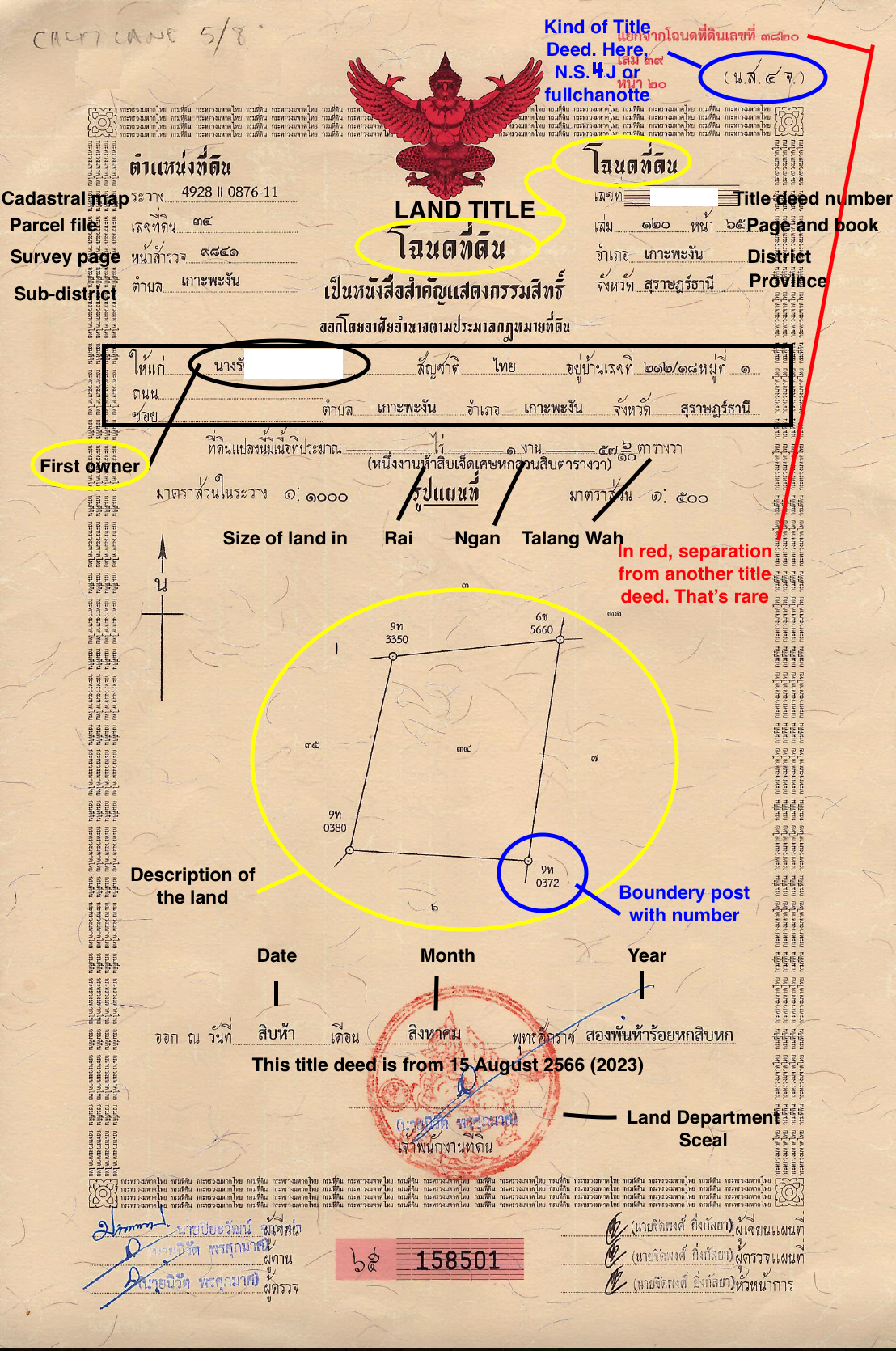
The colour of the Garuda tells you the deed type. A red Garuda is a Chanote (Nor Sor 4 Jor), the strongest title, surveyed by precise GPS. A green Garuda is a “Nor Sor 3 (sam) Kor,” a weaker document whose boundaries were fixed from an aerial photograph rather than a ground survey, which is why the recorded area can shift when the plot is later surveyed for a chanote. This title deed is Nor Sor 4 Jor (sometimes only called Nor Sor 4) and you see it on the upper right corner circled in blue. Also, the word “Chanote” appears translated to “title deed” in yellow circles. That is not written on Nor Sor 3 or Nor Sor 3 Kor. When you learn How to Read a Title Deed in Thailand, the type of title deed is crucial.
Most people recognize the drawing of the plot of land on the front page in the center. If you look closely, you’ll also see boundary posts with numbers (0372 is circled), often made of concrete and set in the soil.
En haut de ce schéma figurent le nom, la nationalité et l'adresse du premier propriétaire, c'est-à-dire le propriétaire initial lors de la création de l'acte de propriété. Le type d'acte est indiqué en haut à droite. Apprendre à lire un acte de propriété en Thaïlande peut vous apporter de précieuses informations.
NUMÉRO DE TITRE DE PROPRIÉTÉ POUR UNE CHANOTTE EN THAÏLANDE
Par souci de confidentialité, j'ai masqué le numéro du titre de propriété et les coordonnées du premier propriétaire, car les titres de propriété sont semi-publics. Les avocats peuvent en obtenir des copies pour un motif valable, comme une action en justice, un divorce ou une vente aux enchères immobilière.
If you see “S.P.K.,” on top right, be cautious. It stands for Sor Por Kor, and these title deeds cannot be purchased. Foreigners should never buy or build on a Sor Por Kor. I rather have a Por Bor Tor, which is agricultural land and the owner is the government. These are common in rural areas and the title deed is very different.
Seuls certains titres de propriété se trouvent au service foncier.
Title deeds like Nor Sor 3 and higher are stored at the Land Department, while Sor Por Kor has its own office and Por Bor Tor 5 tax receipts, which are not title deeds at all, are kept by the local authority, such as the SAO, the amphur ou Tessaban. Searching for Por Bor Tor records is challenging due to their variety. Some older documents, such as chanotes issued long before the 1954 Land Code created the Nor Sor 3, can be over 100 years old and impressive in size. Difficult to read because old, mostly use Thai numbers, but even if a little different, they kept some characteritics. Meaning if you learn how to read title deed in Thailand, you will be able to read all of them.
Below the first owner’s details, you will find the size of the land listed in Rai, Ngan, and Talang Wah. For example, 1-2-32 means 1 Rai, 2 Ngan, and 32 Talang Wah. The date the title deed was issued is noted beneath the plot description. Some title deeds also indicate if the parcel was derived from a previous deed, which is uncommon. The province, district, sub-district, and land department numbers, such as the cadastral map, book, and page, are also included on both sides at the top. So when you see a title deed, you know which province and which land department.
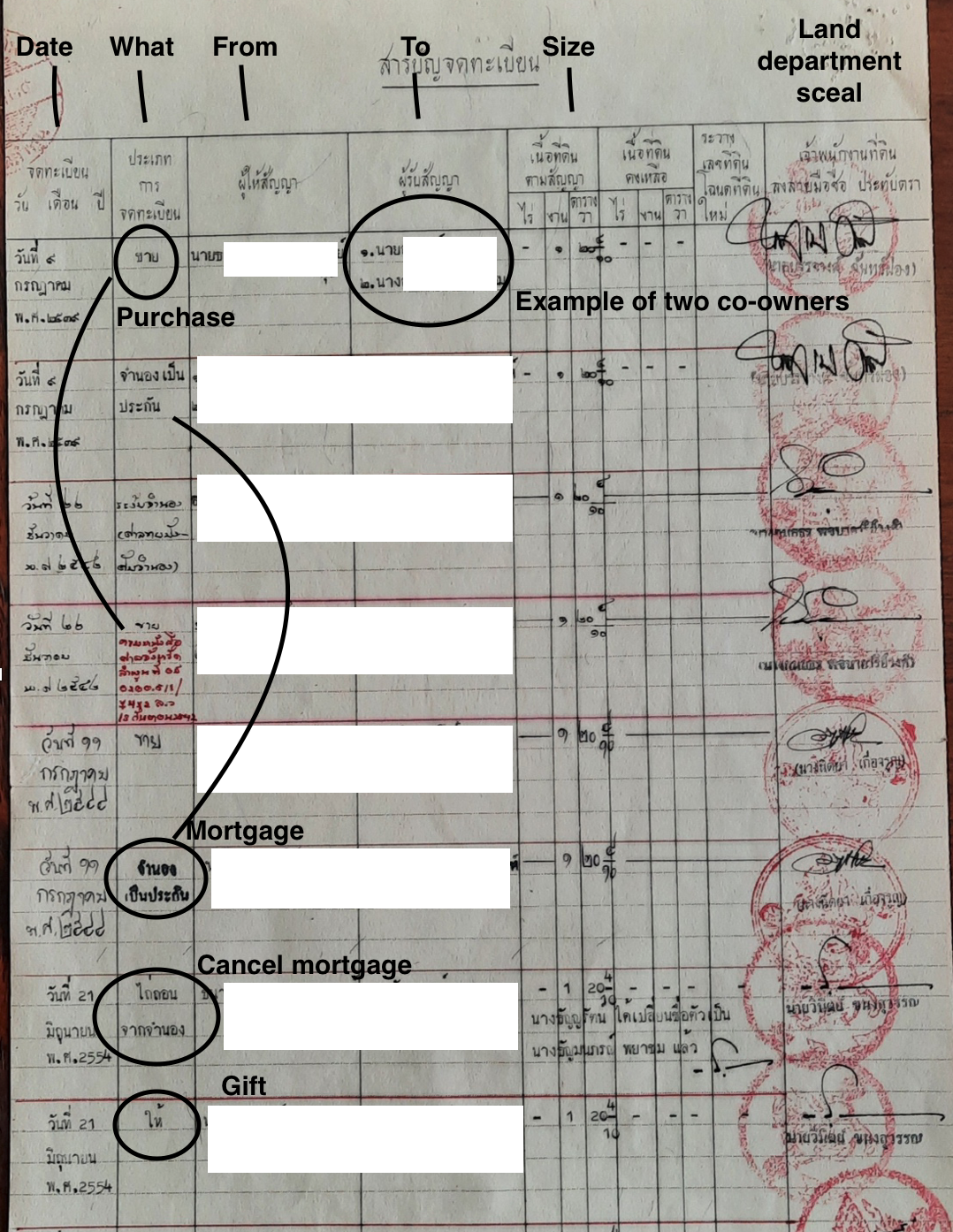
La deuxième image montre le verso d'un titre de propriété, différent du même. J'ai également masqué les noms par souci de confidentialité, bien que la publication d'un titre de propriété ne porte généralement pas atteinte aux droits à la vie privée. Le verso ressemble à un tableau, retraçant l'historique de la propriété. La première colonne indique la date, la deuxième décrit l'opération effectuée, et les troisième et quatrième colonnes mentionnent respectivement le vendeur et l'acquéreur. Par exemple, lors d'une vente, le vendeur figure dans la troisième colonne et l'acheteur dans la quatrième. Les colonnes suivantes indiquent la superficie du terrain, en chiffres thaïlandais ou romains, suivie du sceau du Département du cadastre confirmant la transaction officielle.
How to Read Title Deed in Thailand : The Back of a Chanote
In this example, you can see entries for purchase (Kay), hypothèque (Jam Nong), or donation (Hai). When registering a lease, it will state “Chao Tee Din” (lease of land), while a usufruct is noted as “See Tee Kep Kin.” Droit de superficie are “See Tee Nua Tee Din”.
Foreigner’s names can appear on title deeds, usually not as owners (though possible under certain exceptions) but often as usufructuary, lessee, mortgagee, superficiaire or holders of other rights.
The most interesting document for me is the Sap-Ing-Sith certificate, and it is not a title deed. Under Section 5 of the Sap-Ing-Sith Act B.E. 2562 (2019) the right is registered on the chanote itself and the Land Office issues a separate certificate in two copies, one for the owner and one kept at the office. Section 4 allows a term of not more than 30 years, and the Act contains no provision for renewing or extending it, so a further 30 years is something you negotiate with the landowner and not something the statute gives you. The Act says nothing about nationality, which is why a foreigner can hold one, and Section 11 gives the holder the rights and duties of an owner apart from the right to recover the property from a stranger who has no right to hold it. Our law firm has registered more than four such deeds, and each time, the Land Department had never encountered one before. Some people will say it’s only temporary, but you do not have a lessor. Section 12 lets you transfer it, mortgage it under the Civil and Commercial Code and pass it on by inheritance, none of which needs the landowner’s consent. Section 8 is the limit worth knowing in advance: a Sap-Ing-Sith cannot be divided, and land carrying one cannot be split into several plots or merged into another.
A chanotte is a crucial document. If lost, the owner can request a new copy 30 days after filing a police report. Chanotes are often used as security for loans, but this is not very secure. Banks typically register a mortgage instead. Mortgage or rights registered will be on the back on a title deed. So if you know How to Read a Title Deed in Thailand you will see all the chain of possession.
Registration fees are set by Ministerial Regulation No. 47 (B.E. 2541) clause 2(7) under the Land Code, and the Department of Lands publishes the schedule. An act registered with no capital value costs 50 baht per parcel, which is the figure for a usufruct, a superficies or a servitude granted for nothing. Granted for consideration, those same real rights are charged 1 per cent under paragraph (ฏ). A lease is 1 per cent under paragraph (ฐ), with stamp duty of 0.1 per cent on top. A mortgage is 1 per cent, capped at 200,000 baht, and that cap is the part people forget on a large loan. A transfer with a capital value, a sale for instance, is 2 per cent of the appraised value. Sap-Ing-Sith is charged under its own regulation and not this one: creating it costs a flat 20,000 baht, the certificate 10,000, cancelling it another 20,000, a mortgage of it 1 per cent, and the 2 per cent applies only when it is transferred. The Cabinet reduces some of these rates from time to time, so confirm the figure at the Land Office on the day. If you want to buy real estate the chanote is the most important document. It is crucial to learn how to read title deed in Thailand.
- Title deeds in Thailand, the full list of land documents
- Diligence raisonnable en Thaïlande
- Department of land, Thailand (official website, English and Thai)
Once you can read the deed, someone still has to check it against the Land Office register. C'est title due diligence, and it is where most problems surface.
Actualités juridiques thaïlandaises, gratuites par courriel
Des informations claires et concises sur les changements législatifs thaïlandais concernant les étrangers : propriété, visas, mariage, affaires et testaments. Un court courriel par mois, envoyé par un cabinet d’avocats établi depuis 2006. Zéro spam, désabonnement possible à tout moment.