Appels en matière pénale : Procédures devant la Cour suprême en Thaïlande

Révisé par ThaiLawOnline, un cabinet d'avocats thaïlandais agréé exerçant en Thaïlande depuis 2006. Avocate thaïlandaise en charge du dossier : Wichuda Atthamethakon, LL.M., licence du barreau thaïlandais 3149/2556.

Dernière mise à jour :

Thailand’s criminal appeals system provides defendants with structured opportunities to challenge court decisions through a hierarchical three-tier system. The Cour suprême, also called the Dika Court, is the final authority in criminal cases. However, access to this court has specific rules and limits. These rules help make sure that only important legal cases reach the top of the judicial system.

The deadline: one month, at both levels

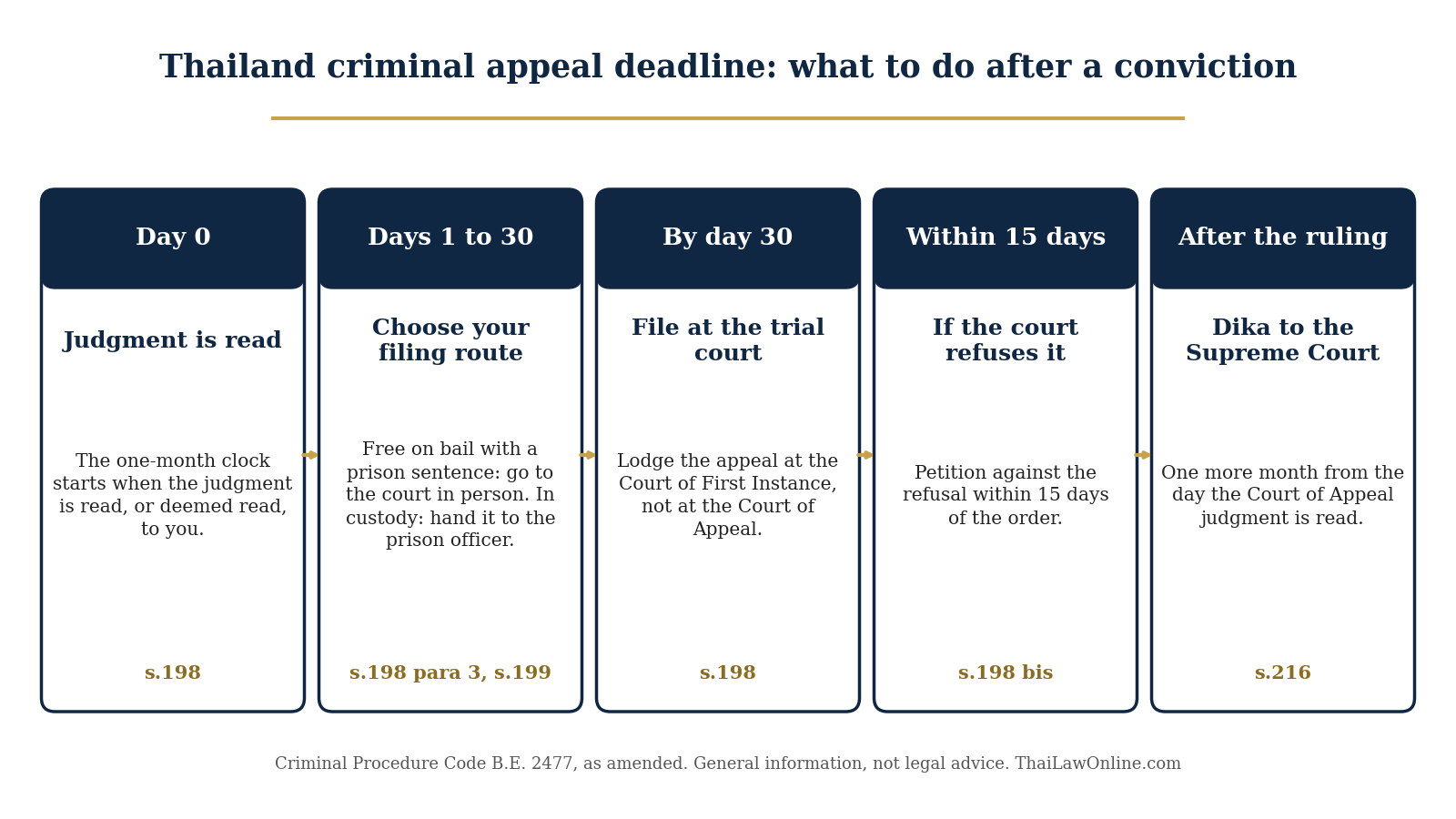
You have one month, and it is one month at each tier. An appeal against a judgment of the Court of First Instance must be filed within one month from the day the judgment or order is read, or is deemed to have been read, to the party appealing. That is Criminal Procedure Code section 198. A dika appeal against a judgment of the Cour d'appel runs on its own one-month clock under section 216. The two clocks are separate: the first runs from the reading at the Court of First Instance, the second from the reading at the Court of Appeal.

Both are filed at the Court of First Instance, not at the court you are appealing to. Section 216 says so expressly for the dika, and section 198 for the appeal. That court then examines the filing and decides whether to accept it and send it up; if it refuses, it must record its reasons in the order.

The requirement that costs defendants their appeal sits in section 198 paragraph 3. Where the judgment imposes imprisonment or a heavier punishment and the defendant is not in custody, the defendant may file an appeal only on presenting themselves to a court officer at the time of filing; otherwise the court shall order that the appeal not be accepted. If you are at liberty on caution, filing through a lawyer without surrendering yourself does not satisfy it. Paragraph 3 does not apply where the imprisonment has been suspended, or has already been served in full.

If the Court of First Instance refuses to accept the filing, you have fifteen days from the day that order is read to petition against the refusal: to the Court of Appeal under section 198 bis where an appeal was refused, and to the Supreme Court under section 224 where a dika was refused. The petition is filed at the Court of First Instance in both cases.

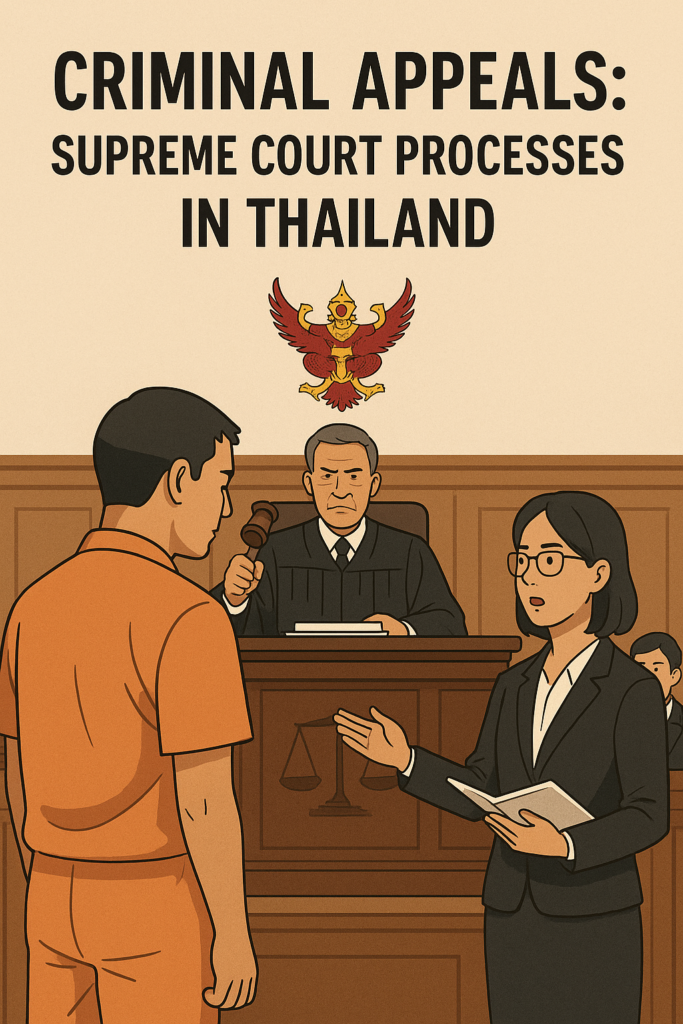
Illustration de la salle d'audience d'appel en matière pénale de la Cour suprême thaïlandaise
SujetDescription
Comprendre la structure du système judiciaire thaïlandaisAperçu du système judiciaire pénal à trois niveaux en Thaïlande : Cour de première instance, Cour d’appel et Cour suprême (Dika)
Délais et exigences de dépôtVous disposez d'un mois après le jugement pour déposer votre recours. Ce recours doit être porté devant le tribunal de première instance. Les dépôts tardifs ne sont pas autorisés, sauf circonstances exceptionnelles.
Restrictions substantielles aux appels en matière pénaleIf the Court of Appeal affirmed a sentence of five years or less, neither side can appeal the facts (section 218). Other limits apply to short sentences and to double acquittals
Exceptions et circonstances particulièresA barred dika can go ahead only if a judge who sat in the case, or the Attorney-General, certifies it under section 221. Prison terms, suspended sentences and fines over 1,000 baht open the first appeal, not the dika
Considérations procédurales et implications pratiquesDecided on the record; further evidence only if the court orders it (section 208); decisions take months or years; legal representation is essential
Coûts et considérations financièresIncludes court filing fees (200-1,000 baht), legal fees (50,000-200,000 baht), translations, bail, and possible fines/security
Évolutions récentes et tendances futuresClearer written decisions and electronic filing; unlike civil cases, a criminal dika still needs no permission from the Supreme Court

Comprendre la structure du système judiciaire thaïlandais

La Thaïlande applique un système de droit civil comportant trois niveaux distincts de juridictions pénales. Le tribunal de première instance est le lieu où débutent les affaires pénales. Au-dessus se trouve la cour d'appel, qui examine les décisions des juridictions inférieures. Enfin, la Cour suprême assure le dernier recours en matière juridique.

Thailand’s Supreme Court has complete authority over civil and criminal appeals. This is different from common law areas, which have many supreme courts or special appellate divisions. This centralized method helps interpret Thai law consistently in all areas. However, it also creates heavy caseload pressures. These pressures have affected how the court chooses cases.

La Cour suprême applique des règles strictes en matière de procédure pénale. Ces règles fixent les délais de dépôt des plaintes et définissent les types de questions pouvant être soulevées en appel. Ces procédures illustrent le double rôle essentiel de la Cour : protéger les droits individuels et garantir la cohérence juridique au sein du royaume.

Délais et exigences de dépôt

Criminal appeals to the Supreme Court have strict time limits. These limits require quick action from both defendants and their lawyers. The main rule sets a one-month deadline to file a dika appeal after the Court of Appeal’s judgment is read. This timeline matches the deadline for appealing from the Court of First Instance to the regional appeals court. This creates consistency in the appellate system.

The one-month period starts from the date the Court of Appeal’s judgment is read to the parties. It also starts when it is considered to have been read under the rules. This “deemed reading” provision prevents parties from avoiding appeal deadlines simply by failing to appear for judgment. The calculation of this period follows strict legal standards, with no extensions available except in the most extraordinary circumstances.

Vous devez déposer votre recours devant le même tribunal de première instance qui a examiné l'affaire. Ne le saisissez pas directement devant la Cour suprême. Cette exigence peut paraître étrange, mais elle est essentielle. Elle permet au tribunal de première instance de rassembler l'intégralité du dossier. Elle garantit également le respect de toutes les procédures avant la saisine de la Cour suprême.

The Court of First Instance maintains discretionary authority to review the appeal for compliance with procedural requirements. If the court determines the appeal fails to meet statutory requirements, it may reject the filing outright. If the Court of First Instance refuses to accept a dika, the person filing it may petition the Supreme Court against that order under section 224. The petition goes to the Court of First Instance, within fifteen days from the day the refusal is read, and that court forwards it to the Supreme Court with the dika and both judgments. Where it is an appeal rather than a dika that has been refused, the equivalent petition goes to the Court of Appeal under section 198 bis, on the same fifteen-day clock.

Frais de justice are payable at filing. What the Code does pas do is make payment of your fine a precondition of appealing: no provision conditions the filing of an appeal or a dika on paying the fine or posting security, and the security provisions of the Code (sections 106 to 119) govern provisional release, which is a separate question from whether your appeal is accepted. The condition that does bite is section 198 paragraph 3: where the judgment imposes imprisonment or heavier and the defendant is not in custody, the appeal may be filed only on the defendant presenting themselves to a court officer at the time of filing, failing which the court shall order the appeal not accepted.

Time Limits for Expatriate Defendants

Expats in Thailand often face unique challenges when filing appeals. These include language barriers and problems working with lawyers from other countries. If you are an expatriate defendant, you should hire a Thai-licensed attorney. Do this right after the Court of Appeal’s judgment. They can manage the filing at the original Court of First Instance. They will make sure all documents are in Thai and follow local rules. Remember, if you miss the one-month deadline, you might lose your chance for Supreme Court review. This is a common mistake for people who do not know Thailand’s system.

Restrictions substantielles aux appels en matière pénale

La Cour suprême ne fonctionne pas comme une juridiction de droit commun compétente pour examiner toutes les affaires pénales. Le droit thaïlandais est régi par des règles strictes qui limitent la compétence de la Cour suprême aux affaires soulevant de véritables questions de droit ou impliquant des crimes graves.

The main restriction is on appeals about facts, not laws, especially in criminal cases. When the Court of Appeal has affirmed the judgment of the lower court or made only minor modifications, and the resulting sentence involves imprisonment for five years or less, parties are generally prohibited from raising factual disputes in their Supreme Court appeal. This limitation acknowledges that trial courts and intermediate appellate courts mainly make factual decisions. The Supreme Court’s role is to ensure that legal principles are interpreted and applied consistently.

This five-year limit sets a clear line. It shows which cases need Supreme Court attention and which can be handled at lower levels. However, the restriction applies only to appeals on questions of fact. Appeals that focus only on legal questions are still allowed, no matter how long the sentence is. This shows the Supreme Court’s important role in interpreting and developing the law beyond a reasonable doubt.

Additional rules apply when both the Court of First Instance and the Court of Appeal have dismissed the charge. Section 220 then bars a dika by either party, prosecution or defence. The only way past that bar is certification under section 221, described below.

Special rules also govern appeals in minor criminal cases. Under section 219, where the Court of First Instance imposed two years’ imprisonment or less, or amendes of 40,000 baht or less, and the Court of Appeal kept the penalty within those limits, neither party may appeal the facts to the Supreme Court, unless the Court of Appeal substantially amended and increased the defendant’s penalty. This rule stops the highest court from being overloaded with minor criminal cases. It also keeps access open for more serious cases.

Exceptions et circonstances particulières

Malgré ces restrictions, le droit pénal thaïlandais comporte d'importantes exceptions. Celles-ci permettent de rétablir le droit d'appel dans des affaires qui, en temps normal, ne pourraient faire l'objet d'un examen par la Cour suprême. Ces exceptions témoignent de l'importance que le système judiciaire accorde à l'accès à la justice, ce qui est essentiel pour les affaires touchant aux droits fondamentaux ou aux principes juridiques essentiels.

Two things are often described as opening the door to the Supreme Court, and neither does. A sentence of actual imprisonment, however short, and a peine avec sursis are both exceptions to the bar on appealing the facts to the Court of Appeal, explained in the next paragraph. They are not exceptions to the dika bars in sections 218 to 220: a prison term of two years or less that the Court of Appeal kept within that limit still cannot be challenged on the facts before the Supreme Court.

Fine levels do open an exception, but at the first appeal rather than at the dika, and the two are routinely confused. Under section 193 bis, no appeal on a question of fact lies against a judgment of the Court of First Instance where the maximum penalty prescribed by law is imprisonment of not more than three years, or a fine of not more than 60,000 baht, or both. A defendant may still appeal on the facts in four situations, and the fourth is a fine exceeding 1,000 baht; the other three are a sentence of imprisonment or confinement in its place, a suspended sentence, and a finding of guilt with the punishment deferred. That is a route to the Court of Appeal, not to the Supreme Court.

The dika thresholds are set elsewhere and are much higher. Article 219 bars a dika on the facts where the Court of First Instance imposed not more than two years’ imprisonment or a fine of not more than 40,000 baht and the Court of Appeal kept the penalty within those limits, except for a defendant whose penalty the Court of Appeal substantially increased. Article 218 bars a dika on the facts where the Court of Appeal affirmed or only slightly amended a sentence of not more than five years. Article 220 bars a dika altogether where both courts below dismissed the charge.

The one way past a bar in sections 218, 219 or 220 is certification under section 221. A judge who sat in the case, signed the judgment or wrote a dissenting opinion in the Court of First Instance or the Court of Appeal may find that the decision raises an important question fit for the Supreme Court and permit the dika. Alternatively, the Attorney-General (the Code still says the Director-General of the Public Prosecution Department) may sign the dika certifying that there is good reason for the Supreme Court to decide it. Unlike the equivalent rule for the first appeal in section 193 ter, section 221 does not let the Attorney-General delegate this to other prosecutors.

No permission stage in criminal cases. Some English guides describe the Supreme Court as choosing its criminal cases the way a common-law court grants leave. That describes civil appeals. Since the Civil Procedure Code was amended, a civil dika needs the Supreme Court’s permission, granted where the question is important, for example because it concerns the public interest, the Court of Appeal’s rulings conflict, or there is no Supreme Court precedent yet (sections 244/1, 247 and 249). The Criminal Procedure Code has no equivalent. A criminal dika that is filed in time and is not barred by sections 218 to 220, or is certified under section 221, is accepted and decided.

What the Supreme Court can do on its own motion is narrower. Through section 225, which applies the appeal rules to the dika, a question of law concerning public order may be raised even if nobody raised it in the lower courts (section 195).

Considérations procédurales et implications pratiques

Appealing criminal cases to Thailand’s Supreme Court is not easy. It requires following complex rules and meeting strict deadlines to appeal within the designated timeframe. Legal representation is very important at this level of criminal litigation. The Supreme Court has special procedures and high standards for legal arguments. This requires a strong understanding of criminal law and appellate practice.

The Supreme Court usually makes decisions based on the written records from lower courts. They rarely take new evidence, although section 208, which section 225 applies to the dika, allows the court to hear further witnesses itself or order the trial court to do so. This limitation means that appellants must carefully build their legal arguments using the current facts. They should focus on legal interpretation instead of arguing about the facts. The court’s review process is based on written submissions.

Processing times for Supreme Court appeals can change a lot. This depends on the court’s workload and the complexity of the issues. The court wants to resolve cases quickly. However, final decisions often take several months or even years for complex cases. This extended timeline must be factored into strategic decisions about whether to pursue Supreme Court review.

The Supreme Court’s decisions are important in Thailand’s legal system. This means that winning an appeal can affect many cases, not just the one at hand. On the other hand, unsuccessful appeals lead to final judgments. These judgments use up all legal options before one can file an appeal. This makes the choice to appeal very important.

Coûts et considérations financières dans les appels devant la Cour suprême

Appealing to Thailand’s Supreme Court has many costs. Defendants need to be ready for these costs, especially in criminal cases with possible fines or jail time. Court fees for filing a Dika appeal usually range from 200 to 1,000 baht. The cost depends on how complex the case is. There are also extra costs, like lawyer fees. These fees can be between 50,000 and 200,000 baht for Supreme Court representation. Non-Thai speakers may also need to pay for translation services. Budget separately for bail: if you are at liberty pending appeal, section 198 paragraph 3 requires a defendant sentenced to imprisonment or heavier, and not in custody, to present themselves to a court officer when the appeal is filed, so provisional release under sections 106 to 119 becomes the practical question at that moment. Paying the fine itself is not a precondition of appealing. For expats, these financial burdens can be significant, particularly if you’re supporting a family or business in Thailand. It is smart to budget for bail during the appeal process. Bail amounts can vary and may exceed 100,000 baht for serious crimes. Consulting a legal expert early can help minimize costs and explore options like legal aid for qualifying cases.

Thailand’s Supreme Court has made important changes to its procedures in recent years. These changes aim to improve efficiency and keep the quality of judicial review high. These changes are part of a larger effort to update the Thai legal system. They aim to handle more cases while ensuring access to justice for serious crimes.

L'intégration des technologies a rendu les procédures de la Cour suprême plus efficaces. Les systèmes de dépôt électronique et les outils numériques de gestion des dossiers contribuent à rationaliser le processus d'appel devant les cours d'appel régionales. Ces améliorations technologiques ont permis de réduire les délais de traitement tout en préservant les normes rigoureuses d'examen qui caractérisent les procédures de la Cour suprême.

La Cour privilégie désormais des décisions écrites claires et détaillées. Ces décisions sont utiles aux juridictions inférieures et aux praticiens du droit. Cette priorité accordée à des précédents clairs garantit que les arrêts de la Cour suprême orientent les affaires futures. Elle réduit également le risque d'interprétations divergentes devant les juridictions inférieures.

FAQ sur les appels en matière pénale : Procédures devant la Cour suprême en Thaïlande

Quel est le processus de procédure pénale en Thaïlande ?

La procédure pénale en Thaïlande comporte plusieurs étapes. Elle débute par le dépôt d'une plainte. Viennent ensuite l'enquête, les procédures judiciaires et les appels. Le prévenu comparaît devant le tribunal. L'accusation doit prouver la culpabilité de l'accusé au-delà de tout doute raisonnable. En cas de condamnation, le prévenu a le droit de faire appel devant les juridictions supérieures, notamment la Cour d'appel. Cour suprême de Thaïlande.

Combien de temps un accusé a-t-il pour interjeter appel en Thaïlande ?

Defendants usually have one month to file an appeal. This can happen in two ways. It can go from the Court of First Instance to the Court of Appeal. Alternatively, it can go from the Court of Appeal to the Supreme Court. The first route is section 198 and the second is section 216, which is the dika appeal; section 193 is the provision that sends appeals on fact and law to the Court of Appeal, not the dika provision. Each one-month period runs from the day that court’s judgment is read, or is deemed read, to the party appealing. Extensions are rare, so act quickly, and expats should work with a Thai-licensed lawyer to avoid procedural errors.

Quel est le rôle de la Cour suprême de Thaïlande en matière d'appels ?

Le Cour suprême de Thaïlande handles appeals. It reviews cases to decide if they should be accepted based on legal and factual reasons. The president of the Supreme Court has an important role in this decision-making process. He oversees administration, but case decisions are made by panels of at least three judges (Charter of Courts of Justice, section 27), and a case may also be decided by the court’s plenary meeting.

Quelles preuves doivent être présentées lors d'un appel en matière pénale ?

In a criminal appeal, Supreme Court cases mainly rely on the current record. No new trial is held, and further evidence is taken only if the court orders it under CPC section 208, which section 225 applies to the Supreme Court. Cross-examination typically occurs at the trial level, not appeals. Appeals focus on legal errors, not re-litigating facts.

Que se passe-t-il si le tribunal conclut que l'accusé a commis l'infraction ?

Si le tribunal conclut à la culpabilité de l'accusé, un jugement est rendu. L'accusé peut alors être condamné. Il peut faire appel de ce jugement dans un délai imparti afin de contester la décision du tribunal et d'obtenir un résultat différent.

Un accusé peut-il contre-interroger les témoins lors d'un appel ?

Not as a rule. Witnesses are examined and cross-examined at trial, and appeals are decided on that record, unless the appellate court decides under section 208 to take further evidence.

Comment la cause probable est-elle établie dans les procédures pénales thaïlandaises ?

En Thaïlande, la notion de cause probable est établie dès les premières phases de la procédure pénale, généralement lors de l'enquête. Le ministère public doit prouver l'existence de motifs suffisants pour croire que l'accusé a commis l'infraction. En common law, on parle de “ motifs raisonnables ”. Le droit thaïlandais applique le critère de la “ prima facie ”, c'est-à-dire la présence de preuves initiales suffisantes. Ce critère est défini aux articles 134 à 143 du Code de procédure pénale. Cette appréciation relève souvent de la police ou du parquet. Ce critère diffère de la notion de “ cause probable ” en common law.

Quel est le calendrier des procédures pénales en Thaïlande ?

Les délais de procédure pénale sont variables. Les affaires simples peuvent être résolues en 6 à 12 mois. En revanche, les affaires complexes, comme celles impliquant des expatriés dans des affaires de fraude ou de stupéfiants, peuvent durer de 2 à 5 ans, appels compris. Des facteurs tels que l'encombrement des tribunaux, les enquêtes et les retards liés à la COVID-19 peuvent impacter votre affaire. Il est également essentiel de préparer une argumentation solide pour contester le jugement. Les accusés doivent impérativement respecter les délais impartis.

Conclusion

Thailand’s Supreme Court appeals process in criminal cases is a balanced system. It aims to give a fair review while using limited court resources wisely. The strict rules, limits on what can be done, and review powers create a system. This system focuses on important legal cases. It also makes sure that serious criminal matters have access to justice.

For defendants and lawyers, it’s important to know the rules. They also need to understand the overall strategy. This knowledge is key for effective advocacy in criminal cases. The one-month filing deadline and complex rules require careful planning. A smart legal analysis can help improve the chances of a successful Supreme Court review.

The system focuses on legal interpretation instead of looking at facts. This shows the Supreme Court’s special role in Thailand’s court system. This focus may limit the court’s ability to handle individual injustices in regular cases, especially in criminal litigation. However, it ensures that the court’s decisions guide the development of Thai criminal law. It also helps maintain consistent justice across the kingdom.

If you’re an expat facing a criminal conviction in Thailand, don’t navigate the Supreme Court appeals process alone. Our team of experienced Thai lawyers can review your case, handle filings, and maximize your chances of success. Contact us today for consultation sur ThaiLawOnline.com ou par courriel info@thailawonline.com. Let’s protect your rights and future in Thailand

Actualités juridiques thaïlandaises, gratuites par courriel

Des informations claires et concises sur les changements législatifs thaïlandais concernant les étrangers : propriété, visas, mariage, affaires et testaments. Un court courriel par mois, envoyé par un cabinet d’avocats établi depuis 2006. Zéro spam, désabonnement possible à tout moment.

Retour en haut de la page
WhatsApp LINE Appeler Rendez-vous