


Reviewed by ThaiLawOnline, a licensed Thai law firm practising in Thailand since 2006. Thai lawyer of record: Wichuda Atthamethakon, LL.M., Thai Bar Licence 3149/2556.
Last updated on September 5, 2026
Two new Immigration Bureau Orders, starting on October 1, 2025, update Thailand’s investment-based visa and stay rules. They link long-stay eligibility to buying real estate or renting high-value housing. A “tourism long-stay support” option has a lower 3,000,000 THB threshold. They also set a 85,000 THB per month rental benchmark, with rules on advance payments.
This framework is not a standalone “golden visa.” The legal result is a Non-Immigrant visa. Or, it is an in-country change of Non-Immigrant category under Order 237/2568. This is followed by an extension of temporary stay for up to 1 year at a time under Order 238/2568. You can renew it if you still meet the requirements. Do note overhype this visa : It is still just a 1 year renewable extension visa.
A key gating issue many commentators omit: the 3M real estate route depends on a support or request letter. The letter must come from the Ministry of Tourism and Sports, or a delegated body. Without that letter, the filing typically fails regardless of property value.
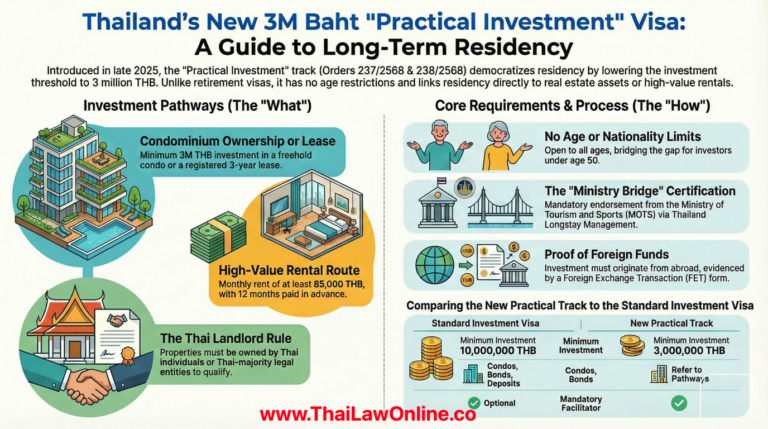
Table of Contents
Legal basis and what changed
The controlling instruments
The changes come from two orders issued by the Thai Immigration Bureau (สำนักงานตรวจคนเข้าเมือง):
- Order 237/2568 updates the rules and document standards for visa issuance. It also covers in-country changes of visa category in certain cases. These include investment-based cases and the new tourism-linked 3M real estate path.
- Order 238/2568: updates the rules and document standards for extending a temporary stay. You can extend for up to 1 year at a time. It covers investment-based extensions, including the tourism-linked 3M real estate option.It also updates related family rules.
Both orders set an effective date of October 1, 2025. This means they apply from that date onward. The orders do not describe any transition period.
What is “new” in practical terms
Thailand already had a stricter investment route, often called a 10,000,000 THB investment. It allowed buying or leasing qualifying real estate for large sums. This was often framed as a major capital inflow. The baseline criteria in the earlier 2025 immigration order set a 10M framework. It required proof of transfer-in funds and proof of investment. This included buying or leasing a condo for at least three years. The condo’s price or lease value had to be at least 10M THB.
The 2025 October amendments add a more achievable, tourism-linked route centered on:
- 3,000,000 THB condominium purchase (ownership evidence in the applicant’s name), or
- high-value residential rental using a 85,000 THB/month benchmark tied to advance-payment evidence and contract constraints,
- plus a required Ministry of Tourism and Sports endorsement/request to Immigration.
Why these rules appear now
The orders themselves justify the revisions as an update of criteria and documents to fit current circumstances and administration.
In parallel, Thai media reports show active promotion of long-stay residency linked to condo purchases. Many reports cite a threshold of 3 million baht or more. This promotion involves a partnership between Sansiri and a long-stay operator. It is presented as a strategy to attract higher-spending foreign residents. It also aims to boost tourism-focused cities.
Important distinction: marketing partnerships do not override the legal text. The orders control the requirements Immigration officers apply.
Eligibility routes and thresholds
Tourism-linked 3M real estate route (the “new” practical pathway)
This pathway has two stages in law:
- Stage 1 (visa issuance or change of category) under Order 237/2568.
- Stage 2 (extension of stay up to 1 year) under Order 238/2568.
The investment/accommodation structures recognized in the orders include:
- Condominium purchase at ≥ 3,000,000 THB (ownership must be evidenced in the applicant’s name through official documentation).
- Residential rental tied to ≥ 85,000 THB/month with advance-payment evidence and contract conditions (including landlord eligibility constraints).
A required item is a certification/request letter from the Ministry of Tourism and Sports. Online summaries often leave this out. A delegated party may also issue it. This letter confirms the applicant supports long-stay tourism.It also confirms the applicant meets the investment and accommodation criteria.
Classic 10M investment route (still exists alongside the 3M route)
The October 2025 orders still preserve an investment not less than 10,000,000 THB route, generally requiring:
- proof of transferring at least 10M THB into Thailand, and
- proof that you placed the 10M into qualifying investments. These may include certain real estate purchases or leases. They may also include fixed deposits. Government or state enterprise bonds also qualify. Combined investment structures may qualify as well.
This route is separate from the tourism-linked 3M structure. Content that merges these two often becomes inaccurate on documents, eligible investments, and renewal expectations.
Family members and dependents
Both orders also cover family members. This includes parents, spouses, children, adopted children, and stepchildren. They use proof of the relationship and extra criteria. These include age, dependency, and the relationship in law and practice. For the tourism-linked 3M path, the orders show extra review. They also link to the same Ministry endorsement logic. This applies when the family route ties to the principal investor’s status.
Family members, like parents, spouses, children, and adopted or stepchildren, are covered under Clause 2.20 of Order 238/2568. Their extensions depend on the main applicant’s compliance. They must provide proof of the relationship, such as birth or marriage certificates. The orders leave room for additional documentation as requested by Immigration oversight committees.
Requirements and conditions
Core conditions Immigration officers look for
Across both orders, the recurring “deal-breaker” checks are:
- Status check: the applicant must hold (or obtain) the relevant Non-Immigrant / temporary stay status consistent with the route.
- Money trail: proof of a fund transfer into Thailand from overseas, with bank records that match Bank of Thailand inward transfer formats.
- Asset/accommodation evidence: Proof that the applicant owns a condo, or a qualifying rental or lease agreement. Include records of advance payments.
- Tourism endorsement bridge (3M route): The Ministry of Tourism and Sports, or its delegate, must issue a letter. The letter must request a visa or category change. It may also request a stay extension. It must support the applicant as a long-stay tourism supporter.
Real estate purchase requirements (condominium purchase)
The orders set eligibility for a condo unit (ห้องชุดในอาคารชุด) and proof of ownership. They also require the purchase price to meet a set threshold.The threshold is 3M for the tourism route and 10M for the classic route.
Commonly required evidence in the orders includes:
- Sale and purchase contract and proof of payment. Include registration evidence showing ownership in the applicant’s name. The relevant authority must issue the registration evidence.
- For a foreign condo owner, the orders require official documents naming the applicant. They also often require photos of the unit. This helps Immigration feel comfortable with the evidence.
Practical pitfall: Foreign ownership in a Thailand condominium project is limited by the foreign quota. A buyer must qualify for foreign ownership registration. A failure at the Land Office registration stage breaks the visa strategy.
Rental and lease requirements (high-value accommodation)
The October 2025 orders allow condo or house rentals with a 85,000 THB per month benchmark. However, it is not a “rent and forget” setup The document list emphasizes:
- contract length requirements (for the entry/visa alignment stage, a lease term is explicitly referenced),
- advance-payment evidence meeting stated minimums (not merely a promise to pay),
- and landlord eligibility: the lessor or owner must be a Thai natural person. Or, it must be a Thai-majority juristic person with more than 50% Thai shareholding.
A second major pitfall: a lease longer than 3 years usually needs registration at the Land Office. Without registration, it may not be enforceable against third parties. The orders’ document requirements also match what is expected for registered leases in longer-term cases. The order text links the evidence to land law and condominium or building law.
The Ministry endorsement letter (the gating document)
For the 3M tourism-linked route, both orders share the same core requirement. You must provide a letter that certifies and requests Immigration action. This letter is for a long-stay tourism supporter. They must meet the real estate investment and accommodation structure requirements.
What the orders do not specify (and should be treated as unspecified) includes:
- the precise internal Ministry workflow,
- the list of delegated entities (if any),
- expected lead times at the Ministry level,
- and whether an annual re-endorsement is mandatory or applied case-by-case.
Because the legal text does not cover these points. Any article that claims “automatic approval” or “no Ministry involvement” goes against the orders.
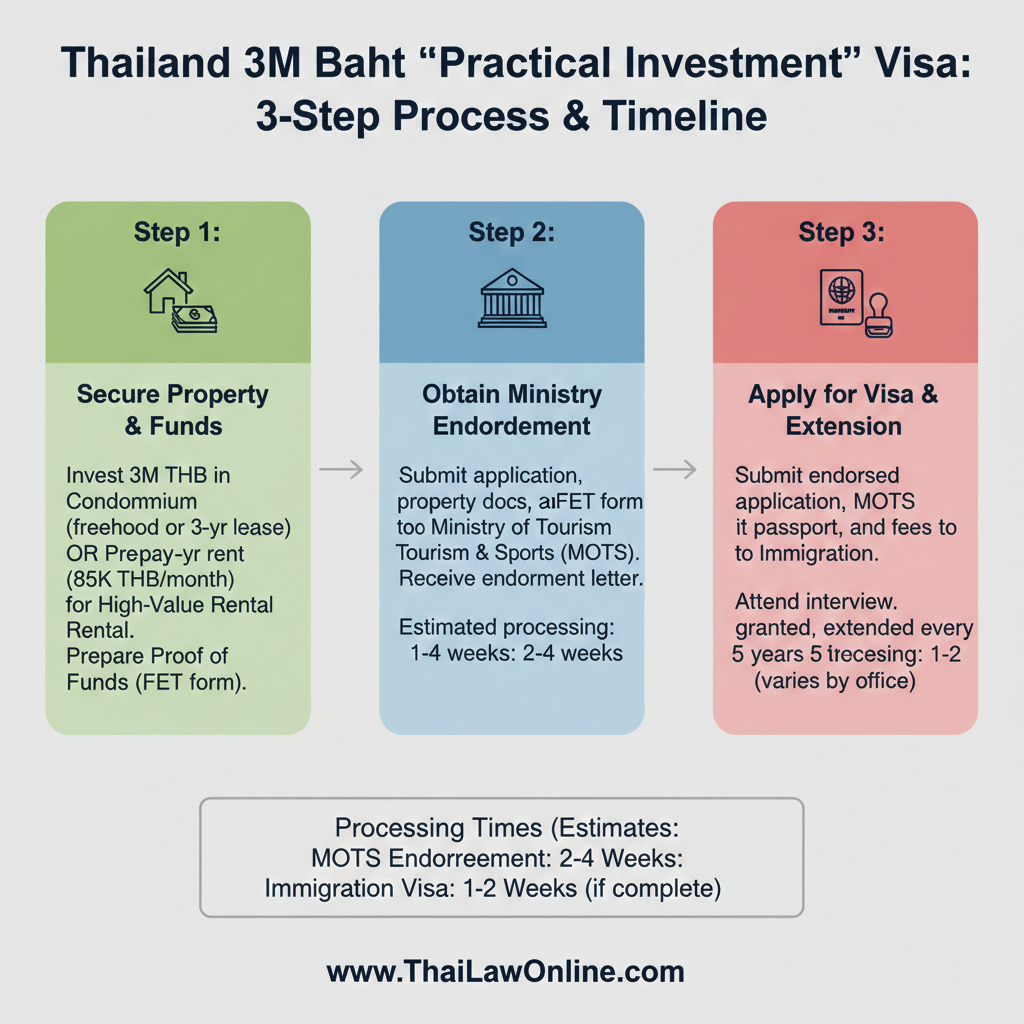
Step-by-step application guidance
This guidance tracks how Immigration officers typically sequence the file under the two-order structure. The key steps come from the orders. Operational friction points reflect common front-desk practice in immigration filings and document checks.
Prepare the case correctly before any visa filing
First confirm which route is targeted:
- 3M purchase (condo ownership in applicant’s name), or
- 3M tourism rental structure (85,000 THB/month benchmark with advance-payment evidence and compliant landlord), or
- 10M investment (classic route).
Then prepare the “money trail”:
- Transfer funds into Thailand in an auditable way. Keep all documents that show the remittance source and inbound transfer details. The orders require bank records as evidence of inbound funds.
Then prepare the property evidence:
- purchase route: ensure quota/registration feasibility and complete ownership registration before relying on property ownership for Immigration purposes.
- Rental route: Make sure the landlord meets the Thai national or Thai-majority rule. Set up payments to meet the orders’ advance-payment requirement. Do not use a casual month-to-month transfer.
Obtain the Ministry of Tourism and Sports endorsement/request letter (3M route)
Before Immigration accepts the 3M tourism-linked file, you must get an endorsement or request letter. Get this letter from the Ministry of Tourism and Sports. This letter may also come from a delegated party, as required.
If a third party offers “facilitated long-stay” services, treat them as service arrangements. For example, this includes developer-linked packages discussed in the media. Do not assume these offers provide automatic compliance. The Immigration officer still checks the legal elements found in the orders.
Stage 1: visa issuance or in-country change of visa category (Order 237/2568)
Order 237/2568 is the legal entry point for:
- obtaining the appropriate visa, or
- changing visa category inside Thailand (where eligible and accepted in practice),
based on the investment route and supporting documents.
For the 3M tourism-linked route, Immigration expects:
- the property purchase or rental evidence,
- the fund-transfer evidence, and
- the Ministry request letter.
Unspecified in the orders: whether each local Immigration office will accept an in-country category change for every fact pattern. Practice depends on immigration history, current status, overstay history, and local office policy.
Stage 2: apply for a 1-year extension of temporary stay (Order 238/2568)
After you have the correct status, Order 238/2568 governs the extension of stay (up to 1 year at a time) based on investment. This includes the 3M real estate route.
In a straightforward 3M (tourism) renewal cycle, Immigration commonly checks:
- continued compliance (ownership retained or qualifying lease still valid),
- evidence of the required rent/payment structure, and
- the Ministry request letter supporting the extension.
Ongoing obligations after approval (often forgotten)
Even with a valid 1-year extension, the holder remains under standard Immigration compliance mechanics:
- 90-day reporting obligations generally apply to most long-stay Non-Immigrant extensions unless a special program explicitly waives them (the orders here focus on eligibility/documents and do not state a 90-day waiver). Unspecified in these orders.
- TM30 residence reporting still matters for interaction with Immigration in practice (not created by these orders, but routinely requested at counters).
- Re-entry permit is required before leaving Thailand if the holder wants to preserve the permission to stay; official fee references commonly used by Immigration offices list 1,000 THB single and 3,800 THB multiple.
Practical implications, risks, and what other writeups often omit
The comparison table expats need
| Route (investment basis) | Eligibility focus | Investment / rental threshold | Key documents Immigration focuses on | Processing time (practical) | Government fees (typical) | Rights granted (core) |
|---|---|---|---|---|---|---|
| Tourism-linked 3M condo purchase | Long-stay tourism supporter with qualifying condo ownership | Condo purchase price ≥ 3,000,000 THB | Inbound transfer proof; condo purchase + payment evidence; official ownership evidence in applicant’s name; Ministry request letter | Unspecified in orders. Expect longer lead time if Ministry letter is pending; Immigration stamping often faster once a complete file is accepted. | Extension fee frequently shown as 1,900 THB; re-entry 1,000 / 3,800 THB if traveling. | Non-Immigrant alignment + 1-year stay extension (renewable while compliant). Work authorization not granted by these orders. |
| Tourism-linked 3M high-value rental / lease | Long-stay tourism supporter with compliant accommodation contract | Rental benchmark ≥ 85,000 THB/month with advance-payment evidence; longer-term lease scenarios require stronger proof (including registered lease expectations in the document list). | Lease/rental contract meeting term rules; landlord eligibility (Thai or Thai-majority juristic person); advance-payment proof meeting the order’s benchmarks; Ministry request letter | Unspecified in orders. Often slower than standard extensions due to verification and letter coordination. | Same government fee pattern: 1,900 THB per extension; re-entry 1,000 / 3,800 THB if traveling. | Non-Immigrant alignment + 1-year stay extension (renewable while lease and payment structure remain compliant). |
| Classic 10M investment route | Investor meeting high capital inflow rules | Transfer ≥ 10,000,000 THB and invest via recognized forms (real estate purchase/lease, deposits, bonds, or combination) | Bank transfer evidence; investment evidence by category (deposit certificate, bond proof, purchase/lease proof); application and passport copies | Unspecified in orders. Usually document-heavy; verification varies by office. | Extension and re-entry fees as above in Immigration office fee schedules. | Non-Immigrant alignment + 1-year stay extension (renewable while investment remains). |
The biggest omissions and traps
The landlord eligibility rule (rental route).
Many promotional articles describe “rent any luxury condo and qualify.” The order text is narrower. The lessor/owner is expected to be Thai (natural person) or a Thai-majority juristic person, and Immigration expects documentation reflecting that status. A rental from a foreign owner is a frequent failure point.
Advance-payment evidence is not optional.
Both Stage 1 and Stage 2 documentation lists place emphasis on advance rental payment evidence meeting the stated benchmarks (85,000 THB/month and minimum periods or lump sums depending on the structure). A lease contract without compliant payment evidence leaves the file exposed.
The Ministry endorsement is a required bridge.
Any writeup promising “buy condo, walk into Immigration, receive long-stay stamp” is incomplete. The orders require a Ministry of Tourism and Sports request/certification (or a delegated entity’s request) for the 3M tourism-linked route.
Media coverage about partnerships and “one-stop” promotion should be read as business packaging around this legal bridge, not a replacement of it.
Condo ownership must be legally registrable.
Foreign condo ownership is constrained by quota rules and legal eligibility conditions; a buyer who cannot register ownership in their own name cannot use “ownership” as Immigration evidence.
Not the LTR visa.
Confusion with LTR is common. LTR is a separate scheme with its own rules administered through investment promotion channels, described in legal updates from firms such as Tilleke & Gibbins. Treat LTR and the investment extension route as two different products.
Rights are limited.
These orders govern visa/category processing and permission to stay. They do not grant work authorization. Anyone planning employment needs a separate work-permit compliant status route.
Does Immigration guarantee a fixed processing time?
Are there age limits or minimum income requirements?
The 3M tourism-linked route in these orders is framed around investment/accommodation evidence and Ministry endorsement, not age or retirement income. Age and income rules appear in other visa routes (retirement, marriage), but are not stated as core eligibility elements of this specific 3M investment/accommodation path. Any age requirement not shown in the orders should be treated as unspecified for this route.
Do I still need 90-day reporting and a re-entry permit?
The orders at issue focus on eligibility and documents for visa/category and extensions; they do not state a universal waiver of 90-day reporting. Re-entry permits remain a standard requirement for preserving a stay extension when traveling, with commonly published official fee schedules at Immigration offices.
Frequently Asked Questions (FAQ)
Is this a “golden visa” that grants permanent residence?
No. The orders cover visa and category processing. They also allow temporary stay extensions for up to one year. You can renew them if you still meet the requirements. Nothing in the orders grants permanent residence by default.
Can my spouse and children stay with me under this visa?
Yes, if they meet the dependant criteria and MoTS also certifies them as your accompanying family. Spouses must prove a legal and real marriage. Children must be under 20 years old.Children must be unmarried. Children must live with you unless they are disabled and dependent. Parents must be at least 50 years old
Can I work in Thailand on this visa?
The investment-based Non-Immigrant visa itself does not automatically grant work rights. To work legally in Thailand, you usually need the right visa and a work permit. For example, you may need a Non-B visa with a work permit. Or you may need an LTR visa that allows work. In some cases, you may need to change your visa type.You should not rely only on this investment route.
What happens if I sell the condo or terminate the lease early?
If you no longer meet the main investment or rental rules, Immigration may refuse more extensions. Immigration may also cancel your permission to stay. Any sale, lease end, or major change in your property should be reviewed with legal advice first. This helps you plan a safe move to another visa or keep your investment status.
Can I switch from a Retirement (Non-O) or Marriage (Non-O) visa to this 3M investment visa?
In many cases, you can apply to change your visa category in Thailand. You must meet the investment, lease, and MoTS certification criteria. Apply before your current permission to stay expires. However, practice can vary between immigration offices, and timing and documentation are critical.
Is the 3,000,000 THB route the same as the LTR visa?
No. The 3M route described here is in Immigration Bureau orders. These orders cover visa or category handling and one-year extensions. LTR is a separate long-term resident program with distinct eligibility frameworks and administering agencies.
Does a condo purchase require freehold ownership in my own name?
The order language focuses on ownership evidence naming the applicant (and related official documentation). A purchase structured in a spouse’s name or through an entity risks failing the “ownership evidence” test for this route. The orders do not include a substitute “beneficial ownership” concept.
Can a house purchase qualify?
In the order text, the purchase track focuses on condominium units. Houses appear mainly in the rental or lease accommodation context. Treat “house purchase qualifies” claims as marketing. Trust them only if backed by the exact document list Immigration accepts at your local office.
Can I qualify by renting from a foreign condo owner?
High risk. The rental document list expects the property owner/lessor to be Thai or a Thai-majority juristic person. A foreign landlord arrangement is a common mismatch with the stated evidence expectations.
Do I need to transfer money into Thailand from abroad?
Yes for the investment logic. The orders list proof of transferring funds into Thailand as core evidence in the investment routes. Paying locally without a traceable inbound transfer record often creates problems at verification.
Must I keep the condo or maintain the lease to renew the stay?
Renewals depend on continued compliance. The extension order is built around a continuing investment/accommodation structure, and documentation expectations include presenting relevant contracts and evidence at renewal. Ending the lease or selling before renewal creates a renewal risk.
Does Immigration guarantee a fixed processing time?
No. The orders define criteria and documents, not an SLA. Timeframes vary by Immigration office, the completeness of documents, and the Ministry endorsement lead time. Treat any fixed “X days guaranteed” claim as not official. Trust it only if it comes from an official service charter. It must cover that exact procedure.
Are there age limits or minimum income requirements?
The 3M tourism-linked route in these orders focuses on proof of investment and lodging, plus Ministry approval. It does not focus on age or retirement income. Age and income rules exist in other visa routes, like retirement or marriage. But they are not key eligibility rules for this 3M investment and accommodation path. Any age requirement not shown in the orders should be treated as unspecified for this route.
Do I still need 90-day reporting and a re-entry permit?
The orders at issue focus on visa and category eligibility. They also address required documents and extensions. They do not grant a universal waiver of 90-day reporting. Re-entry permits are still required to keep a stay extension when you travel. Official fee schedules are often posted at Immigration offices.
Is this visa available everywhere in Thailand, or only in specific provinces or projects?
The Orders are national, but MoTS certification and practical implementation often go through long-stay operators and developer partners. This happens in key destinations like Bangkok, Phuket, Pattaya, and Chiang Mai. For projects outside the main tourist hubs, additional coordination may be needed to obtain MoTS recognition.
This article is a general overview of Thailand’s new 3 million baht property investment visa. The regulations are new, and practice is still evolving. Any serious investor should get personalized advice. This advice should cover property selection. It should also cover MoTS certification strategy. It should also cover when to apply and when to request extensions.
Try it yourself first, free
You do not have to book anything to get started. These run in your browser, and you only pay us if you decide you want a lawyer involved.
Thai Visa Finder Free
Answer a few questions and see which Thai visa actually fits your situation.
Open the toolAsk our AI assistant Free
Trained on Thai law and 84,000+ Supreme Court decisions. Ask anything, free.
Thai Law Updates, free by email
Plain-English updates on Thai law changes that affect foreigners: property, visas, marriage, business and wills. One short email a month from a firm practicing since 2006. No spam, unsubscribe anytime.