



Reviewed by ThaiLawOnline, a licensed Thai law firm practising in Thailand since 2006. Thai lawyer of record: Wichuda Atthamethakon, LL.M., Thai Bar Licence 3149/2556.
Last updated on
Choosing a lawyer in Thailand is not just about personal connections anymore. In 2026, the focus is now on skills, ethics, and using technology. As the Kingdom moves forward with its “Thailand 4.0” digital economy, the legal field is split. There are traditional manual firms and modern “LegalTech” practices. The latter use Artificial Intelligence (AI) and the D-Court system. This helps them provide faster and cheaper results.
For expats in a foreign legal system, understanding this change is important. It helps protect their assets and ensures fair representation. And let us be clear: any profession evolves. Lawyers that do not use technology have no chance to survive at this stage. It is imperative to use AI these days but you must also understand the limits of AI. This guide gives a detailed look at the Thai legal market. It focuses on expats’ needs, the effects of AI, and key points for 2026.
Table of Contents
1. The 2026 Checklist about Choosing a Lawyer in Thailand
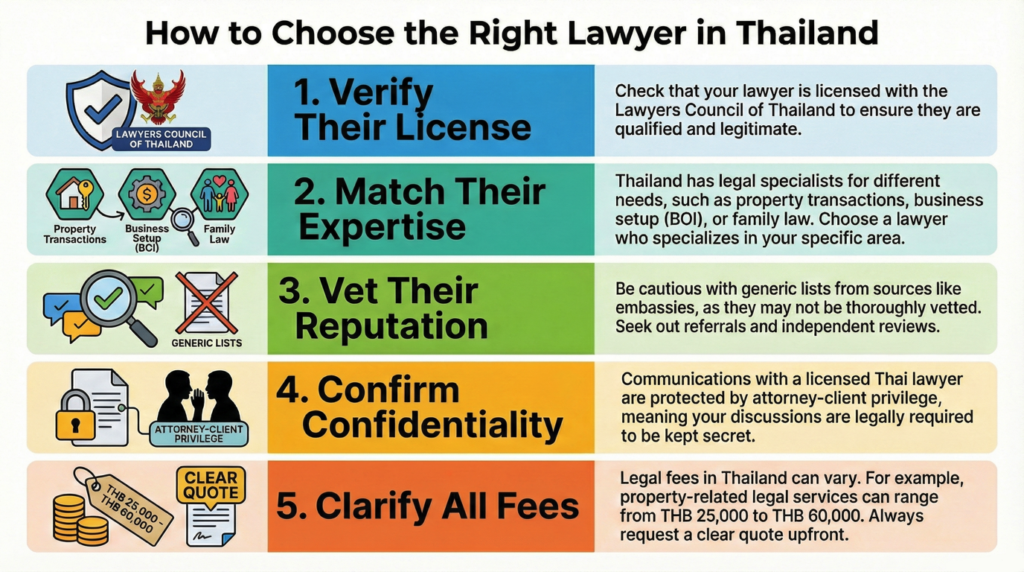
When hiring a lawyer, you must ensure they are properly qualified and aligned with your specific needs. Lawyers are not identical. You need a specialist, not a generalist and this is especially true with the recent raise of AI systems:
- Criminal Charges: Requires a defense lawyer intimate with Thai procedure.
- Property: Requires a specialist in land codes to verify title deeds and access rights.
- Cross-Border Issues: If you have issues in both your home country (e.g., the UK) and Thailand, you need a firm with international depth.
Firms like ThaiLawOnline bridge this gap with in-house experts who have backgrounds in both Western and Thai legal systems. As an example, we are specialists in Family, Criminal, Property and Corporate law. Nothing more. We do have criminal defence lawyers like Garn or JJ that are specialized in that field. But also people Thai attorneys like Khun Wichuda specialized in family law and civil litigation. As for me, I would say that I am a specialist of Thai property law. I began to use the idea of usufruct in Thailand. I also learned about superficies rights and other contracts that are not common here. Sap Ing Sith is one of them.
1.1 What Expats are looking for in a lawyer in Thailand
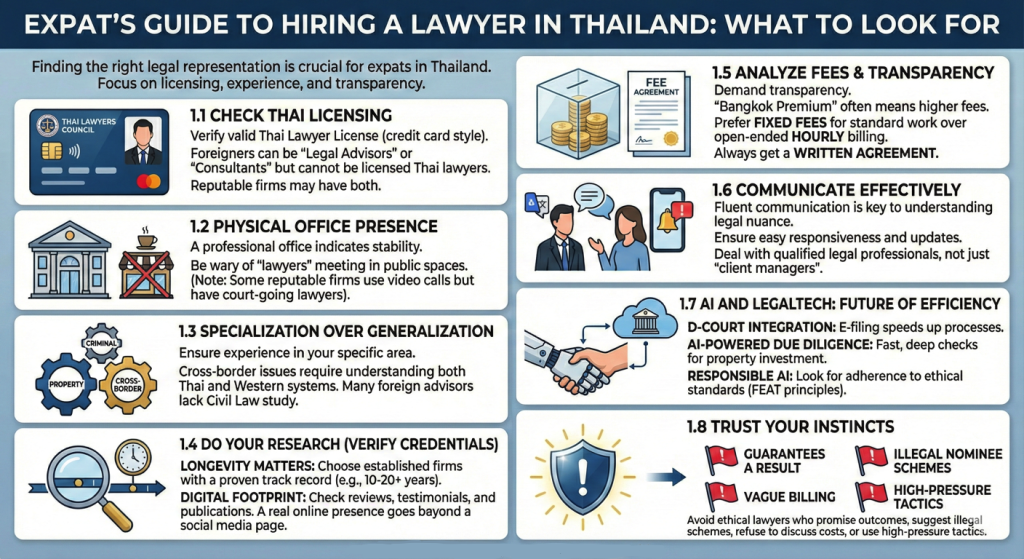
• Check Thai Licensing: A real Thai lawyer must be registered with the Lawyers Council of Thailand. They should have a valid license that looks like a credit card. Section 35(1) of the Lawyers Act B.E. 2528 requires Thai nationality of anyone registering for a licence, so a foreigner cannot hold one in Thailand. Providing legal services, including legal advice, is also work barred to foreigners outright (Ministry of Labour notification of 2020, List 1 item 27), the only exception being arbitration work where the law governing the dispute is not Thai. The same section requires a law degree the Lawyers Council accepts and membership of the Thai Bar Association. Do note that most reputable law firms do have foreigners working with them.
• Physical Office Presence: A professional office is an important indicator of dedication and stability. Be careful of “lawyers” who want to meet in coffee shops, hotel lobbies, or co-working spaces. This is a big warning sign in Thailand. Do note that ThaiLawOnline do things differently. We do have an office in Bangkok but strategically decided to meet clients only through video conference. However, our Thai lawyers go to court and meet client each week. We are also NOT new. I am the founder of Isaan Lawyers and have been managing law firms since 2006. Before that I worked for law firms in Canada, starting in 1994.
• Specialization Over Generalization: Make sure your lawyer has experience in the area you need. This could be about Criminal Law or Property Law. Another possibility is Cross-Border issues. This requires understanding both Thai and Western systems. It is even more complex as many foreign lawyers in Thailand did not study Civil Law. They cannot fully grasp a civil law system they never studied.
1.2 Do Your Research (Verify Credentials)
Never rely solely on advertisements. You must verify the reputation and track record of the firm.
- Longevity Matters: Look for a firm that has been around for many years. ThaiLawOnline, for instance, has been established since 2006. A firm with a 20-year track record offers stability that a “pop-up” visa agent cannot. The distinction matters legally as well as commercially: see what a visa agent may and may not lawfully do, and why the criminal exposure for a false document sits with the applicant. Some law firms claim they have been around for 10-15 years. However, they may have new management that lacks experience in Thai law.
- Digital Footprint: Check reviews, testimonials, and publications. Does the firm have a real presence, or just a Facebook page? Our website has about 400 deep articles about law. Not many law firms explain you Supreme Court decisions. We do it.
1.3 Analyze Fees and Transparency for Choosing a Lawyer in Thailand
Are they transparent? This is the biggest friction point for expats.
- The “Bangkok Premium”: Companies in busy areas like Bangkok and Phuket often charge much higher fees. This is true even though they provide the same quality of service as firms in other regions. But you might want to find a lawyer in Pak Kret, or a Chonburi attorney.
- Fixed Fees vs. Hourly: Avoid open-ended hourly billing. Reputable firms often provide fixed fee packages for standard work (e.g., company formation, visas). This ensures you pay for expertise, not just for “retaining” someone.
- Written Agreements: Always demand a fee agreement stating the scope of work and potential expenses clearly.
1.4 Communicate Effectively
Communication is key to a favorable outcome.
- Language Skills: You need a lawyer who speaks your language fluently. It’s not just about “English”; it’s about understanding legal nuance.
- Responsiveness: Can you reach your lawyer easily? Do they provide regular updates? You should be dealing with qualified lawyer, Attorneys, Solicitors, and Barristers, not just “client managers” with no legal knowledge.
1.5 AI and LegalTech: The Future of Efficiency
The adoption of technology is a game-changer for clients in 2026. If you believe in it or not, it doesn’t matter. You want a lawyer able to deliver results and provide you the best fees.
• D-Court Integration: Modern companies use the D-Court initiative. This includes an E-filing system for sending documents online. This reduces the need to travel and speeds up court processes.
The D-Court initiative is a digital program started by the Thai Office of the Judiciary. Its goal is to modernize the justice system in Thailand. The program aims to make the system more accessible, efficient, and user-friendly. This initiative is a key part of the “Thailand 4.0” digital economy strategy. It uses technology to offer faster and cheaper services to the public. It also helps close the digital gap in legal processes.
The program has key features like an E-filing system. This system lets people submit complaints, statements, and documents online. They do not need to go to a courthouse. It also includes advanced tools to help manage cases better. For clients, this move to a digital court system allows modern “LegalTech” firms to use AI and other tools. They can finish complex tasks, like due diligence, in hours instead of days.
• AI-Powered Due Diligence as example: Expats investing in property can now use AI tools. These tools can finish detailed checks in hours, not days. This can greatly affect your legal fees and safety. These tools are very powerful.
• Responsible AI Standards: The Bank of Thailand issued its AI Risk Management Guidelines for Financial Service Providers on 12 September 2025. They require a financial firm’s AI policy to align with recognised responsible-AI frameworks, in particular the FEAT principles: Fairness, Ethics, Accountability and Transparency. When picking a firm, ask if their AI tools follow the new ethical rules. This matters all the more because Thailand is preparing dedicated AI legislation, though none has been enacted that we can cite. For example, ThaiLawOnline has their own servers and own database. They are not shared with AI companies like OpenAI or Google.
1.6 Trust Your Instincts
Finally, trust your gut. Does the lawyer make you feel confident? Do they treat you as a partner? These are questions to ask yourself. Be cautious of any representative who exhibits the following behaviours:
• Guarantees a Result: An ethical lawyer will not promise you will win or stay out of jail. They can only give you a fair look at possible outcomes.
• Illegal Nominee Schemes: Avoid anyone who recommends using random Thai individuals to hold 51% of your company shares. This is against the law, and the government is taking action against it.
• Vague Billing: A refusal to discuss costs or provide written agreements is a sign of a “bad” lawyer.
• High-Pressure Tactics: Good lawyers know that picking a lawyer is a big choice. They will not rush you to sign right away.
2. Market Rates: The 2026 Fee Schedule for a Lawyer in Thailand
Transparency in billing is the biggest friction point for expats. Always ask for a written fee agreement. Always be sure to know the exact costs of your lawyer in Thailand. This should clearly explain the work to be done and any extra costs, like court fees or translations. Legal fees in Thailand vary wildly. Use this table as a benchmark to avoid being overcharged.
Table 1: Estimated Legal Fees in Thailand (2026)
| Service | Independent Lawyer | Boutique Firm | International Tier 1 Firm |
| Hourly Rate | 2,000-4,000 THB ThaiLawOnline is cheap at 2,000 baht. | 6,000-10,000 THB | 15,000-25,000+ THB |
| Company Registration | 20,000 THB | 40,000 THB | 100,000+ THB |
| Property Due Diligence | 10,000 THB | 30,000 THB | 80,000+ THB |
| Simple Will | 5,000 THB Last Will Only 3,900 baht with ThaiLawOnline. | 15,000 THB | 40,000+ THB |
| Notary Stamp (Per doc) | 1,000 THB We ask only 950 baht. | 2,500 THB | 5,000+ THB |
| Civil Litigation (Start) | 50,000 THB | 150,000 THB | 500,000+ THB |
> Pro Tip: Always ask if the fee includes “disbursements” (court fees, translations, transport). These are usually extra.
For property buyers, legal fees for checking the title and reviewing contracts can vary. They usually cost between THB 25,000 and THB 60,000. The cost depends on how complex the case is. We have lower price packages for properties in Thailand, due diligence and others here.
3. Frequently Asked Questions about Choosing a Lawyer in Thailand (FAQs)
Can I represent myself in a Thai court?
Theoretically yes, but practically no. All proceedings are in Thai. Without fluency in legal Thai language and procedure, you will likely lose.
What is the difference between a Barrister and a Lawyer in Thailand?
Thailand has a fused profession. A “Lawyer” holds a license from the Lawyers Council. A “Barrister” has passed an advanced exam run by the Thai Bar Association. Barristers often become judges or prosecutors later. They are very academic. Commercial lawyers may not be barristers, but they are great at business law.
Is a “Visa Agent” the same as an Immigration Lawyer?
No. Agents often use “grey” methods (like falsifying bank statements) which can get you blacklisted. A lawyer uses legal avenues to secure your long-term status.
How do I check if my lawyer is real?
Ask for their License Number and verify it with the Lawyers Council of Thailand. You can also ask to see their physical license card (it looks like a credit card)
4. Conclusion
Choosing a lawyer in Thailand is a strategic investment in your safety and success. In 2026, the best choice is a partner who combines deep local knowledge with modern AI efficiency tools. By focusing on transparency and checking credentials, you can support firms that use “Thailand 4.0” technology. This way, your voice will be heard clearly in the Kingdom’s courts.
Analogy: Think of the Thai legal system like a complex, fast-moving river. A traditional lawyer is a skilled rower who knows the currents but moves slowly. An AI-powered “LegalTech” firm is like a modern navigator with GPS. They travel the same river but get to the destination faster and more accurately.
P.S. The $500/Hour Myth
A mentor once told me back in law school: “Charge $50 an hour, and they’ll think you’re cheap. Charge $500, and they’ll think you’re the best.” That might have been true in 1994, but today, that logic is going the way of the fax machine.
Artificial Intelligence is destroying the idea that you have to pay a fortune to get good legal protection. The distinctions of price are disappearing. Now, the only distinction that matters is competence.
The best lawyer for you is no longer the most expensive one. It is someone who is creative enough to use AI to solve your problems. They rely on decades of real experience in Thai courts.
If you are looking for that specific mix of history and high-tech, you’re already in the right place.
Last reviewed: 5 September 2026. The licensing rule was read in Thai from the Lawyers Act B.E. 2528, section 35, and the AI paragraph against the instrument it describes. Eight corrections were made. Section 35(1) requires Thai nationality of anyone registering for a lawyer’s licence, which is why a foreigner can only advise, and section 35(3) requires a law degree the Lawyers Council accepts plus membership of the Thai Bar Association, which is the distinction the FAQ below draws between a lawyer and a barrister. The Bank of Thailand paragraph now names the instrument: the AI Risk Management Guidelines for Financial Service Providers, issued 12 September 2025, which require a firm’s AI policy to align with the FEAT principles rather than the Bank having authored them. The fees table, the firm history and the 950 baht notarial fee were left as written; the 950 matches our notarial services page. Three broken sentences and two typographic faults were repaired. Re-read on 4 October 2026: Lawyers Act section 35 re-read in Thai (nationality, law degree and Thai Bar membership confirmed); an unsourced 2027 date for an AI Act and a mistaken glossary link were removed.
We also list lawyers by province, including Samut Sakhon.
Thai Law Updates, free by email
Plain-English updates on Thai law changes that affect foreigners: property, visas, marriage, business and wills. One short email a month from a firm practicing since 2006. No spam, unsubscribe anytime.