


Reviewed by ThaiLawOnline, a licensed Thai law firm practising in Thailand since 2006. Thai lawyer of record: Wichuda Atthamethakon, LL.M., Thai Bar Licence 3149/2556.
Last updated on
For many expatriates and foreign nationals in Thailand, the country’s criminal justice system can feel strange. If you ever face arrest or investigation, knowing how pre-trial detention works can help protect your freedom. It could keep you from spending months in jail. This guide explains your rights under the Constitution. It also covers the legal steps involved and your options for getting released.
Last reviewed: 26 September 2026. Sections 7/1, 8, 87, 106 to 108/1, 110, 114, 117, 119, 119/2, 134/1 and 173 of the Criminal Procedure Code were read in the Thai text in our annotated Code, with section 29 of the 2017 Constitution and section 10 of the Witness Protection Act B.E. 2546. The bail amounts, detention conditions and the case examples are practice experience and reports, not law.
Table of Contents
Constitutional and Legal Foundations
Thailand’s rules on pre-trial detention come from both the Constitution and the Criminal Procedure Code. The Constitution states in Section 29 that everyone is considered innocent until proven guilty. The same section says a suspect or defendant may be held only as far as necessary to prevent escape, that every bail request must be considered, that bail may not be set excessively high, and that bail may be refused only as the law provides. These are the principles every detention procedure must follow.
The Criminal Procedure Code provides the details. Section 106 allows for provisional release at any point in the process. This can be on your own recognizance, with bail, or with bail and extra security. Sections 107 and 108 explain how to apply for bail and how the court makes its decision. Section 108/1 allows a refusal only on five grounds (flight, interference with evidence, other danger, an unreliable surety or security, or harm to the investigation or trial), and the reasons must be given in writing. Section 114 lists the three kinds of security: cash, other assets, or a person who pledges assets. Sections 106(4) and (5) say where to apply for bail during appeals.
Judges must think about how serious the crime is. They look at the strength of the evidence. They also consider the risk of the person fleeing. Judges check if the sureties are trustworthy. Lastly, they think about the chance of tampering with evidence or witnesses. Section 108 also lets the court, with the person’s consent, order an electronic monitoring device such as an ankle bracelet as a condition of release; if the device is destroyed or disabled, the person is presumed to have fled (section 117).
From Arrest to First Court Hearing, Pre-Trial Detention in Thailand
The first stage of pre-trial detention begins the moment you are arrested. Thai police can keep you in custody for up to 48 hours before a judge reviews your case (CPC Section 87). This does not include the time it takes to transport you to a police station. In those 48 hours, you have important rights. You can stay silent, ask for a lawyer, contact your family or embassy, and get medical treatment.
At the end of this time, the police must either release you or take you to a judge. The inquiry official or prosecutor applies for a custody warrant. The court asks you whether you object, and may call the police to explain why detention is needed. Judges will look at a few important factors. They will think about how serious the crime is. They will also consider how strong the evidence is. Finally, they will assess the risks to public safety and the investigation.
Investigative Detention Periods
If the court approves continued detention, you may be transferred from police cells to a remand prison. How long you can be held before criminal charges are filed depends on the severity of the alleged offense.
| Offense Type | Maximum Pre-Charge Detention | Example Offenses |
|---|---|---|
| Maximum penalty up to 6 months, or a fine up to 500 baht | 7 days, one order only | Minor offences |
| Medium (6 months, 10 years jail) | up to 48 days | Fraud, burglary |
| Maximum penalty 10 years or more | 84 days (orders of up to 12 days each; beyond 48 days only if the police or prosecutor prove the need with evidence, CPC Section 87) | Drug trafficking, serious violence |
Longer timeframes for serious cases acknowledge that these investigations can be complex. They also provide several chances for judicial review.
Rights During Detention
Even in pre-trial detention, you retain key legal rights under Thai authorities. You have the right to hire a lawyer of your choice and to meet with them privately. If the offence carries the death penalty or you are under 18, the state must provide a lawyer; for any offence punishable by imprisonment, one is provided if you ask (sections 134/1 and 173). You have the right to tell your family or embassy where you are. You can also receive visits and get medical care if you need it while waiting for your trial.
Access to court files and evidence is another important protection. Once the prosecutor has filed the case, you and your lawyer may inspect and copy the evidence filed with the court, the court file, and your own statements to the police (section 8).
Bail and Provisional Release
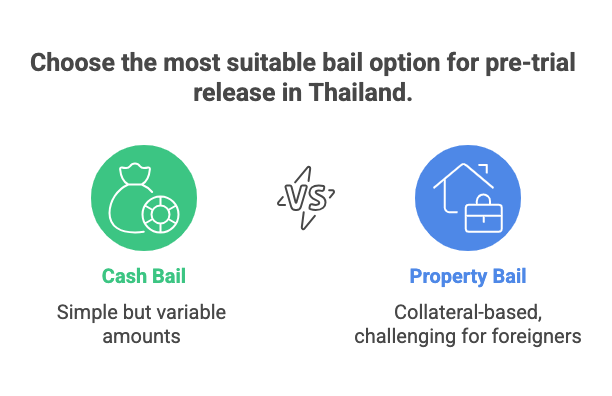
Bail is the main way to secure release before trial. In Thailand, this can be done through cash bail, property bail, or personal sureties. Cash bail is simple, but the amounts can be very different. They can be small for minor charges or over two million baht for serious crimes.
As a general guide, bail for minor cases often ranges from 50,000 to 500,000 THB, while serious cases can run into the millions. Note that foreigners often need higher bail due to flight risk perceptions. Property bail means using real estate or other assets as collateral for bail in Thailand. This can be hard for foreign nationals due to rules on land ownership. In politically sensitive cases such as lèse-majesté, bail is often refused or set high. Personal surety bail relies on a trusted person who guarantees you will follow bail conditions.
Courts consider many factors when deciding on bail. They look at how serious the charges are. They also think about whether you might flee. Lastly, they check if public safety could be at risk. Foreign nationals are often required to surrender their passports and may face travel restrictions.
How to Apply for Bail in Thailand, A Step-by-Step Guide
If you’re facing pre-trial detention, applying for bail promptly can make all the difference. Here’s a simple step-by-step guide based on the Criminal Procedure Code (Sections 107-108):
- Prepare Your Application: Work with a Thai lawyer to file a bail petition at the court handling your case. Include details like the charges, your personal circumstances, and any sureties or collateral. You might also need witnesses, a Thai guarantor and more. Read our article on bail in Thailand for more information.
- Submit Supporting Documents: Provide evidence of ties to Thailand (e.g., job, family, or property). For expats, include embassy letters or proof of legal residence.
- Attend the Hearing: The court reviews your application quickly, often within days. Be prepared to address flight risk or public safety concerns.
- Post-Approval Compliance: If granted, follow conditions strictly to avoid arrest and enforcement of the bail bond (sections 117 and 119).
Remember, expats often benefit from professional help to navigate language barriers. At ThaiLawOnline, we’ve secured bail for clients in under 48 hours, contact us for tailored support.
Conditional Release and Electronic Monitoring
Not all release options require money or property. Electronic monitoring, often with GPS ankle bracelets, helps courts track defendants awaiting trial. This lets them live in the community. Conditions might include curfews, avoiding certain places, reporting to authorities regularly, or staying away from witnesses.
Appeals and Higher Court Review
If your bail request is denied, the reasons must be given to you in writing (section 108/1), and you can appeal to a higher court. These appeals are often handled quickly because they involve someone’s liberty. A refusal by the court of first instance goes to the Court of Appeal, and a refusal by the Court of Appeal to the Supreme Court; once the Court of Appeal upholds a refusal that route ends, but a fresh application can always be made (section 119/2). New evidence, stronger sureties, or changes in circumstances can improve your chances.
Special Challenges for Foreign Nationals
Foreigners face additional hurdles. Court proceedings are in Thai, and although interpreters are available, the quality can vary. Cultural differences may also affect how you are perceived in court. Surrendering your passport is normal for foreign defendants. It can be hard to find local sureties if you lack family or strong ties in Thailand.
Legal Aid and Financial Support
The Ministry of Justice’s guidelines on bail in Thailand are essential for understanding your rights. Justice Fund can help with bail and legal fees for those who cannot afford them. NGOs and human rights organizations also assist in certain cases, especially those involving vulnerable defendants or political issues. However, court-appointed lawyers may have limited time or resources, so private legal representation is often advisable when possible.
Detention Conditions
Pre-trial detention facilities in Thailand often face overcrowding and limited medical services. Bangkok Remand Prison is part of the Klong Prem complex. It is the main facility for cases in Bangkok. International observers have criticized its conditions. Visits are allowed but must follow strict schedules and procedures set by the prison, which is run by the Department of Corrections. Conditions vary by facility (e.g., better in some provincial prisons).
Witness Protection
The Witness Protection Act offers security measures for witnesses and their families, including relocation, identity changes, and safe housing. (Witness Protection Act B.E. 2546, section 10).
Recent Developments and Reforms
Thailand is working on a better way to handle pre-trial detention. They are using more electronic monitoring. They also focus on the presumption of innocence for minor or first-time offenders facing a criminal charge. These changes aim to reduce unnecessary detention while keeping the public safe.
Real-Life Examples of Pre-Trial Detention in Thailand
At ThaiLawOnline, we have handled many bail applications for foreign nationals facing criminal charges in Thailand. Around 2012, we assisted a Canadian accused of murder and detained near Bangkok. His first bail request was denied. However, we appealed and got his release after about two weeks in jail. Because the charge was extremely serious, the court required extensive documentation and evidence to prove exceptional circumstances.
In another case in Nakhon Ratchasima, an American client was facing charges in a military court. This client was accused of having weapons of war. At first, they were also denied bail. This type of charge is rare and subject to strict scrutiny, but we navigated the process to protect his rights.
More recently, in 2024, we obtained bail for a foreigner in Roi Et accused of trespassing and assault. This case was different from more serious allegations. It needed proof that the accused was not a danger to society. The accused also had to show they had no prior criminal record and enough local support.
These cases show that bail can often be secured for most offenses. This is true when you have strong guarantees. These guarantees include a Thai guarantor, a clean criminal history, and proof of stable ties. However, it is important to have skilled legal help. This is especially true for foreigners who do not know the Thai system. Acting quickly and having experienced lawyers by your side can make all the difference.
Frequently Asked Questions about Pre-Trial Detention in Thailand
How does the bail process work in Thailand?
In Thailand, the bail process lets a detainee leave pre-trial detention while awaiting trial. They can do this by paying a set amount of money. This money guarantees that they will appear in court. A bail application can be sent to the court. The court will look at different factors. These include the type of crime, the risk of fleeing, and the possible danger to public safety. If granted bail, the detainee may be required to comply with specific conditions.
What are the human rights implications of pre-trial detention in Thailand?
The pre-trial detention system in Thailand has raised concerns about human rights violations. This is especially true for arbitrary detention and the conditions in detention facilities. International human rights groups, like Amnesty International, have pointed out problems. These include long detention without trial, no access to legal help, and overcrowded prisons. These issues may go against international standards.
How long can someone be held in pre-trial detention in Thailand?
In Thailand, the duration for which an individual can be held in pre-trial detention varies. The law usually allows detention for up to 7 days for minor offenses. However, for serious crimes, a person may be held longer. Before charges are filed, the court can authorise at most 7, 48 or 84 days depending on the maximum penalty (section 87 of the Criminal Procedure Code). Once the case is filed, detention can continue until the trial ends unless bail is granted. Prolonged detention can be a significant issue, often leading to concerns about the detainee’s rights and welfare.
What happens if bail is denied in Thailand?
First, you can appeal this decision or make a new request later. If bail is denied in Thailand, the detainee remains in pre-trial detention until their case is resolved in court. The court can deny bail if the crime is serious, if the person might flee, or if releasing them could harm the public. In such cases, the detainee may have to wait for the trial to commence before being released.
What are the conditions like for pre-trial detainees in Thai prisons?
Conditions for pre-trial detainees in Thai prisons can be challenging. Many facilities experience overcrowding, which can lead to inadequate living conditions, limited access to healthcare, and insufficient resources. These issues have raised concerns about how detainees are treated. They also question how well the Thai criminal justice system follows international human rights standards.
Can a detainee access legal counsel during pre-trial detention in Thailand?
Yes, detainees in Thailand have the right to access legal counsel during pre-trial detention. However, access may be limited in practice, and some detainees may experience difficulties in obtaining timely legal representation. Detainees need legal support to understand the Thai legal system. This helps protect their rights during the judicial process.
What role do Thai lawyers for human rights play in pre-trial detention cases?
Thai lawyers for human rights are important in fighting for the rights of people in pre-trial detention. They provide legal help. They challenge illegal detention. They ensure that detainees are treated according to Thai law and international human rights rules. Their efforts contribute to raising awareness about the issues within the Thai criminal justice system and promoting necessary reforms.
Final Thoughts
Release from pre-trial detention in Thailand is a relief, but it’s just the start. You may need to comply with conditions like regular check-ins or travel bans. Expats should notify their embassy and consider immigration status updates under the Immigration Act. Focus on mental health, detention can be traumatic, so seek counseling if needed. Finally, prepare for trial by gathering evidence and witnesses. Our team at ThaiLawOnline can guide you through this phase, ensuring you’re ready for court.
ThaiLawOnline has 20 years of experience helping clients across Thailand in criminal matters. We can assess your situation, prepare a solid bail application, and protect your rights every step of the way. Contact us now for a confidential consultation, because in these situations, time is not on your side.
Thai Law Updates, free by email
Plain-English updates on Thai law changes that affect foreigners: property, visas, marriage, business and wills. One short email a month from a firm practicing since 2006. No spam, unsubscribe anytime.