


Reviewed by ThaiLawOnline, a licensed Thai law firm practising in Thailand since 2006. Thai lawyer of record: Wichuda Atthamethakon, LL.M., Thai Bar Licence 3149/2556.
Last updated on
Update, 13 September 2026. Use the current checklist of the Thai embassy or consulate responsible for your application. Residence evidence, bank history, police certificates and payable fees differ between missions. See the London checklist and Washington checklist.
This is our main DTV rules and eligibility page. Use it for current eligibility, the 500,000 THB financial test, stay limits and 2026 rule changes. For document preparation and filing steps, see our DTV application guide.
The Destination Thailand Visa (DTV visa Thailand) gives remote workers, freelancers, digital nomads, Muay Thai students, and medical patients a five-year, multiple-entry base in Thailand with a THB 10,000 base fee, payable at the deciding mission’s published local rate. Since its launch in July 2024 it has become the most requested long-stay visa our firm handles, Chinese applicants call it “泰国dtv签证.” It has also become harder to get. Common preparation problems include unclear financial history, incomplete work evidence and activity documents that do not meet the mission’s checklist. This guide explains the 2026 rules as they stand now after the modifications of 31st August 2026, what changed, and the tax consequence that surprises almost every DTV holder who stays past 180 days.
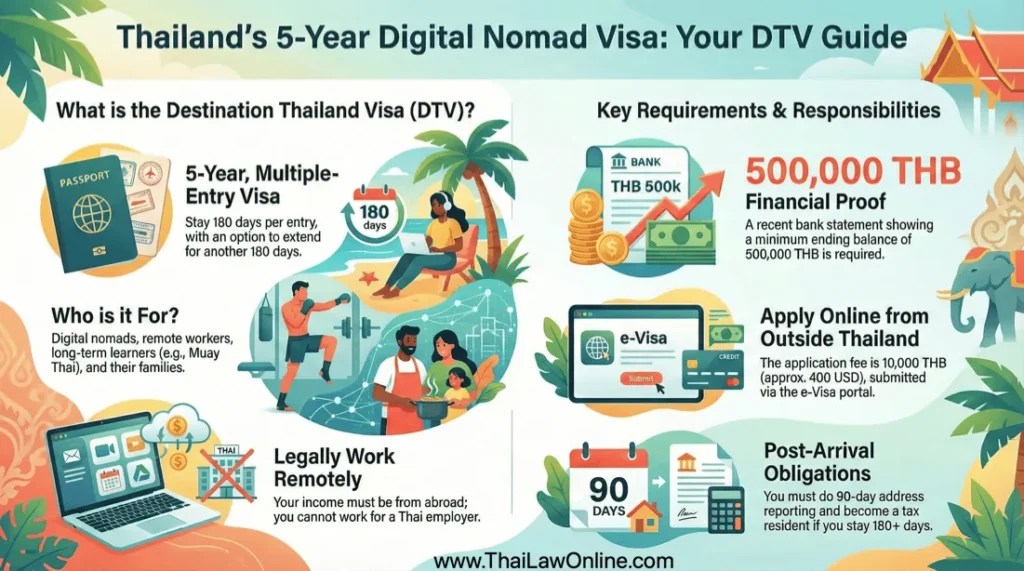
Table of Contents
What the Destination Thailand Visa (DTV) Is and Where It Comes From
The Thai Cabinet approved the DTV on 28 May 2024, and the Ministry of Foreign Affairs opened applications on 15 July 2024. The visa operates under the Immigration Act B.E. 2522 (1979), the framework statute that governs every entry category, with the DTV created by Cabinet resolution and implemented by the Ministry of Foreign Affairs rather than by a new act of parliament. That matters in practice: the government can tighten or relax DTV conditions without going through the legislature, and it has already done so more than once. Unlike an extension based on a Thai spouse or a retirement extension, the DTV is issued abroad and needs no annual renewal.
The core terms have stayed stable since launch:
- Validity: 5 years, multiple entry (no re-entry permit needed).
- Stay per entry: 180 days, stamped on arrival.
- Extension: one extension of 180 days per entry, filed at a local immigration office for 1,900 THB, up to 360 consecutive days.
- Fee: THB 10,000 base reference; pay the deciding mission’s published local fee.
- Where to apply: outside Thailand, through the official e-Visa portal at thaievisa.go.th. Since 31 August 2026 the deciding mission must be the one covering a country where you are a national or a permanent resident. You cannot convert a tourist entry into a DTV inside Thailand.
New Rule From 31 August 2026: Apply From Your Home Country or Country of Residence
The rule is a mission notice, not a Royal Gazette instrument. There is no single central announcement: each Thai embassy and consulate published it on its own site. The Royal Thai Embassy in Vientiane states it in full on its visa application page, updated 28 August 2026: new additional requirements for DTV applications take effect worldwide from 31 August 2026, under which an applicant must be a national or permanent resident of the country where the application is submitted, and must provide a certificate of criminal record clearance issued by the authorities of either their country of nationality or the country where the application is submitted. The Royal Thai Consulate-General in Los Angeles publishes the same effective date under the heading New Requirement for DTV. We read both on 15 September 2026.
If you filed and paid before 31 August 2026, the new requirements do not reach you. The Vientiane notice says applicants whose applications have been submitted and whose visa payment has been completed prior to 31 August 2026 are not affected. Submission on its own is not enough: the fee has to have been paid.
The third-country application is closed. A DTV filed in Vientiane must now come from a Lao national or a permanent resident of Laos, which that notice says in terms, and the same logic applies at every post. What differs is the paperwork each mission accepts as residence evidence, and some of it falls short of permanent residence: Los Angeles lists a valid driving licence, a valid U.S. visa or a Permanent Resident Card; London requires proof of permanent residence in the UK, Ireland or the British Overseas Territories, such as indefinite leave to remain; Ho Chi Minh City accepts only a Vietnamese Temporary or Permanent Residence Card and refuses a temporary residence declaration in terms. Read the checklist of the mission that will decide your file, not a general summary of the rule.
The criminal record certificate is now required everywhere, not a local extra at some posts. Its accepted issuer and maximum age are set by the mission: London specifies a certificate issued within six months, such as an ACRO certificate; Washington and Los Angeles specify an FBI certificate issued within three months; Ho Chi Minh City specifies Vietnamese Criminal Record Certificate No. 2, or one from your country of nationality. The core visa is unchanged: five years, multiple entry, 180 days per entry, extendable once by up to 180 days subject to approval.
Mission checklists compared (read 14 September 2026)
The table below is what each mission actually publishes, not a merged checklist. An application that satisfies the e-Visa prompts can still fail the local screening, and a police certificate can expire while the rest of the file is being assembled, so select the mission first and quote its requirements, not a generic list.
| Mission (page date) | Fee | Residence evidence | Criminal record certificate | Bank statements | Other |
|---|---|---|---|---|---|
| London (updated 8 Sep 2026) | GBP 300 | Proof of permanent residence in the UK, Ireland or a British Overseas Territory (for example indefinite leave to remain); a document showing current location is no longer accepted on its own | Issued within 6 months (ACRO or Irish police certificate) | Evidence of no less than GBP 12,000 (500,000 THB); no statement period stated | Non-UK citizens add a BRP or UKVI settlement letter and a letter from a UK or Irish employer |
| Washington D.C. (updated 10 Sep 2026) | USD 400 | Two items: a document indicating current location (driving licence, bank statement or proof of stay) and proof of permanent residence (valid U.S. visa or Permanent Resident Card) | FBI certificate issued within 3 months; minors under 16 may use the main sponsor’s certificate | Savings or checking statements for the last three months, each with an ending balance of no less than 500,000 THB (USD 16,000) | Family category uses the same list; under-20s add birth and custody documents |
| Helsinki (updated 26 Aug 2026) | EUR 350 | Document indicating current location; non-Finnish and non-Estonian citizens add a valid residence permit card | From Finland or Estonia | Ending balance of no less than 500,000 THB (EUR 15,000) | Accommodation booking of at least 7 days for the first visit |
| Ho Chi Minh City (undated) | USD 340 | Only a Vietnamese Temporary Residence Card or Permanent Residence Card; temporary residence declarations (NA17, CT07) refused in terms | Vietnamese Criminal Record Certificate No. 2, or one from the country of nationality | 500,000 THB equivalent | Consulate covers southern Vietnam only |
| Vientiane (updated 28 Aug 2026) | 10,000 THB in cash | Lao national or permanent resident of Laos | From the country of nationality or from Laos | 500,000 THB equivalent | Carries the worldwide 31 August 2026 notice in full |
Two practical consequences follow. First, the balance test differs: Washington wants three monthly statements each ending above the threshold, London states no period, so a single seasoned balance that passes in London may fail in Washington. Second, the certificate clock starts at issue: order the police certificate last, after the statements and residence documents are in hand, and record its issue date against the mission’s maximum age. Pages change without notice; the dates in the first column are the update dates shown on each mission’s page when we read it.
Thailand Digital Nomad Visa (DTV) Overview
| Feature | Details |
|---|---|
| Visa name | Destination Thailand Visa (DTV), Thailand’s digital nomad visa |
| Who can apply | Remote workers, freelancers, online entrepreneurs aged 20+; soft-power students; medical patients. Under-20s apply as dependents. |
| Validity | 5 years, multiple entry |
| Stay per entry | 180 days, extendable once to 360 days per entry |
| Work permit | The DTV cannot support a Thai work permit. Its workcation purpose covers remote work for foreign employers and clients, but the work-permit law contains no express exemption for it (see below) |
| Financial proof | 500,000 THB or the mission’s stated local equivalent. The statement period is mission practice, not a published rule: Washington asks for three months of statements each ending at no less than 500,000 THB; London asks for evidence of no less than £12,000 and states no period at all. |
| Application | Online via the Thai e-Visa portal, at the mission covering a country where you are a national or a permanent resident (mission notices, worldwide from 31 August 2026) |
| Fee | 10,000 THB reference rate, charged by each mission in local currency: £300 in London, USD 400 in Washington, 10,000 baht in cash in Vientiane. Extension of stay 1,900 THB at a Thai immigration office. |
| Best for | Digital nomads, remote employees, online consultants, long-stay visitors |
DTV Categories and Supporting Evidence
Use the three application groups shown by the responsible mission: workcation; soft-power activities including medical treatment; and dependants. Medical treatment is described separately below to explain its evidence requirements, not as a fourth universal application category.
1. Workcation (remote workers and freelancers)
For employees of foreign companies and freelancers whose clients sit outside Thailand. You must show an employment contract or client contracts, plus evidence the employer or clients are foreign entities. Digital professionals with a portfolio (developers, designers, consultants) pass review more smoothly than applicants who simply describe themselves as “freelancers.” Vague freelance documentation is one of the top rejection grounds in 2026, see our legal guide for digital nomads in Thailand.
2. Thai Soft Power
For applicants enrolled in a qualifying Thai activity: Muay Thai camps, accredited culinary schools, sports training, seminars, and similar programs. ThaiLawOnline has a partnership with a Muay Thai gym in Phuket and can provide the enrollment paperwork if you wish. Two changes bite in 2026. First, Thai language schools no longer appear among the soft-power examples on any mission checklist we have read, although they were a popular route in 2024 and early 2025, and applications based on them are reported to be refused. No published instrument removed them, so this is mission practice; if your purpose is studying Thai, use the Non-Immigrant ED student visa instead). Second, embassies scrutinize program duration and the provider’s registration: obtain a formal provider letter covering the activity, duration, schedule and fees; neither a course’s length nor registration guarantees visa approval.
Medical Treatment within the Activity Category
For patients receiving extended treatment at licensed Thai hospitals or clinics. You need a confirmation letter from the treating institution and evidence of the treatment plan. Wellness programs at licensed providers can qualify, but the closer the file sits to documented medical care, the safer it is.
3. Dependents
The legal spouse and unmarried children under 20 of a DTV holder apply separately in this category, and only after the principal holds the visa (each paying the 10,000 THB fee). Marriage and birth certificates need legalization, and mismatched names between documents cause preventable rejections. See our guide to spouse and dependent visas in Thailand for the documentation standard Thai authorities expect.
The 500,000 THB Rule: Seasoning Is Now the Battleground
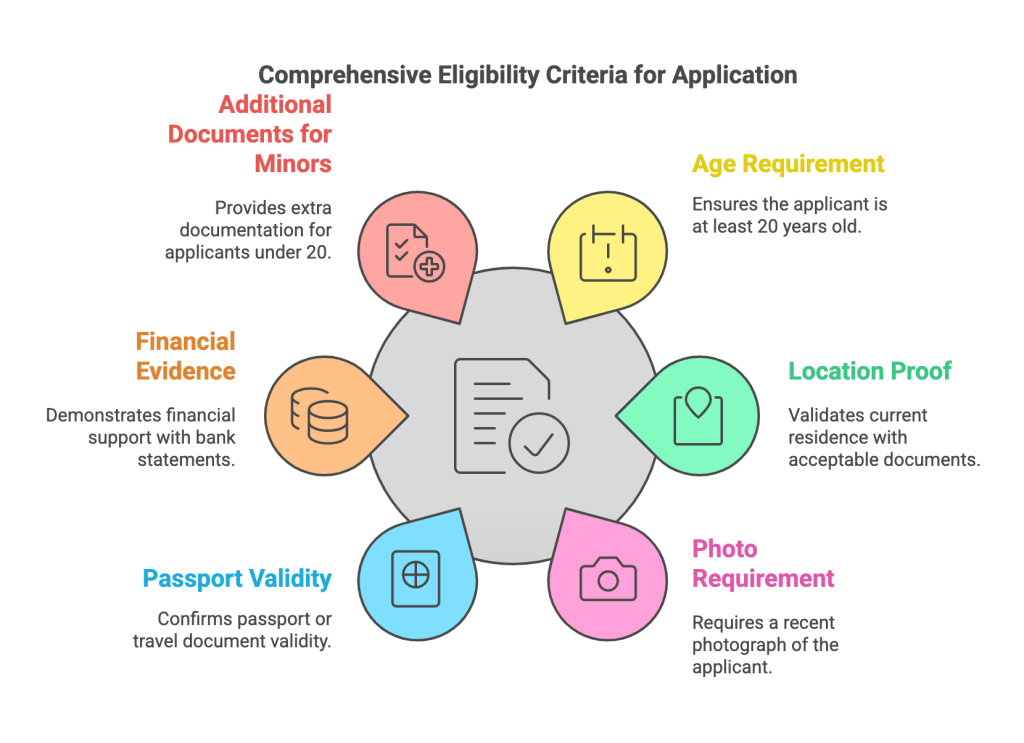
Every applicant must show liquid funds of at least 500,000 THB (about USD 15,000) or the foreign-currency equivalent. The published requirement sounds simple. The enforcement is where applications die.
Show financial evidence meeting the deciding mission’s THB 500,000-equivalent requirement. Prepare a clear funds history and explain unusual deposits. The required statement period and acceptance of joint, sponsored or family accounts depend on the mission; a recent deposit is not a published universal ground for automatic refusal. A spouse and children under 20 apply separately as dependants, with the principal holder’s DTV and evidence of relationship. Follow the mission’s financial and supporting-document checklist for each family member. Do not assume every child needs a separate personal account containing THB 500,000.
Keep the money in place through the decision. Some posts request an updated statement during processing, and immigration offices ask for fresh statements again at extension time.
How Long Can You Stay: the 180-Day Mechanics
Each arrival stamps 180 days. Before that period ends, you may file one extension of 180 days at your local immigration office for 1,900 THB, taking a single entry to 360 days. After that, you leave Thailand and re-enter on the same visa for a fresh 180-day stamp. The visa allows unlimited entries during its five-year validity, so a border run resets the clock, and remember the 90-day report and TM30 obligations still apply while you are in the country.
Extensions look routine on paper. In practice, immigration offices exercise discretion. Offices in Bangkok, Chiang Mai, and Phuket have asked DTV holders for updated bank statements, proof of ongoing remote work, and lease agreements before granting the second 180 days. Bring the same file you used for the visa, refreshed. An extension is a request, not an entitlement, and the officer decides under the Immigration Act.
What You Can and Cannot Do on a DTV
The DTV permits remote work for foreign employers and foreign clients. It does not permit work for Thai companies or Thai clients, and it cannot support a Thai work permit under the Emergency Decree on Foreign Workers Management B.E. 2560 (2017). Be clear about what that rests on. Section 5 of the Emergency Decree on Managing the Work of Aliens, as amended in 2018, defines work as engaging in any occupation whether or not there is an employer, and the decree makes no exception for DTV holders. So remote work for a foreign employer rests on the visa’s stated purpose, not on a statutory exemption, and the employer’s location is not itself the legal test. What is clear is the other side of the line: the same developer invoicing a Bangkok startup breaks the DTV condition, risks visa revocation, and exposes the Thai company to penalties for employing a foreigner without a permit.
If you want to work for Thai businesses, you need a different status: a Non-B visa with a work permit, or in some cases the LTR visa with its digital work permit. Our Thai visa finder maps which category fits your situation.
The Tax Trap: 180 Days Makes You a Thai Tax Resident
The DTV is not a work visa, and many holders assume that a visitor visa means no Thai tax. The Revenue Code does not care what your visa is called. Section 41 has three paragraphs and they do different jobs. Paragraph three is the residency test: a person present in Thailand for one or more periods totalling 180 days or more in a tax year is treated as a resident of Thailand for that year, and for an individual the tax year is the calendar year. Paragraph two is the rule that then bites: a resident who derives assessable income from employment or business carried on abroad, or from property situated abroad, pays Thai tax on it upon bringing it into Thailand. Paragraph one is separate again, and taxes Thai-sourced income whether or not it is paid in Thailand.
Since 1 January 2024, under Departmental Instruction Por. 161/2566, which the Revenue Department annotates onto that second paragraph, Thai tax residents owe Thai personal income tax on foreign-sourced income they remit to Thailand, whatever year they earned it. Por. 162/2566 carves out income earned before 1 January 2024, which you can still remit tax-free. The practical consequences for a DTV holder:
- Stay 179 days or fewer in a calendar year and you are not a tax resident. Thailand taxes only your Thai-sourced income, and remitted foreign income stays outside the net.
- Stay 180 days or more (one full entry plus a short return trip will do it) and you are a tax resident for that year. Salary, freelance income, dividends, or savings earned after 2023 and brought into Thailand become assessable income, subject to progressive rates up to 35%, with credits available under Thailand’s double-tax treaties.
- The count runs on the calendar year, 1 January to 31 December, and aggregates all days across all entries. The visa clock and the tax clock run on different calendars.
A relaxation is on the table, but not yet law. In 2025 the Revenue Department drafted an amendment that would exempt foreign income remitted within the year it is earned or the following year (a two-year grace period). As of mid-2026 that draft has not been enacted and remains pending Cabinet and Council of State approval, so the strict Por. 161/2566 remittance rule still governs. Treat the exemption as a hoped-for change, not a plan. We keep this under review on our Thailand remittance tax status tracker, which records what has and has not reached the Royal Gazette.
Note the contrast with the LTR visa: Royal Decree No. 743 B.E. 2565 exempts LTR “Wealthy Global Citizen,” “Wealthy Pensioner,” and “Work-from-Thailand Professional” holders from tax on remitted foreign income. The DTV carries no such exemption. Nomads who qualify for both should price this difference into the choice: for a high earner, the LTR’s tax shield can outweigh its higher entry requirements. A tax adviser should review your position before you cross 180 days, not after.
Applying for the DTV in 2026: Step by Step
- Choose the category and assemble the evidence for that category alone: employment or client contracts (workcation), an acceptance letter from a registered provider (soft power), or a hospital confirmation (medical).
- Prepare financial evidence. Show financial evidence meeting the deciding mission’s THB 500,000-equivalent requirement. Prepare a clear funds history and explain unusual deposits. The required statement period and acceptance of joint, sponsored or family accounts depend on the mission; a recent deposit is not a published universal ground for automatic refusal.
- File through the official e-Visa portal. Apply from outside Thailand, at the mission covering a country where you are a national or a permanent resident, with the residence evidence that mission accepts. A short visit to a neighbouring country no longer establishes eligibility. Order the criminal record certificate to the deciding mission’s specification and check its maximum age first: London specifies six months, Washington and Los Angeles an FBI certificate within three months.
- Meet the two requirements that took effect on 31 August 2026. File at the mission covering a country where you are a national or a permanent resident, and include a certificate of criminal record clearance issued by your country of nationality or by the country where you apply. See our guides to the police clearance certificate and to what counts as a criminal record. Applications submitted and paid before 31 August 2026 are decided under the old rules.
- Pay the 10,000 THB fee in local currency. The fee is non-refundable on rejection.
- Wait for processing. Most posts decide within 5 to 15 business days; some ask follow-up questions or request updated statements.
- Enter Thailand and receive the 180-day stamp. Calendar your extension or exit date immediately.
Common Pitfalls
- Incomplete financial evidence. Check the statement period and balance required by the deciding mission.
- Applying under soft power with a language school. Accepted in 2024; no mission lists it now, and such applications are reported to be refused.
- Thin freelance files. “I am a freelancer” without contracts, invoices, or a portfolio fails. Show foreign clients on paper.
- Assuming the extension is automatic. Offices ask for updated statements and proof of ongoing activity. Keep your file current.
- Ignoring the 180-day tax line. The visa lets you stay 360 days straight, but your tax exposure changes at day 180 of the calendar year. Plan the calendar, not just the visa.
- Working for Thai clients. Revocation risk for you, penalties for the Thai business. Route Thai-sourced work through a proper work-permit structure first.
Frequently Asked Questions
What is the DTV visa Thailand?
The Destination Thailand Visa (DTV) is a five-year, multiple-entry visa for remote workers, freelancers, digital nomads, and participants in qualifying Thai activities such as Muay Thai or cooking courses, or medical treatment. Each entry allows a 180-day stay, extendable once to 360 days.
How much money do I need for the DTV visa in 2026?
Show financial evidence meeting the deciding mission’s THB 500,000-equivalent requirement. Prepare a clear funds history and explain unusual deposits. The required statement period and acceptance of joint, sponsored or family accounts depend on the mission; a recent deposit is not a published universal ground for automatic refusal. A spouse and children under 20 apply separately as dependants, with the principal holder’s DTV and evidence of relationship. Follow the mission’s financial and supporting-document checklist for each family member. Do not assume every child needs a separate personal account containing THB 500,000.
Can I apply for the DTV inside Thailand?
No. The DTV is issued only outside Thailand, and a tourist entry cannot be converted into one at an immigration office. Since 31 August 2026 you must also file at the mission covering a country where you are a national or a permanent resident, so the nearest embassy to where you happen to be is not necessarily the one that can decide your file. The missions differ on what they accept as residence evidence, so read the checklist of the one that will decide yours.
Can I apply for the DTV in Laos or another third country?
No, unless you are a national or a permanent resident of that country. Since 31 August 2026 a Thai mission accepts a DTV application only from a national or permanent resident of the country where it is submitted, and requires a certificate of criminal record clearance issued by your country of nationality or by that country. The Royal Thai Embassy in Vientiane, which published the notice on 28 August 2026, says a DTV filed there must now come from a Lao national or a permanent resident of Laos. Applications submitted and paid before 31 August 2026 are decided under the old rules.
Do I need a police clearance certificate for the DTV?
Yes. Since 31 August 2026 a certificate of criminal record clearance is required at every mission, issued by the authorities of your country of nationality or of the country where you apply. The maximum age is set by the mission: London specifies six months, for example an ACRO certificate; Washington and Los Angeles specify an FBI certificate issued within three months; Ho Chi Minh City specifies Vietnamese Criminal Record Certificate No. 2. Check the deciding mission before you order one.
How long can I stay in Thailand on a DTV?
180 days per entry, extendable once per entry for 1,900 THB to a maximum of 360 consecutive days. The visa is multiple-entry for five years, so leaving and re-entering resets the 180-day stamp.
Do DTV holders pay Thai tax?
If you stay 180 days or more in a calendar year, you become a Thai tax resident under Section 41 paragraph three of the Revenue Code, and under paragraph two the foreign income you remit to Thailand becomes taxable (income earned before 2024 stays exempt under Por. 162/2566). Stay under 180 days in the calendar year and Thailand taxes only your Thai-sourced income. A proposed two-year exemption remains draft-only as of 2026, confirm the current rule before filing.
Can I work for a Thai company on a DTV?
No. The DTV covers remote work for foreign employers and clients only. Working for a Thai employer requires a work permit, which the DTV cannot support.
Do language schools still qualify for the DTV?
Not in practice. No mission checklist now lists Thai language study among the soft-power activities, applications based on it are reported to be refused, and no published instrument sets this out; study-Thai applicants should use the ED visa. Muay Thai camps, accredited culinary programs, sports training, and medical or wellness programs at registered providers continue to qualify.
Can my family join me on a DTV?
Yes. Your legal spouse and unmarried children under 20 apply as dependents after your visa is approved, each paying the 10,000 THB fee with legalized relationship documents.
Ready to Start Your New Chapter in Thailand?
The DTV remains the best-value long-stay visa Thailand has offered in years: five years of access, 360-day stays, and a 10,000 THB price. The 2026 reality is a stricter gate. Meet the deciding mission’s financial standard, document your category with primary evidence, and treat the 180-day tax residency line as seriously as the visa rules themselves.
ThaiLawOnline has guided foreigners through Thai immigration and tax questions since 2006. If you want your DTV file reviewed before you pay a non-refundable fee, or your stay planned around the tax residency line, get a consultation today, we deduct the consultation fee from your DTV legal fees. Compare alternatives on our Thailand Privilege Visa and LTR visa guides, or start with the Thai visa finder.
Last reviewed: 21 September 2026. Read end to end. The 31 August 2026 rule is sourced to the Royal Thai Embassy Vientiane notice of 28 August 2026 and the Royal Thai Consulate-General Los Angeles visa information page. The mission table was checked against the published checklists of London, Washington, Helsinki (re-read 21 September 2026), Ho Chi Minh City and Vientiane. Section 41 of the Revenue Code and Departmental Instructions Por. 161/2566 and 162/2566 were checked against the Revenue Department register. The Cabinet approval of 28 May 2024 is corroborated. Royal Decree No. 743 on the LTR exemption was not re-read in this review. The removal of Thai language schools is reported practice, not a published rule, and is described as such. Requirements vary by mission; use the checklist applicable to your application.
Official Links
- Royal Thai Embassy, Washington D.C., DTV page
- Royal Thai Embassy, Vientiane, visa application page, which carries the 31 August 2026 DTV notice in full (updated 28 August 2026)
- Royal Thai Consulate-General, Los Angeles, visa information, which publishes the same 31 August 2026 effective date
- Royal Thai Embassy, Vientiane, DTV page (document list, last updated 17 July 2024)
- Royal Thai Embassy, London, DTV page (new residence and police clearance requirements)
- Royal Thai Embassy, Helsinki, DTV page (updated 26 August 2026; EUR 350 fee, criminal record certificate from Finland or Estonia, 7-day accommodation booking)
- Royal Thai Consulate-General, Ho Chi Minh City, DTV page (USD 340 fee; Vietnamese residence cards only)
- Thailand e-Visa portal, official DTV page (Ministry of Foreign Affairs)
Try it yourself first, free
You do not have to book anything to get started. These run in your browser, and you only pay us if you decide you want a lawyer involved.
Thai Visa Finder Free
Answer a few questions and see which Thai visa actually fits your situation.
Open the toolAsk our AI assistant Free
Trained on Thai law and 84,000+ Supreme Court decisions. Ask anything, free.
Thai Law Updates, free by email
Plain-English updates on Thai law changes that affect foreigners: property, visas, marriage, business and wills. One short email a month from a firm practicing since 2006. No spam, unsubscribe anytime.