


Reviewed by ThaiLawOnline, a licensed Thai law firm practising in Thailand since 2006. Thai lawyer of record: Wichuda Atthamethakon, LL.M., Thai Bar Licence 3149/2556.
Last updated on September 5, 2026
We know this page is long, It’s intentional
TL;DR: Thailand’s Pink ID card is a small identity card. District offices give it to long-term foreign residents. You need a Thai 13-digit ID number to get one. This number is usually given after your name is added to a yellow house-book. For a one-time fee of 60 baht you get a card that’s valid for 10 years (or for life if your card has not expired by the time you turn 70). It works for most daily tasks like domestic flights, hotel check-ins, banking, and getting SIM cards. This means you can keep your passport in a safe place. However, it does not remove immigration duties like the 90-day reporting requirement. We explain below “what is a pink card” and how to get it.
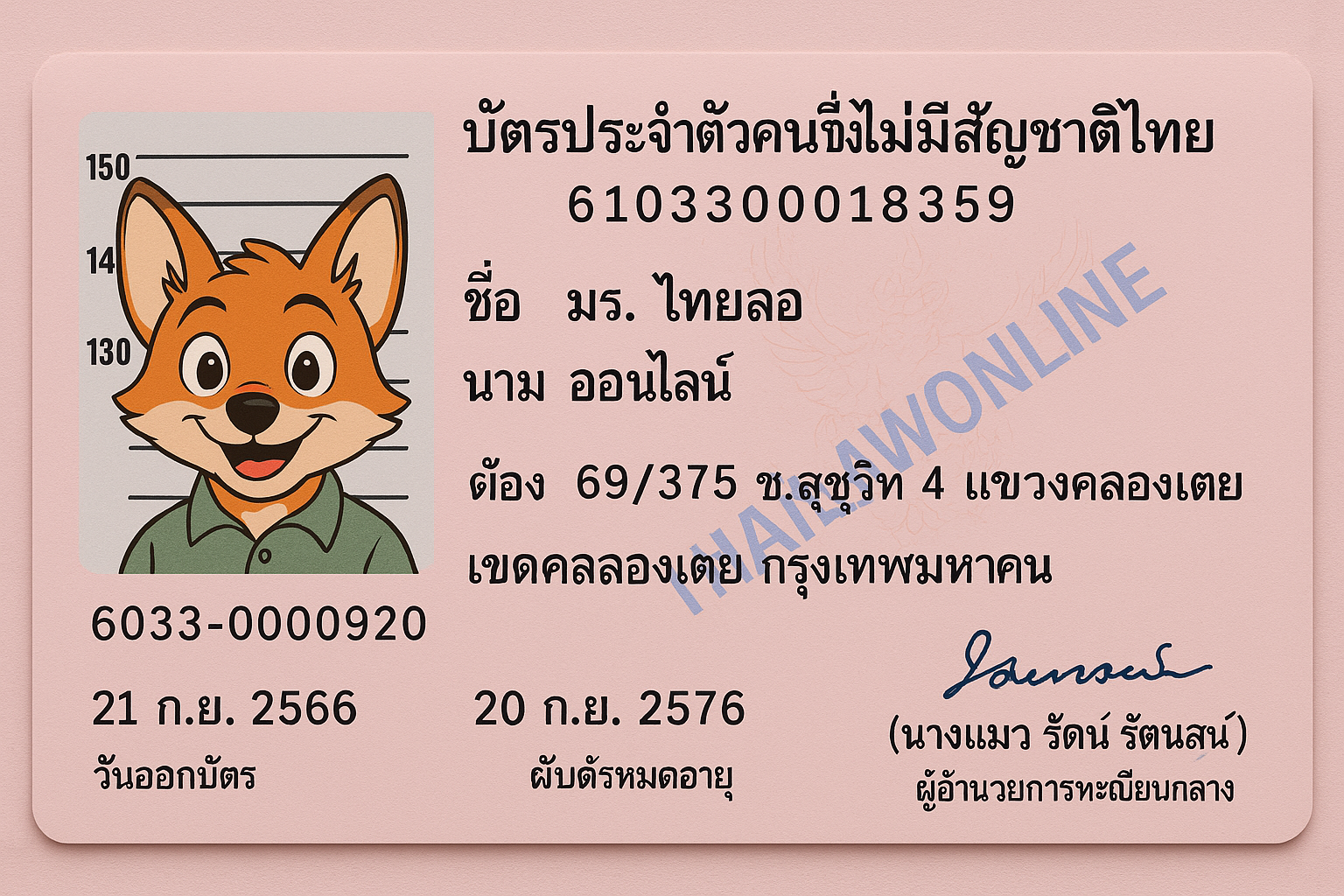
Yes, it is a fake One, his name is “ThaiLaw Online”. Valid 10 years.
Key Takeaways about the Thai Pink ID Card:
- Who can apply? You need a Thai ID number from a yellow Tabien Baan. You must also have something like permanent residency or a long-stay visa. Permanent residents are in a blue ta bian baan. After that, apply at your local amphur (district office) or tessaban. Click here to learn where to apply for a pink Thai ID, the differences between amphur and tessaban.
- Paperwork checklist: Passport with valid visa, house-book. Rwo Thai witnesses with their ID cards (not universal, depends on location). Two photos, and (if relevant) work permit or marriage certificate. Requirements can vary slightly between districts, so bring extra copies and translations.
- Cost & validity: The card costs 60 THB to get or renew. It is valid for 10 years. A card that has not expired by the time the holder turns 70 stays valid for life, under section 38/3 of the Civil Registration Act.
- Everyday benefits: You can use it as ID for domestic flights, hotel check-ins, and opening some bank accounts. It also helps prove your address, so you don’t have to carry your passport all the time. Some local attractions may also accept it for Thai-price admission, but this is hit-or-miss.
- Limits to remember: The Pink ID is not an immigration document: visa stamps, 90-day reports, TM30 rules and renewing your retirement extension every year still apply.
Table of Contents
What is the Thai Pink ID Card and Who is Eligible?
The Pink ID Card is an official ID for foreigners living in Thailand. It is made to make it easier to interact with the Thai government and other organizations. It provides a recognized form of identification. While it does not give all the rights of a Thai citizen, it provides a useful solution for daily needs. This includes accessing healthcare, enrolling in national parks, and using other government services. The card is especially helpful for permanent residents and people who have lived in Thailand for a long time.
The Thai pink ID for foreigners in Thailand has become more frequent after 2016. I personally posted an article on the subject after gaining mine in 2016 and many foreigners did the same. As far as I know, it began around 2013. A new rule mainly targeted Cambodian, Burmese, and Laos residents living in Thailand. The Department of Provincial Administration (DOPA) created a citizen’s guide about the pink ID in July 2015. It was followed by letters to local authorities in February 2016. You can find the original citzen’s guide on the Pink ID card at here.
Non-Thai residents, like foreigners, use passports for ID in Thailand. Foreigners can also get a “Yellow Ta bian baan” for an official address. The “certificate of residence” from immigration is important for confirming address details.
Thai citizens have a blue ID card (citizen id คือ) with their name, photo, address, and a 13-digit number. This card is important for things like buying land, voting, applying for government jobs, and opening bank accounts. It is blue and has a chip.
Differences from the Blue Thai ID Card that Thai citizens have:
- Eligibility: The Blue ID Card is exclusively for Thai citizens. The Thai Pink ID Card is for non-citizens who meet specific residency or legal criteria.
- Having a Pink ID Card does not give the same rights as Thai citizenship. This includes voting rights and access to all government programs. It is primarily a convenience for identification within Thailand.
- The Blue ID Card is a main ID for Thai citizens. The Pink ID Card helps foreigners by adding to their passports or visas. It offers a more local way to identify themselves.
To get the Thai Pink ID Card, foreigners must have a valid visa and understand the advantages of having a Thai ID number. They also need a yellow house registration book, called the "Tabien Baan." It is also available to those married to a Thai national or who have a work permit in Thailand. The Thai Pink ID Card is for people who want to live in Thailand long-term. It offers a simpler form of ID than a passport. Applicants must provide the required documents to show they are eligible. This includes a valid passport and a marriage certificate if needed.
Is the Pink ID Card equivalent to a Thai Citizen ID?
The Pink ID Card is not equivalent to a Thai Citizen ID. It gives a unique Thai ID number and is an important form of ID in Thailand. However, it does not grant citizenship rights. Thai citizens have privileges like voting rights and full access to public services. These benefits are not given to Pink ID Card holders. However, this card is an essential tool for foreigners to conduct their daily affairs more efficiently.
The Legal Basis, and What the Card Actually Is
Last reviewed: 3 September 2026, against the Civil Registration Act B.E. 2534 in Thai from the Office of the Council of State consolidated text: section 38 for the register of non-Thai nationals and the deletion of an entry when permission to stay ends, and sections 38/1, 38/2 and 38/3 as inserted by the Civil Registration Act (No. 3) B.E. 2562 for the duty to issue the card, the ten-year life, the sixty-day renewal window and the card that stays valid for life from age seventy. The fees were read from the Ministerial Regulation Prescribing Compliance with Civil Registration by Persons without Thai Nationality B.E. 2562, Royal Gazette volume 137 part 1 Kor page 13 of 7 January 2020, clause 9(1) for the 60 baht card fee, clause 10 for the waiver under fifteen and clause 11 for the waived copy fees, checked against the superseded B.E. 2551 regulation it repeals. This review corrected the card’s lifetime-validity age, which three places on this page gave as 60 and which the Act sets at seventy.
Most English writing on the pink card describes a queue rather than a rule. Two instruments govern it, and both are short.
Start with the Act, because it is the part that binds the district office. The card is issued under the Civil Registration Act B.E. 2534, and the operative provision is section 38/1, inserted by the Civil Registration Act (No. 3) B.E. 2562. It does two things. It puts a duty on a person without Thai nationality who is required to be added to a house register, or to have a registration record made, to notify the district or local registrar within the time the ministerial regulation sets. And then it says that once the registrar has added the name or made the record, the registrar shall issue an identity card. The only exception in the section is a person under five years of age, who is given an identity document for the time being instead.
That wording matters more than anything else on this page. The pink card is not a favour the office may grant or withhold. Once your name is on the register, issuing the card is what the Act tells the registrar to do. If you are turned away by an office that treats it as discretionary, section 38/1 is the provision to point at, together with the ministerial regulation that sets your time limit.
The ten year validity is statutory, not just regulatory. Section 38/3 provides that a card issued under sections 19/2, 38/1 or 38/2 has a life of ten years, and that the holder must apply to renew within sixty days of expiry, except where the holder has reached seventy, in which case the card already held is valid for life. The same section gives sixty days to apply for a new card where one is lost, destroyed or materially damaged, or where a name or date of birth is corrected in the register. Where the holder is a child under fifteen, the application is the duty of the parent, guardian or carer, and section 38/2 requires them to apply within sixty days of the child turning five.
And the entry can be removed. Section 38 paragraph one requires the registrar to make the house register for non Thais permitted to stay temporarily, for those given special case leave, and for their children born in the Kingdom. Its second sentence is the one to keep in mind: where a person listed in that register ceases to hold the permission or leave to stay, the registrar is to delete their entry promptly. The card follows the register, and the register follows your permission to stay.
Who must have one, and who may. The Ministerial Regulation Prescribing Compliance with Civil Registration by Persons without Thai Nationality B.E. 2562, Royal Gazette volume 137 part 1 Kor page 13, 7 January 2020, made under sections 5, 7 and 38/1 of the Civil Registration Act B.E. 2534, replaced the 2551 regulation. Clause 2 defines four categories of person without Thai nationality: permanent residents holding a residence certificate or an alien registration certificate; those given special case leave by the Minister of Interior; those permitted to stay temporarily under the immigration law; and those present without permission. Clause 4(3) brings the third category inside the registration and card rules where the permission to stay is continuous for not less than six months.
The card itself. The Central Registration Office Regulation on the Making of Identity Cards for Persons without Thai Nationality B.E. 2551, Royal Gazette volume 125 special part 174 Ngor page 2, 11 November 2008, made under sections 8/2 and 19/2 of the Act, sets out the mechanics.
- Clause 5. A person aged five to seventy whose name appears in a house register (Tor Ror 14, or the yellow Tor Ror 13) or in a registration record must have the card within 60 days of turning five or of being added to the register. The same 60 days runs again after expiry, loss, damage, or a change of name or date of birth.
- Clause 9. The card is valid for ten years from issue. A card still valid on the holder’s seventieth birthday is good for life. And it expires on the day the holder ceases to be a person without Thai nationality, which is to say the day naturalisation comes through.
- Clause 10. On that day the right to use it ends and the card must be returned to the registrar within ten days. That obligation is almost never mentioned.
- Clause 6. You apply to the district or local registrar for the district where your name sits in the house register, at an office running the computerised card system.
- Clause 8. Both thumbprints are taken.
The fee is fixed by regulation, not by the office. Clause 9(1) of the 2562 Ministerial Regulation sets 60 baht for a first card at fifteen or over, 60 baht on expiry, 60 baht for a lost, destroyed or damaged card, and 60 baht for a change of particulars. A certified copy of a register or card entry is 20 baht, and clause 11 waives that copy fee where it is needed for education, religion, an application for state welfare, or the work of a government body.
How to Apply for a Thai Pink ID Card?
To apply for a Pink ID Card, foreigners must prepare several required documents. These typically include a valid passport, a valid visa, two passport-sized photos, and the yellow house registration book. If married to a Thai national, a marriage certificate is also necessary. These documents are crucial for verifying eligibility and must be presented during the application process. It is advisable to have copies of all documents to avoid any delays in processing.
To apply for a Thai Pink ID Card, go to the district office (Amphoe or Tessaban). This is where your yellow house book is registered. It can also be at the Tessaban depending on the location. Each district office may have different procedures. It is important to check the specific requirements of your local office. Applicants should be prepared to complete forms and possibly attend an interview as part of the application process. It is also wise to contact the district office in advance to ensure all necessary documentation is in order.
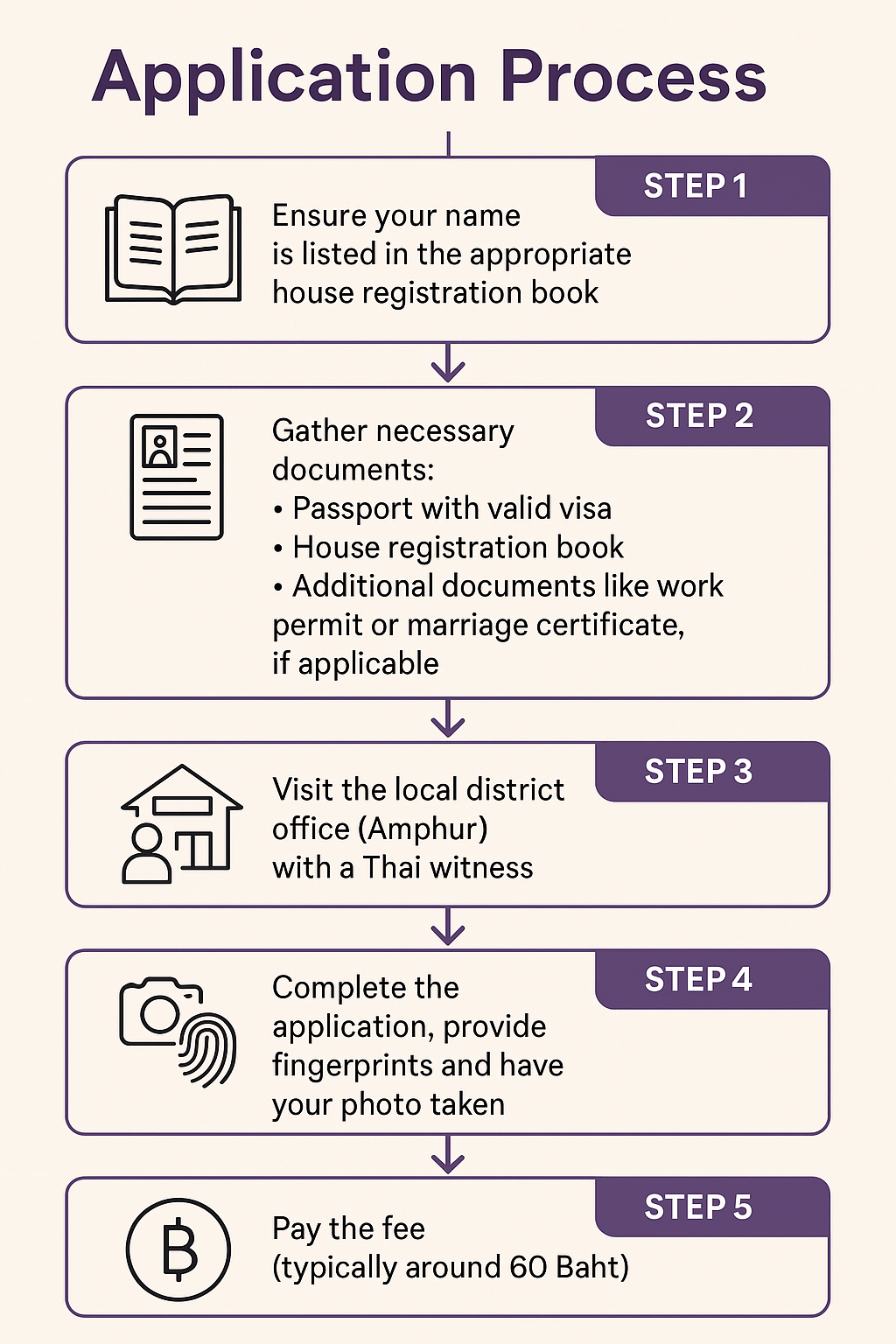
The process of obtaining a Pink ID Card involves several steps. First, gather all the required documents, ensuring that they are current and valid. Next, visit the district office to file the application and present the documents. An official will review the application and may request additional information or documentation. Once approved, the Pink ID Card is issued, typically valid for ten years. Applicants should allow for processing time, which can vary depending on the office and the completeness of the application. Do note that the price of a Thai ID card for foreigners is 60 baht, according to the regulation. If you are lucky, you might not pay but the real price is 60 baht.
As someone who obtained mine in 2016, here’s my top tip: Always bring extra photos! But they will also use their own photo system.
What is the Relationship Between the Pink ID Card and the Yellow House Registration Book?
The Yellow House Registration Book, or "Tabien Baan," is an official document. It records where foreigners live in Thailand. It is similar to the blue house book used by Thai nationals but is specifically tailored for non-citizens. This document is essential for foreigners who wish to establish an official domicile in Thailand. It shows the names of all registered people at a specific address. This list is used for different administrative tasks, like issuing a Pink ID Card, which can help you get the Yellow House Book.
The Yellow House Book and the Pink ID Card are closely interlinked. The Yellow House Book is a prerequisite for obtaining a Pink ID Card, as it serves as proof of residency. Without it, foreigners may find it challenging to demonstrate their eligibility for a Pink ID Card. The link between these two documents shows how important it is to have a registered address in Thailand. This address helps people access many other services and rights.
Obtaining a Yellow House Book or house registration book is a key step before getting a Pink ID Card. The Yellow House Book shows where you live. It is needed to confirm your home in Thailand, especially for those wanting a pink card. Foreigners must register their residence in the Yellow House Book at their local district office. This is necessary to get the Pink ID Card. Not having this book can lead to delays or denials in applications. It’s important to contact us for help. It is an important document for expats who want to formalize their status in Thailand.
9 Benefits of Having a Thai Pink ID for Foreigners
For expats, the Pink ID Card significantly eases the complexities of daily life in Thailand. It serves as a recognized form of identification, reducing the need to carry a passport for routine activities. With a Pink ID Card, expats can use public services more easily. They can also take part in local transactions and apply for memberships in local groups.
It also makes it easier to interact with government offices. It provides a unique Thai Pink ID number that works with local systems. I was the first foreigner to get a Thai pink ID in Nakhon Ratchasima province. I use it almost every week. I go to the bank, the hospital, or try to get discounts at local parks. Do note that you might not get discounts but for me, it does work often.
- Official Identity: This card gives you an official ID in Thailand with a unique Thai ID number.
- Convenience: It makes it easier to use public and private services, sometimes instead of needing a passport.
- Banking: It is easier to open bank accounts and use financial services with the ta bian baan and Thai ID number.
- Employment: A Thai driver’s license helps you find jobs. It confirms your legal status with your Thai ID number.
- Property Rental: It makes renting property easier. It provides the necessary legal ID. This is helpful for people living in Thailand.
- Healthcare: It speeds up access to services. It may also provide medical benefits to cardholders, especially those with a pink card.
- Transportation: Can be used as ID for domestic travel on trains and buses.
- Telecommunications: Makes it easier to get SIM cards and related services.
- It can help with getting a Thai driver’s license
Some people that do not have a pink Thai ID wrongly say on the Internet that the pink ID is useless.
Significance of the First Digit on a Thai ID
The Thai Identification Card was introduced by a law from 1983. The first digit of the ID number has different meanings. Each digit corresponds to a specific category of individuals based on factors like birth date and nationality status. It is the same on a blue Thai ID or a Thai Pink ID card for foreigners in Thailand.
Number and meaning of the first number on a Thai ID Card and also Thai pink ID card:
| First Number | Meaning |
|---|---|
| 1 | Thai nationals born after January 1, 1984 and registered at birth. |
| 2 | Thai nationals born after January 1, 1984 with delayed birth registration. |
| 3 | Thai nationals and foreigners who were issued ID cards before May 31, 1984. |
| 4 | Thai citizens born before January 1, 1984 who were not included in a house registration book at first. |
| 5 | Thai nationals missed in the official census or in special cases, such as dual nationality. (Very rare cases like abandoned children.) |
| 6 | Foreign nationals living in Thailand temporarily or illegally. Foreigners get a “6” when requesting a work permit or being added to a house registration book (tabien baan). |
| 7 | Children of people in category 6 who were born in Thailand. This is quite rare. |
| 8 | Foreigners living in Thailand permanently or Thai nationals by naturalization. |
As per the law in 2025, Thai people above seven years of age must have a Thai ID Card.
The pink ID card for foreigners is a special card that gives fewer rights than Thai citizens. It’s not an official ID, but it can help foreign residents in Thailand. It shows the benefits of having a Thai driver’s license. I got mine in Nakhon Ratchasima province and my number was 000001, which is essential for obtaining the yellow book and pink ID card.
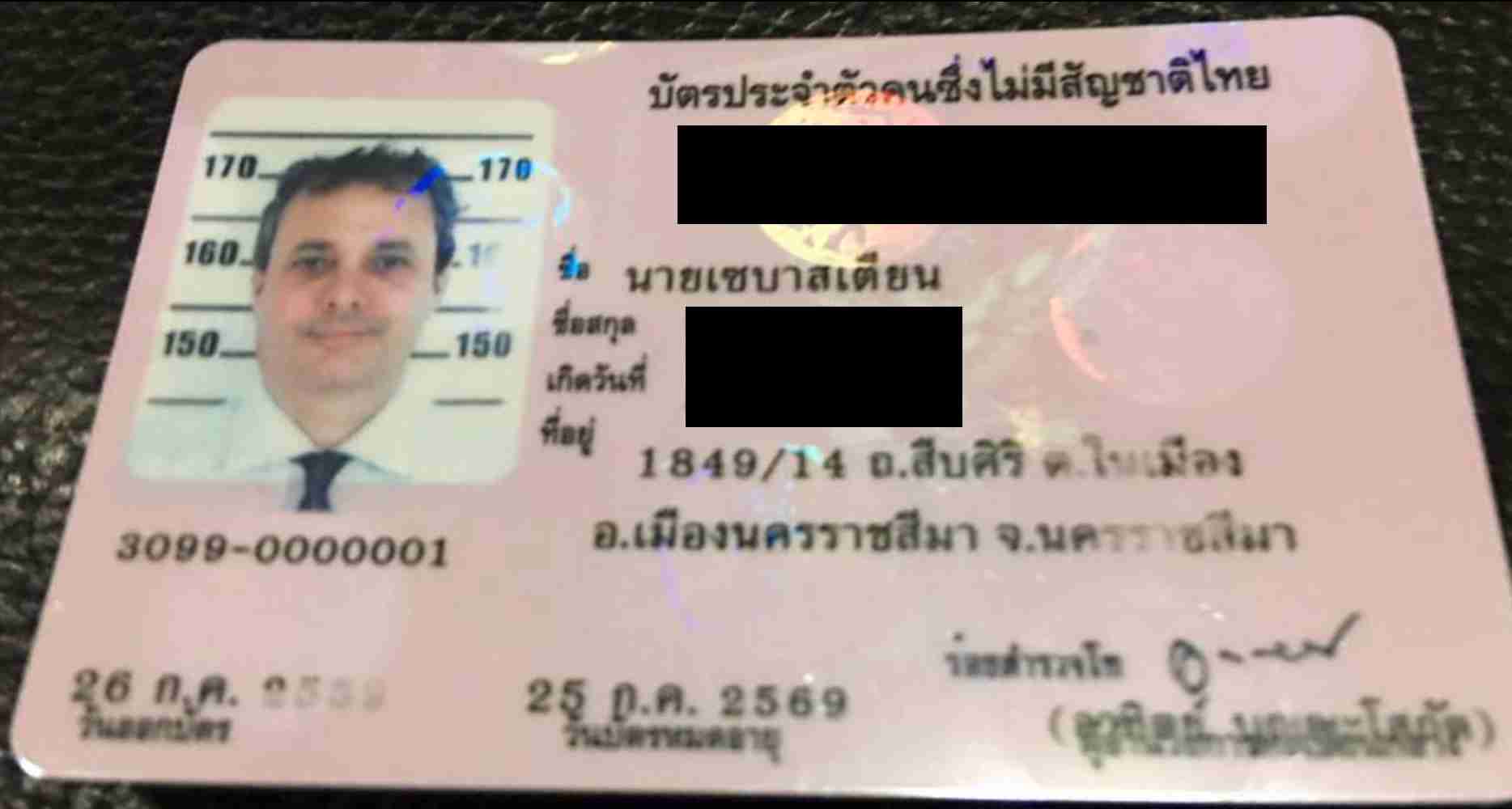
You can see that it is 3099-000001 or the first card in Nakhon Ratchasima (30) and Amphur Mueang (99). 26 July 2016.
Foreigners living in Thailand must follow rules to get an ID card, especially if they are married to a Thai citizen. They need to meet requirements like age, living in Thailand, and giving personal details. To get a pink Thai ID card, they must have a Thai ID number and show documents like a passport, work permit, and certificates. Sometimes, they may need to give more documents to the local office. This includes proof of marriage if they are a foreigner married to a Thai.
Rules for non-Thai people getting ID cards in Thailand depend on things like age, where they live, and personal information. To get a pink Thai ID, applicants must have a Thai ID number. They also need to provide documents like a passport, work permit, and certificates. These certificates can include a driver’s license. Local offices may need more papers, especially for foreigners married to Thai citizens. It’s best to contact us for help.
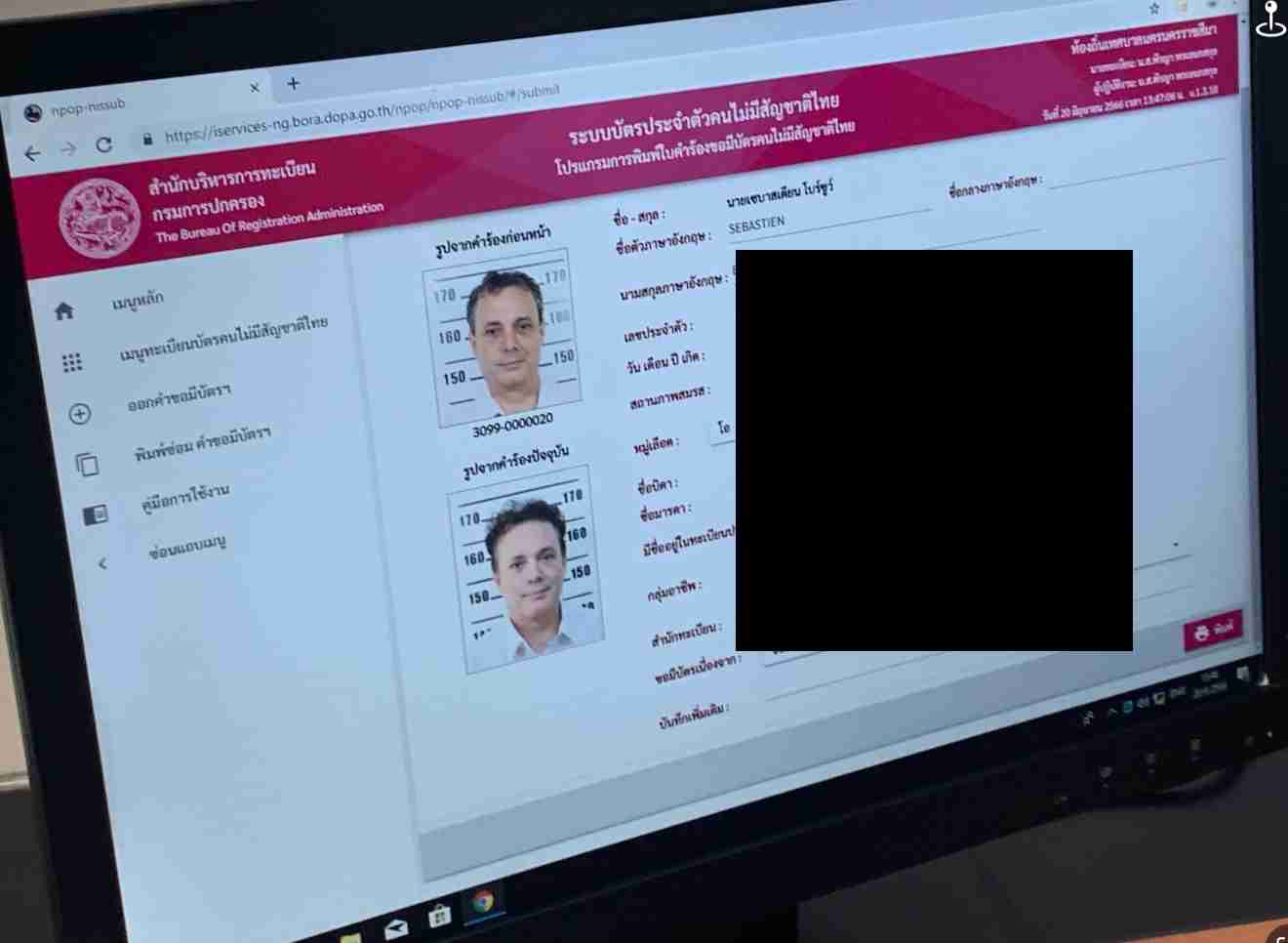
Information inside the DOPA computers at the Tessaban or Amphur related to Pink ID Card.
You see my number changed from 0001 to 00020 after I lost my card.
Rules for non-Thai nationals who want valid ID in Thailand depend on age, residency status, and personal information. These regulations govern the acquisition of identification cards and may entail specific deadlines and requirements.
Common Challenges and How to Overcome Them
Foreigners often encounter several challenges when applying for a Pink ID Card in Thailand. Common issues include incomplete documentation, misunderstandings about eligibility requirements, and language barriers. Some applicants may find it hard to get a Yellow House Book. This book is often needed to get a Thai driver’s license. This can happen because of complicated rules or not knowing the local area. These challenges can cause delays or even rejection of the application if not handled correctly. This is especially true for the yellow book and pink ID card.
To fix documentation problems, applicants should make sure all required documents are complete, current, and filled out correctly. It is a good idea to check with the district office. They can provide any specific requirements or changes, especially about the Thai price for services. Seeking assistance from a legal consultant or someone fluent in Thai can also be beneficial in navigating complex paperwork. Preparing copies of all documents and verifying their authenticity before submission can prevent common pitfalls.
If an application for a Pink ID Card is denied, applicants should ask the district office for clarification. This will help them understand why their application was rejected. It may involve missing documentation, incorrect information, or failure to meet eligibility criteria. Fixing these problems quickly can help. You can do this by adding documents or correcting mistakes. This can improve your chances of successfully reapplying for the pink card. Working with legal experts or advisors who know about Thai residency can help fix the situation.
FAQS About Thai Pink ID Card for foreigners in Thailand
What is a Thai Pink ID Card for foreigners?
The Pink Thai ID Card is a type of ID for foreigners living in Thailand. It gives them a Thai ID number. It is mainly for expats who live permanently in Thailand and are registered in the yellow book or tabien baan.
What are the benefits of having a Pink Thai ID Card?
The Pink Thai ID Card can make things easier for the holder, especially when applying for a driving license. It helps with transactions and registrations with the government, including those related to obtaining a Thai driver’s license. It also works as a valid form of ID, so you don’t have to carry your passport. It shows a legal place of residence in Thailand and aids in various administrative processes.
How can I get a Thai Pink ID Card for Foreigners?
To get a Pink Thai ID Card, you need to register your residency (or address) in a yellow book or tabien baan. You must also meet other requirements to obtain the card, including proof of residency in Thailand with the government. You will need to visit your local district office to apply.
What are the requirements for obtaining a Pink Thai ID Card?
To get a Pink Thai ID Card, you need to meet a few requirements. First, your name must be in a yellow book or a blue house registration book. Second, you must have a valid visa. Lastly, you need to show your passport. You must also provide proof of residence and possibly other supporting documents as requested by the local district office.
How long is the Thai Pink ID Card for Foreigners Card valid?
The Pink Thai ID Card is valid for 10 years. Section 38/3 of the Civil Registration Act B.E. 2534 gives the holder 60 days from expiry to apply for a renewal, and a card that has not expired by the time the holder turns 70 stays valid for life. Keep your registration and permission to stay current, because the card follows the house register.
Do I need a Thai ID number to apply for a Pink Thai ID Card?
Yes, you will be issued a Thai ID number when you apply for the Pink Thai ID Card. This number is essential for the identification process and helps in various governmental interactions.
Can I get a Pink Thai ID Card if I don’t have permanent residency?
You do not need permanent residency, but you must have a registered address in Thailand. This can be shown by being listed in a yellow book or a blue house registration book to qualify for the card.
Do I still need to carry my passport after getting a Thai Pink Thai ID Card?
The Thai Pink ID Card for foreigners is a valid ID in Thailand. However, it is best to carry your passport for proof of nationality or when traveling abroad.
How does having a Pink Thai ID Card benefit expats living in Thailand?
For expats in Thailand, a Pink Thai ID Card is helpful. It makes it easier to work with local authorities. It also simplifies interactions with banks and other institutions. It helps in establishing a legal presence and facilitates smoother interactions in daily life. Some people say it is “useless” but I find it helpful. I use it daily at the hospital, in banks, and many other places instead of my passport.
Can I use the Pink ID for international travel?
No. You must use your passport. In Nepal, they surprisingly accepted my pink ID card to rent a motorcycle instead of my passport. So even abroad, it can be useful.
What if I lose my Pink ID?
Make a police report and re-apply at the amphur/tessaban. I’ve already done it, no problem.
The Thai Pink ID card for foreigners in Thailand is a very important document for expats. It assists with interactions and services both in the country and abroad. This ID is particularly beneficial for foreign residents who require official identification in Thailand. It is useful for foreign residents who need official identification in Thailand.
Do note that ThaiLawOnline do not helps to get a Thai Pink ID card for foreigners in Thailand. Since the rules can change from one office to another, we cannot offer this service everywhere in Thailand. It needs to be applied at the local amphur, Khet, or Tessaban.
Recent Updates
- The rule that lets an ordinary long-stay foreigner hold the card dates from 2019, not from a recent memo. The Ministerial Regulation Prescribing Compliance with Civil Registration by Persons without Thai Nationality B.E. 2562, Royal Gazette volume 137 part 1 Kor page 13, 7 January 2020, repealed the 2551 regulation and widened the class from two categories to four. Clause 2(3) brought in aliens permitted to stay in the Kingdom temporarily under the immigration law, which is the category almost every retiree, spouse and work permit holder falls into.
- The test is six months of permitted stay, not a visa class. Clause 4(3) brings that category inside the house registration and card rules where the permission to stay runs continuously for not less than six months, and clause 5 paragraph three gives you 30 days from the visa or extension that takes you to six months or more in which to apply to be added to the house register. The question is the length of your permitted stay, not whether the visa is an O-A, an O-X, a Thailand Privilege membership or anything else.
- Under six months is not an absolute bar. Clause 8 lets a person permitted to stay for less than six months who wishes to comply ask the registrar to do it. That is a request rather than an entitlement, and district practice varies.
- DOPA’s 2025 guidance on registration and identity cards for persons without Thai nationality is the operational manual district offices work from, and it did make the process easier for migrant workers from Cambodia, Laos and Myanmar in particular. It does not change the six month rule above.
Most applicants need proof of address before they apply, which is covered in our guide to the certificate of residence in Thailand. For how the pink ID fits alongside your permission to stay, see our Thai immigration overview.
Thai Law Updates, free by email
Plain-English updates on Thai law changes that affect foreigners: property, visas, marriage, business and wills. One short email a month from a firm practicing since 2006. No spam, unsubscribe anytime.