


Reviewed by ThaiLawOnline, a licensed Thai law firm practising in Thailand since 2006. Thai lawyer of record: Wichuda Atthamethakon, LL.M., Thai Bar Licence 3149/2556.
Last updated on
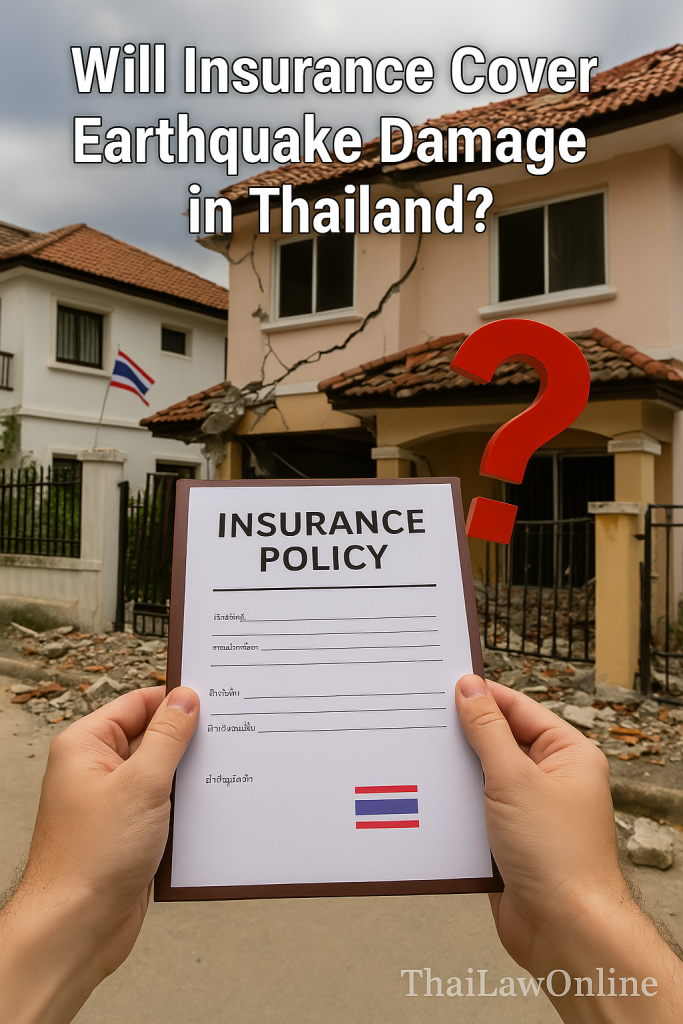
Earthquakes are natural disasters that can cause significant devastation, particularly in regions prone to seismic activity. Myanmar and Thailand, two neighboring countries in Southeast Asia, have experienced their share of earthquakes over the years. As such, understanding whether insurance pays for damages from earthquakes in Thailand is crucial for residents and businesses.
Table of Contents
Last reviewed: 27 September 2026. The insurance points follow statements by the Office of Insurance Commission and the Thai General Insurance Association after the 28 March 2025 earthquake, as reported by ThaiPublica on 30 March 2025. Casualty figures and building details are from news reports.
This article delves into the likelihood of earthquakes in Thailand and Myanmar, how earthquake insurance functions in these countries, and the impacts of recent seismic events, particularly focusing on the March 28, 2025, earthquake in Bangkok. Additionally, we will explore how insurance does indeed pay for damages from earthquakes in Thailand, addressing the essential question: do insurance pay for damages from earthquakes in Thailand? This is an important topic that this article will address in detail. We will also examine the various insurance policies available and clarify how insurance pays for damages from earthquakes in Thailand.
What is the likelihood of an earthquake in Thailand and Myanmar?
The historical data on earthquakes in Thailand and Myanmar shows a pattern of seismic activity that has affected both countries. Thailand has experienced several minor to moderate earthquakes over the years, with the northern provinces being more prone to tremors due to their proximity to major fault lines. Myanmar, on the other hand, sits on the Sagaing Fault, one of the most active seismic zones in the region. Notably, the 7.7 magnitude earthquake in Myanmar on March 28, 2025, rocked both Myanmar and neighboring Thailand, causing significant damage and reminding residents of the ever-present threat.
The geological conditions of Myanmar and Thailand significantly influence the frequency and intensity of earthquakes. Myanmar’s location along the Sagaing Fault and other tectonic plate boundaries makes it particularly susceptible to earthquakes, which can lead to severe incidents like the one that affected Mandalay. The rock formations and fault lines in these areas can generate powerful earthquakes, posing a constant threat to the region, particularly in places like Mandalay. In Thailand, while the seismic activity is less frequent, the country still experiences tremors, particularly in the northern provinces, due to its proximity to Myanmar’s seismically active zones.
Seismologists continue to study the tectonic movements in Myanmar and Thailand to predict future trends in seismic activity. While predicting the exact timing and magnitude of earthquakes remains challenging, historical patterns and current geological assessments suggest that both countries should remain prepared for future seismic events. The magnitude 7.7 earthquake of March 2025, centred in Myanmar but felt strongly in Bangkok, serves as a stark reminder of the potential for powerful earthquakes in the region, particularly after the Myanmar earthquake that caused significant damage. Continuous monitoring and research are essential to better understand and predict these natural phenomena, especially in light of the recent Myanmar earthquake.
How does earthquake insurance work in Thailand and Myanmar?
Earthquake insurance in Thailand and Myanmar typically covers a range of damages resulting from seismic activity. These policies often compensate for structural damage to residential and commercial properties, including high-rise buildings that may collapse during a quake. Coverage may also extend to personal belongings damaged within the property. However, the specifics of coverage can vary between insurance providers, and it’s crucial for policyholders to thoroughly understand the terms of their insurance agreements. In Thailand, the standard residential fire policy approved by the Office of Insurance Commission (OIC) already covers catastrophic natural perils, earthquake included, but only up to 20,000 THB a year; more cover can be bought as an add-on. A condominium’s juristic person usually insures the structure and common property, often under an industrial all-risk policy, so ask the building manager what that policy covers.
While earthquake insurance offers financial protection against certain damages, there are often exclusions and limitations within these policies. Common exclusions may include damage to land, such as soil liquefaction, or pre-existing structural weaknesses not caused by the earthquake. Additionally, insurance policies may have deductibles that require policyholders to cover a portion of the repair costs. It’s essential for individuals and businesses to carefully review their insurance policies to understand what is and isn’t covered, ensuring they are adequately protected.
Filing an insurance claim after an earthquake involves several steps. Policyholders should first document all damages by taking photographs and making an inventory of affected items. Contacting the insurance provider promptly is crucial to initiating the claims process. The insurer will likely send an adjuster to assess the damage and determine the appropriate compensation. It’s important for claimants to keep records of all communications and expenses related to repairs to facilitate a smoother claims process following an earthquake.
What were the impacts of the March 28, 2025, earthquake in Bangkok?
The 28 March 2025 magnitude 7.7 earthquake struck Myanmar, on the Sagaing Fault, with its epicentre near Sagaing and Mandalay at a shallow depth of about 10 kilometres. The epicentre was not in Bangkok. The rupture was large and shallow enough that the shaking travelled more than 1,000 kilometres and was felt strongly across Thailand, including in Bangkok, where the soft marine clay under the city amplifies long-period waves and makes tall buildings sway. That is why a distant Myanmar earthquake was felt in Bangkok high-rises and at street level in places such as Chatuchak Market.
In Bangkok the most serious consequence was the collapse of a 30-storey tower under construction for the State Audit Office in the Chatuchak area, which killed dozens of workers. Other buildings in the city were damaged and had to be inspected, but the widespread structural failure was in Myanmar, near the epicentre. The Bangkok collapse prompted a review of building standards and construction supervision rather than proving that the earthquake originated in Thailand.
The great majority of the deaths were in Myanmar, close to the epicentre. In Thailand the loss of life was concentrated at the State Audit Office construction site in Bangkok. Figures changed while rescue operations continued, and readers should rely on official Thai and Myanmar sources for final numbers. Thai and international aid organisations mobilised quickly to assist those affected in both countries.
How does the government respond to earthquakes in Myanmar and Thailand?
In the wake of an earthquake, the governments of Myanmar and Thailand implement a series of emergency measures to ensure public safety and facilitate recovery, particularly after the 7.7 magnitude earthquake rocked the region. These measures often include the deployment of emergency services, the establishment of temporary shelters, and the dissemination of vital information through official channels. Both countries have emergency response plans designed to coordinate efforts between local authorities, military units, and international aid organizations.
During a state of emergency following an earthquake, evacuation protocols are activated to ensure the safety of affected populations. Evacuation efforts focus on moving people from high-risk areas, such as those near the epicenter or locations with a high likelihood of building collapse. Authorities may establish designated evacuation routes and centers where evacuees can receive shelter and medical care. Communication is key, with government and media outlets providing updates and instructions to facilitate orderly evacuations.
International aid organizations play a crucial role in the aftermath of earthquakes in Myanmar and Thailand. These organisations, including United Nations agencies, the Red Cross and Red Crescent movement and international NGOs, work alongside local authorities to provide humanitarian assistance, medical care and shelter to affected communities. Their involvement is particularly vital in large-scale disasters where national resources may be overwhelmed. The collaboration between local and international entities ensures a more effective and comprehensive response to the needs of earthquake victims.
What steps can residents take to prepare for future earthquakes?
Residents in earthquake-prone areas like Myanmar and Thailand can take proactive steps to strengthen their homes against seismic activity. Retrofitting buildings to meet modern earthquake-resistant standards can significantly reduce the risk of damage. This may involve reinforcing walls, securing heavy furniture, and ensuring that structures are anchored to their foundations. Consulting with structural engineers can provide homeowners with tailored solutions to enhance their properties’ resilience to earthquakes.
Having an emergency preparedness kit is vital for surviving the immediate aftermath of an earthquake. Essential items to include are water, non-perishable food, a first-aid kit, flashlights, batteries, and a portable radio. Personal documents, medications, and cash should also be part of the kit. Regularly updating and maintaining the kit ensures that individuals and families are ready to cope with the disruptions caused by an earthquake.
Staying informed about earthquake risks and warnings is crucial for residents of Myanmar and Thailand. Engaging with local government alerts, subscribing to seismic activity monitoring services, and participating in community preparedness programs can enhance awareness. Additionally, education on the signs of an impending earthquake and understanding the appropriate safety measures can empower individuals to respond effectively when a quake occurs. By staying informed, residents can better protect themselves and their families from the dangers posed by earthquakes.
Faqs about Insurance Paying for Damages from Earthquake in Thailand
Does insurance cover damages from earthquakes in Thailand?
Partly. The standard residential fire policy approved by the Office of Insurance Commission covers catastrophic natural perils, earthquake included, but only up to 20,000 THB a year. Insurers sell additional earthquake cover as an add-on, and commercial, all-risk and construction policies depend on their own wording. It is important to check with your provider to know if you are covered for damages caused by events like the 7.7 magnitude earthquake that rocked Myanmar and neighboring Thailand.
How can I ensure my condominium in Thailand is protected against earthquake damages?
Your own residential fire policy covers earthquake damage only up to 20,000 THB a year, so consider buying additional earthquake coverage. The condominium juristic person usually insures the structure and common property, often under an industrial all-risk policy. Additional cover can be added to ensure protection against damages seen after an earthquake like the one that rocked Myanmar.
What should I do if I need to evacuate my building due to an earthquake in Thailand?
If you need to evacuate due to an earthquake, follow local emergency procedures. Make sure you have an emergency kit ready, and move to open spaces away from buildings that could collapse, as was the case with the building under construction that collapsed after a strong earthquake.
Are there any recent examples of earthquake damage in Thailand or nearby regions?
Yes, a notable event was the 7.7 magnitude earthquake that rocked Myanmar and was felt across Thailand, including areas like Chatuchak. Buildings were damaged, and people had to be evacuated, highlighting the importance of earthquake coverage
What steps should be taken if damage is reported after an earthquake?
After an earthquake, report any damages to your insurance provider as soon as possible. Document the damage with photos and detailed descriptions to support your claim. The Office of Insurance Commission’s hotline, 1186, and the Thai General Insurance Association can provide additional guidance on claims.
How did the March 28 earthquake impact Thailand?
The earthquake of 28 March 2025 struck Myanmar on the Sagaing Fault and was felt across neighbouring countries, including Thailand. In Bangkok it caused evacuations of high-rise buildings and the collapse of a tower under construction for the State Audit Office. The epicentre was in Myanmar, not in Thailand.
Who are some key figures involved in earthquake response in the region?
In Thailand the relevant bodies are the Department of Disaster Prevention and Mitigation, the Bangkok Metropolitan Administration and, for insurance questions, the Thai General Insurance Association. In Myanmar the response is coordinated by the national authorities together with United Nations agencies and international relief organisations.
What should I do if I am trapped under a building after an earthquake?
If trapped, try to remain calm and signal for help using a whistle or tapping on pipes. Avoid shouting to conserve energy. Rescue teams are trained to find those trapped under debris, as was the unfortunate case for some victims caused by an earthquake.
How does the Thai General Insurance Association assist during an earthquake?
The Thai General Insurance Association provides information on available insurance policies and coverage options for earthquake-related damages. They also guide policyholders on the claims process following an earthquake, particularly after the 7.7 magnitude earthquake that caused extensive damage.
Links
Thai Law Updates, free by email
Plain-English updates on Thai law changes that affect foreigners: property, visas, marriage, business and wills. One short email a month from a firm practicing since 2006. No spam, unsubscribe anytime.