


Reviewed by ThaiLawOnline, a licensed Thai law firm practising in Thailand since 2006. Thai lawyer of record: Wichuda Atthamethakon, LL.M., Thai Bar Licence 3149/2556.
Last updated on September 5, 2026
What changed: Transfer and mortgage registration fees are cut to 0.01% on qualifying residential property up to 7 million baht. The standard rates are 2% transfer and 1% mortgage.
Effective: 1 July 2026 to 30 June 2027, under two Ministry of Interior announcements published in the Royal Gazette on 1 July 2026.
Who it affects: Individual Thai nationals only. Both announcements require the buyer to be a Thai national, so a foreign buyer registering under the foreign quota pays the standard 2% transfer fee.
What to do now: If you are a foreign buyer, budget the full 2%. The reduction still matters to you on resale, because a Thai buyer purchasing from you before 30 June 2027 may qualify.
Last verified: 1 August 2026 against the two Ministry of Interior announcements published in the Royal Gazette on 1 July 2026.
Understanding the different types of land title deeds in Thailand is absolutely crucial before purchasing property. These documents define ownership rights, boundary accuracy, and the overall security of your investment. This guide explains the most common title deeds. It looks at the differences between the top levels of land titles. These are Chanote (Nor Sor Si Jor / NS4J), Nor Sor Sam Gor (NS3G), and Nor Sor Sam (NS3). Knowing these differences is the first step towards secure land acquisition in Thailand.
Do note that we personally think title deeds should be in these 4 categories but there are always exceptions. These are made to make it easier for you to understand. They are the 1) Land Department 2) The Agricultural Reform 3) The Treasury Department Land and finally they land 4) Without Title deeds.
Provincial Discretion Notice: While the Thai Civil and Commercial Code and the Land Code Act B.E. 2497 provide a uniform national framework, day-to-day administration relies on the discretion of the presiding officials at each branch Land Office. Documentary requirements, registration procedures, and the level of scrutiny applied to foreign transactions can vary significantly between provinces. Always confirm exact requirements with the specific local Land Office registrar before executing any transaction.
Table of Contents
Table of Contents
- Decision Guide for Expats: Start Here
- The Four Categories of Land Documents in Thailand
- Category 1: Land Department Titles (Full Ownership & Possessory Rights)
- Category 2: Agricultural Reform Land (Sor Por Kor / ส.ป.ก. 4-01)
- Category 3: Treasury Department Land (ที่ราชพัสดุ)
- Category 4: Land Without Title Deeds (Por Bor Tor 5 & Others)
- Master Comparison Table: All Thai Land Documents
- Understanding Garuda Emblem Colors (ตราครุฑ)
- Land Office Registration Rules Expats Must Know
- The Essential Due Diligence Workflow
- Supreme Court Decisions: Legal Authority on Title Deeds
- Thai Land Measurements: Rai, Ngan, Wah Explained
- Common Property Scams Targeting Expatriates
- Frequently Asked Questions
- Protect Your Investment: Contact ThaiLawOnline
- Related Guides on ThaiLawOnline
1. Decision Guide for Expats: Start Here
Before reading the detailed analysis below, answer one question: will the Land Office register the right you need?
Most expatriates want to either purchase a condominium, register a long-term lease on land, or secure a right of superficies to own a building. Under Land Code Section 4 bis, transfer of ownership or possessory rights for land with a Title Deed or Utilization Certificate must be in writing and registered with the competent official. Under CCC Section 538, a lease of immovable property exceeding three years is enforceable only for three years unless it is made in writing and registered.
First Question: What Document Are You Looking At?
If the land comes with a Chanote (โฉนดที่ดิน) or Nor Sor 3 Gor (น.ส.3 ก.), you are dealing with a Land Department-issued document that allows registration of leases, mortgages, usufructs, and superficies. These are the only documents most expatriates should consider. For a full overview, see our property guide for foreigners in Thailand.
If you are offered anything else, a Nor Sor 3, a Sor Kor 1, a Por Bor Tor 5, or SPK 4-01 land, treat it as high-risk and conduct a thorough title-status verification before paying anything.
The Fastest Safe Next Step
Request a Land Office title search (ค้นหาเอกสารสิทธิ์ที่กรมที่ดิน). The Department of Lands warns that LandsMaps is only basic information and not legal evidence. Only a physical verification at the Land Office confirms ownership, encumbrances, seizures, and document authenticity. Read our complete due diligence guide and learn how to read a Thai title deed.
2. The Four Categories of Land Documents in Thailand
Thailand’s land documentation system is more complex than most Western jurisdictions. Rather than a single title registry, land documents are issued by different government agencies with vastly different legal effects. If you are considering buying property in Thailand, understanding this system is the first step. We classify all Thai land documents into four categories based on the issuing authority and the level of legal protection they provide:
| Category | Issuing Authority | Documents | Legal Nature | Expat Risk |
|---|---|---|---|---|
| 1. Land Department Titles | Department of Lands กรมที่ดิน | Chanote, NS3G, NS3, SK1 | Ownership to notification of possession | Low to High |
| 2. Agricultural Reform | ALRO สปก. | SPK 4-01 (ส.ป.ก. 4-01) | Agricultural allotment (restricted) | Avoid |
| 3. Treasury Department | Treasury Department กรมธนารักษ์ | Ratchaphatsadu registry (ที่ราชพัสดุ) | Government-owned; lease only | Special |
| 4. No Title Deed | SAO / Various อบต. | Por Bor Tor 5, Nor Kor 3 | Tax receipt / informal claim | Avoid |
3. Category 1: Land Department Titles (เอกสารสิทธิ์จากกรมที่ดิน)
The Department of Lands (กรมที่ดิน) issues the primary land title documents in Thailand under the Land Code Act B.E. 2497 (1954). These range from full freehold ownership (Chanote) down to a mere notification of possession (Sor Kor 1). Understanding the hierarchy is essential because the legal rights, registrable real rights, and risk levels are dramatically different.
3.1. Chanote (โฉนดที่ดิน / นส.4 จ.), Full Freehold Ownership
✅ Verdict: SAFE to Invest
The Chanote is Thailand’s gold standard of land ownership. It confers full freehold title (กรรมสิทธิ์) with GPS-surveyed boundaries and concrete marker posts. All real rights (leases, mortgages, usufructs, superficies) can be registered unconditionally.
The Chanote title deed (โฉนดที่ดิน) is the highest level of land document in Thailand.Its formal name is Nor Sor 4 Jor (น.ส.4 จ.). It is identified by the Red Garuda emblem (ตราครุฑสีแดง) and confers absolute freehold ownership recognized by law.
Key Features of a Chanote
Survey Precision: Chanote land is surveyed using GPS grid coordinates with physical concrete marker posts (หลักเขตที่ดิน) planted at each boundary corner. This eliminates the boundary ambiguity that plagues lower-tier documents.
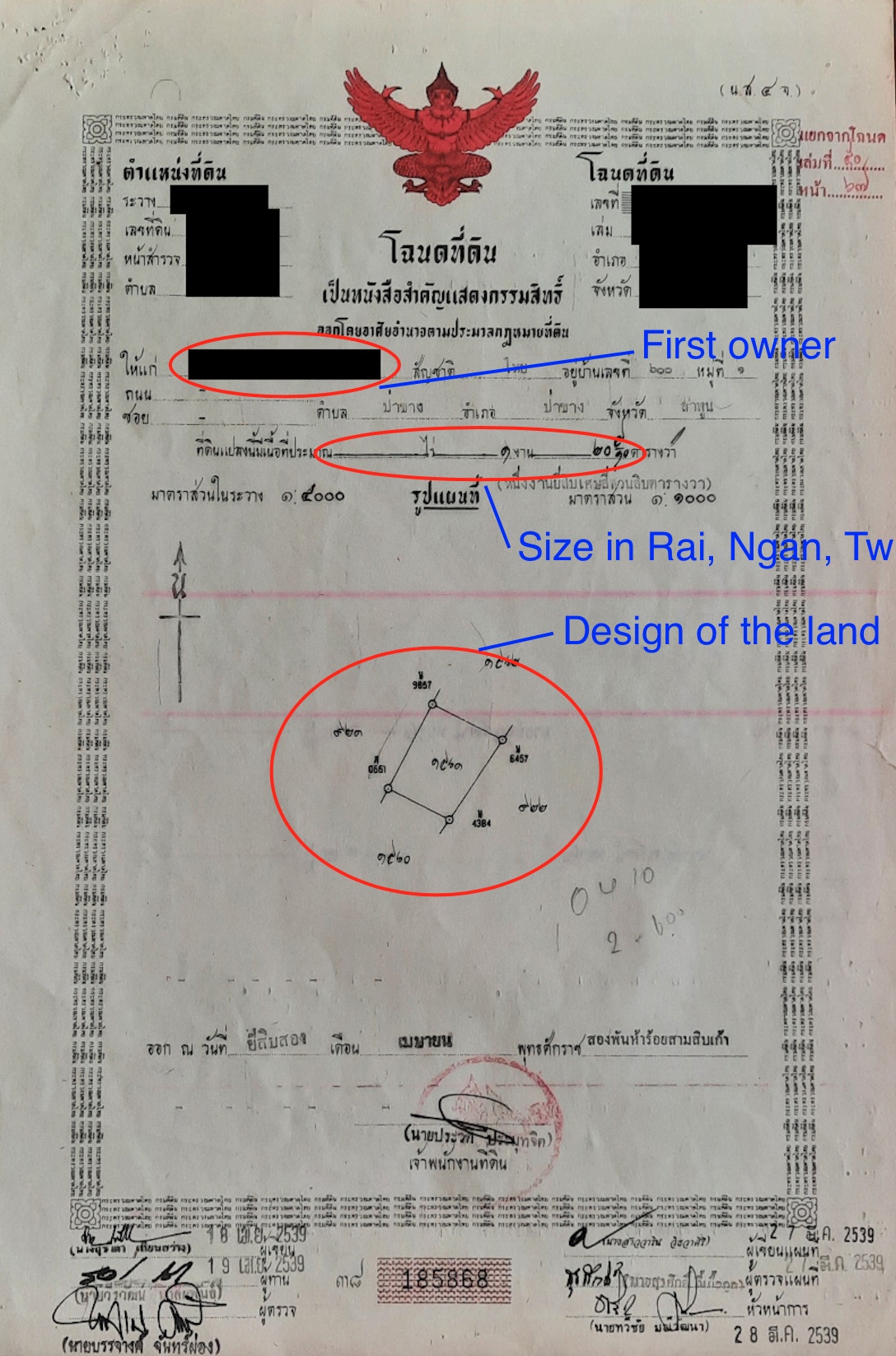
Example of Red Chanotte, or Full Chanotte, or also Called Nor Sor Sam Jor.
Full Ownership Rights: The holder has complete legal ownership (กรรมสิทธิ์), not merely a possessory right. The owner can sell, subdivide, mortgage, lease, grant usufructs, and grant superficies, all registrable at the Land Office. For a comparison of these real rights, see Lease, Usufruct, and Sap Ing Sith in Thailand.
Reading the Chanote: The front page shows the Red Garuda, deed number, and land area in Rai-Ngan-Wah (ไร่-งาน-ตารางวา). It also lists the survey map and the registered owner. The back page is just as important. It has the encumbrance index (สารบัญจดทะเบียน). This list shows all registered rights, mortgages, leases, seizures, and notes. For a detailed walkthrough, see our guide on how to read a title deed in Thailand.
A key feature of the Chanote is its high level of boundary accuracy. The land is surveyed with modern tools like GPS. Boundaries are marked with permanent, numbered concrete posts. This precision greatly reduces the risk of future boundary disputes with neighbors. Banks accept Chanote titles for financing because they are clear and secure. This makes transactions easier for both buyers and sellers.
Adverse Possession Warning: Even Chanote land is subject to adverse possession (การครอบครองปรปักษ์) under CCC Section 1382. If someone else openly possesses your Chanote land for 10 continuous years, they may gain ownership by court order. Never leave Chanote land unattended and unfenced. Consider protecting your property through proper Thai inheritance law and a last will in Thailand. See Supreme Court authority below.
3.2. Nor Sor 3 Gor (น.ส.3 ก.), Confirmed Right of Possession
⚠️ Verdict: VIABLE with Conditions
NS3G confers a strong possessory right and allows registration of real rights. It is often upgradeable to Chanote. However, these boundaries rely on aerial surveys, not concrete marker posts. This creates a risk of differences between the documented and actual boundaries.
The Nor Sor 3 Gor (น.ส.3 ก.) carries the Green Garuda emblem (ตราครุฑสีเขียว) and represents a confirmed right of possession (สิทธิครอบครอง). It is a significant step below Chanote in legal weight because it confers possession, not ownership.
Boundaries: NS3G boundaries are derived from aerial photograph survey points rather than GPS ground surveys. There are no physical concrete marker posts. This creates a measurable risk of boundary discrepancy when the aerial coordinates are translated to ground level.
Registrable Rights: Despite being a possessory document, the Land Office will register leases, mortgages, usufructs, and superficies on NS3G land. Unlike the lower Nor Sor 3, NS3G transactions are exempt from the mandatory 30-day public notice period.
Upgrade Path: NS3G can be upgraded to Chanote by petitioning the Land Department for a GPS ground survey. If no boundary objections are raised by adjoining landowners, the upgrade typically proceeds. However, upgrades are not guaranteed and depend on land status, neighbor cooperation, and the local Land Office’s processing queue.
Deal Structuring Tip: If purchasing NS3G land with an upgrade promise, never pay the full Chanote-equivalent price. The Sale and Purchase Agreement should include a pro-rata price adjustment clause based on the GPS-verified area. Any upgrade promise should be treated as potential upside, not guaranteed value.
3.3. Nor Sor 3 (น.ส.3), Right of Possession (Unsurveyed)
⚠️ Verdict: HIGH RISK, Proceed Only with Extreme Caution
NS3 has unsurveyed boundaries and a high risk of boundary disputes.Any transaction requires a mandatory 30-day public notice. Best treated as a risk-discounted asset requiring upgrade before closing.
The Nor Sor 3 (น.ส.3) carries the Black Garuda emblem (ตราครุฑสีดำ) and represents a basic right of possession. The main problem is that NS3 boundaries are not surveyed. They rely on rough, often vague descriptions, such as natural landmarks.
Mandatory 30-Day Notice: Any NS3 land transaction (sale, lease, or mortgage) needs a 30-day public notice (ประกาศ 30 วัน). The notice must be posted at the Land Office. It must also be posted at the District Office (อำเภอ). It must also be posted at the property site. During this period, any third party may file an objection, immediately freezing the transaction. For example, you can register a usufruct on this kind of title deed but you must make a 30-Day notice first. They notifications are normally public and placed according to the regulation.
Supreme Court Authority: In คำพิพากษาศาลฎีกาที่ 4423/2534 (Decision No. 4423/2534), the Supreme Court addressed an NS3 land boundary dispute. Both parties claimed the disputed area was within their NS3 boundaries. Each side genuinely believed the disputed trees stood on their own land, and on that basis the Court held the matter civil rather than criminal. The wider point about unsurveyed NS3 boundaries is ours, not the Court’s.
One-Year Dispossession Rule: Under CCC Section 1375, possessory rights under NS3 can be lost after one year. This period is much shorter than the 10-year adverse possession period for Chanote. This is a critical risk for absentee owners.
3.4. Sor Kor 1 (ส.ค.1), Notification of Possession (Legacy Claim)
❌ Verdict: NOT a Title Deed, Walk Away from Purchases
Sor Kor 1 is a notification of land use from the 1950s-1970s. It does NOT grant ownership. You cannot transfer it at the Land Office. You cannot register real rights on it. This includes leases and mortgages. The Land Department stopped issuing new SK1 documents in 1972.
The Sor Kor 1 (ส.ค.1) is a historical notification document from the Land Code Act B.E. 2497 era. It was issued to occupants who claimed possession of land before formal surveying programs reached their area. Boundaries are described using vague geographical references (“from the large tree to the riverbank”), making verification nearly impossible.
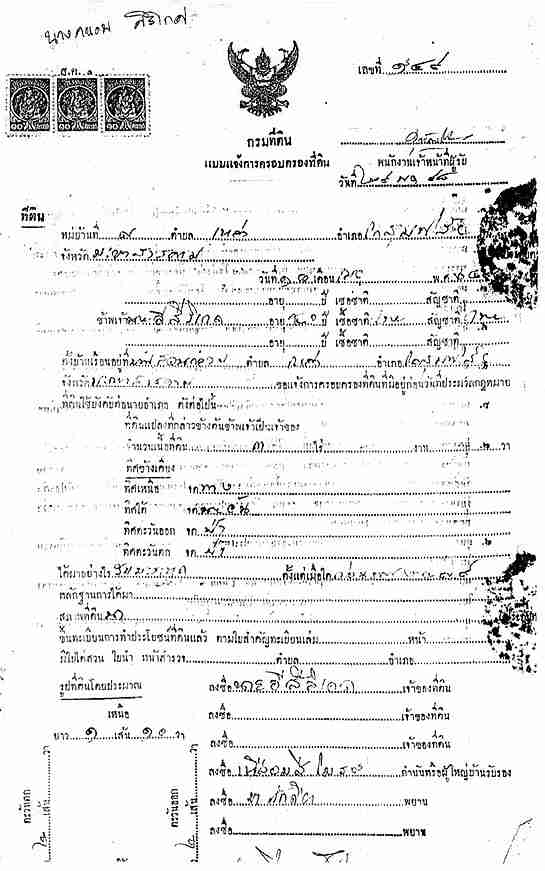
Example of Sor Kor 1 title deed.
Transfer Limitations: SK1 cannot be transferred through the Land Office registration system. Possession is typically transferred by physical handover of the document, which provides zero legal protection to the buyer.
Upgrade Process: Upgrading SK1 to a Chanote now requires a Civil Court petition with comprehensive evidence of continuous, uninterrupted land use since the Land Code era. This is a protracted, expensive legal process with no guaranteed outcome.
4. Category 2: Agricultural Reform Land (ที่ดิน ส.ป.ก. 4-01)
❌ Verdict: PROHIBITED for Foreigners, Non-Starter
SPK 4-01 land is allocated exclusively to qualifying Thai farmers by ALRO. It cannot be sold, leased to foreigners, mortgaged commercially, or used for non-agricultural purposes. Even the 2024-2026 “agricultural Chanote” conversions retain these restrictions.
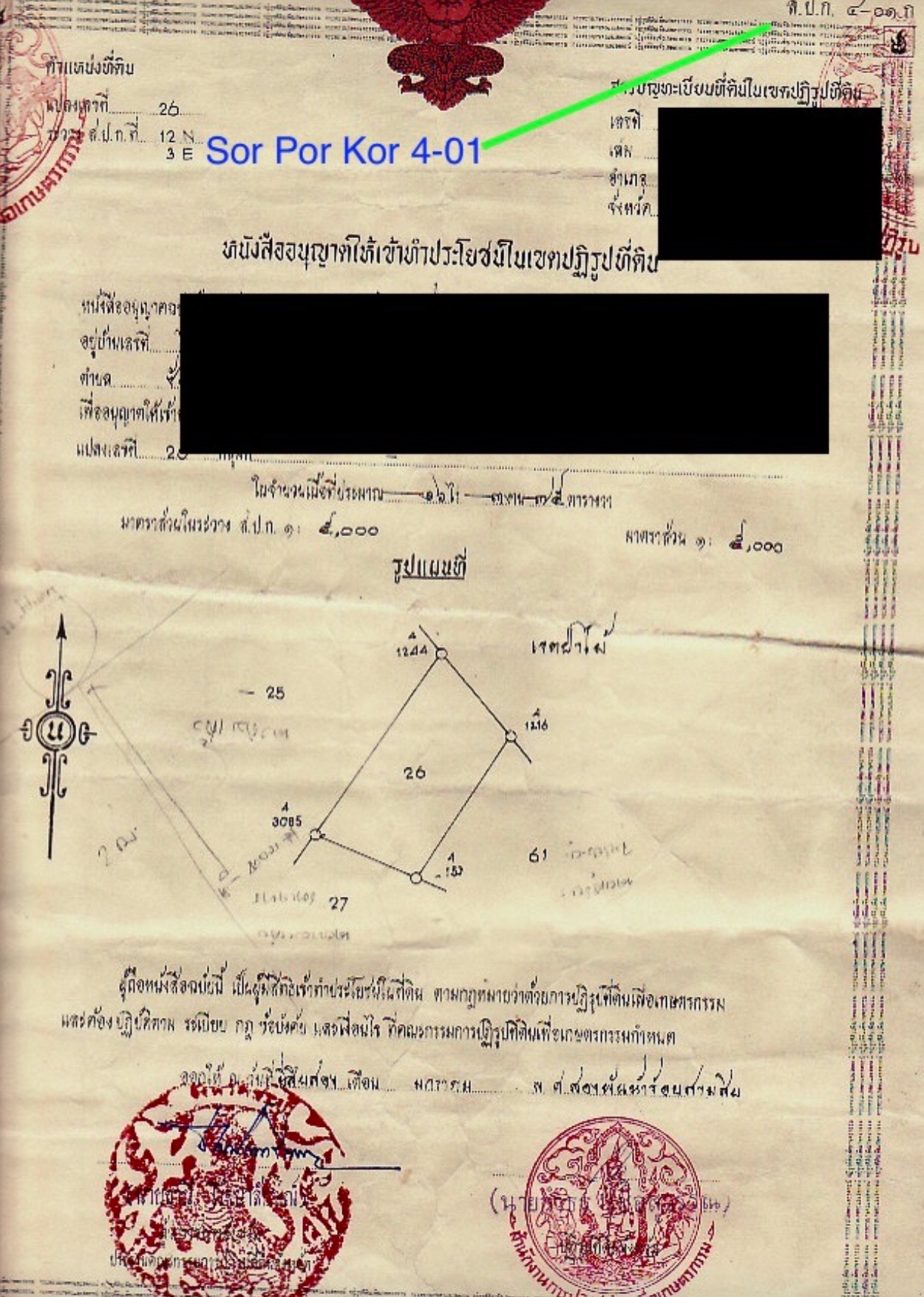
This is an example of Sor Por Kor 4-01. (ส.ป.ก. 4-01).
SPK 4-01 (ส.ป.ก. 4-01) is issued under the Agricultural Land Reform Act B.E. 2518.It is managed by the Agricultural Land Reform Office (สำนักงานการปฏิรูปที่ดินเพื่อเกษตรกรรม / สปก.). This land was originally state-owned forest or public land allocated to impoverished Thai farmers for agricultural use.
Strict Transfer and Use Restrictions
Under Section 39 of the Agricultural Land Reform Act, people who get SPK land rights cannot transfer them to others. The only permitted transfer is by inheritance to qualifying heirs who are themselves practicing Thai farmers. The Supreme Court has upheld these restrictions:
Supreme Court Authority: In คำพิพากษาศาลฎีกาที่ 9780/2539 (Decision No. 9780/2539), the Supreme Court confirmed that Section 39 of the Agricultural Land Reform Act prohibits the transfer of SPK land rights. The Royal Decree designating agricultural reform zones also operates to withdraw the land from public domain status, placing it under ALRO control with strict usage conditions.
The 2024-2026 “Agricultural Chanote” Conversion
The Thai government announced a program to convert approximately 1.62 million SPK documents to โฉนดเพื่อการเกษตร (“agricultural title deeds”). Despite the “Chanote” label, these converted documents retain all agricultural use and transfer restrictions. They are NOT equivalent to regular Chanote deeds. Foreigners cannot legally lease, purchase, or benefit from SPK land in any form.
Expat Trap: If a broker offers beachfront or prime farmland at an unusually low price, check if it is SPK 4-01 land. Any claimed sale of SPK land to foreigners is illegal. ALRO will confiscate the land. The buyer will have no legal recourse.
5. Category 3: Treasury Department Land (ที่ราชพัสดุ)
⚠️ Verdict: LEASE ONLY, Special Government-Owned Land
Ratchaphatsadu (ที่ราชพัสดุ) land is owned by the Thai state and managed by the Treasury Department. It cannot be purchased, but can be leased under strictly regulated terms. Many prominent properties in Bangkok sit on Ratchaphatsadu land.
Treasury land (ที่ราชพัสดุ), governed by the Ratchaphatsadu Land Act B.E. 2518 (1975) and its successor B.E. 2562 (2019), is state-owned property managed by the Treasury Department (กรมธนารักษ์) under the Ministry of Finance. This category includes government buildings, military installations, and commercial land leased to private parties.
Lease Terms: Under Ministerial Regulation B.E. 2545, residential leases may not exceed 30 years. Commercial and industrial leases may last up to 50 years. The Ratchaphatsadu Land Committee (คณะกรรมการที่ราชพัสดุ) must approve all leases and renewals.
Foreigners and Ratchaphatsadu: Foreign individuals generally cannot lease Ratchaphatsadu land directly. However, foreign-majority companies with Board of Investment (BOI) promotion may negotiate commercial leases with Treasury approval.Joint ventures with Thai majority control may also negotiate these leases. For more on foreign ownership restrictions in Thailand, see our dedicated guide.
Read More: For a comprehensive guide to Ratchaphatsadu land law including lease procedures, fees, Supreme Court decisions, and the 99-year lease proposal, see our dedicated article: Ratchaphatsadu Land in Thailand: Complete Legal Guide.
6. Category 4: Land Without Title Deeds (ที่ดินไม่มีเอกสารสิทธิ์)
❌ Verdict: AVOID ENTIRELY, Zero Legal Protection
Land in this category has no Land Department title deed. The most common document encountered is the Por Bor Tor 5 (ภ.บ.ท.5), which is a local tax receipt, NOT a land title. The Land Department will refuse to register any transaction on such documents.
6.1. Por Bor Tor 5 (ภ.บ.ท.5), The “Grass Tax” Receipt
The Por Bor Tor 5 (ภ.บ.ท.5) is issued by the Subdistrict Administrative Organization (องค์การบริหารส่วนตำบล / อบต.). It is a record of local maintenance tax payments. It is NOT a title deed and does NOT prove land ownership. It merely records that someone paid a nominal “grass tax” (ภาษีบำรุงท้องที่) on a piece of land. For an in-depth analysis, read our dedicated guide on Por Bor Tor 5 in Thailand.
ResultWhat PBT5 Cannot Do: The Land Department will not register these for PBT5 land. It will not register a sale. It will not register a lease. It will not register a mortgage. It will not register a usufruct. It will not register a superficies. There is no back-page encumbrance index. Transfer is done informally by crossing out one taxpayer’s name and writing another at the SAO office. This process has no legal weight.
The Island Scam: PBT5 scams are common on tourist islands like Koh Samui, Koh Chang, and Koh Phangan. Cheap “sea-view land” is often offered to unsuspecting foreigners. Agents promise that government upgrades to Chanote are “imminent.” In reality, much PBT5 land overlaps with national park, forest reserve, or military zones, making any upgrade legally impossible.
6.2. Nor Kor 3 (นค.3), Old Surveyed Plots
Nor Kor 3 documents represent old survey-based land records that pre-date the modern titling system. They are encountered infrequently and carry similar limitations to SK1 documents in terms of registrability.
7. Master Comparison Table: All Thai Land Documents
| Document | Thai Name | Garuda Color | Issuing Authority | Legal Nature | Survey Type | Registrable Rights | Public Notice | Upgrade Path | Expat Risk |
|---|---|---|---|---|---|---|---|---|---|
| Chanote (NS4J) | โฉนดที่ดิน น.ส.4 จ. | Red 🔴 | Dept. of Lands | Full Ownership (กรรมสิทธิ์) | GPS + Concrete markers | All (sale, lease, mortgage, usufruct, superficies) | No | N/A (highest) | Lowest |
| NS3G | น.ส.3 ก. | Green 🟢 | Dept. of Lands | Confirmed Possession (สิทธิครอบครอง) | Aerial survey points | All (sale, lease, mortgage, usufruct, superficies) | No | Chanote (petition + GPS survey) | Low-Med |
| NS3 | น.ส.3 | Black ⚫ | Dept. of Lands | Right of Possession (สิทธิครอบครอง) | Unsurveyed | Yes (with 30-day notice) | Yes (30 days) | NS3G → Chanote | High |
| SK1 | ส.ค.1 | None | Dept. of Lands (ceased 1972) | Notification only (ไม่ใช่เอกสารสิทธิ์) | Vague description | No | N/A | Court order required | Extreme |
| SPK 4-01 | ส.ป.ก. 4-01 | Blue/Red | ALRO (สปก.) | Agricultural allotment (สิทธิทำกิน) | Varies | No (sale/lease prohibited) | N/A | “Agri Chanote” (restricted) | Prohibited |
| Ratchaphatsadu | ที่ราชพัสดุ | N/A | Treasury Dept. (กรมธนารักษ์) | Government-owned (lease only) | Government registry | Lease only (max 30-50 yrs) | Committee approval | N/A (state land) | Special |
| PBT5 | ภ.บ.ท.5 | None | SAO (อบต.) | Tax receipt only (ไม่ใช่เอกสารสิทธิ์) | None | No | N/A | Uncertain (usually impossible) | Scam Risk |
8. Understanding the Garuda Emblem Colors (ตราครุฑ)
The Garuda (ครุฑ) is the mythical half-bird, half-human emblem of the Thai government. Its color on a land document serves as an immediate visual indicator of the document’s legal standing:
| Garuda Color | Document | Meaning | Quick Guide |
|---|---|---|---|
| 🔴 Red Garuda | Chanote (NS4J) | Full freehold ownership, GPS surveyed | The only document conferring กรรมสิทธิ์ (ownership) |
| 🟢 Green Garuda | NS3G | Confirmed possessory right, aerial surveyed | Strong but not ownership; upgradeable to Chanote |
| ⚫ Black Garuda | NS3 | Basic possessory right, unsurveyed | High risk; requires 30-day notice for any transaction |
Documents without a Garuda emblem (SK1, PBT5) are not title deeds and should be treated with extreme caution.
9. Land Office Registration Rules Expats Must Know
9.1. Transfers Must Be Registered (การโอนต้องจดทะเบียน)
Under Land Code Section 4 bis, any transfer of ownership or possessory rights to land must be in writing. This rule applies to land with a Title Deed or Utilization Certificate. The transfer must also be registered with the proper official. A private contract or MOU alone is not legally enough. The official Tor Dor 13 (ท.ด.13) transfer agreement must be signed at the Land Office. The registrar must be present.
9.2. Leases Over 3 Years Must Be Registered (เช่าเกิน 3 ปีต้องจดทะเบียน)
Under CCC Section 538, a lease of immovable property for more than three years is enforceable for only three years. This applies unless the lease is in writing and registered by the proper official. This is critical for expatriates relying on 30-year leases, an unregistered lease provides virtually no protection. Be aware that 90-year leases are a myth, and understand the reality of automatic lease renewals in Thailand.
9.3. Usufructs and Superficies Must Be Registered
A usufruct (สิทธิเก็บกิน) under CCC Section 1417 and a right of superficies (สิทธิเหนือพื้นดิน) under CCC Section 1410 are registered real rights used by foreigners to secure long-term use of land. Without registration, these rights have no legal effect. Also consider the right of habitation, servitude, and Sap Ing Sith as additional real rights available to foreigners. For a cost breakdown, see usufruct agreement costs for foreigners.
Supreme Court Authority: In Supreme Court Decision No. 895/2510 (คำพิพากษาศาลฎีกาที่ 895/2510), the Court ruled that, “a right of superficies is a real right (ทรัพยสิทธิ).” It must be registered with the proper official to be legally valid Without registration, a person who builds on another’s land has no right of superficies and no real right in that land.” This ruling is binding authority that every expatriate building on leased land must understand.
9.4. Fees and Taxes at Transfer
The Department of Lands publishes fee and tax guidance for land transactions. Common parts include a 2% transfer fee, a business tax or stamp duty based on holding time, and withholding tax. A reduced rate of 0.01% applies until 30 June 2027 on qualifying residential property up to 7 million baht, but only where the buyer is an individual Thai national, so foreign buyers should budget the full 2%. Exact amounts depend on the seller type, holding period, and property classification. Always confirm at the local Land Office using the Department of Lands fee calculator as a starting point. For step-by-step guidance, see our article on transferring property in Thailand.
10. The Essential Due Diligence Workflow for Expatriates
For the full methodology, read our comprehensive due diligence guide for Thailand.
Step 1: Identify the Document and Issuing Authority
Use the comparison table above. If the document is anything other than a Chanote or NS3G, apply heightened due diligence or walk away.
Step 2: Preliminary Map Check (LandsMaps, Not Legal Proof)
The Department of Lands’ LandsMaps system shows parcel shapes and basic information. However, the Department explicitly warns that LandsMaps is not legal evidence. It is a useful starting point, nothing more.
Step 3: Land Office Registry Verification (ตรวจสอบเอกสารที่กรมที่ดิน)
The Department of Lands will confirm who holds the rights. It will confirm how the owner acquired them. It will list all registered encumbrances, like mortgages, leases, and usufructs. It will confirm any court seizures. It will confirm if it issued a replacement deed. This applies to Chanote and utilization certificates.
Step 4: Scrutinize the Back-Page Encumbrance Index
The back of a Chanote or NS3G reveals the complete registration history. Look for registered mortgages (จำนอง) and registered leases (เช่า). Look for lifetime usufructs (สิทธิเก็บกิน) and court seizures (อายัด). Also look for any notes that restrict transfer.
Step 5: Physical Boundary Verification
For Chanote land, physically locate the concrete boundary markers and verify they match the deed map. If markers are missing or displaced, request a resurvey from the Land Office before proceeding. For NS3G land, an independent surveyor should correlate the aerial survey points with the physical ground.
When to Walk Away: End the transaction right away if: (1) the seller refuses a Land Office search. (2) The deed shows unpaid mortgages or seizures. (3) Boundary markers are missing, and the seller pushes closing without a new survey. (4) The encumbrance index shows a lifetime usufruct for someone else. (5) The claimed owner does not match the registered owner.
11. Supreme Court Decisions: Legal Authority on Title Deeds
The following Thai Supreme Court (ศาลฎีกา) decisions provide binding legal authority on key title deed issues. These rulings strengthen the guidance in this article and demonstrate the real-world consequences of property law violations.
11.1. Adverse Possession on Chanote Land
คำพิพากษาศาลฎีกาที่ 3035/2526
Topic: Adverse Possession (ครอบครองปรปักษ์) on Chanote-titled Land
The plaintiff owned Chanote-titled land (deed No. 310) and sued to remove the defendant’s fence encroaching on the property. The defendant counterclaimed adverse possession, stating they had openly occupied the disputed area for over 20 years with the intention of ownership. The Supreme Court confirmed that a defendant may claim ownership by adverse possession. They must prove peaceful, open, and continuous possession of Chanote land for 10 years. This must meet the requirements of CCC Section 1382.This rule can apply even against a registered Chanote holder.
Practical Lesson: Even Chanote ownership is not absolute. Expatriates must physically inspect and maintain their land. Fencing, signage, and regular visits prevent adverse possession claims.
11.2. Foreign National Land Ownership
คำพิพากษาศาลฎีกาที่ 981/2524
Topic: Foreigner’s Right to Acquire Land (คนต่างด้าว กรรมสิทธิ์ที่ดิน)
The Supreme Court held that a foreigner may own land with the Minister’s permission. This is allowed under Land Code Section 86, paragraph 2. A contract to buy land is not void just because permission is pending. However, the foreigner cannot transfer ownership without the Minister’s approval. The Court also confirmed that the foreigner’s unmarried partner living on the property was a “servant” (บริวาร).The partner was not seen as an independent occupant.
Practical Lesson: Land purchase contracts by foreigners are legally valid but cannot result in ownership without rare ministerial approval. This is why foreigners use registered leases, usufructs, and superficies instead of attempting outright purchase. For the full picture, see foreigners buying land in Thailand and can foreigners own a house in Thailand.
11.3. Right of Superficies Requires Registration
คำพิพากษาศาลฎีกาที่ 895/2510
Topic: Unregistered Superficies Has No Legal Effect (สิทธิเหนือพื้นดินต้องจดทะเบียน)
The plaintiff claimed a right of superficies to build on temple land (Wat Yuan, Sam Sen). However, the plaintiff never registered this right with the proper official. The Supreme Court ruled clearly: a right of superficies is a real right (ทรัพยสิทธิ).It must be registered to be legally valid. Without registration, the builder has no real right in the land. When the building was seized and sold at auction, the plaintiff had no standing to prevent its removal.
Practical Lesson: Expatriates who build villas on leased land MUST register both the lease AND the superficies at the Land Office. Verbal permission from the landowner provides zero legal protection. Learn more about building permits as proof of ownership for foreigners.
11.4. NS3 Fraud by Impersonation
คำพิพากษาศาลฎีกาที่ 863/2513
Topic: Impersonating the Registered Owner of NS3 Land (แสดงตนเป็นเจ้าของที่ดินตาม น.ส.3)
The defendants worked together to defraud the plaintiff. The second defendant held himself out to the plaintiff as Mr Chaweng Sae Phu, the registered owner of the NS3 land. No document was forged. Believing him, the plaintiff issued a property guarantee certificate, which was then used to obtain bail for a third party before the court. The Supreme Court noted that the defendants gained no property themselves, and held that obtaining the benefit for someone else is dishonest just the same. They were convicted of fraud by impersonation under Criminal Code Sections 341, 342 and 1(1).
Practical Lesson: Always verify the seller’s identity against the Land Office registry. Never accept photocopies of title deeds as proof, demand to see the original at the Land Office.
11.5. Forged Chanote Title Deed
คำพิพากษาศาลฎีกาที่ 5048/2530
Topic: Use of Forged Chanote to Obtain Money (ใช้โฉนดปลอม)
The defendants used a forged Chanote title deed to trick the victim into lending 300,000 Baht. The recorded decision says they used a deed that had been forged; it does not say who forged it. They took the fake deed as collateral. The Supreme Court convicted the defendants for using a forged official document (เอกสารราชการปลอม). It also found that they committed fraud. The Court ruled it was one act that broke several laws. This falls under Criminal Code Section 90.
Practical Lesson: Title deed forgery is a criminal offense in Thailand. Always verify deed authenticity at the Land Office before transferring any money. A Tor Dor 15 title search will reveal discrepancies between a presented deed and the official registry.
11.6. SPK/ALRO Land Transfer Prohibition
คำพิพากษาศาลฎีกาที่ 9797/2558
Topic: ALRO Land Reform Zone Does Not Extinguish Pre-Existing Rights
The Supreme Court ruled that declaring an agricultural reform zone under Section 26 is valid. This section is part of the Agricultural Land Reform Act B.E. 2518. It gives ALRO the power to manage the land.But it does not cancel rights lawfully gained before the Act took effect. However, persons who received SPK land allotments have no authority to transfer those allotments outside the ALRO framework. Only ALRO itself can initiate title challenges.
Practical Lesson: If land existed as private property before the ALRO zone was declared, the original rights survive. But land allocated by ALRO under SPK 4-01 remains permanently restricted.
11.7. NS3 Boundary Disputes
คำพิพากษาศาลฎีกาที่ 4423/2534
Topic: Boundary Dispute on NS3 Land (พิพาทเขตที่ดิน น.ส.3)
The plaintiff claimed bamboo trees on their NS3 land were cut by the defendant. The defendant had a long-standing dispute over the same boundary and believed the trees were on their own land. Because each side genuinely claimed the trees as their own, the Supreme Court held the matter to be a civil dispute over ownership rather than a criminal one, and that cutting the trees was therefore not theft under Section 334 of the Penal Code.
Practical Lesson: NS3 boundaries are inherently unreliable. Before purchasing NS3 land, require a boundary confirmation with all adjoining landowners. If any neighbor refuses, walk away.
Summary of Supreme Court Authority
| Decision No. | Year (B.E.) | Topic | Key Ruling |
|---|---|---|---|
| 3035/2526 | 2526 | Adverse Possession | An adverse-possession counterclaim is directly related to the owner’s claim and must be accepted |
| 981/2524 | 2524 | Foreigner Land | Contract valid but transfer requires ministerial permission |
| 895/2510 | 2510 | Superficies | Must be registered to be legally valid; no registration = no rights |
| 863/2513 | 2513 | NS3 Fraud | Impersonating the registered owner of NS3 land is fraud under ss.341 and 342, even where the defendant gains nothing himself |
| 5048/2530 | 2530 | Forged Chanote | Forged Chanote used for collateral = criminal fraud + forgery |
| 9797/2558 | 2558 | ALRO Land | ALRO zone does not extinguish pre-existing private rights |
| 9780/2539 | 2539 | SPK Transfer | Section 39 prohibits transfer of SPK allotments |
| 4423/2534 | 2534 | NS3 Boundary | Where both sides genuinely claim ownership, cutting the disputed trees is a civil matter and not theft under s.334 |
| 997/2531 | 2531 | Farm Lease | Pre-existing tenant rights survive sale of leased farmland |
12. Thai Land Measurements: Rai, Ngan, Wah (ไร่, งาน, ตารางวา)
All Thai title deeds express land area using the traditional Thai measurement system. Understanding this system is essential for reading title deeds and negotiating property transactions. For a complete reference, see our measurements in Thailand guide.
| Thai Unit | Thai Script | Equals | Metric Equivalent | Imperial Approx. |
|---|---|---|---|---|
| 1 Square Wah | 1 ตารางวา | 1 sq wah | 4 sqm | 43 sq ft |
| 1 Ngan | 1 งาน | 100 sq wah | 400 sqm | 0.099 acres |
| 1 Rai | 1 ไร่ | 4 Ngan = 400 sq wah | 1,600 sqm | 0.395 acres |
Quick Conversion: 1 acre ≈ 2.53 Rai. 1 hectare = 6.25 Rai. These measurements appear on the front page of every Chanote and NS3G document in the format: [X] Rai [Y] Ngan [Z] Square Wah.
13. Common Property Scams Targeting Expatriates
13.1. Selling PBT5 as a “Title Deed”
Unscrupulous agents sell PBT5 tax receipts as real title deeds. They promise, “the government will upgrade it to Chanote soon.” This is almost always false. This is especially true on tourist islands, where land often overlaps protected forests or national park boundaries.
13.2. SPK 4-01 Offered “For Sale”
Agricultural reform land is promoted as cheap investment opportunities. Any claimed sale of SPK land breaks the Agricultural Land Reform Act. It may lead to confiscation and criminal prosecution.
13.3. Forged Title Deeds
The Supreme Court has convicted defendants for using a forged Chanote as loan security in Decision 5048/2530. Decision 863/2513 is a different offence on the same theme: no document was forged there, the defendant simply impersonated the registered owner of NS3 land. These are serious offenses under Thai criminal law. Always verify deed authenticity at the Land Office before transferring any money.
13.4. Nominee Company Structures
Using Thai shell companies (nominee structures) to hold land for foreigners breaks the Foreign Business Act B.E. 2542. The 2024-2025 government crackdowns carry penalties of up to three years imprisonment and confiscation of the property. Read about Thai nominee shareholders and the recent crackdowns on nominees in Thailand.
13.5. Pre-Agreed “30+30+30” Lease Renewals
For decades, agents sold the concept of three consecutive 30-year leases totaling 90 years. However, pre-agreed lease renewals have no legal enforceability under Thai law. CCC Section 540 caps the maximum lease term at 30 years. Each renewal requires a new agreement between willing parties and fresh registration. See our detailed analysis: 90-Year Lease in Thailand: Myth vs Reality.
14. How to check a title deeds in Thailand and Obtaining Land Documents from the Land Department
In Thailand, the official government body is the Land Department, known formally in Thai as Krom Teedin (กรมที่ดิน). When talking about the local or provincial offices where you do business, people often use the term Samnak Ngan Tee Din (สำนักงานที่ดิน). This means ‘Land Office’. They issue official title deeds. They keep land records and oversee land surveys. They handle property transfers and ensure compliance with land laws. Any transaction involving land registration, verification, or transfer must go through the relevant local or provincial Land Department office.
Obtaining land documents in Thailand involves a formal procedure that requires interaction with the land department. Interested parties must request the land documents they need. These may include title deeds in Thailand, survey maps, and ownership history.
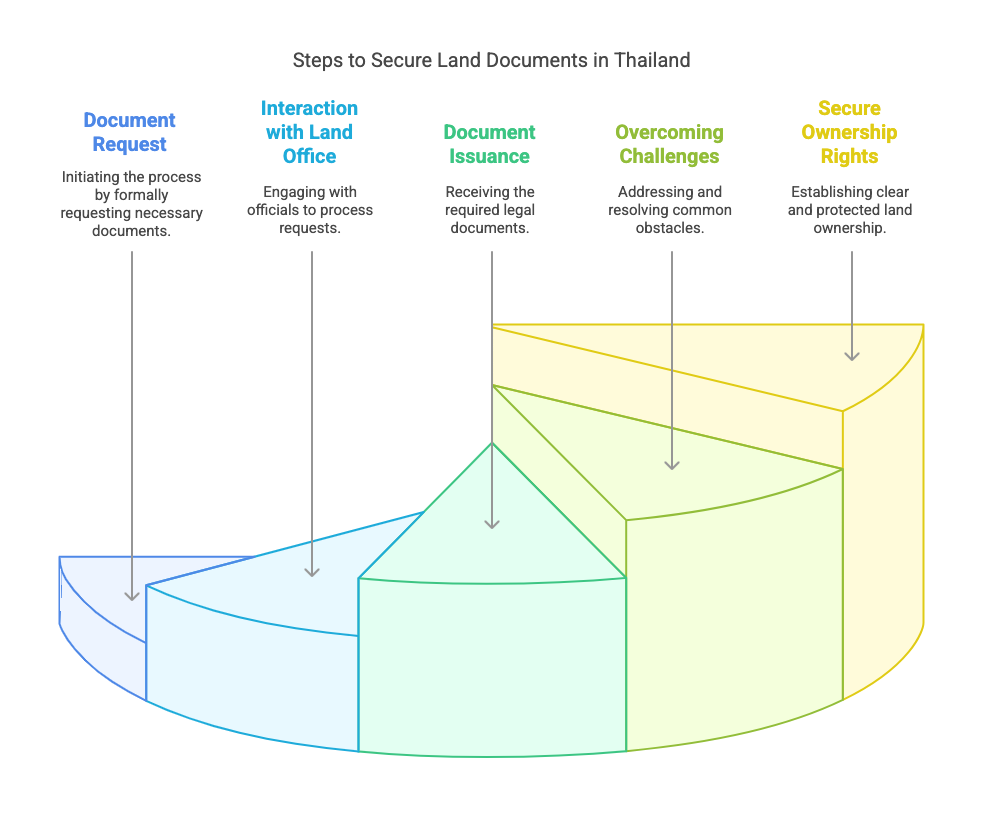
The land department issues a variety of documents to support land ownership and transactions in Thailand. These include title deeds in Thailand, land surveys, and official maps that delineate the boundaries of the land. Each document is important for defining the rights and duties of landowners.
Transferring land ownership requires a formal process at the Land Department. Both buyer and seller must be present (or represented by power of attorney). Key steps include submitting the original title deed, sale agreement, ID documents, and paying applicable transfer fees and taxes. The Land Department reviews the documents. They register the transfer. Then, they update the title deeds in Thailand with the new owner’s name. This officially recognizes their right to the land.
15. Frequently Asked Questions About Title Deeds in Thailand
Can a foreign national legally own land in Thailand?
Under the Land Code Act B.E. 2497, foreigners cannot own land.They can only own land with ministerial approval under Section 86.This approval is extremely rare. The Supreme Court confirmed in Decision No. 981/2524 that a foreigner’s purchase contract is valid. However, ownership cannot transfer without the minister’s permission. In practice, foreigners use registered leases (max 30 years), usufructs, or rights of superficies on Chanote-titled land. See our guide on foreigners buying land in Thailand. There are other special laws allowing foreigners to buy land, like a 40 million baht investment or under the BOI.
What is the difference between a Red Garuda and a Green Garuda title deed?
The Red Garuda (ครุฑแดง) appears on Chanote deeds and signifies full freehold ownership with GPS-surveyed boundaries. The Green Garuda (ครุฑเขียว) appears on NS3G documents and represents a confirmed possessory right based on aerial surveys. Chanote confers กรรมสิทธิ์ (ownership); NS3G confers สิทธิครอบครอง (possessory right). Both allow registration of real rights.
What happens to a 30-year registered lease if the Thai landowner dies?
A registered lease under CCC Section 538 survives the death of the lessor and binds all subsequent owners, including heirs. This is precisely why registration is essential, an unregistered lease over three years provides no such protection.
Can a foreign spouse inherit Chanote land?
Yes, a foreign spouse can inherit land under Thai succession law, but must dispose of the land within one year under Land Code Section 94. During that year the foreigner holds legal ownership but cannot retain it permanently. Typically, the land is sold and the proceeds kept, or transferred to a Thai child. See our guide to inheriting property as a foreign hei.
Is Por Bor Tor 5 (PBT5) a real title deed?
No. PBT5 is a local tax receipt issued by the SAO (อบต.), not a title deed. The Land Department will not register any transaction on PBT5 land. It provides zero legal proof of ownership and zero protection for buyers. Do note that since Thailand’s Land and Building Tax Act B.E. 2562 (2019), this replaced older property tax systems. So Por Bor Tor is now called Por Dor Sor 3 (PTD3).
Can foreigners lease or buy SPK 4-01 land?
Q: Can foreigners lease or buy SPK 4-01 land?
No. SPK 4-01 is agricultural reform land controlled by ALRO, strictly allocated to qualifying Thai farmers. Sale, lease to foreigners, and commercial use are all prohibited. The Supreme Court (Decision 9780/2539) confirmed these transfer restrictions under Section 39 of the Agricultural Land Reform Act.
Is the LandsMaps online system sufficient for due diligence?
No. The Department of Lands explicitly states that LandsMaps provides basic preliminary information only and is not legal evidence. A proper search requires physical verification at the Land Office to confirm ownership, encumbrances, seizures, and document authenticity.
What is adverse possession and how does it affect Chanote land?
Under CCC Section 1382, peaceful, open possession of Chanote land for 10 continuous years may result in ownership transfer by court order. In Supreme Court Decision 3035/2526 the Court held that where a defendant pleads adverse possession of the disputed land, that counterclaim is directly related to the owner’s claim and must be accepted, so ownership is decided in the same case. For NS3 land, the risk is even greater: CCC Section 1375 allows loss of possessory rights after just one year of dispossession. It is also called acquisition by prescription in some legal systems including some civil law systems.
Must a Right of Superficies be registered at the Land Office?
Yes. The Supreme Court ruled in Decision No. 895/2510 that a right of superficies must be registered to be legally valid. Without registration, a person building on another’s land has no legal right of superficies and no real right in the land. This applies even if the landowner gave verbal permission.
What is the Tor Dor 13 and why is it essential?
The Tor Dor 13 (ท.ด.13) is the official Garuda-stamped Land Office Sale and Purchase Agreement. Under Land Code Section 4 bis, land transfer must be in writing and registered by the competent official. A private sale contract is legally insufficient, only the Tor Dor 13 executed at the Land Office effects a valid transfer.
What is Ratchaphatsadu (ที่ราชพัสดุ) land?
Ratchaphatsadu is government-owned land managed by the Treasury Department (กรมธนารักษ์). It cannot be purchased, only leased. Many prime properties in Bangkok sit on Ratchaphatsadu land. Residential leases are capped at 30 years, commercial at 50 years. See our complete Ratchaphatsadu guide.
Understanding Encumbrances and Registered Rights
Title deeds also record important limitations or third-party rights, known as encumbrances. These can include mortgages (Jumnong), leases (Chao), rights of habitation (Sithi Ar-sai), or usufructs (Sithi Keb Kin). It’s important to check the back of the title deed during due diligence. This is because registered rights can affect the owner’s control and the property’s value. Certain rights, like usufruct rights or superficies rights in Thailand, cannot be registered on lower-tier documents. This includes possessory rights titles.
In summary, Thai land title deeds show different levels of rights and security. Chanote (NS4J) provides the best protection. Understanding the specific type of deed associated with a property is fundamental to making an informed purchase decision. Always prioritize comprehensive due diligence and seek professional legal advice.
For expert assistance with property due diligence, title deed verification, and secure land acquisition in Thailand, contact ThaiLawOnline today.
Links:
Reading a deed is one thing, verifying it at the Land Office is another. Title due diligence is the first item in our fixed-fee property packages.
Last reviewed: 5 September 2026. Checked against primary sources and corrected: the one-year rule for losing possession of Nor Sor 3 land is Civil and Commercial Code section 1375, not section 1374 – s.1374 governs disturbance of possession, s.1375 governs dispossession – and the adverse-possession case was cited by a number whose two components had been transposed, so it now reads 3035/2526. That case was also read to its disposition and does not hold what it was cited for: the Supreme Court decided that a defendant’s adverse-possession counterclaim is directly related to the owner’s claim and must be accepted, not that ten years’ possession transfers ownership. Verified as correct and left alone: CCC ss.538, 540, 1382, 1410 and 1417, and Penal Code s.90. Not verified against a primary source, and stated here so the date above does not imply more than it should: the Land Code section numbers, the Agricultural Land Reform Act references, the Ratchaphatsadu Land Act reference, the deed-type descriptions, and the transfer-cost figures. One of those needs a reader’s care in the meantime: the 0.01% transfer and mortgage fee applies only where the buyer is an individual Thai national, so a foreign buyer registering under the foreign quota budgets the full 2%, which this page already says and which is worth not losing.
Thai Law Updates, free by email
Plain-English updates on Thai law changes that affect foreigners: property, visas, marriage, business and wills. One short email a month from a firm practicing since 2006. No spam, unsubscribe anytime.