


Reviewed by Wichuda Atthamethakon, LL.M., Thai Bar Licence 3149/2556, for ThaiLawOnline, a Thai law firm acting for foreigners since 2006.
Update log
- 2 November 2026: Added the statute box with Thai, English and French text and checked the page against the official text
Update, 31 August 2026: it is now law. The Ministry of Interior announcements were published in the Royal Gazette on 31 August 2026 and take effect on 15 September 2026. From that date the visa-exemption period referenced below drops from 60 to 30 days for a final list of 60 countries and territories (tourism only, one 30-day extension), and Visa on Arrival narrows to Azerbaijan, Belarus and Serbia (not India, which made the exemption list). The announcement also writes the border-run limit into the exemption itself: a maximum of two visa-exempt land-border entries per calendar year, with nationals of Malaysia, Brunei, Indonesia and Singapore excepted. Travelers admitted before 15 September 2026 keep their 60-day stamp, and immigration can still refuse anyone who appears to be living in Thailand on tourist stamps. Full details in our article on the new visa rules in Thailand and our Tourist Visa Guide.
If you are relying on repeated entries, a proper long-stay route is usually cheaper: compare them with our Thai visa finder.
If you have been using “border runs” to stay in Thailand, you need to pay attention. Since late 2024 Thai Immigration has run a sustained crackdown on what it calls “visa abuse.” Since 15 September 2026 the land-border limit is written into the Ministry of Interior announcements published in the Royal Gazette on 31 August 2026, and it is set out below. Understanding the new Border Runs Limits in Thailand is essential for maintaining your stay legally.
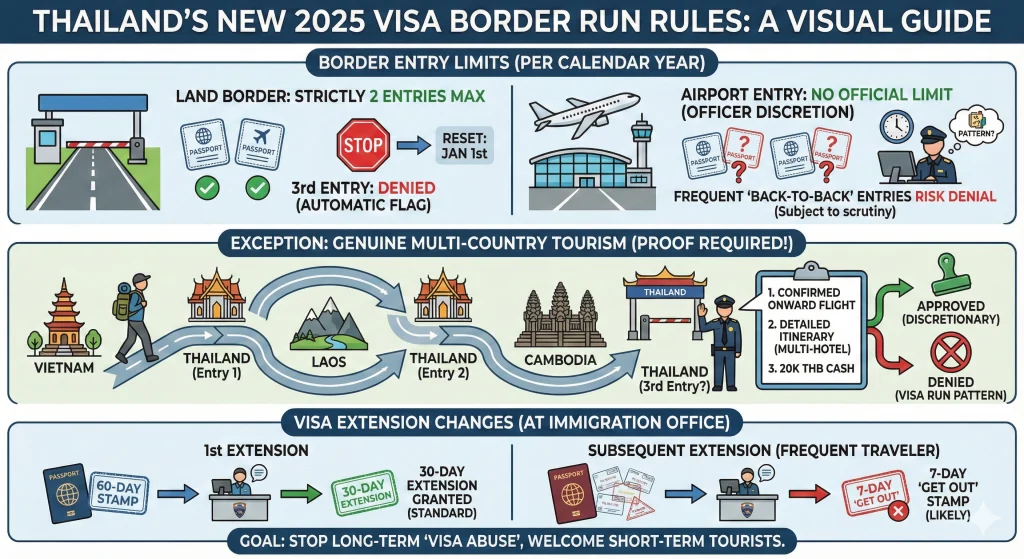
In July 2024, Thailand opened to 93 countries that can come to Thailand for 60 days and can extend to 30 days (that scheme ended on 14 September 2026; from 15 September 2026 the stamp is 30 days for 60 countries). Sometimes, they will deny your 30 days if they think you exaggerated and you get only 7 days (denied extension), not 30. Most blogs still say you can extend 30 days every time. However, in November 2025 the government announced that this would be limited. The Thai Examiner explains the situation here and here’s the government website where they do write that it is limited to two. However, seasoned expats will know this is not a new phenomenon. It is the latest, and strictest, enforcement of laws that have existed for over a decade.
The November 2025 announcement worried travelers. They are used to the more relaxed entry rules from before. Understanding the rules about border runs in Thailand is important. This is especially true for anyone planning to visit or stay for a long time. Be aware of how the Border Runs Limits in Thailand are evolving as regulations tighten. This history illuminates the reasoning behind current Border Runs Limits in Thailand.
Poipet Warning
According to recent posts, Poipet (Cambodia) border has the highest rejection rate for “valid reason” claims.
Last reviewed: 3 September 2026. The two-entry land-border cap and the 15 September 2026 change are stated as the Ministry of Interior announcements published in the Royal Gazette on 31 August 2026 record them, consistent with the rest of this site’s visa cluster. Police Order 327/2557 is named here as the instrument behind the valid-reason refusals as a matter of record. ⚠️ It was repealed on 26 September 2023 by Order of the Royal Thai Police No. 542/2566, and the criteria passed to the Commissioner of the Immigration Bureau, first under Immigration Bureau Order No. 242/2566 from 30 September 2023 and now under Immigration Bureau Order No. 12/2568 of 23 January 2025, both of which we have read. The refusal power an officer exercises at the border comes from the Immigration Act itself, not from that order, so the account below is unaffected; what is corrected is the citation.
This review does not certify the border-specific practice described below, including the refusal rates at particular crossings and the seven-day extension reports, which are traveller accounts rather than published rules, nor the discretionary criteria an officer applies, which are by definition not fixed.
Table of Contents
Understanding Border Runs Limits in Thailand
1. This Has Happened Before: A History of “Crackdowns”
To understand why this is happening now, you must look at the legal history. Thailand does not create new laws for these crackdowns. They enforce refusal grounds already written into section 12 of the Immigration Act, through police and Immigration orders. These orders are often ignored during times of leniency, like after COVID when tourism is recovering.
- 2014: The “Out-In” Ban (Police Order 327/2557) After the 2014 coup, the “Out-In” practice was officially banned. This practice involved walking across a border and then turning back right away. Police Order 327/2557, in force from 29 August 2014, set the criteria for extensions of stay (it has since been replaced by Immigration Bureau Order 12/2568); the power to refuse entry comes from section 12 of the Immigration Act, and officers applied it to repeated out-in entries. This change ended the practice of unlimited monthly border runs.
- In December 2016, a new rule was introduced. It limits you to two land entries each year. It wasn’t invented in 2025. It was designed specifically to stop foreigners from living in Thailand on visa-exempt stamps while working illegally.
- 2018: “Good Guys In, Bad Guys Out”Under previous immigration leadership, a massive sweep saw thousands of overstayers arrested. The current 2025 crackdown is a return to this strict strictness after the “relaxed” COVID years (2020-2023).
The Takeaway: This is not a sudden change; it is the “pendulum swinging back.” If you argue with an officer that “it was fine last year,” you are flagging yourself as someone who doesn’t understand Thai law. Please note that the latest changes are not part of the immigration Act. They are just rules, and rules can change easily. They can also be applied differently in different borders. We know that some people have been refused to get out in Nong Khai by land. They normally had an exemption of visa of 60 days and an extension of 30 days. That is not the law but policies and application can vary. Be aware.
The law behind this page
English
Section 12 Immigration Act B.E. 2522
Full text
An alien having any of the following characteristics is prohibited from entering the Kingdom: (1) not having a genuine and valid passport or document used in place of a passport, or having one but without a visa in that passport or document from a Thai embassy or consulate abroad or from the Ministry of Foreign Affairs, except where a visa is not required for certain categories of alien as a special case. Visas and visa exemptions shall be in accordance with the rules, procedures and conditions prescribed in ministerial regulations. A visa under (1) is subject to the fee prescribed in ministerial regulations. (2) not having means of subsistence appropriate to the case of entry into the Kingdom; (3) entering to perform work prohibited to aliens under the law on the management of alien employment; (4) being of unsound mind or having any disease prescribed in ministerial regulations; (5) not having been vaccinated against smallpox, or inoculated, or having undergone other medical procedures for the prevention of communicable diseases as provided by law, and refusing to allow an immigration doctor to carry out such procedures; (6) having received a penalty of imprisonment under a judgment of a Thai court or a lawful order, or under a judgment of a foreign court, except a penalty for a petty offence, an offence committed through negligence, or an offence excepted in ministerial regulations; (7) showing behaviour giving reason to believe that the person is a danger to society, or will commit acts endangering the peace or safety of the public or the security of the Kingdom, or being a person for whom officials of a foreign government have issued an arrest warrant; (8) showing behaviour giving reason to believe that the person is entering for prostitution, trafficking in women or children, narcotics trafficking, customs duty evasion, or to engage in any other business contrary to public order or the good morals of the people; (9) not having money on their person or not having a guarantee as announced by the Minister under section 14; (10) not being permitted by the Minister to enter the Kingdom under section 16; (11) having been deported by the Thai government or a foreign government, or having had the right of residence in the Kingdom or abroad revoked, or having been sent out of the Kingdom by a competent official at the expense of the Thai government, unless, in all these cases, the Minister has granted an exemption as a special individual case. Examination and diagnosis of disease, whether of body or mind, and procedures for the prevention of communicable diseases shall be carried out by immigration doctors.
ThaiLawOnline translation
Section 35 Immigration Act B.E. 2522
Full text
In the case of an alien entering the Kingdom temporarily under section 34, the Director-General, or a competent official assigned by the Director-General, may permit the alien to stay in the Kingdom subject to any conditions. The period of permitted stay in the Kingdom shall be set as follows: (1) not more than 30 days, for cases under section 34 (4), (8) and (9); (2) not more than 90 days, for cases under section 34 (3); (3) not more than 1 year, for cases under section 34 (5), (10), (11), (12), (13), (14) and (15); (4) not more than 2 years, for cases under section 34 (6); (5) for the period necessary, for cases under section 34 (1) and (2); (6) for the period the Board of Investment considers appropriate, for cases under section 34 (7). Where an alien has a necessary reason to stay in the Kingdom beyond the periods set in (1), (2), (3) and (4), the Director-General shall consider permitting a further stay of not more than 1 year at a time and, having given permission, shall report it with reasons to the Committee for information within 7 days from the date of permission. For each application for permission to stay temporarily in the Kingdom further, the alien shall file an application in the prescribed form and pay the fee prescribed in ministerial regulations. While awaiting the order, the alien may remain in the Kingdom in the meantime.
ThaiLawOnline translation
Section 14 Immigration Act B.E. 2522
Full text
The Minister has the power to require aliens entering the Kingdom to carry money or provide security, or to grant an exemption under any conditions, by notification in the Government Gazette. A notification under paragraph one does not apply to children under 12 years of age.
ThaiLawOnline translation
Section 34 Immigration Act B.E. 2522
Full text
An alien who may enter the Kingdom temporarily must enter for the following purposes: (1) performing diplomatic or consular duties; (2) performing official government duties; (3) tourism; (4) sports; (5) business; (6) investment approved by the relevant ministries, sub-ministries and departments; (7) investment or other activities relating to investment, subject to the law on investment promotion; (8) transit through the Kingdom; (9) acting as the person in charge of, or as crew of, a conveyance arriving at a port, station or locality in the Kingdom; (10) study or observation visits; (11) performing mass media duties; (12) religious missionary work approved by the relevant ministries, sub-ministries and departments; (13) scientific research or training and teaching in a research institution or educational institution in the Kingdom; (14) performing work as a skilled craftsman or expert; (15) other purposes prescribed in ministerial regulations.
ThaiLawOnline translation
Section 22 Immigration Act B.E. 2522
Full text
Where a competent official finds that an alien who has a characteristic prohibiting entry into the Kingdom under section 12 has entered the Kingdom, the competent official has the power to order that alien, by written order, to leave the Kingdom. If the alien is dissatisfied with the order, the alien may appeal to the Minister, except that no appeal is allowed in a case under section 12 (1) or (10). The order of the Minister shall be final, but if the Minister does not issue an order within 7 days from the date of filing the appeal, the Minister shall be deemed to have ordered that the alien is not a person prohibited from entering the Kingdom under section 12. The appeal shall be filed with the competent official within 48 hours from the time of learning of the competent official's order, and shall be made in the form and on payment of the fee prescribed in a ministerial regulation. Once the alien has filed an appeal, the competent official shall stay the sending of that alien out of the Kingdom until the Minister has issued an order in the case. During the execution of the competent official's order, or while awaiting the Minister's order, as the case may be, section 19 paragraph one shall apply mutatis mutandis, but section 20 shall not apply.
ThaiLawOnline translation
ไทย
มาตรา 12 พระราชบัญญัติคนเข้าเมือง พ.ศ. 2522
ข้อความเต็ม
ห้ามมิให้คนต่างด้าวซึ่งมีลักษณะอย่างใดอย่างหนึ่งดังต่อไปนี้เข้ามาในราชอาณาจักร (๑) ไม่มีหนังสือเดินทางหรือเอกสารใช้แทนหนังสือเดินทางอันถูกต้องและยังสมบูรณ์อยู่ หรือมีแต่ไม่ได้รับการตรวจลงตราในหนังสือเดินทางหรือเอกสารใช้แทนหนังสือเดินทางเช่นว่านั้นจากสถานทูตหรือสถานกงสุลไทยในต่างประเทศ หรือจากกระทรวงการต่างประเทศ เว้นแต่กรณีที่ไม่ต้องมีการตรวจลงตราสำหรับคนต่างด้าวบางประเภทเป็นกรณีพิเศษ การตรวจลงตราและการยกเว้นการตรวจลงตราให้เป็นไปตามหลักเกณฑ์ วิธีการและเงื่อนไขที่กำหนดในกฎกระทรวง การตรวจลงตราตาม (๑) ให้เสียค่าธรรมเนียมตามที่กำหนดในกฎกระทรวง (๒) ไม่มีปัจจัยในการยังชีพตามควรแก่กรณีที่เข้ามาในราชอาณาจักร (๓) เข้ามาเพื่อทำงานที่ห้ามคนต่างด้าวทำตามกฎหมายว่าด้วยการบริหารจัดการการทำงานของคนต่างด้าว (๔) วิกลจริตหรือมีโรคอย่างใดอย่างหนึ่งตามที่กำหนดในกฎกระทรวง (๕) ยังมิได้ปลูกฝีป้องกันไข้ทรพิษ หรือฉีดวัคซีน หรือปฏิบัติการอย่างอื่นตามวิชาการแพทย์เพื่อป้องกันโรคติดต่อตามที่กฎหมายบัญญัติและไม่ยอมให้แพทย์ตรวจคนเข้าเมืองกระทำการเช่นว่านั้น (๖) เคยได้รับโทษจำคุกโดยคำพิพากษาของศาลไทยหรือคำสั่งที่ชอบด้วยกฎหมาย หรือคำพิพากษาของศาลต่างประเทศ เว้นแต่เป็นโทษสำหรับความผิดลหุโทษหรือความผิดอันได้กระทำโดยประมาท หรือความผิดที่ยกเว้นไว้ในกฎกระทรวง (๗) มีพฤติการณ์เป็นที่น่าเชื่อว่าเป็นบุคคลที่เป็นภัยต่อสังคม หรือจะก่อเหตุร้ายให้เกิดอันตรายต่อความสงบสุขหรือความปลอดภัยของประชาชน หรือความมั่นคงแห่งราชอาณาจักร หรือบุคคลซึ่งเจ้าหน้าที่รัฐบาลต่างประเทศได้ออกหมายจับ (๘) มีพฤติการณ์เป็นที่น่าเชื่อว่าเข้ามาเพื่อการค้าประเวณี การค้าหญิงหรือเด็ก การค้ายาเสพติดให้โทษ การลักลอบหนีภาษีศุลกากรหรือเพื่อประกอบกิจการอื่นที่ขัดต่อความสงบเรียบร้อยหรือศีลธรรมอันดีของประชาชน (๙) ไม่มีเงินติดตัวหรือไม่มีประกันตามที่รัฐมนตรีประกาศตามมาตรา ๑๔ (๑๐) รัฐมนตรีไม่อนุญาตให้เข้ามาในราชอาณาจักรตามมาตรา ๑๖ (๑๑) ถูกรัฐบาลไทยหรือรัฐบาลต่างประเทศเนรเทศ หรือถูกเพิกถอนสิทธิการอยู่อาศัยในราชอาณาจักรหรือในต่างประเทศมาแล้ว หรือถูกพนักงานเจ้าหน้าที่ส่งกลับออกไปนอกราชอาณาจักร โดยรัฐบาลไทยเสียค่าใช้จ่าย ทั้งนี้ เว้นแต่รัฐมนตรีได้พิจารณายกเว้นให้เป็นกรณีพิเศษเฉพาะราย การตรวจวินิจฉัยโรค ร่างกายหรือจิต ตลอดจนการปฏิบัติการเพื่อป้องกันโรคติดต่อ ให้ใช้แพทย์ตรวจคนเข้าเมือง
ตรงตามข้อความในราชกิจจานุเบกษา / สำนักงานคณะกรรมการกฤษฎีกา (Verbatim from the Royal Gazette / Office of the Council of State)
มาตรา 35 พระราชบัญญัติคนเข้าเมือง พ.ศ. 2522
ข้อความเต็ม
คนต่างด้าวซึ่งเข้ามาในราชอาณาจักรเป็นการชั่วคราวตามมาตรา ๓๔ อธิบดีหรือพนักงานเจ้าหน้าที่ซึ่งอธิบดีมอบหมายจะอนุญาตให้อยู่ในราชอาณาจักรภายใต้เงื่อนไขใด ๆ ก็ได้ ระยะเวลาที่จะอนุญาตให้อยู่ในราชอาณาจักรให้กำหนดดังนี้ (๑) ไม่เกินสามสิบวัน สำหรับกรณีตามมาตรา ๓๔ (๔) (๘) และ (๙) (๒) ไม่เกินเก้าสิบวัน สำหรับกรณีตามมาตรา ๓๔ (๓) (๓) ไม่เกินหนึ่งปี สำหรับกรณีตามมาตรา ๓๔ (๕) (๑๐) (๑๑) (๑๒) (๑๓) (๑๔) และ (๑๕) (๔) ไม่เกินสองปี สำหรับกรณีตามมาตรา ๓๔ (๖) (๕) ตามกำหนดระยะเวลาตามความจำเป็น สำหรับกรณีตาม มาตรา ๓๔ (๑) และ (๒) (๖) ตามกำหนดระยะเวลาที่คณะกรรมการส่งเสริมการลงทุนพิจารณาเห็นสมควรสำหรับกรณีตามมาตรา ๓๔ (๗) ในกรณีที่คนต่างด้าวมีเหตุจำเป็นจะต้องอยู่ในราชอาณาจักรเกินระยะเวลาที่กำหนดใน (๑) (๒) (๓) และ (๔) ให้อธิบดีเป็นผู้พิจารณาอนุญาตให้อยู่ต่อไปได้ครั้งละไม่เกินหนึ่งปี และเมื่อได้อนุญาตแล้วให้รายงานต่อคณะกรรมการเพื่อทราบพร้อมด้วยเหตุผลภายในเจ็ดวันนับแต่วันอนุญาต การขออนุญาตเพื่ออยู่ในราชอาณาจักรเป็นการชั่วคราวต่อไปแต่ละครั้ง ให้คนต่างด้าวยื่นคำขอตามแบบและเสียค่าธรรมเนียมตามที่กำหนดในกฎกระทรวง ในระหว่างรอฟังคำสั่งให้คนต่างด้าวผู้นั้นอยู่ในราชอาณาจักรไปพลางก่อนได้
ตรงตามข้อความในราชกิจจานุเบกษา / สำนักงานคณะกรรมการกฤษฎีกา (Verbatim from the Royal Gazette / Office of the Council of State)
มาตรา 14 พระราชบัญญัติคนเข้าเมือง พ.ศ. 2522
ข้อความเต็ม
รัฐมนตรีมีอำนาจกำหนดให้คนต่างด้าวซึ่งเข้ามาในราชอาณาจักรมีเงินติดตัว หรือมีประกันหรือจะยกเว้นภายใต้เงื่อนไขใด ๆ ก็ได้ ทั้งนี้ โดยประกาศในราชกิจจานุเบกษา ประกาศตามวรรคหนึ่งมิให้ใช้บังคับแก่เด็กอายุต่ำกว่าสิบสองปี
ตรงตามข้อความในราชกิจจานุเบกษา / สำนักงานคณะกรรมการกฤษฎีกา (Verbatim from the Royal Gazette / Office of the Council of State)
มาตรา 34 พระราชบัญญัติคนเข้าเมือง พ.ศ. 2522
ข้อความเต็ม
คนต่างด้าวซึ่งจะเข้ามาในราชอาณาจักรเป็นการชั่วคราวได้จะต้องเข้ามาเพื่อการดังต่อไปนี้ (๑) การปฏิบัติหน้าที่ทางทูตหรือกงสุล (๒) การปฏิบัติหน้าที่ทางราชการ (๓) การท่องเที่ยว (๔) การเล่นกีฬา (๕) ธุรกิจ (๖) การลงทุนที่ได้รับความเห็นชอบจากกระทรวงทบวงกรมที่เกี่ยวข้อง (๗) การลงทุนหรือการอื่นที่เกี่ยวกับการลงทุนภายใต้บังคับกฎหมายว่าด้วยการส่งเสริมการลงทุน (๘) การเดินทางผ่านราชอาณาจักร (๙) การเป็นผู้ควบคุมพาหนะหรือคนประจำพาหนะที่เข้ามายังท่าสถานี หรือท้องที่ในราชอาณาจักร (๑๐) การศึกษาหรือดูงาน (๑๑) การปฏิบัติหน้าที่สื่อมวลชน (๑๒) การเผยแพร่ศาสนาที่ได้รับความเห็นชอบจากกระทรวงทบวงกรมที่เกี่ยวข้อง (๑๓) การค้นคว้าทางวิทยาศาสตร์หรือฝึกสอนในสถาบันการค้นคว้าหรือสถาบันการศึกษาในราชอาณาจักร (๑๔) การปฏิบัติงานด้านช่างฝีมือหรือผู้เชี่ยวชาญ (๑๕) การอื่นตามที่กำหนดในกฎกระทรวง
ตรงตามข้อความในราชกิจจานุเบกษา / สำนักงานคณะกรรมการกฤษฎีกา (Verbatim from the Royal Gazette / Office of the Council of State)
มาตรา 22 พระราชบัญญัติคนเข้าเมือง พ.ศ. 2522
ข้อความเต็ม
ในกรณีที่พนักงานเจ้าหน้าที่ตรวจพบว่าคนต่างด้าวซึ่งมีลักษณะต้องห้ามมิให้เข้ามาในราชอาณาจักรตามมาตรา ๑๒ เข้ามาในราชอาณาจักร ให้พนักงานเจ้าหน้าที่มีอำนาจสั่งให้คนต่างด้าวผู้นั้นกลับออกไปนอกราชอาณาจักรได้ โดยมีคำสั่งเป็นหนังสือ ถ้าคนต่างด้าวผู้นั้นไม่พอใจในคำสั่ง อาจอุทธรณ์ต่อรัฐมนตรีได้ เว้นแต่กรณีตามมาตรา ๑๒ (๑) หรือ (๑๐) ห้ามมิให้อุทธรณ์ คำสั่งของรัฐมนตรีให้เป็นที่สุด แต่ถ้ารัฐมนตรีมิได้มีคำสั่งภายในเจ็ดวันนับแต่วันยื่นอุทธรณ์ ให้ถือว่ารัฐมนตรีมีคำสั่งว่าคนต่างด้าวผู้นั้นไม่เป็นผู้ต้องห้ามมิให้เข้ามาในราชอาณาจักรตามมาตรา ๑๒ การอุทธรณ์ ให้ยื่นต่อพนักงานเจ้าหน้าที่ภายในสี่สิบแปดชั่วโมงนับแต่เวลาที่ได้ทราบคำสั่งของพนักงานเจ้าหน้าที่ และให้ทำตามแบบและเสียค่าธรรมเนียมตามที่กำหนดในกฎกระทรวง เมื่อคนต่างด้าวยื่นอุทธรณ์แล้ว ให้พนักงานเจ้าหน้าที่รอการส่งตัวคนต่างด้าวผู้นั้นออกไปนอกราชอาณาจักรไว้จนกว่าจะได้มีคำสั่งของรัฐมนตรีในกรณีนั้น ในระหว่างดำเนินการตามคำสั่งของพนักงานเจ้าหน้าที่ หรือระหว่างรอฟังคำสั่งของรัฐมนตรี แล้วแต่กรณี ให้นำมาตรา ๑๙ วรรคหนึ่งมาใช้บังคับโดยอนุโลม แต่มิให้นำมาตรา ๒๐ มาใช้บังคับด้วย
ตรงตามข้อความในราชกิจจานุเบกษา / สำนักงานคณะกรรมการกฤษฎีกา (Verbatim from the Royal Gazette / Office of the Council of State)
Français
Article 12 Immigration Act B.E. 2522
L'entrée est notamment interdite à l'étranger sans passeport ou visa valables, sans moyens de subsistance, atteint d'une maladie désignée, ayant subi une peine d'emprisonnement (sauf contravention, négligence ou exception), dangereux, venu pour la prostitution ou un trafic, ou déjà expulsé, sauf dérogation du ministre pour ce dernier cas.
résumé non officiel
Article 35 Immigration Act B.E. 2522
Séjour maximal : 30 jours, 90 jours, 1 an ou 2 ans selon l'article 34 ; durée nécessaire pour 34 (1), (2) ; fixée par le BOI pour 34 (7). Le directeur général peut prolonger ces quatre durées d'1 an maximum par fois. Le demandeur reste en attendant.
résumé non officiel
Article 14 Immigration Act B.E. 2522
Le Ministre peut, par avis au Journal officiel, exiger des étrangers entrants qu'ils aient des fonds ou une garantie, ou les en dispenser sous conditions. L'avis ne s'applique pas aux enfants de moins de 12 ans.
résumé non officiel
Article 34 Immigration Act B.E. 2522
L'étranger ne peut entrer temporairement dans le Royaume que pour les motifs énumérés, notamment fonctions diplomatiques ou officielles, tourisme, sport, affaires, investissement approuvé, transit, études, médias, recherche, missions religieuses approuvées, travaux de spécialiste, ou tout autre motif fixé par règlement ministériel.
résumé non officiel
Article 22 Immigration Act B.E. 2522
L'agent compétent peut ordonner par écrit le départ d'un étranger interdit selon l'article 12. Appel au ministre sous 48 heures, sauf article 12 (1) ou (10), avec sursis au renvoi; sans décision sous sept jours, l'étranger est réputé non interdit.
résumé non officiel
Sources
- Immigration Act B.E. 2522, retrieved 31 October 2026
2. The Core Rule: The “Two-Entry” Limit (UNLESS VALID REASONS)
Understanding the Border Runs Limits in Thailand allows you to navigate immigration smoothly.
The most critical rule for overland travel remains the hard cap on visa-exempt entries.
- Land Borders: You can enter without a visa at land checkpoints only 2 times each year. This applies to borders with Cambodia, Laos, Malaysia, and Myanmar. From 15 September 2026 this cap is written into the Ministry of Interior announcement itself, with nationals of Malaysia, Brunei, Indonesia and Singapore excepted.
- Airports: Technically, there is no written “number” limit for air arrivals. However, under Section 12 of the Immigration Act B.E. 2522 (1979), officers can deny entry to anyone. They can do this if they think a person has no means of support appropriate to the purpose of entry (section 12(2)) or is entering to do work prohibited to foreigners (section 12(3)).
The “Calendar Year” Reset
The count resets on January 1st of each year. If you used two land entries in 2024, you theoretically get two fresh ones in 2025. Officers can still see your full history. They may deny you if your total time in Thailand seems like residency.
3. Can You Enter More Than Twice with a “Valid Reason”?
Consider a common multi-entry itinerary: traveling Vietnam → Thailand → Laos → Thailand → Cambodia → Thailand.
This itinerary involves 3 entries. According to the law for Visa Exemption, the land border computers automatically flag a third entry.
Why It May Be Refused:
- The “Out-In” Red Flag: If you spend only 1-2 days in Laos or Cambodia, you may be a “visa runner.” This is a group targeted by the 2014 Order.
- The “Cumulative Stay” Risk: If you have spent 4 to 5 months in Thailand this year, you may face a risk. A third entry into the country suggests that you are living there, not just visiting.
How to Get Approved (The “Genuine Tourist” Defense):
You can be granted a 3rd entry, but it is discretionary. You must build a case that overrides the officer’s suspicion:
- Proof of Onward Travel: A confirmed flight ticket out of Thailand within the stay you are granted (30 days for a visa-exempt entry since 15 September 2026). A bus ticket is rarely accepted as “proof” at strict borders like Poipet.
- Detailed Itinerary: Show hotel bookings in different provinces (e.g., confirmation in Bangkok, then Chiang Mai, then Krabi). This proves tourism, whereas a single booking in one city suggests residency.
- Proof of Funds: the requirement for visa-exempt tourists is 20,000 THB per person, or 40,000 THB per family (the figure Thai embassies state; transit and Visa on Arrival remain 10,000 / 20,000), and at a land border you should expect to show it in cash. Credit cards are often rejected as proof during interrogation.
But if you want to avoid any problem, get the TOURIST VISA DOUBLE ENTRY (Multiple). That is just simply better than taking a chance. With the new Border Runs Limits in Thailand, travelers must adapt to evolving policies.
4. The New 2025 Twist: “30 Days + 7 Days”
A major shift reported in late 2024 concerns visa extensions.
Previously, you could enter visa-exempt (60 days, or 30 days for entries from 15 September 2026), extend at immigration (30 days), leave, and repeat.
The New Reality: Immigration offices are applying the tourist-extension rule more strictly. That rule is now clause 2.4 of the table annexed to Immigration Bureau Order No. 12/2568 (it carried the same number in the repealed Police Order 327/2557), and it allows a tourist one extension only, of not more than 30 days counted from the end of the permitted stay.
- 1st Extension: Standard 30-day extension is usually granted.
- 2nd Extension (after a new entry): Many border runners are saying they are not getting a full 30-day extension. Instead, they receive a 7-day “denied/get out” stamp.
- Land Entry Restrictions: Some offices now completely deny extensions for land entries if the passport shows past abuse.
Summary Checklist for Travelers
| If you are… | The Risk Level | Recommendation |
| A Genuine Tourist | Low | The 2-entry land limit applies unless valid reason. Strategy: Plan your route to enter by air for your 3rd entry (e.g., fly Siem Reap to Bangkok instead of taking the bus). Air entries do not count toward the “2 land entry” limit. |
| An Expat without a Visa | Critical | Do not rely on a border run. Apply for the DTV (Destination Thailand Visa) or LTR Visa. The “good old days” of monthly runs are over. Any other visa. |
| Backpacking SE Asia | Medium | If your route requires 3+ Thailand entries, ensure your stays in neighboring countries are at least 3-4 days long. “Same day” returns are the #1 reason for refusal. |
Official Resources
By understanding the Border Runs Limits in Thailand, you can ensure compliance and avoid penalties.
- Royal Thai Immigration Bureau: immigration.go.th
- Immigration Act B.E. 2522 (1979): The governing law for all entry denials.
- Thai E-Visa Official System: thaievisa.go.th
Next Step for You
If you are planning a trip to multiple countries, I suggest flying from Cambodia to Thailand. This route goes through Vietnam, Thailand, Laos, and Cambodia. It avoids the land-border count limit and the “Poipet trap.” The Poipet trap is a border crossing known for rejecting travelers with too many stamps.
Adjust your travel plans according to the latest Border Runs Limits in Thailand. Prioritize knowledge about the Border Runs Limits in Thailand for a successful journey.
Frequently Asked Questions
What is a border run in Thailand?
A border run means leaving and re-entering Thailand to obtain a fresh period of stay, often used by travellers on visa-exempt entries.
How many border runs can I do in Thailand?
There is a published number for land borders: a maximum of two visa-exempt land-border entries per calendar year, written into the Ministry of Interior announcements published in the Royal Gazette on 31 August 2026 and in force from 15 September 2026, with nationals of Malaysia, Brunei, Indonesia and Singapore excepted. Air arrivals carry no numeric cap, but an officer may still refuse entry under the Immigration Act where it appears you are living in Thailand on tourist stamps.
Are visa runs still allowed in Thailand?
They remain possible but are increasingly scrutinised. Relying on repeated runs risks refusal of entry, so a proper long-stay visa is safer.
What is the difference between a border run and a visa run?
A border run is a quick exit and re-entry for a new stay stamp, while a visa run means leaving to obtain a new visa from an embassy abroad.
Can I be refused re-entry to Thailand after too many runs?
Yes. Immigration officers have discretion to deny entry to travellers who appear to be living in Thailand on back-to-back tourist entries.
Try it yourself first, free
You do not have to book anything to get started. These run in your browser, and you only pay us if you decide you want a lawyer involved.
Thai Visa Finder Free
Answer a few questions and see which Thai visa actually fits your situation.
Open the toolAsk our AI assistant Free
Trained on Thai law and 77,000+ Supreme Court decisions. Ask anything, free.
Thai Law Updates, free by email
Plain-English updates on Thai law changes that affect foreigners: property, visas, marriage, business and wills. One short email a month from a firm practicing since 2006. No spam, unsubscribe anytime.