


A usufruct (สิทธิเก็บกิน, sitthi kep kin) is a right registered on a Thai title deed that lets a person possess, use and earn income from land or a house owned by someone else (section 1417 of the Civil and Commercial Code). It can be granted for a fixed term of up to 30 years or for the holder’s lifetime, and it always ends when the holder dies (section 1418). Foreigners use it most often to secure their home on land owned by a Thai spouse or partner. ThaiLawOnline drafts usufruct agreements for 3,900 THB.
Reviewed by Wichuda Atthamethakon, LL.M., Thai Bar Licence 3149/2556, for ThaiLawOnline, a Thai law firm acting for foreigners since 2006.
Update log
- 2 November 2026: Moved the answer to the top, shortened the page and moved the detail to the related guides
- 31 October 2026: Added the statute box with Thai, English and French text and checked the page against the official text
Usufruct separates ownership from use. The usufructuary gets the benefits of the property. The landowner keeps bare legal title. For foreigners in Thailand, usufruct is one of the strongest legal tools available. Foreigners generally cannot own land under the Land Code Act B.E. 2497. A registered usufruct lets a foreign national legally occupy and enjoy property for their entire lifetime. The right is enforceable against the whole world, including any future buyers of the land.

A Thai lawyer drafts your usufruct agreement in Thai and English for a fixed 3,900 THB, first draft in 5 to 7 working days, with guidance for registering it at the Land Office. The Land Office fee is paid there, at cost. If you would rather fill it in yourself, the template is 890 THB.
🎧 Listen to Our Usufruct Agreement Explanation
If you prefer listening, you can hear a short podcast explaining usufruct agreements in Thailand. Click below to play:
เขียนโดยผู้มีประสบการณ์สิทธิเก็บกินกว่า 20 ปี เซบาสเตียน โบร์ซูว์ ผู้เผยแพร่คู่มือสิทธิเก็บกินรายแรก ๆ ของไทยตั้งแต่ปี 2551
This guide covers what a usufruct is, how to register it, what it costs and where it can go wrong, with the statute text in the box further down and the key Supreme Court decisions at the end.
Table of Contents
What Is a Usufruct. (Definition for Non-Lawyers)
Short definition: usufruct meaning.
The Simple Explanation
Think of usufruct as the right to live in, use, and profit from property you do not own. The simplest analogy for readers from common law countries (Canada, the United States, the United Kingdom, or Australia) is the life estate. One person has the right to live on and benefit from property for their lifetime. After that, it goes back to the owner.
In civil law systems. France, Quebec, Germany, and Thailand have all adopted usufruct. The Thai Civil and Commercial Code of B.E. 2468 (1925) included it. The code was heavily influenced by European civil codes.
If you want to see a usufruct in Thailand visually explained in simple terms, click here.
Usufruct vs. Ownership. What You Actually Get
A usufructuary receives three core rights under Section 1417 of the CCC.
| Right | What It Means in Practice | What You Cannot Do |
|---|---|---|
| Possession (ครอบครอง) | Live on the land, occupy the house, control access | Sell the property |
| Use (ใช้) | Farm the land, operate a business, use it personally | Destroy or radically change the property |
| Enjoyment of Fruits (ถือเอาซึ่งประโยชน์) | Collect rent, harvest crops, receive all income | Bequeath the usufruct in a will |
The usufructuary also has the power to manage the property (อำนาจจัดการทรัพย์สิน). This includes the right to lease the property, collect rent, and file lawsuits. For example, you can evict tenants. You don’t need the landowner’s permission unless your agreement says so. The Supreme Court has confirmed this many times (see our analysis of 64 Supreme Court decisions).
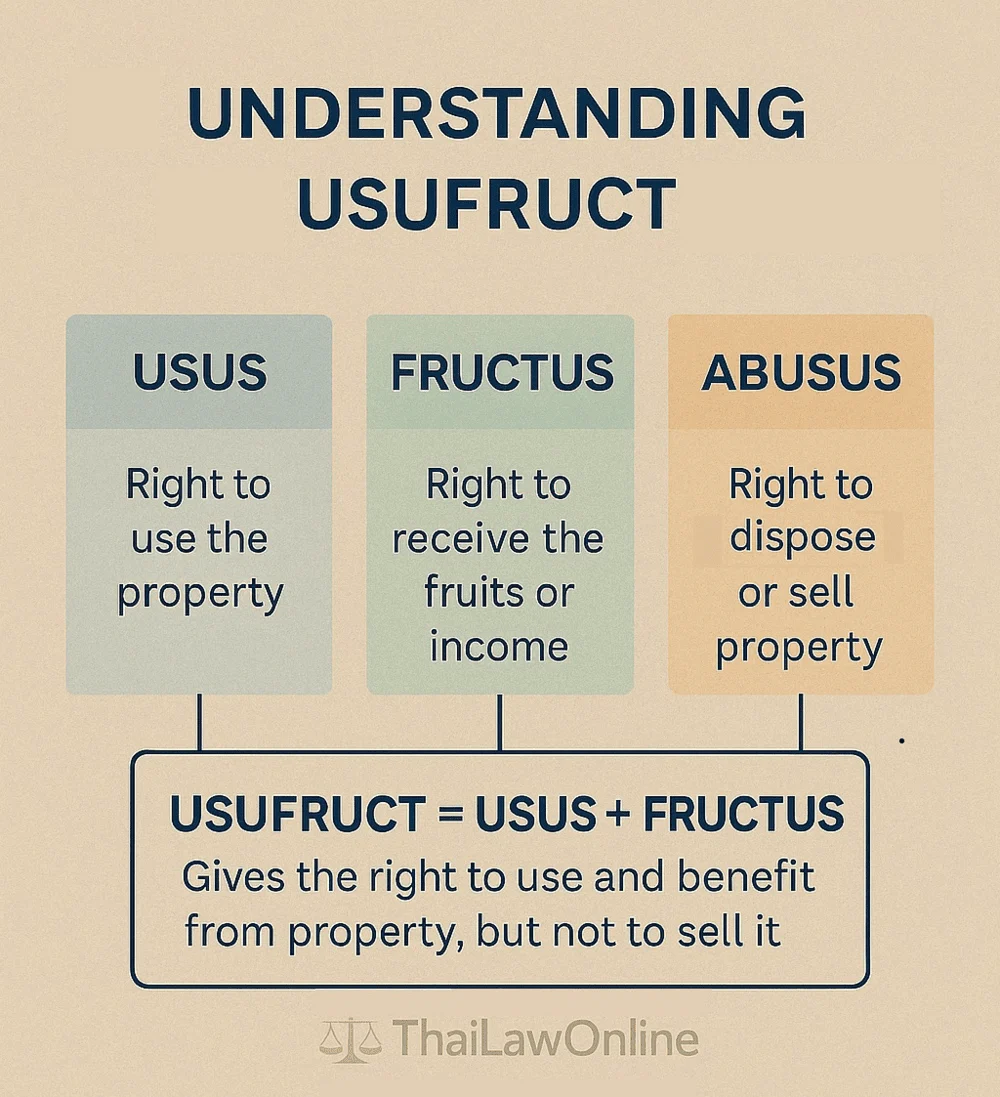
- Usus: The right to use or possess the property.
- Fructus: The right to benefit from the property’s “fruits,” such as crops or rental income (as clarified in Section 148).
- Abusus: The right to dispose of the property (sell, transfer, or even destroy it), which is full ownership.
Why Usufruct Matters for Foreigners in Thailand
Under Thai law, foreigners generally cannot own land: the Land Code allows it only under a treaty (Section 86) or, narrowly, with a minimum 40-million-baht investment and ministerial permission (Section 96 bis). This is a problem for the thousands of foreign retirees, spouses of Thai nationals, and business people who live in Thailand. They want to secure their homes. Usufruct provides a solution. It’s a registered real right that gives the foreign holder virtually all the practical benefits of ownership. You don’t actually need to own the land.
A registered usufruct binds not only the current landowner but also any future buyer. If the Thai landowner sells the property, the foreign usufructuary’s right survives. The buyer takes the property subject to the usufruct. This makes usufruct much stronger than an unregistered lease or a private agreement. For a detailed comparison, see our guide on usufruct for foreigners in Thailand.
The law behind this page
English
Section 1417
A usufruct gives a person the right to possess, use and take the fruits and income of another person's immovable property, and the right to manage it. Ownership stays with the owner. The term is governed by Section 1418: it may be for a fixed period or for the usufructuary's life, and where a period is fixed, Section 1403 paragraph 3 applies, which caps it at thirty years.
Full text
An immovable property may be subject to a usufruct, by virtue of which the usufructuary is entitled to possess, use and take the benefit of that property. The usufructuary has the power to manage the property. A usufructuary of a forest, mine or quarry is entitled to exploit the forest, mine or quarry.
ThaiLawOnline translation
Section 1418
A usufruct may be created for a fixed period or for the life of the usufructuary. If no period is fixed, it is presumed to be for the usufructuary's life. Where a period is fixed, Section 1403 paragraph 3 applies, so it cannot exceed thirty years, though it may be renewed. A usufruct comes to an end on the death of the usufructuary and does not pass to heirs.
Full text
A usufruct may be created either for a fixed period or for the lifetime of the usufructuary. If no period is fixed, the usufruct is presumed to last for the lifetime of the usufructuary. If a period is fixed, the provisions of section 1403 paragraph three apply mutatis mutandis. If the usufructuary dies, the usufruct always comes to an end.
ThaiLawOnline translation
Section 1299
Subject to other provisions of this Code or other laws, an acquisition by juristic act of immovable property, or of a real right in it, is not complete unless the act is made in writing and registered by the competent official. A right acquired otherwise than by juristic act cannot be dealt with on the register until it is registered, and until then it cannot be set up against a third person who acquired for value and in good faith and registered his right in good faith.
Full text
Subject to the provisions of this Code or of other laws, an acquisition by juristic act of immovable property, or of a real right appertaining to immovable property, is not complete unless the juristic act is made in writing and the acquisition is registered with the competent official. Where a person acquires immovable property, or a real right appertaining to immovable property, otherwise than by juristic act, the acquirer's right, so long as it has not been registered, cannot be the subject of any change in the register, and that unregistered right may not be set up against a third person who has acquired a right for value and in good faith and has registered that right in good faith.
ThaiLawOnline translation
Section 1403
A right of habitation may be granted for a fixed period or for the life of the holder. If no period is fixed, it may be brought to an end at any time on reasonable notice to the holder. If a period is fixed, it may not exceed thirty years, and a longer period is reduced to thirty years; the grant may be renewed, again for no more than thirty years from the date of renewal.
Full text
A right of habitation may be created for a fixed period or for the lifetime of the holder. If no period is fixed, the right may be terminated at any time, but the holder must be given reasonable notice. If a right of habitation is granted for a fixed period, that period may not exceed thirty years; if a longer period is fixed, it shall be reduced to thirty years. The grant of a right of habitation may be renewed, but for a period not exceeding thirty years from the date of renewal.
ThaiLawOnline translation
Section 1422
Unless the act creating the usufruct provides otherwise, the usufructuary may transfer the exercise of the right to a third person. That is what allows a usufructuary to let the property and take the rent, but the section is not limited to leasing: what may be transferred is the exercise of the right itself. Where that happens, the owner of the property may sue the transferee directly. The transferred exercise cannot outlast the usufruct, so it ends when the usufruct ends.
Full text
Unless otherwise provided in the juristic act creating the usufruct, the usufructuary may transfer the exercise of his right to a third person. In such a case the owner of the property may sue the transferee directly.
ThaiLawOnline translation
Section 1423
The owner may object to any unlawful or unreasonable use of the property, and if he proves his rights are in peril he may require the usufructuary to give security. That right to demand security does not apply where a donor reserved the usufruct to himself over property he gave away. If security is not given within a reasonable time set for it, or the usufructuary ignores the objection and carries on, the court may appoint a receiver to manage the property in his stead, and may discharge that receiver once security is given.
Full text
The owner of the property may object to any unlawful or unreasonable use of the property. If the owner proves that his rights are in danger, he may require the usufructuary to provide security, except where the person who gave the property reserved the usufruct of it for himself. If the usufructuary fails to provide security within a reasonable time fixed for that purpose, or if the usufructuary disregards the owner's objection and continues to use the property unlawfully or unreasonably, the Court may appoint a receiver to manage the property in place of the usufructuary. Once security has been provided, the Court may remove the receiver so appointed.
ThaiLawOnline translation
Section 1476Amended on 23 January 2025
Certain major transactions over Sin Somros require joint management or the other spouse's consent; under Section 1480 a transaction made by one spouse alone or without consent may be revoked by the court on the other spouse's action, unless the other spouse ratified it or the third party acted in good faith and for value.
Full text
Section 1476. The spouses must manage the marital property jointly, or with the consent of the other spouse, in the following cases: (1) selling, exchanging, selling with a right of redemption, letting on hire purchase, mortgaging, discharging a mortgage or transferring a mortgage, of immovable property or of movable property that may be mortgaged; (2) creating, or extinguishing in whole or in part, a servitude, a right of habitation, a right of superficies, a usufruct or a charge on immovable property; (3) letting immovable property for more than three years; (4) lending money; (5) making a gift, except a gift in keeping with the family's station in life made for charity, for social purposes or in accordance with a moral duty; (6) making a compromise; (7) submitting a dispute to arbitration; (8) furnishing property as security or as a guarantee to an official or to a court. Management of the marital property in cases other than those provided in paragraph one may be carried out by either spouse without the consent of the other spouse.
ThaiLawOnline translation
Section 86 Limitation of Aliens Right in Land
Full text
An alien may acquire land only by virtue of the provisions of a treaty which provides that ownership of immovable property may be held, and subject also to the provisions of this Code. Subject to section 84, such an alien may acquire land for residential, commercial, industrial, agricultural, cemetery, public charity or religious purposes only in accordance with the conditions and procedure prescribed by ministerial regulation, and permission must be obtained from the Minister.
Unofficial translation by the Office of the Council of State
ไทย
มาตรา 1417
ข้อความเต็ม
อสังหาริมทรัพย์อาจต้องตกอยู่ในบังคับสิทธิเก็บกิน อันเป็นเหตุให้ผู้ทรงสิทธินั้นมีสิทธิครอบครอง ใช้ และถือเอาซึ่งประโยชน์แห่งทรัพย์สินนั้น ผู้ทรงสิทธิเก็บกินมีอำนาจจัดการทรัพย์สิน ผู้ทรงสิทธิเก็บกินในป่าไม้ เหมืองแร่ หรือที่ขุดหิน มีสิทธิทำการแสวงประโยชน์จากป่าไม้ เหมืองแร่ หรือที่ขุดหินนั้น
ตรงตามข้อความในราชกิจจานุเบกษา / สำนักงานคณะกรรมการกฤษฎีกา (Verbatim from the Royal Gazette / Office of the Council of State)
มาตรา 1418
ข้อความเต็ม
สิทธิเก็บกินนั้น จะก่อให้เกิดโดยมีกำหนดเวลา หรือตลอดชีวิตแห่งผู้ทรงสิทธิก็ได้ ถ้าไม่มีกำหนดเวลา ท่านให้สันนิษฐานไว้ก่อนว่าสิทธิเก็บกินมีอยู่ตลอดชีวิตผู้ทรงสิทธิ ถ้ามีกำหนดเวลา ท่านให้นำบทบัญญัติมาตรา ๑๔๐๓ วรรคสาม มาใช้บังคับโดยอนุโลม ถ้าผู้ทรงสิทธิเก็บกินถึงแก่ความตาย ท่านว่าสิทธินั้นย่อมสิ้นไปเสมอ
ตรงตามข้อความในราชกิจจานุเบกษา / สำนักงานคณะกรรมการกฤษฎีกา (Verbatim from the Royal Gazette / Office of the Council of State)
มาตรา 1299
ข้อความเต็ม
ภายในบังคับแห่งบทบัญญัติในประมวลกฎหมายนี้หรือกฎหมายอื่น ท่านว่าการได้มาโดยนิติกรรมซึ่งอสังหาริมทรัพย์หรือทรัพยสิทธิอันเกี่ยวกับอสังหาริมทรัพย์นั้นไม่บริบูรณ์ เว้นแต่นิติกรรมจะได้ทำเป็นหนังสือและได้จดทะเบียนการได้มากับพนักงานเจ้าหน้าที่ ถ้ามีผู้ได้มาซึ่งอสังหาริมทรัพย์หรือทรัพยสิทธิอันเกี่ยวกับอสังหาริมทรัพย์โดยทางอื่นนอกจากนิติกรรม สิทธิของผู้ได้มานั้น ถ้ายังมิได้จดทะเบียนไซร้ ท่านว่าจะมีการเปลี่ยนแปลงทางทะเบียนไม่ได้ และสิทธิอันยังมิได้จดทะเบียนนั้น มิให้ยกขึ้นเป็นข้อต่อสู้บุคคลภายนอกผู้ได้สิทธิมาโดยเสียค่าตอบแทนและโดยสุจริต และได้จดทะเบียนสิทธิโดยสุจริตแล้ว
ตรงตามข้อความในราชกิจจานุเบกษา / สำนักงานคณะกรรมการกฤษฎีกา (Verbatim from the Royal Gazette / Office of the Council of State)
มาตรา 1403
ข้อความเต็ม
สิทธิอาศัยนั้น ท่านว่าจะก่อให้เกิดโดยมีกำหนดเวลา หรือตลอดชีวิตของผู้อาศัยก็ได้ถ้าไม่มีกำหนดเวลา ท่านว่าสิทธินั้นจะเลิกเสียในเวลาใด ๆ ก็ได้ แต่ต้องบอกล่วงหน้าแก่ผู้อาศัยตามสมควรถ้าให้สิทธิอาศัยโดยมีกำหนดเวลา กำหนดนั้นท่านมิให้เกินสามสิบปี ถ้ากำหนดไว้นานกว่านั้น ให้ลดลงมาเป็นสามสิบปี การให้สิทธิอาศัยจะต่ออายุก็ได้ แต่ต้องกำหนดเวลาไม่เกินสามสิบปีนับแต่วันทำต่อ
ตรงตามข้อความในราชกิจจานุเบกษา / สำนักงานคณะกรรมการกฤษฎีกา (Verbatim from the Royal Gazette / Office of the Council of State)
มาตรา 1422
ข้อความเต็ม
ถ้ามิได้กำหนดไว้เป็นอย่างอื่นในนิติกรรมอันก่อให้เกิดสิทธิเก็บกินไซร้ ท่านว่าผู้ทรงสิทธินั้นจะโอนการใช้สิทธิของตนให้บุคคลภายนอกก็ได้ ในกรณีเช่นนั้นเจ้าของทรัพย์สินอาจฟ้องร้องผู้รับโอนโดยตรง
ตรงตามข้อความในราชกิจจานุเบกษา / สำนักงานคณะกรรมการกฤษฎีกา (Verbatim from the Royal Gazette / Office of the Council of State)
มาตรา 1423
ข้อความเต็ม
เจ้าของทรัพย์สินจะคัดค้านมิให้ใช้ทรัพย์สินในทางอันมิชอบด้วยกฎหมาย หรือมิสมควรก็ได้ ถ้าเจ้าของพิสูจน์ได้ว่าสิทธิของตนตกอยู่ในภยันตราย ท่านว่าจะเรียกให้ผู้ทรงสิทธิเก็บกินหาประกันให้ก็ได้ เว้นแต่ในกรณีซึ่งผู้ให้ทรัพย์สินสงวนสิทธิเก็บกินในทรัพย์สินนั้นไว้เพื่อตนเอง ถ้าผู้ทรงสิทธิเก็บกินละเลยไม่หาประกันมาให้ภายในเวลาอันควรซึ่งกำหนดให้เพื่อการนั้น หรือถ้าผู้ทรงสิทธิเก็บกินมินำพาต่อคำคัดค้านแห่งเจ้าของ ยังคงใช้ทรัพย์สินนั้นในทางอันมิชอบด้วยกฎหมาย หรือมิสมควรไซร้ ท่านว่าศาลจะตั้งผู้รักษาทรัพย์เพื่อจัดการทรัพย์สินแทนผู้ทรงสิทธิเก็บกินก็ได้ แต่เมื่อหาประกันมาให้แล้ว ศาลจะถอนผู้รักษาทรัพย์ที่ตั้งขึ้นไว้นั้นก็ได้
ข้อความจากฐานข้อมูลประมวลกฎหมายของเรา โปรดตรวจสอบกับข้อความทางการ (Thai text from our annotated code. Check it against the official text.)
มาตรา 1476แก้ไขเมื่อ 23 มกราคม 2568
ข้อความเต็ม
คู่สมรสต้องจัดการสินสมรสร่วมกันหรือได้รับความยินยอมจากอีกฝ่ายหนึ่งในกรณีดังต่อไปนี้ (๑) ขาย แลกเปลี่ยน ขายฝาก ให้เช่าซื้อ จำนอง ปลดจำนอง หรือโอนสิทธิจำนอง ซึ่งอสังหาริมทรัพย์หรือสังหาริมทรัพย์ที่อาจจำนองได้ (๒) ก่อตั้งหรือกระทำให้สุดสิ้นลงทั้งหมดหรือบางส่วนซึ่งภาระจำยอม สิทธิอาศัย สิทธิเหนือพื้นดิน สิทธิเก็บกิน หรือภาระติดพันในอสังหาริมทรัพย์ (๓) ให้เช่าอสังหาริมทรัพย์เกินสามปี (๔) ให้กู้ยืมเงิน (๕) ให้โดยเสน่หา เว้นแต่การให้ที่พอควรแก่ฐานานุรูปของครอบครัวเพื่อการกุศล เพื่อการสังคม หรือตามหน้าที่ธรรมจรรยา (๖) ประนีประนอมยอมความ (๗) มอบข้อพิพาทให้อนุญาโตตุลาการวินิจฉัย (๘) นำทรัพย์สินไปเป็นประกันหรือหลักประกันต่อเจ้าพนักงานหรือศาล การจัดการสินสมรสนอกจากกรณีที่บัญญัติไว้ในวรรคหนึ่ง คู่สมรสฝ่ายใดฝ่ายหนึ่งจัดการได้โดยมิต้องได้รับความยินยอมจากอีกฝ่ายหนึ่ง
ตรงตามข้อความในราชกิจจานุเบกษา / สำนักงานคณะกรรมการกฤษฎีกา (Verbatim from the Royal Gazette / Office of the Council of State)
มาตรา 86
ข้อความเต็ม
คนต่างด้าวจะได้มาซึ่งที่ดินก็โดยอาศัยบทสนธิสัญญาซึ่งบัญญัติให้มีกรรมสิทธิ์ในอสังหาริมทรัพย์ได้ และอยู่ในบังคับบทบัญญัติแห่งประมวลกฎหมายนี้ด้วย ภายใต้บังคับมาตรา ๘๔ คนต่างด้าวดังกล่าวจะได้มาซึ่งที่ดินเพื่อใช้เป็นที่อยู่อาศัย ประกอบกิจการในทางพาณิชยกรรม อุตสาหกรรม เกษตรกรรม การสุสาน การกุศลสาธารณะ หรือการศาสนา ต้องเป็นไปตามเงื่อนไขและวิธีการซึ่งกำหนดโดยกฎกระทรวง และต้องได้รับอนุญาตจากรัฐมนตรี
ตรงตามข้อความในราชกิจจานุเบกษา / สำนักงานคณะกรรมการกฤษฎีกา (Verbatim from the Royal Gazette / Office of the Council of State)
Français
Article 1417
Un immeuble peut être grevé d'un usufruit, en vertu duquel l'usufruitier a le droit de posséder ce bien, d'en user et d'en tirer profit. L'usufruitier a le pouvoir d'administrer le bien. L'usufruitier d'une forêt, d'une mine ou d'une carrière a le droit d'exploiter cette forêt, cette mine ou cette carrière.
résumé non officiel
Article 1418
L'usufruit peut être constitué soit pour une durée déterminée, soit pour la vie de l'usufruitier. À défaut de durée fixée, l'usufruit est présumé constitué pour la vie de l'usufruitier. Si une durée est fixée, les dispositions de l'article 1403, alinéa 3, s'appliquent par analogie. Si l'usufruitier décède, l'usufruit s'éteint dans tous les cas.
résumé non officiel
Article 1299
Sous réserve des dispositions du présent Code ou d'autres lois, l'acquisition par acte juridique d'un immeuble ou d'un droit réel immobilier n'est parfaite que si l'acte juridique est fait par écrit et si l'acquisition est enregistrée auprès du fonctionnaire compétent. Lorsqu'une personne acquiert un immeuble ou un droit réel immobilier autrement que par un acte juridique, le droit de l'acquéreur, tant qu'il n'a pas été enregistré, ne peut donner lieu à aucune modification du registre, et ce droit non enregistré ne peut être opposé au tiers qui a acquis un droit à titre onéreux et de bonne foi et qui a fait enregistrer ce droit de bonne foi.
résumé non officiel
Article 1403
Le droit d'habitation est constitué à terme ou à vie. Sans terme, il peut prendre fin à tout moment moyennant un préavis raisonnable. Le terme ne peut excéder 30 ans, tout terme plus long y étant réduit; il est renouvelable pour 30 ans au plus.
résumé non officiel
Article 1422
Sauf disposition contraire de l'acte constitutif, l'usufruitier peut transférer l'exercice de son droit à un tiers; le propriétaire peut alors agir directement contre le cessionnaire.
résumé non officiel
Article 1423
Le propriétaire peut s'opposer à un usage illégal ou inapproprié et, s'il prouve que son droit est en péril, exiger une garantie, sauf si le donateur s'est réservé l'usufruit. À défaut, ou si l'usage persiste, le tribunal peut nommer un administrateur, révocable une fois la garantie fournie.
résumé non officiel
Article 1476Modifié le 23 janvier 2025
Article 1476. Les époux doivent gérer conjointement les biens communs, ou avec le consentement de l'autre époux, dans les cas suivants : (1) vendre, échanger, vendre avec faculté de rachat, donner en location-vente, hypothéquer, donner mainlevée d'une hypothèque ou céder une hypothèque, lorsque l'acte porte sur un immeuble ou sur un meuble susceptible d'hypothèque ; (2) constituer, ou éteindre en tout ou en partie, une servitude, un droit d'habitation, un droit de superficie, un usufruit ou une charge grevant un immeuble ; (3) donner à bail un immeuble pour une durée supérieure à trois ans ; (4) consentir un prêt d'argent ; (5) faire une donation, sauf la donation proportionnée au rang social de la famille faite dans un but charitable, dans un but social ou en exécution d'un devoir moral ; (6) transiger ; (7) soumettre un litige à l'arbitrage ; (8) remettre des biens en garantie ou en sûreté auprès d'un agent public ou d'un tribunal. Dans les cas autres que ceux prévus à l'alinéa premier, la gestion des biens communs peut être assurée par l'un ou l'autre des époux sans le consentement de l'autre.
résumé non officiel
Article 86
Un étranger ne peut acquérir un terrain qu'en vertu des dispositions d'un traité qui permet d'avoir la propriété d'un bien immobilier, et sous réserve également des dispositions du présent Code. Sous réserve de l'article 84, cet étranger ne peut acquérir un terrain à usage d'habitation, d'activité commerciale, industrielle ou agricole, de cimetière, de bienfaisance publique ou de culte que conformément aux conditions et à la procédure fixées par règlement ministériel, et il doit obtenir l'autorisation du Ministre.
résumé non officiel
Supreme Court decisions
- 10344/2551 (2008): A Gift With a Reserved Usufruct is a Burdened Gift: Cannot Be Revoked for Ingratitude Under Section 535
- 7199/2552 (2009): A Will Granting 'Right of Habitation and Usufruct for Life' Gives Only Usufructuary Rights, Not Ownership
Sources
- Civil and Commercial Code, Office of the Council of State, retrieved 31 October 2026
- Land Code, Office of the Council of State, retrieved 31 October 2026
- deka.supremecourt.or.th, Supreme Court of Thailand decisions database (copy held in our library), retrieved 19 February 2026
How Usufruct Works in Practice
Step 1. Drafting the Agreement
A usufruct agreement should be drafted by a qualified Thai lawyer. Include the identity of both parties. Provide a precise description of the property (including title deed number). State the duration (lifetime or fixed term). Specify rights and restrictions. Cover maintenance responsibilities and provisions for termination. Both Thai and English versions should be prepared for international parties.
Why the Standard Land Office Form Isn’t Enough & The Power of Our Custom Addendum
The Thai Land Department offers an official form for registering a usufruct. This was shown in the example image earlier. It is important to know its main purpose and limitations. This standard document is mainly for meeting the minimum legal requirement for registration. It identifies the parties involved, the specific property, and the length of the usufruct. It typically contains only a couple of very basic clauses, as our registration guide shows.
Step 2. Registering at the Land Office
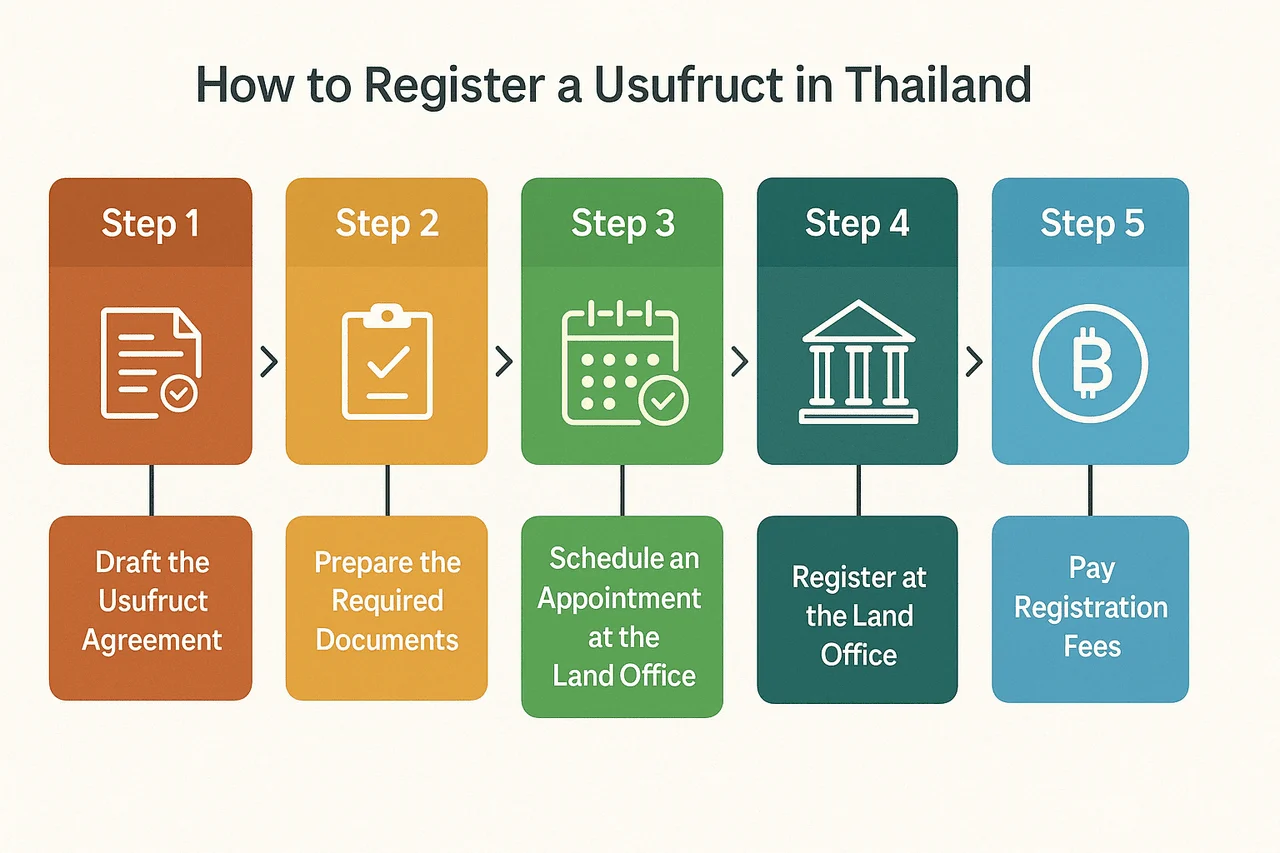
Both the landowner and the usufructuary must attend the local Land Department office (สำนักงานที่ดิน) in person. The officer reviews the agreement. They verify identities. They assess the registration fee. It is 1% plus 0.5% stamp duty on the consideration stated in the agreement. Without consideration, the published registration fee is 50 baht per parcel, plus applicable incidental charges. Confirm the itemised amount with the local Land Office. They record the usufruct on the title deed. Only after registration does the usufruct become a “real right” (ทรัพยสิทธิ) that works against third parties. For the complete registration process, see our step-by-step registration guide.
At the Land Office, in order
- Call the Land Office for the district where the land sits before you book anything. Some offices are refusing usufructs for foreigners at the moment (see the July 2026 note at the top of this page).
- The owner and the usufructuary both go in person, with the original title deed, both IDs, the owner’s house registration book and the signed agreement. Bring a certified Thai translation of your passport: an office in Hua Hin refused a registration in March 2026 without one.
- The officer checks the deed and identities, and may interview you both separately. Say it plainly: the usufruct is a right to use the property, and the Thai owner stays the owner.
- The office assesses its fee. With no price stated in the agreement it is 50 baht per plot. With a price, it is 1% plus 0.5% stamp duty on that price.
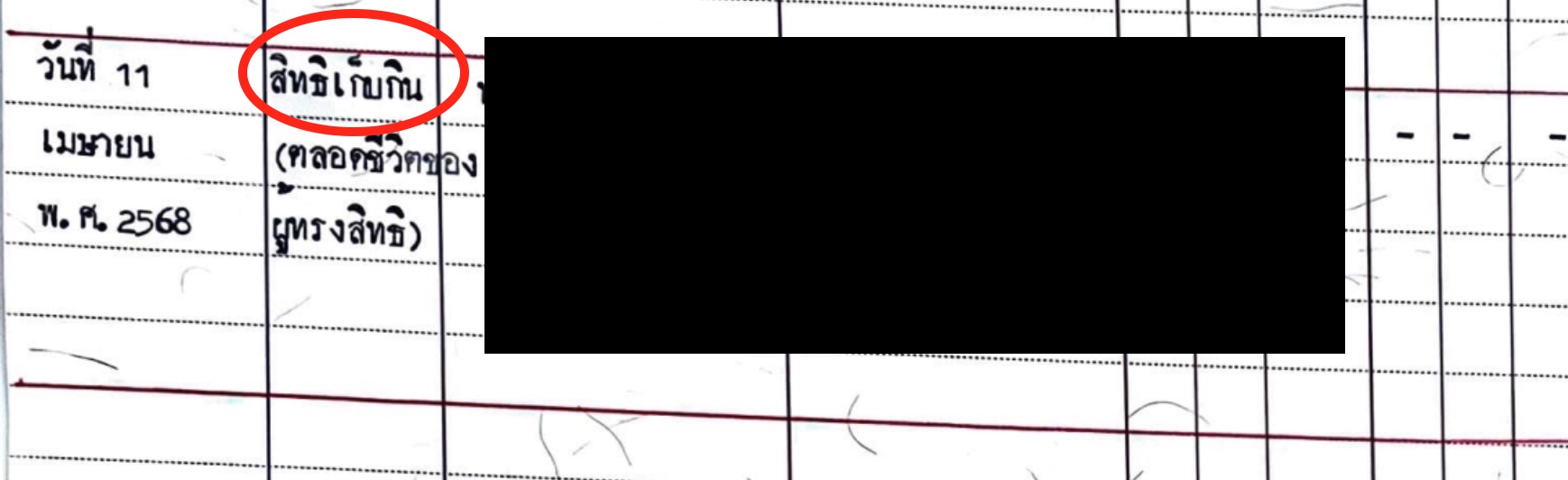
- The officer writes the usufruct on the back of the title deed. From that entry it binds any later buyer of the land.
Sources: Civil and Commercial Code sections 1299 and 1417 to 1418; Ministerial Regulation No. 47 (B.E. 2541), clause 2(7)(ฏ) (1% on a grant with a price) and (ฑ) (50 baht per plot with no price); Revenue Code stamp duty schedule, item 28(b).
Read more: how to register a usufruct at the Land Office.
Step 3. Living Under Usufruct
Once registered, the usufructuary has full authority. You can live on the property. Lease it to tenants. Collect rent. Manage the premises. Take legal action regarding the property. The landowner retains bare ownership and cannot interfere with your lawful management, but Section 1423 lets the owner object to unlawful or unreasonable use, demand security if the owner’s rights are in peril, and ask the court to appoint a receiver. The usufructuary must take proper care of the property and carry out ordinary maintenance and minor repairs (Sections 1421 and 1424). Pay property taxes (Section 1426). Insure the property if required by the owner (Section 1427).
What Happens When It Ends
Usufruct terminates through death of the holder (automatic), expiry of the fixed term, mutual agreement, court order, or destruction of the property that is not restored (Section 1419). Upon termination, the property reverts to the landowner. There is no transfer tax when usufruct terminates by death. This is a big advantage for estate planning. See our complete guides on termination rules and tax implications.
Read more: the seven ways a usufruct ends.
How Much Does a Usufruct Cost in Thailand? (2026)
A lawyer-drafted bilingual usufruct agreement is a fixed 3,900 THB, prepared in 5 to 7 business days. On top of that you pay the Land Office’s own registration fee, charged at cost. The Department of Lands publishes a 1% registration fee plus 0.5% stamp duty on stated consideration. Where there is no consideration, the registration fee is 50 baht per parcel, with applicable incidental charges added. See the Land Office fee explanation.
| Item | Cost (THB) | Notes |
|---|---|---|
| Usufruct agreement, bilingual and lawyer-drafted | 3,900 | 5 to 7 business days, includes guidance through registration |
| Land Office registration fee | 50 per parcel without consideration, plus incidental charges | government fee, paid at registration, charged at cost |
| Bilingual template, if you prefer to do it yourself | 890 | free for Silver members and above |
| Lease agreement, the main alternative, up to 30 years | 4,900 | 3 to 5 business days |
| Consultation, if you want advice before deciding | 2,000 per hour | useful before committing to either route |
A Worked Example
For a proposed usufruct without consideration over one parcel, budget the 3,900 THB drafting fee separately from registration costs. The published registration fee is 50 baht, with incidental charges added. Lawyer attendance, title checks and other services require separate confirmation. If the parties are married, assess the inter-spousal agreement risk before treating a lifetime usufruct as secure.
What the Fee Includes
The fixed fee covers drafting the bilingual agreement and guiding you through registration at the Land Office. Registration is the step that makes the right real, because an unregistered usufruct binds only the person who signed it, not the land, and not a later buyer. See the full legal fees page, or book a consultation.
Your usufruct agreement, prepared in Thai and English
Our 3,900 THB drafting service includes a personalised bilingual agreement and guidance for Land Office registration. The usual drafting period is five to seven working days after we receive payment and complete instructions.
- Bilingual usufruct agreement and registration guidance฿3,900Personalised Thai-English usufruct agreement with Land Office registration guidance. First draft usually within five to seven working days after payment and complete instructions. Land Office attendance and completed registration are not included in this drafting promise.See what is included
Drafting the agreement and completing registration are separate steps. This service provides the documents and registration guidance. Do not assume the quoted drafting fee includes a lawyer attending the Land Office or a guaranteed registration outcome.
Before ordering, tell us where the property is located and whether the owner has already checked the proposed registration with the local Land Office.
What should I prepare?
Send copies of both sides of the title deed, identification for the owner and intended usufructuary, the owner’s Tabien Baan, your current address, and any official document showing your name in Thai. Explain any special conditions you want included.
Read our Land Office registration guide before arranging an appointment. For advice about your particular property, book a consultation.
Not sure which one fits? Book a 2,000 baht consultation and we credit it against your fee if you go ahead.
Three Ways to Get Your Usufruct Agreement
Most firms offer one route at one price. We publish three, because the right answer depends on how complicated your situation is and how much you want to do yourself. All three produce the same underlying document: the bilingual usufruct agreement this firm uses for its own clients.
| Bilingual template ฿890 | Document Maker Fill it in online | We draft it for you ฿3,900 | |
|---|---|---|---|
| What you get | The same usufruct agreement our lawyers use, as an editable bilingual file | The same firm documents, assembled for you from a guided questionnaire | A finished agreement drafted around your facts, in English and Thai |
| Who fills it in | You do | The questionnaire does, from your answers | We do, from the details you send us |
| Languages | English and Thai | English and Thai, and it can translate for you | English and Thai, drafted side by side |
| Turnaround | Immediate download | Minutes | 5 to 7 business days |
| Best for | A straightforward grant you are comfortable completing yourself | Anyone needing several documents across the year | Anything with a wrinkle: company owners, unusual land, protective clauses, a nervous counterparty |
| Also included | The Land Office registration guide | Ten lawyer-drafted documents: wills, leases, loans, prenuptial agreements and more | We walk you through registration at the Land Office |
Usufruct vs. Lease vs. Superficies. Quick Comparison
Thai law offers three main mechanisms for granting property use rights. The table below provides a summary comparison. For a detailed analysis of each with real-world scenarios and recommendations, see our dedicated guide on usufruct vs. lease vs. superficies.
| Criteria | Usufruct (สิทธิเก็บกิน) | Lease (สัญญาเช่า) | Superficies (สิทธิเหนือพื้นดิน) |
|---|---|---|---|
| Duration | Lifetime or up to 30 years | Maximum 30 years (a renewal can be agreed, but a promise in advance cannot extend the term past 30 years) | Maximum 30 years or lifetime |
| Survives Owner’s Death? | Yes. Binds new owner | Yes. Binds new owner | Yes. Binds new owner |
| Survives Holder’s Death? | No. Terminates automatically | Only if the contract expressly provides for succession | Yes, unless the grant says otherwise (Section 1411) |
| Can Collect Rent? | Yes | Yes (sublease) | No (building rights only) |
| Registration Fee | Depends on consideration; confirm the Land Office assessment | 1% of total rent | Depends on consideration; confirm the Land Office assessment |
| Best For | Lifetime home security | Commercial/fixed-term use | Building on another’s land |
Read more: usufruct, lease and superficies compared.
Who Uses Usufruct in Thailand.
Foreign Retirees Protecting Their Home
The most common use case is a foreign retiree who lives in a house on land owned by a Thai partner, friend, or family member. A lifetime usufruct registered at the Land Office ensures the retiree can live in the house for life. This works regardless of what happens to the ownership. Even if the Thai owner sells the land, dies, or becomes incapacitated, the retiree’s right is protected. See our guide for foreigners using usufruct in Thailand. If you live together without marrying, see our guide to property bought with a Thai girlfriend or partner before marriage.
Thai-Foreign Married Couples
When a Thai national and a foreign spouse purchase property, the land must typically be registered in the Thai spouse’s name alone. Usufruct provides the foreign spouse with legal protection. It’s a registered right to live on and use the property for life. However, the intersection of usufruct with Thai marital property law creates legal questions. Couples should address these proactively. For protection strategies, see our guide on usufruct and marriage in Thailand.
Read more: protecting a foreign spouse with a usufruct, a usufruct over a condominium unit.
Risks and Limitations. What We Tell Clients Honestly
A usufruct is the strongest protection most foreigners can get over Thai land, but it is not perfect. Three limitations are worth understanding before you register one.
Land Office Discretion
Land Office officials have some discretion in how they process registrations, and they occasionally question foreign usufruct registrations, particularly at rural offices. Having a qualified Thai lawyer present at the appointment reduces this risk substantially. If an office refuses outright, remedies exist through the courts. Our registration guide covers the practical workarounds.
Death Ends It, and It Cannot Be Inherited
This is the limitation people most often miss. A usufruct terminates on the death of the usufructuary under CCC Section 1418, and your heirs take no claim to the property from it. If passing the interest to your children matters more to you than a lifetime right, a superficies (inheritable unless the grant says otherwise, section 1411) or a Sap Ing Sith right (inheritable under section 12 of its Act) is the better instrument. An ordinary lease does not help here: it ends on the tenant’s death. See our usufruct and inheritance guide.
Read more: what happens to a usufruct when someone dies.
Key Supreme Court Decisions on Usufruct
ThaiLawOnline maintains the most thorough English-language database of Supreme Court decisions on usufruct in Thailand. We have 64 decisions spanning from 1936 to 2022. Below are the landmark rulings that property owners, investors, and legal practitioners should know. For the complete analysis of all 64 decisions organized by legal principle, see our dedicated Supreme Court decisions guide.
The Usufructuary’s Management Power. ฎีกา 15033/2555 (2012)
This is one of the most important modern decisions on usufruct. The Supreme Court held that while a usufruct is registered and the usufructuary is alive, the landowner does not have the right to possess, use, or manage the property. The owner cannot terminate a lease or file eviction proceedings. Only the usufructuary can. This decision confirmed that Section 1417 gives the usufructuary complete practical control over the property during the usufruct period.
Tax Follows the Actual Earner. ฎีกา 575/2560 (2017)
Holding a usufruct does not by itself make you the person taxed on the income. The owner leased the land to a company for thirty years against 87.5 million baht in key money and, on the same day, granted a usufruct to her three grandchildren, the company agreeing to pay them; but the usufruct was only registered after the lease was made. The Supreme Court held that the person with the assessable income under the lease was the owner, as the contracting party, and that the three were merely receiving her rent for her. The practical lesson is about sequence: register the usufruct before the lease is granted, and let the usufructuary be the party to it. Analysed in detail in our tax guide.
Usufruct Binds a Later Buyer. ฎีกา 2783/2516 (1973)
The owner remains free to sell the land, but the buyer takes it subject to the registered usufruct. The Supreme Court held that the sale does not disturb the usufructuary’s right, which is exactly why registration matters: it is the registration that makes the right good against the whole world rather than against the person who signed the agreement.
We summarise the rest in Supreme Court decisions on usufruct in Thailand, and you can read the judgments in our Supreme Court decisions library.
Our Experience. Why ThaiLawOnline
ThaiLawOnline was among the first law firms in Thailand to actively use usufruct agreements as a property protection tool for foreign clients. In 2006 to 2008, when most firms relied exclusively on 30-year leases, founding partner Sébastien Brousseau identified usufruct under Sections 1417 to 1428 of the Civil and Commercial Code as a superior alternative in many situations.
This early adoption was driven by Brousseau’s training in Quebec civil law at the University of Ottawa. Usufruct (usufruit) is a well-established institution under the Code civil du Québec (Articles 1120 to 1171). His dual civil-and-common-law background gave him unique insight. He could apply this right under Thailand’s Civil and Commercial Code. The code itself draws on European civil law traditions.
Together with Thai legal counsel Wichuda Atthamethakon, the firm has since registered hundreds of usufruct agreements across Thailand. We maintain the most thorough database of usufruct-related Supreme Court decisions (64 decisions spanning 1936 to 2022) available in English.
Frequently Asked Questions about Thai Usufruct
Can you sell a property with a usufruct?
The owner can sell, but the buyer takes the land subject to a registered usufruct (Decision 2783/2516), so the holder keeps the right. The holder cannot sell the land, because a usufruct gives possession, use and income, not ownership. See how a usufruct ends.
Who pays the taxes under a usufruct?
The holder. Section 1426 of the Civil and Commercial Code makes the usufructuary pay taxes and duties during the usufruct. Income tax on rent falls on the person who actually earns the income (Decision 575/2560). See usufruct and Thai taxes.
What does section 1426 say about a usufruct?
Section 1426 says the usufructuary shall, for the duration of the usufruct, bear the expenses of managing the property, pay taxes and duties, and be responsible for interest payable on debts charged upon it.
How much does a usufruct agreement cost in Thailand?
Our lawyer-drafted bilingual usufruct agreement is a fixed 3,900 THB, first draft in 5 to 7 working days, with guidance for registration. The template alone is 890 THB. The Land Office charges its own fee: 50 baht per plot with no price stated, or 1% plus 0.5% stamp duty on a stated price.
Can a foreigner inherit a usufruct in Thailand?
No. The right ends when the usufructuary dies; the landowner then holds full ownership again, which passes to the landowner’s own heirs in the ordinary way.
What fees must be paid to register a usufruct?
The published registration fee is 1% plus 0.5% stamp duty on the stated consideration. Without consideration, the registration fee is 50 baht per parcel, plus applicable incidental charges. Ask the Land Office for an itemised assessment.
Can the usufructuary rent the property out?
Yes, unless your agreement forbids it. As usufructuary you manage the property and can pass on the use of it, for example by letting it. A lease for more than three years has to be registered, and some Land Offices decline to register one where the lessor is a foreigner. So most foreign usufructuaries let for three years or less.
Can a foreigner register a usufruct in Thailand?
Yes, a foreigner can register a usufruct. Usufruct is not the same as full property and the law doesn’t forbid it.
How long does a usufruct last in Thailand?
For the lifetime of the usufructuary, which is the usual grant and has no maximum, or for a fixed term. Only a fixed term is capped, at 30 years, because Section 1418 applies Section 1403 paragraph three to it. Either way it ends when the usufructuary dies, whether that falls before or after the 30 years.
Can I build on usufruct land?
Yes, but you need written permission from the landowner and must comply with local building regulations, unless otherwise written in contracts, which we always do.
Need Help With Your Usufruct? ThaiLawOnline has registered hundreds of usufruct agreements since 2006. We know the law. We know the Land Office process. We know the Supreme Court decisions that protect your rights.
Links:
- Department of Lands, Thailand (Thai language)
- Complete Usufruct Registration Instructions by ThaiLawOnline (.PDF document updated in January 2026)
How much does a usufruct cost? A lawyer-drafted bilingual usufruct agreement is a fixed 3,900 THB. See the full usufruct cost breakdown (2026) or all our fixed fees on the legal fees page.
The Complete Usufruct Series: All Our Guides
- How to Register a Usufruct at the Land Office
- Usufruct Cost & Registration Fees
- Usufruct for Thai-Foreign Married Couples
- Usufruct on a Condominium
- Tax on Usufructs
- Usufruct & Inheritance
- How to Cancel a Usufruct
- Supreme Court Decisions on Usufruct
- Usufruct vs Lease vs Superficies
- Lease, Usufruct & Sap Ing Sith Compared
Our fee for a usufruct agreement
| Service | Fixed fee | What is included | Timeline |
|---|---|---|---|
| Usufruct agreement | 3,900 THB | Bilingual usufruct agreement plus Land Office registration guidance. | 5 to 7 business days |
Government disbursements are charged at cost unless the service says they are included.
Book a consultation Answer within 24 to 48 hours EN · FR · TH
These fees come from one source and are the same everywhere on this site. See all our fees.
Try it yourself first, free
You do not have to book anything to get started. These run in your browser, and you only pay us if you decide you want a lawyer involved.
Lease Red-Flag Scanner Free
Paste your Thai lease. We check it against the five clauses that most often cause trouble.
Open the toolLegal Document Maker Gold members
Ten bilingual documents from a guided questionnaire, in the firm's own wording.
Open the toolAsk our AI assistant Free
Trained on Thai law and 77,000+ Supreme Court decisions. Ask anything, free.
Expat Legal Health Check Free
Ten minutes on your property, family, visa and will. You get a written report naming the exact gaps and what each one costs to fix.
Take the Legal Health CheckThai Law Updates, free by email
Plain-English updates on Thai law changes that affect foreigners: property, visas, marriage, business and wills. One short email a month from a firm practicing since 2006. No spam, unsubscribe anytime.