


Reviewed by ThaiLawOnline, a licensed Thai law firm practising in Thailand since 2006. Thai lawyer of record: Wichuda Atthamethakon, LL.M., Thai Bar Licence 3149/2556.
Last updated on
What changed: Transfer and mortgage registration fees are cut to 0.01% on qualifying residential property up to 7 million baht. The standard rates are 2% transfer and 1% mortgage.
Effective: 1 July 2026 to 30 June 2027, under two Ministry of Interior announcements published in the Royal Gazette on 1 July 2026.
Who it affects: Individual Thai nationals only. Both announcements require the buyer to be a Thai national, so a foreign buyer registering under the foreign quota pays the standard 2% transfer fee.
What to do now: If you are a foreign buyer, budget the full 2%. The reduction still matters to you on resale, because a Thai buyer purchasing from you before 30 June 2027 may qualify.
Last verified: 31 July 2026 against the two Ministry of Interior announcements published in the Royal Gazette on 1 July 2026.
The rules limiting what a foreigner may hold are in Chapter 8 of the Thai Land Code, sections 86 to 96.
Are you an expat or foreign investor eyeing real estate in Thailand? Understanding property law in Thailand is crucial to avoid costly mistakes. With its booming market, driven by tourism, retirement hotspots, and digital nomads,Thailand offers attractive opportunities. But strict rules limit direct land ownership for non-Thais. This comprehensive guide breaks down Thailand land ownership for expats. It explains key regulations, and practical strategies for buying property in Thailand as a foreigner. Let’s dive into Thai property law.
Table of Contents
Below we set out what changed in 2026, the routes that are lawful and the ones that are not. If you want a beachfront villa in Phuket or a condo in Bangkok, knowing the rules first helps you choose safely.
More property guides
Condominiums
Land and houses
Checking before you buy
Rights short of ownership
Property Guide for Foreigners in Thailand: Key Considerations
Three points decide almost every foreign purchase in Thailand: what you may own outright (a condominium unit, within the foreign quota), what you may only use (land, through a registered lease, usufruct, superficies or sap ing sith), and what must be registered at the Land Office before it binds anyone else. The sections below take them in turn.
Why Thailand Property Law Matters for Foreign Buyers
Thailand draws foreign buyers every year: retirees, families with a Thai spouse, investors and remote workers. The Thai Land Code of 1954 (B.E. 2497) does not allow foreigners to own land, apart from a few narrow exceptions. That does not lock you out: a condominium unit can be owned outright within the foreign quota, and registered rights such as a lease, a usufruct or a superficies give long-term, lawful use of land. One figure is worth stating precisely, because it is a legal ceiling and not a market statistic: in any one building, foreigners together may hold no more than 49 per cent of the combined floor area of all the units, measured when the condominium was registered. But pitfalls abound, such as unregistered rights leading to disputes. Always consult a Thai property lawyer to ensure compliance.
What Changed in 2026 for Foreign Property Buyers
- Transfer and mortgage fees. Cut to 0.01% from 1 July 2026 to 30 June 2027 on homes up to 7 million baht, for buyers of Thai nationality only. A foreign buyer still pays the standard 2% transfer fee.
- Company registration tightened. Since 1 August 2026, DBD Order 2/2569 requires every Thai shareholder to prove that the subscribed capital was genuinely their own money. Holding land through a company with nominee shareholders is an offence, and enforcement is active. See the 2026 nominee crackdown and how to restructure a 51/49 company legally.
- Forfeiture proposal (not law). The Department of Lands is studying an amendment to section 94 of the Land Code that would forfeit unlawfully held land to the State with no proceeds to the holder. The Cabinet acknowledged the proposal on 24 February 2026. It has not been enacted.
- Longer leases and wider foreign quotas. Still proposals. The registered lease maximum remains 30 years. Where each measure stands is set out under Reforms and Proposals below.
Land Ownership Restrictions Under Thai Law
At the core of property law in Thailand is the restriction on freehold land ownership for foreigners. Only Thai nationals or majority-Thai companies can hold freehold titles like Chanote (the most secure deed). Foreigners attempting direct ownership risk invalidation and fines.
Under section 86 of the Land Code, a foreigner may acquire land only under a treaty that allows it, and no such treaty is in force today. What remains are the statutory exceptions below.
A small number of statutes let a foreigner, or a foreign-owned company, own land when specific conditions are met. They exist to attract investment, and each one is narrow.
1. Investment Promotion Act, B.E. 2520 (1977)
Foreign companies that get approval from the Board of Investment (BOI) can own land for their business activities. This includes land for industrial facilities or offices. This involves obtaining a promotion certificate from the BOI and strictly complying with its terms and regulations.
2. Industrial Estate Authority of Thailand Act, B.E. 2522 (1979)
Section 44 Foreign entities can own land within designated industrial estates for industrial purposes. The Industrial Estate Authority of Thailand (IEAT) regulates this ownership, ensuring the land is exclusively used for approved industrial activities.
3. Petroleum Act, B.E. 2514 (1971)
Section 65 allows foreign companies in oil exploration and production to own land needed for their work. This includes land for exploration and processing sites. Compliance with Petroleum Act regulations is required.
4. Land Code, section 96 bis: the 40 million baht investment route
This route is in the Land Code itself, at section 96 bis, and not in the Investment Promotion Act. An alien who brings in investment funds of the amount fixed by ministerial regulation, which the section requires to be not less than 40 million baht, may acquire land to use as a residence of not more than 1 rai, about 1,600 square metres, and must have the Minister’s permission. Section 96 ter adds the two conditions that make it impractical in real life: if the land is not actually used as a residence within two years of the registration, the Director General may dispose of it, and on any breach of the ministerial-regulation conditions the holder must sell within a period the Director General fixes, of not less than 180 days and not more than one year.
Additional Ways Foreigners Can Secure Land Use Rights:
5. Land Code, Inheritance
Section 93 of the Land Code lets an alien who inherits land as a statutory heir acquire it with the Minister’s permission, provided that the land, added to any the alien already holds, stays inside the area limits in section 87, which for residential land is one rai per family. Permission is exceedingly rare. Without it, section 94 applies: the land must be sold within a period the Director General fixes, and that period is not less than 180 days and not more than one year. One year is the outer limit of the period, not a period you can count on, and if the deadline passes the Director General may sell the land instead.
6. Sap Ing Sith
By the Sap-Ing-Sith Act, B.E. 2562 (2019), foreigners can get a long-term land-use right called Sap-Ing-Sith. Section 4 of that Act allows a term of not more than 30 years, and the Act contains no provision for renewing or extending it, so a further 30 years is a matter of agreement with the landowner rather than something the statute guarantees. This right allows the foreign holder to manage, use, transfer, inherit, or mortgage the property. This right is among the strongest land-use rights available to foreigners after condominium ownership. Do note that the sap ing sith holder has similar rights as ownership, but it is limited in time.
7. Condominium Act
Foreigners can buy condo units in Thailand. However, foreign owners in a building can together hold no more than 49% of the combined area of all the units, measured at the time the condominium was registered. Foreigners can own condominium units in Thailand. This option facilitates foreign property investment within existing legal frameworks.
Primary Exceptions Summarized:
- High-value investment (minimum 40 million Baht) permits residential land ownership (maximum 1 rai), requiring Interior Ministry approval.
- BOI-promoted foreign companies may own land for their business operations.
- Foreign entities within industrial estates regulated by IEAT can own land for industrial purposes.
- Foreign statutory heirs who do not obtain the Minister’s permission must dispose of the land within a period the Director General fixes, of not less than 180 days and not more than one year.
Clarifications:
- Foreign-controlled Thai companies often use majority Thai ownership through preference shares. This method is common but controversial for foreigners who want to control land indirectly. The Thai government has actively discouraged this since 2006.
- Section 93 does not itself require a treaty. The treaty condition is in section 86, and section 96 bis is written as an express exception to it. What section 93 requires is the Minister’s permission and that the total stays inside the section 87 limits. Permission is granted very rarely, so inheritance is impractical in fact rather than impossible in law.
Example Case Study: on 11 September 2024 the Criminal Court gave judgment in Red Case No. A.2812/2567 against 23 defendants, Thai and foreign, individuals and companies, over nominee arrangements built around roughly 60 companies in Phuket. The Department of Special Investigation brought the case after the Department of Business Development found a Phuket law and accounting firm registering companies in the names of Thai nationals for foreign clients, which let those clients run restricted businesses and hold real estate. We set the judgment out in full in our note on recent crackdowns on nominees in Thailand.
Key facts from the case:
- Thai nationals acted as nominee owners. This allowed foreign investors to use the land and operate against the Foreign Business Act and Land Code.
- Each defendant was sentenced to ten years, reduced to five on their confessions and clean records, then suspended for two years with one year of probation, and fined 200,000 baht. The companies were ordered to be dissolved. The two years is the period of suspension, not the length of the sentence
- This prosecution follows intensified investigations by the Department of Business Development, DSI, and other agencies, particularly targeting properties in Phuket, Pattaya, and similar areas
Types of Land Titles in Thailand
Understanding titles is key for buying property in Thailand as a foreigner. Here’s a quick comparison table of title deeds in Thailand:
| Title Type | Security Level | Common Use | Foreigner Eligibility |
|---|---|---|---|
| Chanote | High | Residential/Commercial | Indirect only (e.g., via company) |
| Nor Sor 3 | Medium | Agricultural | Lease possible, but risky |
| Sor Kor 1 | Low | Farming | Not recommended for investment |
Always verify titles at the local Land Department to avoid fraud.
Legal Options for Foreigners Buying Property in Thailand
While direct land ownership is off-limits, several compliant alternatives exist under Thai real estate laws. These provide long-term security without violating regulations.
8. Lease Agreement (often wrongly called “Leasehold” which is common law term) Structures / โครงสร้างการเช่า
A popular choice for Thailand land ownership for expats is leasing. Leases can last up to 30 years. They are renewable, but not automatically or in advance, according to the Supreme Court of Thailand. Leases can last for up to 30 years. They can be renewed, but not automatically or in advance. This is according to the Supreme Court of Thailand. You can find more information about leases here and about the Supreme Court ruling here. Ideal for villas or land plots.
- Pros: Affordable entry; full usage rights.
- Cons: No inheritance without clauses; ends upon death unless structured properly.
- 2025 Tip: New digital registration at Land Offices streamlines processes.
For step-by-step guidance, read our leasehold or lease agreement in Thailand overview.
9. Usufruct Rights (สิทธิเก็บกิน)
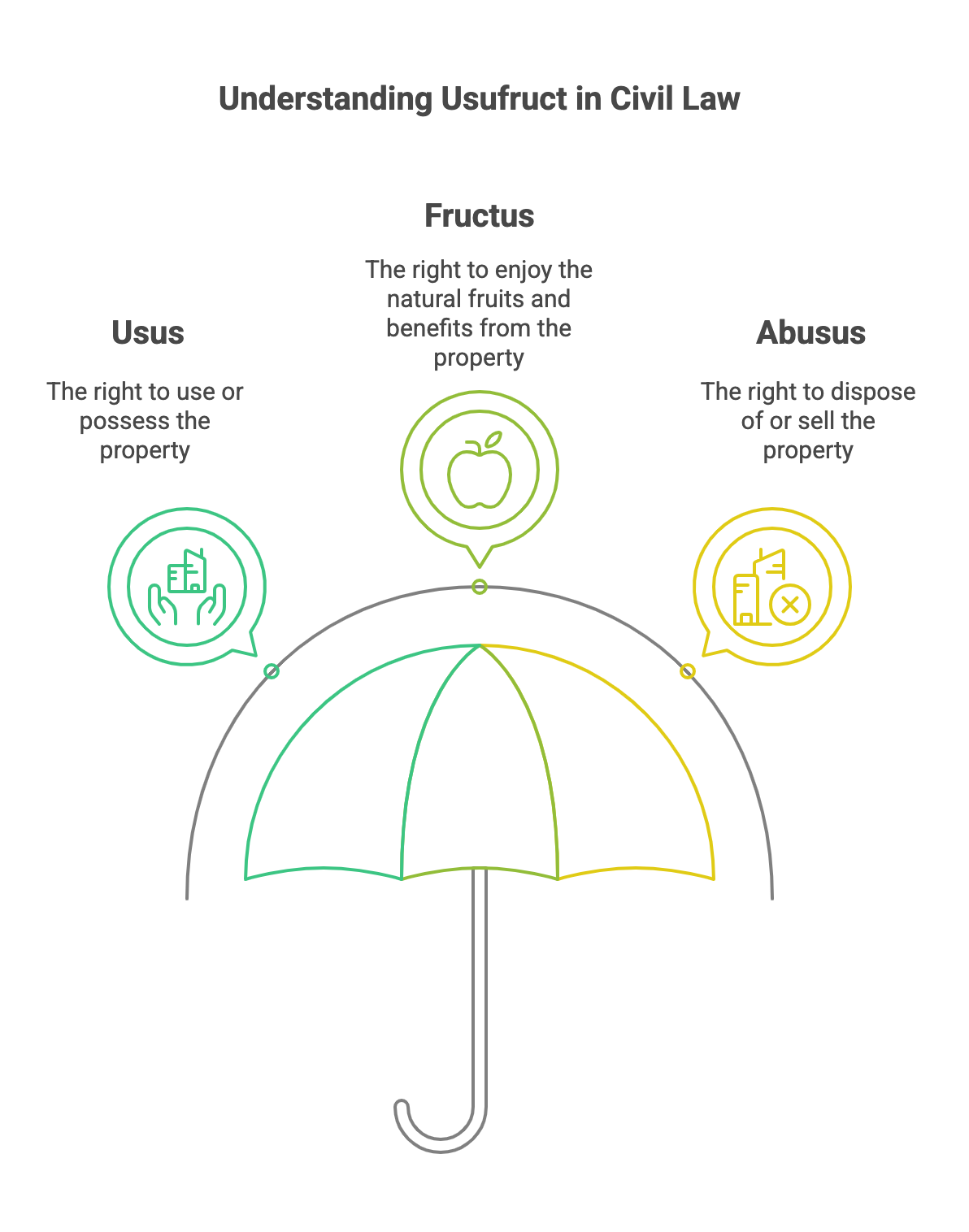
Usufruct is a legal right. It allows a person, called the usufructuary, to use and enjoy the profits from someone else’s property. In Thailand, this can be an effective way for foreigners to secure long-term rights to property. They are the two first parts of property under Civil Law, called “usus” and “fructus” in latin. Do note that Thailand adopted a Civil Code and it is linked with the same concepts used under French Law, derived from Roman Law.
Legal Framework:
- Usufruct are governed by property law in Thailand to ensure legal compliance. Sections 1417-1428 of the Civil and Commercial Code
- Can be created either for a period of time or for the life of the usufructuary. If a period is fixed it may not exceed thirty years; a longer term is reduced to thirty years, and it may be renewed for a further period of not more than thirty years from the date of renewal (Civil and Commercial Code, section 1418, applying section 1403 paragraph three)
- It ends when the usufructuary dies, always, even if the fixed period has not run out (section 1418, last paragraph). A usufruct is not inherited, so it cannot be used to pass rights over the land to a spouse or to children
- Must be registered at the Land Department to be enforceable against third parties
- Example: An American expat secures usufruct on a Chiang Mai farm, generating rental income legally.
- Limitations: The usufructuary never owns the land and cannot sell it. He may, however, transfer the exercise of his right to somebody else unless the deed creating the usufruct says otherwise, and the owner may then sue that transferee direct (section 1422). The transfer does not outlive him: the usufruct still ends on his death.
10. Superficies Rights / สิทธิเหนือพื้นดิน (Right to Build)
Superficies is a legal right that allows a person to own buildings or structures on someone else’s land. This can be an effective option for foreigners who want to build on land they cannot legally own. That is the perfect right to get for a foreigner who wish to build a property on an empty land. He can either lease the land or obtain superficies rights, allowing him to own the structures built on it. The lease agreement must explicitly mention superficies, or the registration should indicate it. Additionally, obtaining a building permit in the foreigner’s name enhances credibility and strengthens legal rights.
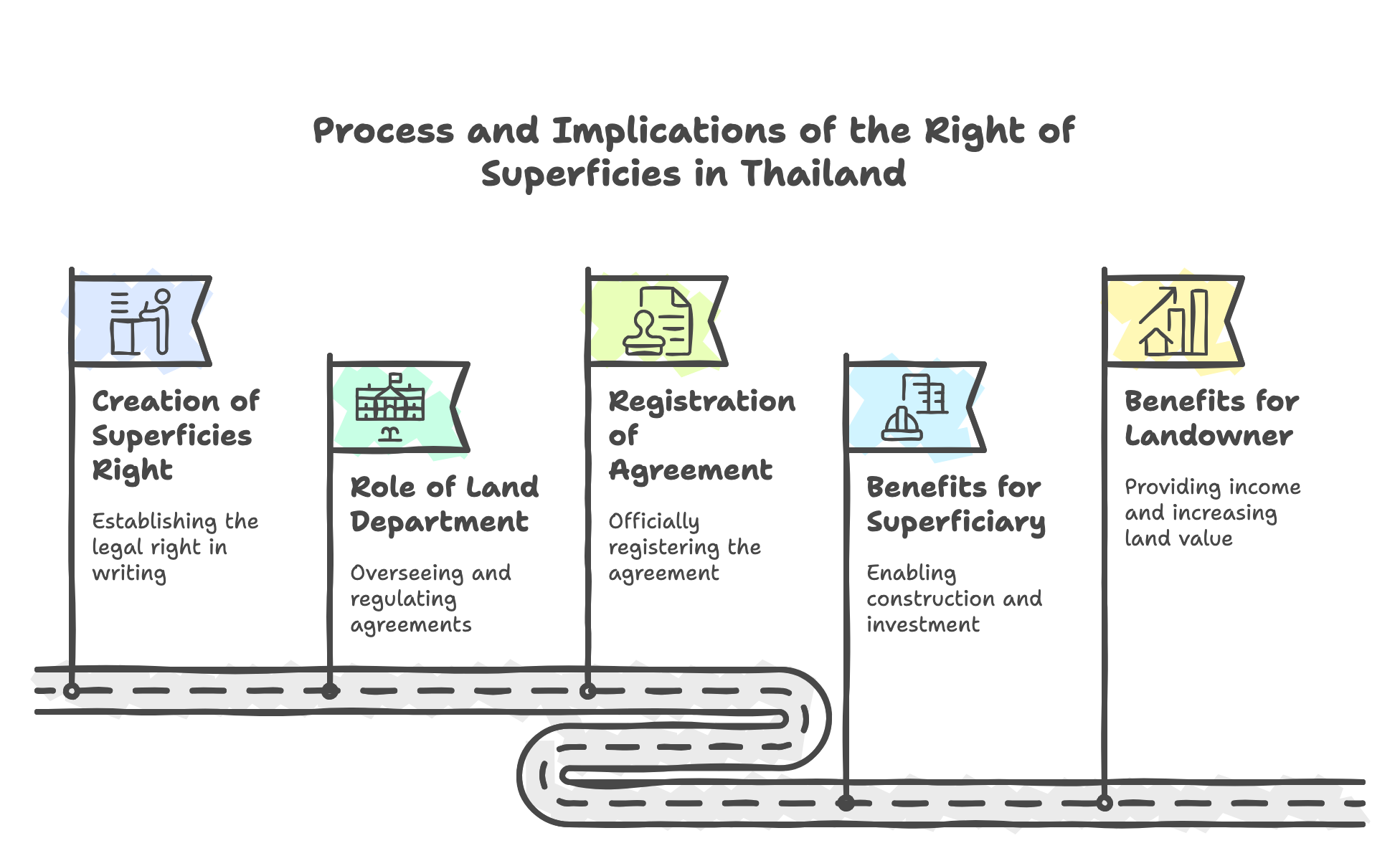
- Governed by Sections 1410-1416 of the Civil and Commercial Code
- It can be created for a period of time, for the life of the landowner, or for the life of the superficiary (section 1412). The third form is usually the one a foreign builder wants, because it does not end when the landowner dies. A fixed period may not exceed thirty years and may be renewed for not more than thirty years from the date of renewal (section 1412, applying section 1403 paragraph three)
- Must be registered at the Land Department to be enforceable against third parties
- Pros: Ownership of the buildings is separate from ownership of the land, and unless the deed says otherwise the right of superficies can be sold and can be inherited (section 1411). That is the practical difference from a usufruct, which always dies with its holder.
- Cons: The land was never yours and stays with its owner. What is at stake at the end is the buildings: the superficiary may take them away provided he restores the land to its former condition, but if the landowner instead gives notice that he will buy them at market value the superficiary cannot refuse except on reasonable ground (section 1416). Agree the exit in the deed rather than leaving it to that section.
11. Company Ownership / การเป็นเจ้าของบริษัท
Establishing a Thai company to own property is another option for foreigners. However, this approach has become more scrutinized by Thai authorities in recent years.
Legal Framework:
- Governed by the Civil and Commercial Code, Foreign Business Act, and Land Code
- The Foreign Business Act does not cap foreign shareholding. What it does is define, in section 4, a company registered in Thailand as a foreigner once shares amounting to half or more of its capital are held by foreigners. A company stays Thai only while foreign holding stays below half, which is where the familiar 49% comes from; above that line it is a foreigner and needs a licence or a certificate for the businesses on the Act’s three lists
- The company must have legitimate business operations beyond property ownership
- Risks: A nominee arrangement is a criminal offence under section 36 of the Foreign Business Act, and it is an offence for the Thai holder and for the foreigner who consents to it alike. The penalty is imprisonment of not more than three years or a fine of 100,000 to 1,000,000 baht or both, and the court must order the assistance, the joint operation or the shareholding to cease. Ignoring that order carries a further fine of 10,000 to 50,000 baht for every day the breach continues.
- Best Practice: If the plan is a real trading or manufacturing business, BOI promotion is the clean route, because a promoted company may hold land for the promoted activity. It is not a way to hold a home: the land a BOI company may own is land for its approved business, as set out under the Investment Promotion Act above, and buying a villa through a promoted company does not become lawful because the promotion exists.
12. Condominium Ownership
Condominium ownership is the most straightforward option for foreigners looking to own property in Thailand. Under the Condominium Act, foreigners can own condominium units outright, with their name on the title deed (Chanote).
Legal Framework:
, Governed by the Condominium Act B.E. 2522 (1979) and its amendments
, Ownership is registered at the Land Department
, Foreign ownership is limited to 49% of the combined area of all the units in the building, measured at the time the condominium was registered
Foreign owners together can hold up to 49% of the combined area of all the units in a building (Condominium Act B.E. 2522, section 19 bis). Bangkok and Pattaya are hotspots.
- Example: A British investor buys a Phuket condo unit, enjoying freehold title and resale potential.
Due Diligence and Legal Steps for Property Purchases
Skipping due diligence can lead to disasters like title disputes. For buying property in Thailand as a foreigner, follow these steps:
- Title Search: Verify at the Land Office for encumbrances.
- Contract Review: Include clauses for disputes (e.g., arbitration under Thai law).
- Taxes and Fees: Expect roughly 2% to 5% in combined transfer costs (a 0.01% reduced transfer fee runs to 30 June 2027 on qualifying residential property up to 7 million baht, but it is restricted to individual Thai nationals, so foreign buyers should budget the full rate); foreigners pay withholding tax on sales.
- Legal Assistance: Hire a lawyer for escrow and compliance.
Common pitfalls: Overlooking environmental zoning or inheritance issues. For protection, see our property due diligence Thailand. ThaiLawOnline offer some packages for
Reforms and Proposals Affecting Foreign Property Buyers
The list below sets out where each measure actually stands. Some are law and in force; others are proposals that have not been enacted:
- Land against a 40 million baht investment: this is long-standing law, not a recent reform, and it is not part of the Long-Term Resident (LTR) visa. It is section 96 bis of the Land Code, added in 1999. A foreigner who brings in investment of at least 40 million baht, of a type prescribed by ministerial regulation, may acquire up to 1 rai for use as a residence, with the Minister’s permission. The investment must be maintained for at least three years, and the land must lie in Bangkok, Pattaya City, a municipality, or an area zoned residential under the town planning law. Section 96 ter allows the Director-General to force a sale if those conditions are broken, or if the land is not used as a residence within two years of registering the acquisition. The Nation on the policy debate.
- Extended Leasehold Terms: The government wants to make the maximum leasehold period longer. This change aims to attract more foreign investment in Thailand’s property market. It would go from 30 years (with one 30-year renewal) to 50 years, with one 49-year renewal. This change could allow for 99-year leases for qualified investors. Here’s an article of the Bangkok Post mentioning it.
- Reduced Transfer and Registration Fees: the transfer fee drops from 2% to 0.01% and the mortgage registration fee from 1% to 0.01%, where the sale price and the appraised value are both no more than 7 million baht. Read the condition before you rely on it. The Department of Lands states that the reduction is for natural persons of Thai nationality, so it does nothing for a foreign buyer. The current reduction runs from 1 July 2026 to 30 June 2027, under two Ministry of Interior announcements published in the Royal Gazette on 1 July 2026. Bangkok Post coverage of an earlier extension.
- Relaxed Foreign Ownership in Specific Zones: The government is thinking about allowing more foreign ownership in certain areas. This includes special economic zones and tourist spots. Here’s for example the Bangkok Post about that.
- Digital Property Registration: Thailand is implementing a digital property registration system to streamline the process and reduce paperwork for property transactions. Here’s an article of 2022 talking about it on The Nation.
Comparison of Ownership Options
Legal Security Comparison
| Ownership option | Legal Security | Registration | Duration | Inheritance |
| Condominium | High, Full ownership with title deed | Land Department | Perpetual | Yes, can be inherited |
| Leasehold | Medium, Dependent on contract terms and lessor cooperation | Land Department (if >3 years) | Max 30 years with renewal options (no automatic renewal) | Limited, requires specific provisions |
| Usufruct | Medium-High, Strong possessory rights | Land Department | Up to 30 years or lifetime | No, typically ends upon death |
| Superficies | Medium-High, Ownership of buildings | Land Department | Can be perpetual (structure) or fixed term or others o | Yes, can be inherited |
| Ownership | Medium, Subject to corporate compliance | Department of Business Development (DBD) for company and Land Department for ownership of property | Perpetual as long as the company exists, especially when considering buying real estate in Thailand. | Yes, through company shares |
Cost Comparison
| Ownership Option | Initial Cost | Ongoing Costs | Tax Implications | Exit Costs |
| Condominium | Purchase price + transfer fee (2%) + specific business tax (3.3% if sold within 5 years) are critical components of the buying real estate process. | Maintenance fees and property tax are essential factors to consider when investing in real estate in Thailand. | Capital gains tax on sale | Transfer fee (2%) when selling (Can be split between buyer and seller) |
| Leasehold | Lease premium + registration fee (1% of total lease value, capped at 50,000 Baht) | Possible annual rent | Income tax on rental income for lessor | Minimal if lease expires naturally |
| Usufruct | One-time fee + registration fee | Maintenance, property tax | Income tax implications for property owner | Minimal if right expires naturally |
| Superficies | One-time fee + registration fee | Maintenance of buildings, possible ground rent | Income tax on rental income if buildings are leased | Compensation for buildings or removal costs |
| Company ownership | Company setup costs (60,000+ Baht) + property purchase costs + transfer fees | Annual accounting, auditing, tax filing costs | Corporate income tax (20%), dividend withholding tax (10%) | Company dissolution costs + property transfer costs. Often more than when set up the company. |
Risk Assessment
| Ownership Option | Legal Risks | Political Risks | Market Risks | Practical Considerations |
| Condominum | Low, Clear legal framework | Low, Well-established rights | Medium, Subject to market fluctuations | Limited to condominiums only; 49% foreign quota may be filled |
| Lease Agreement | Medium, Dependent on lessor honoring renewal options | Medium, Potential changes to lease laws | Medium, Value decreases as lease term shortens | Requires trust in lessor; may need additional security mechanisms |
| Usufruct | Low-Medium, Well-defined in law | Low, Established legal concept | Medium, Limited resale market | Typically ends upon death; limited transferability |
| Superficies | Low-Medium, Well-defined in law | Low, Established legal concept | Medium, Limited resale market | Ownership of buildings only; land remains with landowner |
| Company Ownership | High, Scrutiny of nominee structures | Medium-High, Changing regulations | Medium, Corporate compliance risks | Complex structure; ongoing compliance requirements; nominee issues |
Case Studies
A) Case Study 1: Condominium Purchase in Bangkok
John, a British citizen, wanted to purchase a condominium in central Bangkok for both personal use and investment purposes.
Process:
John looked into condominium projects in Bangkok. He found a new development with units still available for foreign buyers.
1. He verified that the condominium had received its Condominium Juristic Person registration.
2. John transferred the purchase funds from his UK bank account to Thailand and obtained a Foreign Exchange Transaction Form (FETF).
3. He signed a reservation agreement and paid a deposit. (That could be step 2)
4. John’s lawyer did due diligence on the property. They checked the title deed and made sure there were no problems. You should do due diligence before paying a large amount. This can include checking the background of the company or developer selling the property. Due diligence can be simple or extensive.
5.. He signed the sale and purchase agreement and paid the remaining balance. The balance should actually be paid at the transfer to protect your rights.
The Land Department registered the ownership transfer. John paid the transfer fee and some of the taxes that applied.
John successfully obtained full ownership of the condominium unit with his name on the title deed. He later obtained a long-term visa and used the condominium as his primary residence in Thailand.
Lessons Learned:
- Ensuring the foreign ownership quota is not filled is crucial before making any commitments.
- Proper documentation of foreign currency transfer is essential for condominium purchases.
- Due diligence on the developer and the project can prevent potential issues.
B) Case Study 2: Villa Purchase with Leasehold Structure
Maria, a German citizen, wanted to purchase a villa in Phuket for retirement.
Process:
1. Maria found a villa development marketed to foreigners with a leasehold structure.
2. She negotiated a 30-year lease. Note that a renewal agreed in advance is not merely unguaranteed, it is void. In Supreme Court decision 4655/2566 a landowner granted a thirty-year lease and, on the same day, promised two further thirty-year terms with the rent for all ninety years paid up front. The Court held the parties meant to evade section 540 of the Civil and Commercial Code, struck out the renewal part, and refused to let it survive even as a personal promise binding the landlord. The tenant was evicted and lost the money paid for the extra sixty years. See also automatic renewal of a lease.
3. Maria’s lawyer drafted a comprehensive lease agreement that included:
- Prepayment of the entire 30-year lease term
- Specific renewal terms and conditions
- Right to sublease or assign the lease
- Right to make alterations to the property
- Inheritance provisions
What a lawyer cannot do is pre-arrange the renewal. A declaration of intention to renew, signed up front with a payment plan for a further thirty years, is the precise structure 4655/2566 struck down, and signing it later does not save it if the bargain was struck at the outset. Section 540 permits a renewal only once the current term has actually ended, and the renewed term cannot itself exceed thirty years from the date of renewal. So treat the first thirty years as the whole of what you are buying, and put the effort into what genuinely survives: a registered superficies over the building, a succession clause, and the right to sublet or assign.
4. The lease was registered at the Land Department.
Maria signed a separate agreement with the landowner. This agreement gave her the right of superficies. It allows her to own the villa structure.
Maria got a 30-year lease on the land. She also has options to renew the lease. She owns the villa structure. She was able to obtain a House Registration Book (Tabien Baan) for the villa.
Lessons Learned:
- Combining leasehold with other rights (such as superficies) can provide additional security. You can also separate the land and the building which is more complex but can be done.
- Detailed contractual provisions are essential for protecting the lessee’s interests.
- Registration of the lease at the Land Department is crucial for enforceability against third parties.
C) Case Study 3: Property Purchase through Usufruct
Robert, an American retiree, wanted to purchase a house with land in Chiang Mai.
Process:
1. Robert found a property he liked and negotiated with the Thai owner.
2. Instead of attempting to purchase the land directly, Robert’s lawyer advised him to use a usufruct structure.
3. The Thai owner retained ownership of the land but granted Robert a lifetime usufruct right.
4. Robert paid a one-time fee for the usufruct right, which was registered at the Land Department.
5. The usufruct agreement granted Robert the right to:
- Live in the house for his lifetime
- Make improvements to the property
- Sublease the property to others if desired. This is what we call “fruits” under Civil Law.
- Retaining the title deed in possession should be included in contracts
- Apply for a House Registration Book (Tabien Baan). Do note that for unknown reasons, some local authorities might request that you are married. That is not in the law, but this is Thailand. You should just do as they ask and if not, it could play against you.
Robert secured the right to use and enjoy the property for his lifetime. He was able to obtain a House Registration Book and used the property as his primary residence in Thailand.
Lessons Learned:
- Usufruct can be an effective alternative to leasehold for lifetime use of property.
- Registration of the usufruct at the Land Department is essential for legal protection.
- Retaining the title deed could avoid further complications.
Our fees
Fees and representation
Most property work is fixed price. A full condominium purchase package is 19,900 THB, a usufruct agreement is 3,900 THB and a property lease is 4,900 THB. Standalone due diligence on land or a house starts from 30,000 THB, because the depth depends on the title and the seller. Our condo and property lawyer page sets out what each package covers, or book a consultation.
The usufruct agreement is one of the services you can order and pay for online, drafted by a lawyer and registered for you at the Land Office. You then follow it in your own client portal. See all our fixed-fee services.
Final Thoughts: Secure Your Thai Property Investment
Navigating property law in Thailand requires knowledge and caution, but with the right approach, expats can thrive. For personalized advice on land ownership in Thailand for expats, contact our team. We can also help with buying property in Thailand as a foreigner. Reach out to us today. Ready to start? Schedule a consultation. There are many complex parts of Thai property. For example, servitude in Thailand and the right of habitation are rarely discussed. We can help.
Testimonials related to Properties related to ThaiLawOnline
When approaching property investments, this Property Guide for Foreigners in Thailand serves as a valuable reference. And the information in this Property Guide for Foreigners in Thailand will help you succeed in real estate transactions.
Resources and References
Government Agencies
1. Department of Lands (กรมที่ดิน)
, Responsible for land registration, title deeds, and property transfers
2. Board of Investment (คณะกรรมการส่งเสริมการลงทุน)
, Provides investment incentives that may include land ownership rights
3. Department of Business Development (กรมพัฒนาธุรกิจการค้า)
, Oversees company registration and corporate compliance
4. Revenue Department (กรมสรรพากร)
, Handles taxation related to property ownership and transfers
Legal References / เอกสารอ้างอิงทางกฎหมาย
1. Land Code of Thailand (ประมวลกฎหมายที่ดิน). That file is the unofficial English translation published by the Office of the Council of State for information only. Its own disclaimer states that it carries no legal authority and that the Thai text as published in the Royal Gazette remains the sole authoritative version: what you can and cannot rely on in an English translation.
2. Civil and Commercial Code of Thailand (ประมวลกฎหมายแพ่งและพาณิชย์)
3. Condominium Act B.E. 2522 (1979) and amendments (พระราชบัญญัติอาคารชุด พ.ศ. 2522 และฉบับแก้ไขเพิ่มเติม)
4. Foreign Business Act B.E. 2542 (1999) (พระราชบัญญัติการประกอบธุรกิจของคนต่างด้าว พ.ศ. 2542)
5. Building Control Act B.E. 2522 (1979) (พระราชบัญญัติควบคุมอาคาร พ.ศ. 2522)
Disclaimer
This guide is provided for informational purposes only and does not constitute legal advice. Laws and regulations in Thailand are subject to change, and specific situations may require professional legal consultation. Readers are advised to seek professional legal advice before entering into any property transactions in Thailand.
คู่มือนี้มีไว้เพื่อวัตถุประสงค์ในการให้ข้อมูลเท่านั้นและไม่ถือเป็นคำแนะนำทางกฎหมาย กฎหมายและระเบียบในประเทศไทยอาจมีการเปลี่ยนแปลง และสถานการณ์เฉพาะอาจต้องการการปรึกษาทางกฎหมายจากผู้เชี่ยวชาญ ผู้อ่านควรขอคำแนะนำทางกฎหมายจากผู้เชี่ยวชาญก่อนเข้าทำธุรกรรมทรัพย์สินใด ๆ ในประเทศไทย
If you would rather not run these checks yourself, our property lawyer in Thailand page sets out what we verify and what it costs.
Step-by-Step: How to Buy a Condo in Thailand as a Foreigner
- Sign the Reservation Agreement, Upon selecting a unit, you pay a holding deposit (typically THB 100,000-200,000) to remove the property from the market. This is generally non-refundable unless “subject to clear due diligence” clauses are negotiated by your attorney.
- Engage an independent Thai lawyer, Not the developer’s lawyer. Your counsel handles all due diligence: title verification, seller standing, foreign quota availability, and encumbrance searches.
- Review and sign the Sale and Purchase Agreement (SPA), Your lawyer scrutinizes and amends the SPA for construction warranties, penalty defaults, and the division of transfer taxes (typically 50/50). Do not sign without legal review.
- Bring in the funds in a form the Act accepts, Section 19 (5) of the Condominium Act recognises three routes, not one: bringing foreign currency into Thailand, withdrawing from a non-resident baht account, or withdrawing from a foreign currency deposit account. The commonest is to wire the price from an offshore account in foreign currency, and the SWIFT instructions should state the condominium details.
- Obtain your evidence of the funds, The receiving Thai bank converts the funds to Baht and issues the Foreign Exchange Transaction Form, which is the usual evidence where the money is wired in. Section 19 ter (5) requires evidence of whichever of the three routes you used, and the amount evidenced must be not less than the price of the unit you are buying. The Land Office will ask for it at registration.
- Prepare cashier’s cheques, Final balances are settled via official cashier’s cheques payable to the seller. Separate cheques are prepared for the Land Department to cover transfer fees, stamp duty, and taxes.
- Register at the Land Department, You or your lawyer (via Power of Attorney) meets the seller at the local Land Office. Upon presenting your passport, original FETF, signed SPA, and payment of all transfer taxes and fees, the official transfers the Chanote. Update your Thai will to include the new asset.
Costs & Taxes When Buying Property in Thailand
| Fee / Tax | Rate | Paid By | Notes |
|---|---|---|---|
| Transfer fee | 2% of appraised value | Typically split 50/50 | Negotiable between parties. Cut to 0.01% until 30 June 2027 on qualifying residential property up to 7 million baht, but only where the buyer is an individual Thai national, foreign buyers budget the full 2%. |
| Stamp duty | 0.5% | Seller | Only if exempt from SBT |
| Specific Business Tax (SBT) | 3.3% | Seller | If seller owned <5 years |
| Withholding tax | 1% (company) or progressive (individual) | Seller | Deducted at Land Department |
| Lease registration fee | 1% of total rent | Negotiable | For leasehold only |
| Legal fees | THB 30,000-150,000+ | Buyer | See our property legal packages |
For a full breakdown of transfer costs, see our property transfer process page.
Frequently Asked Questions
Can foreigners own land in Thailand?
Generally, no. The Land Code does not allow foreigners to own land in Thailand. There are a few exceptions. These include cases with Board of Investment promotion or when investing at least 40 million Baht under certain conditions.
What property can foreigners legally own in Thailand?
Foreigners can legally own:
1. Condominium units, so long as foreign owners together hold no more than 49% of the combined area of all the units in that building
2. Buildings (but not the land they sit on)
3. A “Lease” interests (wrongly sometimes called “Leasehold”) in land or buildings
What is the process for buying a condominium in Thailand as a foreigner?
The process typically involves:
1. Finding a suitable condominium within the foreign ownership quota
2. Transferring funds from abroad and obtaining a Foreign Exchange Transaction Form
3. Signing a reservation agreement and paying a deposit
4. Conducting due diligence on the property
5. Signing the sale and purchase agreement
6. Registering the transfer of ownership at the Land Department
7. Paying applicable taxes and fees
What is the maximum lease term in Thailand?
The maximum lease term under Thai law is 30 years. However, the lease can include renewal options for additional terms.
Are lease renewal options legally enforceable in Thailand?
Renewal options are contractual obligations but are not automatically enforceable. The renewal requires the cooperation of the lessor to register a new lease when the initial term expires. To enhance security, additional mechanisms such as a power of attorney or corporate structures can be used.
What happens if the landowner sells the property during my lease term?
If your lease is registered at the Land Department, it stays valid for the new owner for the rest of the lease term. This is why registration of leases exceeding 3 years is crucial.
What is the difference between usufruct and superficies rights?
Usufruct gives the right to use and enjoy someone else’s property, including receiving the fruits or profits from it. Superficies specifically gives the right to own buildings or structures on someone else’s land. The decisive difference is that a usufruct always ends when the usufructuary dies, whatever period was agreed (Civil and Commercial Code section 1418), while a right of superficies is transferable and passes to the holder’s heirs unless the deed creating it provides otherwise (section 1411).
Can I sell or transfer my usufruct or superficies rights?
Neither right can be sold in the sense of selling the land, which is never yours. What a usufructuary may do, unless the deed creating the usufruct provides otherwise, is transfer the exercise of his right to a third person; the landowner’s consent is not required, and the landowner may then sue that transferee direct (section 1422). Two limits matter in practice. The transfer cannot outlast the usufruct, which still ends on the original holder’s death, and a deed can validly take the power away, so read the deed before you rely on it. A right of superficies is different: it is transferable and inheritable by default (section 1411), which is why a foreigner who has built on the land is usually better served by superficies than by a usufruct.
Can I obtain a House Registration Book (Tabien Baan) with usufruct or superficies rights?
Yes, both usufruct and superficies rights let you apply for a House Registration Book for the property. This can help with utility connections, mail delivery, and visa needs. However, do note that some local authorities might ask more, like being married to a Thai person, which is not into the law.
Is it legal to set up a Thai company to own land as a foreigner?
It is legal to create a Thai company with foreign owners that can own land. This is allowed if the company has real business operations and is not just a front to get around foreign land ownership rules. The company must have majority Thai shareholders who are genuine shareholders, not nominees.
What are the risks of using a company to own land in Thailand?
The main risks include:
1. Legal scrutiny of nominee structures by Thai authorities
2. Potential changes in regulations affecting foreign-influenced companies
3. Corporate compliance requirements and associated costs
4. Potential disputes with Thai shareholders
5. Tax implications for both the company and shareholders
What ongoing requirements are there for a Thai company owning land?
Ongoing requirements include:
1. Annual financial statement filing
2. Corporate income tax returns
3. VAT returns (if applicable)
4. Shareholder meetings
5. Maintaining proper accounting records
6. Withholding tax on dividends
7. Social security contributions for employees (if any)
Can foreigners buy property in Thailand?
Yes, foreigners are allowed to buy certain types of property in Thailand. They cannot own land directly. However, they can buy condominiums. Total foreign ownership in a building must not exceed 49% of the combined area of all the units, measured at the time the condominium was registered. For land or property, foreigners often invest through leasing or setting up a Thai limited company.
What types of property can a foreigner own in Thailand?
Foreigners can fully own a condo in Thailand. This is allowed if the building has not exceeded the foreign ownership limit. However, acquiring land requires different approaches, such as long-term leases or forming a Thai limited company.
Are there any restrictions on foreigners purchasing land in Thailand?
Yes, the Thai government restricts foreigners from owning land directly with some rare exceptions. However, they can purchase land through a leasehold agreement or by setting up a Thai limited company to hold the land.
What is the process for buying a property in Thailand as a foreigner?
The buying process involves several steps, including selecting the property type, conducting due diligence, signing a purchase agreement, transferring funds, and registering the property with the Land Department. It is advisable to consult a legal professional to navigate Thai real estate laws effectively.
How does the Thailand Condominium Act affect foreign property buyers?
The Thailand Condominium Act lets foreigners buy and own condos in Thailand. However, foreign owners together cannot hold more than 49% of the combined area of all the units in that building, measured at the time the condominium was registered. This law is crucial for foreigners seeking to invest in Thai real estate.
What should foreigners consider when investing in Thailand property?
Foreigners should consider property value, location, legal restrictions, and the real estate market in Thailand. Researching market trends and consulting with real estate experts ensures informed investment decisions.
Are there any taxes or fees foreigners should be aware of when buying a property in Thailand?
Yes, foreigners should be aware of taxes such as transfer fees, stamp duty, and specific business tax if applicable. It’s important to factor these costs into the overall investment in Thailand property.
Can a foreigner get a mortgage to buy property in Thailand?
Some banks in Thailand and international financial institutions offer mortgages to foreigners who want to buy a condo. However, terms and conditions vary, and it is advisable to explore financing options thoroughly. Do note that foreigners can also get a mortgage when buying a property with a Thai partner, for example. Banks will have different requirements, like a work permit, a Thai guarantor or others.
What are the benefits of buying a condo in Thailand for foreigners?
Buying a condo in Thailand has many benefits. You can earn rental income and access Southeast Asia’s growing market. Plus, you get to enjoy living in Thailand. Condos also provide a more straightforward ownership structure compared to land.
Checked against 84,000+ Supreme Court decisions, Vortex database
Thai Law Updates, free by email
Plain-English updates on Thai law changes that affect foreigners: property, visas, marriage, business and wills. One short email a month from a firm practicing since 2006. No spam, unsubscribe anytime.