


Reviewed by Wichuda Atthamethakon, LL.M., Thai Bar Licence 3149/2556, for ThaiLawOnline, a Thai law firm acting for foreigners since 2006.
Last updated on
Land offices are refusing a right the Civil Code grants
Several land offices now refuse to register a usufruct when the usufructuary is a foreigner. Koh Samui and Koh Phangan have stopped. Suphan Buri and parts of Prachuap Khiri Khan are difficult. The reason given at the counter is one word: nominee.
My position is narrow and I state it first. Foreign nationality alone does not make a usufruct a nominee arrangement. If a land office doubts a particular application, the question is what the parties really agreed. A genuine grant gives the foreigner the use of land that belongs to someone else. If the evidence shows that the Thai owner bought the land on the foreigner’s behalf, the officer has grounds to investigate, and the Land Code tells him how. What he may not do is refuse every foreigner because of his passport.
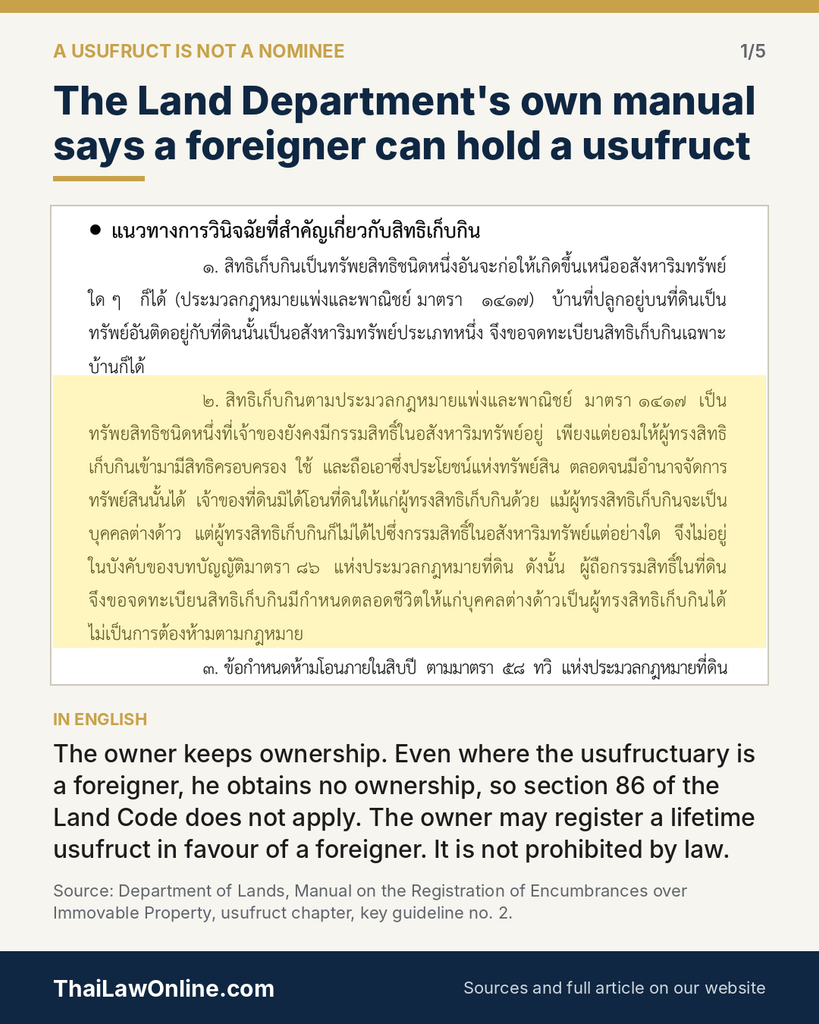
The Department of Lands agrees, in writing. Its own Manual on the Registration of Encumbrances over Immovable Property, in the usufruct chapter, key guideline no. 2, explains that a usufruct leaves ownership with the owner. Even where the usufructuary is a foreigner he obtains no ownership, so section 86 of the Land Code does not apply. The manual concludes that an owner may register a lifetime usufruct in favour of a foreigner and that this is not prohibited by law (ไม่เป็นการต้องห้ามตามกฎหมาย). An officer who refuses every foreigner is contradicting the book his own Department printed for him.
That reasoning is wrong in law. A usufruct is a real right that has been in the Civil and Commercial Code for almost a century. A nominee is a person who holds ownership for somebody else. The first is a legal tool. The second is a lie told to the land registry. They are not the same thing, and no section of any Thai statute says they are.
A usufruct is not a nominee, and understanding this distinction is crucial for proper legal arrangements in Thailand.
I have lived in Thailand since 2004 and I hold permanent residency. I have worked with Thai lawyers since 2006. Between 2006 and 2010 I went to about 50 land offices where our file was the first usufruct the officers had ever seen. Thai lawyers did not use it because it was not taught at university, and it was not taught because nobody used it. It was in the Code the whole time. The same thing happened with Sap-Ing-Sith from 2022 to 2024: an Act of Parliament from 2019 that the counter had never heard of.
I studied usufruct in Quebec, a mixed-law jurisdiction like Thailand, where it is first-year property law. This week a Thai lawyer who works on property in the south wrote to me to say that land offices no longer register usufructs. Her reasons were three. If a foreigner registers a usufruct, the money must have come from the foreigner. If the land came from the woman’s parents, it can be registered. And if the money was a gift, nothing should come back, so why does he need a usufruct?
I answered with sections 1417 to 1428. The replies I received were that I use her country to make money, that I cannot be a lawyer in Thailand, that she could report my clients to the DSI, and that I should go back to live in Canada. I will not name her. Her three arguments deserve a real answer, because they are the same ones my clients hear at the counter. This text is that answer, and it is made of sections and judgments.
Table of Contents
What a usufruct is
A usufruct is the right to use another person’s property and take its fruits, without becoming its owner. It comes from Roman law. The Romans built it so a man could leave his widow the house and its income for her lifetime while the property itself stayed with his heirs. The need was the same then as now: protect the person who lives there without moving the ownership.
French law calls it a démembrement de la propriété, a dismemberment of ownership. Ownership is a bundle of three powers: to use the thing (usus), to take its fruits (fructus), and to dispose of it (abusus). A usufruct lends the first two to the usufructuary for a limited time. The third stays with the owner, who keeps what civil lawyers call bare ownership. France has it in article 578 of its Civil Code and Quebec in article 1120. Thailand has it in sections 1417 to 1428 of the Civil and Commercial Code.
The Thai sections are short and clear:
- Section 1417: the usufructuary has the right to possess, use and enjoy the property, and to manage it.
- Section 1418: a usufruct lasts for a fixed term of no more than 30 years, or for the life of the usufructuary. It ends in every case when the usufructuary dies.
- Section 1421: the usufructuary must take as much care of the property as a person of ordinary prudence takes of his own.
- Section 1299: like every real right over land, it is complete only when registered with the competent official.
The usufructuary cannot sell the land, cannot mortgage it, and cannot leave it to his children. When he dies, the right dies with him and the owner has the property back, subject only to a registered lease the usufructuary may have granted (Decision 2297/2541). A foreign usufructuary never appears on the title deed as owner. His name is on the back of it, as the holder of a burden that everybody can read.
What a nominee is
A nominee is a person whose name is on the title deed while the real owner is someone else. The Land Code is precise about it. Section 86 bars a foreigner from acquiring land except under a treaty or a specific statutory permission. Section 96 covers the person who acquires land “as owner in place of” a foreigner, and sends the land to forced disposal under section 94. Section 113 makes holding land as agent for a foreigner a criminal offence. For companies, section 36 of the Foreign Business Act punishes the Thai who holds shares on behalf of a foreigner.
Every one of these provisions is about ownership. The offence is the acquisition of land by a foreigner behind a Thai name. The Supreme Court has applied them for almost sixty years, and always to the same fact pattern: the foreigner paid, the Thai signed as buyer, and both understood that the land belonged to the foreigner. Decisions 1810/2511, 6136/2537, 1038/2538, 2690/2538 and 17923/2557 all say the same thing: an acquisition of land by a foreigner behind a Thai name is void.
The statutory question is a single one: did the Thai acquire the land as owner on behalf of the foreigner? The courts answer it from evidence. Was the Thai ever meant to own? Who decides what happens to the land? Who takes the value when it is sold? Is there a side agreement? No single item is required and none is conclusive alone, but together they are what a nominee case is made of.
Why a usufruct cannot be a nominee holding
A genuine usufruct points the other way on every one of those indicators, because the Thai owner stays the real owner.
| Question | Nominee holding | Registered usufruct |
|---|---|---|
| Who owns the land? | The foreigner, hidden behind a Thai name | The Thai owner, openly |
| Who can sell or mortgage it? | The foreigner decides | Only the Thai owner |
| Who receives the price on a sale? | The foreigner | The Thai owner |
| What happens when the foreigner dies? | His heirs claim the land or its value | The right ends and the owner has everything back |
| Is the foreigner’s interest on the public register? | No, it is concealed | Yes, registered at the land office |
| Legal basis | None: void under Land Code section 86 | Civil and Commercial Code sections 1417 to 1428 |
The Supreme Court settled the central point in Decision 2783/2516. The usufructuary has the rights to possess, use, enjoy and manage, and nothing more. He cannot stop the owner from selling the land. The buyer simply takes it subject to the usufruct. A person who cannot prevent the sale of the land is not its owner.
A nominee arrangement works only if it is hidden. A usufruct is complete as a real right only when it is registered. The foreigner walks into the land office with his passport, declares who he is, and asks the State to write his limited right on the title deed. That is the opposite of concealment.
The officers’ argument is that the foreigner paid, so the foreigner must be the real owner. That confuses paying with owning. A person who gives money to his wife or partner, and takes back a lifetime right to live in the house, has acquired exactly what the register says: a usufruct. He has no ownership to hide.
I accept one limit. If a file shows that the Thai owner is a stranger with no interest in the land, bound by a secret agreement to hand over the sale price or to transfer on demand, the problem is that secret agreement. It would be a nominee case with or without a usufruct. The usufruct alone does not establish it.
What the Supreme Court has said
The Supreme Court has enforced usufructs since 1942 and has never treated the right as a form of ownership. Our firm keeps a database of 64 Supreme Court decisions on usufruct, from 1936 to 2022. Not one of them holds that a usufruct is a nominee holding or a way around the Land Code.
| Decision | Year | What the Court held |
|---|---|---|
| 1013/2485 | 1942 | A usufruct is a real right and must be registered to be acquired as such |
| 2783/2516 | 1973 | The usufructuary cannot prevent the owner from selling; the buyer is bound by the usufruct |
| 2428/2518 | 1975 | Suing to evict is part of the usufructuary’s power of management under section 1417 |
| 1516/2525 | 1982 | A gift of land with a lifetime usufruct reserved is a gift with a charge |
| 3019/2528 | 1985 | The usufructuary has standing to sue a tenant |
| 4470/2528 | 1985 | The owner keeps standing to sue for damage to the building despite the registered usufruct |
| 2297/2541 | 1998 | A registered lease granted by a usufructuary binds the owner after her death |
| 7341/2542 | 1999 | A usufruct over land covers the buildings that are component parts of it |
| 4446/2543 | 2000 | An unregistered usufruct is a valid personal right between the parties |
| 10344/2551 | 2008 | A gift with a reserved usufruct cannot be revoked for ingratitude |
| 7199/2552 | 2009 | A will granting a life usufruct and habitation gives those rights only, not ownership |
| 15033/2555 | 2012 | While the usufruct lasts, only the usufructuary may possess, use and manage the land |
Read 4470/2528 and 7199/2552 together. The owner keeps his own rights and his own standing while the usufruct is registered, and a person who receives a usufruct has not received ownership. The Court has drawn the line between the two rights again and again. The land offices are now erasing it.
On the other side, the nominee decisions are all about title. In 2690/2538 a foreigner funded a purchase and had a Thai registered as owner in name only. In 1810/2511 and 6136/2537 the object of the contract was the foreigner’s acquisition of the land itself. None of them concerns a registered real right over land that a Thai person truly owns.
What 84,920 decisions show when you search them
Our firm holds 84,920 Supreme Court decisions in full text. I searched all of them for this article with tools called agentic workflow and semantic search to help my work. These are verified. 71 mention usufruct (สิทธิเก็บกิน). 71 apply the Land Code to a foreigner (คนต่างด้าว). The two lists do not share a single decision. I found no decision in that search holding that a genuine usufruct, by itself, makes the owner a nominee. The 71 are keyword hits; most are among the 64 decisions analysed on our website. Every foreigner case under the Land Code is about who owns the land.
Five groups of decisions carry the argument. I have not found them discussed together anywhere.
1. Plenary Decision 312/2511: a right that does not move ownership is not evasion
A foreign bank agreed to buy land and needed the Minister’s permission to take title. While waiting, it paid the price, took possession, and registered a mortgage and a lease over the land. The seller’s heirs argued that the mortgage and the lease were a device to get around section 86. The Supreme Court decided the case in plenary session, the full court. It held that because the mortgage and the lease did not make ownership pass from the seller (เมื่อไม่มีผลทำให้กรรมสิทธิ์โอนไป), the parties could not be regarded as intending to evade the law. Both contracts were valid and neither was a sham.
This is the land office’s argument, made in 1968 and rejected by the full Supreme Court. The foreigner had paid everything. The foreigner was in possession. The foreigner held registered rights. None of it was evasion, because ownership had not moved. A usufruct does not move ownership either.
I use this decision as an analogy and I state its limits. The Court was not asked about a usufruct. The sale was openly conditional on the Minister’s permission, the mortgage secured a real debt, and the lease had a real function. Read it beside Decision 17923/2557, where a contract called a lease was found to be a sale to foreigners behind a Thai company, and was void. Together they show the rule: the Court looks at the real bargain. A right that leaves ownership with the owner is not evasion. A label that hides a transfer of ownership does not save it.
2. Decisions 429 to 438/2506: what “acquiring land” means
The Land Code punishes a foreigner who acquires land. The Court defined the word. Acquisition means obtaining ownership, and also obtaining possession as an owner (สิทธิครอบครองในฐานะเจ้าของ). A usufructuary possesses, but never as owner. He possesses under a registered right that names somebody else as owner. He is outside the definition.
3. Decisions 4470/2528 and 7956/2557: the Court itself separates the two rights
In 4470/2528 the owner of a shophouse had registered a usufruct in favour of another person. The Court said the usufructuary had possession, use and enjoyment, but ownership still belonged to the plaintiff (กรรมสิทธิ์ในตึกแถวยังเป็นของโจทก์). In 7956/2557 a plaintiff sued to be declared usufructuary of estate land. The lower courts charged court fees on the value of the land. The Supreme Court ordered a refund: a person who claims a usufruct has not asked for the land to be his (มิได้ขอให้ที่ดินพิพาทเป็นของตน), so for court-fee purposes the claim was not valued by the land. A claim to ownership would have been.
4. Decision 874/2490: the officer may not refuse at his own pleasure
In 1943 a land office refused to register a sale because the father of the Thai child buying the land was a foreigner. The Land Department confirmed the refusal without giving any reason. The Supreme Court held that under section 1336 and the Constitution an owner may dispose of his property unless a law forbids it, and that the land officer has no power to refuse the transfer (เจ้าพนักงานที่ดินไม่มีอำนาจที่จะไม่ยอมทำการโอน) according to his own preference. A refusal needs a law behind it. That was the rule eighty years ago, under a far harsher statute on foreigners than today’s.
5. Decisions 1403/2519 and 1617/2519: the only lawful procedure
Both cases involved a Thai buyer living with a foreign partner. In both, the officer investigated under section 74 and sent the file to the Minister. The Court approved that procedure and described it as the officer’s duty. Two things follow. First, where an officer suspects evasion, the Code’s path is investigation and referral to the Minister. In 1403/2519 the Court would not order registration while that investigation was still running, so an applicant must expect to wait for it. Second, the second paragraph of section 74 speaks of a person who will buy land (ซื้อที่ดิน) for the benefit of a foreigner. A usufruct is not a purchase of land. The first limb, evasion of the law, can still be raised against a usufruct, which is why Plenary Decision 312/2511 matters.
I note for honesty that in 1617/2519 the Minister refused and the Court would not overturn him. That was 1976. A Thai man was denied the right to buy a home because he had lived with a Chinese woman and had twelve children with her. It is exactly the doctrine the Ministry of Interior abandoned in 1999, and since 2001 a Minister’s order answers to the Administrative Court.
The decision they will quote against us: 1523/2565
One recent decision uses the words “evade the law” about a foreigner with a registered right, and a land officer who wants to refuse will find it. It has to be read to the end.
A Swedish man paid for land and a house in Udon Thani. The money went from Sweden to the seller without passing through his Thai partner. She was registered as owner. He made her sign a loan agreement for 2,400,000 baht, kept both title deeds himself, and registered a lifetime superficies. After their divorce he sued her on the loan.
The Supreme Court dismissed his claim. It found that there had been no gift, because everything he did showed he never meant her to have the property. She owned half in her own right, because she had worked in their business. For the other half the real transaction was an agency: she held title for him. The loan was a sham hiding that agency (นิติกรรมอำพราง) and was void.
Three points matter. First, the Court voided the loan, not the superficies. Nobody had asked the Court to cancel the superficies, and it was not declared illegal. The Court did count it among the circumstances that showed there was no gift. Second, what made him a hidden owner was control: a fictitious debt and the physical title deeds, used, in the Court’s own reasoning, to stop her from selling. Third, the foreigner himself was the one who told the court the land was really his.
So 1523/2565 shows where the Court looks: at whether the Thai was ever meant to own, and at who controls disposal. Take the same couple with a real gift, the 1999 declaration signed, no fake loan, the title deed in the owner’s hands and her freedom to sell intact under Decision 2783/2516. Nothing is left for the Court to call an agency. Decision 9801/2558 shows the same pattern. The foreigner was found to be the true owner because his own contract said the land would be transferred to him if the law ever changed. The Court declared him owner and ordered him to dispose of the land under section 94. In each case the decisive evidence was a side agreement or the foreigner’s control. In none was the registered right enough by itself.
The three arguments made at the counter
“If a foreigner registers a usufruct, the money came from the foreigner.” Perhaps it did. Money moving from a foreigner to a Thai is not an offence under any section of the Land Code. The offence is the foreigner acquiring the land. In Plenary Decision 312/2511 the foreigner had paid the entire price and the Court still found no evasion. And the Land Department’s own regulation of 2006 provides, in clause 26, for usufructs granted against payment.
“If the land comes from her parents it can be registered.” This is an admission. If the usufruct were illegal for a foreigner, it would be illegal on inherited land too. The right is the same, the foreigner is the same, the sections are the same. The office is therefore not applying a rule about usufruct. It is applying a suspicion about where a Thai citizen’s money came from, after having accepted her signed declaration that the money was hers.
“If it is a gift, nothing should come back. Why does he need a usufruct?” Because Thai law has always allowed a gift to carry a charge. Sections 528 and 535(2) of the Civil and Commercial Code speak of gifts encumbered with a charge. The Supreme Court has applied them to exactly this arrangement for decades: land is given, and the giver keeps a lifetime usufruct. See Decisions 1516/2525, 2651/2543 and 10344/2551. In Decision 2380/2542 a mother gave land to her child in exchange for a lifetime usufruct. The Court called it a reciprocal contract (สัญญาต่างตอบแทน) and ordered the child to register the usufruct. Thai parents do this with their children every day at every land office in the country. He needs a usufruct for the reason a Thai mother needs one: so that the person he was generous to cannot put him out of his home.
Two limits belong here. A parent who reserves a usufruct over land she already owned is not in the same position as a partner who supplied cash for another person’s purchase, so the family cases are an analogy and not an identical case. And between legal spouses, section 1469 of the Civil and Commercial Code lets either spouse avoid an agreement about property made during the marriage, during the marriage or within one year after it ends. Decision 818/2546 applied it to gifts of land between husband and wife. A usufruct granted by a wife to her husband is strong against third parties and weaker against her. Clients should be told that.
What other firms publish, and where they stop
I read what other firms have published on these refusals in 2025 and 2026. They report the problem accurately. None of the publications I found takes the next step.
| Publication | What it says | What is missing |
|---|---|---|
| Luther | An officer may refuse if he considers a usufruct to a foreigner would circumvent the Land Code | Any authority for that power, or any decision defining circumvention |
| Formichella & Sritawat | Offices use wide discretion; refusals in Suphan Buri and Cha-Am; scrutiny where money changed hands | Whether that discretion is lawful, and the remedy |
| Khonsu Legal | Section 74 requires referral to the Minister, yet a usufruct “can be refused” by the office | The two statements conflict; no case law |
| Siam Legal | No law restricts a usufruct for a foreigner, but approval is not guaranteed | Why an office may refuse what no law restricts |
| Tilleke & Gibbins | Reports the Ministry of Interior circular of 25 August 2026 on screening legal entities that hold land | Does not address usufruct; as reported, the circular concerns companies holding ownership |
The common thread is the word discretion. Every publication treats the refusals as weather: something that happens to clients, to be planned around. None cites Plenary Decision 312/2511, Decision 874/2490 or Decision 1403/2519. None reads 1523/2565 to its end. And none asks the first question a lawyer should ask of any administrative act: which section gives the officer this power?
That is also what the circular shows. As reported, the instruction of 25 August 2026 tells land offices to screen legal entities suspected of holding land for foreigners. Its screening order is aimed at companies, and nothing in it, as reported, prohibits a personal usufruct. If an office relies on it to refuse a personal usufruct on a Thai woman’s land, it is applying an instruction to a case the instruction does not cover.
Money from a foreigner does not make a Thai owner a nominee
A Thai person who receives money from a foreign spouse or partner and buys land with it owns that land. Thai law says so in the land rules and in the Civil and Commercial Code.
First, the land rules themselves. Until 1999, a Thai woman married to a foreigner was in practice refused the right to buy land. The 1997 Constitution made that position impossible to defend, and the Ministry of Interior ended it by letter MOI 0710/Wor 792 of 23 March 1999. Since then a Thai spouse buys land in her own name, and the couple declares in writing that the money is her personal property. The foreign spouse’s signature on that form is his statement that he owns nothing. The Supreme Court had reached the same logic in Decision 128/2538: the buyer was Thai, so section 86 did not apply, and the foreigner in her life did not change that.
Second, the Civil and Commercial Code. A gift is a contract under section 521. Once the money is given, it belongs to the person who received it. A gift between spouses is personal property of the spouse who receives it under section 1471. Since 23 January 2025 these rules apply to same-sex spouses in the same way.
The declaration is evidence, and I do not claim more for it than the Supreme Court does. In Decision 14736/2555 a foreign husband had signed the usual form stating that the purchase money was his Thai wife’s personal property. In their later dispute the Court called the form preliminary evidence only (หลักฐานเบื้องต้น) and found, on all the evidence, that the land was marital property. The lesson runs in both directions. The form does not close every later question. But a land office that has received it holds signed evidence that the land is hers, and it needs evidence of its own, about this couple and this land, before it treats her as a front. A foreign name on the usufruct application is not that evidence.
A Thai owner also has the right, under section 1336, to use and dispose of her property as she sees fit within the law. Granting a usufruct is one of the ways the Code gives her to do that, next to a lease, a superficies, a right of habitation or a servitude. To tell a Thai citizen that she may grant a usufruct to anyone in the world except the man she lives with is a restriction on her property that no statute contains.
A land officer cannot refuse because he feels like it
A land office is an administrative agency. It applies the law. It does not make it.
No provision of the Land Code prohibits a foreigner from holding a usufruct. Section 86 speaks of acquiring land, which the Supreme Court reads as ownership or possession as an owner. The Land Department has its own Regulation on the Registration of Rights and Juristic Acts concerning Usufruct, B.E. 2549 (2006). Its clause on who may be registered says the owner grants the usufruct to “another person”, with no condition of nationality. Its clause 26 goes further: it tells the officer how to charge the fee when a usufruct is granted for a price, and how when it is granted for free. The Department’s own rulebook expects usufructs that are paid for.
Section 73 of the Land Code allows an officer to decline an act that is shown to him to be void. A usufruct granted by a real owner in the form the Department’s own regulation prescribes is not void on its face. Suspicion that something lies behind it belongs to section 74.
The Land Code does give the officer a tool for doubtful cases, and it is not refusal at the counter. Under section 74, he may question the parties and call for documents. If he has reason to believe a registration would evade the law, or that someone is buying land for the benefit of a foreigner, the text says ให้ขอคำสั่งต่อรัฐมนตรี: he shall ask for the order of the Minister. In Decision 1403/2519 the Supreme Court read that paragraph as a duty: once the officer holds that belief, it is his job to carry the file forward to the Minister. The Code tells him to send the file up with his reasons. It does not tell him to send the applicants home with a verbal no.
A refusal to register is an administrative order. Under sections 34 and 35 of the Administrative Procedure Act B.E. 2539 an order may be oral, but the officer must confirm it in writing if the applicant asks within seven days. Under sections 37 and 40 the written order must state the facts, the legal provision and the reasoning behind it, and must tell the applicant how and when to challenge it. A refusal that cites no section of law, because none exists, does not meet that standard.
The remedies are real:
- Lodge the application formally and keep proof that it was submitted. A remark at the counter is not yet a decision.
- If the officer refuses orally, ask within seven days for written confirmation with reasons. Many refusals stop here, because the officer has to name a legal basis.
- An order made by the land officer can be appealed to him within 15 days of notification under section 44 of the Administrative Procedure Act. An order of the Minister under section 74 is final inside the administration, so that appeal does not apply to it.
- The Administrative Court can review either order under section 9 of the Act on Establishment of Administrative Courts B.E. 2542, generally within 90 days. Check which decision is being challenged and from which date the period runs.
- A claim for compensation under the Act on Liability for Wrongful Acts of Officials B.E. 2539 has its own conditions and time limit.
- Where an officer refuses a lawful registration in order to obtain something for himself, section 157 of the Criminal Code on wrongful exercise of duty applies.
Discretion exists to apply the law to the facts of a file. It is not a licence to suspend a chapter of the Civil Code in one district because a ministry wants results on nominees.
Who built the nominee structures
Nominee structures exist, and they are illegal. I do not set them up and I never have. But a foreigner cannot create one alone. A nominee company needs a Thai lawyer to draft it, a Thai accountant to file for it, Thai shareholders to sign, a registration at the Department of Business Development, a seller who takes the money, and a land office that registers the transfer. For twenty years that chain worked in plain view. In April 2025 the Department of Business Development announced a plan to inspect 46,918 companies with foreign shareholders in six business sectors, land trading and real estate among them.
Now the pressure is on to show results, and the easiest file to refuse is the one where a foreigner stands at the counter under his own name. That is the wrong target. The retired teacher asking for a usufruct on his wife’s house is the foreigner who did not use a nominee. He chose the weaker right, the one that ends when he dies, because it is the lawful one. Refusing him tells every foreigner in Thailand that following the Civil Code earns the same treatment as breaking the Land Code.
There is a harder thing to say. Clients tell us that in some offices a registration that was impossible in the morning becomes possible in the afternoon, for a fee that appears on no receipt. I cannot prove each case and I name no office. But where a lawful right is refused without a written reason, and the refusal can then be negotiated, the nominee problem is not what is being protected. A rule applied only to those who do not pay is a tariff.
Thailand is a wonderful country and I have made my life here. Saying that its land offices must follow its own Civil Code is not an attack on Thailand. It is what respect for Thai law looks like.
Knowledge is not nationality
The lawyer who told me to go back to Canada also reminded me that I can never be a Thai lawyer. She is right, and I have never claimed otherwise. The Lawyers Act B.E. 2528 reserves the licence for Thai nationals. I respect that. I am a manager and a minority shareholder in a Thai firm, the lawyers who sign and appear are Thai, and they are my partners.
But a licence and knowledge are two different things. In 1989 the Supreme Court of Canada decided Andrews v. Law Society of British Columbia. A British lawyer living in Canada met every requirement for the bar except citizenship. The Court struck the citizenship rule down. Its reasoning was that the purpose of regulating lawyers is to protect the public, and what protects the public is competence and integrity. A passport proves neither.
Thailand already knows this. The large Bangkok firms, Tilleke & Gibbins and Baker McKenzie among them, have employed foreign-qualified lawyers as consultants and partners for decades. They do it because it serves Thai clients and the Thai economy: international companies and expatriates are advised by people trained in their own legal systems, working beside the Thai lawyers who sign and plead. I have managed Thai law firms for twenty years, with permanent residency and a work permit. I managed Siam Legal’s Pattaya office in 2007. Before Thailand, in Canada, I worked on a case before the International Criminal Tribunal for Rwanda. A foreign manager in a Thai law firm is not a loophole. It is how every serious firm in this country works.
Go after corruption. Go after the fake companies and the people who sold them. A foreigner who has followed the rules for twenty years, and who says in public that the Civil Code should be applied as written, is not the problem.
Thailand is free to make a different choice about who holds the licence. It cannot make a different choice about what the law says. Sections 1417 to 1428 read the same whether a Thai or a foreigner reads them aloud. If my reading is wrong, the answer is a section number or a judgment, not a threat to report my clients to the DSI.
What should happen now
The Land Department should issue one circular to every office stating three things that are already the law:
- A usufruct in favour of a foreigner is not an acquisition of land under section 86 of the Land Code and is registrable under sections 1417 to 1428 of the Civil and Commercial Code.
- An officer who suspects a nominee holding must investigate under section 74 and refer the file with written reasons. He may not refuse verbally.
- The source of the money used by a Thai owner to buy her land, once declared as her personal property, is not by itself a ground to refuse a later usufruct.
Until that happens, owners and usufructuaries should ask for every refusal in writing and use the appeal and the Administrative Court. One judgment against a land office will do more than a hundred arguments at the counter.
A usufruct is a dismemberment of ownership, known to Roman, French, Quebec and Thai law. A nominee is a false owner. Thai law permits the first and punishes the second, and the land offices have no legal ground to confuse them.
Sebastien H. Brousseau, LL.B., B.Sc., ThaiLawOnline.com
Sources
The Supreme Court decisions were read in full Thai text in the ThaiLawOnline archive (84,920 decisions, most collected from deka.supremecourt.or.th). Decisions 429 to 438/2506 are held as a short note only and should be confirmed on the official database before being cited in a filing. The Land Department usufruct regulation of B.E. 2549 was read from the Department’s own PDF.
- Supreme Court decisions on usufruct, ThaiLawOnline database
- Civil and Commercial Code section 1417, annotated
- Usufruct agreement in Thailand, with the July 2026 note on refusing offices
- Department of Lands: acquisition of land by Thais having an alien spouse (letter MOI 0710/Wor 792)
- Department of Lands guide to registering a usufruct, citing the 2006 regulation
- Khonsu Legal on nominee enforcement, section 74 and the 2025 and 2026 measures
- Formichella & Sritawat on recent land office refusals
- Mazars on the gift tax exemptions in force since 1 February 2016
Thai Law Updates, free by email
Plain-English updates on Thai law changes that affect foreigners: property, visas, marriage, business and wills. One short email a month from a firm practicing since 2006. No spam, unsubscribe anytime.