


Reviewed by ThaiLawOnline, a licensed Thai law firm practising in Thailand since 2006. Thai lawyer of record: Wichuda Atthamethakon, LL.M., Thai Bar Licence 3149/2556.
Last updated on
Thailand’s Non-B visa is also known as the Non-Immigrant B visa. It is the main way for foreigners to work or do business in Thailand. This guide gives expats all the information they need about getting, keeping, and renewing this important visa. It covers the online application process through the new e-portal system and long-term compliance requirements.
To check the Non-B against the other work-related routes, use the Thai Visa Finder.
Table of Contents
Understanding the Non-B Visa
The Non-Immigrant B visa is designed for foreigners who wish to enter Thailand for business and employment purposes. This visa category encompasses several subcategories including working in Thai companies, conducting business meetings, teaching in educational institutions, and pursuing investment activities. The visa allows a 90-day stay when you enter. This can be extended to one year after you get a work permit.
Business Trips After September 2026: When the Visa Exemption No Longer Fits
Since 15 September 2026, the visa exemption for nationals of 60 countries and territories is 30 days and for tourism only. It rests on four Ministry of Interior announcements of 26 August 2026, published in the Royal Gazette, volume 143, special part 207 Ngor, on 31 August 2026. The July 2024 announcement they replaced covered entry for tourism, work or short-term business, and that wording is gone. A business visitor who used to fly in on the exemption for meetings, site visits or board sessions can no longer point to it. Our guide to the 2026 visa exemption rules and our report on the removal of work and business from the exemption set out the new lists.
A business trip now raises two separate questions, and they have different answers. The first is the immigration question: is the purpose of your entry one the exemption covers? For anything other than tourism, it no longer is, and the Non-B is the category designed for business. The second is the work-permit question: is what you will do in Thailand work under the Emergency Decree on the Management of the Work of Aliens B.E. 2560, as amended in 2018? Two provisions matter for short visits:
- Section 4(6) takes outside the Decree a person who comes in occasionally to organise or attend a meeting, or to give an opinion, a lecture or a demonstration at a meeting, training, study visit or seminar, among other listed activities, but only as the Cabinet prescribes, and the Cabinet may attach time limits and conditions. We have not located the current Cabinet list, so read this exemption narrowly.
- Section 61 lets a foreigner who entered temporarily under the immigration law do work of a necessary or urgent nature, or a one-off assignment to be finished within fifteen days, after notifying the Registrar in writing. If the work runs over, the period can be extended once by up to fifteen more days, by notifying the Registrar before the first period ends. What counts as necessary or urgent work is set by the Director-General of the Department of Employment.
An open question, as of 30 September 2026: whether a visitor who entered on the new tourism-only exemption can still file a section 61 notification has not been settled. International relocation firms reported in early September that the point was under review, and we have found no published position from the Department of Employment. We will update this page when one appears.
Until then, get a Non-B before you fly if you will do more than attend a meeting: if you will sign, supervise, install, train or sell on site, or if you visit repeatedly. Holding a Non-B settles the immigration question only. Working still needs a work permit or one of the exceptions above, as our work permit guide explains.
Key Features of the Non-B Visa:
- Initial validity: 90 days from date of issue
- Entry permission: Up to 90 days per entry
- Extension possibility: Can be extended to 1-year with valid work permit
- Multiple entry options: Available for business purposes
The Revolutionary e-Visa System
Since 1 January 2025, Thai embassies and consulates around the world take visa applications through the official e-Visa portal, www.thaievisa.go.th. For most applicants this means the application, the documents and the fee are handled online rather than at the mission’s counter.
e-Visa Application Process
The online application follows a streamlined six-step process:
- Visit the Official Portal: Access www.thaievisa.go.th
- Create an Account: Register using a valid email address
- Complete the Application: Fill out all required forms and details
- Upload Documents: Attach all supporting documentation
- Pay the Fee: Complete payment through the secure online portal
- Receive e-Visa: Download the approved visa electronically
Processing Time: there is no single Thailand-wide figure. Each embassy or consulate publishes its own processing time and its own fee in local currency, and they differ. Check the page of the mission you apply to before booking travel, and allow extra time if a document is missing.
Comprehensive Application Requirements
Essential Documents for e-Visa Application
The Non-B visa application requires specific documentation that varies depending on the purpose of visit:
Core Requirements:
- Valid passport with minimum 6 months validity
- Completed e-Visa application form
- Recent passport-sized photograph (taken within 6 months)
- Evidence of adequate finances (20,000 THB per person, 40,000 THB per family)
Employment-Specific Documentation
For work-related applications, additional documentation is mandatory:
Employee Documents:
- WP.3 approval letter from the Ministry of Labour
- Job offer letter from the Thai employer
- Employment contract (bilingual Thai-English versions)
Company Documents (Provided by Employer):
- Company registration certificate and business license
- List of shareholders
- Corporate income tax filings and balance sheets
- VAT registration certificate (Por Por 20)
- Company profile and business operation details
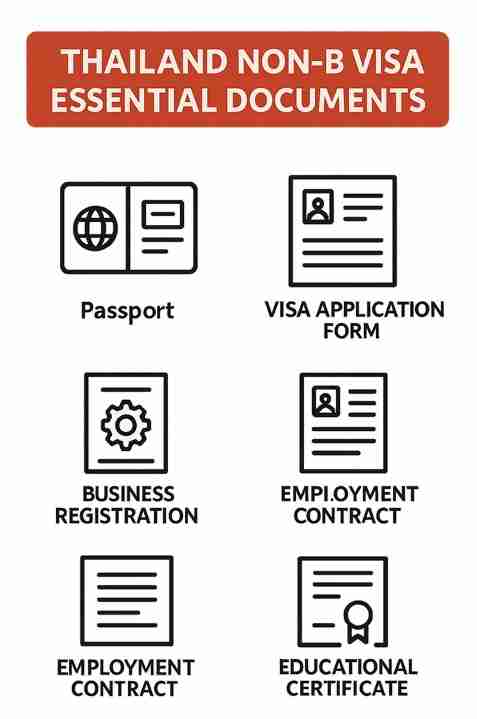
Essential documents needed for Thailand Non-B visa application process
Work Permit Requirements and Process
No foreign national can legally work in Thailand without a valid work permit. The prohibition is section 8 of the Emergency Decree on the Management of the Work of Aliens B.E. 2560, as amended in B.E. 2561: an alien may not work without a permit, and may not do work outside what the permit entitles them to do. There is no 90-day grace period in it. The practical deadline is simply that the permit has to be in hand before you start work and before your 90 days of permitted stay run out.
What breaking that rule actually costs, which is the part most guides leave out. Under section 101 the alien is fined 5,000 to 50,000 baht and, once the fine is paid, is sent back out of the Kingdom. Worse for anyone building a career here, section 64/1 then bars that person from being granted a work permit until at least two years have passed since the penalty was served. The employer is not spared either: under section 102 taking on an alien without a permit costs 10,000 to 100,000 baht per alien, and on a repeat offence up to a year in prison or 50,000 to 200,000 baht per alien, or both, plus a three-year ban on employing any foreigner.
Company Eligibility Requirements
Thai companies must meet specific criteria to sponsor foreign workers:
Financial Requirements:
- 2 million THB minimum registered capital per foreign employee
- 4 Thai employees for each foreigner (4:1 ratio), which Immigration applies to the one-year extension of stay rather than the Department of Employment to the work permit (Unless married to a Thai which is half)
- Neither figure scales without limit, but only one of the limits reaches a company: the capital route stops at ten foreigners unless the employer meets one of four tests on tax paid, export earnings, tourist numbers or Thai headcount (Department of Employment Regulation B.E. 2547, clause 5(3)). The regulation does cap a headcount route at three, but that is clause 6, which applies where the employer is a natural person rather than a company, so it does not bite on a company sponsoring a Non-B
- Valid VAT registration
- These are the work-permit tests, and the extension of stay has a separate set of its own. The capital and staffing figures above come from the Department of Employment regulation. Whether immigration will grant the one-year extension is judged against criterion 2.1 of the table annexed to Immigration Bureau Order 12/2568, which is a different list: 2 million baht of paid-up capital, audited financial statements for the last year showing the business is genuinely trading and continuing, and the same one-to-four ratio. Three kinds of business are excused the capital and accounts tests and get a one-to-one ratio instead: an international trading business (representative office), a regional office, and a branch office of a multinational. Meeting one does not guarantee the other, and it is possible to hold a valid work permit and still be refused the extension.
- Demonstrated revenue to cover foreign employee salaries
Work Permit Application Documents
Personal Documentation:
- Medical certificate from approved clinic
- Educational certificates and degrees
- Work experience certificates from previous employers
- Official translations of foreign document
Processing: Work permit applications typically take 7-10 business days to process at the Ministry of Labour.
Visa Extensions: From 90 Days to Long-Term Stay
Initial Extension to One Year
Once a work permit is approved, holders can extend their 90-day Non-B visa to a one-year extension of stay. This extension eliminates the need for border runs and provides stable long-term residence.
The extension is section 35 of the Immigration Act B.E. 2522, which lets the Director-General or an authorised officer permit a temporary stay to continue, for not more than one year at a time. The criteria an officer applies are not in the Act. They are in a separate order made under section 35 paragraph 3, and the order changed hands in September 2023. For nine years it was Royal Thai Police Order 327/2557; on 26 September 2023 Royal Thai Police Order 542/2566 repealed it, so that the power would sit with the Commissioner of the Immigration Bureau instead. The order passed to Immigration Bureau Order 242/2566, signed 27 September 2023 and in force from 30 September 2023, which also swept away the old document-list orders 138/2557, 100/2562, 104/2563 and 312/2564. The chain then runs on again: the table that governs applications today is the one annexed to Immigration Bureau Order 12/2568, dated 23 January 2025, and the criteria and figures on this page are read from that annex and its income table. We hold the annex rather than the order’s operative clauses, so we do not say here in what terms 12/2568 displaces 242/2566, only that the table in force is its own. Almost everything written in English about Thai visa extensions still cites 327/2557, which has been repealed since 2023.
Its clause 2 puts both the criteria and the list of supporting documents in a table annexed to the order, which is why the requirements differ so much between one category of applicant and the next: each is a separate row.
Two deadlines in that order that decide what happens if things go wrong, and almost nobody publishes them. Clause 3: while your extension application is still being considered, the officer stamps an appointment to hear the result and you may lawfully remain, for a total of not more than 30 days counted from the day after your permission expired. So the application being slow does not by itself put you on overstay. Clause 4: if you do not meet the criteria, you are notified of the refusal and you must leave within 7 days, again counted from the day after your permission expired. Seven days is the whole of the margin, and it is why an application refused at the counter is an emergency rather than a setback. Both rules survived the change of order intact.
One rule in the new order has no equivalent in the old one, and it is worth knowing. Clause 6: an extension already granted TERMINATES by itself if the stay stops matching the necessity it was granted for, or if you stop meeting the criteria you were judged on, including where those criteria themselves change. A permission is therefore not a year of safety bought in advance; it is conditional throughout. The one written mercy sits in the same clause: where the extension was granted because you are the family of a Thai national, of a permanent resident or of another foreigner, and that person dies, you keep the rest of the period you were given.
Extension Requirements:
- Valid work permit
- Employment certification letter
- TM.7 application form
- 1,900 THB extension fee
- Supporting company documents
Salary Requirements by Nationality
The extension approval depends on meeting a minimum monthly income that varies by nationality. This is not immigration folklore and it is not a rule of thumb: it is Annex Kor, the income table attached to Immigration Bureau Order 12/2568 of 23 January 2025, which criterion 2.1(a)(2) of that order requires a business applicant to meet. The table below is that annex, reproduced.
It has four bands, not six, and two of the exceptions matter more than the bands do. Russia is carved out of the European band and sits in the third at 35,000, and South Africa is carved out of the African band and also sits in the third at 35,000. Those two exclusions are written into the annex itself and are the sort of detail a summarised table silently loses.
An earlier version of this page published six bands taken from secondary sources, and three of its rows were wrong. It put Canadians, Japanese and Americans at 60,000 baht a month when the annex puts them in the same 50,000 band as Europe and Australia; it put India, Malaysia and the Middle East at 45,000 when the annex puts them at 35,000; and it had no way to express the Russia and South Africa carve-outs. Those figures are corrected below against the annex. This is the number a salary negotiation turns on, so it is worth knowing it comes from a table the Bureau publishes rather than from custom.
| Band (Annex Kor) | Nationalities | Minimum monthly income |
|---|---|---|
| 1 | Countries of Europe except Russia, and Australia, Canada, Japan, the United States | 50,000 THB |
| 2 | South Korea, Singapore, Taiwan, Hong Kong | 45,000 THB |
| 3 | Countries of Asia except Japan, South Korea, Singapore, Taiwan, Hong Kong, Cambodia, Myanmar, Laos and Vietnam; and South America, Eastern Europe, Central America, Mexico, Russia and South Africa | 35,000 THB |
| 4 | Countries of Africa except South Africa, and Cambodia, Myanmar, Laos, Vietnam | 25,000 THB |
The Critical 90-Day Reporting Requirement
Every foreign national in Thailand for over 90 days must report their address to immigration every 90 days. This requirement is separate from visa extensions and applies to all long-term residents. We have an extensive document on the 90-day report and click here for more information.
Annual Visa Renewal Process
Non-B visa holders must renew their one-year extensions annually before expiry. The renewal process requires updated documentation demonstrating continued employment and legal compliance.
Annual Renewal Requirements
Core Documentation:
- Valid work permit and copies
- Current employment letter with salary details
- Income tax payment receipt (Por Ngor Dor 91)
- Updated company documents (issued within 6 months
- Social Security payment records
- 1,900 THB renewal fee
Application Window: Renewals should be submitted 30-45 days before the current extension expires.
Cost Analysis and Financial Planning
Understanding the complete cost structure helps expats budget effectively for their Thai business visa journey. Costs are divided between employee responsibilities and employer obligations.
Employee Cost Breakdown (First Year)
Mandatory Costs:
| Item | Amount (THB) | Source |
|---|---|---|
| Non-B visa, single entry | 2,000 | Ministerial Regulation No. 27 (B.E. 2546); a mission abroad charges the local-currency equivalent |
| Non-B visa, multiple entry within one year | 5,000 | same |
| Extension of stay (Immigration Act s.35), each application | 1,900 | same |
| Re-entry permit (Immigration Act s.39), single / multiple | 1,000 / 3,800 | same |
| Medical certificate | 500-1,000 | clinic rate, estimate |
| Document translations | 2,000-5,000 | translator rate, estimate |
Estimated first-year total: about 7,400 to 16,700 THB. The low end is a single-entry visa, one extension of stay, one single re-entry permit and the low estimates for the medical certificate and translations. The high end is a multiple-entry visa, one extension, a multiple re-entry permit and the high estimates. In the first year there is one extension of stay, not two: the 1,900 baht is paid again only when you extend again the following year.
Do not leave out the re-entry permit. If you leave Thailand during your one-year extension without one, the permission to stay ends when you leave, and you start again with a new visa. Our re-entry permit guide explains the single and multiple permits. Work permit fees are paid separately; see our guide to work permits in Thailand.
Optional Services (all is approximative)
- 90-day reporting via agent: 1,000-4,000 THB per report
- Professional visa assistance: 10,000-30,000 THB
- Express processing services: Additional fees may apply
Employer Responsibilities
- WP.3 application processing
- Work permit issuance fees
- BOI registration costs (if applicable)
Common Pitfalls and How to Avoid Them
Critical Application Mistakes
Documentation Errors:
- Spelling mistakes in passport details cause automatic rejection
- Incomplete or missing company documents
- Incorrect photograph specifications
- Using wrong passport type selection in e-Visa system
Process-Related Mistakes
Legal Compliance Issues:
- Never start working before receiving a work permit
- Missing 90-day reporting deadlines
- Failing to maintain required bank balance for extensions
- Not keeping proper documentation records
Timeline Mismanagement:
- Applying too close to visa expiry dates
- Underestimating processing times
- Not planning for document translation time
Ongoing Obligations and Compliance
Long-Term Requirements
Annual Obligations:
- Work permit renewal (before expiry)
- Visa extension renewal
- Income tax filing and payment
- Social Security contributions
Quarterly Obligations:
- 90-day address reporting
- Maintaining legal employment status
Record Keeping Best Practices
Essential Documentation to Maintain:
- All visa extension receipts and stamps
- 90-day reporting confirmations
- Work permit copies and renewals
- Tax payment receipts
- Employment contracts and updates
Official Resources and Support
Government Portals and Services
Primary Official Websites:
- Thai e-Visa System: https://www.thaievisa.go.th/
- Immigration Bureau: https://www.immigration.go.th/
- Ministry of Labour: https://www.mol.go.th/
- 90-Day Online Reporting: https://tm47.immigration.go.th/
Emergency Contacts:
- Immigration Hotline: 1178 or 02-572-8500
- Tourist Police: 1155
Regional Immigration Offices
Bangkok: Government Complex Chaengwattana, Building B, 120 Moo 3, Chaengwattana Road, Laksi District
Processing Hours: Most offices operate Monday-Friday, 8:30 AM, 4:30 PM
Conclusion
The Thailand Non-B visa represents a gateway to professional opportunities in one of Southeast Asia’s most dynamic economies. The new e-Visa system has made it much easier to apply at first. The process still has many steps and ongoing rules to follow. Success depends on thorough preparation, accurate documentation, and maintaining ongoing legal compliance through work permits, regular reporting, and timely renewals.
The key to a smooth Non-B visa experience is knowing that this is not just a one-time application. It is the start of a long-term relationship with Thai immigration authorities. Expats can build stable careers in Thailand. To do this, they should follow the right steps. They also need to keep accurate records. Staying updated on changes is important too. They can do this while staying fully legal.
If you are thinking about this path, start preparing early. Work with trusted Thai employers who know the sponsorship rules. This will greatly improve your chances of success. Investing in proper visa compliance brings benefits. It provides legal work authorization, long-term residence stability, and allows full participation in Thailand’s business environment.
If you are not sure whether your next trip fits the tourism-only exemption, or you need the visa, the extension, the re-entry permit and the work permit lined up in the right order, we can map the whole route in one immigration consultation. Our current fees are on the pricing page.
Frequently Asked Questions
What is a Non-B business visa in Thailand?
A Non-Immigrant B visa is issued to foreigners coming to Thailand to work, conduct business or be employed by a Thai company.
What documents do I need for a Non-B visa?
Typically an invitation or employment letter, the company’s registration and financial documents, and your passport. Exact requirements vary by embassy or consulate.
Does a Non-B visa let me work in Thailand?
It allows entry for work purposes, but you must also obtain a separate work permit before you can legally work.
How long is a Non-B visa valid?
A single-entry Non-B visa usually allows 90 days; it can be extended to one year at immigration once you hold a work permit and meet the conditions.
Can I change to a Non-B visa inside Thailand?
In many cases yes. You can convert from certain visa types at an immigration office if you have a qualifying job offer and the right documents.
Can I attend business meetings in Thailand without a Non-B visa since September 2026?
Since 15 September 2026 the 30-day visa exemption covers tourism only, so it is no longer an entry route for business. Attending a meeting or seminar can fall outside the work-permit rules under section 4(6) of the Emergency Decree on the Management of the Work of Aliens, but only for the activities the Cabinet prescribes. If you will do more than attend, get a Non-B before you travel.
How much does a Non-B visa cost in 2026?
The government fee is 2,000 baht for a single-entry Non-B or 5,000 baht for multiple entry within one year, charged abroad in local currency. An extension of stay costs 1,900 baht and a re-entry permit 1,000 baht single or 3,800 baht multiple. These are set by Ministerial Regulation No. 27 (B.E. 2546) and are not refunded if the application is refused.
Do I need a re-entry permit on a Non-B extension?
Yes, if you will leave Thailand during the extension. Without a re-entry permit your permission to stay ends when you leave. The permit costs 1,000 baht for one trip or 3,800 baht for multiple trips.
Is a work permit enough, or do I also need the Non-B?
You need both. The Non-B is the immigration permission to enter and stay for business; the work permit is the separate authorisation to work under the Emergency Decree on the Management of the Work of Aliens. Each is checked by a different authority, and one does not replace the other.
How long does a Non-B application take?
Each Thai embassy or consulate sets and publishes its own processing time for e-Visa applications, and the times differ. Check the page of the mission you apply to and apply well before your travel date.
Try it yourself first, free
You do not have to book anything to get started. These run in your browser, and you only pay us if you decide you want a lawyer involved.
Last reviewed: 15 September 2026. Read for this review, in Thai: the Immigration Act B.E. 2522, section 35 for the one-year temporary-stay extension; Immigration Bureau Order 12/2568 of 23 January 2025, the instrument in force, whose annexed criteria table and whose Annex Kor income table were read in full from a text copy published by a provincial immigration office, for criterion 2.1 (the visa type, the income requirement, the 2 million baht of paid-up capital, the audited accounts, the one-to-four ratio and the one-to-one exemption for representative, regional and branch offices) and for the four income bands and their Russia and South Africa carve-outs; Immigration Bureau Order 242/2566, signed 27 September 2023 and in force from 30 September 2023, read from a scan of the order itself, for the criteria and documents being placed in its annexed table (clause 2), for the 30-day appointment rule (clause 3), the 7-day departure rule (clause 4) and the termination rule (clause 6), and for its recital recording that Royal Thai Police Order 542/2566 of 26 September 2023 repealed the previous criteria order; and Royal Thai Police Order 327/2557 of 30 June 2014, Gazette volume 131, special part 150 Ngor, page 3, of 8 August 2014, which that repeal ended and which is cited here only as history; and the Emergency Decree on the Management of the Work of Aliens B.E. 2560 as amended by No. 2 B.E. 2561, sections 8, 64/1, 101 and 102, for the prohibition on working without a permit and what it costs the employee and the employer. Corrected later the same day: an earlier version of this review named Police Order 327/2557 as the current source of the extension criteria. It was repealed on 26 September 2023 and the correction is in the text above. Not verified in this review: whether any order later than 12/2568 is in force. A non-official social media post refers to an Order 122/2569, and we could find no official Immigration Bureau source for it, while several provincial immigration offices publish 12/2568 as their standing order. Also not verified: the 1,900 baht extension fee, which is set by ministerial regulation and which we could not locate (the Act’s own fee schedule states 2,000 baht for a section 35 application); the e-Visa portal steps, processing times and the 94 posts figure; the document lists; the cost estimates; and the 2 million baht capital figure, which was added and sourced separately on 14 September to the Department of Employment Regulation B.E. 2547 clause 5 and was not re-opened here. The 4:1 staffing figure was sourced to that same clause on 14 September and that was wrong: clause 5 is the capital route and sets no headcount ratio for a company at all. It is item 2.1(5) of the criteria annexed to Immigration Bureau Order 12/2568 of 23 January 2025, which Immigration applies to the extension of stay, corrected 21 September 2026. Updated 30 September 2026: the extension fee is now located. The Immigration Division 1 fee schedule (bangkok.immigration.go.th, read that day), citing Ministerial Regulation No. 27 (B.E. 2546), sets the Non-Immigrant visa at 2,000 baht single and 5,000 baht multiple entry, the extension of stay at 1,900 baht and the re-entry permit at 1,000 and 3,800 baht; the cost table now uses those figures, counts one extension in the first year instead of two, and adds the re-entry permit. The Act’s schedule of 2,000 baht for a section 35 application is a ceiling; the ministerial regulation sets the amount charged. A new section on business trips after the 15 September 2026 tourism-only exemption cites sections 4(6) and 61 of the Emergency Decree on the Management of the Work of Aliens B.E. 2560, as amended in 2018, read in Thai; the Cabinet list of activities under section 4(6) was not located. The unsourced e-Visa figures (94 posts, 5 to 10 working days, about 2,500 baht) were removed. Order 122/2569 is still neither confirmed nor excluded, so the extension criteria and income table above are unchanged.
Thai Visa Finder Free
Answer a few questions and see which Thai visa actually fits your situation.
Open the toolAsk our AI assistant Free
Trained on Thai law and 77,000+ Supreme Court decisions. Ask anything, free.
Thai Law Updates, free by email
Plain-English updates on Thai law changes that affect foreigners: property, visas, marriage, business and wills. One short email a month from a firm practicing since 2006. No spam, unsubscribe anytime.