


Reviewed by Wichuda Atthamethakon, LL.M., Thai Bar Licence 3149/2556, for ThaiLawOnline, a Thai law firm acting for foreigners since 2006.
Update log
- 6 November 2026: French title, description and breadcrumb now carry the French keyword "décès d'un étranger en thaïlande"
- 31 October 2026: Added the statute box with Thai, English and French text and checked the page against the official text
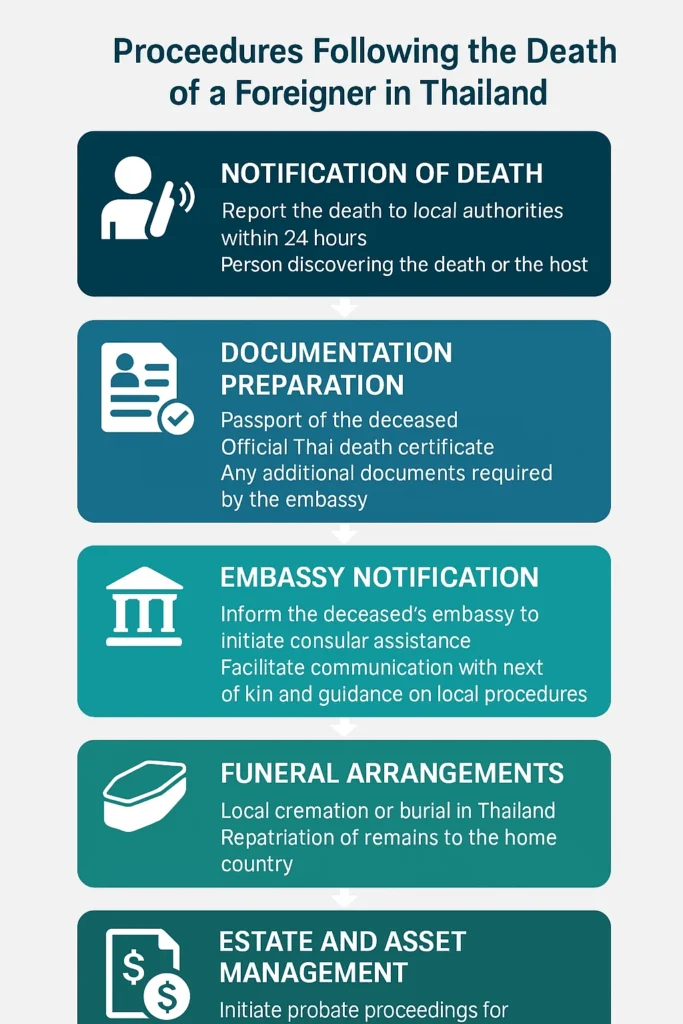
Short answer: report the death promptly, obtain the district death certificate, and confirm body-release and funeral arrangements with the hospital, police and the deceased’s embassy as applicable. Separately, secure the estate and establish who has authority to deal with each asset. Thai banks commonly require a Thai court appointment order, but Thai law also recognises an estate administrator appointed by will. The required route depends on the will, heirs, asset and receiving institution. A family relationship or access to the deceased’s PIN does not establish authority to withdraw money.
FREE DOWNLOAD, KEEP IT WHERE YOUR FAMILY CAN FIND IT
Death of a Foreigner in Thailand, Family Guide & Checklist (Word + PDF, English & Thai)
The family guide covers the first 24 hours, the Thai death certificate, what the embassy does, cremation or repatriation, the bank and the estate, with a checklist and a family record sheet. Complete English text first, then the complete Thai text. Checked 3 October 2026.
Download free Protect your family in advance: Thai will by our lawyers ฿3,900 →
In the first days: confirm who is reporting the death, contact the embassy and insurer, and ask the district registrar for the original certificate and the certified copies needed by identified recipients. Keep the estate secure. See the immediate steps below.
Our full guide to the estate side is Thai inheritance law for foreigners. This page is the practical sequence, from the death itself through to each asset.
Table of Contents
What Has to Happen in the First 7 Days?
The order matters, because each step needs the document produced by the one before it. Almost everything downstream depends on the Thai death certificate, so that is the priority.
| When | What happens | Who does it | What you come away with |
|---|---|---|---|
| Within 24 hours | The death is reported. In a hospital, the hospital issues the medical certificate of death; confirm who will notify the registrar. Anywhere else, or if the death was sudden or unnatural, the police are called first and attend. | Hospital, or the police plus the owner or person in charge of the house where the death occurred. Outside a house, the person who was with the deceased or who found the body | Medical certificate of death, or a police report |
| Notify promptly, generally within 24 hours | Notify the responsible registrar within the applicable deadline. Confirm the evidence needed to complete death registration. | The legally responsible informant or an accepted authorised representative; confirm the route with the registrar | The district death certificate and any certified copies the registrar issues. Processing depends on the evidence and circumstances. |
| Day 1 to 3 | Notify the embassy or consulate of the deceased’s nationality. | Family, or the lawyer | Consular registration of the death, and in many cases a consular death record for use back home |
| Day 1 to 7 | If the death was unnatural (suicide, homicide, animal attack, accident or unknown cause) or happened in official custody, an inquest is held (Criminal Procedure Code section 148); the inquest officials may order an autopsy where it is needed to find the cause (section 151), and the body is released afterwards. | Institute of Forensic Medicine, or the provincial equivalent | Release of the body, and an autopsy report if requested |
| Day 2 to 7 | Choose repatriation or cremation in Thailand, and instruct a funeral director. | Family | A date, and a cost you can plan around |
| Day 3 onward | Have the death certificate translated and legalised if it will be used abroad, for a foreign pension, insurer, bank or probate registry. | Translator, then the Ministry of Foreign Affairs | A death certificate that a foreign institution will accept |
| Week 2 onward | Begin the estate: locate the will, list the Thai assets, and petition the Thai court to appoint an estate administrator. | Lawyer | The court petition filed. This is the long part. |
The DOPA registration guide generally requires death notification within 24 hours after death or discovery, with the responsible informant and reporting route depending on where the death occurred. The notification deadline differs from the time needed to issue documents. Confirm the report has been made; do not assume a hospital or hotel completed every step. Police and post-mortem requirements depend on the circumstances.
Get more copies of the death certificate than you think you need
List the recipients who need evidence of death, such as the embassy, funeral director, insurer, pension provider, bank or registry. Ask which require the original, a certified copy or a translated and legalised version. The British Embassy guide describes one original district death certificate; certified copies are a separate matter. There is no universal rule requiring five originals or five copies for every family.
The law behind this page
English
Section 21 Civil Registration Act B.E. 2534
Full text
When a person dies, the death shall be notified as follows: (1) If the person dies in a house, the house master shall notify the receiving Registrar of the locality where the death occurred within 24 hours of the time of death. If there is no house master, the person who finds the body shall notify within 24 hours of the time of finding the body. (2) If the person dies outside a house, a person who was with the deceased or the person who finds the body shall notify the receiving Registrar of the locality where the death occurred or the body was found, as the case may be, or of a locality where notification can be made, within 24 hours of the time of death or of finding the body. In such a case, notification may instead be made to an administrative officer or the police. In a locality where communications are inconvenient, the Director of Central Registration may extend the time limit for notification under (1) and (2) as considered appropriate, but not beyond 7 days from the time of death or of finding the body. Notification under (1) and (2) shall be made on the form prescribed by the Director of Central Registration, and shall also state the name of the notifier. Paragraph three of section 18 applies mutatis mutandis to notification under paragraph one. The death notification form under paragraph three must at least specify the method and place of disposal of the body, and where the notifier has stated the method and place of disposal of the body, the receiving Registrar shall record them in the proof of notification.
ThaiLawOnline translation
Section 22 Civil Registration Act B.E. 2534
Full text
When notification is made under section 21, the receiving Registrar shall issue a death certificate to the notifier as evidence, except in a case under section 25.
ThaiLawOnline translation
Section 23 Civil Registration Act B.E. 2534
Full text
When a birth or death occurs, the person who delivered the child or the person who gave medical care shall issue a certificate of birth or death, on the form prescribed by the Director of Central Registration, to the person under a duty to notify under section 18 or section 21.
ThaiLawOnline translation
Section 1599
When a person dies, the estate passes to the heirs. An heir can lose the right to the estate only under a provision of this Code or of another law.
Full text
When a person dies, that person's estate devolves on the heirs. An heir may lose the right to the estate only under the provisions of this Code or of other laws.
ThaiLawOnline translation
Section 37 Act on Conflict of Laws B.E. 2481
Full text
Succession, so far as it relates to immovable property, is governed by the law of the place where the property is situated.
ThaiLawOnline translation
Section 38 Act on Conflict of Laws B.E. 2481
Full text
As regards movable property, succession by statutory right or by will is governed by the law of the domicile of the deceased at the time of death.
ThaiLawOnline translation
Section 1713
An heir, an interested person or the public prosecutor may apply to the court to appoint an administrator where a statutory heir or legatee has disappeared, is outside the Kingdom or is a minor; where the administrator or an heir is unable or unwilling to act, or there is an impediment to administering or distributing the estate; or where the clause of the will appointing an administrator cannot take effect.
Full text
An heir, an interested person, or the public prosecutor may apply to the court for the appointment of an administrator of the estate in the following cases: (1) where, on the death of the deceased, a statutory heir or a beneficiary under the will has disappeared, is outside the Kingdom, or is a minor; (2) where the administrator of the estate or an heir is unable or unwilling to administer the estate, or where there is an impediment to its administration or distribution; (3) where a provision of the will appointing an administrator of the estate is for any reason unenforceable. As to the appointment, if the will contains a provision on the point the court appoints in accordance with it; if it does not, the court appoints such person as it thinks fit for the benefit of the estate in the circumstances, having regard to the intention of the deceased.
ThaiLawOnline translation
Section 1754
An inheritance claim is barred one year after the death, or after the statutory heir knew or ought to have known of the death. A claim under a will is barred one year after the legatee knew or ought to have known of the right. Subject to Section 193/27 (which preserves a secured creditor's right to enforce against the mortgaged, pledged or retained property), a creditor whose claim against the deceased has a prescription period longer than one year must sue within one year after he knew or ought to have known of the death. In every case no claim may be brought more than ten years after the death.
Full text
No action concerning an estate may be brought after one year from the death of the deceased, or from the time when the statutory heir knew or ought to have known of the death of the deceased. An action claiming under a provision of a will may not be brought after one year from the time when the legatee knew or ought to have known of the right that the legatee has under the will. Subject to section 193/27 of this Code, where a creditor's claim against the deceased has a prescription period longer than one year, that creditor may not bring an action after one year from the time when the creditor knew or ought to have known of the death of the deceased. In any event, the claims referred to in the preceding paragraphs may not be brought after ten years from the death of the deceased.
ThaiLawOnline translation
ไทย
มาตรา 21 พระราชบัญญัติการทะเบียนราษฎร พ.ศ. 2534
ข้อความเต็ม
เมื่อมีคนตายให้แจ้งการตายดังต่อไปนี้ (๑) คนตายในบ้าน ให้เจ้าบ้านแจ้งต่อนายทะเบียนผู้รับแจ้งแห่งท้องที่ที่มีคนตายภายในยี่สิบสี่ชั่วโมง นับแต่เวลาตาย ในกรณีไม่มีเจ้าบ้าน ให้ผู้พบศพแจ้งภายในยี่สิบสี่ชั่วโมงนับแต่เวลาพบศพ (๒) คนตายนอกบ้าน ให้บุคคลที่ไปกับผู้ตายหรือผู้พบศพแจ้งต่อนายทะเบียนผู้รับแจ้งแห่งท้องที่ที่มีการตายหรือพบศพ แล้วแต่กรณี หรือแห่งท้องที่ที่จะพึงแจ้งได้ ภายในยี่สิบสี่ชั่วโมงนับแต่เวลาตายหรือเวลาพบศพ ในกรณีเช่นนี้จะแจ้งต่อพนักงานฝ่ายปกครองหรือตำรวจก็ได้ กำหนดเวลาให้แจ้งตาม (๑) และ (๒) ถ้าในท้องที่ใดการคมนาคมไม่สะดวก ผู้อำนวยการทะเบียนกลางอาจขยายเวลาออกไปตามที่เห็นสมควร แต่ต้องไม่เกินเจ็ดวันนับแต่เวลาตายหรือเวลาพบศพ การแจ้งตาม (๑) และ (๒) ให้แจ้งตามแบบพิมพ์ที่ผู้อำนวยการทะเบียนกลางกำหนด พร้อมทั้งแจ้งชื่อผู้แจ้งด้วย ให้นำความในวรรคสามของมาตรา ๑๘ มาใช้บังคับกับการแจ้งตามวรรคหนึ่งด้วยโดยอนุโลม แบบพิมพ์แจ้งการตายตามวรรคสาม อย่างน้อยต้องระบุวิธีการและสถานที่จัดการศพไว้ด้วย และในกรณีที่ผู้แจ้งได้แจ้งถึงวิธีการและสถานที่จัดการศพ ให้นายทะเบียนผู้รับแจ้งระบุไว้ในหลักฐานการรับแจ้งด้วย
ตรงตามข้อความในราชกิจจานุเบกษา / สำนักงานคณะกรรมการกฤษฎีกา (Verbatim from the Royal Gazette / Office of the Council of State)
มาตรา 22 พระราชบัญญัติการทะเบียนราษฎร พ.ศ. 2534
ข้อความเต็ม
เมื่อมีการแจ้งตามมาตรา ๒๑ ให้นายทะเบียนผู้รับแจ้งออกมรณบัตรเป็นหลักฐานให้แก่ผู้แจ้ง เว้นแต่เป็นกรณีตามมาตรา ๒๕
ตรงตามข้อความในราชกิจจานุเบกษา / สำนักงานคณะกรรมการกฤษฎีกา (Verbatim from the Royal Gazette / Office of the Council of State)
มาตรา 23 พระราชบัญญัติการทะเบียนราษฎร พ.ศ. 2534
ข้อความเต็ม
เมื่อมีคนเกิดหรือคนตาย ผู้ทำคลอดหรือผู้รักษาพยาบาลต้องออกหนังสือรับรองการเกิดหรือการตายตามแบบพิมพ์ที่ผู้อำนวยการทะเบียนกลางกำหนดให้แก่ผู้มีหน้าที่ต้องแจ้งตามมาตรา ๑๘ หรือมาตรา ๒๑
ตรงตามข้อความในราชกิจจานุเบกษา / สำนักงานคณะกรรมการกฤษฎีกา (Verbatim from the Royal Gazette / Office of the Council of State)
มาตรา 1599
ข้อความเต็ม
เมื่อบุคคลใดตาย มรดกของบุคคลนั้นตกทอดแก่ทายาท ทายาทอาจเสียไปซึ่งสิทธิในมรดกได้แต่โดยบทบัญญัติแห่งประมวลกฎหมายนี้หรือกฎหมายอื่น
ตรงตามข้อความในราชกิจจานุเบกษา / สำนักงานคณะกรรมการกฤษฎีกา (Verbatim from the Royal Gazette / Office of the Council of State)
มาตรา 37 พระราชบัญญัติว่าด้วยการขัดกันแห่งกฎหมาย พุทธศักราช 2481
ข้อความเต็ม
มรดกเท่าที่เกี่ยวกับอสังหาริมทรัพย์ ให้เป็นไปตามกฎหมายแห่งถิ่นที่ทรัพย์สินนั้นตั้งอยู่
ตรงตามข้อความในราชกิจจานุเบกษา / สำนักงานคณะกรรมการกฤษฎีกา (Verbatim from the Royal Gazette / Office of the Council of State)
มาตรา 38 พระราชบัญญัติว่าด้วยการขัดกันแห่งกฎหมาย พุทธศักราช 2481
ข้อความเต็ม
ในส่วนที่เกี่ยวกับสังหาริมทรัพย์ มรดกโดยสิทธิโดยธรรม หรือโดยพินัยกรรม ให้เป็นไปตามกฎหมายภูมิลำเนาของเจ้ามรดกในขณะที่เจ้ามรดกถึงแก่ความตาย
ตรงตามข้อความในราชกิจจานุเบกษา / สำนักงานคณะกรรมการกฤษฎีกา (Verbatim from the Royal Gazette / Office of the Council of State)
มาตรา 1713
ข้อความเต็ม
ทายาทหรือผู้มีส่วนได้เสียหรือพนักงานอัยการจะร้องต่อศาลขอให้ตั้งผู้จัดการมรดกก็ได้ ในกรณีดังต่อไปนี้ (๑) เมื่อเจ้ามรดกตาย ทายาทโดยธรรมหรือผู้รับพินัยกรรมได้สูญหายไป หรืออยู่นอกราชอาณาเขต หรือเป็นผู้เยาว์ (๒) เมื่อผู้จัดการมรดกหรือทายาทไม่สามารถ หรือไม่เต็มใจที่จะจัดการ หรือมีเหตุขัดข้องในการจัดการ หรือในการแบ่งปันมรดก (๓) เมื่อข้อกำหนดพินัยกรรมซึ่งตั้งผู้จัดการมรดกไว้ไม่มีผลบังคับได้ด้วยประการใด ๆ การตั้งผู้จัดการมรดกนั้น ถ้ามีข้อกำหนดพินัยกรรมก็ให้ศาลตั้งตามข้อกำหนดพินัยกรรม และถ้าไม่มีข้อกำหนดพินัยกรรม ก็ให้ศาลตั้งเพื่อประโยชน์แก่กองมรดกตามพฤติการณ์ และโดยคำนึงถึงเจตนาของเจ้ามรดก แล้วแต่ศาลจะเห็นสมควร
ตรงตามข้อความในราชกิจจานุเบกษา / สำนักงานคณะกรรมการกฤษฎีกา (Verbatim from the Royal Gazette / Office of the Council of State)
มาตรา 1754
ข้อความเต็ม
ห้ามมิให้ฟ้องคดีมรดกเมื่อพ้นกำหนดหนึ่งปี นับแต่เมื่อเจ้ามรดกตาย หรือนับแต่เมื่อทายาทโดยธรรมได้รู้ หรือควรได้รู้ถึงความตายของเจ้ามรดก คดีฟ้องเรียกตามข้อกำหนดพินัยกรรม มิให้ฟ้องเมื่อพ้นกำหนดหนึ่งปีนับแต่เมื่อผู้รับพินัยกรรมได้รู้หรือควรได้รู้ถึงสิทธิซึ่งตนมีอยู่ตามพินัยกรรม ภายใต้บังคับแห่งมาตรา ๑๙๓/๒๗ แห่งประมวลกฎหมายนี้ ถ้าสิทธิเรียกร้องของเจ้าหนี้อันมีต่อเจ้ามรดกมีกำหนดอายุความยาวกว่าหนึ่งปี มิให้เจ้าหนี้นั้นฟ้องร้องเมื่อพ้นกำหนดหนึ่งปีนับแต่เมื่อเจ้าหนี้ได้รู้ หรือควรได้รู้ถึงความตายของเจ้ามรดก ถึงอย่างไรก็ดี สิทธิเรียกร้องตามที่ว่ามาในวรรคก่อน ๆ นั้น มิให้ฟ้องร้องเมื่อพ้นกำหนดสิบปีนับแต่เมื่อเจ้ามรดกตาย หมายเหตุ: [เลขมาตรา ๑๙๓/๒๗ แก้ไขเพิ่มเติมโดยมาตรา ๑๕ แห่งพระราชบัญญัติให้ใช้บทบัญญัติบรรพ ๑ แห่งประมวลกฎหมายแพ่งและพาณิชย์ที่ได้ตรวจชำระใหม่ พ.ศ. ๒๕๓๕]
ตรงตามข้อความในราชกิจจานุเบกษา / สำนักงานคณะกรรมการกฤษฎีกา (Verbatim from the Royal Gazette / Office of the Council of State)
Français
Article 21 Civil Registration Act B.E. 2534
Décès dans une maison: le chef de maison, ou à défaut celui qui trouve le corps, déclare sous 24 heures. Décès à l'extérieur: l'accompagnant ou celui qui trouve le corps déclare sous 24 heures, à l'officier d'état civil, l'administration ou la police. Prorogation possible si communications difficiles, sept jours maximum.
résumé non officiel
Article 22 Civil Registration Act B.E. 2534
Sur déclaration selon l'article 21, l'officier d'état civil délivre au déclarant un acte de décès, sauf dans le cas de l'article 25.
résumé non officiel
Article 23 Civil Registration Act B.E. 2534
Lors d'une naissance ou d'un décès, la personne ayant pratiqué l'accouchement ou donné les soins doit délivrer un certificat, sur le formulaire officiel, à la personne tenue de déclarer selon l'article 18 ou l'article 21.
résumé non officiel
Article 1599
Au décès d'une personne, sa succession est dévolue à ses héritiers. Un héritier ne peut perdre ses droits sur la succession qu'en vertu des dispositions du présent Code ou d'autres lois.
résumé non officiel
Article 37 Act on Conflict of Laws B.E. 2481
La succession immobilière est régie par la loi du lieu de situation du bien.
résumé non officiel
Article 38 Act on Conflict of Laws B.E. 2481
Pour les meubles, la succession légale ou testamentaire est régie par la loi du domicile du défunt au moment du décès.
résumé non officiel
Article 1713
Un héritier, une personne intéressée ou le ministère public peut demander au tribunal la nomination d'un administrateur de la succession dans les cas suivants : (1) lorsque, au décès du de cujus, un héritier légal ou un légataire a disparu, se trouve hors du Royaume ou est mineur ; (2) lorsque l'administrateur de la succession ou un héritier ne peut pas ou ne veut pas administrer, ou qu'un empêchement fait obstacle à l'administration ou au partage de la succession ; (3) lorsque la disposition testamentaire désignant un administrateur de la succession est, pour quelque cause que ce soit, dépourvue d'effet. Pour la nomination de l'administrateur de la succession, s'il existe une disposition testamentaire, le tribunal nomme conformément à celle-ci ; à défaut, le tribunal nomme, dans l'intérêt de la succession, selon les circonstances et en tenant compte de l'intention du de cujus, comme il le juge approprié.
résumé non officiel
Article 1754
Aucune action successorale ne peut être intentée après l'expiration d'un délai d'un an à compter du décès du de cujus, ou à compter du moment où l'héritier légal a eu connaissance ou aurait dû avoir connaissance du décès du de cujus. L'action fondée sur une disposition testamentaire ne peut être intentée après l'expiration d'un délai d'un an à compter du moment où le légataire a eu connaissance ou aurait dû avoir connaissance du droit qu'il tient du testament. Sous réserve de l'article 193/27 du présent Code, lorsque la créance d'un créancier contre le de cujus est soumise à un délai de prescription supérieur à un an, ce créancier ne peut agir en justice après l'expiration d'un délai d'un an à compter du moment où il a eu connaissance ou aurait dû avoir connaissance du décès du de cujus. En tout état de cause, les droits visés aux alinéas précédents ne peuvent être exercés en justice après l'expiration d'un délai de dix ans à compter du décès du de cujus.
résumé non officiel
Sources
- Civil Registration Act B.E. 2534, retrieved 31 October 2026
- Civil and Commercial Code, Office of the Council of State, retrieved 31 October 2026
- Act on Conflict of Laws B.E. 2481, retrieved 31 October 2026
What Does the Embassy Actually Do?
Embassies are helpful and they are not a solution. The distinction matters, because families arriving from abroad frequently expect the consulate to take charge, and it will not.
| The embassy will | The embassy will not |
|---|---|
| Notify the next of kin | Pay for the funeral, the cremation, or the repatriation |
| Explain the local process and the choices | Settle the deceased’s debts in Thailand |
| Liaise with Thai authorities and, where needed, the police | Act as executor or administrator of the estate |
| Explain any consular death-record or body-release procedure available for that nationality | Release funds from a Thai bank account |
| Provide a list of local funeral directors, translators and lawyers | Recommend or vouch for any one of them |
| Help arrange the transfer of money from family abroad to cover costs | Advance that money |
| Cancel and, in some cases, return the passport | Register the death for Thai purposes: that is the amphur’s job |
Take the passport and the Thai death certificate to the first appointment. If the deceased held two nationalities, contact both embassies: the estate paperwork at home may be simpler through one of them.
Repatriation or Cremation in Thailand?
This is the family’s decision and it is largely a financial one, made under time pressure and grief, which is a bad combination. The gap between the two options is wide.
| Repatriation of the body | Cremation in Thailand | |
|---|---|---|
| What is required | Embalming, an embalming certificate, a sealed zinc-lined coffin, the death certificate, airline approval, customs and export clearance | The death certificate and a crematorium booking |
| Typical timescale | One to three weeks, longer if an autopsy is involved | Days |
| Typical cost | Substantial. Quotes commonly run from roughly THB 150,000 to well over THB 400,000, driven by destination, airline and province. | A small fraction of that |
| Who pays | Ask the insurer and funeral director before committing. A family member may need to advance costs while estate authority or bank access is resolved. Reasonable funeral expenses are addressed by Section 1650 of the Civil and Commercial Code. | Check cover and keep itemised receipts. Embassy funding is not automatic. |
| Insurance | Check the actual policy, exclusions, authorisation process and destination. Repatriation cover varies; do not assume cover or exclusion from the policy label alone. | Check the policy and obtain approval where required. |
Cremation followed by taking the ashes home is by far the most common route for foreign deaths in Thailand, and the ashes can be carried by a family member or shipped. Burial is possible but unusual.
The cruel part of the timing is worth stating plainly. The funeral has to be paid for in the first fortnight, and the deceased’s Thai money cannot be reached for months. If the deceased was the only earner and their account is the only account, the family pays from its own resources and is reimbursed from the estate much later. Anyone with dependants in Thailand should hold a modest joint account for exactly this reason, and we say so on the Thai will page as well.
What Happens to Each Asset?
The estate devolves on heirs at death under Section 1599 of the Civil and Commercial Code. Establishing an entitlement differs from satisfying a bank or registry’s transfer requirements. Check authority, supporting records and the accepted procedure for each asset before instructing a transfer.
| Asset | What actually happens | What the heir needs |
|---|---|---|
| Thai bank account | Notify the bank and request its deceased-customer procedure. A spouse or foreign executor should not assume immediate access. Banks commonly require a Thai appointment order. | Death certificate, identity and succession documents, plus a court order where the bank requires one. Confirm the bank’s written requirements. |
| Joint bank account | Practice varies by bank and by how the account was opened. Some release the survivor’s share; many freeze the whole account pending the court order. | Ask the branch early. Do not assume. |
| Condominium unit | A foreign heir can inherit the unit, but can only keep it registered in their own name if the building’s 49% foreign quota allows. If it does not, or if the heir does not qualify, the unit must be disposed of, and the Land Department can sell it if the heir does not. | Court order, plus the juristic person’s written confirmation of the quota position |
| Land, or a house on land | Foreign ownership restrictions remain. Section 93 of the Land Code provides a restricted permission route for a foreign statutory heir; inheritance does not itself authorise registration. Where retention is not permitted, disposal requirements apply. Building ownership needs separate examination. | Check the Department of Lands Section 93 procedure, eligibility, permission and any disposal deadline with the responsible Land Office. |
| Vehicle | Ask the Department of Land Transport which inheritance-transfer route and evidence apply. Preserve the registration book and check tax and insurance. | Death certificate, registration book, heir or administrator evidence, and a court order where required by the applicable procedure. |
| Company shares | Review the shareholder register, articles and succession evidence. A vacant authorised-director position requires separate corporate action; inheriting shares does not automatically appoint a director. | Succession and authority records, lawful share-register changes, and the resolutions and DBD filings required for a director change. |
| Life insurance | The important exception. Where the policy names a specific beneficiary, the sum insured goes to that person and is not part of the estate. Section 897 leaves one thing behind: the premiums the deceased actually paid still form part of the estate and creditors can claim against those. Where the policy simply says “my heirs” without naming anyone, section 897 of the Civil and Commercial Code puts the money into the estate, where creditors can. The wording on an old policy is worth checking now, not later. | Death certificate and the policy. Usually no court order needed if a beneficiary is named. |
| Foreign pension | Governed by the home country, not by Thailand. Stop it promptly: overpayments after death are reclaimed, sometimes aggressively, and sometimes from the widow’s own account. | Legalised and translated death certificate |
| Rented home | The lease does not end automatically on death. The deposit and any notice period remain due. | Talk to the landlord in the first week |
| Phone, utilities, subscriptions | Keep the electricity and water on if anyone still lives there, and if the condominium is empty keep paying the common area charges. Arrears block a later transfer at the Land Office. | Nothing formal, but do not let them lapse |
| Pets | No legal mechanism protects them. Somebody has to decide in the first days. | A named person, agreed in advance if possible |
When a Court Appointment Is Needed
Separate the source of an administrator’s legal authority from the evidence a bank or registry requires before acting.
Section 1711 of the Civil and Commercial Code recognises administrators appointed by will or by court. Section 1713 provides for a court petition in the circumstances specified there, including obstacles to administration and ineffective appointment provisions. An heir, interested person or public prosecutor has the petition route specified by that section. In practice, banks and registries frequently require a Thai court order for the proposed transaction. A foreign grant should not be assumed to satisfy those requirements. Section 1718 separately excludes persons disqualified from acting as administrator.
Where a court application is needed, produce the will, proposed administrator’s qualifications and complete heirship evidence. A nomination helps identify the proposed administrator but does not guarantee an uncontested appointment or a short hearing. Without an effective disposition, the statutory heirs and surviving spouse’s entitlement require assessment under Sections 1629 and 1635 for Thai land and buildings (Conflict of Laws Act section 37). Movable assets such as bank accounts and shares follow the law of the deceased’s domicile at death (section 38). Cross-border records and disputes affect the timetable.
There is also a deadline that surprises people. Under section 1754, an heir’s claim to the estate is generally barred one year after they knew or ought to have known of the death. We have written up a recent decision on exactly that point in Thai inheritance claims after one year, Dika 284/2569. If the family is abroad and assumes there is no rush, the year runs anyway.
The mechanics of the court process, the documents, and the typical timeline are set out in our probate and estate administration guide. If the will was made abroad, see probate of a foreign will in Thailand.
Proving You Are the Heir When the Marriage or Birth Happened Abroad
A cross-border family has an extra hurdle: the Thai court needs to be satisfied that a foreign marriage or a foreign birth actually creates the relationship claimed. It can be, and routinely is.
In Supreme Court Decision 170/2569, a widow opposing another applicant’s appointment as administrator produced a certified copy of a Florida marriage record with a translation, plus a certificate from the Clerk of the Court of Miami-Dade County confirming the copy was genuine. The Supreme Court held that under section 1459 paragraph one of the Civil and Commercial Code a marriage abroad where at least one party is Thai may be celebrated in the form prescribed by Thai law or by the law of that country, and under section 20 paragraph two of the Conflict of Laws Act B.E. 2481 such a marriage is valid in Thailand. Where both spouses are foreign nationals that section does not apply and the marriage is proved a different way, but the evidential point below is the same. She was therefore the lawful wife and an heir entitled to inherit.
The practical lesson is about evidence, not law. What carried it was a properly certified copy from the issuing authority, with a translation. The same applies to foreign birth certificates for children and to foreign divorce decrees where an earlier marriage has to be shown to have ended. Gather these early, have them legalised, and expect the process to take weeks; our document legalisation guide explains the route.
What Does It Cost and How Long Does It Take?
| Item | Typical timing | Fee |
|---|---|---|
| Death certificate at the amphur | Same day to 3 working days | Nominal government fee |
| First consultation, so somebody tells you the order of events | 1 to 2 business days | 2,000 THB per hour |
| Probate: petition to appoint an estate administrator | Several months from filing to order, longer without a will or with a contest | Tiered, individual quote once the estate is listed |
| Dealing with banks, Land Office and Land Transport after appointment | Weeks | Quoted with the probate work |
| Making a Thai will, for those still reading this in time | 3 to 5 business days | 3,900 THB |
| Safekeeping of the original will at our office | Ongoing | 1,000 THB |
Government court fees and translation and legalisation costs are separate and depend on the size of the estate and the documents involved.
The One Thing That Changes All of This
A properly coordinated Thai will records the intended beneficiaries and administrator for Thai assets. It does not guarantee immediate bank access or eliminate a necessary court application. Equally, there is no rule that every asset in every estate must await a court appointment. Check the will’s interaction with foreign wills and the transaction requirements of each institution.
If you live in Thailand and have anything here at all, a bank account, a car, a condominium, a company share, this is the kindest paperwork you will ever do for the people who will have to sort it out. See making a Thai will, our free bilingual will template, and if you also have a will at home, how a Thai will and a foreign will work together. What happens when there is no will is set out in dying without a will in Thailand.
Common Questions
What happens if a foreigner dies in Thailand?
Report the death promptly and complete district registration. Confirm body-release and funeral requirements with the responsible authorities and embassy. Separately, secure the estate and establish authority for each asset. A court appointment is often needed in practice, particularly for bank release, but it is not a universal statutory prerequisite for every asset.
Can my wife access my Thai bank account when I die?
Marriage alone does not authorise access to an account held solely by the deceased. Notify the bank and obtain its written succession-document requirements; a Thai court appointment order is commonly required. Joint accounts have separate terms and procedures. Do not use the deceased’s PIN or online credentials as a substitute for authority.
How long does the whole process take?
Medical and police enquiries, body release, document completeness, embassy procedures and funeral arrangements determine the immediate timetable. Estate administration depends on the assets, required court proceedings and any dispute. Obtain a case-specific estimate; a fixed minimum or maximum is not reliable.
Is a foreign will valid in Thailand?
A foreign will requires assessment of validity, applicable law, translation and any certification requirements. Section 1711 recognises appointment by will, but a foreign nomination or grant does not guarantee acceptance by a Thai institution. A Thai court order is often required for practical administration. Coordinate any Thai will with existing foreign wills to avoid unintended revocation.
Can a foreign heir inherit a condominium in Thailand?
Yes, subject to the building’s 49% foreign ownership quota. If registering the unit in the foreign heir’s name would breach the quota, or the heir does not qualify to hold it, the unit has to be disposed of, and the Land Department can sell it if the heir does not act. Get the quota position in writing from the juristic person early.
Can a foreign heir inherit land or a house in Thailand?
Foreign ownership restrictions continue after inheritance. Section 93 of the Land Code provides a restricted permission route for a foreign statutory heir, subject to conditions and area limits. Where lawful retention is unavailable, disposal requirements apply. Building ownership is a separate question. Obtain the Land Office’s assessment promptly.
Does life insurance form part of the estate?
It depends on the wording. Where the policy names a specific beneficiary, the sum insured is paid to that person and is outside the estate. Only the premiums the deceased actually paid remain part of the estate and within reach of creditors. Where the policy is simply payable to “my heirs” with nobody named, section 897 of the Civil and Commercial Code treats the proceeds as part of the estate and creditors can claim against it.
Is there a deadline to claim an inheritance in Thailand?
Inheritance claims have short and claim-specific limitation rules. Section 1754 generally provides a one-year period and a ten-year long-stop, with different starting points for different claims and relevant exceptions elsewhere in the Code. Possession and administration disputes need separate analysis. Have the earliest applicable deadline checked promptly.
Who pays for the funeral or repatriation?
Check the insurer’s cover and obtain written funeral quotations. A family member may need to advance costs while authority or account access is being resolved. Reasonable funeral expenses are addressed by Section 1650; keep receipts and distinguish an estate expense from a personal promise to pay. The embassy does not ordinarily fund the funeral.
We are abroad. Do we have to fly to Thailand?
Usually not immediately. A Thai lawyer acting under a power of attorney, working alongside the embassy, can help with death registration where the registrar accepts that route, obtain and legalise the certificates, instruct a funeral director and file the court petition. Someone normally attends at some stage, but the first week can be handled remotely.
How We Help
We act for families dealing with a death in Thailand, very often from abroad and in a different time zone. That means obtaining and legalising the death certificate, coordinating with the embassy and a funeral director for repatriation or cremation, and then the estate: petitioning the court to appoint the administrator, and afterwards dealing with the banks, the Land Office, the Department of Land Transport and any company shares.
If you are in the first days, the useful first step is a short consultation at 2,000 THB per hour so that somebody sets out the order of events and tells you what can wait. Probate is quoted individually once the estate has been listed. Our published legal fees and pricing are online.
Contact us in English, French or Thai.
Email: info@thailawonline.com | Phone: +66 87 225 1340 (English and French), +66 87 414 9288 (Thai and English). We work by appointment, including outside Thai office hours for families in other time zones.
This page states the position as at August 2026 and is general information, not advice on your situation. Statutory references are to the Thai Civil and Commercial Code unless stated otherwise. Repatriation figures are indicative market quotes, not our fees.
Last reviewed: 5 September 2026. No corrections were needed. Every Civil and Commercial Code citation on this page was checked against the statute text: section 1754 (an inheritance claim is barred one year after the heir knew or ought to have known of the death), section 897 (a named beneficiary takes the sum outside the estate and only the premiums paid fall into it, while a policy payable simply to the heirs falls into the estate), sections 1711 to 1713 on appointing an administrator, section 1718 on who cannot be appointed, and the six classes of statutory heir in section 1629. All fifteen links on the page resolve. Re-checked on 6 October 2026: Civil and Commercial Code sections 1459 and 1650 and Supreme Court Decision 170/2569 read in Thai; the account of the Florida marriage evidence and the funeral-expense rule match; nothing changed.
Thai Law Updates, free by email
Plain-English updates on Thai law changes that affect foreigners: property, visas, marriage, business and wills. One short email a month from a firm practicing since 2006. No spam, unsubscribe anytime.