


Reviewed by Wichuda Atthamethakon, LL.M., Thai Bar Licence 3149/2556, for ThaiLawOnline, a Thai law firm acting for foreigners since 2006.
Update log
- 6 November 2026: Added the statute box with Thai, English and French text and checked the page against the official text
Bringing a dog or cat to Thailand is manageable when the documents follow the correct order. The key steps are a microchip, the required vaccinations, an import permit from the Department of Livestock Development, an official health certificate from the exporting country, and veterinary clearance on arrival.
Most healthy dogs and cats with complete papers are released without routine quarantine. This does not mean Thailand has a blanket “no quarantine” rule. An Animal Quarantine Station officer retains authority to detain a pet showing signs of disease or arriving with missing, inconsistent or invalid documents.
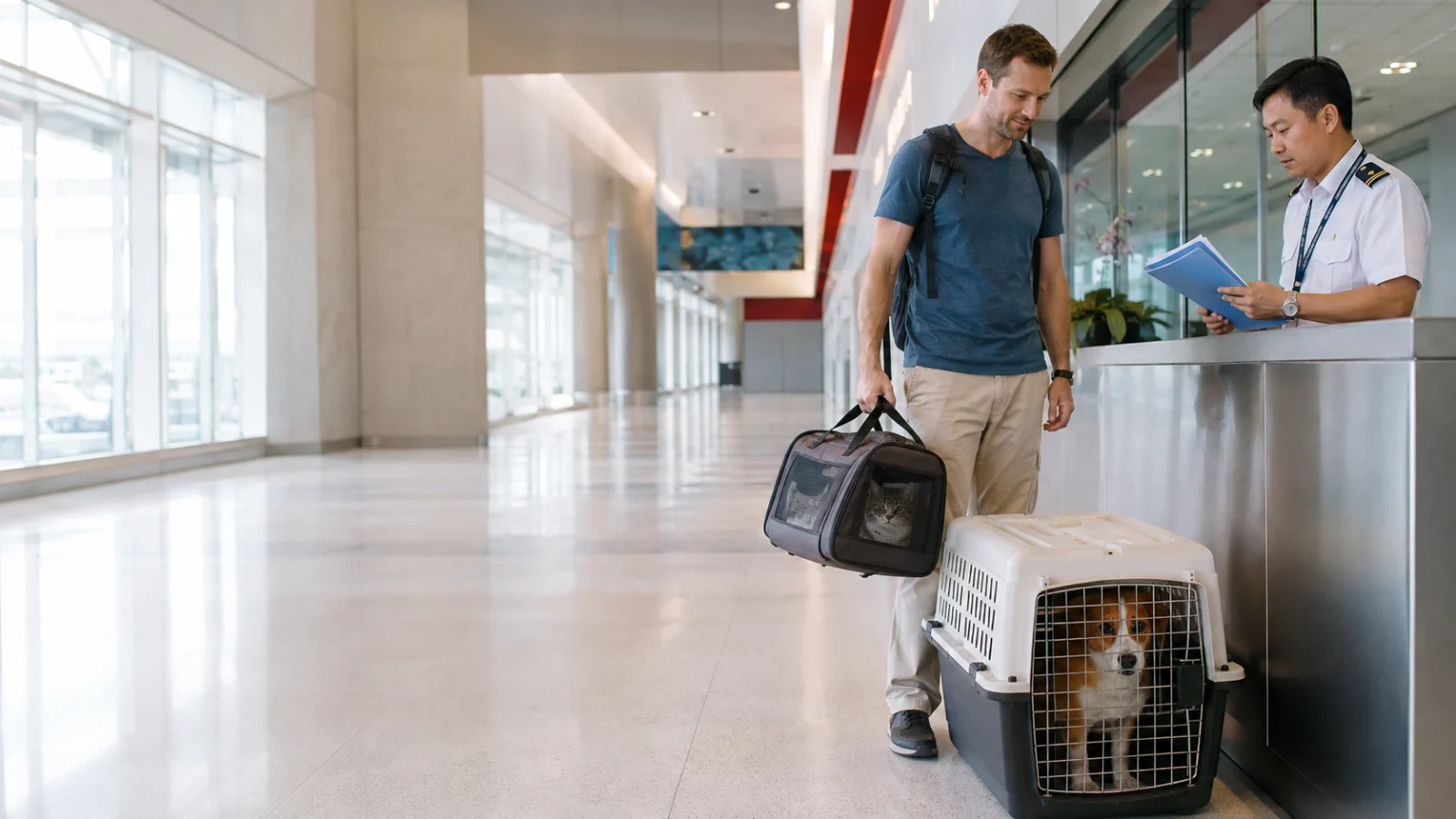
This pet import Thailand guide covers accompanied pets arriving by air. Cargo shipments, land-border arrivals, birds, reptiles and other animals follow different procedures. Confirm those cases directly with the Animal Quarantine Station at the intended port of entry before booking transport.
If the pet forms part of a permanent relocation, use our moving to Thailand legal guide to plan visas, housing, banking and other formalities alongside the animal import process.
Table of Contents
Thailand pet import requirements at a glance
Pet Import Thailand Overview
| Step | What is required | Safe timing |
|---|---|---|
| 1. Identify the pet | Microchip and implantation certificate | Before the permit application and preferably before vaccination |
| 2. Complete vaccines | Dogs: rabies, distemper, hepatitis, parvovirus and leptospirosis. Cats: rabies and feline panleukopenia | Primary vaccines at least 21 days before the permit application |
| 3. Apply for permission | Form R.1/1 and supporting documents sent to the AQS at the arrival airport | At least 7 days and no more than 60 days before departure; 30 days gives a safer margin |
| 4. Obtain health certificate | Original official health certificate, endorsed by the competent government veterinary authority in the country of export | For US departures, valid for 10 days after USDA endorsement; other countries must follow their own official export process |
| 5. Clear AQS on arrival | Veterinary inspection; Forms R.6 and R.7 issued | Before Customs release |
| 6. Clear Customs | Use the Goods to Declare channel and pay assessed duty or tax | Immediately after AQS clearance |
Do not book on the assumption that an arrival permit will solve missing paperwork. Some accompanied pets qualify to apply on arrival, but airlines often require proof of Thai import approval before boarding. Advance approval is the safer route.
The law behind this page
English
Section 31 Animal Epidemics Act B.E. 2558
Full text
For the purpose of preventing and controlling epidemic diseases, any person who imports, exports or transits through the Kingdom animals or animal carcasses must obtain a licence from the Director-General or a person entrusted by the Director-General on each occasion of import, export or transit through the Kingdom. The application for a licence, the issuance of a licence and the method of import, export or transit through the Kingdom shall be in accordance with the rules, procedures and conditions notified by the Director-General.
ThaiLawOnline translation
Section 42 Animal Epidemics Act B.E. 2558
Full text
An inspector shall have the power to seize or attach animals or animal carcasses imported into or transited through the Kingdom when there is reasonable cause to suspect that such animals or animal carcasses are infected with an epidemic disease or are carriers of an epidemic disease. Where the animals or animal carcasses under paragraph one are infected with an epidemic disease or are carriers of an epidemic disease, a veterinarian shall destroy such animals or animal carcasses or deal with them by other means in accordance with the regulations prescribed by the Director-General. Where the animals or animal carcasses under paragraph one have been imported into or transited through the Kingdom without a licence under section 31, or without compliance with section 32 or section 33, the following action shall be taken: (1) where such animals or animal carcasses are not infected with an epidemic disease and are not carriers of an epidemic disease, the inspector shall have the power to order the owner, the importer or the person transiting them to return such animals or animal carcasses to the country of origin; in this regard, the return shall be carried out in accordance with the rules and procedures notified by the Director-General; (2) where the method of examination cannot easily be carried out, or is not worthwhile, to prove whether such animals or animal carcasses are infected with an epidemic disease or are carriers of an epidemic disease, a veterinarian shall destroy such animals or animal carcasses or deal with them by other means in accordance with the regulations prescribed by the Director-General. The expenses relating to the seizure, attachment or destruction shall be borne by the owner, the importer or the person transiting the animals or animal carcasses.
ThaiLawOnline translation
Section 68 Animal Epidemics Act B.E. 2558
Full text
Any person who imports, exports or transits through the Kingdom animals or animal carcasses without a licence under section 31 paragraph one shall be liable to imprisonment for a term not exceeding two years or to a fine not exceeding two hundred thousand baht, or to both.
ThaiLawOnline translation
Section 32 Animal Epidemics Act B.E. 2558
Full text
A licensee under section 31 shall comply with the following: (1) apply animal identification marks before importing, exporting or transiting through the Kingdom the animals or animal carcasses, and the provisions of section 9 paragraph two and paragraph three shall apply mutatis mutandis; (2) bring the animals or animal carcasses dealt with under (1) into, out of or through the port of entry or port of exit notified by the Minister, and comply with the rules, procedures and conditions prescribed in ministerial regulations.
ThaiLawOnline translation
Section 40 Animal Epidemics Act B.E. 2558
Full text
For the purpose of preventing and controlling epidemic diseases, when it appears that there is, or it is suspected that there is, an epidemic disease agent or a carrier of an epidemic disease, a veterinarian shall have the following powers: (1) to issue a notification or a written order requiring the owner of animals or animal carcasses to report the number of animals or animal carcasses and, if the veterinarian thinks fit, to bring such animals or animal carcasses so that the veterinarian may carry out disease examination, take samples, carry out epidemic disease prevention or apply animal identification marks; (2) to order in writing the owner of animals or animal carcasses to hold the animals or animal carcasses at such place as the veterinarian thinks fit, as necessary for disease examination; (3) to stop and inspect vehicles, or to enter buildings or any other places, in order to carry out disease examination, take samples, carry out epidemic disease prevention or apply animal identification marks; in this connection, the veterinarian shall have the power to order in writing the owner of the vehicle, building or other place to clean and destroy the epidemic disease agent or the carrier of the epidemic disease at places where the epidemic disease agent is present or is suspected to be present, in accordance with the prescribed method; in this regard, entry into such building or place shall be made between sunrise and sunset or during the working hours of such building or place, and if the action has not been completed, it may be continued until completed; (4) to examine animals, animal carcasses or any articles which are exhibits and have been seized or attached under this Act or under other laws; where such animals or animal carcasses are infected with an epidemic disease or are carriers of an epidemic disease, the veterinarian shall have the power to deal with such animals or animal carcasses in accordance with the regulations prescribed by the Director-General; the expenses of such examination or action shall be borne by the owner of the animals or animal carcasses; (5) to destroy any articles which contain an epidemic disease agent or which there is reasonable cause to suspect contain an epidemic disease agent, in accordance with the rules and procedures notified by the Director-General; in this regard, the owner shall be compensated for the value of the articles in accordance with the rules and procedures prescribed in ministerial regulations, except where the owner has intentionally committed an offence against the provisions of this Act. In the performance of the veterinarian under paragraph one, the persons concerned shall provide reasonable facilities. In the performance of duties under this Act, the veterinarian shall be an official under the Penal Code.
ThaiLawOnline translation
Section 33 Animal Epidemics Act B.E. 2558
Full text
When it appears that any locality outside the Kingdom has, or is suspected of having, an epidemic disease, the Director-General shall have the power to issue a notification to suspend the import into or transit through the Kingdom of animals or animal carcasses from that locality for not more than ninety days at a time. If the Minister thinks fit, the Minister may issue a notification prohibiting the import into or transit through the Kingdom of animals or animal carcasses from that locality.
ThaiLawOnline translation
ไทย
มาตรา 31 พระราชบัญญัติโรคระบาดสัตว์ พ.ศ. 2558
ข้อความเต็ม
เพื่อประโยชน์ในการป้องกันและควบคุมโรคระบาด ผู้ใดนำเข้า ส่งออก หรือนำผ่านราชอาณาจักรซึ่งสัตว์หรือซากสัตว์ ต้องได้รับใบอนุญาตจากอธิบดีหรือผู้ซึ่งอธิบดีมอบหมายทุกครั้งที่นำเข้า ส่งออกหรือนำผ่านราชอาณาจักร การขออนุญาต การออกใบอนุญาต และวิธีการนำเข้า ส่งออก หรือนำผ่านราชอาณาจักรให้เป็นไปตามหลักเกณฑ์ วิธีการและเงื่อนไขที่อธิบดีประกาศกำหนด
ตรงตามข้อความในราชกิจจานุเบกษา / สำนักงานคณะกรรมการกฤษฎีกา (Verbatim from the Royal Gazette / Office of the Council of State)
มาตรา 42 พระราชบัญญัติโรคระบาดสัตว์ พ.ศ. 2558
ข้อความเต็ม
ให้สารวัตรมีอำนาจยึดหรืออายัดสัตว์หรือซากสัตว์ที่นำเข้าหรือนำผ่านราชอาณาจักร เมื่อสัตว์หรือซากสัตว์ดังกล่าวมีเหตุอันควรสงสัยว่าเป็นโรคระบาดหรือเป็นพาหะของโรคระบาด ในกรณีที่สัตว์หรือซากสัตว์ตามวรรคหนึ่ง เป็นโรคระบาดหรือเป็นพาหะของโรคระบาด ให้สัตวแพทย์ทำลายสัตว์หรือซากสัตว์นั้น หรือจัดการโดยวิธีอื่นตามระเบียบที่อธิบดีกำหนด ในกรณีที่สัตว์หรือซากสัตว์ตามวรรคหนึ่งได้นำเข้า หรือนำผ่านราชอาณาจักรโดยไม่ได้รับใบอนุญาตตามมาตรา ๓๑ หรือไม่ปฏิบัติตามมาตรา ๓๒ หรือมาตรา ๓๓ ให้ดำเนินการ ดังต่อไปนี้ (๑) กรณีที่สัตว์หรือซากสัตว์ดังกล่าวมิได้เป็นโรคระบาดหรือมิได้เป็นพาหะของโรคระบาด ให้สารวัตรมีอำนาจสั่งให้เจ้าของ ผู้นำเข้าหรือนำผ่านส่งกลับสัตว์หรือซากสัตว์นั้นไปยังประเทศต้นทาง ทั้งนี้ การดำเนินการส่งกลับให้เป็นไปตามหลักเกณฑ์และวิธีการที่อธิบดีประกาศกำหนด (๒) กรณีที่วิธีการตรวจพิสูจน์ไม่อาจกระทำได้โดยง่ายหรือไม่คุ้มค่าในอันที่จะพิสูจน์ว่าสัตว์หรือซากสัตว์ดังกล่าวเป็นโรคระบาดหรือเป็นพาหะของโรคระบาด ให้สัตวแพทย์ทำลายสัตว์หรือซากสัตว์นั้น หรือจัดการโดยวิธีอื่นตามระเบียบที่อธิบดีกำหนด ค่าใช้จ่ายเกี่ยวกับการยึด อายัด หรือทำลาย ให้เจ้าของ ผู้นำเข้าหรือนำผ่านสัตว์หรือซากสัตว์เป็นผู้รับผิดชอบ
ตรงตามข้อความในราชกิจจานุเบกษา / สำนักงานคณะกรรมการกฤษฎีกา (Verbatim from the Royal Gazette / Office of the Council of State)
มาตรา 68 พระราชบัญญัติโรคระบาดสัตว์ พ.ศ. 2558
ข้อความเต็ม
ผู้ใดนำเข้า ส่งออกหรือนำผ่านราชอาณาจักรซึ่งสัตว์หรือซากสัตว์โดยไม่ได้รับใบอนุญาตตามมาตรา ๓๑ วรรคหนึ่ง ต้องระวางโทษจำคุกไม่เกินสองปี หรือปรับไม่เกินสองแสนบาท หรือทั้งจำทั้งปรับ
ตรงตามข้อความในราชกิจจานุเบกษา / สำนักงานคณะกรรมการกฤษฎีกา (Verbatim from the Royal Gazette / Office of the Council of State)
มาตรา 32 พระราชบัญญัติโรคระบาดสัตว์ พ.ศ. 2558
ข้อความเต็ม
ให้ผู้รับใบอนุญาตตามมาตรา ๓๑ ปฏิบัติดังต่อไปนี้ (๑) ทำเครื่องหมายประจำตัวสัตว์ก่อนการนำเข้า ส่งออก หรือนำผ่านราชอาณาจักรซึ่งสัตว์หรือซากสัตว์ และให้นำความในมาตรา ๙ วรรคสอง และวรรคสาม มาใช้บังคับโดยอนุโลม (๒) นำสัตว์หรือซากสัตว์ที่ได้ดำเนินการตาม (๑) เข้า ออกหรือผ่านท่าเข้าหรือท่าออกตามที่รัฐมนตรีประกาศกำหนด และให้ปฏิบัติตามหลักเกณฑ์ วิธีการและเงื่อนไขที่กำหนดในกฎกระทรวง
ตรงตามข้อความในราชกิจจานุเบกษา / สำนักงานคณะกรรมการกฤษฎีกา (Verbatim from the Royal Gazette / Office of the Council of State)
มาตรา 40 พระราชบัญญัติโรคระบาดสัตว์ พ.ศ. 2558
ข้อความเต็ม
เพื่อประโยชน์ในการป้องกันและควบคุมโรคระบาด เมื่อปรากฏว่ามีหรือสงสัยว่ามีเชื้อโรคระบาด หรือพาหะของโรคระบาด ให้สัตวแพทย์มีอำนาจ ดังต่อไปนี้ (๑) ออกประกาศหรือสั่งเป็นหนังสือให้เจ้าของสัตว์หรือซากสัตว์แจ้งจำนวนสัตว์หรือซากสัตว์ และถ้าเห็นสมควรจะให้นำสัตว์หรือซากสัตว์นั้นมาเพื่อให้สัตวแพทย์ทำการตรวจโรค เก็บตัวอย่าง ป้องกันโรคระบาด หรือทำเครื่องหมายประจำตัวสัตว์ ก็ได้ (๒) สั่งเป็นหนังสือให้เจ้าของสัตว์หรือซากสัตว์กักสัตว์หรือซากสัตว์ไว้ ณ ที่ที่เห็นสมควรตามความจำเป็นเพื่อตรวจโรค (๓) เรียกตรวจยานพาหนะ หรือเข้าไปในอาคาร หรือสถานที่อื่นใดเพื่อตรวจโรค เก็บตัวอย่าง ป้องกันโรคระบาด หรือทำเครื่องหมายประจำตัวสัตว์ ในการนี้ ให้สัตวแพทย์มีอำนาจสั่งเป็นหนังสือให้เจ้าของยานพาหนะ อาคาร หรือสถานที่อื่นใด ทำความสะอาดและทำลายเชื้อโรคระบาดหรือพาหะของโรคระบาดในที่ที่มีเชื้อโรคระบาดหรือสงสัยว่ามีเชื้อโรคระบาด ตามวิธีการที่กำหนด ทั้งนี้ การเข้าไปในอาคารหรือสถานที่ดังกล่าว ให้กระทำได้ระหว่างพระอาทิตย์ขึ้นและตก หรือในเวลาทำการของอาคารหรือสถานที่นั้น และหากยังดำเนินการไม่แล้วเสร็จ จะดำเนินการต่อไปจนแล้วเสร็จก็ได้ (๔) ตรวจสัตว์หรือซากสัตว์ หรือสิ่งของใด ๆ ที่เป็นของกลางและถูกยึดหรืออายัดไว้ตามพระราชบัญญัตินี้หรือตามกฎหมายอื่น ในกรณีที่สัตว์หรือซากสัตว์ดังกล่าวเป็นโรคระบาด หรือเป็นพาหะของโรคระบาด ให้มีอำนาจดำเนินการกับสัตว์หรือซากสัตว์นั้นตามระเบียบที่อธิบดีกำหนด ค่าใช้จ่ายในการตรวจหรือการดำเนินการดังกล่าว ให้เจ้าของสัตว์หรือซากสัตว์เป็นผู้รับผิดชอบ (๕) ทำลายสิ่งของใด ๆ ที่มีเชื้อโรคระบาดหรือมีเหตุอันควรสงสัยว่ามีเชื้อโรคระบาด ตามหลักเกณฑ์และวิธีการที่อธิบดีประกาศกำหนด ทั้งนี้ ให้ชดใช้ราคาสิ่งของแก่เจ้าของตามหลักเกณฑ์และวิธีการที่กำหนดในกฎกระทรวง เว้นแต่กรณีที่เจ้าของได้จงใจกระทำความผิดต่อบทบัญญัติแห่งพระราชบัญญัตินี้ การดำเนินการของสัตวแพทย์ตามวรรคหนึ่ง ให้ผู้ที่เกี่ยวข้องอำนวยความสะดวกตามสมควร ในการปฏิบัติการตามพระราชบัญญัตินี้ ให้สัตวแพทย์เป็นเจ้าพนักงานตามประมวลกฎหมายอาญา
ตรงตามข้อความในราชกิจจานุเบกษา / สำนักงานคณะกรรมการกฤษฎีกา (Verbatim from the Royal Gazette / Office of the Council of State)
มาตรา 33 พระราชบัญญัติโรคระบาดสัตว์ พ.ศ. 2558
ข้อความเต็ม
เมื่อปรากฏว่าท้องที่ใดภายนอกราชอาณาจักรมีหรือสงสัยว่ามีโรคระบาด ให้อธิบดีมีอำนาจประกาศเพื่อชะลอการนำเข้าหรือนำผ่านราชอาณาจักรซึ่งสัตว์หรือซากสัตว์จากท้องที่นั้นได้ครั้งละไม่เกินเก้าสิบวัน หากรัฐมนตรีเห็นสมควรอาจประกาศกำหนดห้ามการนำเข้า หรือนำผ่านราชอาณาจักรซึ่งสัตว์หรือซากสัตว์จากท้องที่นั้นได้
ตรงตามข้อความในราชกิจจานุเบกษา / สำนักงานคณะกรรมการกฤษฎีกา (Verbatim from the Royal Gazette / Office of the Council of State)
Français
Article 31 Animal Epidemics Act B.E. 2558
Afin de prévenir et de contrôler les épizooties, quiconque importe, exporte ou fait transiter par le Royaume des animaux ou des carcasses d'animaux doit obtenir, pour chaque importation, exportation ou transit, une licence du directeur général ou de la personne qu'il a désignée. La demande, la délivrance de la licence et les modalités d'importation, d'exportation ou de transit suivent les règles, procédures et conditions fixées par avis du directeur général.
résumé non officiel
Article 42 Animal Epidemics Act B.E. 2558
L'inspecteur peut saisir ou mettre sous séquestre les animaux ou carcasses importés ou en transit lorsqu'il existe des raisons de soupçonner une épizootie ou un vecteur. S'ils sont atteints ou vecteurs, le vétérinaire les détruit ou en dispose autrement selon le règlement du directeur général. S'ils sont entrés sans licence (article 31) ou en violation des articles 32 ou 33 : (1) sains, l'inspecteur peut en ordonner le renvoi au pays d'origine par le propriétaire, l'importateur ou le transitaire ; (2) si l'examen est difficile ou disproportionné, le vétérinaire les détruit ou en dispose autrement. Les frais incombent au propriétaire, à l'importateur ou au transitaire.
résumé non officiel
Article 68 Animal Epidemics Act B.E. 2558
Quiconque importe, exporte ou fait transiter par le Royaume des animaux ou des carcasses d'animaux sans la licence prévue à l'article 31, alinéa 1, est puni d'un emprisonnement de deux ans au plus ou d'une amende de 200 000 bahts au plus, ou des deux.
résumé non officiel
Article 32 Animal Epidemics Act B.E. 2558
Le titulaire d'une licence prévue à l'article 31 doit : (1) apposer une marque d'identification sur les animaux avant l'importation, l'exportation ou le transit des animaux ou carcasses, l'article 9, alinéas 2 et 3, s'appliquant par analogie ; (2) faire entrer, sortir ou transiter les animaux ou carcasses ainsi marqués par les points d'entrée ou de sortie fixés par avis du ministre, en respectant les règles, procédures et conditions fixées par règlement ministériel.
résumé non officiel
Article 40 Animal Epidemics Act B.E. 2558
Si un agent ou vecteur d'épizootie est avéré ou soupçonné, le vétérinaire peut : (1) exiger la déclaration des animaux ou carcasses et, au besoin, leur présentation pour examen, prélèvement, prophylaxie ou marquage ; (2) ordonner par écrit leur maintien en un lieu, si l'examen l'exige ; (3) contrôler les véhicules, entrer dans les bâtiments ou lieux du lever au coucher du soleil ou aux heures d'ouverture, l'opération entamée pouvant s'achever, et y ordonner la désinfection ; (4) examiner les biens saisis et, s'ils sont atteints ou vecteurs, en disposer selon le règlement du directeur général, aux frais du propriétaire ; (5) détruire les objets contaminés ou suspects, avec indemnisation sauf infraction intentionnelle du propriétaire. Les intéressés prêtent leur concours ; le vétérinaire est agent public au sens du Code pénal.
résumé non officiel
Article 33 Animal Epidemics Act B.E. 2558
Lorsqu'une épizootie est constatée ou soupçonnée dans une localité hors du Royaume, le directeur général peut, par avis, suspendre l'importation ou le transit des animaux ou carcasses provenant de cette localité, pour quatre-vingt-dix jours au plus à chaque fois. Le ministre peut, s'il l'estime opportun, interdire par avis cette importation ou ce transit.
résumé non officiel
Sources
- Animal Epidemics Act B.E. 2558, retrieved 6 November 2026
Step 1: Microchip your dog or cat
The permit application asks for the pet’s microchip number and a microchip certificate. Ask the veterinarian to scan the chip at every appointment and record the same number on the vaccination record, health certificate and permit application.
A single wrong digit creates a real clearance problem. Check the number yourself before every document is signed. An ISO-compatible chip is the sensible choice for international travel, even where a particular Thai instruction only refers to a microchip certificate.
Step 2: Check the vaccination rules
For dogs, the current published requirements list:
- Rabies
- Canine distemper
- Canine hepatitis
- Canine parvovirus
- Leptospirosis
For cats, the listed vaccines are:
- Rabies
- Feline panleukopenia
A first rabies vaccination must be given when the animal is at least 12 weeks old. Primary vaccines require a 21-day waiting period before the import permit application. A booster does not normally trigger a fresh waiting period when the earlier vaccination history proves continuous coverage.
If a dog lacks a valid leptospirosis vaccination or misses the 21-day period, the published alternative is a negative leptospirosis test taken within 30 days before departure.
Is a rabies titre test required to import a pet into Thailand?
The general Thai requirements published for dogs and cats do not list a rabies antibody titre test as a standard entry condition. Some online guides state otherwise. Do not pay for a titre test solely because a private website says Thailand always requires one.
A test might still matter for the exporting country, an airline, a transit country or the pet’s later return journey. Ask the official veterinary authority in the departure country and every airline on the route. The destination rules and return rules are separate.
Step 3: Apply for the Thailand dog or cat import permit
Send the application to the Animal Quarantine Station at the airport where the pet will enter Thailand. The January 2025 official instructions recommend applying about 30 days before departure, while the formal application window is at least 7 days and no more than 60 days before departure. Processing commonly takes 5 to 7 Thai business days after a complete application reaches the office.
The application pack normally includes:
- Completed Form R.1/1
- Copy of the traveller’s passport
- Flight confirmation or itinerary
- Clear colour photograph of the pet showing its face
- Microchip implantation certificate
- Vaccination certificates in English
- Pet details, including species, breed, sex, date of birth, colour and microchip number
- Owner’s address in the exporting country and address in Thailand
The vaccination record should show the veterinarian’s full name, licence number and signature. Send readable colour scans. Names, dates and chip numbers must match across the full pack.
For the latest airport email addresses, use the official instructions issued through the Royal Thai Embassy. Airport contacts change, so copying an old email address from a relocation blog is a poor strategy.
Step 4: Obtain the official export health certificate
The ordinary clinic vaccination booklet is not the same as an official health certificate. Thailand requires a certificate in English signed or endorsed by the competent government veterinary authority of the exporting country. The certificate identifies the animal and confirms health, fitness to travel, disease status and compliance with the relevant vaccines.
For a pet leaving the United States, a USDA-accredited veterinarian prepares the official health certificate and USDA APHIS endorses it. The official US-specific Thai instructions state that the original certificate is valid for 10 days from USDA endorsement and that an electronic copy is not accepted at the Thai inspection.
Procedures differ by country. In the United Kingdom, European Union, Canada, Australia and other jurisdictions, ask the national veterinary authority which official form, endorsement and legalisation process applies. Do this early. The health certificate itself is time-sensitive, but the appointment and endorsement arrangements often need advance booking.
Step 5: Confirm the airline and route
Thai government approval does not guarantee carriage. The airline applies its own rules on breed, crate, weight, cabin travel, checked baggage, manifest cargo, seasonal heat restrictions and transit.
Before paying for a ticket, obtain written confirmation covering:
- Whether the pet travels in the cabin, as checked baggage or as cargo
- Crate dimensions and construction standard
- Weight limit for the animal and carrier combined
- Breed or snub-nosed animal restrictions
- Temperature embargoes at departure, transit and arrival airports
- Documents required at check-in
- Rules imposed by every transit country
- Where and when the animal will be collected in Thailand
Avoid separate tickets with different airlines. A self-transfer might require formal entry into the transit country, collection of the animal and a second export procedure.
Step 6: Clear the Animal Quarantine Station and Customs
Carry originals plus one paper copy of the full file. For an accompanied pet arriving at Suvarnabhumi Airport, collect the animal and report to the Animal Quarantine Station near baggage carousel 8. The veterinary officer checks the pet and documents. If approved, the officer issues the Notice of Import Approval, Form R.6, and Import Licence, Form R.7.
The published AQS entry fee is THB 500 per animal. Keep Thai baht available and obtain a receipt. Fees and procedures should be reconfirmed before travel.
After the AQS process, take the pet and permit to the Goods to Declare channel. Thai Customs treats live animals as restricted goods and states that pets are not automatically exempt from duty. Customs decides the valuation and any duty or tax due. Do not follow travellers through the green channel merely because the AQS has signed the permit.
Cargo arrivals use the airport cargo area and involve extra warehouse, Customs and agent procedures. At Suvarnabhumi, the cargo AQS is in the Free Zone. Do not treat the passenger-terminal instructions as a cargo clearance plan.
Will my pet be quarantined in Thailand?
Routine quarantine does not normally follow when a healthy dog or cat arrives with complete and valid documents. The officer still has discretion to order detention where the animal appears ill, the disease status raises concern or the paperwork fails.
This distinction matters. “No mandatory quarantine for a compliant pet” is accurate. “Thailand never quarantines pets” is false.
Document defects that raise the risk of delay or detention include:
- Missing original official health certificate
- Health certificate issued outside its validity period
- Vaccine given too late
- Expired rabies vaccination
- Microchip number missing from a certificate or failing to match
- Health certificate signed by a private veterinarian without required government endorsement
- Unapproved port of entry or arrival details different from the permit
- Visible illness, parasites or poor fitness to travel
If a serious defect appears before departure, postpone the flight. Turning up and hoping an officer overlooks a missing legal condition puts the animal at risk and leaves the owner with weak options at the airport.
Minimum planning timeline for bringing a pet to Thailand
Eight to twelve weeks before travel: Scan the microchip, review the complete vaccine history, check transit rules and obtain airline approval. Start crate training.
Four to six weeks before travel: Complete any vaccines that need a 21-day interval. Prepare the permit pack and confirm the correct AQS office.
About 30 days before travel: Submit Form R.1/1 and all supporting documents. Correct any mismatch requested by the AQS.
Within the health certificate window: Attend the final veterinary examination and obtain government endorsement. The exact window depends on the exporting country’s approved certificate. Do not assume every country follows the US 10-day period.
One to two days before travel: Reconfirm the booking, weather restrictions and airport handling. Print the import approval and two document sets. Scan all papers to a phone and cloud folder.
On arrival: Clear Immigration, collect the pet, attend the AQS inspection, obtain Forms R.6 and R.7, then report to the Goods to Declare channel.
Practical checklist for pet relocation to Thailand
Keep these items in hand luggage, not checked baggage:
- Original passport
- Printed Thai import approval
- Completed Form R.1/1 copy
- Original official health certificate and government endorsement
- Original vaccination records or pet passport
- Microchip certificate
- Flight itinerary and airway bill, where applicable
- Pet photograph
- AQS and airline contact details
- Thai address and local telephone number
- Thai baht for the AQS fee and any Customs charge
Your own immigration status is separate from the pet import permit. A pet does not obtain a visa and does not extend the owner’s permission to stay. Retirees should review the Thailand retirement visa requirements and the practical distinction between a Non-Immigrant O visa and a yearly extension before relocating.
Housing also deserves early attention. Many condominium juristic persons and landlords restrict pets even when a listing describes the building as pet-friendly. Obtain written permission in the lease or purchase documents. Anyone buying should start with our property guide for foreigners in Thailand and complete independent property due diligence before paying a reservation fee.
Common mistakes when importing a dog or cat into Thailand
The first mistake is relying on the airline alone. Airlines decide carriage; the DLD decides animal entry; Customs decides release and charges. Approval from one does not replace the others.
The second is confusing a pet passport with the official health certificate. A pet passport records identity and vaccinations. The health certificate provides the government veterinary certification required for export and Thai entry.
The third is treating Thailand as the only country in the journey. Transit airports often impose separate rules, even when the animal stays airside. The eventual return destination might also require a rabies titre test months in advance.
The fourth is applying too late. A seven-day minimum is not a sensible planning target. Thai public holidays, missing documents and airline changes leave no room for correction.
The fifth is booking accommodation based on a verbal promise. Put the animal’s species, breed and number in the lease and secure the landlord’s written approval.
Frequently asked questions
Do dogs and cats have to quarantine when entering Thailand?
Usually not when the animal is healthy and all documents meet the requirements. An animal inspector may still seize or hold an animal suspected of carrying an epidemic disease (Animal Epidemics Act, section 42). If such an animal was brought in without the import permit or without meeting the import rules, it may be ordered back to its country of origin, or destroyed where testing it is impractical, and the owner bears the cost.
How far in advance should I apply for a Thailand pet import permit?
Apply roughly 30 days before departure. The published window is at least 7 days and no more than 60 days before departure, with an expected processing period of about 5 to 7 Thai business days for a complete application.
What vaccinations does a dog need to enter Thailand?
A dog normally needs rabies, canine distemper, canine hepatitis, canine parvovirus and leptospirosis vaccinations. A negative leptospirosis test within 30 days before departure provides an alternative where the leptospirosis vaccine is invalid or too recent.
What vaccinations does a cat need to enter Thailand?
A cat normally needs rabies and feline panleukopenia vaccinations. Primary vaccinations must satisfy the published 21-day waiting period.
Does Thailand require a rabies titre test for pets?
Not as a general entry requirement for dogs and cats under the published Thai rules reviewed for this guide. A transit country, airline, exporting authority or later destination might require one.
Does my pet need a microchip for Thailand?
Yes. The permit application process calls for the microchip number and implantation certificate. The chip number should appear consistently across the vaccination papers, health certificate and application.
How much does pet import clearance cost at a Thailand airport?
The published AQS entry fee is THB 500 per animal. Customs separately assesses any duty or tax. Airline charges, veterinary fees, government endorsement, cargo handling and relocation-agent fees are additional.
Can I apply for the import permit when I arrive in Thailand?
Official guidance allows some accompanied travellers with the complete original health certificate and supporting records to apply at the AQS on arrival. Relying on this route is risky because an airline might refuse boarding without advance Thai approval. Apply before travel.
Where do I take my pet after landing at Suvarnabhumi Airport?
For a pet travelling with a passenger, report to the Animal Quarantine Station near baggage carousel 8 after collecting the animal. Cargo shipments clear through the Free Zone cargo facilities instead.
Are any dog breeds banned from import into Thailand?
The January 2025 official instructions state that Thailand bans no dog breed from import. Airlines and transit countries often impose their own breed restrictions, especially for snub-nosed or powerful breeds.
Can I bring a rabbit, bird or reptile into Thailand under the same rules?
No. Rabbits have separate published conditions, while birds, reptiles and exotic animals might require different permits, disease controls or wildlife documentation. Contact the AQS for the specific species before arranging transport.
Do I need a pet relocation agent?
Not for a straightforward accompanied dog or cat when the owner has time to manage the papers. An agent is more useful for manifest cargo, multiple animals, complex transit, an unaccompanied shipment or an owner unable to attend cargo clearance.
Official sources checked
- Thai Customs: Import and export of personal pets
- Royal Thai Embassy / Office of Agricultural Affairs: Instructions for dogs, cats and rabbits, revised 30 January 2025
- Royal Thai Embassy, The Hague: Bringing Pets to Thailand, updated 19 March 2025
Last reviewed: 28 September 2026. Checked against the official instructions for dogs, cats and rabbits revised 30 January 2025 (permit window 7 to 60 days, 21-day wait after primary vaccines, 10-day USDA certificate, THB 500 per animal, AQS beside carousel 8). The permit requirement is statutory: section 31 of the Animal Epidemics Act B.E. 2558 requires a permit from the Director-General of the Department of Livestock Development for every import, and section 68 punishes import without one by up to two years in prison, a fine of up to 200,000 baht, or both. The documents, timings and fees above are administrative practice under that Act; confirm current requirements with the Animal Quarantine Station before travel.
Thai Law Updates, free by email
Plain-English updates on Thai law changes that affect foreigners: property, visas, marriage, business and wills. One short email a month from a firm practicing since 2006. No spam, unsubscribe anytime.