


Reviewed by ThaiLawOnline, a licensed Thai law firm practising in Thailand since 2006. Thai lawyer of record: Wichuda Atthamethakon, LL.M., Thai Bar Licence 3149/2556.
Last updated on
Foreign Business Act offences and deportation
The 2026 deportation regulation was published on 27 August and took effect on 28 August 2026. Deportation is a separate decision from the criminal sentence. Clause 5 includes immigration offences, unlawful work and Foreign Business Act offences; its separate five-year category concerns an offence’s statutory imprisonment threshold, not a requirement for every foreign defendant to receive a five-year sentence. Prison authorities must give at least 15 days’ notice before the relevant release. Suspended sentences and fine-only outcomes are also referred for consideration. Referral does not itself mean an automatic deportation order.
A nominee arrangement therefore creates immigration exposure as well as corporate and criminal exposure. Clause 5(3) expressly covers offences under the law governing foreign business. A company filing or later restructuring does not erase an earlier offence or guarantee continued permission to stay.
Updated August 17, 2026. Order 2/2569 took effect on August 1: the DBD now traces Thai shareholder capital end to end before registering a company with foreign participation. Bank statements on both sides of the transfer plus a signed Investment Explanation Letter are checked at the counter, and Order 2/2568 is superseded.
Between 15 and 25 May 2026 the Department of Lands issued three consecutive circulars marked most urgent to every Provincial Land Office, addressing land held for foreigners through Thai proxies: MT 0515.2/W 10722 of 15 May 2026, W 11266 of 21 May, and W 11493 of 25 May. W 10722 and W 11493 are signed by Director-General Phornphot Phenphas. These are administrative circulars. They create no new law and impose no new reporting duty on the public. W 11493 says so in terms, recording that it does not repeal the earlier Ministry of Interior letters or the Department’s own standing directives but gathers them into one sequence. So the legal exposure of a nominee arrangement is unchanged while the likelihood of it being examined has risen sharply.
When the Land Office actually asks. W 10722 sets two triggers. The officer questions the buyer further where the price is paid in cash of 2 million baht or more, or where the property’s appraised value for registration-fee purposes is 5 million baht or more. Read the second one carefully, because it is the government appraised value and not the price you agree. Above either figure the officer may inquire under section 74 of the Land Code into the source of the funds, the buyer’s income, financial standing and occupation. A transfer of an inheritance to a statutory heir is excepted.
The July return. W 11266 required every Land Office to audit the companies holding land in its district and file returns by 26 June 2026. On 7 July the Department reported back in W 15220 that offices had identified companies falling within sections 97 and 98 of the Land Code, which triggers forced disposal, and directed that suspected proxy holdings go to the provincial committee and, where intent appears, to a criminal complaint.
August went further, and this one is not a Land Department circular. On 25 August 2026 the Ministry of Interior issued MT 0515.2/W 19097, signed by its Permanent Secretary, on cases where grounds for suspicion arise. It widens the provincial fact-finding committee to include agencies with investigative powers, naming the local police station superintendent, and brings in tax records and the linking of financial and asset data. Where that committee finds a company is foreign in law, the provincial Governor fixes the period within which it must dispose of the land. Where it finds the company was formed to hold land for a foreigner, the land officer files a criminal complaint and follows the case to final judgment.
Last verified: 29 August 2026, against the circulars themselves rather than against reports of them.
The Thailand nominee company crackdown 2026 is the most aggressive enforcement action we’ve seen in 20 years of practice. On April 1, 2026, the Department of Business Development (DBD) rolled out mandatory in-person shareholder verification for any company amendment involving foreign participation. Thai shareholders can’t hide behind paper anymore. They have to show up, declare their income, and sign forms that carry criminal liability.
Four months later the DBD went further. Since August 1, 2026 the registrar also traces the money behind every Thai shareholder of a company with foreign participation before it even gets registered. The August section below covers the new Order 2/2569.
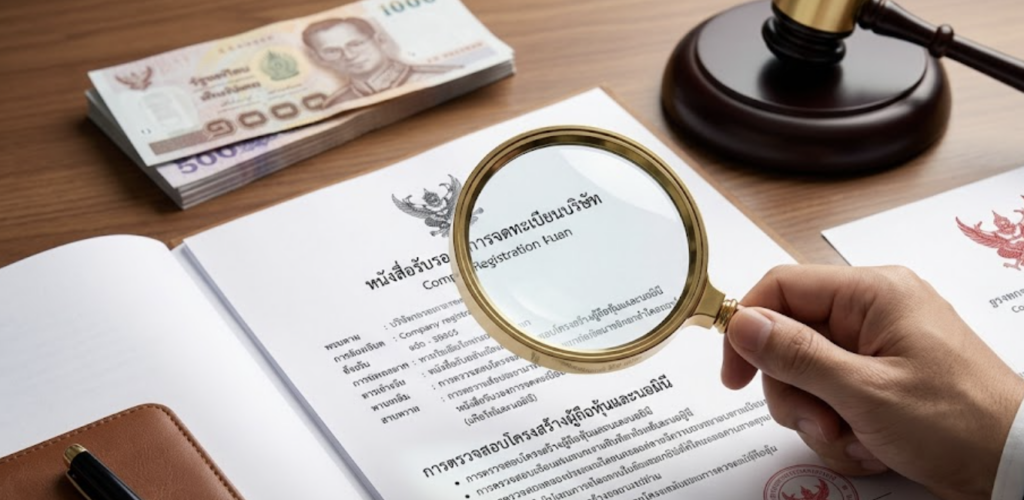
We’re not talking about some distant threat. This is happening now. The DBD estimates that roughly 94,000 companies in Thailand involve Thai nominee shareholders. That’s 80% of all companies with mixed Thai-foreign ownership. If you run a company with the old 49/51 split, ask yourself one question. Can your Thai partners prove they funded their shares? If not, you’ve got a serious problem.
Table of Contents
What Changed on April 1, 2026
Read this section as history, not as the current rule. The order behind it, Central Registrar Order 1/2569 of 16 March 2026, was repealed on 1 August 2026 by Order 2/2569, which is covered further down this page. What follows describes the position between 1 April and 1 August 2026, and it still matters because it is the period most of the enforcement figures below come from.
The short version. Before April 2026, you could amend your company structure using a power of attorney, and your Thai shareholders did not need to show their faces. From 1 April 2026 the DBD’s administrative order required Thai shareholders and directors to appear in person at the registrar’s office for specific types of amendments.
The rule targets two categories of changes. First, partnership amendments that shift foreign capital below 50 percent. Second, limited company amendments that add a foreign authorized signatory where only Thai signatories existed before. If either trigger applies, every Thai director and partner must walk into the DBD office. No exceptions.
This builds on the January 2026 measures that already required three months of bank statements for new registrations. The April rules extend that scrutiny to the lifecycle of existing companies. Share transfers, director changes, capital increases: they all face the same standard now. You can read the full regulatory timeline on our regulatory reform analysis.
The January 2026 Foundation: Bank Statement Rules
To understand April’s rules, you need to understand what happened on January 1, 2026. That’s when the DBD implemented some orders (Orders No. 2/2568, 3/2568, 4/2568, and 5/2568) issued in late 2568 to take effect on January 1, 2026.. Where a foreigner holds less than 50% of the capital, or a foreigner is an authorised signing director, it requires each Thai shareholder to provide personal bank statements covering at least three months before the share payment date. A simple bank balance certificate no longer cuts it.
The statement must show a withdrawal or transfer matching the exact amount of shares subscribed. This is a substance-over-form test. The registrar doesn’t just want to see that you had the money. They want to see where it came from and when it moved.
The impact was immediate and dramatic. The DBD reported that nominee registration attempts dropped by 65% in the first quarter. That single rule knocked out the easiest path for setting up a nominee company.
Update, August 2026: Order No. 2/2568 no longer stands alone. The Central Registrar repealed it with effect from August 1, 2026 and replaced it with the stricter Order No. 2/2569, covered in the August section below. We have now read the order itself. Its clause 1 repeals exactly two instruments, Order 2/2568 and Order 1/2569, and does not touch Orders 3/2568, 4/2568 or 5/2568, so the office-address and vulnerable-shareholder screening rules remain in force.
Order No. 4/2568: The “Rule of Five” for Office Addresses
The DBD also cracked down on virtual office abuse. Under Order No. 4/2568, any address housing five or more companies gets flagged. The DBD calls these “high-density” locations. Companies registered there must now provide a consent letter from the person entitled to allow use of the premises, together with a copy of the evidence of that right to use. Order 4/2568 does not require a floor plan or proof of physical occupation.
This targets the classic shell company setup. We’ve seen addresses in Bangkok with 30 or 40 companies registered to a single room. Those days are done. If you’re registering a company in Thailand in 2026, you need genuine office space.
Order No. 3/2568 and 5/2568: Screening for Vulnerable Nominees
Two additional orders target vulnerable or suspect registrants. Order 3/2568 applies where a partner, shareholder or director is on AMLO’s list of persons linked to predicate offences or to mule bank accounts, as notified by the Anti Online Scam Operation Center (AOC). Order 5/2568 applies to holders of the State Welfare Card. In both cases the person must appear before the registrar in person before registration is accepted, and the applicant files a consent letter for the head-office premises and three months of bank statements tracing the share payment.
We’ve handled cases where a driver or maid was listed as a majority shareholder in a property holding company. That arrangement was always illegal. Now the registrar sees the welfare-card holder in person before the registration is accepted.
April 2026: Closing the Amendment Loophole
The January rules had an obvious gap. Clever operators would register a 100% Thai-owned company. No foreign scrutiny at all. Then they’d amend the shareholder structure later to bring in the foreign investor. This bypass worked because amendments didn’t face the same level of review as new registrations.
The April 1, 2026 order closes that loophole completely. Now, any amendment that introduces a foreign partner or grants a foreigner signatory authority triggers the same in-person verification and financial documentation requirements. The DBD consulted 17 leading law firms on March 9, 2026 before finalizing the new procedures. This wasn’t rushed policy. It was deliberate and well-prepared.
Practice Note, updated: the deadline this paragraph used to urge you to beat no longer exists. Order 1/2569 was repealed on 1 August 2026 and restructuring before or after 1 April 2026 makes no difference now. An amendment that admits a foreign partner or a foreign authorised signatory is instead governed by Order 2/2569, which requires an Investment Confirmation Letter under its clause 4. Do not assume the identity check is gone: the Department’s own published channel list says identity verification cannot be delegated by anybody, and no instrument we can read settles whether that is still done at a counter or now inside the DBD e-Service app. Ask the office handling your filing.
In-Person Verification: What Actually Happens at the DBD
So what did this look like in practice? We walked clients through it many times between April and August 2026. It is recorded here as history. Order 2/2569, which replaced it, contains no income declaration; what it asks for instead is set out in the August section below.
The Sworn Income Declaration
Under the April order, Thai shareholders and directors had to complete a “Statement Record Form” at the DBD. This form requires them to declare their average monthly income. The registrar compares that number against the capital investment the person claims to have made.
Here’s where it gets dangerous. If a Thai national earning 25,000 THB per month claims to have invested 5 million THB in a company, the math doesn’t work. That discrepancy gives the registrar grounds for prosecution under Section 36 of the Foreign Business Act. It also exposes the individual to prosecution for false statements under Sections 137 and 267 of the Thai Criminal Code.
The genius of this form (from an enforcement perspective) is that it creates a documented, signed admission. The Thai partner is either telling the truth (proving they’re a real investor) or lying on a government form (which is a separate criminal offense). Either way, the nominee game gets much harder to play.
No More Power of Attorney
For amendments that triggered the in-person requirement between April and August 2026, power of attorney was rejected. This is a major shift. Many business owners used lawyers or agents to handle all DBD filings. That still works for routine filings. But for anything involving foreign participation, the actual Thai partners must attend.
We’ve already seen cases where amendments were blocked because a Thai shareholder was traveling abroad and couldn’t attend. The DBD would not process the filing until all required individuals appeared.
August 1, 2026: Order 2/2569 and the End-to-End Financial Trail
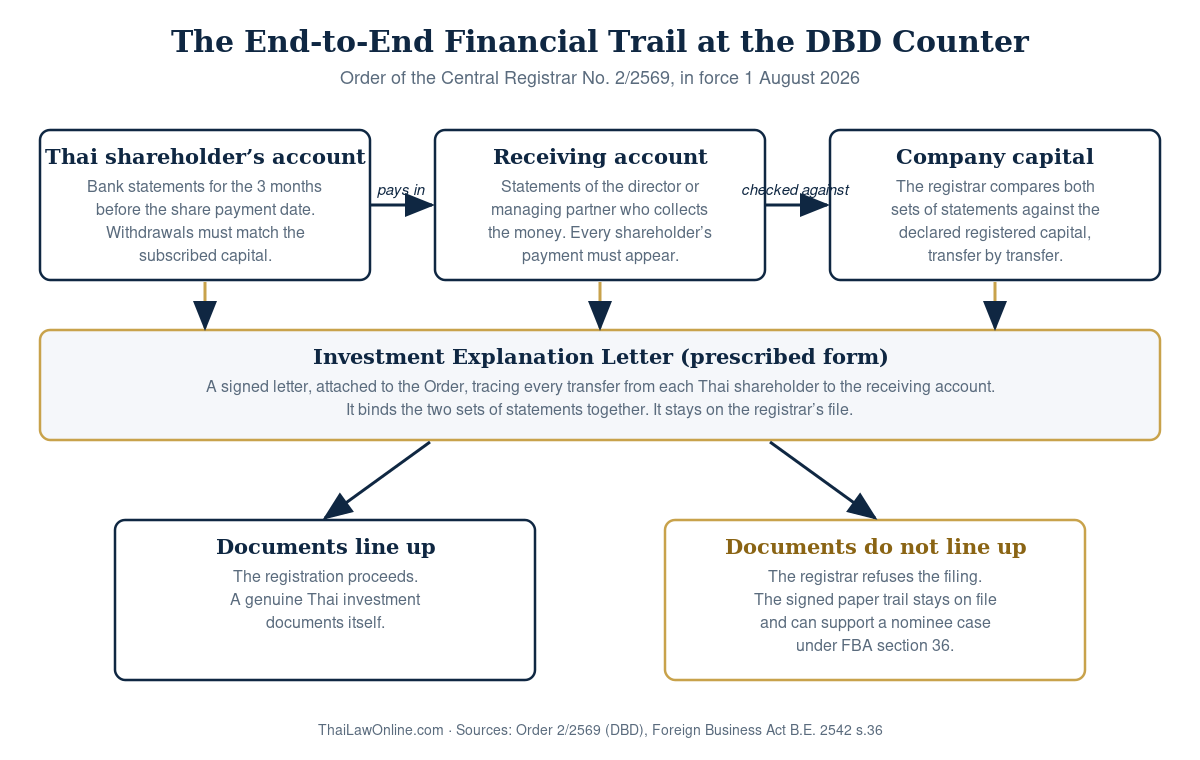
Order 2/2569 did not add to the April regime, it replaced it. Order No. 2/2569 took effect on August 1, 2026 and was signed on July 15, 2026 by Poonpong Naiyanapakorn, Director-General of the DBD and Central Registrar. We have read the signed order, which the DBD publishes as a scanned PDF; the date appears above the signature on page 2. The English summaries circulating since July give July 14, and they are one day out. Its clause 1 repeals two instruments, Order No. 2/2568, the January bank statement rule, and Order No. 1/2569 of 16 March 2026, and replaces them with something stricter. The registrar now follows the money from the Thai shareholder’s bank account all the way into the company.
The order catches three kinds of filings: the incorporation of a partnership or limited company where a foreign national holds less than 50% of the registered capital, the incorporation of a limited company with no foreign shareholder at all but a foreign national as an authorised director, and two kinds of amendment (clause 4): a partnership whose foreign partners come to hold less than 50% of the capital with no foreign managing partner, and a limited company whose signing directors were all Thai registering a foreign signing director. An amendment catches a company through its board, not its share register.
What Order 2/2569 Requires
- Thai shareholder statements. Each Thai shareholder or partner submits bank statements covering the three months before the share payment date, showing the withdrawals or transfers that paid for the shares. This carries over from the January rule.
- Receiving-account statements (new). The account of the director or managing partner that collects the subscription money must show the payment arriving from every shareholder. Where that same account is also the one that paid that person’s own subscription, a statement for the three months before the subscription money was received must be filed as well (clause 3(2)).
- The Investment Explanation Letter (new). A prescribed form attached to the Order. It traces the flow of funds from each Thai shareholder to the receiving account, transfer by transfer, and it stays on the registrar’s file.
Foreign Directors Without Shares Are Now Screened
Read the scope again. A company with zero foreign shareholders and one foreign authorised director now goes through the full documentary pack at incorporation. Consultants sold exactly that structure as the “clean” answer after the January rules: keep the foreigner off the share register, give him the director’s pen. The DBD noticed. If you sign for your Thai spouse’s company, her three months of statements, the account that received her capital, and the explanation letter all land on the registrar’s desk before the company exists.
A second 2026 order sits beside this one, and almost nobody writing in English mentions it. Order No. 1/2569 bit where a company currently has only Thai directors with signing authority and then registers a foreign director with signing authority. It was itself repealed on 1 August 2026 by Order No. 2/2569, whose clause 4 carries the same rule: the applicant for that registration must submit an Investment Confirmation Letter on the form annexed to the order, confirming that every shareholder genuinely invested and paid for their shares and that no Thai is acting as a nominee. Note that this is a different document from the Investment Explanation Letter under Order 2/2569, and the two are already being confused online.
There is a timing trap inside it that catches ordinary restructuring. If a foreign signing director is appointed at incorporation, clause 4 does not apply at that point, although the incorporation pack under clauses 2 and 3 does. But if that director later resigns and the board is left with Thai signing directors only, the declaration becomes due again the next time a foreign signing director is appointed. Plan the order of board changes before you make them, not afterwards. Neither order carries a penalty of its own. The consequence is that the filing does not proceed, and that a director who signs a false declaration is exposed under Sections 137 and 267 of the Criminal Code, set out in the penalties table below.
The Receiving-Account Rule Closes the Recycled-Funds Loophole
Before August 1, the registrar checked only the Thai shareholder’s own statements. That left room for dressing: the foreigner lends the money, the Thai deposits it, the statement looks clean. Now the same money has to appear three times and tell the same story each time. It leaves the shareholder’s account, it arrives in the receiving account, and a signed letter explains the journey line by line. Thai media reported that the registrar rejects filings where the documents do not line up with the declared capital. The deeper risk sits underneath: the pack the company signs becomes evidence. If the arrangement unravels later, prosecutors open a Foreign Business Act section 36 case with a confession-grade paper trail the company wrote itself.
If You Registered Under the January Rules
A registration completed under Order 2/2568 stays valid. Nothing in the new order reopens finished filings. But the amendment trap from April now has an August layer: any filing after August 1, 2026 that registers a foreign signing director in a company whose signing directors were all Thai (or brings a partnership under 50% foreign capital) needs the Investment Confirmation Letter of clause 4 of Order No. 2/2569, and where it is filed within a year of incorporation, the clause 5 statements as well. Plan share transfers and director changes accordingly, and read our guides on setting up a company in Thailand as a foreigner and company registration costs before you file anything.
One more thing nobody tells you: the registration counter is now the third desk where the same money gets examined. The Land Office asks where the funds for a property purchase came from under the May 2026 circulars. The Revenue Department can treat the same transfer as assessable income when it enters Thailand. And the DBD now traces it into the company’s capital. One remittance, three files, and the three agencies share findings under the 21-agency MOU described below. If your structure depends on the three desks never comparing notes, it depends on something that stopped being true in 2026. Our pages on Thai nominee shareholders and the Foreign Business Act cover the underlying law.
The 16 Risk Provinces the DBD Is Checking From 1 August 2026
The financial-trail checks that began on 1 August 2026 are not being applied evenly across the country. The Department of Business Development has named 16 risk provinces where it is examining whether declared investment matches the money that actually moved. Announced by Poonpong Naiyanapakorn, Director-General of the DBD, and reported on 16 July 2026.
The ten provincial targets: Chonburi, Surat Thani, Phuket, Krabi, Phang Nga, Prachuap Khiri Khan, Chiang Mai, Chiang Rai, Mae Hong Son and Rayong. Between them the DBD counted 18,720 very high-risk and 14,118 high-risk companies.
The six in Bangkok and the surrounding metropolitan area: Bangkok, Samut Prakan, Samut Sakhon, Nakhon Pathom, Nonthaburi and Pathum Thani. Between them, 7,579 very high-risk and 1,752 high-risk companies.
That is roughly 42,000 companies already sorted into a risk tier across the 16 provinces, about 26,300 of them in the higher band.
Do not read this as a tourist-province problem. Much of the coverage lists only the resort provinces, and a company registered in Bangkok, Samut Prakan or Nonthaburi can easily conclude it is out of scope. It is not. Bangkok and its five neighbouring provinces are on the list, and they account for 7,579 of the very high-risk companies on their own. If your company is registered anywhere in these 16 provinces and has any foreign shareholding, the financial trail behind your paid-up capital is now something the registrar can ask about.
Source: Department of Business Development, reported by The Nation, 16 July 2026. Status checked 22 August 2026.
The Pattaya Raids and Nationwide “Nominee Busters”
The DBD isn’t just tightening paperwork. They’re running on-the-ground operations. And the results are striking.
The March 2026 Pattaya Operation
From March 18 to 20, 2026, the DBD led a three-day joint operation in Pattaya targeting tourism and property businesses. Investigators found what we’ve long suspected: dozens of firms registered at the same address and individual Thai shareholders holding stakes in over 100 companies. One shareholder had combined investments exceeding 300 million THB.
Four tour companies had their licenses revoked immediately: Aletia Tours, Yor Indo-Thai Group, Y J H, and Di V-Ext. All four were ordered to close. The DBD flagged 146 foreign entities in Chon Buri province for further investigation. For detailed background on enforcement history, see our coverage of recent nominee crackdowns and court cases.
“Nominee Busters” Go Nationwide
By May 2026, the DBD launched an expanded operation branded “Nominee Busters.” This wasn’t limited to Pattaya. Sweeping inspections hit Phuket, Koh Samui, Koh Phangan, Krabi, Phang Nga, Hua Hin, and Pai. Every major tourist destination is under scrutiny.
The operation targets “fully integrated” foreign businesses. Think a foreigner who controls the tour company, the transport, the restaurant, and the souvenir shop through a chain of nominee companies. The DBD is mapping these networks using data analytics. Cross-referencing shareholder records, tax filings, and bank accounts reveals patterns that were invisible before.
Koh Phangan: 22 Arrested, 200 Million in Land Seized (May 2026)
On May 23, 2026, more than 300 police stormed Koh Phangan before dawn. It was the island’s biggest ever nominee crackdown. They arrested 22 foreigners and seized over 40 rai of land worth more than 200 million THB.
The operation targeted lawyers, accountants, and property firms accused of concealing foreign ownership. One key target was FB Properties Co Ltd (also known as Yoga House). Officers found that an Israeli national was the true owner. Thai nationals were listed as nominees to hide his control. The firm controlled eight land plots covering 7.5 rai, valued at over 60 million THB.
Investigators found an accounting firm on the island where a single individual was listed as shareholder in 66 companies. The same address was registered for 89 entities. Most showed no signs of real operations. Police seized computers, records, and land documents.
The numbers on Koh Phangan are staggering. Out of 4,761 registered companies, 3,213 (67%) are foreign-run. Israeli investors form the largest group, followed by French and British nationals. Police say they’ve filed 29 cases since 2024. Courts have already ruled in two, involving 62 suspects: 32 Thais and 30 foreigners.
Koh Phangan Again: 112 Companies and 124 Plots Under Investigation (August to September 2026)
The May raids were the visible part. The data-matching that followed is the part that reaches quiet company-owned land. On 25 August 2026 the Interior Ministry reported the results of its Koh Phangan review, and the Government Spokesman restated them on 10 September 2026: 112 juristic persons on the island were flagged because their foreign shareholding exceeded the legal threshold. Between them they hold 124 land plots, about 86 rai 3 ngan 42.4 square wah. Of the 112, 104 were newly detected; 8 already had court judgments. The Surat Thani Governor had already ordered 8 entities to dispose of 9 plots, and investigators were told to trace shareholder structures, money flows, land holdings and related persons.
The same statement reports that company registrations in the DBD’s nominee-risk category fell from 894 in August 2025 to 163 in August 2026, a drop of 81.77 percent. Read that number carefully: it counts new registrations that triggered the risk flags, not existing nominee ownership, which the Koh Phangan figures show is still being uncovered plot by plot. A disposal order is the Land Code remedy for land a foreigner holds through a Thai front: the land must be sold within the period fixed under the Land Code, between 180 days and one year, failing which the Director-General of the Department of Lands sells it. Our Thai nominee shareholders guide explains that mechanism and the nationwide data-matching announced on 4 September 2026 that feeds it.
If your company holds land on Koh Phangan or Koh Samui, do not start with a shareholder reshuffle. A hurried transfer can add evidence of concealment without curing the original arrangement. Review the historic and current shareholders and their capital payments, the source of the acquisition funds and any shareholder loans, the voting and signing arrangements, the accounts and tax returns that show a real business, and every letter received from the DBD or the Land Office, before any share transfer, director change, mortgage, lease, usufruct or sale is registered.
June 21, 2026: The Andaman Blitz (48 Arrests, THB 1 Billion Seized)
The latest and largest operation hit on June 21, 2026. More than 500 officers raided Phuket, Phang Nga, and Krabi simultaneously. They executed 55 warrants and arrested 48 suspects: 27 Thais and 21 foreign nationals.
The foreigners included five Israelis, two French nationals, one Dutch national, and one Russian. Police identified two separate networks controlling 56 land plots covering 15 rai, valued at 231 million THB. Across all three Andaman provinces, officials seized or pursued legal action over 46 rai of land worth more than 1.053 billion THB.
The DBD flagged over 600 companies in Phuket alone as being at risk of nominee arrangements. That’s a single province. The crackdown is now touching every corner of southern Thailand.
June 2026 Update: Thailand has seized or frozen more than 24 billion THB in assets nationwide. Over 29,000 suspects have been arrested across scam and nominee operations. The scale is beyond anything we’ve seen since we began practising under Thai law in 2006.
The 21-Agency MOU
On April 29, 2026, 21 government agencies signed a memorandum of understanding at Government House. The MOU commits them to sharing data and coordinating enforcement. The agencies include the Revenue Department, AMLO, the DSI, and the Ministry of Tourism.
This is unprecedented in our experience. Previous crackdowns relied on the DBD working alone. Now they have access to tax records, financial intelligence, welfare databases, and immigration data. The net is much tighter than anything we’ve seen before.
What We’re Seeing in Our Practice
I want to share something that happened about three weeks ago. A client called us in a panic. He’d been arrested for a company he closed three years ago. The company was dissolved, wound up, done. Or so he thought.
Here’s what happened. Investigators went to the accounting firm in Koh Samui that had handled his company’s books. They obtained the old records. They examined the shareholder structure, the bank flows, and the director arrangements. They found what they were looking for: evidence of nominee shareholding from years ago. A dissolved company doesn’t erase the criminal offense. The statute of limitations runs from the date the offense was committed, not from the date the company closed.
This isn’t an isolated case. Every week, we’re fielding calls from clients who thought they were safe because their company was inactive, dissolved, or transferred. They’re wrong. The government is going backward through records. If you used nominees at any point, you’re potentially exposed regardless of whether the company still exists.
From our practice: We’ve handled more nominee-related inquiries in the first half of 2026 than in the previous five years combined. The pattern is clear. Clients call after receiving a summons, a surprise visit from investigators, or (worst case) after an arrest. Don’t wait for that call. If you have any doubt about your structure, get a legal review now.
The Phuket case from 2024-2025 should have been a wake-up call. A law and accounting firm had facilitated nominee arrangements for about 60 companies. The Criminal Court sentenced 23 defendants to 10 years imprisonment. Because they cooperated and confessed, the sentence was reduced to 5 years (suspended for 2 years) with one year of probation. Each defendant was also fined 200,000 THB. All companies were dissolved.
That case proved something critical. The facilitators (lawyers and accountants) are now targets too. It’s not just the foreign investor and the Thai nominee anymore. The entire chain of enablers faces prosecution.
Criminal Penalties and What They Really Mean
The penalties for nominee arrangements aren’t new. But enforcement is. Both the Thai nominee and the foreign principal face criminal prosecution. Here’s the penalty structure.
| Offense | Legal Basis | Penalty |
|---|---|---|
| Thai national acting as nominee shareholder | Section 36, Foreign Business Act | Up to 3 years imprisonment and/or 100,000 to 1,000,000 THB fine |
| Foreign national using a nominee | Section 36, Foreign Business Act | Up to 3 years imprisonment and/or 100,000 to 1,000,000 THB fine |
| Continuing after the court has ordered the arrangement or the business to cease | Second paragraph of the section that produced the order, sections 35, 36 and 37 each carry it | Daily fines of 10,000 to 50,000 THB throughout the period of the violation |
| False statement to government official | Section 137, Thai Criminal Code | Up to 6 months imprisonment and/or up to 10,000 THB fine |
| Causing an official to record false information | Section 267, Thai Criminal Code | Up to 3 years imprisonment and/or up to 60,000 THB fine |
| Foreign national operating a restricted business without a licence or certificate | Section 37, Foreign Business Act | Up to 3 years imprisonment and/or 100,000 to 1,000,000 THB fine, and the court orders the business to cease |
| Licensed foreigner fronting for an unlicensed foreigner | Section 35, Foreign Business Act | Up to 3 years imprisonment and/or 100,000 to 1,000,000 THB fine, and the court orders the participation to cease |
Beyond the statutory penalties, there’s a growing risk of asset seizure. AMLO is now involved in nominee investigations. If proceeds from a nominee-structured business are classified as connected to a predicate offense, the government can freeze and seize assets. We’ve seen this happen. It’s not theoretical.
For foreign nationals, there’s also the deportation risk. A criminal conviction related to nominee arrangements typically results in blacklisting and removal from Thailand. You can’t come back for a specified period (or ever, in severe cases).
What the Supreme Court Has Said About Nominees
The courts aren’t buying the old excuses. Three Supreme Court decisions define the current legal landscape. Every foreign investor should know them.
Supreme Court Decision No. 17923/2557 (2014): The Koh Samui Land Case
This is the case people cite, and it is worth stating precisely, because it is a civil dispute and not a prosecution. Two foreign buyers held a contract with a Thai landowner over two plots at Mae Nam, Koh Samui. The document was headed a lease. The court read what it actually did.
Its substance was the transfer of ownership, not a right to occupy for a term, so it was a contract of sale under section 453 of the Civil and Commercial Code and not a lease under section 537. The buyers were foreigners, and the land was to be held in the name of a Thai juristic person while they remained the real occupiers. That placed the purpose of the contract squarely within the prohibition in section 86 of the Land Code, which is a provision of public order, so the sale was void under section 150 of the Civil and Commercial Code and the buyers’ claim to have the land transferred to their company was dismissed. Nobody was convicted of anything, and the judgment does not mention section 36 of the Foreign Business Act at all.
The reasoning matters. The court looked past the label to what the parties meant: the buyers paid the whole price, the Thai company was to take title, and nothing showed the buyers received anything from that company in return, so it would have held the land in name only for them. That is the same substance-over-form question the DBD now asks at registration: who paid, and for whom is the holder really holding?
Supreme Court Decision No. 5457/2560 (2017): Sham Loans Don’t Work
Loan paperwork is a common way to dress up a purchase that a foreigner is not allowed to make openly. In this case a Japanese buyer agreed to buy the whole of a Thai company’s business. Because, as his own side put it in an email, a Japanese buyer could not hold 100% of a Thai company, the price of 19.5 million baht was documented as a loan from him to the company, guaranteed by its director. On the register he and his son then held 49% and six Thai nationals the other 51%.
The Supreme Court saw through it. The buyer sued to get the 19.5 million baht back under the loan. The company and the director admitted signing it but argued that it concealed the sale of the business. The court agreed: the real transaction was the purchase of the business, the six Thai shareholders held their shares in name only for the buyer, and the purpose was to evade the Foreign Business Act.
The concealed sale was therefore void under section 150 of the Civil and Commercial Code. And because the buyer had knowingly set out to break the law, the money he had paid was performance of an unlawful obligation that cannot be recovered under section 411. The Court of Appeal had ordered repayment with interest; the Supreme Court reversed it and dismissed the claim. He could not use the Thai courts to get his money back from an arrangement he had built to evade the Act.
Supreme Court Decision No. 2252/2560 (2017): The Register Is Not the Test, the Capital Is
Some investors think a minority holding on the share register keeps them safe. This case is the answer, though not in the form it is usually retold. A company incorporated in the British Virgin Islands, and therefore a foreigner under section 4 of the Foreign Business Act, appeared on the register of a Thai company holding less than half the shares. The judgment states no percentage, and any source that gives you one is not reading the judgment.
What the evidence showed was that more than half of the real capital in the Thai company was the foreigner’s money, which did not match the registered capital. On that footing the court treated the Thai company and the foreigner together as carrying on a land trading business, which is List One under the Act and closed to foreigners. Then comes the part worth knowing. Because its own business was unlawful, the foreign company was held not to be a lawful injured party and could not prosecute the directors of the Thai company it had charged. It did not lose an argument. It lost its standing to bring the case at all.
Practice Tip: These three decisions tell you everything about how Thai courts approach nominee cases. They look at substance. Who paid for the shares? Who controls the company? Who takes the profit? If the answers point to a foreigner, the structure fails. The percentage split doesn’t matter.
Recent Enforcement Cases: Real People, Real Consequences
The cases below aren’t hypothetical. These are actual prosecutions with named defendants and documented outcomes.
| Case | What Happened | Outcome |
|---|---|---|
| Phuket Law Firm Network (2024-2025) | Law and accounting firm facilitated nominees for ~60 companies | 23 defendants convicted. Initial 10-year sentences reduced to 5 years (suspended). THB 200,000 fine each. All companies dissolved. |
| China Railway No. 10 (2025) | Three Thai nationals used as proxies for Chinese state-owned enterprise. Former manual laborers listed as shareholders in multi-billion-THB company. | Arrest warrants for 4 individuals. Case file: 17,620 documents in 46 files. THB 2 billion in linked transactions. |
| Chinese Shell Companies (2025) | Accounting firm used staff and their families as shareholders in 15 nominee companies for Chinese investors. | 21 Chinese and 51 Thai nationals arrested. CIB seized 225 bank accounts and 1,601 company stamps. THB 1.5 billion in assets. |
| Koh Phangan Accounting Firm (2025) | One individual listed as shareholder in 66 companies. Same address used for 89 entities. | Computers and records seized. Firm ordered to produce additional documents. Under ongoing investigation. |
| Andaman Province Blitz (June 2026) | 500+ officers raided Phuket, Phang Nga, and Krabi. Targeted foreign-controlled land networks. | 48 arrested (27 Thai, 21 foreign). 46 rai of land seized worth THB 1.053 billion. 600+ companies flagged in Phuket alone. |
The Numbers: Scale of the Crackdown
The data tells the story better than any analysis. Here are the figures driving the Thailand nominee company crackdown 2026.
| Metric | Figure | Source / Context |
|---|---|---|
| Total active companies in Thailand | ~782,000 | DBD registration database, 2026 |
| Companies with foreign investment (0.01%-49.99%) | ~118,000 | DBD analysis of shareholding patterns |
| Estimated companies with nominee arrangements | ~94,000 (80%) | DBD Director-General estimate |
| Drop in nominee registration attempts (Jan-Mar 2026) | 65% | After bank statement requirement took effect |
| Drop in high-risk companies (Apr 1-23, 2026) | 75% (658 to 175) | Compared to same period in 2025 |
| Companies prosecuted under nominee laws | 852 | Cumulative enforcement data, mid-2026 |
| Economic damages identified | THB 15.1 billion | From prosecuted nominee cases |
| Government agencies in enforcement MOU | 21 | MOU signed April 29, 2026 |
| Entities flagged in Chon Buri (Pattaya) alone | 146 | March 2026 joint operation |
| Companies flagged in Phuket province | 600+ | June 2026 DBD analysis |
| Arrests in Andaman blitz (June 21, 2026) | 48 (27 Thai, 21 foreign) | Phuket, Phang Nga, Krabi combined operation |
| Land seized in Andaman provinces | 46 rai (THB 1.053 billion) | June 2026 combined enforcement value |
| Total assets seized/frozen nationwide | THB 24+ billion | Combined scam and nominee enforcement, 2026 |
| Foreign-run companies on Koh Phangan | 3,213 out of 4,761 (67%) | DBD registration analysis |
| Koh Phangan companies flagged for excess foreign shareholding | 112 (104 new, 8 with judgments), holding 124 plots (86-3-42.4 rai) | Interior Ministry 25 Aug 2026; Government Spokesman 10 Sep 2026 |
| Koh Phangan disposal orders issued | 8 entities, 9 plots | Surat Thani Governor, reported 25 Aug 2026 |
| Nominee-risk company registrations, Aug 2025 to Aug 2026 | 894 to 163 (down 81.77%) | DBD figures cited by the Government Spokesman, 10 Sep 2026 (new registrations flagged, not existing ownership) |
The 75% drop in high-risk companies between April 1 and 23 is particularly telling. That happened in just three weeks. It shows the deterrent effect of the new rules. Companies that would have filed routine amendments are now pausing because they can’t meet the verification requirements.
Who Is Most at Risk in 2026
Tourism and Hospitality
Tour companies, dive shops, restaurants, and hotel operators in tourist areas face the highest risk. The Pattaya and Phuket operations specifically targeted these businesses. The Ministry of Tourism is now cross-checking tour licenses against DBD nominee flags. We’ve seen license revocations happen within days of a finding.
Real Estate and Property Holding Companies
Companies formed to hold land or villas on behalf of foreign investors are under intense scrutiny. The DBD is investigating over 21,000 companies suspected of using nominees to circumvent the Land Code prohibition on foreign land ownership. Phuket, Koh Samui, and Koh Phangan are the primary enforcement zones.
If your company owns land and you’re the foreign minority shareholder who actually paid for everything, you’re exactly what the DBD is looking for. The courts are increasingly willing to order land disposal and impose prison sentences.
Cannabis Businesses
The cannabis sector drew enormous foreign investment after decriminalization. But many of those investments used nominee structures. A high-profile raid in Krabi in early 2026 uncovered a cannabis farm. The company was initially registered as 100% Thai. A foreign national later became a director and shareholder. That case led to criminal warrants for the operator and the facilitating lawyers.
Service Businesses in Restricted Sectors
Consulting firms, marketing agencies, and tech service companies operating in sectors restricted under List 3 of the Foreign Business Act are also exposed. Many were set up with the common 49/51 structure without obtaining a Foreign Business License. If your Thai shareholders can’t demonstrate real financial participation, the structure won’t survive the new verification regime.
How to Get Compliant Before It’s Too Late
Step 1: Audit Your Shareholder Structure
Start by asking a simple question. Can every Thai shareholder in your company prove (with bank statements) that they personally funded their shares? If the answer is no, you have a nominee arrangement. Period. The DBD doesn’t care what your lawyers told you ten years ago. They care about substance.
Step 2: Review Your Amendment Plans
If you’re planning any changes to your company structure (new directors, share transfers, capital increases), check first whether the change falls under clause 4 of Order 2/2569 (a foreign signing director, or a partnership moving under 50% foreign capital) and prepare the Investment Confirmation Letter. Identity verification cannot be delegated, so make sure every Thai director and shareholder who must verify is available.
Step 3: Assess Your Exposure
Work with qualified legal counsel to evaluate your risk. Key questions include: Is your office address shared with more than four other companies? Do your Thai shareholders hold stakes in multiple other companies? Can your Thai directors explain the source of their capital contributions under oath? A failure on any of these points raises a red flag.
Step 4: Consider Restructuring
If your current structure won’t survive scrutiny, explore the legal alternatives we discuss below. The cost of restructuring is significant. But it’s a fraction of the cost of prosecution, asset seizure, and deportation.
Where the company was set up so a foreigner could hold land, the exit routes are specific and there are only a handful of them. We set each one out, with the Land Code consequence and the Supreme Court authority behind it, in how to restructure a 51/49 property company legally.
Legal Alternatives to Nominee Structures
The government isn’t just cracking down. It’s also opening new doors. Foreign investors who restructure through legitimate channels can achieve majority or full ownership in many cases.
| Pathway | Ownership Allowed | Key Requirements | Timeline |
|---|---|---|---|
| BOI Promotion | Up to 100% | Promoted business activity, minimum investment, reporting | 2-4 months |
| Foreign Business License (FBL) | Up to 100% | 3M THB minimum capital, Commerce Ministry approval | 4-8 months |
| US-Thai Treaty of Amity | Up to 100% | American citizenship, most service sectors | 1-3 months |
| FBA List 3 exemptions (Ministerial Regulation No. 5, 2026) | 100% | Business falls squarely within one of the eight exempted categories; several apply only between related companies | Published 28 August 2026 |
| Genuine Thai Partnership | 49% foreign | Real Thai partner with verifiable capital, active role | Standard registration |
The FBA List 3 Exemptions of August 2026
This is no longer a proposal. Ministerial Regulation No. 5 B.E. 2569, signed on 18 August 2026 and published in the Royal Gazette on 28 August 2026, adds eight service businesses a foreign company may run without a Foreign Business Licence: securities-purchase lending, reverse repurchase transactions, qualifying Type 1 telecommunications, treasury centres, qualifying intra-group administration, HR and IT services, qualifying intra-group domestic debt guarantees, employee-service machine space rental, and qualifying petroleum drilling. Our Foreign Business Act guide sets out the conditions of each.
Read the category narrowly before relying on it. Several of the new entries cover services between related companies only, so a business that serves outside customers still needs a licence, and a company already structured with Thai nominees is not cured by the exemption. We cover the details on our regulatory reform page.
BOI: Still the Gold Standard
For businesses that qualify, Board of Investment promotion remains the safest route to majority or full foreign ownership. BOI-promoted companies also receive tax incentives and work permit facilitation, and because the foreign ownership is lawful in its own name, there is no Thai nominee for anyone to investigate. The application process takes two to four months. That’s time well spent when the alternative is prison.
Frequently Asked Questions
What changed on April 1, 2026 for nominee companies in Thailand?
From 1 April 2026 the DBD required in-person verification for company amendments involving foreign participation: Thai shareholders appeared at the DBD office, declared their monthly income and signed forms referencing criminal liability. That order, Order 1/2569, was repealed on 1 August 2026 by Order 2/2569, which instead requires an Investment Confirmation Letter on such an amendment. Identity verification itself still cannot be delegated, so do not treat the repeal as removing the check.
What are the penalties for using Thai nominee shareholders in 2026?
Penalties include up to 3 years imprisonment and fines of 100,000 to 1,000,000 THB. The court also orders the nominee assistance, joint operation or shareholding to end, and a fine of 10,000 to 50,000 THB runs for every day that order is disobeyed (Foreign Business Act section 36). Section 36 gives the court no power to dissolve the company, although for the foreigner’s own offence under section 37 the court orders the business stopped or wound up; land held through the structure can separately be forced to sale under the Land Code. Both the Thai nominee and the foreign principal face prosecution.
Does the Thailand nominee crackdown 2026 affect existing companies?
Yes. The April rules, repealed on 1 August 2026, targeted amendments to existing companies involving foreign participation. The DBD is also auditing roughly 118,000 existing companies with mixed ownership. Since August 1, 2026, any amendment that admits a foreign partner or a foreign authorised director requires an Investment Confirmation Letter under clause 4 of Order 2/2569, which is a different document from the Investment Explanation Letter filed on incorporation. An Investment Explanation Letter and a bank statement are added only where a company registered from 1 August 2026 files that amendment within a year of being registered (clause 5).
How many companies in Thailand use nominee shareholders?
The DBD estimates that out of 118,000 companies with foreign investment between 0.01% and 49.99%, approximately 80% (around 94,000 companies) involve nominee arrangements. That’s out of roughly 782,000 total active companies.
Can my Thai spouse still be a shareholder in my company?
Yes. But since August 1, 2026 the paperwork got heavier under Order 2/2569. Your spouse must provide bank statements for the three months before paying for her shares, the account receiving the capital must show her payment arriving, and a signed Investment Explanation Letter must trace the transfer. The April 2026 order that made her appear in person and declare her income was repealed on 1 August; identity verification still cannot be delegated, so ask the office handling the filing how it is done. The DBD makes no exception for married couples.
What legal alternatives exist to nominee structures in Thailand?
BOI promotion (allows 100% foreign ownership), Foreign Business License, the US-Thai Treaty of Amity (for Americans), and the List 3 exemptions added by Ministerial Regulation No. 5 of 2026. Each has specific requirements and processing timelines. For land, the lawful routes are registered rights such as usufruct, superficies and sap ing sith.
Can I be prosecuted for a nominee company I already closed or dissolved?
Yes. Dissolving a company does not erase the criminal offense. The statute of limitations runs from when the offense was committed, not when the company closed. We’ve seen clients arrested in 2026 for companies dissolved years earlier. Investigators obtain old records from accounting firms and trace the nominee arrangement backward.
What triggered the Pattaya nominee crackdown in March 2026?
A three-day DBD joint operation from March 18-20 uncovered major irregularities. Investigators found a single Thai shareholder holding stakes in 100+ companies with combined investments over 300 million THB. Four tour companies lost their licenses. The DBD flagged 146 entities in Chon Buri.
What is the Investment Explanation Letter required by the DBD?
A prescribed form attached to Order 2/2569, in force since August 1, 2026. It traces the flow of subscription funds from each Thai shareholder to the account that receives the capital. The letter is signed, filed with the registrar, and stays on record. If a nominee investigation opens later, the letter is evidence.
Why was my company registration rejected in 2026?
The most common new reason: the money trail does not match the declared capital. Under Order 2/2569 the registrar compares each Thai shareholder’s bank statements, the receiving account’s statements, and the Investment Explanation Letter. Statements that do not show the subscription moving as declared stop the filing. Fix the documentation and refile, or restructure lawfully before trying again.
Last reviewed: 25 September 2026. The legal rules on this page were read against the primaries: Central Registrar Order 2/2569 in full (clauses 1 to 6, from the signed scan) and sections 4 and 36 of the Foreign Business Act. The Land Office section was verified against the circulars on 29 August 2026, as it says, and was not re-read here. This review corrected the scope of clause 4 of Order 2/2569, removed statements that described the repealed April 2026 regime as current, and recorded that the List 3 exemptions have been enacted. Not verified in this review: the enforcement figures, raids and statistics, which come from press reports and official statements as cited, and the text of Ministerial Regulation No. 5 of 2026 itself.
How ThaiLawOnline Can Help
We’ve been advising foreign investors on Thai corporate structures since 2006. Our team has handled over 5,000 client matters. We know how the DBD operates because we deal with them every week.
If you’re concerned about your company’s nominee exposure, we can conduct a confidential compliance audit. We’ll review your shareholder structure, assess your risk level, and recommend a restructuring pathway if needed. This isn’t something to put off. The enforcement machinery is running, and it’s accelerating.
Contact us for a consultation. We offer initial assessments by phone, video call, or in person at our offices.
Key Takeaways
- August 1, 2026: Order 2/2569 replaces the January bank statement rule. Thai shareholder statements, receiving-account statements, and a signed Investment Explanation Letter are now checked before a company with foreign participation is registered. An amendment adding a foreign signing director needs an Investment Confirmation Letter instead.
- April 1 to July 31, 2026: Order 1/2569 required in-person shareholder verification at the DBD for amendments involving foreign participation, with no power of attorney. It was repealed on 1 August 2026.
- A false statement in any of these filings is exposed under sections 137 and 267 of the Criminal Code, and a nominee arrangement under section 36 of the Foreign Business Act.
- January 2026 bank statement rules cut nominee registration attempts by 65%. The April rules close the amendment loophole used to bypass them.
- High-risk companies dropped 75% in the first three weeks of April 2026 (from 658 to 175 compared to the same period in 2025).
- 852 companies prosecuted. THB 15.1 billion in economic damages identified. 21 government agencies now coordinating enforcement.
- Penalties under Foreign Business Act section 36: up to 3 years prison or 100K-1M THB fines or both, plus a court order to end the nominee shareholding (10K-50K THB a day while ignored). Land held through the structure can be ordered sold under the Land Code, and a convicted foreigner can face deportation. Both nominees and foreign principals face prosecution.
- Pattaya raids revoked 4 tour company licenses. 146 entities flagged in Chon Buri. “Nominee Busters” expanded to Phuket, Samui, Krabi, Hua Hin, and Pai.
- Legal alternatives exist: BOI promotion, Foreign Business License, Treaty of Amity, and the List 3 exemptions of August 2026.
- If your Thai shareholders can’t prove they funded their shares with personal bank records, your company is at risk. Get a compliance audit now.
Thai Law Updates, free by email
Plain-English updates on Thai law changes that affect foreigners: property, visas, marriage, business and wills. One short email a month from a firm practicing since 2006. No spam, unsubscribe anytime.