


Reviewed by Wichuda Atthamethakon, LL.M., Thai Bar Licence 3149/2556, for ThaiLawOnline, a Thai law firm acting for foreigners since 2006.
Update log
- 17 November 2026: Added the statute box with Thai, English and French text and checked the page against the official text
Thailand’s drug laws are notoriously strict, one wrong move could mean years in prison or worse. As an expat, understanding them isn’t optional; it’s essential. Even a single pill can put you behind bars, while large-scale trafficking still attracts the death penalty. Recent reforms have adjusted limits and added rehabilitation options. The main point is clear. Selling or using illegal drugs is treated as a serious threat to national security. It is important to understand the drug laws in Thailand if you live in or visit the country. If you are a foreigner and have been arrested in Thailand, click on this guide.
Table of Contents
For how a drug case fits into the wider process, see our overview of criminal law in Thailand.
Here is a detailed guide for expatriates and long-term visitors. It explains how the law works and what penalties you might face. It also covers recognized defenses and why hiring a specialized Bangkok drug lawyer is important if you get arrested.
This guide on Drug Laws in Thailand will help you navigate the complex legal landscape. Facing charges? Contact us for expert Bangkok drug lawyer support.
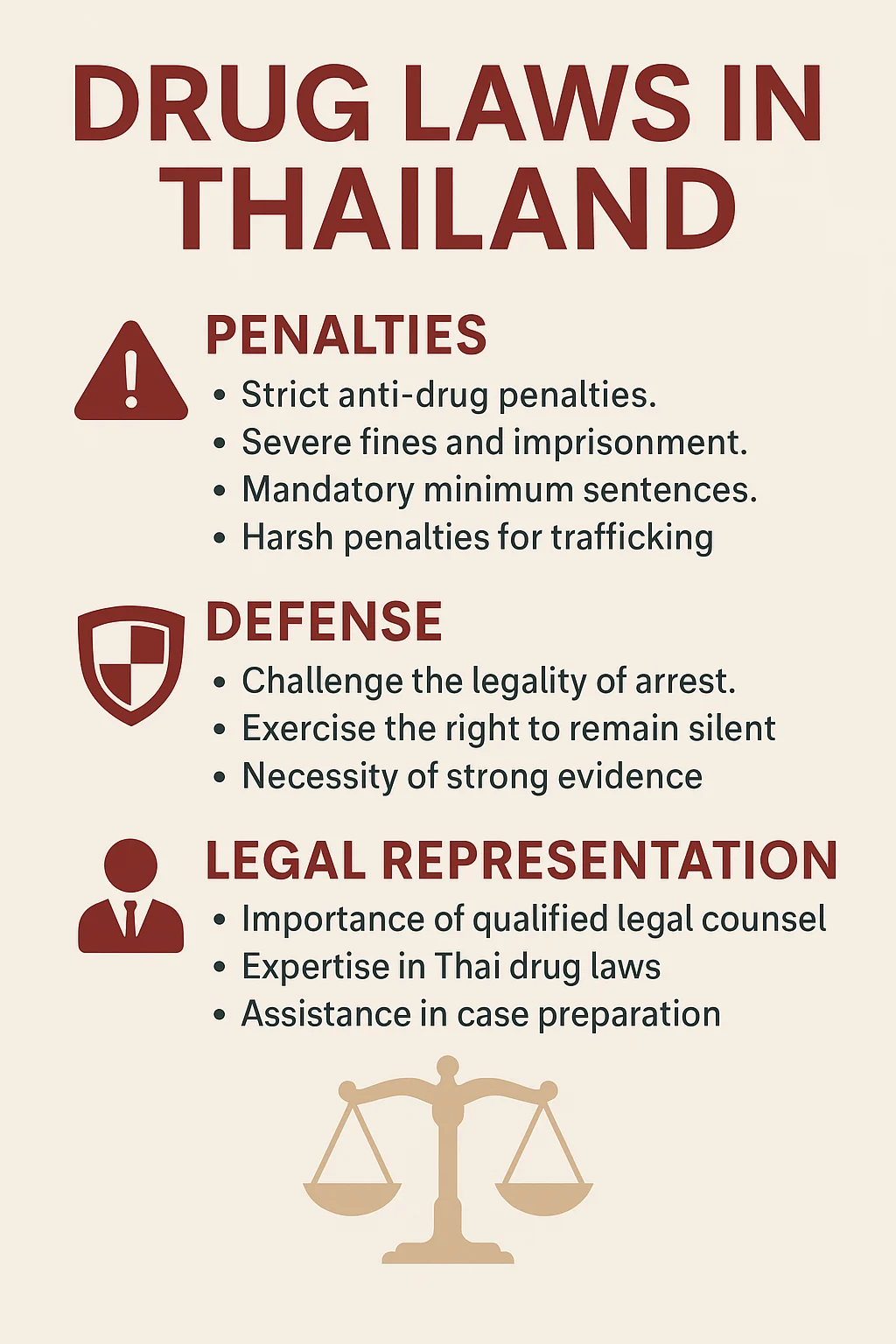
Looking for the penalty tables? Sentencing ranges by drug category and quantity, the presumption of intent to supply, and the 2024 to 2026 changes are set out in full in our reference guide to Thailand drug laws, penalties and trafficking offences. This page is about what to do when someone has actually been arrested.
1. Understanding Drug Laws in Thailand
Thailand’s narcotics regime is built on three pillars: personal use, trafficking, and possession under Thai law.
- The Narcotics Act B.E. 2522 (1979) and the Psychotropic Substances Act B.E. 2559 (2016) were repealed, along with twenty-two other instruments, by section 4 of the Act Promulgating the Narcotics Code. Both subjects now sit in the single Narcotics Code, the “Narcotics Code B.E. 2564 (2021)”. The Act was published on 8 November 2021 and took effect the following day; the Code annexed to it took effect thirty days later, on 9 December 2021.
- Five categories of narcotic under section 29, from Category I down to Category V, and a separate scheme of four categories of psychotropic substance under section 30. The Code gives examples only: which named substance sits in which category, and any move between categories, is fixed by notification of the Minister of Public Health, not by the Code.
- Parallel offences for possession, use, manufacture, import/export and trafficking of drugs in Thailand, each carrying sharply escalating penalties including years imprisonment.
Key 2024-25 updates
- The quantity of methamphetamine presumed to be held for personal consumption was cut from five dosage units to one, by Ministerial Regulation (No. 2) B.E. 2567 of 17 June 2024. One tablet is inside that presumption, not outside it; carrying more simply removes the presumption, and the prosecution must then prove what the drug was for.
- Cannabis was removed from Category V in 2022 and has not been re-listed. Since 26 June 2025 the flower is a controlled herb: a licensed shop may sell it only to another licence holder or to a buyer holding a prescription, under the Ministry of Public Health controlled-herb notification B.E. 2568. That is not a narcotics charge, although extracts above 0.2 per cent THC remain Category V narcotics. Smoke or odour in public is a separate matter under the Public Health Act. See Is marijuana legal in Thailand?
- New sentencing bands let judges shorten jail terms. This is possible if the crime is “serious” but not “aggravated” under the 2021 Code.
The law behind this page
English
Section 145 Narcotics Code B.E. 2564
Full text
A person who produces, imports, exports, disposes of or has in possession a narcotic of Category 1 in contravention of section 90 shall be liable to imprisonment for a term not exceeding 15 years and a fine not exceeding 1,500,000 baht. If the commission of the offence under paragraph one is any of the following acts, the offender shall be liable to imprisonment for a term of 2 to 20 years and a fine of 200,000 to 2,000,000 baht: (1) an act for trade; (2) causing spread among the public; (3) disposal to a person aged not exceeding 18 years; (4) disposal within the area of an educational institution, a place of religious worship of any community, or a government premises; (5) an act committed by using violence or threatening to use violence; (6) an act committed while carrying or using a weapon. If the commission of the offence under paragraph one or paragraph two is any of the following acts, the offender shall be liable to imprisonment for a term of 5 years to life and a fine of 500,000 to 5,000,000 baht, or to death: (1) an act committed by a leader, a person with the duty of giving orders, or a person with the duty of management in a criminal network; (2) causing an impact on the security of the State or the safety of the general public.
ThaiLawOnline translation
Section 107 Narcotics Code B.E. 2564
Full text
No person shall have in possession a narcotic of Category 1, Category 2 or Category 5, or a psychotropic substance of Category 1 or Category 2, for consumption. Possession of a narcotic of Category 1, Category 2 or Category 5, or a psychotropic substance of Category 1 or Category 2, in a small quantity not exceeding the quantity prescribed by the Minister of Public Health in a ministerial regulation, is presumed to be possession for consumption.
ThaiLawOnline translation
Section 162 Narcotics Code B.E. 2564
Full text
Any person who consumes a Category 1, Category 2 or Category 5 narcotic, or a Schedule 1 or Schedule 2 psychotropic substance, not being a case under section 113 or section 114, in violation of section 104, shall be punished by imprisonment not exceeding 1 year, or a fine not exceeding 20,000 baht, or both.
ThaiLawOnline translation
Section 164 Narcotics Code B.E. 2564
Full text
Any person who possesses a Category 1, Category 2 or Category 5 narcotic, or a Schedule 1 or Schedule 2 psychotropic substance, for consumption, in violation of section 107, shall be punished by imprisonment not exceeding 2 years, or a fine not exceeding 40,000 baht, or both.
ThaiLawOnline translation
Section 165 Narcotics Code B.E. 2564
Full text
In the trial and adjudication of cases under this Title, the court shall have the power to try and adjudicate the case having regard to assisting the defendant to cease using narcotics through treatment rather than punishment. If the defendant is to be punished, the court shall determine a punishment appropriate to each defendant individually, even though the defendants committed the offence jointly, having regard to the differing gravity of the nature of the offence in each case, the serious consequences according to the category and quantity of the narcotics involved with the offender, and the facts concerning the offender, such as age, background, conduct, character, intelligence, education and training, the burden of supporting a family, use for the treatment of disease or the relief of pain, the necessity of use for other reasons, physical condition and mental condition, environment, having been coerced, threatened or deceived into using narcotics, or having been made a tool of narcotics dealers, or any other extenuating circumstance. In addition, the punishment should take into account the type of narcotic used or possessed for use, the quantity of narcotics used or possessed for use, whether the narcotics were used occasionally or regularly, or whether the narcotics were used for the purpose of performing certain work. In the case where the court orders a probation officer to inquire into the facts under paragraph one, the person responsible shall send the court order and the related documents to the probation office within three days from the date of the court order, unless the court orders otherwise. When the probation office has received the order under paragraph three, the probation officer shall inquire into the facts and complete a report and opinion within thirty days from the date on which the probation office received the letter. Where there is a necessary cause, the probation officer may request the court to extend the period by not more than fifteen days.
ThaiLawOnline translation
Section 29 Narcotics Code B.E. 2564
Full text
Narcotics are divided into 5 categories: (1) Category 1: dangerous narcotics, such as heroin; (2) Category 2: general narcotics, such as morphine, cocaine, codeine or medicinal opium; (3) Category 3: narcotics in the form of pharmaceutical preparations containing a Category 2 narcotic, in accordance with the criteria announced by the Minister of Public Health on the recommendation of the Narcotics Control Committee; (4) Category 4: chemicals used in producing Category 1 or Category 2 narcotics, such as acetic anhydride; (5) Category 5: narcotics not falling within Categories 1 to 4, such as the opium plant. The naming of which narcotic falls within which category under paragraph one (1), (2), (4) and (5), and the withdrawal or change of the name or category of such a narcotic, shall be as announced by the Minister of Public Health with the approval of the Narcotics Control Board. For the purposes of this section, "medicinal opium" means opium that has undergone a preparation process for the purpose of medicinal use.
ThaiLawOnline translation
Section 87
An arrested person cannot be held longer than necessary. If not released, they must be taken to court within 48 hours so the police or prosecutor can ask for a detention warrant. The court can only order remand for limited, capped periods that grow with the seriousness of the offense, and the accused may have a lawyer at the hearing. The 48 hour period runs from arrival at the inquiry official's office under Section 83, and it does not apply where there is force majeure or other unavoidable necessity.
Full text
It is prohibited to keep the arrested person in custody beyond what is necessary according to the circumstances of the case. In the case of a petty offence, the arrested person may be kept in custody only for such time as is needed to take his statement and to ascertain who he is and where his residence is. Where the arrested person is not released provisionally and there is a necessity for the purpose of the investigation or the prosecution of the case, the arrested person shall be taken to the court within forty-eight hours from the time the arrested person was brought to the office of the inquiry official under section 83, except where there is force majeure or another unavoidable necessity, by having the inquiry official or the public prosecutor file an application with the court for a warrant to detain the accused. The court shall ask the accused whether he has any objection, and the court may summon the inquiry official or the public prosecutor to explain the necessity, or may summon evidence for its consideration. In the case of a criminal offence with a maximum penalty of imprisonment not exceeding six months or a fine not exceeding five hundred baht, or both, the court has the power to order detention only once, for a period not exceeding seven days. In the case of a criminal offence with a maximum penalty of imprisonment exceeding six months but less than ten years, or a fine exceeding five hundred baht, or both, the court has the power to order detention several consecutive times, but each time must not exceed twelve days and all together must not exceed forty-eight days. In the case of a criminal offence with a maximum penalty of imprisonment of ten years or more, whether or not there is also a fine, the court has the power to order detention several consecutive times, but each time must not exceed twelve days and all together must not exceed eighty-four days. In the case under paragraph six, when the court has ordered detention for the full forty-eight days, if the public prosecutor or the inquiry official files an application with the court to detain further by claiming a necessity, the court may order further detention only when the public prosecutor or the inquiry official has shown the necessity and has brought evidence for the court to examine until the court is satisfied. In the examination under paragraph three and paragraph seven, the accused has the right to appoint a lawyer to state objections and to question witnesses. If the accused has no lawyer because there has not yet been compliance with section 134/1 and the accused so requests, the court shall appoint a lawyer for him, and that lawyer has the right to receive a fee and expenses as prescribed in section 134/1 paragraph three, mutatis mutandis. If the inquiry official must conduct the investigation in another locality outside the jurisdiction of the court that ordered the detention of the accused, the inquiry official may file an application to transfer the detention to the court in the locality where the investigation must be conducted; and when the court that ordered the detention deems it appropriate, it shall order the transfer.
ThaiLawOnline translation
Section 176
If a defendant pleads guilty, the court can convict without hearing evidence, unless the offence carries a minimum of five years' imprisonment or more, where the prosecution must still prove guilt. Where several defendants are charged and some plead guilty, the court may sever the case for those who deny the charge.
Full text
At the trial, if the defendant pleads guilty as charged, the court may render judgment without further taking of evidence, except in a case where the offence to which the defendant pleads guilty is one for which the law prescribes a minimum penalty of imprisonment of five years or more, or a heavier penalty, in which case the court must hear the prosecution's witnesses until it is satisfied that the defendant has actually committed the offence. In a case with several defendants where some of them plead guilty, the court may, when it thinks fit, order the case to be struck out in respect of the defendants who deny the charge, so that the prosecutor may prosecute the defendants who deny the charge as a new case within the time fixed by the court.
ThaiLawOnline translation
ไทย
มาตรา 145 ประมวลกฎหมายยาเสพติด
ข้อความเต็ม
ผู้ใดผลิต นำเข้า ส่งออก จำหน่าย หรือมีไว้ในครอบครองซึ่งยาเสพติดให้โทษในประเภท ๑ อันเป็นการฝ่าฝืนมาตรา ๙๐ ต้องระวางโทษจำคุกไม่เกินสิบห้าปี และปรับไม่เกินหนึ่งล้านห้าแสนบาท ถ้าการกระทำความผิดตามวรรคหนึ่งเป็นการกระทำดังต่อไปนี้ ต้องระวางโทษจำคุกตั้งแต่สองปีถึงยี่สิบปี และปรับตั้งแต่สองแสนบาทถึงสองล้านบาท (๑) การกระทำเพื่อการค้า (๒) การก่อให้เกิดการแพร่กระจายในกลุ่มประชาชน (๓) การจำหน่ายแก่บุคคลอายุไม่เกินสิบแปดปี (๔) การจำหน่ายในบริเวณสถานศึกษา สถานอันเป็นที่เคารพในทางศาสนาของหมู่ชนใด หรือสถานที่ราชการ (๕) การกระทำโดยใช้กำลังประทุษร้ายหรือขู่เข็ญว่าจะใช้กำลังประทุษร้าย (๖) การกระทำโดยมีอาวุธหรือใช้อาวุธ ถ้าการกระทำความผิดตามวรรคหนึ่งหรือวรรคสองเป็นการกระทำดังต่อไปนี้ ต้องระวางโทษจำคุกตั้งแต่ห้าปีถึงจำคุกตลอดชีวิต และปรับตั้งแต่ห้าแสนบาทถึงห้าล้านบาท หรือประหารชีวิต (๑) การกระทำโดยหัวหน้า ผู้มีหน้าที่สั่งการ หรือผู้มีหน้าที่จัดการในเครือข่ายอาชญากรรม (๒) การทำให้เกิดผลกระทบต่อความมั่นคงของรัฐหรือความปลอดภัยของประชาชนทั่วไป
ตรงตามข้อความในราชกิจจานุเบกษา / สำนักงานคณะกรรมการกฤษฎีกา (Verbatim from the Royal Gazette / Office of the Council of State)
มาตรา 107 ประมวลกฎหมายยาเสพติด
ข้อความเต็ม
ห้ามผู้ใดมีไว้ในครอบครองซึ่งยาเสพติดให้โทษในประเภท ๑ ประเภท ๒ หรือประเภท ๕ หรือวัตถุออกฤทธิ์ในประเภท ๑ หรือประเภท ๒ เพื่อเสพ การมีไว้ในครอบครองซึ่งยาเสพติดให้โทษในประเภท ๑ ประเภท ๒ หรือประเภท ๕ หรือวัตถุออกฤทธิ์ในประเภท ๑ หรือประเภท ๒ ในปริมาณเล็กน้อยซึ่งไม่เกินปริมาณที่รัฐมนตรีว่าการกระทรวงสาธารณสุขกำหนดในกฎกระทรวง ให้สันนิษฐานไว้ก่อนว่ามีไว้ในครอบครองเพื่อเสพ
ตรงตามข้อความในราชกิจจานุเบกษา / สำนักงานคณะกรรมการกฤษฎีกา (Verbatim from the Royal Gazette / Office of the Council of State)
มาตรา 162 ประมวลกฎหมายยาเสพติด
ข้อความเต็ม
ผู้ใดเสพยาเสพติดให้โทษในประเภท ๑ ประเภท ๒ หรือประเภท ๕ หรือเสพวัตถุออกฤทธิ์ในประเภท ๑ หรือประเภท ๒ และมิใช่กรณีตามมาตรา ๑๑๓ หรือมาตรา ๑๑๔ อันเป็นการฝ่าฝืนมาตรา ๑๐๔ ต้องระวางโทษจำคุกไม่เกินหนึ่งปี หรือปรับไม่เกินสองหมื่นบาท หรือทั้งจำทั้งปรับ
ตรงตามข้อความในราชกิจจานุเบกษา / สำนักงานคณะกรรมการกฤษฎีกา (Verbatim from the Royal Gazette / Office of the Council of State)
มาตรา 164 ประมวลกฎหมายยาเสพติด
ข้อความเต็ม
ผู้ใดมีไว้ในครอบครองซึ่งยาเสพติดให้โทษในประเภท ๑ ประเภท ๒ หรือประเภท ๕ หรือวัตถุออกฤทธิ์ในประเภท ๑ หรือประเภท ๒ เพื่อเสพ อันเป็นการฝ่าฝืนมาตรา ๑๐๗ ต้องระวางโทษจำคุกไม่เกินสองปี หรือปรับไม่เกินสี่หมื่นบาท หรือทั้งจำทั้งปรับ
ตรงตามข้อความในราชกิจจานุเบกษา / สำนักงานคณะกรรมการกฤษฎีกา (Verbatim from the Royal Gazette / Office of the Council of State)
มาตรา 165 ประมวลกฎหมายยาเสพติด
ข้อความเต็ม
ในการพิจารณาและพิพากษาคดีตามลักษณะนี้ ให้ศาลมีอำนาจพิจารณาพิพากษาคดีโดยคำนึงถึงการสงเคราะห์ให้จำเลยเลิกเสพยาเสพติดโดยการบำบัดรักษายิ่งกว่าการลงโทษ หากจะลงโทษจำเลยก็ให้พิจารณาลงโทษให้เหมาะสมกับจำเลยแต่ละคน แม้จำเลยจะได้กระทำผิดร่วมกัน โดยคำนึงถึงความร้ายแรงตามลักษณะของความผิดที่แตกต่างกันในแต่ละคดี ผลร้ายแรงตามประเภทและปริมาณของยาเสพติดที่เกี่ยวพันกับผู้กระทำความผิด และข้อเท็จจริงที่เกี่ยวกับผู้กระทำความผิด เช่น อายุ ประวัติ ความประพฤติ นิสัย สติปัญญา การศึกษาอบรม ภาระในการเลี้ยงดูครอบครัว การเสพเพื่อรักษาโรคบรรเทาความเจ็บปวด ความจำเป็นต้องเสพด้วยเหตุอื่น สภาพร่างกาย และสภาพจิตใจ สิ่งแวดล้อม การถูกบังคับขู่เข็ญหลอกลวงให้เสพยาเสพติด หรือตกเป็นเครื่องมือของผู้ค้ายาเสพติด หรือเหตุอันควรปรานีอื่นใด นอกจากนั้นการลงโทษควรได้คำนึงถึงชนิดของยาเสพติดที่เสพหรือครอบครองเพื่อเสพ จำนวนยาเสพติดที่เสพหรือครอบครองเพื่อเสพ การเสพยาเสพติดเป็นครั้งคราวหรือประจำ หรือเสพยาเสพติดเพื่อประโยชน์ในการปฏิบัติงานบางอย่าง ในกรณีที่ศาลมีคำสั่งให้พนักงานคุมประพฤติแสวงหาข้อเท็จจริงตามวรรคหนึ่ง ให้ผู้มีหน้าที่รับผิดชอบส่งคำสั่งศาลและเอกสารที่เกี่ยวข้องไปยังสำนักงานคุมประพฤติภายในสามวันนับแต่วันที่ศาลมีคำสั่ง เว้นแต่ศาลมีคำสั่งเป็นอย่างอื่น เมื่อสำนักงานคุมประพฤติได้รับคำสั่งตามวรรคสาม ให้พนักงานคุมประพฤติดำเนินการแสวงหาข้อเท็จจริง แล้วทำรายงานและความเห็นให้แล้วเสร็จภายในสามสิบวันนับแต่วันที่สำนักงานคุมประพฤติได้รับหนังสือ ในกรณีที่มีเหตุจำเป็นพนักงานคุมประพฤติอาจร้องขอต่อศาลเพื่อขยายระยะเวลาออกไปได้อีกไม่เกินสิบห้าวัน
ตรงตามข้อความในราชกิจจานุเบกษา / สำนักงานคณะกรรมการกฤษฎีกา (Verbatim from the Royal Gazette / Office of the Council of State)
มาตรา 29 ประมวลกฎหมายยาเสพติด
ข้อความเต็ม
ยาเสพติดให้โทษแบ่งออกเป็น ๕ ประเภท คือ (๑) ประเภท ๑ ยาเสพติดให้โทษชนิดร้ายแรง เช่น เฮโรอีน (Heroin) (๒) ประเภท ๒ ยาเสพติดให้โทษทั่วไป เช่น มอร์ฟีน (Morphine) โคคาอีน (Cocaine) โคเดอีน (Codeine) หรือฝิ่นยา (Medicinal Opium) (๓) ประเภท ๓ ยาเสพติดให้โทษที่มีลักษณะเป็นตำรับยา และมียาเสพติดให้โทษในประเภท ๒ ผสมอยู่ด้วย ทั้งนี้ ตามหลักเกณฑ์ที่รัฐมนตรีว่าการกระทรวงสาธารณสุขโดยการเสนอแนะของคณะกรรมการควบคุมยาเสพติดประกาศกำหนด (๔) ประเภท ๔ สารเคมีที่ใช้ในการผลิตยาเสพติดให้โทษในประเภท ๑ หรือประเภท ๒ เช่น อาเซติค แอนไฮไดรด์ (Acetic Anhydride) (๕) ประเภท ๕ ยาเสพติดให้โทษที่มิได้เข้าอยู่ในประเภท ๑ ถึงประเภท ๔ เช่น พืชฝิ่น การระบุชื่อยาเสพติดให้โทษว่ายาเสพติดให้โทษชื่อใดอยู่ในประเภทใดตามวรรคหนึ่ง (๑) (๒) (๔) และ (๕) และการเพิกถอนหรือเปลี่ยนแปลงชื่อหรือประเภทยาเสพติดให้โทษดังกล่าว ให้เป็นไปตามที่รัฐมนตรีว่าการกระทรวงสาธารณสุขโดยความเห็นชอบของคณะกรรมการ ป.ป.ส. ประกาศกำหนด เพื่อประโยชน์แห่งมาตรานี้ คำว่า “ฝิ่นยา (Medicinal Opium)” หมายความว่า ฝิ่นที่ได้ผ่านกรรมวิธีปรุงแต่งโดยมีความมุ่งหมายเพื่อใช้ในทางยา
ตรงตามข้อความในราชกิจจานุเบกษา / สำนักงานคณะกรรมการกฤษฎีกา (Verbatim from the Royal Gazette / Office of the Council of State)
มาตรา 87
ข้อความเต็ม
ห้ามมิให้ควบคุมผู้ถูกจับไว้เกินกว่าจำเป็นตามพฤติการณ์แห่งคดี ในกรณีความผิดลหุโทษ จะควบคุมผู้ถูกจับไว้ได้เท่าเวลาที่จะถามคำให้การ และที่จะรู้ตัวว่าเป็นใครและที่อยู่ของเขาอยู่ที่ไหนเท่านั้น ในกรณีที่ผู้ถูกจับไม่ได้รับการปล่อยชั่วคราว และมีเหตุจำเป็นเพื่อทำการสอบสวน หรือการฟ้องคดีให้นำตัวผู้ถูกจับไปศาลภายในสี่สิบแปดชั่วโมงนับแต่เวลาที่ผู้ถูกจับถูกนำตัวไปถึงที่ทำการของพนักงานสอบสวนตามมาตรา ๘๓ เว้นแต่มีเหตุสุดวิสัยหรือมีเหตุจำเป็นอย่างอื่นอันมิอาจก้าวล่วงเสียได้ โดยให้พนักงานสอบสวนหรือพนักงานอัยการยื่นคำร้องต่อศาลขอหมายขังผู้ต้องหานั้นไว้ ให้ศาลสอบถามผู้ต้องหาว่าจะมีข้อคัดค้านประการใดหรือไม่ และศาลอาจเรียกพนักงานสอบสวนหรือพนักงานอัยการมาชี้แจงเหตุจำเป็น หรืออาจเรียกพยานหลักฐานมาเพื่อประกอบการพิจารณาก็ได้ ในกรณีความผิดอาญาที่ได้กระทำลงมีอัตราโทษจำคุกอย่างสูงไม่เกินหกเดือนหรือปรับไม่เกินห้าร้อยบาท หรือทั้งจำทั้งปรับ ศาลมีอำนาจสั่งขังได้ครั้งเดียว มีกำหนดไม่เกินเจ็ดวัน ในกรณีความผิดอาญาที่มีอัตราโทษจำคุกอย่างสูงเกินกว่าหกเดือนแต่ไม่ถึงสิบปี หรือปรับเกินกว่าห้าร้อยบาท หรือทั้งจำทั้งปรับ ศาลมีอำนาจสั่งขังหลายครั้งติด ๆ กันได้ แต่ครั้งหนึ่งต้องไม่เกินสิบสองวันและรวมกันทั้งหมดต้องไม่เกินสี่สิบแปดวัน ในกรณีความผิดอาญาที่มีอัตราโทษจำคุกอย่างสูงตั้งแต่สิบปีขึ้นไป จะมีโทษปรับด้วยหรือไม่ก็ตามศาลมีอำนาจสั่งขังหลายครั้งติด ๆ กันได้ แต่ครั้งหนึ่งต้องไม่เกินสิบสองวัน และรวมกันทั้งหมดต้องไม่เกินแปดสิบสี่วัน ในกรณีตามวรรคหกเมื่อศาลสั่งขังครบสี่สิบแปดวันแล้ว หากพนักงานอัยการหรือพนักงานสอบสวนยื่นคำร้องต่อศาลเพื่อขอขังต่อไปอีกโดยอ้างเหตุจำเป็น ศาลจะสั่งขังต่อไปได้ก็ต่อเมื่อพนักงานอัยการหรือพนักงานสอบสวนได้แสดงถึงเหตุจำเป็น และนำพยานหลักฐานมาให้ศาลไต่สวนจนเป็นที่พอใจแก่ศาล ในการไต่สวนตามวรรคสามและวรรคเจ็ด ผู้ต้องหามีสิทธิแต่งทนายความเพื่อแถลงข้อคัดค้านและซักถามพยาน ถ้าผู้ต้องหาไม่มีทนายความเนื่องจากยังไม่ได้มีการปฏิบัติตามมาตรา ๑๓๔/๑ และผู้ต้องหาร้องขอ ให้ศาลตั้งทนายความให้ โดยทนายความนั้นมีสิทธิได้รับเงินรางวัลและค่าใช้จ่ายตามที่กำหนดไว้ในมาตรา ๑๓๔/๑ วรรคสาม โดยอนุโลม ถ้าพนักงานสอบสวนต้องไปทำการสอบสวนในท้องที่อื่นนอกเขตของศาลซึ่งได้สั่งขังผู้ต้องหาไว้ พนักงานสอบสวนจะยื่นคำร้องขอให้โอนการขังไปยังศาลในท้องที่ที่จะต้องไปทำการสอบสวนนั้นก็ได้ เมื่อศาลที่สั่งขังไว้เห็นเป็นการสมควรก็ให้สั่งโอนไป
ตรงตามข้อความในราชกิจจานุเบกษา / สำนักงานคณะกรรมการกฤษฎีกา (Verbatim from the Royal Gazette / Office of the Council of State)
มาตรา 176
ข้อความเต็ม
ในชั้นพิจารณา ถ้าจำเลยให้การรับสารภาพตามฟ้องศาลจะพิพากษาโดยไม่สืบพยานหลักฐานต่อไปก็ได้ เว้นแต่คดีที่มีข้อหาในความผิดซึ่งจำเลยรับสารภาพนั้นกฎหมายกำหนดอัตราโทษอย่างต่ำไว้ให้จำคุกตั้งแต่ห้าปีขึ้นไปหรือโทษสถานที่หนักกว่านั้น ศาลต้องฟังพยานโจทก์จนกว่าจะพอใจว่าจำเลยได้กระทำผิดจริงในคดีที่มีจำเลยหลายคน และจำเลยบางคนรับสารภาพ เมื่อศาลเห็นสมควรจะสั่งจำหน่ายคดี สำหรับจำเลยที่ปฏิเสธเพื่อให้โจทก์ฟ้องจำเลยที่ปฏิเสธนั้น เป็นคดีใหม่ภายในเวลาที่ศาลกำหนดก็ได้
ข้อความจากฐานข้อมูลประมวลกฎหมายของเรา โปรดตรวจสอบกับข้อความทางการ (Thai text from our annotated code. Check it against the official text.)
Français
Article 145 Narcotics Code B.E. 2564
Production, importation, exportation, cession ou détention de stupéfiant de catégorie 1: au plus 15 ans et 1,5 million de bahts; circonstances aggravantes, notamment commerce: 2 à 20 ans et 200 000 à 2 millions. Chef de réseau ou atteinte à la sécurité: 5 ans à perpétuité et amende, ou mort.
résumé non officiel
Article 107 Narcotics Code B.E. 2564
Interdit la détention pour consommation de stupéfiants des catégories 1, 2 ou 5 ou de psychotropes des catégories 1 ou 2. Une petite quantité n'excédant pas le seuil du règlement ministériel est présumée détenue pour consommation.
résumé non officiel
Article 162 Narcotics Code B.E. 2564
La consommation d'un stupéfiant de catégorie 1, 2 ou 5, ou d'un psychotrope de catégorie 1 ou 2, hors cas des articles 113 et 114, en violation de l'article 104, est punie d'un an au plus, de 20 000 bahts au plus, ou des deux.
résumé non officiel
Article 164 Narcotics Code B.E. 2564
La détention pour consommation d'un stupéfiant de catégorie 1, 2 ou 5, ou d'un psychotrope de catégorie 1 ou 2, en violation de l'article 107, est punie de 2 ans d'emprisonnement au plus, de 40 000 bahts d'amende au plus, ou des deux.
résumé non officiel
Article 165 Narcotics Code B.E. 2564
Le tribunal a le pouvoir de juger en privilégiant l'aide au prévenu pour cesser de consommer par le traitement plutôt que par la peine. S'il punit, il adapte la peine à chaque prévenu, même coauteurs, selon la gravité de l'infraction, la catégorie et la quantité des stupéfiants et la situation de l'auteur (âge, antécédents, santé, famille, usage thérapeutique, contrainte, instrumentalisation par des trafiquants, autre motif de clémence). La peine devrait aussi tenir compte du type et de la quantité consommés ou détenus, de l'usage occasionnel, habituel ou lié au travail. En cas d'enquête de probation, le dossier est transmis sous trois jours, sauf décision contraire ; le rapport est remis sous trente jours, l'agent pouvant demander au tribunal, si nécessaire, quinze jours de plus au maximum.
résumé non officiel
Article 29 Narcotics Code B.E. 2564
Cinq catégories de stupéfiants: 1, dangereux (notamment héroïne); 2, généraux (notamment morphine, cocaïne, codéine, opium médicinal); 3, préparations pharmaceutiques contenant un stupéfiant de catégorie 2; 4, produits chimiques précurseurs (notamment anhydride acétique); 5, les autres (notamment plant d'opium). Classement fixé par le ministre de la Santé publique.
résumé non officiel
Article 87
Non libéré, le suspect est présenté au tribunal sous 48 heures dès son arrivée chez l'enquêteur, sauf force majeure. Détention maximale : 7 jours, une fois, peine jusqu'à 6 mois ou 500 bahts ; 12 jours renouvelables, 48 au total, sous 10 ans ; 84 dès 10 ans, nécessité prouvée.
résumé non officiel
Article 176
Sources
- Narcotics Code B.E. 2564, retrieved 2 November 2026
- Criminal Procedure Code, Office of the Council of State, retrieved 31 October 2026
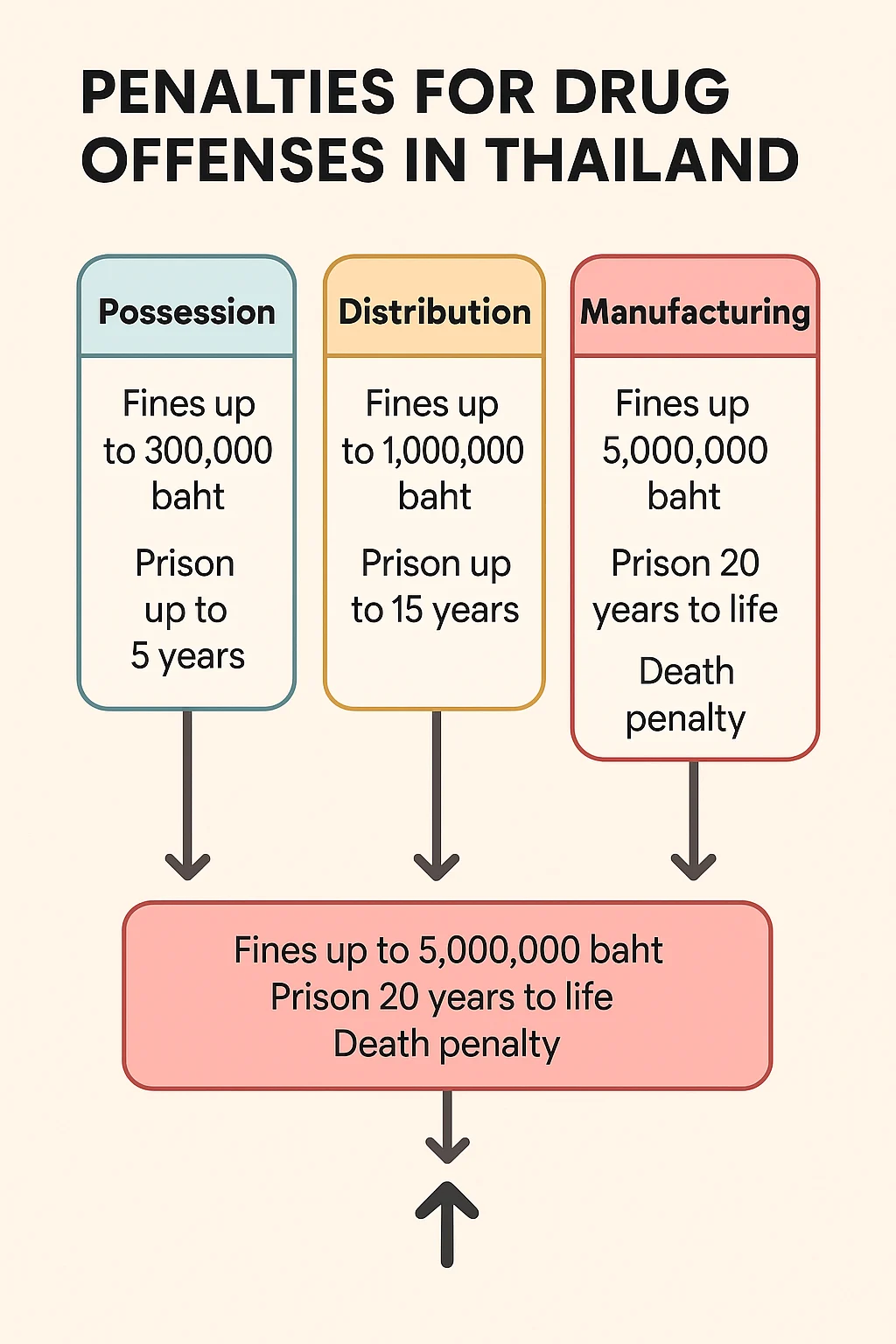
2. Penalties by Category related to Drug Laws in Thailand
| Category and Code sections | Producing, importing, exporting, disposing of or possessing it, basic penalty | Where the act is for trade or is otherwise aggravated | Notes |
| I, severe narcotics. Section 29(1) names heroin; methamphetamine and MDMA are placed here by notification, not by the Code. Offence s.90, penalty s.145 | Imprisonment not exceeding 15 years and a fine not exceeding 1,500,000 THB | 2 to 20 years and a fine of 200,000 to 2,000,000 THB. Where the offender is a chief, a person with authority to give orders or a person with managing authority in a criminal network, or where the act affects the security of the State or the safety of the general public: 5 years to life imprisonment and a fine of 500,000 to 5,000,000 THB, or death | Holding a Category I drug for your own consumption is a separate and far lighter offence. See the paragraph below the table |
| II, general narcotics. Section 29(2) names morphine, cocaine, codeine and medicinal opium. IV, chemicals used to produce a Category I or II narcotic, s.29(4) naming acetic anhydride. Offence s.91, penalty s.146 | Imprisonment not exceeding 10 years and a fine not exceeding 1,000,000 THB | 1 to 15 years and a fine of 100,000 to 1,500,000 THB, for Category II only. Section 146 gives Category IV no aggravated tier at all | Categories II and IV share one offence provision and one basic penalty. Category IV is not treated more lightly than Category II at the basic level |
| III, preparations containing a Category II narcotic, e.g. codeine mixtures. Offence s.92, penalty s.147 | Imprisonment not exceeding 3 years and a fine not exceeding 300,000 THB | None. Section 147 has no aggravated tier | Section 92 does not prohibit possession. It reaches producing, importing, exporting and disposing only, so simply holding a Category III preparation is not an offence under this head |
| V, narcotics not falling in Categories I to IV, s.29(5) naming the opium plant. Offence s.93, penalty s.148 | Imprisonment not exceeding 5 years and a fine not exceeding 500,000 THB | 1 to 15 years and a fine of 100,000 to 1,500,000 THB | Cannabis is no longer in this category: it was removed by Ministry of Public Health notification of 9 June 2022 made under section 29 paragraph two. See is marijuana legal in Thailand |
*Read the table with four things in mind, all of them from the Code itself. First, the fine is cumulative, not alternative. Sections 145 to 148 each read “imprisonment … and a fine”, so a court sentencing under one of them imposes both. Second, the aggravating limbs are the same six in sections 145, 146 and 148: the act is done for trade; it causes the drug to spread among the public; the drug is disposed of to a person not over eighteen; it is disposed of in an educational institution, a place of religious veneration or a government place; force or the threat of force is used; or the offender is armed or uses a weapon. Only section 145 adds the third tier shown above. Third, the Code grades by conduct and by the offender’s role, not by weight. There is no quantity threshold anywhere in sections 145 to 148, and quantity matters as evidence of what the drug was for rather than as a sentencing band. Fourth, section 165 directs the court, in these cases, to weigh helping the defendant stop using narcotics through treatment above punishing them, and to sentence each defendant individually even where they offended together.
Two lighter offences sit outside the table, and they are the ones most expats actually face. Consuming a Category I, II or V narcotic, or a Category I or II psychotropic substance, breaches section 104 and is punishable under section 162 by imprisonment not exceeding one year, or a fine not exceeding 20,000 THB, or both. Possessing one for your own consumption breaches section 107 and is punishable under section 164 by imprisonment not exceeding two years, or a fine not exceeding 40,000 THB, or both. Section 107 paragraph two makes a quantity below the amount fixed by ministerial regulation presumed to be held for consumption. In these two provisions the fine is an alternative to prison, which is the opposite of sections 145 to 148.
Psychotropic substances are a separate scheme with four categories, not five. Section 30 divides them by medical use and abuse potential, and section 94 prohibits producing, importing, exporting, disposing of, possessing or transiting them without a licence. Section 149 sets the penalties: Category 1, imprisonment not exceeding 10 years and a fine not exceeding 1,000,000 THB; Category 2, not exceeding 7 years and 700,000 THB; Categories 3 and 4, not exceeding 5 years and 500,000 THB. For Categories 1 and 2 the same six aggravating limbs raise it to 1 to 15 years and 100,000 to 1,500,000 THB.
3. What Really Happens After an Arrest
3.1 Police Phase (0-48 hrs)
- Police may search without warrant if they claim exigent circumstances; challenge illegal searches early.
- Confession culture is strong; remain polite but exercise your right to silence until your lawyer arrives.
- Bail for minor drug offences can be paid at the station. Serious drug charges need a Criminal Court hearing and a high bond.
3.2 Investigation & Remand (Day 3, Day 84)
- Judges can extend detention in blocks of up to 12 days, up to 84 days in total before prosecutors file charges where the maximum penalty is ten years or more, and up to 48 days where it is over six months but under ten years (Criminal Procedure Code section 87).
- During this time, your defense team should review evidence, conduct forensic tests, and interview witnesses. They should already be testing the state’s case.
3.3 Trial & Sentencing
- No jury system; panels of professional judges decide fact and law.
- Where the offence carries a minimum penalty of five years’ imprisonment or more, the court must still hear the prosecution’s evidence after a guilty plea (Criminal Procedure Code section 176).
- Sentencing mitigants include: cooperation, first-time offence, proven addiction, entrapment, duress, improper search, or violation of statutory procedures.
- An appeal must be filed within one month of the judgment being read (Criminal Procedure Code section 198); fresh evidence is sometimes admissible on appeal.
4. Common Defenses and Mitigation Strategies
- Lack of knowledge / possession not proved, Useful where drugs in Thailand are found in shared accommodation or vehicles.
- Entrapment or controlled delivery gone wrong, Increasingly relevant with online sting operations.
- Duress / Necessity (Penal Code §67), Frequent in “drug-mule” scenarios involving opium.
- Procedural violations, Unlawful search, unsigned inventory, absence of translator during interrogation.
- Addiction and Rehabilitation, Under the 2021 Code, small-quantity users may petition for mandatory treatment instead of prison.
- Plea negotiation with police , Thai prosecutors do not have U.S.-style plea-bargaining power. Charge-reduction talks occur during the police investigation stage.
5. Special Risks for Foreigners
- Blacklists & Overstay, Any drug conviction triggers deportation and up to a lifetime re-entry ban.
- Prison Transfers, Transfer to home country possible only after serving one-third (or four years) of sentence and paying all fines.
- Extradition, Thailand will extradite foreigners for drug trafficking under bilateral treaties, but will not surrender Thai nationals.
- Asset Seizure, Narcotics Code mandates aggressive forfeiture of cars, condos and crypto suspected of being drug proceeds.
- Death-Penalty Cases, Foreign nationals have been condemned. The Malaysian national Ong Gim Wah was sentenced to death on 4 March 2025, following a 2023 seizure in Ratchaburi of 998 kilograms of crystal methamphetamine. That was a sentence of a court of first instance and is subject to appeal, so it is not a final sentence. Executions are rare under a de facto moratorium, but the penalty remains on the books.
6. Choosing a Bangkok Drug Lawyer
- Language & Court Experience, Court-appointed counsel often lack English-fluency and trial depth. Select counsel with a record in high-weight drug cases and interpreter support.
- Early Engagement, The first 48 hours are crucial for bail options and charge framing. A delay can lead to harsher drug offence penalties.
- Bail Strategy, Counsel must craft surety packages (cash, land titles) and flight-risk arguments tailored for foreigners
- Evidence-Testing Capability under Thai law., Access to independent labs and experts to challenge purity levels and weights can slash potential sentences.
- Appeal & Deportation Counsel, Same firm should be able to handle sentence reduction petitions, prisoner-transfer applications, and liaise with your embassy.
7. Practical Compliance Tips for Expats
- Travel with prescriptions for personal use of medications., Obtain FDA permits in advance for any medication containing codeine, diazepam or similar controlled ingredients.
- One-Pill Rule, one dosage unit, or a net weight of 100 mg, or 20 mg where the drug is in flakes, powder or crystals, is the quantity presumed to be held for consumption. Carrying more does not make you a presumed seller and does not close off treatment: it removes the presumption, so the purpose becomes a matter of proof.
- Cannabis Is Not a Free Pass, the flower is no longer a narcotic, but it is a controlled herb: a shop may lawfully sell it to you only on a prescription, and extracts above 0.2 per cent THC are still Category V narcotics. Smoke or odour in public is a nuisance under the Public Health Act, and ignoring an official’s order to stop can bring a fine or jail. See our cannabis guide.
- Night-Life Hotspots, Random urine tests for drug use happen often at clubs and private parties. A positive result can lead to prosecution.
- Digital Footprint, Police are using chat apps and delivery-service data more often in drug stings. To protect yourself, encrypt and delete your devices or, even better, avoid using them.
- Asset Paper Trail for drug use and trafficking cases., Large unexplained transfers from overseas can be frozen pending money-laundering probes linked to narcotics.
8. FAQS about DRUG LAWS IN THAILAND
What are the drug laws in Thailand regarding psychotropic substances?
Psychotropic substances are no longer governed by the Narcotics Act B.E. 2522, which section 4 of the Act Promulgating the Narcotics Code repealed, nor by the Psychotropic Substances Act B.E. 2559, repealed by the same section. They sit in the Narcotics Code B.E. 2564, which divides them into four categories under section 30. Section 94 prohibits producing, importing, exporting, disposing of, possessing or transiting them without a licence, and section 149 sets the penalty: up to 10 years and a fine up to 1,000,000 THB for Category 1, up to 7 years and 700,000 THB for Category 2, and up to 5 years and 500,000 THB for Categories 3 and 4. Consuming a Category 1 or 2 psychotropic substance is a separate offence under section 104, punishable under section 162 by up to one year, or a fine up to 20,000 THB, or both.
What is the penalty for drug offenses in Thailand?
The penalty for drug offenses in Thailand can be severe, often resulting in years in prison. For serious drug crimes like trafficking, the punishment can be life in prison or even death. This depends on the category of drug and on what the offender did, such as dealing, supplying a minor, using a weapon or leading a network. Quantity is evidence of purpose, not a sentencing band. Possessing drugs for personal use can lead to jail time. However, the punishment depends on the type of drug.
How does the law classify drugs in Thailand?
There are two schemes, and neither has two categories. Section 29 of the Narcotics Code divides narcotics into five categories: I, severe narcotics, the section naming heroin; II, general narcotics, naming morphine, cocaine, codeine and medicinal opium; III, preparations containing a Category II narcotic; IV, chemicals used to produce a Category I or II narcotic, naming acetic anhydride; and V, narcotics falling in none of the others, naming the opium plant. Section 30 separately divides psychotropic substances into four categories by medical use and abuse potential. Which named substance sits in which category is fixed by notification of the Minister of Public Health, not by the Code.
What are the consequences of drug smuggling in Thailand?
Drug smuggling is treated as a serious offense in Thailand, with severe penalties including long-term imprisonment. The laws are designed to deter trafficking activities, and the government has adopted measures for suppressing narcotic offenders. Importing and exporting are not graded separately in the Narcotics Code: sections 90 to 93 list them beside producing, disposing and possessing, so the penalty is the one for the category. For a Category I narcotic that is up to 15 years and a fine up to 1,500,000 THB under section 145, rising to 2 to 20 years where the act is for trade and, for a network leader or where the security of the State is affected, to 5 years to life or death. They may also face fines and lose money made from drug trafficking.
Can legal services in Thailand help with drug-related offenses?
Yes, legal services in Thailand, such as those offered by ThaiLawOnline, can assist individuals facing drug-related offenses. These services provide legal help and advice. They focus on understanding the complex laws about drug possession, trafficking, and other drug-related offenses. It is advisable to seek professional legal assistance if suspected of drug involvement.
What are the implications of drug possession for personal use?
Possessing drugs for personal use is still illegal in Thailand. People caught with illegal drugs can face serious penalties. Even small amounts can result in imprisonment, a fine, or both, reflecting the country’s strict stance on drug enforcement. It is important to be aware of these laws to avoid serious legal consequences.
What should I know about drug tests in Thailand?
Drug tests in Thailand are commonly conducted in various settings, including workplaces and law enforcement situations. If you test positive for illegal drugs, you may face legal consequences. These can include fines or jail time, depending on the situation and the drug. Awareness of drug laws is essential for those living or traveling in Thailand.
9. How the Supreme Court Has Applied the 2021 Narcotics Code
Two Supreme Court decisions govern how the 2021 Code changed sentencing, and they are worth reading together because they cut in opposite directions. Neither is a general promise of leniency. Both are rulings about which law applies to conduct that straddles the Code’s commencement on 9 December 2021, which is the question that decides a great many drug cases still moving through the courts.
- Decision 272/2565, the Supreme Court sitting as a Grand Chamber: quantity is no longer the criterion. The Court held that the former Narcotics Act B.E. 2522, section 15 with section 66, imposed a heavier penalty by taking the quantity of the drug alone as decisive, whereas section 145 of the Code imposes a heavier penalty by reference to the offender’s conduct in committing the offence and their role and duty in it, and no longer takes quantity as the old law did, although a greater quantity may itself indicate that conduct and role. The consequence the Court drew is exact: where the quantity reaches the old section 66 paragraph two or three but the offender has none of the conduct or role described in section 145 paragraph two or three, the court may convict only under section 145 paragraph one.
- The same decision holds the other half, and it is the half a defendant is more likely to be hurt by. Section 21 paragraph one of the Act promulgating the Code keeps the old presumption of possession for sale in force for any case in which the trial court gave judgment before the Code commenced, until that case becomes final. So a defendant sentenced at first instance before 9 December 2021 still faces the old section 15 presumption, under which possessing a Category I narcotic in the specified quantity, for amphetamine 375 milligrams or more calculated as pure substance, is presumed to be possession for sale.
- Decision 4302/2567: for consumption offences the more favourable law applies, and it is the Code. Penal Code section 3 decides which law governs conduct committed before a change. Consuming methamphetamine was an offence under section 57 of the 1979 Act, punished by its section 91 with 6 months to 3 years, or a fine of 10,000 to 60,000 baht, or both. The same conduct is now section 104 of the Code, punished by section 162 with not more than 1 year, or a fine of not more than 20,000 baht, or both. Section 162 is more favourable, so it governs. Because section 157/1 paragraph two of the Road Traffic Act B.E. 2522 raises the narcotics penalty by one third for a driver who has consumed, the ceiling there works out at 1 year 4 months, or a fine of 26,666.66 baht, or both. On that count the defendant was sentenced to 3 months, suspended for 2 years.
What this does and does not mean for you. Section 165 of the Code directs a court hearing these offences to weigh helping the defendant stop using narcotics through treatment above punishing them, and to sentence each defendant individually even where they offended together. That is a real instruction to the court and it is why mitigation, treatment and a clear account of your role matter more under the Code than they did under the 1979 Act. It is not a guarantee, and for anyone whose case began before December 2021 the old presumption in 272/2565 may still be the thing that decides it.
These outcomes show that while drug laws remain strict, outcomes can improve with evidence-based defenses. At ThaiLawOnline, our team is led by Sébastien Brousseau. We have licensed Thai lawyers, like Garn (barrister), JJ, and Wichuda (who has a master’s degree). We have used similar cases to help secure reductions, acquittals, and rehabilitation options. Don’t navigate this alone. Contact us at info@thailawonline.com for personalized advice on how these rulings might apply to your situation.
ThaiLawOnline can help you if you are arrested, contact us at info@thailawonline.com.
Last reviewed: 5 September 2026. The penalty table and the classification statements on this page were read against the Narcotics Code B.E. 2564 itself, from the Royal Gazette publication of 8 November 2021 (volume 138, part 73 Kor, page 1), which carries the Act bringing the Code into force and the Code annexed to it. The sections read in full are ss.29 and 30 (classification of narcotics and of psychotropic substances), the prohibitions ss.90 to 94, s.104 (consumption) and s.107 (possession for consumption and the quantity presumption), and the penalties ss.145 to 149, s.162, s.164 and s.165. Every figure in the five-row penalty table was wrong against those sections and all of them have been replaced, along with three FAQ answers that repeated the same errors in the page’s structured data. The published table gave Category IV a five-year maximum where s.146 provides ten years and a fine of 1,000,000 Baht, took Category III to life imprisonment where s.147 caps it at three years and 300,000, and wrote every penalty as prison or a fine where ss.145 to 148 all say and. The figures here now match our fuller reference guide to Thailand drug laws and penalties section for section; the two pages previously disagreed on Categories I and V.
What this review does not cover, said plainly. Which named substance falls in which category is fixed by notification of the Minister of Public Health under section 29 paragraph two, and those notifications were not read here. Section 29 itself names heroin, morphine, cocaine, codeine, medicinal opium, acetic anhydride and the opium plant, and those seven are quoted from the Code; every other substance named on this page, methamphetamine and MDMA included, comes from a notification we have not read. The cannabis position is taken from our own cannabis guide, reviewed against the controlled-herb notification on 4 September 2026, and the status of kratom is not asserted here either way. Nothing on this page about the conduct of an arrest, remand in twelve-day blocks, bail practice, evidence of corroboration after a guilty plea, prisoner transfer, extradition or deportation was verified against the Criminal Procedure Code or the transfer legislation.
Updated the same day. The final section previously described five Supreme Court outcomes with no case numbers of any kind. None could be produced from either of our stores, so they have been replaced by the two decisions that can be: 272/2565, read verbatim including the Grand Chamber passage and the section 21 transitional holding, and 4302/2567, read to its disposition. The death-penalty example was checked rather than removed: the sentence on Ong Gim Wah of 4 March 2025 is reported consistently by several independent outlets and is correctly stated, with the addition that it is a first-instance sentence and appealable.
Thai Law Updates, free by email
Plain-English updates on Thai law changes that affect foreigners: property, visas, marriage, business and wills. One short email a month from a firm practicing since 2006. No spam, unsubscribe anytime.