


Reviewed by Wichuda Atthamethakon, LL.M., Thai Bar Licence 3149/2556, for ThaiLawOnline, a Thai law firm acting for foreigners since 2006.
Update log
- 2 November 2026: Added the statute box with Thai, English and French text and checked the page against the official text
This topic is complex, as some title deeds belong to the government and only allow possession of the land, while others cannot be transferred except by inheritance. Today, we will focus on the most common type, known as “full chanotte,” which features a red Garuda. Even in Isaan, the chanotte will be the main title deed in cities. This post aims to explain how to read title deed in Thailand.
Reading the deed is part of the due diligence described in our guide to buying property in Thailand.
Last reviewed: 7 September 2026. The registration fees were taken from Ministerial Regulation No. 47 (B.E. 2541) clause 2(7) under the Land Code as the Department of Lands publishes it. The Sap-Ing-Sith passages were read in Thai against the Sap-Ing-Sith Act B.E. 2562 (2019), sections 4, 5, 8, 11 and 12, and against the ministerial regulation on its fees and expenses B.E. 2563. Not verified in this review: the colours of the Garuda on each document type, and the procedure for replacing a lost chanote. Corrected 4 October 2026: the page said a Nor Sor 3 can be over 100 years old; that document dates from the 1954 Land Code, and the century-old deeds are early chanotes.
Table of Contents
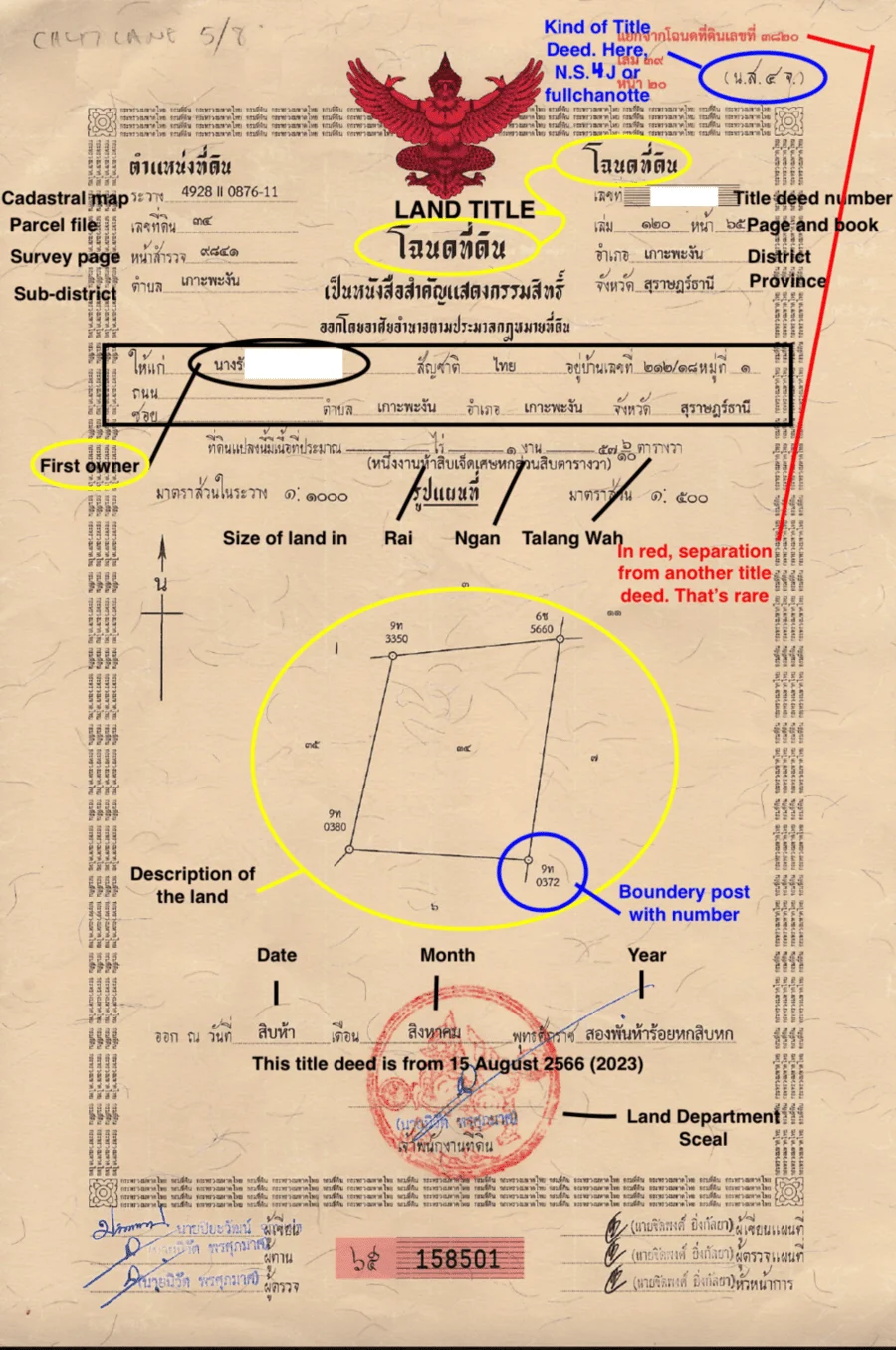
The colour of the Garuda tells you the deed type. A red Garuda is a Chanote (Nor Sor 4 Jor), the strongest title, surveyed by precise GPS. A green Garuda is a “Nor Sor 3 (sam) Kor,” a weaker document whose boundaries were fixed from an aerial photograph rather than a ground survey, which is why the recorded area can shift when the plot is later surveyed for a chanote. This title deed is Nor Sor 4 Jor (sometimes only called Nor Sor 4) and you see it on the upper right corner circled in blue. Also, the word “Chanote” appears translated to “title deed” in yellow circles. That is not written on Nor Sor 3 or Nor Sor 3 Kor. When you learn How to Read a Title Deed in Thailand, the type of title deed is crucial.
Most people recognize the drawing of the plot of land on the front page in the center. If you look closely, you’ll also see boundary posts with numbers (0372 is circled), often made of concrete and set in the soil.
At the top of this drawing, you’ll find the first owner’s name, nationality, and address, representing the initial owner when the title deed was created. The type of title deed is shown in the top right corner. Learning How to Read Title Deed in Thailand can provide you a wealth of information.
TITLE DEED NUMBER FOR A CHANOTTE IN THAILAND
I have hidden the title deed number and the first owner’s details for privacy, as title deeds are semi-public. Lawyers can search for and obtain copies with a valid reason, such as a lawsuit, divorce, or property auction.
If you see “S.P.K.,” on top right, be cautious. It stands for Sor Por Kor, and these title deeds cannot be purchased. Foreigners should never buy or build on a Sor Por Kor. I rather have a Por Bor Tor, which is agricultural land and the owner is the government. These are common in rural areas and the title deed is very different.
The law behind this page
English
Section 1 General Provisions
Full text
In this Code: “Land” means the land surface everywhere, and includes mountains, hills, streams, ponds, canals, swamps, marshes, waterways, lakes, islands and the sea coast. “Rights in land” means ownership, and includes possessory rights. “Pre-emption certificate” means the document showing authorisation of temporary occupation of land. “Certificate of use” means the document from the competent official certifying that the land has already been put to use. “Land particulars certificate” means the paper showing the inquiry for the purpose of issuing a title deed, and includes the plot identification slip. “Title deed” means the document showing ownership of the land, and includes a land title deed with map, a pre-emption title deed, and a pre-emption certificate stamped “ALREADY PUT TO USE”. “Survey” means the survey and recording of boundaries, or the computation of area, in order to determine the location of the boundary lines or the area of the land. “Land trading”: repealed by the Land Code Amendment Act (No.12), B.E. 2551 (2008). “Public body” means (1) central administration, provincial administration or local administration; (2) other agencies of the State which are not State enterprises. “Committee” means the Land Allocation Committee. “Competent official” means the official acting under this Code, and any other official appointed by the Minister to act under this Code. “Director-General” means the Director-General of the Department of Lands. “Minister” means the Minister having charge under the Act Promulgating the Land Code and under this Code.
ThaiLawOnline translation
Section 71 Recording of Rights and Legal Acts
Full text
A land official shall be a competent officer for right and juristic act registration concerning immovable properties under the Civil and Commercial Code for immovable properties located in the locality of such provincial land office or land branch office. If the provincial land office or land branch office has introduced information technology and communication system into right and juristic act registration, a land official shall also be a competent officer for right and juristic act registration concerning immovable properties under the Civil and Commercial Code through information technology and communication system for immovable properties located in a locality of other provincial land offices or land branch offices, except registration that requires an announcement or survey, in accordance with the rules and procedure prescribed and published by the Director-General in the Government Gazzette.55
Unofficial translation by the Office of the Council of State
Section 72 Recording of Rights and Legal Acts
Full text
For any person wishing to effect a right and juristic act registration concerning immovable properties under the Civil and Commercial Code, the parties shall bring a land right document to effect registration with the competent officer under Section 71. In applying for right and juristic act registration under paragraph one for land with a title deed, certificate of investigation (bai tai suan) or certificate or utilization, the parties may file an application with the competent officer at the Department of Lands or any land office for the competent officer under Section 71 to effect registration, except registration that requires an announcement or survey.
Unofficial translation by the Office of the Council of State
Section 63 Issuance of Documents Showing Rights in Land
Full text
The owner of land whose title deed is endangered, damaged or lost by any means whatsoever may apply for a substitute. After the substitute has been issued, the original title deed shall be cancelled unless otherwise ordered by the court. The above-mentioned provisions shall apply mutatis mutandis to the application for a substitute for a pre-emption certificate, certificate of utilization or certificate of investigation (bai tai suan).
Unofficial translation by the Office of the Council of State
Section 5 Sap Ing Sith Act B.E. 2562
Full text
On receiving an application to create a Sap Ing Sith under section 4, the competent official shall register the creation of the Sap Ing Sith on the land title deed or condominium unit title deed, as the case may be, and issue a Sap Ing Sith certificate. The Sap Ing Sith certificate shall be made in 2 counterparts, one given to the owner of the immovable property and the other kept at the competent official's office.
ThaiLawOnline translation
Section 4 Sap Ing Sith Act B.E. 2562
Full text
An owner of immovable property who wishes to create a Sap Ing Sith shall file an application with the competent official and present the land title deed or the condominium unit title deed, as the case may be. A Sap Ing Sith may have a term not exceeding 30 years. A Sap Ing Sith may not be created over only part of the immovable property under a land title deed or condominium unit title deed. A Sap Ing Sith over immovable property that is mortgaged, used as security under the law on business security, or subject to any right registered on the land title deed or condominium unit title deed may be created only with the written consent of the mortgagee, the security receiver or the holder of that right, as the case may be.
ThaiLawOnline translation
Section 12 Sap Ing Sith Act B.E. 2562
Full text
A Sap Ing Sith may be transferred, or used as security for the payment of a debt by mortgage under the Civil and Commercial Code. A Sap Ing Sith may pass by inheritance. Any juristic act concerning a Sap Ing Sith must be made in writing and registered with the competent official, and once it is registered the competent official shall promptly notify the owner of the immovable property in writing, in accordance with the types of juristic act and rules prescribed in a Ministerial Regulation.
ThaiLawOnline translation
Section 8 Sap Ing Sith Act B.E. 2562
Full text
A sap ing sith is indivisible. Land over which a sap ing sith has been created may not be subdivided into several plots or amalgamated with another plot into a single plot.
ThaiLawOnline translation
ไทย
มาตรา 1
ข้อความเต็ม
ในประมวลกฎหมายนี้ “ ที่ดิน ” หมายความว่า พื้นที่ดินทั่วไป และให้หมายความรวมถึง ภูเขา ห้วย หนอง คลอง บึง บาง ลำน้ำ ทะเลสาบ เกาะ และที่ชายทะเลด้วย “ สิทธิในที่ดิน ” หมายความว่า กรรมสิทธิ์ และให้หมายความรวมถึงสิทธิครอบครองด้วย “ ใบจอง ” หมายความว่า หนังสือแสดงการยอมให้เข้าครอบครองที่ดินชั่วคราว “ หนังสือรับรองการทำประโยชน์ ” หมายความว่า หนังสือคำรับรองจากพนักงานเจ้าหน้าที่ว่าได้ทำประโยชน์ในที่ดินแล้ว “ ใบไต่สวน ” หมายความว่า หนังสือแสดงการสอบสวนเพื่อออกโฉนดที่ดิน และให้หมายความรวมถึงใบนำด้วย “ โฉนดที่ดิน ” หมายความว่า หนังสือสำคัญแสดงกรรมสิทธิ์ที่ดิน และให้หมายความรวมถึงโฉนดแผนที่ โฉนดตราจอง และตราจองที่ตราว่า “ ได้ทำประโยชน์แล้ว ” “ การรังวัด ” หมายความว่า การรังวัดปักเขต และทำเขต จด หรือคำนวณการรังวัด เพื่อให้ทราบที่ตั้งแนวเขตที่ดิน หรือทราบที่ตั้งและเนื้อที่ของที่ดิน “ การค้าที่ดิน ” (ยกเลิก) “ ทบวงการเมือง ” หมายความว่า (๑) ราชการส่วนกลาง ราชการส่วนภูมิภาค หรือราชการส่วนท้องถิ่น (๒) หน่วยงานอื่นของรัฐที่ไม่ใช่รัฐวิสาหกิจ “ คณะกรรมการ ” หมายความว่า คณะกรรมการจัดที่ดิน “ พนักงานเจ้าหน้าที่ ” หมายความว่า เจ้าพนักงานซึ่งเป็นผู้ปฏิบัติการตามประมวลกฎหมายนี้ และพนักงานอื่นซึ่งรัฐมนตรีแต่งตั้งให้ปฏิบัติการตามประมวลกฎหมายนี้ “ อธิบดี ” หมายความว่า อธิบดีกรมที่ดิน “ รัฐมนตรี ” หมายความว่า รัฐมนตรีผู้รักษาการตามพระราชบัญญัติให้ใช้ประมวลกฎหมายที่ดิน และตามประมวลกฎหมายนี้
ตรงตามข้อความในราชกิจจานุเบกษา / สำนักงานคณะกรรมการกฤษฎีกา (Verbatim from the Royal Gazette / Office of the Council of State)
มาตรา 71
ข้อความเต็ม
ให้เจ้าพนักงานที่ดิน เป็นพนักงานเจ้าหน้าที่จดทะเบียนสิทธิและนิติกรรมเกี่ยวกับอสังหาริมทรัพย์ตามประมวลกฎหมายแพ่งและพาณิชย์ สำหรับอสังหาริมทรัพย์ที่อยู่ในเขตท้องที่สำนักงานที่ดินจังหวัดหรือสำนักงานที่ดินสาขานั้น ในกรณีที่สำนักงานที่ดินจังหวัดหรือสำนักงานที่ดินสาขาได้นำระบบเทคโนโลยีสารสนเทศและการสื่อสารมาใช้ในการจดทะเบียนสิทธิและนิติกรรมแล้ว ให้เจ้าพนักงานที่ดินเป็นพนักงานเจ้าหน้าที่จดทะเบียนสิทธิและนิติกรรมเกี่ยวกับอสังหาริมทรัพย์ตามประมวลกฎหมายแพ่งและพาณิชย์โดยระบบเทคโนโลยีสารสนเทศและการสื่อสารสำหรับอสังหาริมทรัพย์ที่อยู่ในเขตท้องที่สำนักงานที่ดินจังหวัดหรือสำนักงานที่ดินสาขาอื่นได้ด้วย เว้นแต่การจดทะเบียนที่ต้องมีการประกาศหรือต้องมีการรังวัดทั้งนี้ ตามหลักเกณฑ์และวิธีการที่อธิบดีประกาศกำหนดในราชกิจจานุเบกษา
ตรงตามข้อความในราชกิจจานุเบกษา / สำนักงานคณะกรรมการกฤษฎีกา (Verbatim from the Royal Gazette / Office of the Council of State)
มาตรา 72
ข้อความเต็ม
ผู้ใดประสงค์จะจดทะเบียนสิทธิและนิติกรรมเกี่ยวกับอสังหาริมทรัพย์ตามประมวลกฎหมายแพ่งและพาณิชย์ ให้คู่กรณีนำหนังสือแสดงสิทธิในที่ดินมาขอจดทะเบียนต่อพนักงานเจ้าหน้าที่ตามมาตรา ๗๑ การขอจดทะเบียนสิทธิและนิติกรรมตามวรรคหนึ่ง สำหรับที่ดินที่มีโฉนดที่ดิน ใบไต่สวนหรือหนังสือรับรองการทำประโยชน์ คู่กรณีอาจยื่นคำขอต่อพนักงานเจ้าหน้าที่ ณ กรมที่ดิน หรือสำนักงานที่ดินแห่งใดแห่งหนึ่ง เพื่อให้พนักงานเจ้าหน้าที่ตามมาตรา ๗๑ ดำเนินการจดทะเบียนให้ เว้นแต่การจดทะเบียนที่ต้องมีการประกาศหรือต้องมีการรังวัด
ตรงตามข้อความในราชกิจจานุเบกษา / สำนักงานคณะกรรมการกฤษฎีกา (Verbatim from the Royal Gazette / Office of the Council of State)
มาตรา 63
ข้อความเต็ม
โฉนดที่ดินของผู้ใดเป็นอันตราย ชำรุด สูญหายด้วยประการใด ให้เจ้าของมาขอรับใบแทนโฉนดที่ดินนั้นได้ เมื่อได้ออกใบแทนไปแล้ว โฉนดที่ดินเดิมเป็นอันยกเลิก เว้นแต่ศาลจะสั่งเป็นอย่างอื่น สำหรับการขอใบแทนใบจอง หนังสือรับรองการทำประโยชน์หรือใบไต่สวน ให้นำความดังกล่าวข้างต้นมาใช้บังคับโดยอนุโลม
ตรงตามข้อความในราชกิจจานุเบกษา / สำนักงานคณะกรรมการกฤษฎีกา (Verbatim from the Royal Gazette / Office of the Council of State)
มาตรา 5 พระราชบัญญัติทรัพย์อิงสิทธิ พ.ศ. 2562
ข้อความเต็ม
เมื่อได้รับคำขอก่อตั้งทรัพย์อิงสิทธิตามมาตรา ๔ ให้พนักงานเจ้าหน้าที่จดทะเบียนการก่อตั้งทรัพย์อิงสิทธิในโฉนดที่ดินหรือหนังสือกรรมสิทธิ์ห้องชุด แล้วแต่กรณี พร้อมทั้งออกหนังสือรับรองทรัพย์อิงสิทธิ หนังสือรับรองทรัพย์อิงสิทธิให้ทำเป็นคู่ฉบับรวมสองฉบับ มอบให้เจ้าของอสังหาริมทรัพย์ฉบับหนึ่งและอีกฉบับหนึ่งเก็บไว้ที่สำนักงานของพนักงานเจ้าหน้าที่
ตรงตามข้อความในราชกิจจานุเบกษา / สำนักงานคณะกรรมการกฤษฎีกา (Verbatim from the Royal Gazette / Office of the Council of State)
มาตรา 4 พระราชบัญญัติทรัพย์อิงสิทธิ พ.ศ. 2562
ข้อความเต็ม
เจ้าของอสังหาริมทรัพย์ผู้ใดประสงค์จะก่อตั้งทรัพย์อิงสิทธิ ให้ยื่นคำขอต่อพนักงานเจ้าหน้าที่พร้อมกับแสดงโฉนดที่ดินหรือหนังสือกรรมสิทธิ์ห้องชุด แล้วแต่กรณี ทรัพย์อิงสิทธิมีกำหนดเวลาได้ไม่เกินสามสิบปี การก่อตั้งทรัพย์อิงสิทธิเฉพาะบางส่วนในอสังหาริมทรัพย์ตามโฉนดที่ดินหรือหนังสือกรรมสิทธิ์ห้องชุดจะกระทำมิได้ การก่อตั้งทรัพย์อิงสิทธิในอสังหาริมทรัพย์ที่มีการจำนองหรือการใช้เป็นหลักประกันตามกฎหมายว่าด้วยหลักประกันทางธุรกิจ หรือมีสิทธิใด ๆ ที่จดทะเบียนอยู่ในโฉนดที่ดินหรือหนังสือกรรมสิทธิ์ห้องชุด ให้กระทำได้เมื่อได้รับความยินยอมเป็นหนังสือจากผู้รับจำนองหรือผู้รับหลักประกัน หรือผู้มีสิทธินั้น แล้วแต่กรณี
ตรงตามข้อความในราชกิจจานุเบกษา / สำนักงานคณะกรรมการกฤษฎีกา (Verbatim from the Royal Gazette / Office of the Council of State)
มาตรา 12 พระราชบัญญัติทรัพย์อิงสิทธิ พ.ศ. 2562
ข้อความเต็ม
ทรัพย์อิงสิทธิสามารถโอนให้แก่กัน หรือใช้เป็นหลักประกันการชำระหนี้โดยการจำนองตามประมวลกฎหมายแพ่งและพาณิชย์ได้ ทรัพย์อิงสิทธิสามารถตกทอดทางมรดกได้ การทำนิติกรรมใด ๆ เกี่ยวกับทรัพย์อิงสิทธิต้องทำเป็นหนังสือและจดทะเบียนต่อพนักงานเจ้าหน้าที่ และเมื่อมีการจดทะเบียนแล้วให้พนักงานเจ้าหน้าที่มีหนังสือแจ้งให้เจ้าของอสังหาริมทรัพย์ทราบโดยเร็ว ทั้งนี้ ตามประเภทนิติกรรมและหลักเกณฑ์ที่กำหนดในกฎกระทรวง
ตรงตามข้อความในราชกิจจานุเบกษา / สำนักงานคณะกรรมการกฤษฎีกา (Verbatim from the Royal Gazette / Office of the Council of State)
มาตรา 8 พระราชบัญญัติทรัพย์อิงสิทธิ พ.ศ. 2562
ข้อความเต็ม
ทรัพย์อิงสิทธิจะแบ่งแยกมิได้ ที่ดินที่มีการก่อตั้งทรัพย์อิงสิทธิจะแบ่งแยกออกเป็นหลายแปลงหรือรวมกับที่ดินแปลงอื่นเข้าเป็นแปลงเดียวกันไม่ได้
ตรงตามข้อความในราชกิจจานุเบกษา / สำนักงานคณะกรรมการกฤษฎีกา (Verbatim from the Royal Gazette / Office of the Council of State)
Français
Article 1
Définit notamment terrain (y compris montagnes, cours d'eau, lacs, îles, rivage), droits fonciers (propriété et droit de possession), bai chong, certificat d'utilisation, titre foncier (chanote), arpentage, organisme public, comité, agent compétent, directeur général et ministre.
résumé non officiel
Article 71
Le fonctionnaire foncier est compétent pour enregistrer les droits et actes immobiliers du Code civil et commercial dans le ressort de son bureau. Si le bureau est informatisé, il peut aussi le faire pour d'autres ressorts, sauf publication ou arpentage requis, selon les règles du directeur général.
résumé non officiel
Article 72
Pour enregistrer des droits et actes immobiliers, les parties présentent leur document de droit foncier au fonctionnaire de l'article 71; pour un chanote, procès-verbal d'enquête ou certificat d'utilisation, elles peuvent déposer la demande au Département des terres ou à tout bureau foncier, sauf enregistrement exigeant publication ou arpentage.
résumé non officiel
Article 63
Si le titre foncier (chanote) est détruit, endommagé ou perdu, le propriétaire peut en demander un duplicata; l'original est alors annulé, sauf décision contraire du tribunal. La règle s'applique par analogie au certificat de réservation, au certificat d'utilisation et au procès-verbal d'enquête.
résumé non officiel
Article 5 Sap Ing Sith Act B.E. 2562
Saisi d'une demande selon l'article 4, l'agent compétent enregistre le Sap Ing Sith sur le titre et délivre un certificat en deux exemplaires, l'un remis au propriétaire, l'autre conservé à son bureau.
résumé non officiel
Article 4 Sap Ing Sith Act B.E. 2562
Le propriétaire dépose sa demande avec le titre auprès de l'agent compétent. La durée n'excède pas 30 ans. La création ne peut porter sur une partie seulement de l'immeuble. Si l'immeuble est hypothéqué, grevé d'une sûreté ou d'un droit enregistré, le consentement écrit du titulaire est requis.
résumé non officiel
Article 12 Sap Ing Sith Act B.E. 2562
Le Sap Ing Sith est cessible, hypothécable selon le Code civil et commercial, et transmissible par succession. Tout acte juridique le concernant doit être écrit et enregistré auprès de l'agent compétent, qui en informe promptement le propriétaire par écrit.
résumé non officiel
Article 8 Sap Ing Sith Act B.E. 2562
Le sap ing sith est indivisible; le terrain sur lequel il est constitué ne peut être divisé en plusieurs parcelles ni réuni à une autre parcelle.
résumé non officiel
Sources
- Land Code, Office of the Council of State, retrieved 31 October 2026
- Sap Ing Sith Act B.E. 2562, retrieved 31 October 2026
Only Some Title Deeds are at the Land Department
Title deeds like Nor Sor 3 and higher are stored at the Land Department, while Sor Por Kor has its own office and Por Bor Tor 5 tax receipts, which are not title deeds at all, are kept by the local authority, such as the SAO, the amphur or tessaban. Searching for Por Bor Tor records is challenging due to their variety. Some older documents, such as chanotes issued long before the 1954 Land Code created the Nor Sor 3, can be over 100 years old and impressive in size. Difficult to read because old, mostly use Thai numbers, but even if a little different, they kept some characteritics. Meaning if you learn how to read title deed in Thailand, you will be able to read all of them.
Below the first owner’s details, you will find the size of the land listed in Rai, Ngan, and Talang Wah. For example, 1-2-32 means 1 Rai, 2 Ngan, and 32 Talang Wah. The date the title deed was issued is noted beneath the plot description. Some title deeds also indicate if the parcel was derived from a previous deed, which is uncommon. The province, district, sub-district, and land department numbers, such as the cadastral map, book, and page, are also included on both sides at the top. So when you see a title deed, you know which province and which land department.
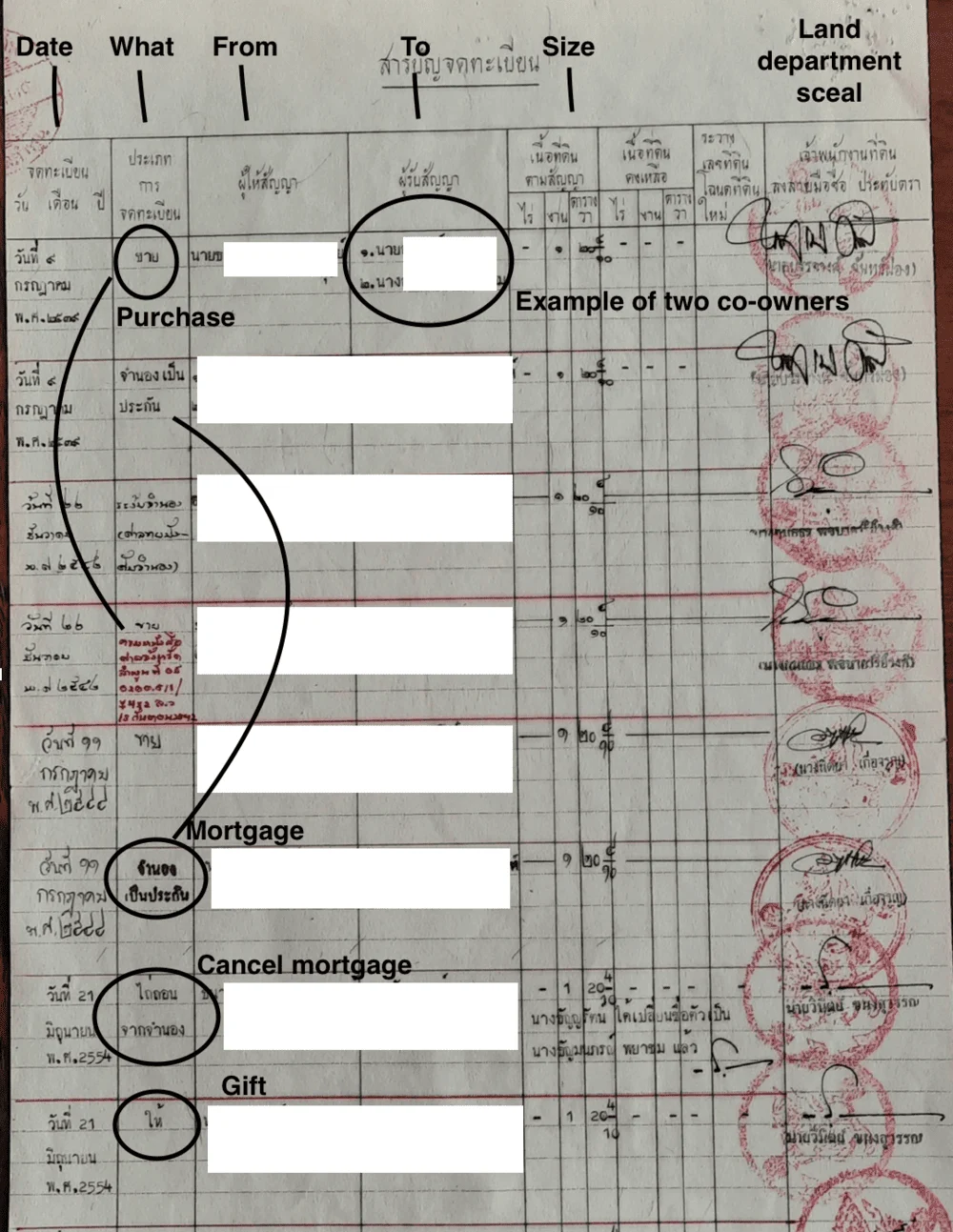
The second picture shows the back of a title deed, not the same one. I’ve also concealed names for privacy, although showing a title deed generally doesn’t violate privacy rights. The back resembles a table, documenting the chain of possession. The first column is the date, the second describes the action taken, and the third and fourth columns list the transferor and transferee, respectively. For instance, in a sale, the seller is in the third column and the buyer in the fourth. The subsequent columns show the land size, with numbers in Thai or regular numerals, followed by the Land Department’s seal to confirm the official transaction.
Frequently asked questions
Where do I find the type of a Thai title deed?
The type is printed in the top right corner of the front page. A chanote is Nor Sor 4 Jor, sometimes called Nor Sor 4, and the word for title deed appears on it. That word does not appear on a Nor Sor 3 or a Nor Sor 3 Kor.
What does the back of a chanote show?
A table recording the chain of possession: the date, the act registered (sale, mortgage, gift, lease, usufruct or superficies), the transferor, the transferee, the land size and the Land Department’s seal confirming the transaction.
Should a foreigner buy land with a Sor Por Kor document?
No. Sor Por Kor documents cannot be purchased, and foreigners should never buy or build on Sor Por Kor land.
Can a foreigner hold a Sap-Ing-Sith?
Yes. The Sap-Ing-Sith Act says nothing about nationality. It runs for up to 30 years with no statutory renewal, can be transferred, mortgaged and inherited without the landowner’s consent, and cannot be divided.
How to Read Title Deed in Thailand : The Back of a Chanote
In this example, you can see entries for purchase (Kay), mortgage (Jam Nong), or gift (Hai). When registering a lease, it will state “Chao Tee Din” (lease of land), while a usufruct is noted as “See Tee Kep Kin.” Superficies are “See Tee Nua Tee Din”.
Foreigner’s names can appear on title deeds, usually not as owners (though possible under certain exceptions) but often as usufructuary, lessee, mortgagee, superficiary or holders of other rights.
The most interesting document for me is the Sap-Ing-Sith certificate, and it is not a title deed. Under Section 5 of the Sap-Ing-Sith Act B.E. 2562 (2019) the right is registered on the chanote itself and the Land Office issues a separate certificate in two copies, one for the owner and one kept at the office. Section 4 allows a term of not more than 30 years, and the Act contains no provision for renewing or extending it, so a further 30 years is something you negotiate with the landowner and not something the statute gives you. The Act says nothing about nationality, which is why a foreigner can hold one, and Section 11 gives the holder the rights, duties and liabilities of an owner, except that the right to recover the property from someone with no right to hold it and the right to stop others interfering with it unlawfully stay with the landowner, whom the holder must tell promptly when either arises. Our law firm has registered more than four such deeds, and each time, the Land Department had never encountered one before. Some people will say it’s only temporary, but you do not have a lessor. Section 12 lets you transfer it, mortgage it under the Civil and Commercial Code and pass it on by inheritance, none of which needs the landowner’s consent. Section 8 is the limit worth knowing in advance: a Sap-Ing-Sith cannot be divided, and land carrying one cannot be split into several plots or merged into another.
A chanotte is a crucial document. If lost, the owner can request a new copy 30 days after filing a police report. Chanotes are often used as security for loans, but this is not very secure. Banks typically register a mortgage instead. Mortgage or rights registered will be on the back on a title deed. So if you know How to Read a Title Deed in Thailand you will see all the chain of possession.
Registration fees are set by Ministerial Regulation No. 47 (B.E. 2541) clause 2(7) under the Land Code, and the Department of Lands publishes the schedule. An act registered with no capital value costs 50 baht per parcel, which is the figure for a usufruct, a superficies or a servitude granted for nothing. Granted for consideration, those same real rights are charged 1 per cent under paragraph (ฏ). A lease is 1 per cent under paragraph (ฐ), with stamp duty of 0.1 per cent on top. A mortgage is 1 per cent, capped at 200,000 baht, and that cap is the part people forget on a large loan. A transfer with a capital value, a sale for instance, is 2 per cent of the appraised value. Sap-Ing-Sith is charged under its own regulation and not this one: creating it costs a flat 20,000 baht, the certificate 10,000, cancelling it another 20,000, a mortgage of it 1 per cent, and the 2 per cent applies only when it is transferred. The Cabinet reduces some of these rates from time to time, so confirm the figure at the Land Office on the day. If you want to buy real estate the chanote is the most important document. It is crucial to learn how to read title deed in Thailand.
- Title deeds in Thailand, the full list of land documents
- Due Diligence in Thailand
- Department of land, Thailand (official website, English and Thai)
Once you can read the deed, someone still has to check it against the Land Office register. That is title due diligence, and it is where most problems surface.
Do not want to read it yourself? The Title Deed Check (4,900 THB) gives you the certified Land Office copy, a field-by-field English translation and a two-page lawyer’s report within 3 business days.
Thai Law Updates, free by email
Plain-English updates on Thai law changes that affect foreigners: property, visas, marriage, business and wills. One short email a month from a firm practicing since 2006. No spam, unsubscribe anytime.