


Révisé par ThaiLawOnline, un cabinet d'avocats thaïlandais agréé exerçant en Thaïlande depuis 2006. Avocate thaïlandaise en charge du dossier : Wichuda Atthamethakon, LL.M., licence du barreau thaïlandais 3149/2556.
Dernière mise à jour :
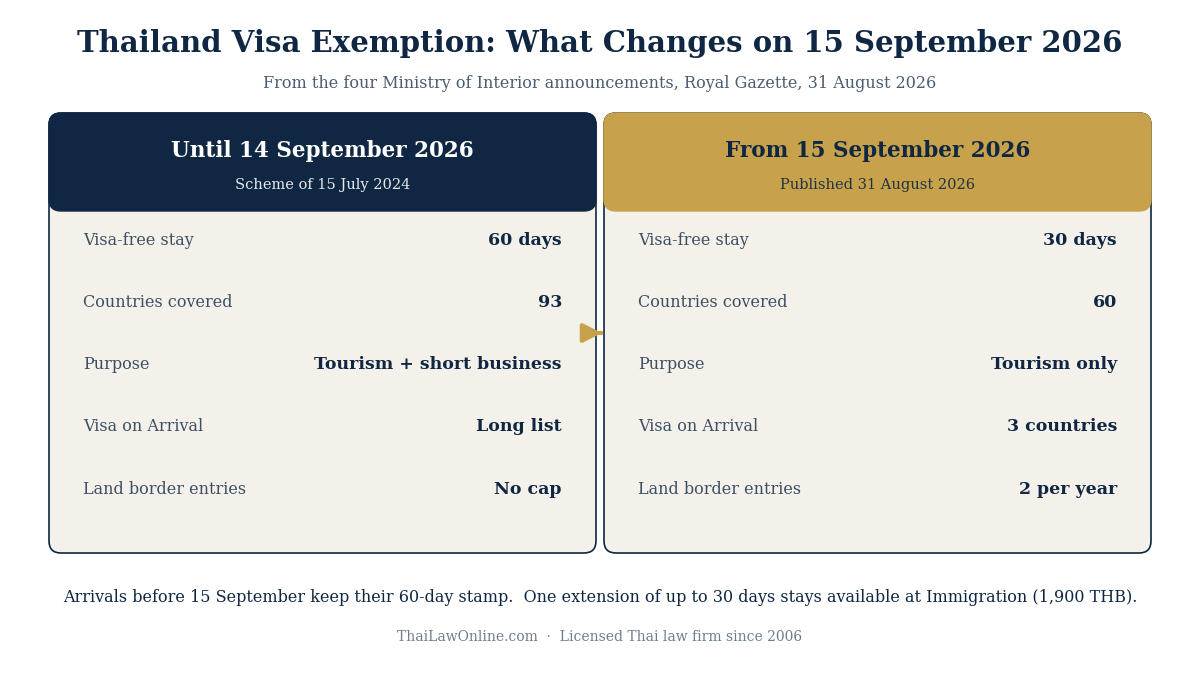
The Thailand 30 day exemption de visa is now law. On 31 August 2026, the Royal Gazette published the four Ministry of Interior announcements that end the 60 day visa exemption for 93 countries and replace it with a 30 day exemption for 60 countries and territories. Official Thai travel guidance states that the new entry rules apply from 15 septembre 2026. Travelers admitted before that date keep the 60 day stay stamped in their passport. This page reads the published instruments themselves, corrects the country counts that circulated all year, and explains what business visitors lose that no travel site has mentioned.
Table des matières
Ce que la Gazette royale a publié le 31 août 2026
Four Ministry of Interior announcements appeared together in the Royal Gazette (Volume 143, Special Part 207 Ngor), each dated 26 August 2026 and signed by Prime Minister and Interior Minister Anutin Charnvirakul. Read them yourself; no summary replaces the source:
- The repeal instrument: revokes the 60 day visa exemption measure of 15 July 2024 that covered 93 countries and territories, and formally repeals the earlier announcements of 4 March 2019 and 21 June 2022 (No. 2).
- The 30 day exemption list: 60 countries and territories, tourism only, 30 days per entry.
- The Visa on Arrival instrument: cuts the Visa on Arrival list to Azerbaijan, Belarus and Serbia.
- The 15 day exemption: a shorter visa free stay for Mauritius and Seychelles.
The announcements rest on the visa exemption power under the Immigration Act B.E. 2522 (1979), the same framework that carried the 2024 scheme. Section 12(1) of the Act requires a visa for entry except as prescribed, and these instruments are the prescription.
Quand commence la règle des 30 jours ? Le compte à rebours de 15 jours expliqué
The Ministry of Interior announcements were published in the Royal Gazette on 31 August 2026. Official Thai travel guidance identifies 15 septembre 2026 as the start of the new visa-exemption arrangements. For travel planning, use the date of admission to Thailand, not the booking date or the date your flight departs. Read the official announcement.
The transition rule protects arrivals, and the logic is simple: the stamp fixes the right at entry. A traveler admitted on 14 September 2026 receives 60 days and keeps all of them. The repeal instrument contains no provision shortening a stay already granted; it has only two clauses, the repeal and the commencement. A traveler landing on 15 September 2026 receives 30 days. What counts is the date of admission, not the date of booking or departure.
La liste complète des exemptions de visa de 30 jours : 60 pays et territoires
Numbers between 54 and 93 circulated all year because briefings changed between May and July. The published list settles it at exactly 60. This is the final list from the Gazette text, in the official order:
| 1. Australie | 21. Islande | 41. Oman |
| 2. Autriche | 22. Indonésie | 42. Philippines |
| 3. Bahreïn | 23. Inde | 43. Pologne |
| 4. Belgique | 24. Irlande | 44. Portugal |
| 5. Bulgarie | 25. Israël | 45. Qatar |
| 6. Bhoutan | 26. Italie | 46. Roumanie |
| 7. Brunei Darussalam | 27. Japon | 47. Arabie saoudite |
| 8. Canada | 28. Jordanie | Singapour |
| 9. Croatie | 29. Koweït | 49. Slovaquie |
| 10. Chypre | 30. Kirghizistan | 50. Slovénie |
| 11. République tchèque | 31. Lettonie | 51. Afrique du Sud |
| 12. Danemark | 32. Liechtenstein | 52. Espagne |
| 13. Estonie | 33. Lituanie | 53. Suède |
| 14. Fidji | 34. Luxembourg | 54. Suisse |
| 15. Finlande | 35. Malte | 55. Taïwan |
| 16. France | 36. Malaisie | 56. Turquie |
| 17. Géorgie | 37. Maldives | 57. Ukraine |
| 18. Allemagne | 38. Pays-Bas | 58. Émirats arabes unis |
| 19. Grèce | Nouvelle-Zélande | 59. Royaume-Uni |
| 20. Hongrie | 40. Norvège | 60. États-Unis |
The list covers all 27 EU member states plus the United Kingdom, the United States, Canada, Australia, New Zealand and Japan. Croatia, Bulgaria, Cyprus, Malta and the Maldives joined compared with earlier drafts.
L'Inde a progressé, et non reculé
India’s position changed three times during the drafting cycle and the final answer surprised the aggregators. Early briefings proposed moving Indian passport holders to Visa on Arrival only. The published instruments do the opposite: India sits on the 30 day exemption list, off the Visa on Arrival track entirely. An Indian tourist from 15 September 2026 enters visa free for 30 days, extendable once at Immigration. Indian nationals planning longer stays or non tourism trips should read our guide to the Exigences de visa pour la Thaïlande pour les ressortissants indiens.
Qui a perdu l'accès sans visa et que faire à la place
Roughly a third of the old 93 country list did not survive, including China, Russia, Cambodia, Laos, Vietnam, Hong Kong, Macau, Mongolia, Kazakhstan, Mexico, Guatemala, Cuba and the South American countries added in 2024. Being dropped does not automatically mean a visa is required, because bilateral agreements are untouched by the reform. South Korea, Brazil, Argentina, Chile and Peru keep 90 days by treaty. China and Russia keep 30 days under their agreements, as do Hong Kong, Macau, Laos, Vietnam and Mongolia under theirs, and Cambodia and Myanmar keep 14 days (Myanmar by air only). The architecture is one country, one entitlement: check the exemption list first, then the treaty, then apply for a visa.
Nationals of a dropped country with no bilateral agreement must apply through the Thai e-Visa system, normally for the 60 day tourist visa (TR). Our Recherche de visa thaïlandais answers the question for your nationality on the day you travel, and our Thailand tourist visa guide walks through the TR application.
Le visa à l'arrivée est désormais limité à trois pays seulement
The Visa on Arrival list shrinks from a long roster to exactly three nationalities: Azerbaijan, Belarus and Serbia. Everyone else who used the VoA counter, including the 17 nationalities added in 2024, now needs either a bilateral entitlement or an e-Visa before boarding.
L'exemption de 15 jours : Maurice et Seychelles
A separate announcement gives Mauritius and Seychelles a 15 day visa free stay, a tier of their own below the 60 country list. Both countries sat on the general exemption list before the reform.
Frontières terrestres : le plafond de deux fois par année civile fait son retour
Visa exempt entries through land border checkpoints are capped at two per calendar year, and the count resets on 1 January. Nationals of Malaysia, Brunei Darussalam, Indonesia and Singapore are exempt from the cap, and the Interior Minister may designate more countries later. Arrivals at international airports are not capped by this rule. The cap restores the pre 2024 position and ends the course de frontière as a residence strategy for everyone else; we cover the practical effect in our article on limites des allers-retours frontaliers en Thaïlande. Remember that dépasser la durée de son séjour carries fines, detention and mise sur liste noire, explained in our guide to visa overstay in Thailand.
Tourisme uniquement : pourquoi les visiteurs d'affaires ne peuvent plus utiliser l'exemption
Here is the change the travel sites skipped. The 2024 scheme expressly covered tourism plus certain urgent business and short term work activities. The new 30 day exemption states its purpose as tourism. A consultant flying in for client meetings, a directeur attending a board session, a buyer inspecting a factory: each of them relied on the old wording, and that wording is gone.
The practical consequence from 15 September 2026: a business visitor from an exempt country still enters without a visa, but the entry is for tourism, and conducting business activities on it sits outside the stated purpose of the stay. The clean routes are the Visa d'affaires Non-B for work and extended business activity, or a tourist visa entry for a genuine holiday with an incidental meeting kept to what immigration practice tolerates. Companies bringing in staff or frequent visitors should treat 15 September as a compliance date, not a travel news item. Our office advises on the right category before the trip, which costs less than arguing at the airport.
What the Thai embassies published after the Gazette: extension, funds and the business question
Between 2 and 10 September 2026 the Thai missions abroad rewrote their visa-exemption pages, and they do not all say the same thing. We read the Washington, London and Copenhagen pages on 14 September 2026, next to the Ministry of Foreign Affairs press briefing of 3 September 2026 and the Tourism Authority of Thailand notice of 1 September 2026. Four points matter for travellers.
The extension is real, and discretionary. Le Royal Thai Embassy in Washington (page updated 10 September 2026) states that a visa-exempt stay can be extended for another period not exceeding 30 days and that the extension is solely at the discretion of the immigration officer. The Royal Thai Embassy in London says travellers may request an extension of stay for up to 30 days. The accurate description is therefore 30 days on entry, with a discretionary extension of up to 30 days, filed at an bureau d'immigration for 1,900 THB. Nobody is owed 60 days.
Carry proof of funds, accommodation and onward travel. Washington requires adequate cash of, or equivalent to, 20,000 baht per person or 40,000 baht per family. London lists proof of sufficient funds of 20,000 THB per person, proof of accommodation, and onward travel within 30 days. These checks are applied more often to repeat visitors than to first-time tourists, so frequent travellers should have all three ready at the counter.
The permitted purpose is described inconsistently. Le MFA briefing, the TAT notice and London describe the exemption as for tourism, London adding the words tourism purposes only. Washington describes it as for the purpose of tourism, business engagements or urgent work or ad-hoc work, and Copenhagen (updated 2 September 2026) says tourism and short-term business. That is an inconsistency between official sources, not between commentators. Until the Immigration Bureau publishes one reading, an embassy web page is no protection against a contrary view at the airport, at a provincial immigration office or during a workplace inspection. Anyone attending meetings or doing urgent work should use the Visa d'affaires Non-B or the correct work authorisation.
The two-entry limit is stated two ways. Le TAT notice and the Interior Ministry announcements confine the twice-per-calendar-year cap to land checkpoints. London states, without qualification, that eligible passport holders are allowed to enter under the scheme only twice within a calendar year. Do not treat a nationwide two-entry rule as settled, but expect a third visa-exempt entry in the same year to be questioned at any checkpoint, and hold a visa if repeated entry is part of the plan.
Practical checklist for every visa-exempt entry from 15 September 2026: passport valid six months, a completed Carte d'arrivée numérique Thaïlande, an onward ticket dated within 30 days, an accommodation booking, and 20,000 THB per person in cash or on an accessible card statement. Our Recherche de visa thaïlandais applies these rules to your nationality and travel dates.
Comment rester plus de 30 jours
The one time extension survives the reform. A visa exempt entry can be extended once, for up to 30 additional days, at a local bureau d'immigration for 1,900 THB. The extension rests on the standing extension framework under section 35 of the Immigration Act, and it remains discretionary. Do the arithmetic: 30 days at entry plus 30 days extended equals roughly the same 60 days the old scheme gave, at the cost of 1,900 THB and a morning at Immigration. A determined tourist loses convenience, not time in the country.
For anything longer, the established routes are unchanged: the 60 day tourist visa (TR) extendable by 30 days, the Visa DTV for remote workers and soft power activities, non immigrant visas followed by prolongations fondées sur la retraite or marriage, and the visa LTR for long term residents. Our Recherche de visa thaïlandais matches your situation to the right route, and our page on the 2026 visa changes tracks how the DTV fits the new landscape.
Historique : le dispositif des 60 jours (du 15 juillet 2024 au 14 septembre 2026)
For the record, this is the scheme the 30 day rule replaces. From 15 July 2024, Thailand allowed citizens of 93 countries and territories to enter visa free for 60 days, a jump from the previous 30 days for 57 nationalities, designed to push tourism recovery. An Electronic Travel Authorization was announced alongside it for December 2024, postponed repeatedly, and never launched. The arrival formality actually in use is the Carte d'arrivée numérique de Thaïlande (TDAC), mandatory since 1 May 2025. That chapter closes on 14 September 2026. Our immigration updates page logs each change as it lands, and the visa reform overview places this reform in the longer arc.
Foire aux questions
Does my 60 day stamp get cut short on 15 September 2026?
No. The stamp fixes your right at entry. If Immigration admitted you before 15 September 2026 with a 60 day stay, you keep every day of it. The repeal instrument removes the scheme for future arrivals and does not shorten stays already granted.
Is India visa exempt for Thailand now?
Yes. From 15 September 2026, Indian passport holders enter visa free for 30 days under the published exemption list. Earlier proposals to move India to Visa on Arrival did not survive into the final instruments.
How many times can I enter Thailand visa exempt through a land border?
Twice per calendar year, counted from 1 January. The cap applies to land checkpoints only; airport arrivals are not capped. Nationals of Malaysia, Brunei, Indonesia and Singapore are exempt from the cap.
Can I attend business meetings on the 30 day exemption?
The Royal Gazette instruments, the MFA briefing and the London embassy describe the exemption as for tourism, and the old scheme’s short term business language was not carried over. The Washington embassy page (10 September 2026) nevertheless lists business engagements and urgent or ad-hoc work, and Copenhagen says short-term business. Because official sources conflict, the safe route for meetings, negotiations or board attendance is a Non-B business visa, or advice on your specific activity before travel.
Can I still get 60 days in Thailand somehow?
Yes, two ways. Extend the 30 day exempt entry once by up to 30 days at Immigration for 1,900 THB, or apply for the 60 day tourist visa (TR) through the e-Visa system, which itself extends by 30 days. Longer stays need a visa category matched to your situation.
How much money do I need to show for the 30 day visa exemption?
The Thai embassies in Washington and London both state 20,000 THB per person, and Washington adds 40,000 THB per family, in cash or an equivalent. London also lists proof of accommodation and onward travel within 30 days. Officers do not ask every tourist, but they can, and repeat visitors are asked more often.
Can the 30 day visa-exempt stay be extended?
Yes, once, by up to 30 days, at an immigration office for 1,900 THB. The Washington and London embassy pages both confirm the extension and Washington states that it is solely at the discretion of the immigration officer. Plan on 30 days and treat the extension as an application, not an entitlement.
Conclusion
The 30 day visa exemption is published law with a fixed start date. Tourists from the 60 listed countries lose little beyond convenience: half the stay at entry, recoverable by one extension. The real changes hide in the details the aggregators skipped: the tourism only purpose that removes business visitors from the exemption, the land border cap that ends serial border runs, and a Visa on Arrival list reduced to three flags. If your travel, your stay or your business in Thailand touches any of those edges, réserver une consultation and get the category right before 15 September.
Actualités juridiques thaïlandaises, gratuites par courriel
Des informations claires et concises sur les changements législatifs thaïlandais concernant les étrangers : propriété, visas, mariage, affaires et testaments. Un court courriel par mois, envoyé par un cabinet d’avocats établi depuis 2006. Zéro spam, désabonnement possible à tout moment.