

Last updated on มิถุนายน 10, 2026
A couple in Toronto finds a child waiting in a Bangkok care home. They want to bring her home. The instinct is simple. The legal road is not.
Intercountry adoption in Thailand is a child-protection process first and a family process second. The state treats it as a serious intervention in a child’s life. So the rules are strict, the screening is real, and shortcuts are dangerous. This guide walks you through how the process actually works. You’ll learn who controls it, who qualifies, what the steps look like, and what an adopted child’s rights are once the paperwork is done.
We’ve guided foreign families through Thai family matters for years. Here’s the honest version, not the brochure version.
สารบัญ
Who Controls Adoption in Thailand
Two laws sit at the center. The first is the Child Adoption Act B.E. 2522 (1979), with its later amendments. The second is the Civil and Commercial Code, Sections 1598/19 to 1598/37. The Act handles the administrative machinery. The Code handles the private-law relationship between parent and child.
One agency runs the show. That’s the Department of Children and Youth, known as the DCY. It sits under the Ministry of Social Development and Human Security. Its Child Adoption Center is the operational unit you’ll deal with.
The Department of Children and Youth (DCY)
For foreign families, the DCY is the gatekeeper. It reviews applications, manages waiting lists, and proposes matches. It also acts as Thailand’s Central Authority under the Hague Convention. That last role matters more than most people realize. We’ll come back to it.
The DCY does not work alone. Licensed private child welfare organizations help with parts of the domestic process. But for intercountry cases, the DCY stays in control from start to finish.
The Child Adoption Board (CAB)
No intercountry adoption clears Thailand without Board approval. The Child Adoption Board reviews each case. It signs off on the match and the placement. The Board includes representatives from various government bodies plus qualified experts. The Director-General of the relevant department chairs it.
Think of the Board as the checkpoint. Your file can look perfect and still wait for its meeting. That’s normal. Build it into your expectations.
The Hague Convention and why it matters
Thailand is a party to the Hague Convention on Protection of Children and Co-operation in Respect of Intercountry Adoption. The Convention dates to 1993. It entered into force for Thailand in 2004. The DCY is the designated Central Authority.
Here’s what that means in plain terms. If you live in another Hague country, the adoption runs through two Central Authorities. Yours and Thailand’s. They talk to each other. They agree before the child moves. This is a safeguard against trafficking and against rushed, unsafe placements. It adds steps. It also protects everyone, including you.
Quick point. The Hague Adoption Convention is not the same treaty as the Hague Child Abduction Convention. People mix them up constantly. They cover different problems. This guide is about adoption.
Thailand Adoption Requirements: Who Can Adopt
Thai law sets clear baselines. Your home country adds its own. You must clear both. Let’s start with the Thai side.
Age and the 15-year gap
Section 1598/19 of the Civil and Commercial Code is the anchor. The adopter must be at least 25 years old. The adopter must also be at least 15 years older than the child. Both conditions apply together. There’s no waiver for being a great parent on paper.
The official intercountry guidelines repeat this. You must be 25 or older. And you must be eligible to adopt a foreign child under your own country’s law. Miss either test and the file stops.
Consent: the part people underestimate
Consent rules run through several sections of the Code. They protect the child and the birth family. Read them as a system, not a checklist.
- The birth parents. If the child is a minor, the parents’ consent is generally required. If one parent has died or lost parental power, the other consents (Section 1598/21).
- The child. A child aged 15 or over must consent to their own adoption (Section 1598/20). Their voice counts.
- When consent is refused unfairly. Say a parent or guardian withholds consent without good reason. If that harms the child, the Public Prosecutor can ask the court to allow the adoption (Section 1598/22).
- Your spouse. A married applicant needs the consent of their spouse (Section 1598/25). If the spouse cannot consent or has vanished for at least a year, you petition the court instead.
One more rule trips people up. A child who is already someone’s adopted child cannot be adopted by a second person at the same time. The only exception is adoption by the adopter’s spouse (Section 1598/26). That’s the stepparent route.
Single applicants, couples, and stepparents
Married couples are the typical intercountry applicants. Both spouses must consent and usually both are assessed. Single people can be considered too. But suitability gets judged hard, and your home country’s rules may be stricter than Thailand’s.
Stepparent adoption is a different animal. That’s when you adopt your Thai spouse’s biological child. It’s common in Thai-foreign families. It still needs consent and review, and it’s not a rubber stamp. If that’s your situation, our Thai family law team can map the exact steps for your case.
Domestic vs Intercountry Adoption
Not every adoption is intercountry. The label depends on where the adoptive parents live, not just their nationality. A foreigner legally resident in Thailand may use the domestic track. A foreigner living abroad uses the intercountry track. The difference changes everything about the process.
| คุณสมบัติ | Domestic adoption | Intercountry adoption |
|---|---|---|
| Who it covers | Thai nationals, or foreigners legally resident in Thailand | Foreign nationals living abroad, or Thais living abroad |
| Entry point | DCY or district office, or a licensed child welfare organization | Your home country’s Central Authority, then the DCY |
| Two-country coordination | Usually none | Required under the Hague Convention |
| Board approval | Child Adoption Board | Child Adoption Board, with extra international scrutiny |
| Placement period | Supervised test-of-custody period, often around six months | Supervised placement plus post-placement reports |
| Private/direct adoption | Limited and supervised | Prohibited. Must go through government channels |
| Finalization | Thai authorities and registration | Court order and registration, coordinated with the receiving country |
Notice the bottom row. For intercountry cases, there is no legal “private” route. Anyone offering you a fast, off-the-books placement is offering you trouble. Walk away.
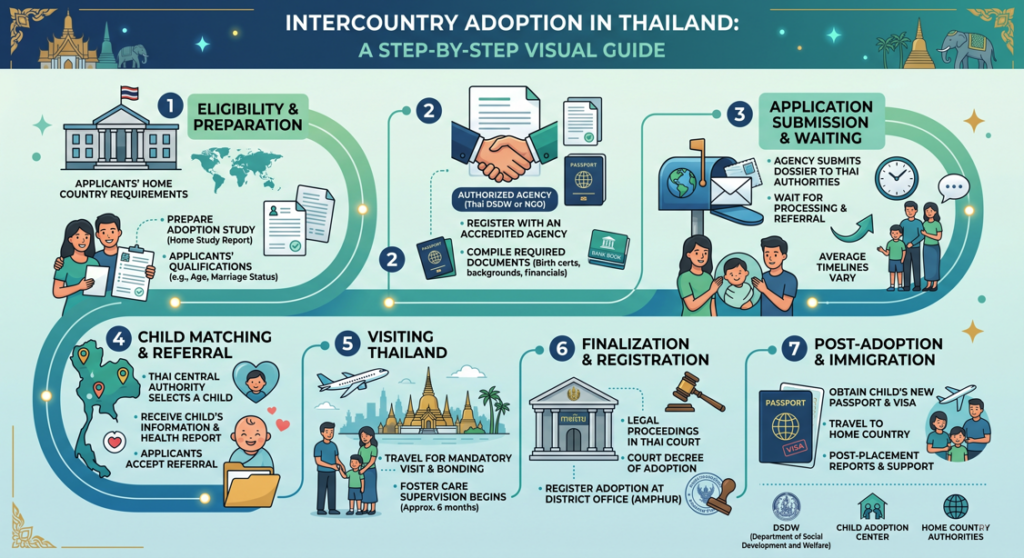
The Intercountry Adoption Process, Step by Step
Intercountry Adoption in Thailand: Overview
The full path is long. It’s also logical once you see it laid out. Here’s the sequence for a typical Hague-country applicant.
- Apply at home first. You start in your own country. You apply through its Central Authority or an accredited adoption agency. You complete a home study. A social worker assesses your home, finances, health, and readiness.
- Your country confirms eligibility. Once approved, your authority certifies that you’re eligible to adopt. It forwards your file to Thailand’s DCY. This is the Hague handshake.
- The DCY reviews and lists you. The Child Adoption Center checks your application. If it’s complete, you join the waiting list. Patience starts here.
- Matching. The DCY proposes a child whose needs fit your family. You receive the child’s background and medical information. This is the heart of the process. It cannot be rushed.
- You accept the match. If you accept, both Central Authorities agree to continue. The Hague rules require this joint agreement before anything moves forward.
- The Child Adoption Board approves. The Board reviews and approves the proposed placement. This is a hard gate, not a formality.
- Pre-adoption placement. The child is placed with you for a supervised trial period. Social workers monitor the bond. Reports are filed. This protects the child and confirms the fit.
- Finalization. The adoption is completed by court order and registration. An adoption certificate is issued and recorded at the district office (amphur). Depending on your country, the legal finalization may happen in Thailand or be completed at home.
- Immigration and travel. The child needs the right visa to enter and live in your country. Coordinate this early with your embassy. Nationality follows your country’s law, not the Thai adoption.
- Post-placement reports. You report back to the DCY at set intervals after the child arrives. This continues for a period after placement.
From experience: the two stages that surprise families are matching and the placement period. Both depend on the child’s welfare, not your calendar. Clients who accept that early have a far smoother time than those who treat the process like a transaction.
Documents You’ll Need
The paperwork is heavy. Most of it is generated in your home country, then legalized for use in Thailand. The exact list varies by country and case. The table below covers the core set.
| เอกสาร | หมายเหตุ |
|---|---|
| Application form | Filed through your Central Authority or accredited agency |
| Home study report | Prepared by a licensed social worker in your country |
| Certificate of eligibility to adopt | From the competent authority in your home country |
| Marriage certificate | Translated and legalized (for married applicants) |
| Birth certificates and passports | Certified copies, with translations |
| Medical certificates | For each applicant |
| Proof of income and employment | Evidence of financial stability |
| Police clearance certificate | Criminal background check for each applicant |
| ภาพถ่าย | Of the applicants and the family home |
| Commitment to post-placement reports | A written undertaking to file progress reports |
Two rules apply to almost all of it. Documents not in English or Thai need certified translation. And original documents plus translations usually need verification through the Royal Thai Embassy or Consulate, or legalization via the Ministry of Foreign Affairs. Get this wrong and your file bounces. We see it happen often.
Costs and Timeline: The Honest Version
Nobody likes vague answers on money and time. So here’s the real shape of it. The Thai government’s own processing fees are modest. The big costs sit elsewhere: your home-country agency, document legalization, translation, and travel.
| รายการ | What to expect |
|---|---|
| Thai government processing | Administrative fees are low. Confirm the current schedule with the DCY |
| Home-country agency fees | Usually the largest cost. Set abroad, not in Thailand |
| Translation and legalization | Varies with the number of documents |
| Travel to Thailand | For placement and any required appearances |
| Legal and advisory support | ThaiLawOnline consultations are THB 2,000 per hour |
| Overall timeline | Commonly 18 months to 3 years, end to end |
That timeline is not padding. Matching alone can take many months. The supervised placement adds more. Anyone promising you a child in a few weeks is not describing a legal adoption. Be skeptical of speed.
After the Adoption: Nationality, Inheritance, and Reporting
The court order is not the finish line. Three issues follow you home. Get ahead of all three.
Does adoption give the child citizenship?
No, not automatically. A Thai adoption does not hand your child a passport from your country. Citizenship outcomes depend on the receiving country’s law. This is exactly why immigration advice belongs at the start, not the end. The child needs lawful entry and status in your country. Plan it in parallel with the adoption, not after.
What does the adopted child inherit?
Once registered, the adopted child holds the same status as a legitimate child of the adopter. That includes inheritance rights under Thai law. Here’s the part many parents miss. The adopted child does not lose inheritance rights in their birth family. They keep both. If you hold assets in Thailand, this affects your estate planning. Our Last Will service in Thailand can make sure your wishes line up with the new family structure.
Post-placement reports
You agreed to report back. So follow through. After the child arrives, you file progress reports with the DCY at set intervals, often every six months, for a defined period. A social worker in your country usually prepares them. These reports assess the child’s adjustment and wellbeing. Skipping them can affect future applications and damages Thailand’s trust in the whole system. Treat them as part of the commitment, because they are.
Red Flags and Ethical Safeguards
Adoption attracts good people. It also attracts bad actors. The Hague framework exists because some intercountry adoptions, in the past, slid into child laundering and trafficking. Protect yourself and the child by knowing the warning signs.
- Anyone who offers a “private” intercountry placement that bypasses the DCY. This is not allowed.
- Pressure to pay large, unexplained, or off-the-record fees.
- Vagueness about the child’s true history, or pressure to falsify it.
- A push to skip the home study, the matching process, or the placement period.
- Refusal to put fees and procedures in writing.
The safeguards are simple to state. Licensed agencies. Full disclosure of the child’s history. Documented consents. Transparent accounting. Central-authority coordination. If any of those is missing, stop and get advice. A delayed adoption is recoverable. A corrupt one is not.
คำถามที่พบบ่อย
Can a foreigner adopt a child in Thailand?
Yes. Foreigners can adopt Thai children. The process is stricter than for Thai nationals. Intercountry cases run through the DCY and your home country’s Central Authority. Private or direct foreign adoptions are not permitted.
What are the age requirements to adopt in Thailand?
You must be at least 25 years old. You must also be at least 15 years older than the child. That comes from Section 1598/19 of the Civil and Commercial Code. A child aged 15 or older must consent too.
How long does intercountry adoption from Thailand take?
Plan for 18 months to 3 years. Matching and the supervised placement period take the most time. Timelines vary by case and by your home country.
Does adoption in Thailand give the child citizenship?
No, not on its own. Nationality depends on the receiving country’s law. Get immigration advice early so the child can legally enter and live in the adoptive country.
Does an adopted child inherit under Thai law?
Yes. After registration, the adopted child has the same status as a legitimate child, including inheritance rights. The child also keeps inheritance rights in their birth family.
Can a single person adopt a child in Thailand?
It’s possible. Single applicants are assessed closely by the Child Adoption Board. Your home country’s rules may be stricter. Married applicants need spousal consent under Section 1598/25.
Is private or independent adoption allowed for foreigners?
No. For intercountry cases, you must go through government channels. Any offer of a private placement that skips the DCY is a serious red flag.
ThaiLawOnline สามารถช่วยเหลือคุณได้อย่างไร
Intercountry adoption is one of the most rewarding things a family can do. It’s also one of the most procedure-heavy areas of Thai family law. Small document errors cause big delays.
We act as your point of contact on the Thai side. We coordinate with the DCY, prepare and check your Thai documents, advise on consent and the Civil and Commercial Code, and help align your Thai adoption with your estate planning and immigration needs. Everything is handled remotely, by email, phone, video, and LINE or WhatsApp, so distance is never the obstacle.
Start with a consultation. Explore our full range of legal services, read more on Thai family law for expats, หรือ book a family law consultation with our team today.
ประเด็นสำคัญ
- Intercountry adoption in Thailand is governed by the Child Adoption Act B.E. 2522 and the Civil and Commercial Code, Sections 1598/19 to 1598/37.
- The Department of Children and Youth is the Central Authority. It controls every intercountry case.
- You must be at least 25 and at least 15 years older than the child (Section 1598/19).
- The Hague Convention requires both countries to coordinate before a child can move.
- There is no legal private route for foreign intercountry adoption. Avoid anyone who offers one.
- Expect 18 months to 3 years. Matching and placement drive the timeline.
- Adoption does not grant citizenship. The adopted child does gain full inheritance rights under Thai law.