


A Thai law firm for foreigners since 2006. 5,000+ client matters. Thai lawyer of record: Wichuda Atthamethakon, LL.M., Thai Bar Licence 3149/2556. English, Thai and French. We answer within 24 hours.
Reviewed by ThaiLawOnline, a licensed Thai law firm practising in Thailand since 2006. Thai lawyer of record: Wichuda Atthamethakon, LL.M., Thai Bar Licence 3149/2556.
Last updated on
Answer a guided questionnaire and download a finished bilingual usufruct agreement, in English and Thai, formatted for signature. Ten lawyer-drafted documents are included, from wills and leases to loans and prenuptial agreements. Watch how it works in 49 seconds.
ตอบคำถามทีละขั้น แล้วดาวน์โหลดสัญญาฉบับสมบูรณ์สองภาษา
Open full screen ↗ · Gold is THB 5,800 for the year, all ten documents / สมาชิก Gold ปีละ 5,800 บาท ครอบคลุมเอกสารทั้งสิบฉบับ
เขียนโดยผู้มีประสบการณ์สิทธิเก็บกินกว่า 20 ปี เซบาสเตียน เอช. บรูสโซ ผู้เผยแพร่คู่มือสิทธิเก็บกินรายแรก ๆ ของไทยตั้งแต่ปี 2551
Usufruct (known in Thai as สิทธิเก็บกิน, or sitthi kep kin) is a real property right under Thai law. It gives one person the right to possess, use, and collect income from property owned by someone else. The Thai Civil and Commercial Code (CCC) covers this in Sections 1417 to 1428.
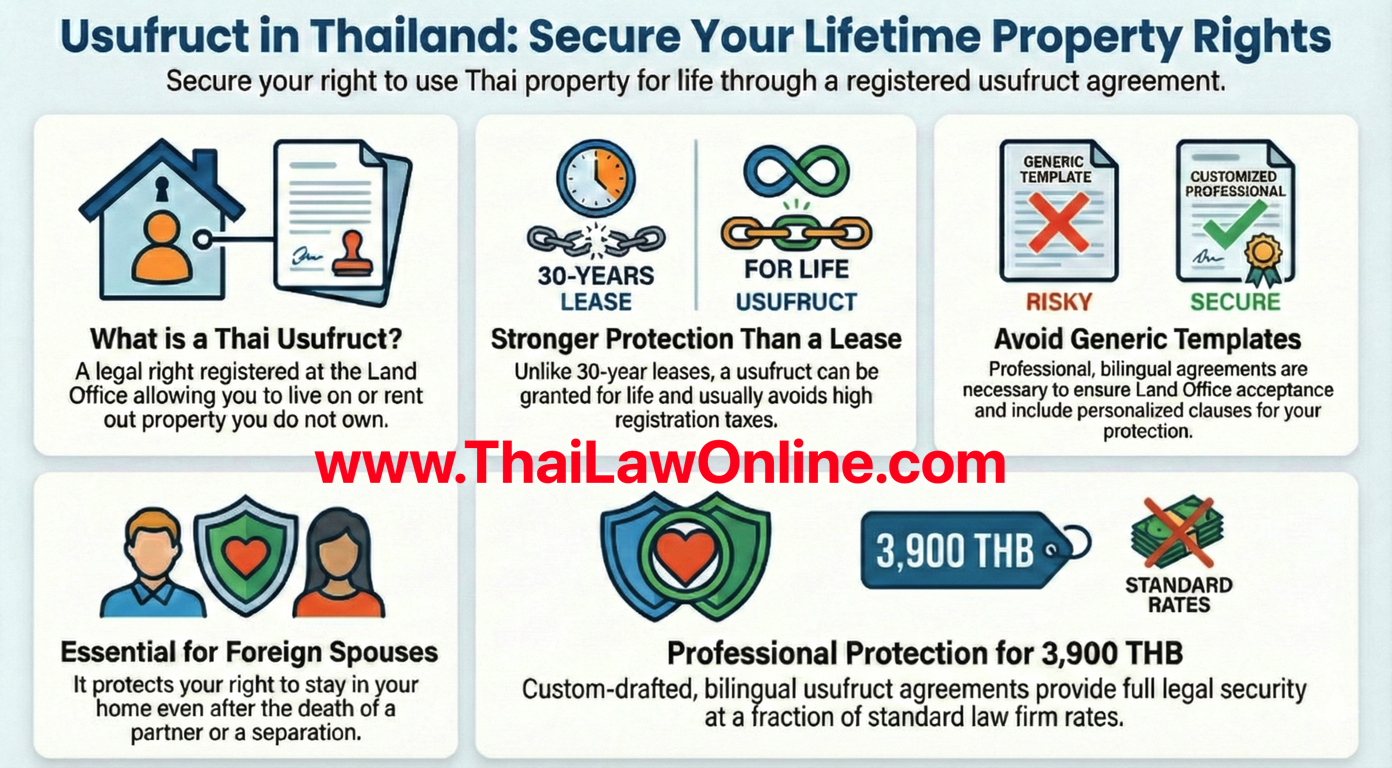
Usufruct separates ownership from use. The usufructuary gets the benefits of the property. The landowner keeps bare legal title. For foreigners in Thailand, usufruct is one of the strongest legal tools available. Foreigners cannot own land under the Land Code Act B.E. 2497. A registered usufruct lets a foreign national legally occupy and enjoy property for their entire lifetime. The right is enforceable against the whole world, including any future buyers of the land.
🎧 Listen to Our Usufruct Agreement Explanation
If you prefer listening, you can hear a short podcast explaining usufruct agreements in Thailand. Click below to play:
Your usufruct agreement, prepared in Thai and English
Our 3,900 THB drafting service includes a personalised bilingual agreement and guidance for Land Office registration. The usual drafting period is five to seven working days after we receive payment and complete instructions.
- Bilingual usufruct agreement and registration guidance฿3,900Personalised Thai-English usufruct agreement with Land Office registration guidance. First draft usually within five to seven working days after payment and complete instructions. Land Office attendance and completed registration are not included in this drafting promise.See what is included
Drafting the agreement and completing registration are separate steps. This service provides the documents and registration guidance. Do not assume the quoted drafting fee includes a lawyer attending the Land Office or a guaranteed registration outcome.
Before ordering, tell us where the property is located and whether the owner has already checked the proposed registration with the local Land Office.
What should I prepare?
Send copies of both sides of the title deed, identification for the owner and intended usufructuary, the owner’s Tabien Baan, your current address, and any official document showing your name in Thai. Explain any special conditions you want included.
Read our Land Office registration guide before arranging an appointment. For advice about your particular property, book a consultation.
Not sure which one fits? Book a 2,000 baht consultation and we credit it against your fee if you go ahead.
🎬 Watch: How a Usufruct Is Registered
A 50 second animated walkthrough of the Land Office registration, from the documents you bring to the endorsement written on the title deed. English with Thai, no sound needed.
ภาพเคลื่อนไหวสรุปขั้นตอนการจดทะเบียนสิทธิเก็บกินที่สำนักงานที่ดิน
Open full screen ↗ · best on a phone in landscape / ดูเต็มหน้าจอ
This guide covers the complete legal framework. You’ll find the full text of every relevant CCC section in both Thai and English. You’ll see analysis of landmark Supreme Court decisions. And you’ll get practical guidance from nearly two decades of practice.
Table of Contents
Last reviewed: 3 September 2026. The twelve sections of the Civil and Commercial Code reproduced below, 1417 to 1428, were replaced in this review. They were checked against our own annotated Code, which is the text served at the section links in each heading, and the earlier version did not match it: from Section 1419 onward the numbering had slipped, so rules were published under the wrong section numbers and the Thai beneath them was not the Code’s wording. Four provisions that the chapter actually contains were missing altogether: the transfer of the exercise of the right (1422), the owner’s right to demand security and ask for a receiver (1423), insurance (1427), and the one-year limitation period after the usufruct ends (1428). Every section here is now the Code text in English and Thai. Sections 148, 535, 538, 540, 569, 1403, 1411, 1412, 1476 and 1480 were read for the passages that rely on them.
The eight Supreme Court decisions cited further down were each read in Thai to their disposition. Six stand exactly as published: 15033/2555, 2297/2541, 4446/2543, 1516/2525, 7341/2542 and 2783/2516, as do 2651/2543 and 10344/2551 in the estate-planning section. Two were rewritten because the judgment does not say what the page said: 3019/2528, which holds that suing a tenant is management of the property under Section 1417 and decides nothing about leasing or the three-year rule, and 575/2560, whose ratio is the order of events rather than substance over form. 4655/2566 was corrected in the same way. The claim that our decisions database holds 64 judgments from 1936 to 2022 was checked and is exact.
What this review does not cover, said rather than implied. The Land Office figures, timings and the July 2026 note on which offices are refusing registrations are practice, gathered from our own files, and no statute fixes them. The statement that no transfer tax arises when a usufruct ends on death is a revenue position that was not re-verified here. The fees, the testimonials and the comparison of our template with others are commercial statements, not legal ones. And two obvious typographical slips in our own library’s English of Section 1419 were corrected as they were carried across; the Thai, which governs, was reproduced exactly.
What Is a Usufruct. (Definition for Non-Lawyers)
The Simple Explanation
Think of usufruct as the right to live in, use, and profit from property you do not own. The simplest analogy for readers from common law countries (Canada, the United States, the United Kingdom, or Australia) is the life estate. One person has the right to live on and benefit from property for their lifetime. After that, it goes back to the owner.
In civil law systems. France, Quebec, Germany, and Thailand have all adopted usufruct. The Thai Civil and Commercial Code of B.E. 2468 (1925) included it. The code was heavily influenced by European civil codes.
If you want to see a usufruct in Thailand visually explained in simple terms, click here.
Usufruct vs. Ownership. What You Actually Get
A usufructuary receives three core rights under Section 1417 of the CCC.
| Right | What It Means in Practice | What You Cannot Do |
|---|---|---|
| Possession (ครอบครอง) | Live on the land, occupy the house, control access | Sell the property |
| Use (ใช้) | Farm the land, operate a business, use it personally | Destroy or radically change the property |
| Enjoyment of Fruits (ถือเอาซึ่งประโยชน์) | Collect rent, harvest crops, receive all income | Bequeath the usufruct in a will |
The usufructuary also has the power to manage the property (อำนาจจัดการทรัพย์สิน). This includes the right to lease the property, collect rent, and file lawsuits. For example, you can evict tenants. You don’t need the landowner’s permission. The Supreme Court has confirmed this many times (see our analysis of 64 Supreme Court decisions).
By its nature, a usufruct is temporary and often arises from family relationships. Civil Law traditionally divides property rights into three components:
- Usus: The right to use or possess the property.
- Fructus: The right to benefit from the property’s “fruits,” such as crops or rental income (as clarified in Section 148).
- Abusus: The right to dispose of the property (sell, transfer, or even destroy it), which is full ownership.
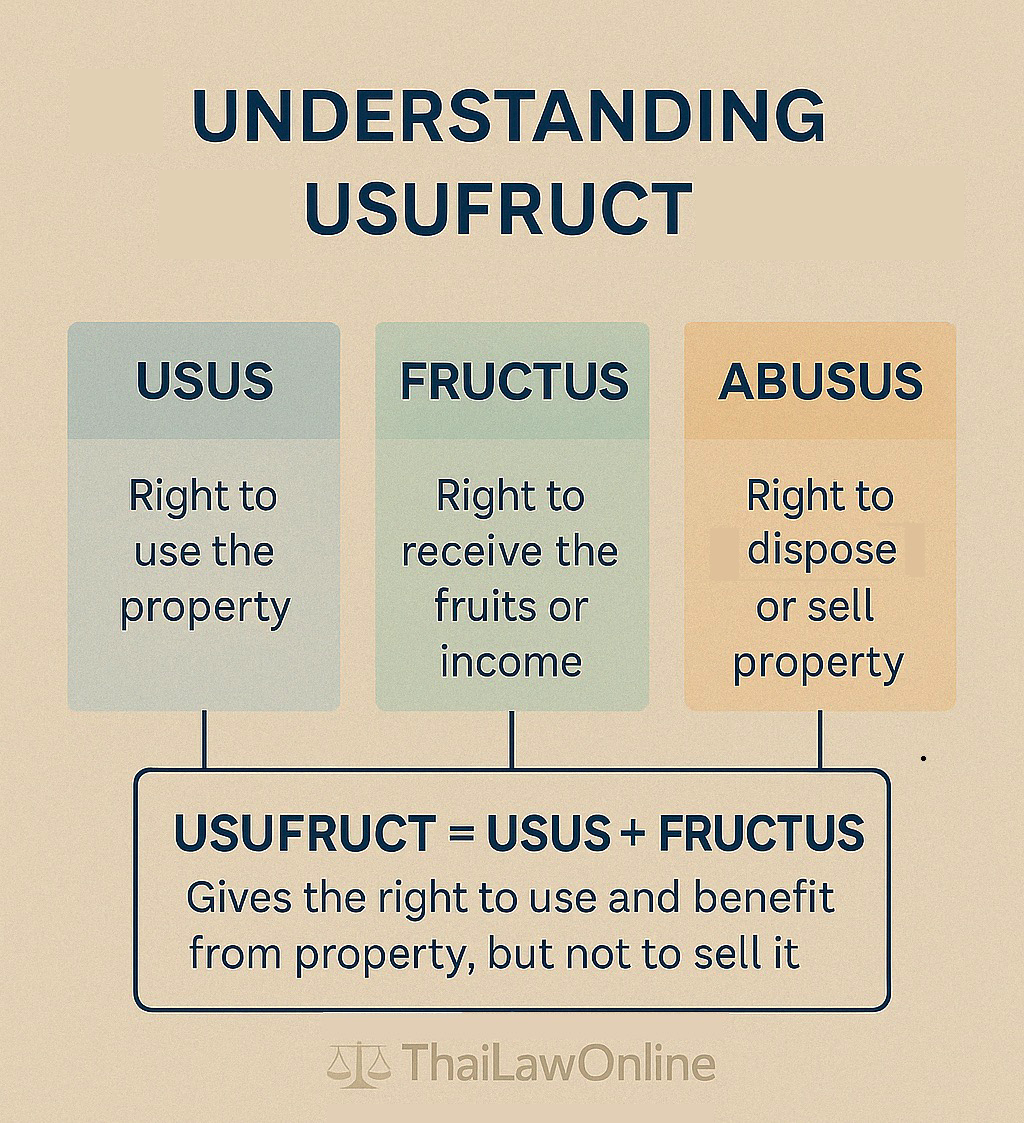
A usufruct gives the holder (the usufructuary) the rights of Usus and Fructus together. This lets them use and benefit from the property. However, it does not grant the right of Abusus; the usufructuary cannot sell or destroy the property.
Note: Terms like “leasehold” or “freehold” are common in other legal systems. However, they are not exact terms in Thai Civil Law and should not be confused with usufruct.
Why Usufruct Matters for Foreigners in Thailand
Under Thai law, foreigners cannot own land (Land Code Act B.E. 2497, Section 86). This is a problem for the thousands of foreign retirees, spouses of Thai nationals, and business people who live in Thailand. They want to secure their homes. Usufruct provides a solution. It’s a registered real right that gives the foreign holder virtually all the practical benefits of ownership. You don’t actually need to own the land.
A registered usufruct binds not only the current landowner but also any future buyer. If the Thai landowner sells the property, the foreign usufructuary’s right survives. The buyer takes the property subject to the usufruct. This makes usufruct much stronger than an unregistered lease or a private agreement. For a detailed comparison, see our guide on usufruct for foreigners in Thailand.
If You Already Know the French or Quebec Usufruit
Usufruct is not a Thai invention and it is not exotic. It is the same institution French, Belgian, Swiss and Quebec lawyers call usufruit, and the Thai Civil and Commercial Code of B.E. 2468 (1925) drew it from the same European sources. If you grew up with that vocabulary, most of what you know carries over. Four differences are worth knowing before you register one here.
Duration. Under Thai law a usufruct runs for the life of the usufructuary, or for a fixed term that cannot exceed 30 years (Section 1418). French law is close: the usufruit ends at the usufructuary’s death (article 617 of the Code civil) and is capped at 30 years when it is granted to a legal person (article 619). Quebec is the outlier, allowing a term of up to 100 years (article 1123 of the Code civil du Québec).
It still does not pass to your heirs. This is the same in all three systems and it surprises people every time. The usufruct dies with the usufructuary. If you want an interest your children can inherit, look at a superficies over the house or a Sap Ing Sith right, not a usufruct or an ordinary lease, which the Supreme Court treats as personal to the tenant and ended by the tenant’s death (Decision 3254/2545). See what happens to a usufruct when someone dies.
Registration does more work here. In Thailand the usufruct becomes a real right binding the land, and every later buyer, only once it is registered on the title deed at the Land Office. Unregistered, it binds only the person who signed it. However well the agreement itself is drafted, nothing in it substitutes for that entry on the chanote.
How it usually arises. In France the usufruit most often comes into being by operation of law, above all through the surviving spouse’s option over the estate (article 757), or by a deliberate démembrement de propriété for tax reasons. In Thailand it is almost always contractual, and the reason is specific: a foreigner cannot own land, so a usufruct is how they secure the right to live on and profit from land held in a Thai name. Thai law also has no equivalent of the French quasi-usufruit over consumable property (article 587).
The Law. Civil and Commercial Code Sections 1417 to 1428 (Full Bilingual Text)
Below is the full text of every CCC section governing usufruct in Thailand. Both English and Thai versions are included. This bilingual presentation is important for practitioners and property owners. You need to reference the exact statutory language. This is the only article in our usufruct series that reproduces the full bilingual text. Our registration guide, termination guide, and other articles reference these sections by number with links back to this page.
How Usufruct Works in Practice
Step 1. Drafting the Agreement
A usufruct agreement should be drafted by a qualified Thai lawyer. Include the identity of both parties. Provide a precise description of the property (including title deed number). State the duration (lifetime or fixed term). Specify rights and restrictions. Cover maintenance responsibilities and provisions for termination. Both Thai and English versions should be prepared for international parties.
Why the Standard Land Office Form Isn’t Enough & The Power of Our Custom Addendum
The Thai Land Department offers an official form for registering a usufruct. This was shown in the example image earlier. It is important to know its main purpose and limitations. This standard document is mainly for meeting the minimum legal requirement for registration. It identifies the parties involved, the specific property, and the length of the usufruct. It typically contains only a couple of very basic clauses, as illustrated below:
This image shows a simple standard form. It includes “Clause 1: Grant of Usufruct…” and “Clause 2: Payment of Fee…”
This shows that a usufruct exists, but it gives very little detail on how it protects you in real life.
The Critical Limitations of the Standard Form Include:
- Minimal Detail on Rights: It often does not include clear terms about the usufructuary’s rights. For example, it may not state the right to rent out the property without asking the owner each time. It also may not clearly outline the rights to make non-structural improvements.
- No Restrictions on the Owner: The property owner can still sell, transfer, or mortgage the land. There are usually no restrictions on these actions. A registered usufruct should stay with the land, even if it is sold. However, this can cause problems, stress, and legal issues for the usufructuary with the new owner.
- No Coverage for Common Scenarios or Disputes: It usually does not cover common issues. These include responsibilities for property maintenance, damage from natural causes, utility agreements, and handling minor disputes.
- Often Thai-Only: The official Land Office form is in Thai. While an informal translation might be offered, the legally registered document itself may not be comprehensively bilingual. Foreign usufructuaries may be at risk. This is because they might not fully understand the details of the Thai text they are signing.
- Limited Proactive Protection: Since it is very basic, it provides little proactive protection. It does not provide clear guidance for any future disagreements between the owner and the usufructuary.
This is precisely where ThaiLawOnline’s custom Usufruct Addendum provides essential, enhanced protection.
Our bilingual (Thai/English) addendum is carefully written by skilled property lawyers. They have over 20 years of experience in registering usufructs and protecting foreign interests in Thailand. It’s meant to be a complete agreement. It should be referenced by, and ideally attached to, the standard Land Office registration documents. This can greatly improve your legal position.
The Difference is in the Detail: Standard Form vs. Our Custom Clause
Compare the simple standard form with a typical protective clause from ThaiLawOnline’s Usufruct Addendum.
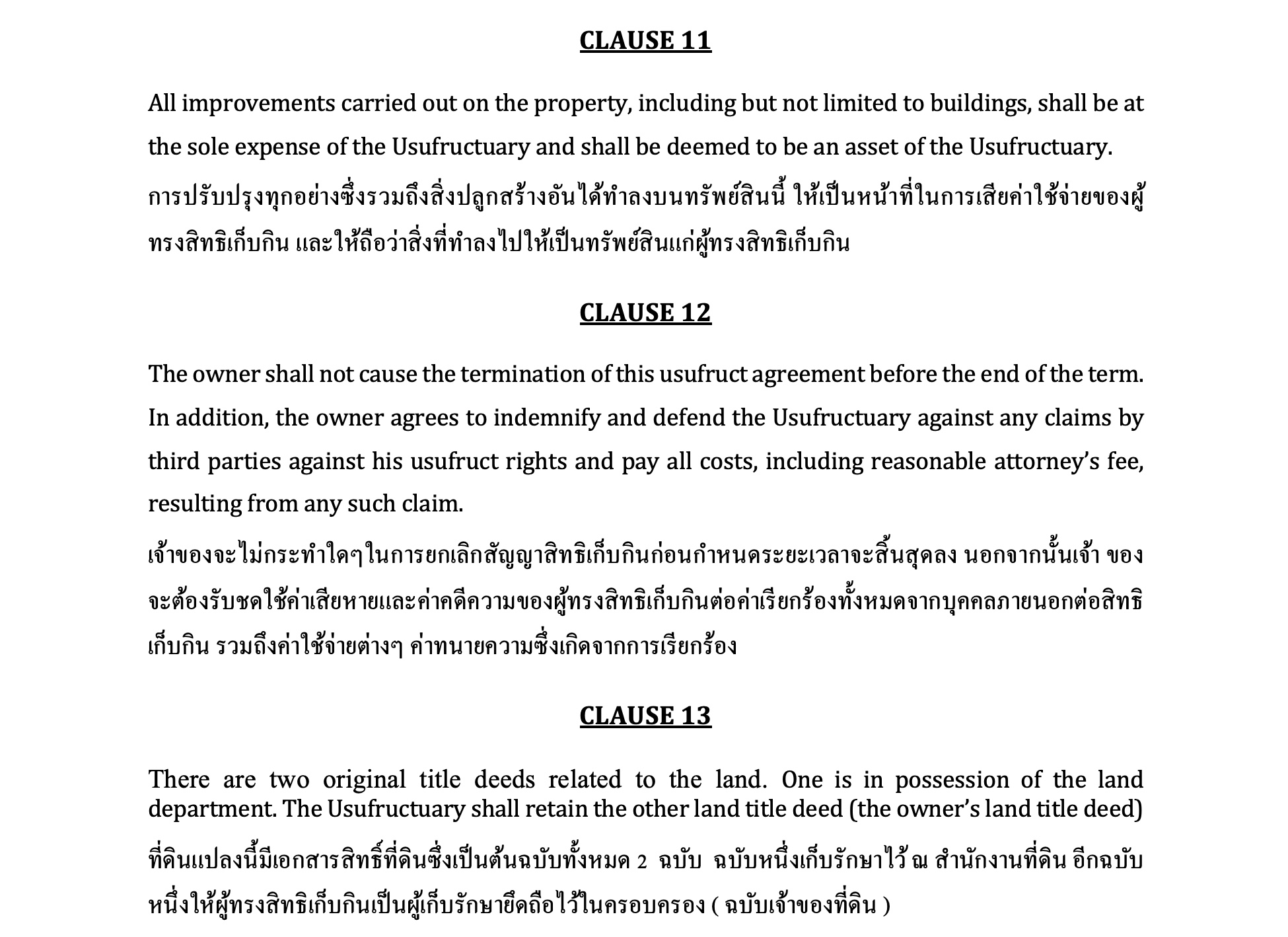
Our Custom Usufruct Addendum Proactively Addresses Key Concerns, Offering:
- Clearly Defined Usage Rights: Clearly states what the usufructuary can and cannot do. This includes renting out the property, making certain improvements, and conducting business activities.
- Property Owner Restrictions: The owner cannot sell, transfer, or mortgage the property. These actions must not hurt the rights of the usufructuary. The owner often needs the usufructuary’s written consent before doing so.
- Detailed Maintenance & Repair Clarity: Specifies responsibilities for ordinary upkeep versus extraordinary repairs, preventing future arguments.
- Insurance Stipulations: Can require the property to be insured against common risks, protecting both parties.
- Bilingual Terms: This ensures that both the Thai owner and the foreign usufructuary understand all terms and conditions. Both language versions have the same legal importance.
- Clauses for Specific Scenarios: Addresses potential future situations, such as damage to the property, access rights, or even early termination conditions if mutually agreed.
- Protects Your Rights: Helps avoid misunderstandings and gives a stronger legal basis if disputes come up.
Relying solely on the basic Land Office form is a significant missed opportunity for robust, tailored protection. Our Usufruct Addendum helps you feel secure. It protects your right to use and enjoy property in Thailand for a long time.
Step 2. Registering at the Land Office
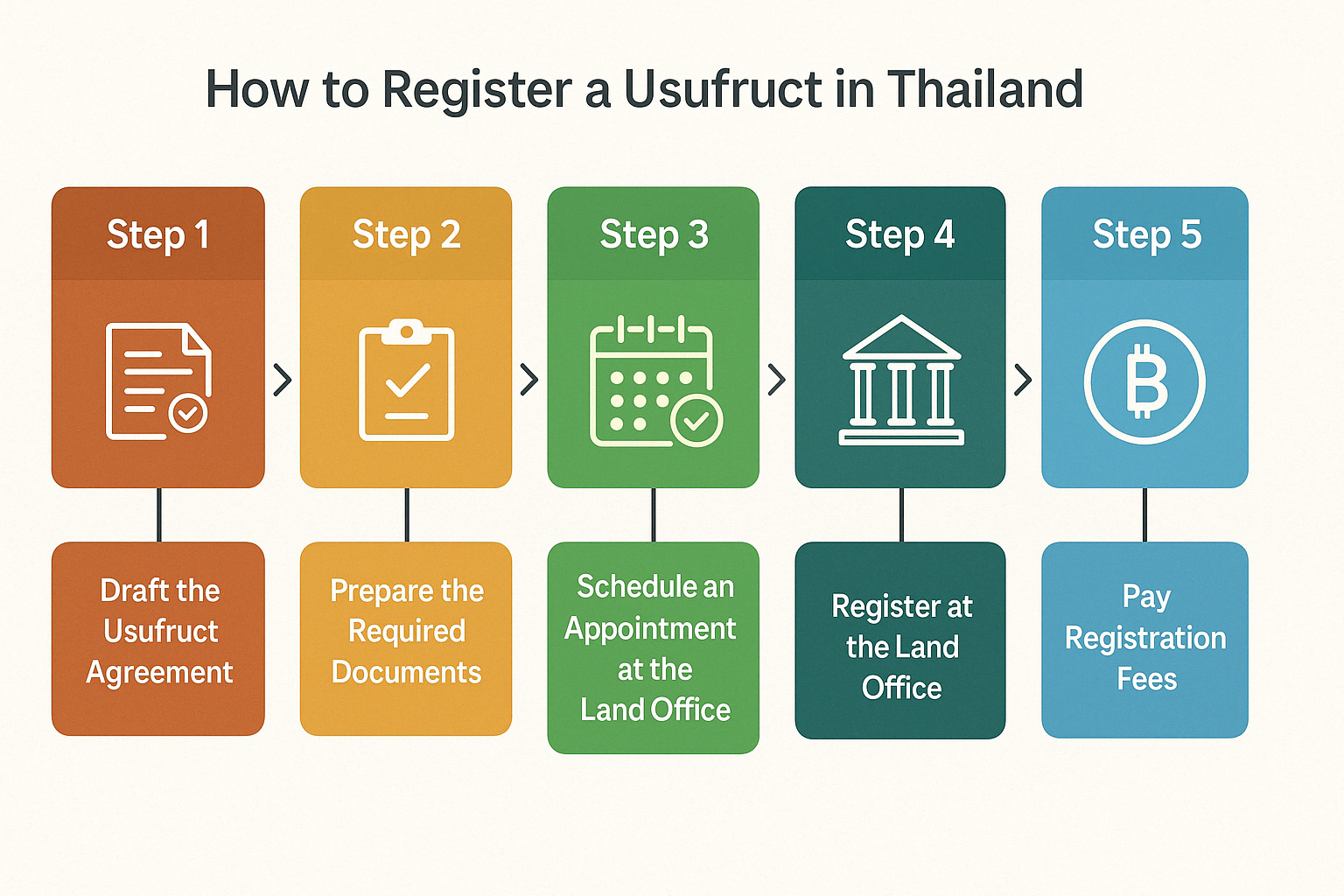
Both the landowner and the usufructuary must attend the local Land Department office (สำนักงานที่ดิน) in person. The officer reviews the agreement. They verify identities. They assess the registration fee. It is 1% plus 0.5% stamp duty on the consideration stated in the agreement. Without consideration, the published registration fee is 50 baht per parcel, plus applicable incidental charges. Confirm the itemised amount with the local Land Office. They record the usufruct on the title deed. Only after registration does the usufruct become a “real right” (ทรัพยสิทธิ) that works against third parties. For the complete registration process, see our step-by-step registration guide.
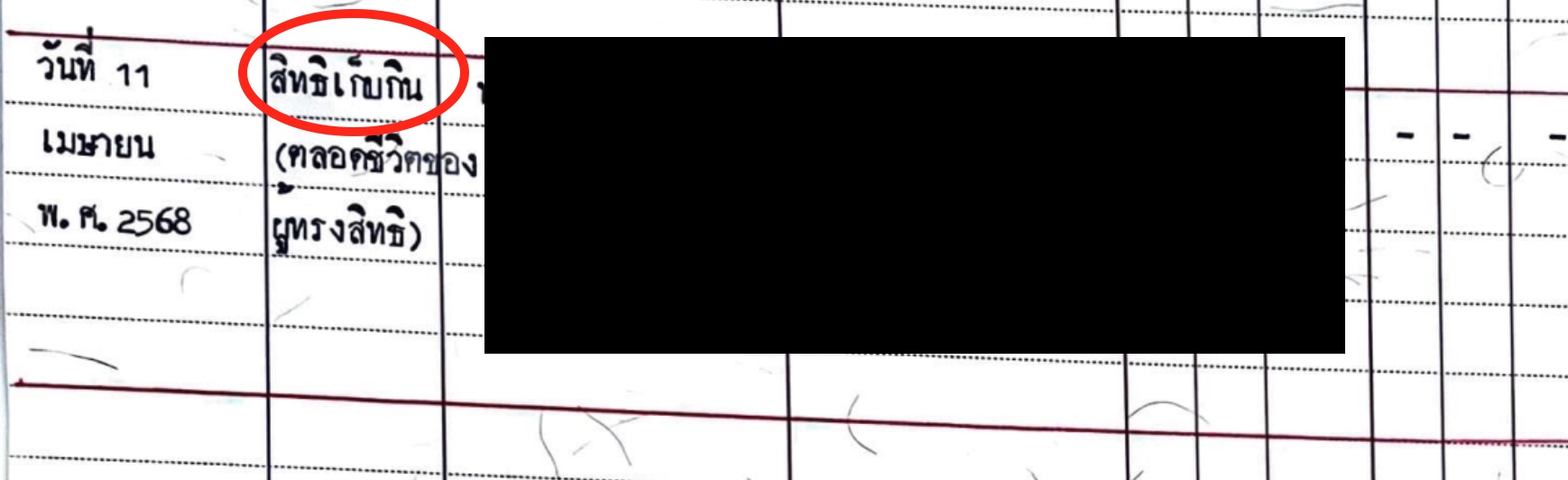
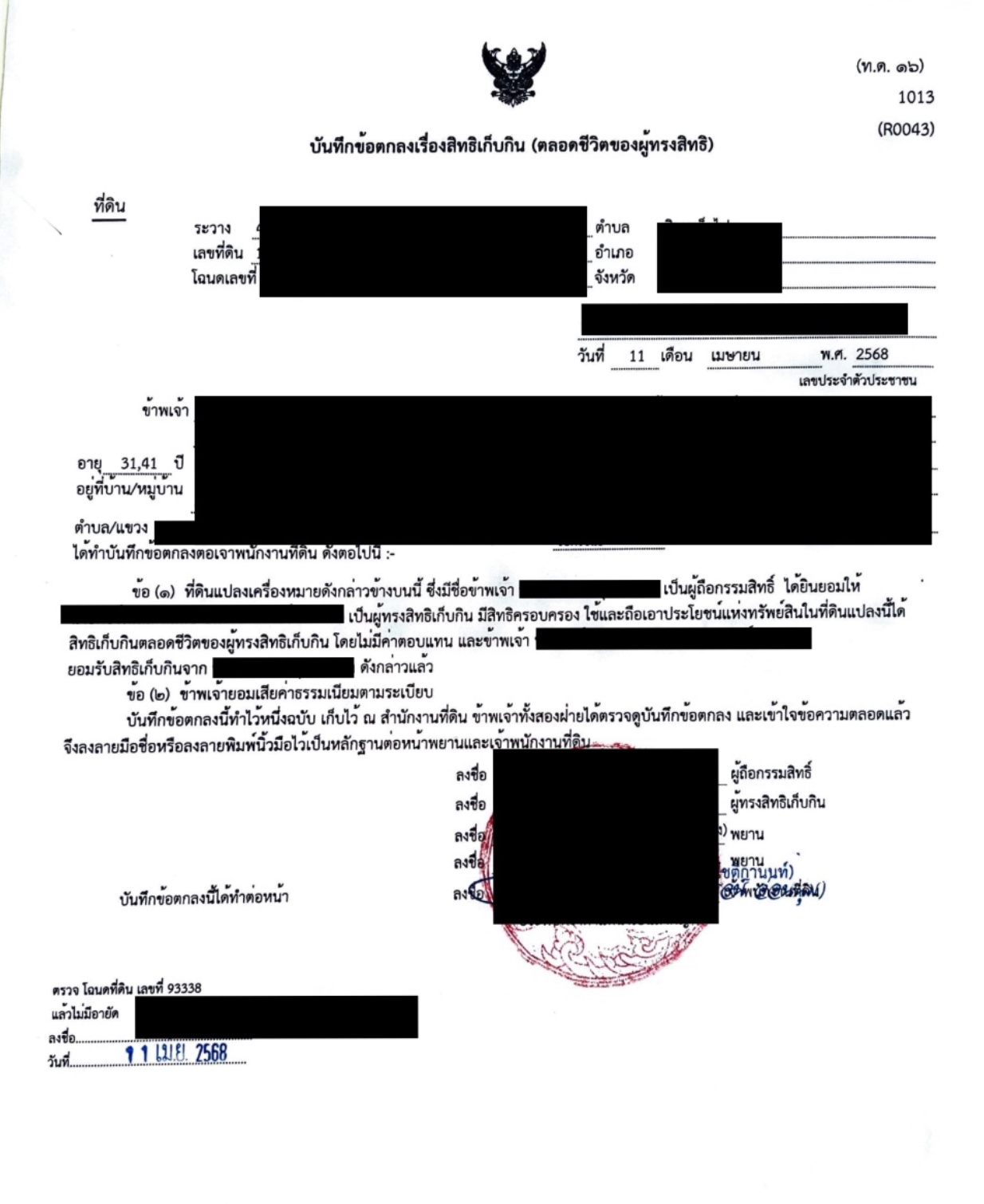
This is an example of usufruct registration on a title deed.
Done in April 2025, it shows in red “usufruct” (See Tee Kep Kin in Thai).
Step 3. Living Under Usufruct
Once registered, the usufructuary has full authority. You can live on the property. Lease it to tenants. Collect rent. Manage the premises. Take legal action regarding the property. The landowner retains bare ownership but cannot interfere with your management. The usufructuary must maintain the property in good condition (Section 1421). Pay property taxes (Section 1426). Insure the property if required by the owner (Section 1427).
What Happens When It Ends
Usufruct terminates through death of the holder (automatic), expiry of the fixed term, mutual agreement, court order, or destruction of the property. Upon termination, the property reverts to the landowner. There is no transfer tax when usufruct terminates by death. This is a big advantage for estate planning. See our complete guides on termination rules and tax implications.
How Much Does a Usufruct Cost in Thailand? (2026)
A lawyer-drafted bilingual usufruct agreement is a fixed 3,900 THB, prepared in 5 to 7 business days. On top of that you pay the Land Office’s own registration fee, charged at cost. The Department of Lands publishes a 1% registration fee plus 0.5% stamp duty on stated consideration. Where there is no consideration, the registration fee is 50 baht per parcel, with applicable incidental charges added. See the Land Office fee explanation.
| Item | Cost (THB) | Notes |
|---|---|---|
| Usufruct agreement, bilingual and lawyer-drafted | 3,900 | 5 to 7 business days, includes guidance through registration |
| Land Office registration fee | 50 per parcel without consideration, plus incidental charges | government fee, paid at registration, charged at cost |
| Bilingual template, if you prefer to do it yourself | 890 | free for Silver members and above |
| Lease agreement, the main alternative, up to 30 years | 4,900 | 3 to 5 business days |
| Consultation, if you want advice before deciding | 2,000 per hour | useful before committing to either route |
A Worked Example
For a proposed usufruct without consideration over one parcel, budget the 3,900 THB drafting fee separately from registration costs. The published registration fee is 50 baht, with incidental charges added. Lawyer attendance, title checks and other services require separate confirmation. If the parties are married, assess the inter-spousal agreement risk before treating a lifetime usufruct as secure.
What the Fee Includes
The fixed fee covers drafting the bilingual agreement and guiding you through registration at the Land Office. Registration is the step that makes the right real, because an unregistered usufruct binds only the person who signed it, not the land, and not a later buyer. See the full legal fees page, or book a consultation.
Three Ways to Get Your Usufruct Agreement
Most firms offer one route at one price. We publish three, because the right answer depends on how complicated your situation is and how much you want to do yourself. All three produce the same underlying document: the bilingual usufruct agreement this firm uses for its own clients.
| Bilingual template ฿890 | Document Maker Gold, ฿5,800 a year | We draft it for you ฿3,900 | |
|---|---|---|---|
| What you get | The same usufruct agreement our lawyers use, as an editable bilingual file | The same firm documents, assembled for you from a guided questionnaire | A finished agreement drafted around your facts, in English and Thai |
| Who fills it in | You do | The questionnaire does, from your answers | We do, from the details you send us |
| Languages | English and Thai | English and Thai, and it can translate for you | English and Thai, drafted side by side |
| Turnaround | Immediate download | Minutes | 5 to 7 business days |
| Best for | A straightforward grant you are comfortable completing yourself | Anyone needing several documents across the year | Anything with a wrinkle: company owners, unusual land, protective clauses, a nervous counterparty |
| Also included | The Land Office registration guide | Ten lawyer-drafted documents: wills, leases, loans, prenuptial agreements and more | We walk you through registration at the Land Office |
Why Our Template Is Not the Template You Find Elsewhere
Most usufruct documents sold online are the same file the seller uploaded years ago. Nobody revisits them when the Supreme Court decides something that changes how the clause should be written, and nobody is available afterwards when the Land Office asks a question. You are buying a file, not a document.
Ours is the agreement this firm uses for paying clients, and it changes when the law changes. When Dika 4655/2566 held that a thirty-year lease coupled, on the same day and on identical terms, with promises to renew twice more for thirty years each was an attempt to get round the thirty-year ceiling in Section 540, so that the renewal promises were void outright and could not even be read down into a personal right between the parties, we rewrote that clause across our documents. The template you download and the document the Document Maker builds are the same drafting, kept current by the people who use it in practice. The Document Maker in particular is not a form filler bolted on to generic text: it assembles the firm’s own bilingual documents from your answers.
Why 3,900 Baht and Not 35,000
A client came to us after being quoted 35,000 baht for a usufruct by a law firm in Ubon Ratchathani. Same Civil and Commercial Code sections, same Land Office, same afternoon of work. Fees for straightforward registered rights in Thailand vary by a factor of ten, and the difference is rarely the quality of the drafting.
We publish our fees so you can check them before you call, and they are fixed rather than hourly. That is the same reason we publish the statute text, the Supreme Court decisions and the honest limitations above: a firm that has drafted usufructs since 2006 does not need to keep the basics behind a consultation fee. If your matter genuinely is complex, we will tell you, and quote for that. Most are not.
Usufruct vs. Lease vs. Superficies. Quick Comparison
Thai law offers three main mechanisms for granting property use rights. The table below provides a summary comparison. For a detailed analysis of each with real-world scenarios and recommendations, see our dedicated guide on usufruct vs. lease vs. superficies.
| Criteria | Usufruct (สิทธิเก็บกิน) | Lease (สัญญาเช่า) | Superficies (สิทธิเหนือพื้นดิน) |
|---|---|---|---|
| Duration | Lifetime or up to 30 years | Maximum 30 years (renewable) | Maximum 30 years or lifetime |
| Survives Owner’s Death? | Yes. Binds new owner | Yes. Binds new owner | Yes. Binds new owner |
| Survives Holder’s Death? | No. Terminates automatically | Only if the contract expressly provides for succession | Yes. Passes to heirs |
| Can Collect Rent? | Yes | Yes (sublease) | No (building rights only) |
| Registration Fee | Depends on consideration; confirm the Land Office assessment | 1% of total rent | Depends on consideration; confirm the Land Office assessment |
| Best For | Lifetime home security | Commercial/fixed-term use | Building on another’s land |
Who Uses Usufruct in Thailand.
Foreign Retirees Protecting Their Home
The most common use case is a foreign retiree who lives in a house on land owned by a Thai partner, friend, or family member. A lifetime usufruct registered at the Land Office ensures the retiree can live in the house for life. This works regardless of what happens to the ownership. Even if the Thai owner sells the land, dies, or becomes incapacitated, the retiree’s right is protected. See our guide for foreigners using usufruct in Thailand. If you live together without marrying, see our guide to property bought with a Thai girlfriend or partner before marriage.
Thai-Foreign Married Couples
When a Thai national and a foreign spouse purchase property, the land must typically be registered in the Thai spouse’s name alone. Usufruct provides the foreign spouse with legal protection. It’s a registered right to live on and use the property for life. However, the intersection of usufruct with Thai marital property law creates legal questions. Couples should address these proactively. For protection strategies, see our guide on usufruct and marriage in Thailand.
Estate Planning for Thai Families
Thai families often use usufruct for succession planning. A common structure: parents transfer land ownership to adult children but retain lifetime usufruct. This ensures they can live on and benefit from the property until death. The Supreme Court has upheld this arrangement as a “gift with encumbrance” in Decisions 1516/2525, 2651/2543, and 10344/2551. This means the children cannot revoke the gift for ingratitude. See our guide on usufruct and inheritance.
Commercial Property Arrangements
Businesses sometimes use usufruct to structure property use in commercial contexts. This includes agricultural operations, resort developments, and retail premises. The usufructuary’s management power under Section 1417 is particularly valuable for commercial use. It allows independent decision-making about the property. You don’t need the landowner’s consent for day-to-day operations.
Risks and Limitations. What We Tell Clients Honestly
A usufruct is the strongest protection most foreigners can get over Thai land, but it is not perfect. Three limitations are worth understanding before you register one.
Spousal Consent: Sections 1476 and 1480
Where the Thai landowner is married and the land is Sin Somros, marital property, the provision to know is CCC Section 1476 (2), which requires the spouses to act jointly, or with the consent of the other, when creating or extinguishing a usufruct over immovable property. Usufruct is named in the subsection in terms, alongside servitude, habitation and superficies. Where one spouse acts alone in a case that needed consent, Section 1480 lets the other apply to the court to revoke the act, unless that spouse has ratified it or the third person acted in good faith and gave counter-payment; and the application cannot be made more than one year after the ground became known, or more than ten years after the act.
Two things keep this in proportion. The court is asked to revoke, so a usufruct registered with the spouse’s consent is not exposed at all, and in the decisions in our own database of 64 Supreme Court judgments on usufruct we have not found one in which a registered usufruct was revoked on this ground. It is also easy to close: register before the marriage where possible, take formal spousal consent at the Land Office, or deal with it in a prenuptial agreement. See our usufruct and marriage guide.
Section 1469 is a different rule and is often quoted here by mistake. It governs an agreement about property made between the spouses themselves, which either of them may avoid while they are still married or within a year of ceasing to be. It matters where the Thai owner grants the usufruct to their own spouse, which is the common case, so it is worth knowing; it is not the provision about acting without a spouse’s consent.
Land Office Discretion
Land Office officials have some discretion in how they process registrations, and they occasionally question foreign usufruct registrations, particularly at rural offices. Having a qualified Thai lawyer present at the appointment reduces this risk substantially. If an office refuses outright, remedies exist through the courts. Our registration guide covers the practical workarounds.
Death Ends It, and It Cannot Be Inherited
This is the limitation people most often miss. A usufruct terminates on the death of the usufructuary under CCC Section 1418, and your heirs take no claim to the property from it. If passing the interest to your children matters more to you than a lifetime right, a superficies (inheritable unless the grant says otherwise, section 1411) or a Sap Ing Sith right (inheritable under section 12 of its Act) is the better instrument. An ordinary lease does not help here: it ends on the tenant’s death. See our usufruct and inheritance guide.
Key Supreme Court Decisions on Usufruct
ThaiLawOnline maintains the most thorough English-language database of Supreme Court decisions on usufruct in Thailand. We have 64 decisions spanning from 1936 to 2022. Below are the landmark rulings that property owners, investors, and legal practitioners should know. For the complete analysis of all 64 decisions organized by legal principle, see our dedicated Supreme Court decisions guide.
The Usufructuary’s Management Power. ฎีกา 15033/2555 (2012)
This is one of the most important modern decisions on usufruct. The Supreme Court held that while a usufruct is registered and the usufructuary is alive, the landowner does not have the right to possess, use, or manage the property. The owner cannot terminate a lease or file eviction proceedings. Only the usufructuary can. This decision confirmed that Section 1417 gives the usufructuary complete practical control over the property during the usufruct period.
Lease Survives Usufructuary’s Death. ฎีกา 2297/2541 (1998)
When a usufructuary grants a registered 30-year lease to a tenant and the usufructuary later dies, the usufruct ends per Section 1418. But the lease remains enforceable against the landowner. The tenant is protected. The owner cannot evict them. This decision has major implications for estate planning and property management. Leases created during usufruct outlive the usufruct itself. Detailed analysis is in our inheritance guide.
Unregistered Usufruct as Personal Right. ฎีกา 4446/2543 (2000)
Even if a usufruct is not registered at the Land Office, it remains valid as a personal right (บุคคลสิทธิ) between the parties. The owner is bound by the agreement and cannot evict the beneficiary. However, an unregistered usufruct will not protect the holder against a third party who purchases the land. This is why registration is important.
Gift with Encumbrance Protection. ฎีกา 1516/2525 (1982)
When a person transfers land but retains a lifetime usufruct (receiving annual rice deliveries), this is a “gift with encumbrance” (การให้ที่มีค่าภาระติดพัน), not a gratuitous gift. The donor cannot revoke the gift for ingratitude. This decision protects parents who give land to children while retaining usufruct. This structure is discussed in detail in our cancellation guide.
Usufruct Includes Structures. ฎีกา 7341/2542 (1999)
Usufruct over a share of land extends to all structures that are component parts (ส่วนควบ) of that land. The usufructuary has standing to file eviction against tenants even if they were not the original landlord. This decision clarifies that usufruct is not limited to bare land. It encompasses buildings, fixtures, and improvements that are legally part of the property.
Tax Follows the Actual Earner. ฎีกา 575/2560 (2017)
Holding a usufruct does not by itself make you the person taxed on the income. The owner leased the land to a company for thirty years against 87.5 million baht in key money and, on the same day, granted a usufruct to her three grandchildren, the company agreeing to pay them; but the usufruct was only registered after the lease was made. The Supreme Court held that the person with the assessable income under the lease was the owner, as the contracting party, and that the three were merely receiving her rent for her. The practical lesson is about sequence: register the usufruct before the lease is granted, and let the usufructuary be the party to it. Analysed in detail in our tax guide.
Usufruct Binds a Later Buyer. ฎีกา 2783/2516 (1973)
The owner remains free to sell the land, but the buyer takes it subject to the registered usufruct. The Supreme Court held that the sale does not disturb the usufructuary’s right, which is exactly why registration matters: it is the registration that makes the right good against the whole world rather than against the person who signed the agreement.
Suing a Tenant Is Management of the Property. ฎีกา 3019/2528 (1985)
The owner had registered the plaintiff as usufructuary for life over the house and land. The Supreme Court held that the usufructuary has the power to manage that property under Section 1417, that bringing an action to evict a tenant is itself an act of management, and that the plaintiff therefore had standing to sue. The rest of the judgment turns on the lease: a reciprocal arrangement that had run its ten years, followed by an open-ended monthly tenancy that the usufructuary was entitled to terminate on notice under Section 566.
The two propositions usually attached to this case come from elsewhere and are worth stating with their real sources. That the usufructuary may lease the property and keep the rent is the management and enjoyment power in Section 1417, applied in 15033/2555 and 2297/2541 below. That a lease of immovable property for more than three years is enforceable only for three years unless it is in writing and registered is Section 538.
Our Experience. Why ThaiLawOnline
ThaiLawOnline was among the first law firms in Thailand to actively use usufruct agreements as a property protection tool for foreign clients. In 2006 to 2008, when most firms relied exclusively on 30-year leases, founding partner Sebastien H. Brousseau identified usufruct under Sections 1417 to 1428 of the Civil and Commercial Code as a superior alternative in many situations.
This early adoption was driven by Brousseau’s training in Quebec civil law at the University of Ottawa. Usufruct (usufruit) is a well-established institution under the Code civil du Québec (Articles 1120 to 1171). His dual civil-and-common-law background gave him unique insight. He could apply this right under Thailand’s Civil and Commercial Code. The code itself draws on European civil law traditions.
Together with Thai legal counsel Wichuda Atthamethakon, the firm has since registered hundreds of usufruct agreements across Thailand. We maintain the most thorough database of usufruct-related Supreme Court decisions (64 decisions spanning 1936 to 2022) available in English.
Frequently Asked Questions about Thai Usufruct
How can foreigners engage in business using a usufruct in Thailand?
Foreigners can do business in Thailand using a usufruct. This gives them rights to manage and benefit from the property, like a lease. This allows foreigners to operate businesses on the land without owning it. Just do note that most “work” made by foreigners in Thailand will require a work permit with some exceptions.
Are usufruct only for maximum 1 rai?
No. We registered Usufruct in Thailand for more than 100 rai with one contract and multiple Title Deeds. However, the Usufruct must be registered on each Title Deed separately.
Do the owner of the land that has a usufruct registered can borrow money?
Yes, the owner of the land with a usufruct registered can borrow money. However, this can be limited by drafting contract about it.
Will I be fully protected with a usufruct in Thailand?
A usufruct in Thailand lets you use and enjoy the property. However, it does not give you full ownership rights. The property owner retains ultimate ownership. But Imagine that you bought a big house in a small village near the family of your girlfriend. Now, imagine that things go wrong with her and you decide to throw her out from this house. You have the legal right to do it. Do you really think your life will be nice and quiet near her family, in the middle of nowhere? A usufruct will legally protect you. However, there are times when legal protection may not matter in real life.
Can a usufruct cover several chanote?
Yes, register it on each deed.
Can a foreigner inherit a usufruct in Thailand?
No. The right ends when the usufructuary dies, but the land owner can still inherit the naked ownership.
How long does a usufruct registration take at the Land Office?
Typically half a day once documents are complete and the owner attends in person.
What fees must be paid to register a usufruct?
The published registration fee is 1% plus 0.5% stamp duty on the stated consideration. Without consideration, the registration fee is 50 baht per parcel, plus applicable incidental charges. Ask the Land Office for an itemised assessment.
Can the usufructuary rent the property out?
Yes, unless restricted in the agreement, and the lease can last up to 30 years.
Can a foreigner register a usufruct in Thailand?
Yes, a foreigner can register a usufruct. Usufruct is not the same as full property and the law doesn’t forbid it.
How long does a usufruct last in Thailand?
For the lifetime of the usufructuary, which is the usual grant and has no maximum, or for a fixed term. Only a fixed term is capped, at 30 years, because Section 1418 applies Section 1403 paragraph three to it. Either way it ends when the usufructuary dies, whether that falls before or after the 30 years.
Can I build on usufruct land?
Yes, but you need written permission from the landowner and must comply with local building regulations, unless otherwise written in contracts, which we always do.
Testimonials about Usufruct Agreement in Thailand:
I am highly recommending their services.
I used to help me to get a usufruct registered with the local land office and the experience was just perfect. They helped a lot with the preparation providing advice and templates and the result was that my name was on the title deed after just 1.5 hours at the government. I am highly recommending their services.

Easy to communicate (…) staff are excellent
They “helped me and my wife purchased a house in isaan they also oversaw the payment and exchanging of the deeds (…) I cannot recommend this company any higher everything they’ve done for us was perfect this isn’t the first time I’ve used them and will definitely not be the last thay also set me up a usufruct on the property so I’m safe to live here until I die again (…) an excellent company to do business with Sebastian the owner easy to communicate with also English-speaking staff are excellent when you need to contact them THANK YOU.
I highly recommend their services
ThaiLawOnline’s usufruct guide was clear and saved me time. I highly recommend their services.
I had been trying unsuccessfully for years
In April 2021, this company helped me obtain a usufruct in Takhu, Pak Thong Chai. I had been trying unsuccessfully for years at the local Land Office, but was repeatedly rejected. The legal firm at the time arranged for me to obtain a usufruct on the house and land within two days, at the agreed-upon, very reasonable price.
Links:
- Department of Lands, Thailand (Thai language)
- Complete Usufruct Registration Instructions by ThaiLawOnline (.PDF document updated in January 2026)
How much does a usufruct cost? A lawyer-drafted bilingual usufruct agreement is a fixed 3,900 THB. See the full usufruct cost breakdown (2026) or all our fixed fees on the legal fees page.
The Complete Usufruct Series: All Our Guides
- How to Register a Usufruct at the Land Office
- Usufruct Cost & Registration Fees
- Usufruct for Thai-Foreign Married Couples
- Usufruct on a Condominium
- Tax on Usufructs
- Usufruct & Inheritance
- How to Cancel a Usufruct
- Supreme Court Decisions on Usufruct
- Usufruct vs Lease vs Superficies
- Lease, Usufruct & Sap Ing Sith Compared
Our fee for a usufruct agreement
| Service | Fixed fee | What is included | Timeline |
|---|---|---|---|
| Usufruct agreement | 3,900 THB | Bilingual usufruct agreement plus Land Office registration guidance. | 5 to 7 business days |
Government disbursements are charged at cost unless the service says they are included.
Book a consultation Answer within 24 hours EN · FR · TH
These fees come from one source and are the same everywhere on this site. See all our fees.
Try it yourself first, free
You do not have to book anything to get started. These run in your browser, and you only pay us if you decide you want a lawyer involved.
Lease Red-Flag Scanner Free
Paste your Thai lease. We check it against the five clauses that most often cause trouble.
Open the toolLegal Document Maker Gold members
Ten bilingual documents from a guided questionnaire, in the firm's own wording.
Open the toolAsk our AI assistant Free
Trained on Thai law and 77,000+ Supreme Court decisions. Ask anything, free.
Expat Legal Health Check Free
Ten minutes on your property, family, visa and will. You get a written report naming the exact gaps and what each one costs to fix.
Take the Legal Health CheckThai Law Updates, free by email
Plain-English updates on Thai law changes that affect foreigners: property, visas, marriage, business and wills. One short email a month from a firm practicing since 2006. No spam, unsubscribe anytime.