


Reviewed by Wichuda Atthamethakon, LL.M., Thai Bar Licence 3149/2556, for ThaiLawOnline, a Thai law firm acting for foreigners since 2006.
Update log
- 4 November 2026: Added the statute box with Thai, English and French text and checked the page against the official text
You married at the district office. Years later you find out your spouse was still married to someone else on the day you signed the register. Or the person you married turns out to be someone else entirely. Can you simply walk away? No. You need a court.
Annulment in Thailand doesn’t work the way most Western readers expect. Thai law splits defective marriages into two groups. A void marriage (mokha) never had legal effect. A voidable marriage (mokhiya) is valid until the court cancels it. In almost every case you’ll need a judgment of the Juvenile and Family Court before the register changes. The one exception is bigamy, which an interested person can also raise in other proceedings.
This guide covers the grounds, who can apply, the deadlines, and what happens to property, inheritance and children. Every rule is tied to a section of the Civil and Commercial Code. We use the text as amended by the Marriage Equality Act, in force since 23 January 2025.
The short answer. A marriage is void only for the four reasons listed in Section 1495. It is voidable only for the five reasons listed in Section 1503. Voidable claims carry short deadlines, some as short as 90 days.
Last reviewed: 22 October 2026. We read the cited sections against the Thai text in our annotated Civil and Commercial Code. That covers Sections 1448 to 1454, 1457 to 1459, 1494 to 1513, 1538, 1560 and 1598/32. The Supreme Court decisions cited are those summarised on our section pages and case notes, where the source of each is stated.
Table of Contents
What annulment means in Thailand
A Thai marriage ends in only three ways: death, divorce, or cancellation by the court (Section 1501). The list is closed. Years apart do not end a marriage. A church annulment does not, either. Neither does a foreign court order. Thai authorities may not recognize it.
English speakers use “annulment” for two different Thai procedures. One is a judgment declaring a marriage void. The other is a judgment cancelling a voidable marriage. They have different grounds, different applicants, different deadlines and different effects. Our glossary entry on void and voidable acts explains the same split for contracts.
Void marriage (mokha)
A void marriage is treated as never having produced a marriage at all. But the register still shows it. Section 1496 says only a court judgment can establish that a marriage is void on the grounds in Sections 1449, 1450 and 1458. Until then, everyone deals with you as married.
The Supreme Court made this point in Decision 3898/2548, summarised on our Section 1458 page. Nobody entitled to sue had challenged the marriage, so it stood. The registered wife remained a statutory heir and could apply to administer her husband’s estate.
Voidable marriage (mokhiya)
A voidable marriage is fully valid until the court cancels it (Section 1502). The cancellation takes effect on the day the judgment becomes final, not on the wedding day (Section 1511). If nobody sues in time, the defect is gone for good.
What annulment is not
- An unregistered ceremony. A marriage exists in Thai law only once it’s registered (Section 1457). A temple or village wedding with no registration creates nothing to annul. See our guide to Buddhist marriage in Thailand and our note on unmarried couples and property.
- A remedy for a short or unhappy marriage. Non-consummation, a marriage that lasted a week, or a partner who changed after the wedding are not grounds. Those cases go to divorce.
- A religious annulment. A decision of a church tribunal has no effect on a marriage registered at the amphur.
The law behind this page
English
Section 1495
Full text
The marriage which is made against Section 1449, Section 1450, Section 1452 and Section 1458 shall be void.
ThaiLawOnline translation
Section 1503
Full text
An application to the Court for the cancellation of a marriage on the ground that it is voidable may be made only where the spouses have contravened Section 1448, Section 1505, Section 1506, Section 1507 or Section 1509.
ThaiLawOnline translation
Section 1496
A marriage that contravenes Section 1449, 1450 or 1458 can be declared void only by a court judgment. The spouses, their parents or descendants may petition; if there are none, an interested person may ask the public prosecutor to petition.
Full text
Only a judgment of the Court may declare void a marriage contravening section 1449, section 1450 or section 1458. A spouse, a parent or a descendant of a spouse may apply to the Court for a judgment declaring the marriage void. If there is no such person, an interested person may request the public prosecutor to make the application to the Court.
ThaiLawOnline translation
Section 1497
Full text
Any interested person may allege, or apply for a judgment of the Court declaring, that a marriage made in contravention of Section 1452 is void.
ThaiLawOnline translation
Section 1499Amended on 23 January 2025
Full text
A marriage which is void for contravening Section 1449, Section 1450 or Section 1458 does not deprive a person who married in good faith of the rights acquired by reason of the marriage before the judgment declaring it void became final. A marriage which is void for contravening Section 1452 does not deprive a person who married in good faith of the rights acquired by reason of the marriage before that person knew of the cause making the marriage void; but such a void marriage does not give a spouse the right to inherit as a statutory heir of the other spouse. Where a marriage is void for contravening Section 1449, Section 1450, Section 1458 or Section 1452, a spouse who married in good faith is entitled to claim compensation. If the void marriage leaves the spouse who married in good faith impoverished, having insufficient income from property or from the work carried on before the judgment became final, or before learning that the marriage was void, as the case may be, that spouse is also entitled to claim maintenance. Section 1526 paragraph one and Section 1528 apply mutatis mutandis to that claim for maintenance. A claim for compensation or for maintenance under paragraph three is barred after two years from the day the judgment became final, where the marriage is void for contravening Section 1449, Section 1450 or Section 1458; or from the day the cause making the marriage void became known, where the marriage is void for contravening Section 1452.
ThaiLawOnline translation
Section 1498Amended on 23 January 2025
Full text
A void marriage does not create any property relationship between the spouses. Where a marriage is void, property which either party had or acquired, whether before or after the marriage, together with its fruits, remains the property of that party. Property jointly earned is divided equally between them, unless the court thinks fit to order otherwise, having regard to the responsibilities of the family, the responsibility of earning a living and the condition of both parties, and to all the other circumstances.
ThaiLawOnline translation
Section 1506
Full text
If a spouse entered into the marriage through fraud of such gravity that without it the marriage would not have been made, the marriage is voidable. Paragraph one does not apply where the fraud was committed by a third person without the knowledge of the other spouse. The right to apply for annulment of the marriage on the ground of fraud is extinguished when ninety days have elapsed from the date on which the fraud was known or ought to have been known, or when one year has elapsed from the date of marriage.
ThaiLawOnline translation
Section 1512
Full text
The provisions on the effects of divorce by judgment apply mutatis mutandis to the effects of the annulment of a marriage.
ThaiLawOnline translation
ไทย
มาตรา 1495
ข้อความเต็ม
การสมรสที่ฝ่าฝืนมาตรา ๑๔๔๙ มาตรา ๑๔๕๐ มาตรา ๑๔๕๒ และมาตรา ๑๔๕๘ เป็นโมฆะ
ตรงตามข้อความในราชกิจจานุเบกษา / สำนักงานคณะกรรมการกฤษฎีกา (Verbatim from the Royal Gazette / Office of the Council of State)
มาตรา 1503
ข้อความเต็ม
เหตุที่จะขอให้ศาลพิพากษาเพิกถอนการสมรส เพราะเหตุว่าเป็นโมฆียะ มีเฉพาะในกรณีที่คู่สมรสทำการฝ่าฝืนมาตรา ๑๔๔๘ มาตรา ๑๕๐๕ มาตรา ๑๕๐๖ มาตรา ๑๕๐๗ และมาตรา ๑๕๐๙
ตรงตามข้อความในราชกิจจานุเบกษา / สำนักงานคณะกรรมการกฤษฎีกา (Verbatim from the Royal Gazette / Office of the Council of State)
มาตรา 1496
ข้อความเต็ม
คำพิพากษาของศาลเท่านั้นที่จะแสดงว่า การสมรสที่ฝ่าฝืนมาตรา ๑๔๔๙ มาตรา ๑๔๕๐ และมาตรา ๑๔๕๘ เป็นโมฆะ คู่สมรส บิดามารดา หรือผู้สืบสันดานของคู่สมรสอาจร้องขอให้ศาลพิพากษาว่าการสมรสเป็นโมฆะได้ ถ้าไม่มีบุคคลดังกล่าว ผู้มีส่วนได้เสียจะร้องขอให้อัยการเป็นผู้ร้องขอต่อศาลก็ได้
ตรงตามข้อความในราชกิจจานุเบกษา / สำนักงานคณะกรรมการกฤษฎีกา (Verbatim from the Royal Gazette / Office of the Council of State)
มาตรา 1497
ข้อความเต็ม
การสมรสที่เป็นโมฆะ เพราะฝ่าฝืนมาตรา ๑๔๕๒ บุคคลผู้มีส่วนได้เสียคนใดคนหนึ่งจะกล่าวอ้างขึ้น หรือจะร้องขอให้ศาลพิพากษาว่าการสมรสเป็นโมฆะก็ได้
ตรงตามข้อความในราชกิจจานุเบกษา / สำนักงานคณะกรรมการกฤษฎีกา (Verbatim from the Royal Gazette / Office of the Council of State)
มาตรา 1499แก้ไขเมื่อ 23 มกราคม 2568
ข้อความเต็ม
การสมรสที่เป็นโมฆะ เพราะฝ่าฝืนมาตรา ๑๔๔๙ มาตรา ๑๔๕๐ หรือมาตรา ๑๔๕๘ ไม่ทำให้ผู้สมรสโดยสุจริตเสื่อมสิทธิที่ได้มาเพราะการสมรสก่อนมีคำพิพากษาถึงที่สุดให้เป็นโมฆะ การสมรสที่เป็นโมฆะเพราะฝ่าฝืนมาตรา ๑๔๕๒ ไม่ทำให้ผู้สมรสโดยสุจริตเสื่อมสิทธิที่ได้มา เพราะการสมรสก่อนที่บุคคลใดบุคคลหนึ่งนั้นรู้ถึงเหตุที่ทำให้การสมรสเป็นโมฆะ แต่การสมรสที่เป็นโมฆะดังกล่าว ไม่ทำให้คู่สมรสเกิดสิทธิรับมรดกในฐานะทายาทโดยธรรมของคู่สมรสอีกฝ่ายหนึ่ง การสมรสที่เป็นโมฆะเพราะฝ่าฝืนมาตรา ๑๔๔๙ มาตรา ๑๔๕๐ หรือมาตรา ๑๔๕๘ หรือฝ่าฝืนมาตรา ๑๔๕๒ ถ้าคู่สมรสฝ่ายใดได้สมรสโดยสุจริตฝ่ายนั้นมีสิทธิเรียกค่าทดแทนได้ และถ้าการสมรสที่เป็นโมฆะนั้นทำให้ฝ่ายที่ได้สมรสโดยสุจริตต้องยากจนลงเพราะไม่มีรายได้พอจากทรัพย์สิน หรือจากการงานที่เคยทำอยู่ก่อนมีคำพิพากษาถึงที่สุด หรือก่อนที่จะได้รู้ว่าการสมรสของตนเป็นโมฆะ แล้วแต่กรณี ฝ่ายนั้นมีสิทธิเรียกค่าเลี้ยงชีพได้ด้วย สิทธิเรียกค่าเลี้ยงชีพในกรณีนี้ให้นำมาตรา ๑๕๒๖ วรรคหนึ่ง และมาตรา ๑๕๒๘ มาใช้บังคับโดยอนุโลม สิทธิเรียกร้องค่าทดแทน หรือค่าเลี้ยงชีพตามวรรคสาม มีกำหนดอายุความสองปีนับแต่วันที่มีคำพิพากษาถึงที่สุด สำหรับกรณีการสมรสเป็นโมฆะเพราะฝ่าฝืนมาตรา ๑๔๔๙ มาตรา ๑๔๕๐ หรือมาตรา ๑๔๕๘ หรือนับแต่วันที่รู้ถึงเหตุที่ทำให้การสมรสเป็นโมฆะ สำหรับกรณีการสมรสเป็นโมฆะเพราะฝ่าฝืนมาตรา ๑๔๕๒
ตรงตามข้อความในราชกิจจานุเบกษา / สำนักงานคณะกรรมการกฤษฎีกา (Verbatim from the Royal Gazette / Office of the Council of State)
มาตรา 1498แก้ไขเมื่อ 23 มกราคม 2568
ข้อความเต็ม
การสมรสที่เป็นโมฆะไม่ก่อให้เกิดความสัมพันธ์ทางทรัพย์สินระหว่างคู่สมรส ในกรณีที่การสมรสเป็นโมฆะ ทรัพย์สินที่ฝ่ายใดมีหรือได้มาไม่ว่าก่อนหรือหลังการสมรส รวมทั้งดอกผลคงเป็นของฝ่ายนั้น ส่วนบรรดาทรัพย์สินที่ทำมาหาได้ร่วมกันให้แบ่งคนละครึ่ง เว้นแต่ศาลจะเห็นสมควรสั่งเป็นประการอื่น เมื่อได้พิเคราะห์ถึงภาระในครอบครัว ภาระในการหาเลี้ยงชีพ และฐานะของคู่กรณีทั้งสองฝ่าย ตลอดจนพฤติการณ์อื่นทั้งปวงแล้ว
ตรงตามข้อความในราชกิจจานุเบกษา / สำนักงานคณะกรรมการกฤษฎีกา (Verbatim from the Royal Gazette / Office of the Council of State)
มาตรา 1506
ข้อความเต็ม
ถ้าคู่สมรสได้ทำการสมรสโดยถูกกลฉ้อฉลอันถึงขนาดซึ่งถ้ามิได้มีกลฉ้อฉลนั้นจะไม่ทำการสมรส การสมรสนั้นเป็นโมฆียะความในวรรคหนึ่ง ไม่ใช้บังคับในกรณีที่กลฉ้อฉลนั้นเกิดขึ้นโดยบุคคลที่สามโดยคู่สมรสอีกฝ่ายหนึ่งมิได้รู้เห็นด้วยสิทธิขอเพิกถอนการสมรสเพราะถูกกลฉ้อฉลเป็นอันระงับเมื่อเวลาได้ผ่านพ้นไปแล้วเก้าสิบวันนับแต่วันที่รู้หรือควรได้รู้ถึงกลฉ้อฉล หรือเมื่อเวลาได้ผ่านพ้นไปแล้วหนึ่งปี นับแต่วันสมรส
ตรงตามข้อความในราชกิจจานุเบกษา / สำนักงานคณะกรรมการกฤษฎีกา (Verbatim from the Royal Gazette / Office of the Council of State)
มาตรา 1512
ข้อความเต็ม
ให้นำบทบัญญัติว่าด้วยผลของการหย่าโดยคำพิพากษามาใช้บังคับแก่ผลของการเพิกถอนการสมรสโดยอนุโลม
ตรงตามข้อความในราชกิจจานุเบกษา / สำนักงานคณะกรรมการกฤษฎีกา (Verbatim from the Royal Gazette / Office of the Council of State)
Français
Article 1495
Le mariage contraire aux articles 1449, 1450, 1452 et 1458 est nul.
résumé non officiel
Article 1503
Le mariage n'est annulable, et son annulation ne peut être demandée au tribunal pour ce motif, que si les époux ont contrevenu aux articles 1448, 1505, 1506, 1507 et 1509.
résumé non officiel
Article 1496
Seul un jugement du tribunal peut déclarer nul un mariage contracté en violation des articles 1449, 1450 et 1458. Les époux, leurs père et mère ou leurs descendants peuvent demander au tribunal de prononcer la nullité. À défaut de ces personnes, tout intéressé peut demander au ministère public d'en saisir le tribunal.
résumé non officiel
Article 1497
La nullité d'un mariage contracté en violation de l'article 1452 peut être invoquée par tout intéressé, qui peut aussi demander au tribunal de la prononcer.
résumé non officiel
Article 1499Modifié le 23 janvier 2025
Le mariage nul pour violation des articles 1449, 1450 ou 1458 ne prive pas l'époux de bonne foi des droits acquis par le mariage avant le jugement définitif ; pour violation de l'article 1452, de ceux acquis avant que l'un d'eux connaisse la cause de nullité, mais ce mariage ne donne pas droit à la succession de l'autre comme héritier légal. L'époux de bonne foi peut réclamer une indemnité et, s'il s'appauvrit faute de revenus suffisants de ses biens ou du travail exercé avant le jugement définitif ou avant de connaître la nullité, une pension alimentaire (articles 1526 alinéa 1 et 1528 par analogie). Prescription : deux ans dès le jugement définitif ou, pour l'article 1452, dès la connaissance de la cause.
résumé non officiel
Article 1498Modifié le 23 janvier 2025
Le mariage nul ne crée aucun rapport patrimonial entre les époux. Chacun conserve les biens qu'il avait ou a acquis avant ou après le mariage, fruits compris. Les biens acquis ensemble sont partagés par moitié, sauf décision contraire du tribunal tenant compte des charges familiales, des charges de subsistance, de la situation des deux parties et de toutes autres circonstances.
résumé non officiel
Article 1506
Le mariage contracté sous l'effet d'un dol d'une gravité telle que, sans lui, l'époux ne se serait pas marié est annulable. Cette règle ne s'applique pas lorsque le dol émane d'un tiers à l'insu de l'autre époux. Le droit de demander l'annulation pour dol s'éteint quatre-vingt-dix jours après que l'époux a connu ou aurait dû connaître le dol, ou un an après la date du mariage.
résumé non officiel
Article 1512
Les dispositions relatives aux effets du divorce prononcé par jugement s'appliquent par analogie aux effets de l'annulation du mariage.
résumé non officiel
Sources
- Civil and Commercial Code, Office of the Council of State, retrieved 31 October 2026
When is a marriage void in Thailand?
Section 1494 says a marriage is void only as that Chapter provides. Section 1495 then names four sections. Breach any of them and the marriage is void. Breach anything else and it isn’t.
A spouse of unsound mind or adjudged incompetent (Section 1449)
Nobody can marry while of unsound mind, or after the court has adjudged them incompetent (Section 1449). The issue often comes up after a death. The family says an elderly parent lacked capacity on the registration day. Medical evidence from that time decides it.
Close blood relatives (Section 1450)
Relatives in the direct line, and full or half siblings, cannot marry (Section 1450). Blood decides, whether or not the relationship was ever legally recognised. Cousins are not caught.
Bigamy: one spouse was already married (Section 1452)
A person cannot marry while already having a spouse (Section 1452). It’s also the ground the Supreme Court deals with most: our index counts 38 decisions citing Section 1452. The district office checks Thai records, but it can’t see a marriage registered in another country. It also can’t see a foreign divorce that was never finalised.
Foreign marriages count. In Decision 6051/2540 a marriage celebrated in Nevada was valid in Thailand. The husband’s later Thai registration with another woman was therefore void (Section 1496 page). In Decision 170/2569 the Supreme Court held a Florida marriage valid here without re-registration. Our case note explains it: is a foreign marriage valid in Thailand?
Lying to the registrar about your status can also be a crime. Section 137 of the Penal Code punishes false information given to an official.
No real consent to be spouses (Section 1458)
Both persons must consent to be each other’s spouse, and declare it openly before the registrar (Section 1458). In Decision 5280/2544 a son claimed that another woman had impersonated his mother at the registration. The Supreme Court held that he could bring the claim after her death, because an undeclared nullity affected his rights as her descendant, but it found the impersonation unproven and the claim failed.
A marriage registered purely on paper raises the same question. Think of a marriage set up for a visa, pension, or nationality. Neither person ever meant to be the other’s spouse. Whether that defeats consent turns on the evidence. Thai Immigration also tests whether a marriage is genuine in fact, as our marriage visa guide explains.
When is a marriage voidable in Thailand?
Section 1503 closes the list: the court can cancel a marriage as voidable only for breach of Sections 1448, 1505, 1506, 1507 or 1509. Each ground has its own applicant and its own clock.
Under 18 without court permission (Section 1448)
Since 23 January 2025 both persons must have reached 18. The court may allow an earlier marriage for an appropriate reason (Section 1448). Before that date the minimum age was 17.
An interested person may ask the court to cancel an underage marriage. A parent or guardian who consented cannot (Section 1504). The problem can cure itself. If the court hasn’t cancelled the marriage by the time both reach 18, it’s treated as valid from the start. The same happens if, in a marriage between a man and a woman, the woman becomes pregnant first.
Mistaken identity (Section 1505)
If you married the wrong person, the marriage is voidable (Section 1505). This means a mistake about who the person is, not about their qualities. The right ends 90 days after the wedding. That’s the shortest deadline in Thai family law.
Fraud (Section 1506)
A marriage is voidable if one spouse was deceived so seriously that, without the fraud, they wouldn’t have married (Section 1506). Fraud by a third person doesn’t count unless the other spouse knew of it. The right ends 90 days after you knew, or should have known, of the fraud. It ends in any case one year after the wedding, whichever comes first.
Be realistic here. Courts don’t cancel marriages because a spouse exaggerated their income or hid a bad habit. The deception has to go to the heart of the decision to marry.
Duress (Section 1507)
A marriage made under threats serious enough that you wouldn’t otherwise have married is voidable (Section 1507). The right ends one year after you are free of the duress. Forced marriages arranged by families are the typical case.
A minor married without the required consent (Section 1509)
A minor needs the consent described in Section 1436, which Section 1454 applies to marriage. Without it, the marriage is voidable (Section 1509). Only a person who could have consented may sue. The right ends when the spouse turns 20 or, in a marriage between a man and a woman, when the woman becomes pregnant. The action must be brought within one year of learning of the marriage (Section 1510).
For mistake, fraud and duress, only the affected spouse may sue (Section 1508). If that spouse has been adjudged incompetent, the persons who could apply for incompetency may sue on their behalf.
Situations that are not grounds for annulment
People often assume these are grounds. They aren’t. None of them makes a marriage void or voidable.
- Remarrying within 310 days. Section 1453 asks a woman to wait 310 days before remarrying a man, with exceptions such as a medical certificate. A marriage in breach of it stays valid. The only consequence is a rule on who is presumed the father (Section 1537).
- An adopter marrying the adopted child. Section 1451 forbids it, but the marriage isn’t void. The adoption ends instead (Section 1598/32).
- Same-sex marriage. Since 23 January 2025 a marriage between two people of the same sex is an ordinary marriage. See our guide to same-sex marriage in Thailand.
- A spouse who left, cheated or stopped paying. Those facts may be grounds for divorce, never for annulment.
Void vs voidable marriage: grounds, applicants and deadlines
| Ground | Section | Result | Who may go to court | Deadline |
|---|---|---|---|---|
| Unsound mind or adjudged incompetent | 1449 | Void | Spouse, parent or descendant; if none, the public prosecutor at an interested person’s request (s.1496) | None set by the Code |
| Close blood relatives | 1450 | Void | Same as above (s.1496) | None set by the Code |
| Already married (bigamy) | 1452 | Void | Any interested person (s.1497) | None set by the Code |
| No consent to be spouses | 1458 | Void | Same as for s.1449 (s.1496) | None set by the Code |
| Under 18 without court permission | 1448 | Voidable | Any interested person, except a parent or guardian who consented (s.1504) | Until both reach 18 or the woman becomes pregnant |
| Mistaken identity | 1505 | Voidable | The mistaken spouse only (s.1508) | 90 days from the wedding |
| Fraud | 1506 | Voidable | The deceived spouse only (s.1508) | 90 days from discovery, and never later than 1 year from the wedding |
| Duress | 1507 | Voidable | The coerced spouse only (s.1508) | 1 year from the end of the duress |
| Minor married without required consent | 1509 | Voidable | Only a person who could have consented (s.1510) | 1 year from learning of the marriage; ends when the spouse turns 20 or the woman becomes pregnant |
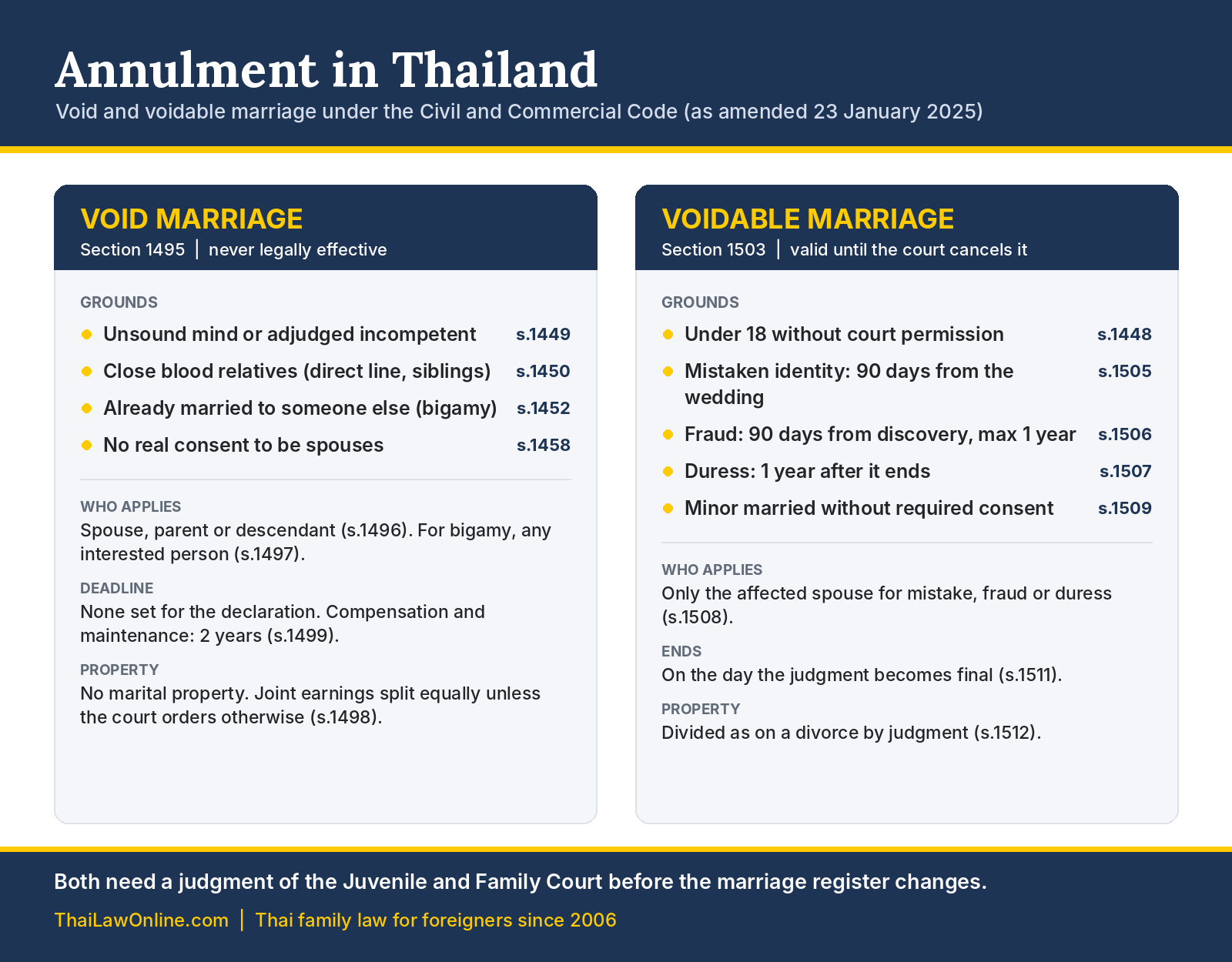
Who can apply, and how long you have
Void marriages
For Sections 1449, 1450 and 1458 the circle is narrow. A spouse, a parent or a descendant of a spouse may apply. If there is none, an interested person can ask the public prosecutor to apply (Section 1496). In Decision 3898/2548 an objector outside that circle was turned away.
Bigamy is different. Any interested person may raise the nullity or apply for a judgment (Section 1497). That includes the first spouse, the second spouse, the children and the heirs. In Decision 4981/2541 a second wife discovered her husband’s earlier marriage. She applied by simple petition, and the Supreme Court held that was the right procedure.
Heirs use this rule often. In Decision 2984/2569, summarised in our guide to marriage in Thailand, a child the father had acknowledged had his later, bigamous marriage declared void. Until that judgment, the second spouse had been treated as a lawful spouse and had even been appointed administrator of the estate.
The Code sets no deadline for a declaration of nullity. The money claims that follow it do have one, covered below. When a judgment of nullity becomes final, the court notifies the registrar so the marriage register is noted (Section 1497/1).
Voidable marriages
Voidable marriages are the opposite. The applicants are few and the clocks are short. If you think you were deceived or forced into a marriage, the deadline matters more than anything else in this article. Get advice in weeks, not months.
Annulment vs divorce in Thailand: which route fits?
| Question | Void marriage | Voidable marriage | Divorce |
|---|---|---|---|
| What does it end? | A marriage that never took legal effect | A valid but defective marriage | A valid marriage |
| From when? | Treated as never effective; good faith rights are protected (s.1499) | From the day the judgment becomes final (s.1511) | From registration, or the day the judgment becomes final |
| Marital property? | None arises; joint earnings are split equally unless the court orders otherwise (s.1498) | Divided as on a divorce by judgment (s.1512) | Divided equally (s.1533) |
| Inheritance between spouses? | A bigamous spouse is never a statutory heir. For other void grounds, a spouse in good faith keeps rights acquired before the final judgment (s.1499) | Ends on the final judgment | Ends on divorce |
| Can it be done at the amphur? | No, a court judgment is needed | No, a court judgment is needed | Yes, if both agree |
Sometimes divorce is the better tool. If the marriage is only voidable and both of you want out, a registered divorce at the district office takes an afternoon. Our divorce guide explains how it works, and contested divorce covers the court route on the grounds in Section 1516.
A void marriage is another matter. Registering a divorce doesn’t cure a bigamous marriage. Heirs can still attack it after a death, and the second spouse can still lose inheritance rights. If the marriage is void, we usually advise fixing the record properly.
What happens to property after annulment in Thailand
Void marriage: no marital property
A void marriage creates no property relationship between the spouses (Section 1498). There is no sin somros. Whatever each person had or acquired, before or after the wedding, stays theirs with its fruits. Property you earned together is split equally, unless the court orders otherwise after looking at family responsibilities, earning capacity and the parties’ circumstances.
Third parties are protected. A buyer or lender who acted in good faith before the nullity was noted in the marriage register keeps their rights (Section 1500). So make sure the court’s notice reaches the registrar and is noted promptly.
Voidable marriage: the divorce rules apply
Once a voidable marriage is cancelled, the rules on the effects of a divorce by judgment apply (Section 1512). Each spouse keeps their sin suan tua, and the marital property is divided equally. The cancellation can’t be used against third parties acting in good faith unless it has been registered (Section 1511).
Compensation and maintenance
A spouse who married in good faith keeps the rights acquired through the marriage up to the cut-off date in Section 1499. For Sections 1449, 1450 and 1458 that date is the final judgment. For bigamy it’s the day the spouse learned of the problem.
That spouse may also claim compensation. If the void marriage leaves them impoverished, they may claim maintenance too, on the terms of Section 1526. Both claims must be brought within two years of the final judgment, or for bigamy, of learning of the cause.
For a voidable marriage, a spouse who knew of the defect must compensate the other for harm to body, reputation or property. If the cancellation leaves the other spouse poorer and without enough income from property or work, that spouse must also pay maintenance (Section 1513).
Inheritance
A bigamous marriage never makes the second spouse a statutory heir of the other (Section 1499). That rule is why so many nullity cases start after a funeral. If the deceased left a will in favour of the second spouse, the will still works within its limits. Our inheritance guide for foreigners explains the order of heirs under Section 1629.
Children of a void or voidable marriage
The answer depends on the route. A child born during a voidable marriage that the court later cancels is legitimate (Section 1560).
A child born during a bigamous marriage is presumed to be the legitimate child of the husband in the later registration (Section 1538). The same applies to a child born within 310 days of the judgment declaring that marriage void. This is a presumption, so it can be rebutted in court.
No section gives the same protection where a marriage is void for unsound mind, blood relationship or lack of consent. In those cases the father may need to legitimate the child to secure his legal tie.
When a marriage is void, the parents agree in writing who exercises parental power over each child and who pays maintenance. If they can’t agree, the court decides with the child’s welfare first (Section 1499/1). Our guides on child custody, child support and child legitimation take each issue further.
How to annul a marriage in Thailand: step by step
- Identify the ground. Decide whether the facts make the marriage void or voidable. Everything else depends on that answer.
- Check the deadline. For a voidable marriage, count the days now. A missed deadline can’t be fixed.
- Collect the documents. You’ll need the marriage certificate (Kor Ror 3) or an extract of the register, ID and passport copies, and the evidence of the ground. For bigamy, that means proof of the earlier marriage and that it still existed on the wedding day.
- Translate and legalise foreign papers. Foreign marriage or divorce records need a certified Thai translation and usually legalisation. See our page on legalisation of documents.
- File with the Juvenile and Family Court. A void-marriage case is usually filed as a petition. A voidable-marriage case is a lawsuit against the other spouse. If you also claim property or maintenance, say so in the same filing.
- Serve the other side and attend the hearing. The court hears the evidence and the witnesses. Proceedings are in Thai, so a foreign party gives evidence through an interpreter.
- Wait for the judgment to become final. Under the general rule, an appeal must be filed within one month of the judgment being read (Civil Procedure Code, Section 229).
- Update the register. For a void marriage the court notifies the registrar. For a cancelled marriage, register the cancellation at the district office so it binds third parties.
- Deal with your home country. Your embassy, your home registry and Thai Immigration may each need a certified, translated copy of the final judgment.
Costs and timing
We don’t publish a fixed fee for annulment, because the work varies too much. An uncontested bigamy petition with clear records is a different job from a fraud case the other spouse fights. Here is what drives the cost.
| Item | What to expect |
|---|---|
| Court filing fee | A flat 200 baht for a claim with no money value. If you also claim property or a sum already due, 2% of the amount claimed applies; a claim for future maintenance payments carries a separate flat 100 baht (Civil Procedure Code Table 1, items (1) and (4); see court fees). |
| Translations and legalisation | Charged per document. Foreign marriage and divorce records are the usual items. |
| Lawyer’s fee | Quoted after a consultation, depending on the ground, the evidence and whether the case is contested. |
| Consultation with ThaiLawOnline | 2,000 THB per hour, paid in advance (book a consultation). |
| Time | An unopposed petition moves fastest. Contested cases, and service on a spouse living abroad, take considerably longer. |
Annulment for foreigners: what to watch for
- You can act from abroad. A Thai lawyer can file for you under a power of attorney signed before a notary and legalised. Ask early whether the court will need your own evidence. Our page on hiring a Thai lawyer from abroad sets out how we work remotely.
- Check the foreign divorce first. Many bigamy cases start with a divorce abroad that was never made final. Before you remarry in Thailand, get the final decree, not the interim order. Our marriage guide lists the documents the amphur asks for.
- Your visa depends on the marriage. An extension of stay based on marriage needs a valid, genuine marriage. Once the marriage is declared void or cancelled, that basis is gone. Plan the next visa before the judgment, not after. See our Non-O marriage visa guide.
- Think about your will. If your status changes, your estate plan probably should too. Our Thai will guide explains what to update.
Frequently asked questions about annulment in Thailand
How do I annul a marriage in Thailand?
You file a case with the Juvenile and Family Court. For a void marriage, a spouse, parent, or descendant may apply for a judgment.In a bigamy case, any interested person may apply. For a voidable marriage, the affected spouse sues for cancellation before the deadline.
Is a bigamous marriage in Thailand void or voidable?
It is void under Sections 1452 and 1495 of the Civil and Commercial Code. Any interested person may ask the court to declare it void (Section 1497). Until then the register still shows the marriage.
What is the deadline to annul a marriage in Thailand?
Mistaken identity: 90 days from the wedding. Fraud: 90 days from discovery, and never later than one year from the wedding. Duress: one year after it ends. The Code sets no deadline for declaring a marriage void. Compensation and maintenance claims expire two years after the final judgment. In a bigamy case, the two years run from when you learned of the earlier marriage.
Can I annul my marriage because my spouse lied to me?
Only if the fraud was so serious that you wouldn’t have married without it. You must act within 90 days of discovering it and within one year of the wedding. Ordinary lies about money or habits are a matter for divorce.
What happens to property after an annulment in Thailand?
A void marriage creates no marital property. Each person keeps their own property. Joint earnings are split equally, unless the court orders otherwise (Section 1498). A cancelled voidable marriage follows the divorce rules, so the marital property is divided equally.
Are children still legitimate if a marriage is annulled?
A child born during a voidable marriage that the court cancels is legitimate (Section 1560). A child of a bigamous marriage is presumed the child of the later husband (Section 1538). If the marriage is void for another reason, the father may need to legitimate the child.
Is annulment the same as divorce in Thailand?
No. Divorce ends a valid marriage, by agreement at the district office or on the grounds in Section 1516. Annulment deals with a marriage that was defective from the start and needs a court judgment. The nullity of a bigamous marriage can also be raised in other cases (Section 1497).
Can a foreigner annul a Thai marriage from abroad?
Yes. A Thai lawyer can file under a notarised and legalised power of attorney. The court may still want your evidence, so plan for a hearing date.
How ThaiLawOnline can help
We’ve handled Thai family matters for foreign clients since 2006, all remotely by email, phone, video, LINE and WhatsApp. Court work is handled by our Thai lawyer of record, Khun Wichuda Atthamethakon. We’ll tell you first whether your marriage is void, voidable or simply over, because that answer decides the cost and the timetable.
- Consultation: 2,000 THB per hour, paid in advance. Book a consultation.
- If divorce is the better route: see our divorce service and our fixed-fee services.
- Research first: browse our family law Supreme Court decisions and the annotated Book 5 of the Civil and Commercial Code.
Key takeaways
- A Thai marriage is void only for unsound mind, close blood relationship, bigamy or lack of consent (Section 1495).
- It is voidable only for underage marriage, mistaken identity, fraud, duress or a minor’s missing consent (Section 1503).
- Both kinds need a court judgment before the register changes, though bigamy can also be raised in other proceedings.
- Voidable claims have short deadlines, as short as 90 days.
- A void marriage creates no marital property, and a bigamous spouse never inherits as a statutory heir.
- Children of a cancelled voidable marriage stay legitimate; after other void marriages the father may need to legitimate the child.
Thai Law Updates, free by email
Plain-English updates on Thai law changes that affect foreigners: property, visas, marriage, business and wills. One short email a month from a firm practicing since 2006. No spam, unsubscribe anytime.