


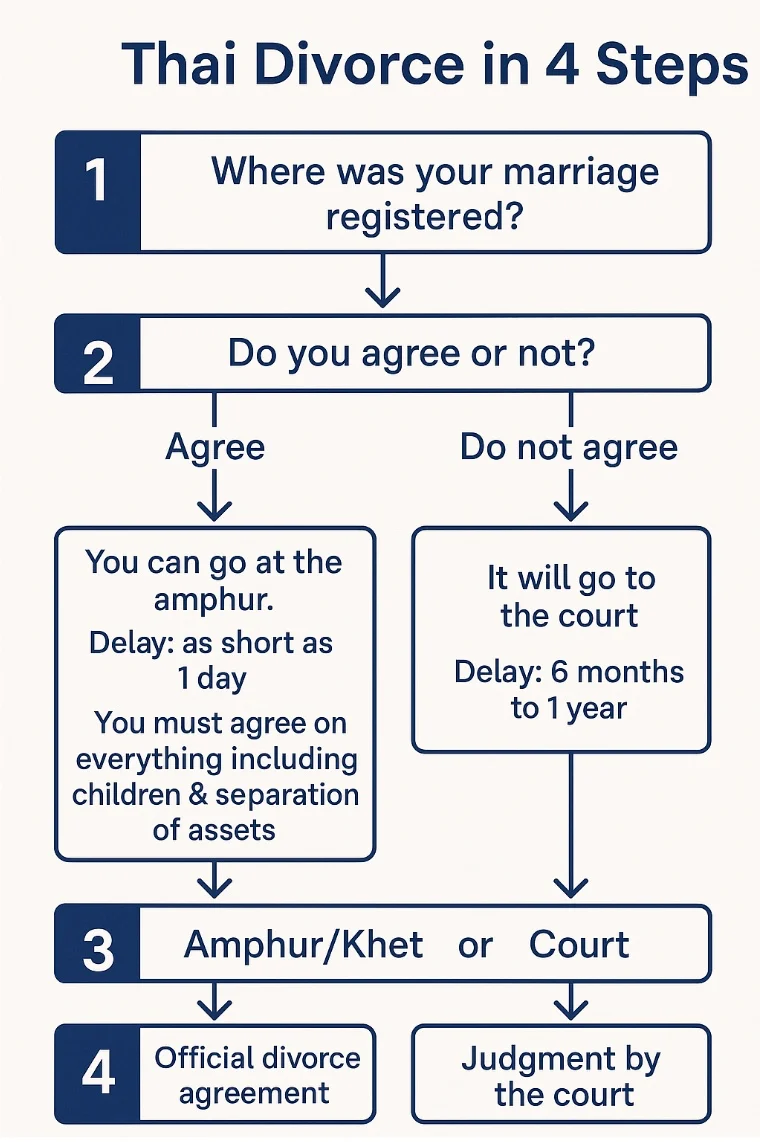
A foreigner can divorce in Thailand in two ways. If both spouses agree, the divorce can be registered at the district office by mutual consent, usually in one visit, with a written divorce agreement signed in front of two witnesses (sections 1514 and 1515 of the Civil and Commercial Code). If one spouse refuses, or the district office will not register it, the case goes to the Family Court on one of the grounds in section 1516. Either way, marital property (sin somros) is normally split equally (section 1533), and custody and child support have to be settled.
Reviewed by Wichuda Atthamethakon, LL.M., Thai Bar Licence 3149/2556, for ThaiLawOnline, a Thai law firm acting for foreigners since 2006.
Update log
- 2 November 2026: Moved the answer to the top, added a route comparison, shortened the page and moved the detail to the related guides
- 31 October 2026: Added the statute box with Thai, English and French text and checked the page against the official text
Divorce is one branch of Thai family law, which also covers marital property, custody and inheritance.
Uncontested or contested: the two routes compared
| Uncontested (mutual consent) | Contested (court) | |
|---|---|---|
| Where | Any district office (amphur or khet), both spouses attending with two witnesses | Juvenile and Family Court |
| Time | Agreement in 3 to 5 days, then one district office visit | Usually 6 to 12 months at first instance, longer on appeal |
| Cost | Fixed 9,900 THB with us, including the bilingual divorce agreement | Court fee of 200 THB without financial claims, 2% of the amount claimed where property is disputed. Our fee is quoted after a consultation |
Watch: Divorce in Thailand Explained
Watch our divorce in Thailand video guide for an overview of uncontested divorce and court proceedings.

Divorce in Thailand in five points
- Uncontested Divorce (Mutual Consent)
If both spouses agree, they can register the divorce at their local amphur (district office). No court is needed, just both spouses present with ID, marriage certificate, a written divorce agreement and two witnesses . - Contested Divorce (Court Route)
When one spouse doesn’t agree, the divorce proceeds through the Thai courts. Grounds include adultery, abandonment, abuse, desertion, and serious misconduct . - Documentation Required
Thai ID or passport, marriage certificates, and a draft divorce agreement are needed. The agreement should specify asset division, child custody, and alimony. Write it clearly in both Thai and English. Have a lawyer review it as well. - Property Division (Separation of Assets)
Assets are categorized as marital (shared) or personal. Marital assets are generally split equally unless stated otherwise in a prenup or divorce agreement . - Divorce Certificate (ใบหย่า)
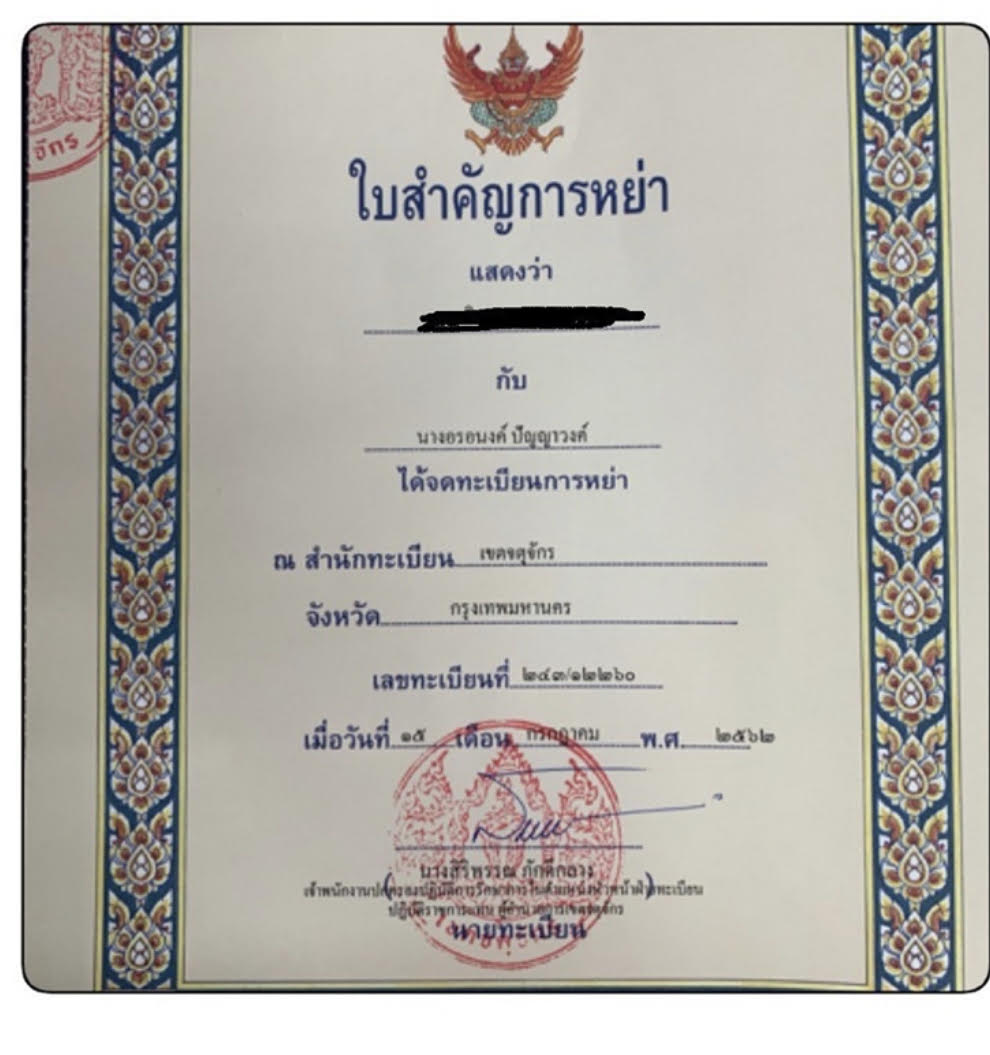
The official divorce certificate (“Bai Yah”) is issued upon completion. For expatriates, ensure proper handling to update immigration or visa status .
Know which of the two routes you are on before you do anything else. If you are a foreigner, get the documents right, above all the written agreement on money and children, because the district office registers what you hand it and will not fix it for you. Our Thai lawyers speak English, which saves time on both routes.
This page is written by me, Sébastien Brousseau (LL.B., B.Sc., managing law firms in Thailand since 2006), with Khun Wichuda Atthamethakon (LL.M., Thai lawyer and Notarial Services Attorney), who handles the Thai court side of our divorce files. We have handled about ten divorces a year since 2006.
Table of Contents
Foreigners Divorce in Thailand: What Expats Need to Know
The short answer is at the top of this page. The detail on jurisdiction, Conflict of Laws sections 26 and 27, and a marriage registered abroad is under Divorce for Foreigners in Thailand below. The statute texts sit in the box that follows.
The law behind this page
English
Section 1514
Divorce is possible only by mutual consent or by court judgment. A divorce by mutual consent must be in writing and signed by at least two witnesses; where the marriage was registered, it takes effect only once the divorce is registered (Section 1515).
Full text
A divorce may be effected only by the consent of both parties or by a judgment of the court. A divorce by consent must be made in writing and signed by at least two witnesses.
ThaiLawOnline translation
Section 1515Amended on 23 January 2025
Full text
Where a marriage has been registered under this Code, a divorce by mutual consent is complete only when the spouses have registered the divorce.
ThaiLawOnline translation
Section 1516Amended on 23 January 2025
Section 1516 sets out twelve grounds for a divorce action; most turn on the other spouse's conduct, but some, such as separation, disappearance, unsoundness of mind, disease and physical incapacity, do not: (1) keeping or honouring another person as a spouse, adultery, or habitual sexual acts with another; (2) misconduct, whether or not a criminal offence, that causes the other spouse serious shame, contempt or hatred, or excessive injury or trouble; (3) serious physical or mental harm, torture, or grave insult to the spouse or the spouse's ascendants; (4) wilful desertion for more than one year; (4/1) final imprisonment served for more than one year for an offence in which the other spouse had no part, where continuing the marriage would cause the other spouse excessive injury or trouble; (4/2) voluntary separation for more than three years, or separation by court order for more than three years; (5) being declared a missing person, or absence for more than three years with no news; (6) failure to give proper support and maintenance, or acting seriously adversely to the marriage, to the point that the other spouse suffers excessive trouble; (7) insanity continuing more than three years and unlikely to be cured; (8) breach of a written bond as to conduct; (9) a serious, chronic and incurable communicable disease dangerous to the other spouse; (10) a physical condition making sexual intercourse permanently impossible. Spouses of any gender rely on the same grounds under the Marriage Equality Act B.E. 2567.
Full text
The grounds for a divorce action are as follows: (1) one spouse has maintained or honoured another person as a spouse, has committed adultery or has a lover, has habitually had sexual intercourse with another person, or has habitually done an act with another person, or accepted an act of another person, to gratify the sexual desire of that spouse or of another person; the other spouse may bring a divorce action; (2) one spouse is guilty of misconduct, whether or not that misconduct is a criminal offence, if it causes the other spouse: (a) to suffer serious shame and humiliation; (b) to be held in contempt and hatred on account of remaining the spouse of the spouse guilty of the misconduct; or (c) to suffer excessive injury or trouble, regard being had to their condition, status and life together as spouses; that other spouse may bring a divorce action; (3) one spouse has physically or mentally harmed or tortured, or has defamed or insulted, the other spouse or an ascendant of the other spouse; provided that it is serious, that other spouse may bring a divorce action; (4) one spouse has wilfully deserted the other spouse for more than one year; that other spouse may bring a divorce action; (4/1) one spouse has been sentenced by a final judgment to imprisonment and has been imprisoned for more than one year for an offence which the other spouse did not contribute to causing, did not consent to and was not privy to, and continuing to be spouses would cause that other spouse excessive injury or trouble; that other spouse may bring a divorce action; (4/2) the spouses have voluntarily lived apart, because they could not live together as spouses in normal happiness, continuously for more than three years, or have lived apart by order of the court for more than three years; either spouse may bring a divorce action; (5) one spouse has been declared by the court to be a disappeared person, or has left that spouse's domicile or residence for more than three years with no one knowing for certain whether that spouse is alive or dead; the other spouse may bring a divorce action; (6) one spouse has failed to give the other proper assistance and maintenance, or has acted in serious hostility to the state of being spouses, to such an extent that the other spouse suffers excessive trouble, regard being had to their condition, status and life together as spouses; that other spouse may bring a divorce action; (7) one spouse has been of unsound mind continuously for more than three years, the unsoundness of mind being unlikely to be cured and so severe that living together as spouses can no longer be endured; the other spouse may bring a divorce action; (8) one spouse has broken a bond of good behaviour given in writing; the other spouse may bring a divorce action; (9) one spouse is suffering from a serious communicable disease which may be dangerous to the other spouse and which is chronic and incurable; that other spouse may bring a divorce action; (10) one spouse has a physical condition making that spouse permanently unable to have sexual intercourse, or permanently unable to do or to accept an act to gratify the sexual desire of the other spouse; the other spouse may bring a divorce action.
ThaiLawOnline translation
Section 1529
A right of action based on Section 1516 (1), (2), (3) or (6), or on Section 1523, is extinguished one year after the claimant knew or ought to have known the facts relied on. The period runs from knowledge, actual or constructive, not from the conduct itself. A ground that can no longer found a divorce claim in its own right may still be proved in support of a divorce claim brought on some other ground.
Full text
The right of action based on a ground in section 1516 (1), (2), (3) or (6), or in section 1523, is extinguished on the expiry of one year from the day on which the person invoking it knew or ought to have known the facts on which that person could rely. A ground that can no longer be relied on to sue for divorce may nevertheless be adduced in evidence in support of a divorce action based on another ground.
ThaiLawOnline translation
Section 27 Act on Conflict of Laws B.E. 2481
Full text
A Thai court shall not grant a divorce unless the law of the nationality of both husband and wife permits divorce. The grounds for divorce are governed by the law of the place where the divorce action is filed.
ThaiLawOnline translation
Section 26 Act on Conflict of Laws B.E. 2481
Full text
A divorce by consent is valid if the law of the nationality of both husband and wife permits it.
ThaiLawOnline translation
Section 1533Amended on 23 January 2025
On divorce, the Sin Somros is divided equally between the spouses.
Full text
On divorce, the marital property shall be divided equally between the spouses.
ThaiLawOnline translation
Section 1520Amended on 23 January 2025
Full text
In the case of a divorce by mutual consent, the spouses shall make a written agreement as to which of them is to exercise parental power over which child. If no agreement is made, or agreement cannot be reached, the court shall decide. In the case of a divorce by judgment of the court, the court trying the divorce action shall also decide which party is to exercise parental power over which child. If, in so deciding, the court considers that there are grounds under Section 1582 for depriving the spouses of parental power, the court may deprive the spouses of parental power and order that a third person be guardian. In all of this, the court shall have regard primarily to the well-being and interests of the child.
ThaiLawOnline translation
ไทย
มาตรา 1514
ข้อความเต็ม
การหย่านั้นจะทำได้แต่โดยความยินยอมของทั้งสองฝ่ายหรือโดยคำพิพากษาของศาล การหย่าโดยความยินยอมต้องทำเป็นหนังสือและมีพยานลงลายมือชื่ออย่างน้อยสองคน
ตรงตามข้อความในราชกิจจานุเบกษา / สำนักงานคณะกรรมการกฤษฎีกา (Verbatim from the Royal Gazette / Office of the Council of State)
มาตรา 1515แก้ไขเมื่อ 23 มกราคม 2568
ข้อความเต็ม
เมื่อได้จดทะเบียนสมรสตามประมวลกฎหมายนี้ การหย่าโดยความยินยอมจะสมบูรณ์ต่อเมื่อคู่สมรสได้จดทะเบียนการหย่านั้นแล้ว
ตรงตามข้อความในราชกิจจานุเบกษา / สำนักงานคณะกรรมการกฤษฎีกา (Verbatim from the Royal Gazette / Office of the Council of State)
มาตรา 1516แก้ไขเมื่อ 23 มกราคม 2568
ข้อความเต็ม
เหตุฟ้องหย่ามีดังต่อไปนี้ (๑) คู่สมรสฝ่ายใดฝ่ายหนึ่งอุปการะเลี้ยงดูหรือยกย่องผู้อื่นฉันคู่สมรส เป็นชู้หรือมีชู้ ร่วมประเวณีกับผู้อื่นเป็นอาจิณ หรือกระทำกับผู้อื่นหรือยอมรับการกระทำของผู้อื่นเพื่อสนองความใคร่ของตนหรือผู้อื่นเป็นอาจิณ อีกฝ่ายหนึ่งฟ้องหย่าได้ (๒) คู่สมรสฝ่ายใดฝ่ายหนึ่งประพฤติชั่ว ไม่ว่าความประพฤติชั่วนั้นจะเป็นความผิดอาญาหรือไม่ ถ้าเป็นเหตุให้อีกฝ่ายหนึ่ง (ก) ได้รับความอับอายขายหน้าอย่างร้ายแรง (ข) ได้รับความดูถูกเกลียดชังเพราะเหตุที่คงเป็นคู่สมรสของฝ่ายที่ประพฤติชั่วอยู่ต่อไป หรือ (ค) ได้รับความเสียหายหรือเดือดร้อนเกินควร ในเมื่อเอาสภาพ ฐานะ และความเป็นอยู่ร่วมกันฉันคู่สมรสมาคำนึงประกอบ อีกฝ่ายหนึ่งนั้นฟ้องหย่าได้ (๓) คู่สมรสฝ่ายใดฝ่ายหนึ่งทำร้าย หรือทรมานร่างกายหรือจิตใจ หรือหมิ่นประมาทหรือเหยียดหยามอีกฝ่ายหนึ่งหรือบุพการีของอีกฝ่ายหนึ่ง ทั้งนี้ ถ้าเป็นการร้ายแรง อีกฝ่ายหนึ่งนั้นฟ้องหย่าได้ (๔) คู่สมรสฝ่ายใดฝ่ายหนึ่งจงใจละทิ้งร้างอีกฝ่ายหนึ่งไปเกินหนึ่งปี อีกฝ่ายหนึ่งนั้นฟ้องหย่าได้ (๔/๑) คู่สมรสฝ่ายใดฝ่ายหนึ่งต้องคำพิพากษาถึงที่สุดให้จำคุก และได้ถูกจำคุกเกินหนึ่งปีในความผิดที่อีกฝ่ายหนึ่งมิได้มีส่วนก่อให้เกิดการกระทำความผิดหรือยินยอมหรือรู้เห็นเป็นใจในการกระทำความผิดนั้นด้วย และการเป็นคู่สมรสกันต่อไปจะเป็นเหตุให้อีกฝ่ายหนึ่งได้รับความเสียหายหรือเดือดร้อนเกินควร อีกฝ่ายหนึ่งนั้นฟ้องหย่าได้ (๔/๒) คู่สมรสสมัครใจแยกกันอยู่เพราะเหตุที่ไม่อาจอยู่ร่วมกันฉันคู่สมรสได้โดยปกติสุขตลอดมาเกินสามปีหรือแยกกันอยู่ตามคำสั่งของศาลเป็นเวลาเกินสามปี ฝ่ายใดฝ่ายหนึ่งฟ้องหย่าได้ (๕) คู่สมรสฝ่ายใดฝ่ายหนึ่งถูกศาลสั่งให้เป็นคนสาบสูญ หรือไปจากภูมิลำเนาหรือถิ่นที่อยู่เป็นเวลาเกินสามปีโดยไม่มีใครทราบแน่ว่าเป็นตายร้ายดีอย่างไร อีกฝ่ายหนึ่งฟ้องหย่าได้ (๖) คู่สมรสฝ่ายใดฝ่ายหนึ่งไม่ให้ความช่วยเหลืออุปการะเลี้ยงดูอีกฝ่ายหนึ่งตามสมควร หรือทำการเป็นปฏิปักษ์ต่อการที่เป็นคู่สมรสอย่างร้ายแรง ทั้งนี้ ถ้าการกระทำนั้นถึงขนาดที่อีกฝ่ายหนึ่งเดือดร้อนเกินควรในเมื่อเอาสภาพ ฐานะ และความเป็นอยู่ร่วมกันฉันคู่สมรสมาคำนึงประกอบ อีกฝ่ายหนึ่งนั้นฟ้องหย่าได้ (๗) คู่สมรสฝ่ายใดฝ่ายหนึ่งวิกลจริตตลอดมาเกินสามปี และความวิกลจริตนั้นมีลักษณะยากจะหายได้ กับทั้งความวิกลจริตถึงขนาดที่จะทนอยู่ร่วมกันฉันคู่สมรสต่อไปไม่ได้ อีกฝ่ายหนึ่งฟ้องหย่าได้ (๘) คู่สมรสฝ่ายใดฝ่ายหนึ่งผิดทัณฑ์บนที่ทำให้ไว้เป็นหนังสือในเรื่องความประพฤติ อีกฝ่ายหนึ่งฟ้องหย่าได้ (๙) คู่สมรสฝ่ายใดฝ่ายหนึ่งเป็นโรคติดต่ออย่างร้ายแรงอันอาจเป็นภัยแก่อีกฝ่ายหนึ่ง และโรคมีลักษณะเรื้อรังไม่มีทางที่จะหายได้ อีกฝ่ายหนึ่งนั้นฟ้องหย่าได้ (๑๐) คู่สมรสฝ่ายใดฝ่ายหนึ่งมีสภาพแห่งกายทำให้ไม่อาจร่วมประเวณีหรือไม่อาจกระทำการหรือยอมรับการกระทำเพื่อสนองความใคร่ของอีกฝ่ายได้ตลอดกาล อีกฝ่ายหนึ่งฟ้องหย่าได้
ตรงตามข้อความในราชกิจจานุเบกษา / สำนักงานคณะกรรมการกฤษฎีกา (Verbatim from the Royal Gazette / Office of the Council of State)
มาตรา 1529
ข้อความเต็ม
สิทธิฟ้องร้องโดยอาศัยเหตุในมาตรา ๑๕๑๖ (๑) (๒) (๓) หรือ (๖) หรือมาตรา ๑๕๒๓ ย่อมระงับไปเมื่อพ้นกำหนดหนึ่งปีนับแต่วันผู้กล่าวอ้างรู้หรือควรรู้ความจริงซึ่งตนอาจยกขึ้นกล่าวอ้าง เหตุอันจะยกขึ้นฟ้องหย่าไม่ได้แล้วนั้น อาจนำสืบสนับสนุนคดีฟ้องหย่าซึ่งอาศัยเหตุอย่างอื่น
ตรงตามข้อความในราชกิจจานุเบกษา / สำนักงานคณะกรรมการกฤษฎีกา (Verbatim from the Royal Gazette / Office of the Council of State)
มาตรา 27 พระราชบัญญัติว่าด้วยการขัดกันแห่งกฎหมาย พุทธศักราช 2481
ข้อความเต็ม
ศาลไทยจะไม่พิพากษาให้หย่ากัน เว้นแต่กฎหมายสัญชาติแห่งสามีและภริยาทั้งสองฝ่ายยอมให้หย่าได้ เหตุหย่า ให้เป็นไปตามกฎหมายแห่งถิ่นที่ยื่นฟ้องหย่า
ตรงตามข้อความในราชกิจจานุเบกษา / สำนักงานคณะกรรมการกฤษฎีกา (Verbatim from the Royal Gazette / Office of the Council of State)
มาตรา 26 พระราชบัญญัติว่าด้วยการขัดกันแห่งกฎหมาย พุทธศักราช 2481
ข้อความเต็ม
การหย่าโดยความยินยอมย่อมสมบูรณ์ ถ้ากฎหมายสัญชาติแห่งสามีและภริยาทั้งสองฝ่ายยอมให้กระทำได้
ตรงตามข้อความในราชกิจจานุเบกษา / สำนักงานคณะกรรมการกฤษฎีกา (Verbatim from the Royal Gazette / Office of the Council of State)
มาตรา 1533แก้ไขเมื่อ 23 มกราคม 2568
ข้อความเต็ม
เมื่อหย่ากัน ให้แบ่งสินสมรสให้คู่สมรสแต่ละฝ่ายได้ส่วนเท่ากัน
ตรงตามข้อความในราชกิจจานุเบกษา / สำนักงานคณะกรรมการกฤษฎีกา (Verbatim from the Royal Gazette / Office of the Council of State)
มาตรา 1520แก้ไขเมื่อ 23 มกราคม 2568
ข้อความเต็ม
ในกรณีหย่าโดยความยินยอม ให้คู่สมรสทำความตกลงเป็นหนังสือว่า ฝ่ายใดจะเป็นผู้ใช้อำนาจปกครองบุตรคนใด ถ้ามิได้ตกลงกันหรือตกลงกันไม่ได้ ให้ศาลเป็นผู้ชี้ขาด ในกรณีหย่าโดยคำพิพากษาของศาล ให้ศาลซึ่งพิจารณาคดีฟ้องหย่านั้นชี้ขาดด้วยว่าฝ่ายใดจะเป็นผู้ใช้อำนาจปกครองบุตรคนใด ในการพิจารณาชี้ขาดถ้าศาลเห็นว่ามีเหตุที่จะถอนอำนาจปกครองของคู่สมรสนั้นได้ตามมาตรา ๑๕๘๒ ศาลจะถอนอำนาจปกครองของคู่สมรสและสั่งให้บุคคลภายนอกเป็นผู้ปกครองก็ได้ ทั้งนี้ ให้ศาลคำนึงถึงความผาสุกและประโยชน์ของบุตรนั้นเป็นสำคัญ
ตรงตามข้อความในราชกิจจานุเบกษา / สำนักงานคณะกรรมการกฤษฎีกา (Verbatim from the Royal Gazette / Office of the Council of State)
Français
Article 1514
Le divorce ne peut avoir lieu que par le consentement des deux parties ou par un jugement du tribunal. Le divorce par consentement doit être fait par écrit et signé par au moins deux témoins.
résumé non officiel
Article 1515Modifié le 23 janvier 2025
Lorsque le mariage a été enregistré conformément au présent Code, le divorce par consentement mutuel n'est parfait qu'une fois que les époux ont fait enregistrer ce divorce.
résumé non officiel
Article 1516Modifié le 23 janvier 2025
Les causes de l'action en divorce sont les suivantes : (1) l'un des époux a entretenu ou honoré une autre personne comme son conjoint, a commis l'adultère ou a un amant, a eu habituellement des relations sexuelles avec une autre personne, ou a habituellement accompli avec une autre personne, ou accepté d'une autre personne, un acte destiné à satisfaire son désir sexuel ou celui d'autrui ; l'autre époux peut demander le divorce ; (2) l'un des époux s'est mal conduit, que cette inconduite constitue ou non une infraction pénale, si elle a pour effet que l'autre époux : (a) subit une honte et une humiliation graves ; (b) est l'objet de mépris et de haine du fait qu'il demeure le conjoint de l'époux fautif ; ou (c) subit un préjudice ou des difficultés excessifs, compte tenu de la condition, de la situation et de la vie commune des époux ; cet autre époux peut demander le divorce ; (3) l'un des époux a porté atteinte au corps ou à l'esprit de l'autre époux ou d'un ascendant de celui ci, l'a torturé, diffamé ou injurié ; si ces faits sont graves, l'autre époux peut demander le divorce ; (4) l'un des époux a volontairement abandonné l'autre pendant plus d'un an ; l'autre époux peut demander le divorce ; (4/1) l'un des époux a été condamné par un jugement définitif à une peine d'emprisonnement et a été emprisonné pendant plus d'un an pour une infraction à la commission de laquelle l'autre époux n'a pas contribué, à laquelle il n'a pas consenti et dont il n'a pas été complice par connivence, et le maintien du mariage causerait à l'autre époux un préjudice ou des difficultés excessifs ; l'autre époux peut demander le divorce ; (4/2) les époux ont volontairement vécu séparés, faute de pouvoir vivre ensemble normalement et heureusement comme époux, de manière continue pendant plus de trois ans, ou ont vécu séparés en vertu d'une décision de justice pendant plus de trois ans ; chacun des époux peut demander le divorce ; (5) l'un des époux a été déclaré absent par le tribunal, ou a quitté son domicile ou sa résidence depuis plus de trois ans sans que personne ne sache avec certitude s'il est vivant ou mort ; l'autre époux peut demander le divorce ; (6) l'un des époux n'a pas fourni à l'autre l'assistance et l'entretien convenables, ou a agi de manière gravement hostile à l'état d'époux, au point que l'autre époux en subit des difficultés excessives, compte tenu de la condition, de la situation et de la vie commune des époux ; l'autre époux peut demander le divorce ; (7) l'un des époux est atteint d'aliénation mentale de manière continue depuis plus de trois ans, cette aliénation étant difficilement curable et d'une gravité telle que la vie commune ne peut plus être supportée ; l'autre époux peut demander le divorce ; (8) l'un des époux a manqué à un engagement de bonne conduite souscrit par écrit ; l'autre époux peut demander le divorce ; (9) l'un des époux est atteint d'une maladie contagieuse grave pouvant mettre l'autre époux en danger, cette maladie étant chronique et incurable ; l'autre époux peut demander le divorce ; (10) l'un des époux présente un état physique le rendant définitivement incapable d'avoir des relations sexuelles, ou d'accomplir ou d'accepter un acte destiné à satisfaire le désir sexuel de l'autre ; l'autre époux peut demander le divorce.
résumé non officiel
Article 1529
L'action fondée sur l'article 1516 (1), (2), (3) ou (6) ou l'article 1523 s'éteint un an après que le demandeur a connu ou aurait dû connaître les faits. Une cause éteinte peut encore étayer une action fondée sur une autre cause.
résumé non officiel
Article 27 Act on Conflict of Laws B.E. 2481
Le tribunal thaïlandais ne prononce le divorce que si la loi nationale des deux époux l'admet. Les causes de divorce relèvent de la loi du lieu où l'action est introduite.
résumé non officiel
Article 26 Act on Conflict of Laws B.E. 2481
Le divorce par consentement est valable si la loi nationale des deux époux le permet.
résumé non officiel
Article 1533Modifié le 23 janvier 2025
En cas de divorce, les biens communs sont partagés de manière que chacun des époux en reçoive une part égale.
résumé non officiel
Article 1520Modifié le 23 janvier 2025
En cas de divorce par consentement mutuel, les époux conviennent par écrit de celui d'entre eux qui exercera l'autorité parentale sur chaque enfant. À défaut d'accord, ou s'ils ne parviennent pas à s'accorder, le tribunal statue. En cas de divorce prononcé par jugement, le tribunal saisi de l'action en divorce statue également sur la partie qui exercera l'autorité parentale sur chaque enfant. Si, en statuant, le tribunal estime qu'il existe un motif de retirer l'autorité parentale aux époux en vertu de l'article 1582, il peut leur retirer l'autorité parentale et ordonner qu'un tiers soit tuteur. Dans tous les cas, le tribunal prend principalement en considération le bien-être et l'intérêt de l'enfant.
résumé non officiel
Supreme Court decisions
- 1869/2566 (2023): No Thai Divorce From a Foreign Spouse Unless Their National Law Is Proved to Allow Divorce
- 451/2567 (2024): Three-Year Separation Divorce Ground Fails If Only One Spouse Wanted It
- 4104/2564 (2021): Expelling the Wife From the Home Is Serious Hostility; Later Family Trips Are Not Forgiveness
- 7534/2560 (2017): Leaving a Sick Spouse for Over a Year Is Desertion; the Other Woman Cannot Appeal the Divorce
- 157/2561 (2018): A Wife Locked Out After Complaining of Her Husband's Affair Has Not Deserted Him
- 875/2561 (2018): No Post-Divorce Alimony After a Consent Settlement Because No Spouse Is Found at Fault
Sources
- Civil and Commercial Code, Office of the Council of State, retrieved 31 October 2026
- Act on Conflict of Laws B.E. 2481, retrieved 31 October 2026
- deka.supremecourt.or.th, Supreme Court of Thailand decisions database (copy held in our library), retrieved 19 February 2026
Sections 1514, 1515, 1516, 1523, 1526, 1564, 1476, 1480 and 1598/39 of the Civil and Commercial Code were read against the Thai text in our own annotated Code. Sections 26 and 27 of the Conflict of Laws Act B.E. 2481 were read in the Thai original, and Supreme Court Decisions 5887/2533, 139/2569 and 1694/2569 were each read in full in Thai, to the final disposition. Court fees, timescales and district-office practice described below are practice rather than Code provisions and were not verified against a statute.
What Is the Legal Process to File for a Divorce in Thailand?
If you’re filing for an uncontested divorce, the process is relatively simple according to Thai law. Both spouses normally appear in person at a district office (amphur or amphoe, เขต in Bangkok). It does not have to be the office where the marriage was registered: a family registration can be requested at any district office (clause 6 of the Ministry of Interior Regulation on Family Registration B.E. 2541). You’ll need your marriage certificate, identification documents, and a signed divorce agreement. Two witnesses must also attend. If everything is in order, you’ll receive a Divorce Certificate (ใบสำคัญการหย่า) on the same day.
A) “Uncontested Divorce” or “Divorce Agreement Settlement”?
An administrative divorce is good for couples who can agree on the terms of the divorce. This mutual consent helps them avoid long court proceedings. It also makes it easy to file for divorce in Thailand. This process is usually simple and ends with a divorce certificate. This is true, especially when both parties agree on the divorce terms. It’s the simplest, quickest, and least stressful way to go, if, and it’s a big if, both you and your spouse agree on everything.
Divorce assumes the marriage was valid in the first place. If your spouse was already married, or you were deceived or forced into the marriage, the right route may be a court case to declare the marriage void or cancel it. Our guide to annulment in Thailand explains the grounds and the deadlines.
A proper divorce agreement in Thailand includes:
- Division of marital property (สินสมรส)
- Designation of personal property (สินส่วนตัว)
- Terms of child custody and parental authority
- Child support schedule and amount
- Any alimony or spousal support arrangement
This document should be in Thai (and ideally bilingual for foreigners). ThaiLawOnline offers customized divorce agreements reviewed by licensed attorneys for just 9,900 baht.
Legal Requirements for Uncontested Divorce
Unlike contested divorces that go through the courts, an uncontested divorce is handled administratively at the local District Office. In most of Thailand, this is called the ‘Amphur’, while in Bangkok it’s known as the ‘Khet’. This is a term used in Thailand, where citizens get married in Thailand.
- Where to Go: Any Amphur/Khet will register the divorce, not only the one where you registered your marriage (clause 6 of the Ministry of Interior Regulation on Family Registration B.E. 2541).
- Go Together, or at Two Offices: Each spouse must sign in person, but not necessarily at the same office. If you cannot both attend one office, each of you can sign at a different district office, or at a Thai registry abroad, and the divorce takes effect only when the second office registers it. If the second spouse does not file within 60 days of being notified, the first office and the first spouse are told (clause 21). Going together is faster: see the section on divorce when one party is abroad below.
- Bring Witnesses: You’ll also need two witnesses to come with you, as required by Thai divorce law.
Make sure you have everything ready:
- You need to provide your original IDs to file for a divorce. Thai nationals should use their Thai ID cards. Foreigners or expats should use their passports.
- Your original Marriage Certificate.
- The signed Divorce Agreement (bring a couple of copies).
- Your two witnesses (they need their IDs too!).
The District Officer will check your documents. They will confirm your identities and those of your witnesses. Most importantly, they will ensure that you both truly agree to the divorce. They will also make sure you understand the terms of your agreement. If everything is in order, they’ll officially register your divorce. You’ll each receive a Divorce Certificate (ใบสำคัญการหย่า, Bai Samkhan Kan Ya). The Divorce Agreement is usually attached or noted, making the terms you agreed upon legally binding.
Read more: uncontested divorce step by step, the divorce certificate, what a divorce agreement covers.
B) Contested divorce (or Divorce in Court)
However, contested cases require legal proceedings where both parties present their arguments and evidence in court. The Family Court will decide how to divide assets, child custody, and other important matters. This includes spousal support. Both parties must understand their rights and duties under Thai law during this process. The legal grounds that justify filing a contested divorce are detailed under Thai law. See the section below on Grounds for Divorce For a full explanation of these reasons regarding marriage in Thailand.
Grounds for Divorce (Reasons for Contested Divorce)
The grounds for divorce in Thailand are set out in Section 1516 of the Thai Civil and Commercial Code. Here are the legally recognized grounds for filing a contested divorce in Thailand, apart from breach of a written bond of good behaviour (section 1516(8)):
| Ground | Explanation |
|---|---|
| Adultery | One spouse has committed adultery or honors another person as a spouse. |
| Misconduct | Serious misconduct or criminal behavior by one spouse causing shame or harm. |
| Abuse or Harm | Physical or mental abuse, including serious insult or cruelty. Any act of domestic violence in Thailand will be looking at by a court. |
| Desertion | Abandonment for more than 1 year without reasonable cause. |
| 3-Year Separation | Living apart for more than 3 years by mutual consent or under a court order. |
| Imprisonment | One spouse has been sentenced by a final judgment and has actually served more than 1 year in prison for an offence the other spouse had no part in and did not tolerate, and continuing the marriage would cause the other spouse undue harm or hardship. |
| Disappearance | A spouse disappears for more than 3 years without news. |
| Incurable Insanity | Insanity that has continued for more than three years, is unlikely to be cured, and is so severe that married life cannot continue (section 1516(7)). |
| Broken Duty | A spouse fails to give the other proper support or is seriously hostile to the marriage, to the point of causing the other undue hardship (section 1516(6)). |
| Incurable Disease | One spouse has a serious contagious disease that may endanger the other, is chronic and cannot be cured (section 1516(9)). |
| Physical Disability | A spouse has a permanent physical condition that makes sexual relations impossible (section 1516(10)). |
For the full text about grounds of divorce at section 1516 of the Commercial Civil Code of Thailand, click on this link.
If you are fighting over the children or the property, get a lawyer.
Proving one of these grounds in court takes evidence, and a lot of it. Before you file, have a Thai family lawyer look at what you actually have and tell you honestly whether it is enough.
A contested divorce is complex: Booking a consultation with us will help you to understand.
Read more: contested divorce in Thailand, adultery as a ground for divorce.
Adultery and Its Role in Divorce Cases in Thailand
Adultery is not a criminal offense in Thailand, but it can be used as legal grounds for a contested divorce. If one spouse supports or honors another person as a spouse, commits adultery, or habitually has sexual relations with someone else, the other spouse has the right to petition the court to dissolve the marriage, unless they consented to it or tolerated it (section 1517). Besides the divorce, the hurt spouse can also ask for money from the other person involved. This is true if that person knew the spouse was already married.
Three Supreme Court decisions every foreigner should know
- Decision 1869/2566: a Thai wife lost her divorce from her British husband because she never proved, as a fact, that English law permits divorce. A foreign spouse must meet section 27 of the Conflict of Laws Act before any ground is examined.
- Decision 451/2567: a husband who had lived apart for far more than three years still lost, because the separation must be voluntary on both sides and his was caused by his own affair.
- Decision 875/2561: a divorce settled by consent produces no fault finding, so no alimony is due unless the settlement says so.
We summarise the rest in Supreme Court decisions on divorce in Thailand, and you can read every judgment in our Family Law decisions library.
A big legal change came in two steps. First, the Thai Constitutional Court decided that current adultery laws were unfair to women. Before this ruling, a husband could sue his wife’s lover regardless of gender, but a wife could sue only her husband’s female lover. This was found to be discriminatory. The law was later revised and came into effect in early 2025, replacing gender-specific terms with the word “spouse.” Now, either husband or wife can claim compensation from the third party, regardless of gender.
What our Thai lawyers do on a divorce file
On a divorce file, our Thai lawyers tell you what documents and evidence to collect, draft or check the divorce agreement, go to court for you if it comes to that, and deal with the translations and the official steps. We do this for foreigners in Bangkok and Pattaya on both the district office route and the court route.
Important parts of any divorce in Thailand or abroad
Child Custody and Support in Thailand
In Thailand, child custody is called “parental power.” It includes the rights and duties of parents to their children until the children turn 20. This includes determining the child’s residence, managing discipline, overseeing education, and handling property matters. Upon divorce, custody arrangements can be settled through mutual agreement or court intervention. If both parents agree on custody terms, these should be documented in the divorce agreement. In disputes, the Thai Family Court will decide what is best for the child. They will look at the child’s age, health, emotional bonds, and the parents’ ability to care for them.
Thai law prioritizes the child’s best interests when determining custody (‘Parental Power’). This can be agreed upon mutually in an uncontested divorce or decided by the court in a contested case. Both sole and joint custody arrangements are possible.
Child support is a separate question from custody. The parent who does not have custody normally pays toward the child’s upbringing. The amount is set by agreement or by the court, looking at what the child needs and what the paying parent can afford. Put it in writing, in the agreement or the court order, so it can be enforced. For more information on custody matters, refer to our Child Custody in Thailand guide.
Read more: child custody in Thailand, child support in Thailand.
Alimony (Spousal Support Laws) in Thailand
Alimony, or spousal support, refers to financial assistance provided by one spouse to the other after divorce. In Thailand, alimony is not given automatically. It must be requested and explained. The court weighs the payer’s ability to pay and the recipient’s position (section 1526). Thai law knows three sources of post-divorce support, not the American categories of temporary, rehabilitative or permanent alimony:
- The living allowance (section 1526): only where the divorce is granted for a ground that is the fault of the other spouse alone and the divorce leaves the claimant poorer, without enough income from property or work. The court may award what it thinks fit, or nothing, weighing the payer’s means and the recipient’s position, and the claim is lost unless it is made in the plaint or counterclaim in the divorce case itself.
- Divorce for insanity or a serious contagious disease (section 1527): the other spouse must pay a living allowance to the spouse who is ill, calculated in the same way.
- Agreed maintenance: whatever the spouses write into a divorce agreement, which is the usual route in a divorce by mutual consent.
A statutory living allowance ends if the recipient remarries (section 1528), and the court can later vary it on a change of circumstances (section 1526 applies section 1598/39).
Read more: how long support lasts and when it can change.
Division of Marital Property in Thailand
- Personal Property (สินส่วนตัว, Sin Suan Tua): This includes assets that a spouse owned before the marriage. It also includes assets received personally during the marriage as an inheritance or a gift. Personal tools or items needed for work can also fall under this category. The property, Sin Suan Tua, stays as the separate property of each spouse. It is usually protected in a marriage. not subject to division between the couple upon divorce. It belongs solely to the original owner.
- Marital Property (สินสมรส, Sin Somros): This encompasses assets, other than inheritances and gifts to one spouse (section 1471), acquired by either spouse during the course of the marriage. This includes money from jobs or businesses, property bought during the marriage, and investments made while married. It also includes income from Sin Suan Tua, like rent from a condo you already own. Under Thai law, Sin Somros is considered jointly owned property. Upon divorce, it is generally subject to an equal (50/50) division between the spouses. This assumption of equal division can change with a valid prenuptial agreement or the spouses’ own divorce agreement. Section 1533 itself gives each spouse an equal share, and section 1534 treats assets a spouse wrongly disposed of as still there.
In cases where there’s ambiguity about the nature of an asset, it is presumed to be marital property. To avoid disputes, couples should keep clear records of who owns what, as this can affect the relationship of husband and wife. They should also think about drafting a prenuptial agreement before getting married. These agreements can outline how to classify and divide assets. This helps provide clarity and reduce conflicts during a divorce.
Read more: property division in a Thai divorce, the marital property sections of the Code.
Can a prenuptial agreement be enforced in Thailand?
Yes, prenuptial agreements are legally recognized in Thailand as long as they follow Thai legal requirements. You must register the agreement at the district office. This is called Amphur or Khet. Its terms must be entered in the marriage register, or it must be made in writing, signed by both spouses and at least two witnesses, annexed to the register and noted in it, at the time the marriage is registered (Civil and Commercial Code section 1466); an agreement not made that way is void. If properly drafted and filed, a Thai court will usually enforce the terms during a divorce. The prenuptial could have an impact on the separation of assets in a Thai divorce.
Costs of a Contested Divorce in Thailand
In a contested divorce, the main fixed cost is the court fee. For most cases without financial claims, it is only 200 Baht. If there is a dispute over marital property, the court fee is 2% of the amount claimed up to 50 million baht, capped at 200,000 baht, plus 0.1% of any part above 50 million baht (Civil Procedure Code, Table 1). Lawyer fees for a Thailand divorce are separate and depend on your chosen attorney. To understand the process and fees before filing a case, read: What to Know Before You Go to Court in Thailand. This includes the importance of knowing divorce law in Thailand.
How to File for Divorce in Thailand: Step-by-Step for Expats
Filing for divorce in Thailand involves two main paths: administrative (uncontested) and court-based (contested). For expats, both paths are open, but the correct procedure depends on your specific situation. In this section, we explain the legal process under Thai family law for expats. This applies if you are filing against a Thai spouse or another foreigner.
A divorce by judgment takes effect when the judgment becomes final (Civil and Commercial Code section 1531). It should then be recorded at the district office (Amphur or Khet), because until it is, the divorce cannot be relied on against third parties acting in good faith.
Divorce for Foreigners in Thailand (Expats Thai Divorce)
Yes, foreigners can divorce in Thailand, whether the other spouse is Thai or another foreigner. The extra step for a foreigner is working out how Thai law meets the law of your home country.
A Thai court can hear the case where the defendant spouse has a domicile in Thailand or the cause of the divorce arose here (Civil Procedure Code section 4). If neither applies, a plaintiff who is Thai or domiciled in Thailand can still file in Thailand (section 4 ter). The court cannot grant the divorce unless the national laws of both spouses permit divorce, and the grounds are those of Thai law (Conflict of Laws Act section 27). Foreigners can register a divorce by consent at a district office (amphur, or khet in Bangkok) when the marriage was registered in Thailand (sections 1514 and 1515), and a divorce by consent is valid only if both spouses’ national laws allow it (Conflict of Laws Act, section 26). For a marriage registered abroad, Decision 5887/2533 held that the spouses could still register a consent divorce in Thailand under the Family Registration Act, and that where one spouse signed a written divorce agreement and then refused to register, the other could ask the court for a divorce judgment without proving a section 1516 ground. In practice a district office may not register it without a Thai record of the marriage, so a Family Court judgment is often the safer route.
Then comes the question foreign clients ask first: whose law applies? Thailand’s Conflict of Laws rules answer that, and the answer depends on your facts. What is certain is the procedure: in a Thai court, filings, deadlines and hearings always follow Thai procedural law.
For decisions about child custody or parental rights made by a Thai court, the main rule is the “best interests of the child.” This rule applies especially to children living in Thailand and follows Thai law.
Read more: divorce with a foreign marriage certificate, is your Thai divorce valid abroad.
Cost of divorce lawyer Thailand
Our fee for an uncontested divorce is a fixed 9,900 THB. It includes a consultation, a bilingual divorce agreement and clear instructions for the district office. A contested divorce goes to court and is quoted after a consultation. See the full divorce cost breakdown and all our fixed fees.
A contested divorce costs more: court filings, evidence, travel and hearings all add up. Every case is different, so the honest answer on price comes after a consultation (2,000 baht per hour), when we have seen your file and can give you a written estimate. In court, a foreigner who does not speak Thai needs an interpreter.
Read more: how much a divorce costs in Thailand.
Divorce by Consent When One Party is Abroad
In Thailand, it is possible for couples to divorce by mutual consent even if one party is living abroad. However, this option is not available everywhere. If you are thinking about this path, first contact the Thai embassy or consulate in your country. They can help with the divorce process, especially if you are a foreign spouse. Some embassies allow you to start the divorce there, but procedures can vary widely depending on the location.
FAQS about Divorce in Thailand
How long does a divorce take in Thailand?
An uncontested divorce is usually the quickest route: the agreement takes 3 to 5 days and registration takes one visit to the district office. A contested divorce usually takes 6 to 12 months at first instance, and longer if it goes on appeal.
Is a Thai wife entitled to half of everything?
Not of everything. She is normally entitled to half of the marital property (sin somros) under section 1533, unless a valid prenuptial agreement or a signed divorce agreement says otherwise. Personal property (sin suan tua), such as assets owned before the marriage, gifts and inheritance, stays with its owner. How section 1533 splits your assets.
What should I know about divorcing a Thai wife?
If she agrees, you can register the divorce at a district office with a written agreement on property, children and support, provided the marriage was registered in Thailand. If she refuses, you need a ground under section 1516 and a Thai court with jurisdiction, and you must show that your own national law also allows the divorce (section 27 of the Conflict of Laws Act). A foreigner cannot own Thai land, so a share in a house on land is usually settled in money or by sale.
Can foreigners get divorced in Thailand?
A Thai court can hear the case where the defendant spouse has a domicile in Thailand or the cause of the divorce arose here (Civil Procedure Code section 4). If neither applies, a plaintiff who is Thai or domiciled in Thailand can still file in Thailand (section 4 ter). The court cannot grant the divorce unless the national laws of both spouses permit divorce, and the grounds are those of Thai law (Conflict of Laws Act section 27).
What documents are required for a divorce in Thailand?
You usually need the marriage certificate, Thai ID cards or passports, and the household registration book if needed. You should also bring any prenuptial agreement. For contested cases, add evidence supporting the grounds such as bank statements, police reports, or witness affidavits.
How much does a divorce cost in Thailand?
Our uncontested divorce is a fixed 9,900 THB: bilingual Thai and English agreement, consultation, and written instructions for the district office. Government fees at the amphur are separate and small. A contested divorce is quoted after a paid consultation (2,000 THB per hour), once we have seen your file; court fees, evidence and an interpreter for a foreigner who does not speak Thai are extra.
Can I remarry after a divorce in Thailand?
Yes, once the divorce is finalized. Ensure you have the divorce certificate and follow any required waiting periods.
My spouse will not sign the divorce. Can I still get divorced?
Often yes, but not at the district office. Without both of you agreeing, you have to ask the court, and you need a reason the law accepts, for example living apart for more than three years. Read about contested divorce in Thailand and what to know before you go to court in Thailand.
The house is in my Thai spouse’s name. Do I get anything in a divorce?
It depends on when and how it was bought. A home bought during the marriage is usually shared property, even if only your spouse’s name is on the title. Property one spouse owned before the marriage, received as a gift or inheritance, or bought with their own separate money usually stays theirs. If the home is land, a foreign spouse cannot own it, so ask us how your share would be handled. See how separate and shared property are split in a divorce.
Is there alimony after a divorce in Thailand?
Only in limited cases: a fault divorce, a divorce for insanity or a serious contagious disease (section 1527), or where the agreement provides for it. Under Section 1526 the spouse at fault may be ordered to pay a living allowance if the divorce leaves the other spouse poorer. Supreme Court Decision 1242/2567 awarded 50,000 THB a month for ten years to a 66-year-old wife divorced for her husband’s sole fault. Decision 875/2561 holds that a divorce settled by consent produces no fault finding, so no alimony unless the agreement provides for it, and Decision 8151/2560 holds that the spouse whose fault caused the divorce cannot claim it.
Why foreigners use us for a divorce in Thailand
Family law is a core part of our practice. We speak your language, and we understand what matters to a foreigner going through this. We handle Thai divorces for foreigners from Bangkok to Chiang Mai and Phuket. An uncontested divorce with us is a fixed 9,900 baht. If you want to talk it through first, book a confidential consultation.
Read more: English speaking divorce lawyer in Bangkok, divorce lawyer in Chiang Mai.
Paid consultation: 2,000 THB per hour. Email info@thailawonline.com.
Ready to proceed with an agreement?
Links about a Divorcing in Thailand:
- The ministry of interior is responsible for marriages and divorces at the local authorities
- Checklist for Expats about Divorce in Thailand (.pdf)
- Comprehensive Guide about Divorce in Thailand by ThaiLawOnline (.PDF)
How much does a divorce in Thailand cost? We publish our real prices: an uncontested divorce is a fixed 9,900 baht package. See the full divorce cost breakdown (2026) or all our fixed fees on the legal fees page.
Property acquired during the marriage has to be dealt with, and often sold or transferred. We handle the property side: condo and property transfers.
Our fee for an uncontested divorce
| Service | Fixed fee | What is included | Timeline |
|---|---|---|---|
| Divorce by mutual consent | 9,900 THB | Bilingual divorce agreement covering assets, debts, custody and support, plus registration at the district office. | Agreement in 3 to 5 days, registered in one visit |
Government disbursements are charged at cost unless the service says they are included.
Book a consultation Answer within 24 to 48 hours EN · FR · TH
Divorce by mutual consent service: what is included, what is not, and how long it takes
| Fixed fee | 9,900 THB |
|---|---|
| Included |
|
| Not included |
|
| Timeline | Agreement in 3 to 5 days from payment and complete information; the divorce is registered in a single visit to the district office |
| After you order |
|
Government fees and third-party costs are charged at cost and no VAT is added. The full process, payment methods and our urgent-matter procedure are on How We Work; every fee is on the pricing page.
These fees come from one source and are the same everywhere on this site. See all our fees.
Try it yourself first, free
You do not have to book anything to get started. These run in your browser, and you only pay us if you decide you want a lawyer involved.
Ask our AI assistant Free
Trained on Thai law and 77,000+ Supreme Court decisions. Ask anything, free.
Expat Legal Health Check Free
Ten minutes on your property, family, visa and will. You get a written report naming the exact gaps and what each one costs to fix.
Take the Legal Health CheckThai Law Updates, free by email
Plain-English updates on Thai law changes that affect foreigners: property, visas, marriage, business and wills. One short email a month from a firm practicing since 2006. No spam, unsubscribe anytime.