


Révisé par ThaiLawOnline, un cabinet d'avocats thaïlandais agréé exerçant en Thaïlande depuis 2006. Avocate thaïlandaise en charge du dossier : Wichuda Atthamethakon, LL.M., licence du barreau thaïlandais 3149/2556.
Dernière mise à jour :
You moved to Thailand, or you plan to. You found the right visa, opened a bank account, and signed a lease. Then someone at the immigration counter asks for your health insurance documents. What happens next depends on which visa you hold, where you bought your policy, and whether that policy meets Thailand’s specific legal thresholds.
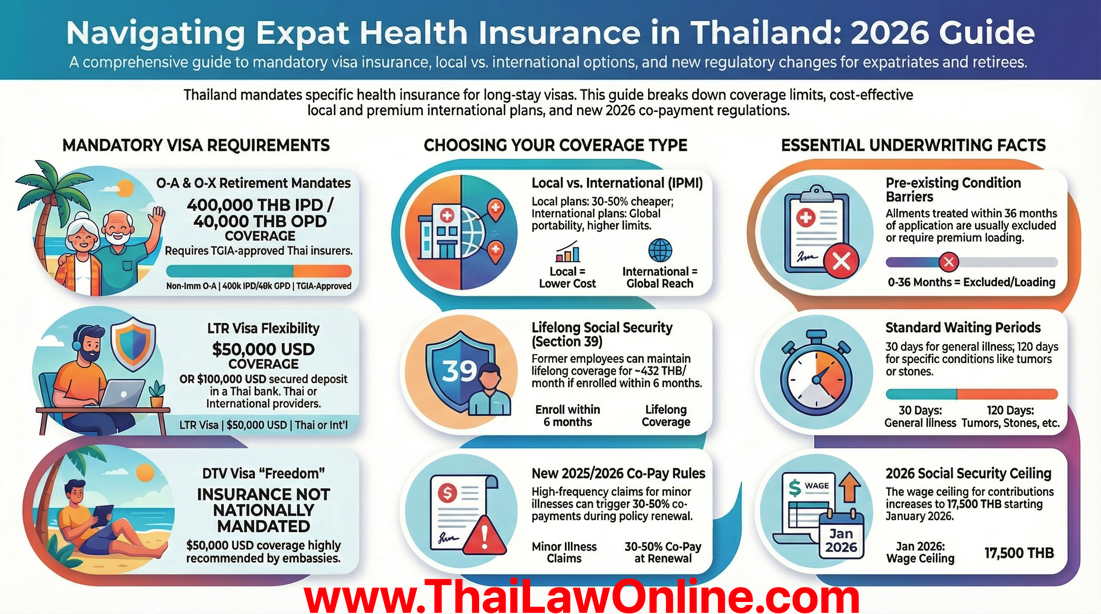
Thailand does not have a single, blanket health insurance mandate for all foreigners. The requirements vary by visa type, and the penalties for getting them wrong range from a denied extension to an uninsured hospital bill running into millions of baht. This guide breaks down the legal framework visa by visa, covers the tax deductions most expats miss, and explains how Thailand’s Sécurité sociale system works for foreign employees.
Last reviewed: 3 September 2026. The visa insurance thresholds and the Social Security figures below were checked against sources rather than carried forward. The Social Security contribution ceiling was verified as the FIRST of three phases set by the Ministerial Regulation published in the Royal Gazette on 12 December 2025 and effective 1 January 2026: 17,500 THB from 2026, 20,000 THB from 2029 and 23,000 THB from 2032, against a floor of 1,650 THB, confirmed from two independent professional summaries that are not copies of one another. The Section 40 passage was corrected because it contradicted our own Social Security guide; the instrument that settles it was then located and the passage was rewritten from it, which is the Royal Decree cited in that section below. The O-A insurance figures were then read in the primary, on the same day and by a second session: Order of the Royal Thai Police No. 654/2564, clause 2.22(6), in the Royal Gazette volume 139, special part 17 Ngor, page 16, of 24 January 2022 (that order has since been overtaken: it amended the annex of Police Order 327/2557, which was repealed with its amendments on 26 September 2023, and the same criteria now sit at clause 2.22 of the table annexed to Immigration Bureau Order 12/2568 of 23 January 2025, where the figures are unchanged), and the Ministry of Foreign Affairs operating manual for the O-A, which records the Cabinet Resolution of 15 June 2021 replacing the 40,000 and 400,000 baht split with a single sum insured. The table above was corrected to match them.
This review does not certify four things and says so rather than implying otherwise. The Social Security Act B.E. 2533 itself could not be read: the only copy in our law corpus is an empty record, so Sections 33, 39 and 40 are stated here from secondary sources and from our own Social Security guide, not from the Act. The Revenue Code deduction figures were not read against the Revenue Department registers. The list of approved insurers and the premium ranges are market practice, not law, and change without notice. And the O-A and O-X thresholds are stated as the orders cited in the text record them; the orders themselves were not re-read in this pass.
Table des matières
Quels visas nécessitent une assurance maladie en Thaïlande ?
Thai immigration treats health insurance as a visa compliance issue, not a general legal obligation. If you hold a tourist visa or a Non-Immigrant B (business) visa, no law forces you to carry health insurance. But for visas de retraite, long-term resident visas, and certain specialty categories, the rules are specific and enforced.
Visa OA non-immigrant (retraite d'un an)
Since 31 October 2019 an O-A applicant, and an O-A holder extending inside Thailand, must show health insurance. The amount was raised in 2021 and 2022, and the superseded figures are still widely quoted, including by insurers. The requirement is now a single total sum insured rather than an outpatient and inpatient split:
| Point | Minimum sum insured | Valeur approximative en USD |
|---|---|---|
| New applications from 1 October 2021; extensions inside Thailand from 1 October 2022 | Not less than 3,000,000 THB, covering the whole period of stay | ~$100,000 |
| 31 October 2019 until those dates (superseded, do not buy to this figure) | 40,000 THB outpatient and 400,000 THB inpatient per policy year | ~$1,100 / ~$11,600 |
The policy must cover the full duration of your stay. The rule runs on two separate tracks, and they do not say the same thing. At issuance abroad, the Ministry of Foreign Affairs has accepted Thai or non-Thai insurers since 31 October 2019. At extension inside Thailand, clause 2.22 of the table annexed to Immigration Bureau Order 12/2568 of 23 January 2025 expressly permits an O-A holder to choose Thai cover, non-Thai cover or foreign state welfare, and applies one threshold to all three: not less than USD 100,000 or 3,000,000 THB, covering the whole period of stay. ⚠️ Two conditions in that clause decide how you buy the cover, and most guidance omits them. Sub-clause (6.1) requires a Thai policy to be purchased online through longstay.tgia.org, so an OIC-approved policy bought some other way can still be queried at the counter. Sub-clause (6.2) gives foreign cover and foreign state welfare two certification routes, not one: certification by that country’s embassy in Thailand, ou a notarised certification of the signatory’s signature obtained through your own Ministry of Foreign Affairs. Sub-clause 6.3 of the same table covers the case an older applicant is most likely to meet, an insurer refusing cover in whole or in part: a deposit of not less than 3,000,000 THB in a Thai commercial bank, held for at least two months before the application, or a deposit plus other health cover totalling not less than 3,000,000 THB, with the refusal certified by the insurer, by that country’s embassy in Thailand, or by a notary through your own Ministry of Foreign Affairs. A foreign policy must be certified or notarised through your own Ministry of Foreign Affairs in the format prescribed by the Ministry of Public Health. That is a documentary hurdle, not a bar. An OIC-approved Thai policy remains the path of least resistance at the counter, but you are not legally obliged to abandon good international cover in order to extend.
Base juridique : Issuance abroad: Ministry of Foreign Affairs criteria effective 31 October 2019, amended from 1 October 2021 following the Cabinet Resolution of 15 June 2021. Extension inside Thailand: clause 2.22 of the table annexed to Immigration Bureau Order 12/2568 of 23 January 2025. The rule reached that table by a chain worth knowing, because almost everything written in English still stops at the first link: Royal Thai Police Order 654/2564 and Bureau de l'immigration Order 312/2564, both given 27 December 2021 and effective 1 October 2022 (Royal Gazette 2565/E/017), were overtaken when Police Order 327/2557 was repealed with its amendments on 26 septembre 2023 and Immigration Bureau Order 242/2566 expressly repealed Order 312/2564. The figures did not change; the instrument to cite did. The approved Thai insurer list is maintained by the Office of Insurance Commission (OIC).
Visa OX non-immigrant (retraite de dix ans)
Do not assume O-X carries the same insurance minimum as O-A. The O-X base requirement is a Thai policy approved by the Office of Insurance Commission at not less than 40,000 THB outpatient and 400,000 THB inpatient per policy year, as published by the Thai General Insurance Association and the Ministry of Foreign Affairs. Since 1 October 2021 a COVID layer with a total sum insured of 3,000,000 THB or USD 100,000 has been applied by several consular posts to the O-X as well, and at least one post accepts foreign insurers for O-X using the Foreign Insurance Certificate. Official sources are not uniform here, so confirm with the post handling your application. The O-X also requires higher financial qualifications (3 million THB in deposits, or 1.8 million plus annual income of 1.2 million THB per year), and the full 3 million THB must be accumulated in a Thai bank account within one year of entry.
Visa O non-immigrant (Prolongation basée sur la retraite ou le mariage)
Here is the gap that confuses many retirees: if you entered Thailand on a Visa Non-Immigrant O (not O-A) and extend your stay based on retirement or a Thai spouse, Thai immigration does not require health insurance as a condition of that extension. The mandatory insurance rule applies to the O-A and O-X categories specifically.
Avertissement pratique : Certains services d'immigration demandent désormais aux titulaires de visa O de présenter une attestation d'assurance lors des demandes de prolongation, même sans obligation légale. Les agents disposent d'un pouvoir discrétionnaire. Avoir sur soi une police d'assurance valide permet d'éviter les retards et les contestations au guichet, même si la loi ne l'exige pas.
Visa de résident de longue durée (LTR)
Le visa LTR, administré par le Board of Investment (BOIL’obtention d’une assurance maladie couvrant au moins 50 000 USD de frais médicaux est obligatoire. Cette assurance doit être valide pendant au moins 10 mois au moment de la demande. Les personnes percevant des prestations de la Sécurité sociale thaïlandaise ou disposant d’un solde d’au moins 100 000 USD sur un compte bancaire thaïlandais depuis 12 mois peuvent satisfaire à cette exigence sans souscrire d’assurance supplémentaire.
Contrairement au visa OA, le visa LTR accepte les polices d'assurance maladie internationales. Les assureurs thaïlandais sont également acceptés. Le BOI examine les documents d'assurance lors du traitement de la demande. Consultez notre Guide du visa LTR pour tous les détails concernant les conditions d'admissibilité.
Visa SMART
Les titulaires d'un visa SMART doivent souscrire une assurance maladie internationale. Bien que la réglementation ne fixe pas de montant précis en bahts, contrairement aux règles relatives aux visas OA, les polices offrant une couverture d'au moins 50 000 USD satisfont à cette exigence. Le BOI examine chaque demande individuellement.
Permis de travail et visas B de non-immigrant
Thai labor law does not require employers to provide private health insurance. But foreign employees who hold permis de travail and earn wages in Thailand contribute to the Social Security Fund. That contribution buys access to public healthcare through the Section 33 system, which we explain below.
Thailand’s Approved Health Insurers for Visa Compliance
For O-A and O-X visa holders, the Office of Insurance Commission (OIC) maintains a list of approved Thai insurance companies. A policy from one of these companies is the simplest way to satisfy immigration, and it is what most extension applicants use. It is not the only lawful route: clause 2.22 of the table annexed to Immigration Bureau Order 12/2568 of 23 January 2025 also provides for foreign policies and state social-welfare cover. There are two ways to certify them and most guides mention only the second: the document list at item 5.2 accepts cover certified either by that country’s embassy in Thailand or by a notarised certificate of the signatory’s signature from your own Ministry of Foreign Affairs, in the form the Ministry of Public Health prescribes. For someone already in Thailand the embassy route is usually the shorter one. The OIC list includes both Thai-owned and international insurers licensed to operate in Thailand:
- Assurance maladie Pacific Cross
- AXA Assurance Thaïlande
- Assurance LMG
- L'assurance Viriyah
- Falcon Insurance
- Assurance Thaivivat
- Navakij Assurance
- Assurance Dhipaya
- Assurance Asie
- Assurance maladie Aetna (Thaïlande)
- Assurance Sompo (Thaïlande)
Les primes varient en fonction de votre âge, de vos antécédents médicaux et de l'étendue de la couverture choisie, au-delà des minimums requis pour votre visa. Un retraité de 60 ans sans antécédents médicaux peut s'attendre à des primes annuelles comprises entre 20 000 et 60 000 THB pour une assurance conforme aux exigences de son visa. Les personnes plus âgées ayant des antécédents médicaux peuvent se voir proposer des primes supérieures à 100 000 THB, et certains assureurs refusent les demandes des personnes de plus de 75 ans.
Si vous détenez un visa LTR ou SMART, vous pouvez utiliser n'importe quel assureur (thaïlandais ou international) qui atteint le seuil de couverture de 50 000 USD.
Sécurité sociale pour les travailleurs étrangers : Soins de santé (article 33)
Si vous travaillez pour un employeur thaïlandais avec un permis de travail valide permis de travail, you contribute to Thailand’s Social Security Fund under Section 33 of the Social Security Act B.E. 2533 (1990). Both you and your employer contribute 5% of your monthly salary, capped at a salary ceiling of 17,500 THB since 1 January 2026. That means the maximum monthly contribution is 875 THB from you and 875 THB from your employer.
Read 17,500 THB as a first step rather than a settled figure. The Ministerial Regulation published in the Royal Gazette on 12 December 2025 raises the ceiling in three phases: 17,500 THB from 2026, 20,000 THB from 2029 ET 23,000 THB from 2032, taking the maximum monthly contribution from 875 THB to 1,000 THB and then to 1,150 THB on each side. The floor is unchanged at 1,650 THB a month. If you are budgeting employer cost over the life of a lease or a business plan, budget the phases. Our guide to La sécurité sociale en Thaïlande carries the full table and the benefit figures that move with it.
L'article 33 vous donne droit à des soins médicaux gratuits dans un hôpital désigné que vous choisissez lors de votre inscription. La couverture inclut les consultations externes, les hospitalisations, les médicaments prescrits et les prestations de maternité. Vous recevez des soins dans l'hôpital qui vous est attribué sans frais supplémentaires. Si vous vous rendez dans un autre hôpital sans recommandation médicale ni justification d'urgence, la Sécurité sociale ne prend pas en charge les frais.
Article 39 : Poursuite volontaire de l’activité après avoir quitté un emploi
Les travailleurs étrangers ayant cotisé au régime de l'article 33 pendant plus de 12 mois peuvent passer au régime de l'article 39 après avoir quitté leur emploi. Ils continuent de cotiser 432 THB par mois et conservent leur couverture santé dans leur hôpital désigné. Ils perdent leur couverture chômage et leurs droits à pension sont réduits par rapport au régime de l'article 33. Pour être éligible, il faut résider en Thaïlande avec un visa valide (retraite, mariage ou autre visa de long séjour) et déposer sa demande dans les six mois suivant la cessation de son emploi.
Base juridique : Loi sur la sécurité sociale BE 2533 (1990), articles 33 et 39. Les ressortissants étrangers titulaires d'un permis de travail valide sont traités de la même manière que les employés thaïlandais aux fins de la sécurité sociale.
Section 40: Why It Is Not Your Answer Either
Section 40 is the voluntary scheme for self-employed and informal workers who fall outside Sections 33 and 39. It is closed to ordinary foreign nationals, and the bar sits in a Royal Decree rather than in the Act. Section 40 itself sets no nationality condition: it delegates the qualifications to a Royal Decree, which is why reading the Act alone answers this question wrongly. The Royal Decree Prescribing the Qualifications of Persons Who May Apply to Become an Insured Person B.E. 2561, published in the Royal Gazette on 27 March 2018 and amended in 2020, requires an applicant to hold nationalité thaïlandaise, or to be a stateless or displaced person holding a Thai-issued non-national identity card, and to be aged between 15 and 65. A foreigner living here on a retirement, marriage, DTV or LTR visa holds none of those statuses. The practical point is the one that matters for insurance planning: no immigration category accepts Section 40 cover in place of the policy a visa requires, and its benefits are far narrower than Section 33’s. If you direct your own entreprise thaïlandaise without a standard contrat de travail, your realistic routes are Section 33 through a genuine payroll, or private insurance.
Déductions fiscales sur les primes d'assurance maladie
Les résidents fiscaux thaïlandais peuvent déduire leurs primes d'assurance maladie de leurs impôts. impôt sur le revenu des personnes physiques. Le Code des impôts autorise deux déductions :
| Type de déduction | Maximum | Condition |
|---|---|---|
| Votre propre assurance maladie | 25 000 THB/an | Police d'assurance d'un assureur agréé en Thaïlande |
| Parents’ health insurance | 15 000 THB/an | Covers your parents or spouse’s parents; parents must earn less than 30,000 THB/year |
Le total cumulé des déductions pour assurance vie et assurance maladie ne peut excéder 100 000 THB par an. Si vous payez 80 000 THB de primes d'assurance vie, vous ne pourrez déduire que 20 000 THB au maximum pour l'assurance maladie, et non la totalité des 25 000 THB.
To claim the deduction, the insurer must be licensed in Thailand. International policies purchased from overseas companies do not qualify, even if they cover you while living in Thailand. Keep your premium receipts and the insurer’s tax certificate (issued annually) for filing with the Revenue Department.
Les pièges courants rencontrés par les expatriés avec l'assurance maladie thaïlandaise
Acheter une assurance inadaptée à votre type de visa
International policies from Cigna, Allianz, or BUPA purchased outside Thailand satisfy most LTR and SMART visa applications. For an O-A extension they can also be used, but only via the certification route in clause 2.22 of the table annexed to Immigration Bureau Order 12/2568 of 23 January 2025: at item 5.2 the policy must be certified either by that country’s embassy in Thailand or by a notarised certificate of the signatory’s signature from your own Ministry of Foreign Affairs, in the form the Ministry of Public Health prescribes. Retirees run into trouble every year not because foreign cover is forbidden, but because they arrive at the counter with an uncertified foreign policy and no time left to fix it. Decide early which route you are taking.
Lacunes de couverture lors des transitions de visa
Si vous passez d'un permis de travail à un visa de retraite, votre couverture au titre de l'article 33 prend fin à la cessation de votre emploi. Vous devez souscrire une assurance privée avant l'échéance de votre prolongation de visa OA ou OX. La période de transition entre l'emploi et la retraite laisse de nombreux expatriés sans assurance pendant des semaines, voire des mois.
Refus de couverture liés à l'âge
La plupart des assureurs thaïlandais limitent les nouvelles souscriptions à 70 ou 75 ans. Les assurés actuels peuvent souvent renouveler leur contrat au-delà de ces âges, mais les nouveaux demandeurs ne peuvent pas être couverts. Si vous arrivez en Thaïlande à 73 ans avec l'intention de demander un visa OA, vous constaterez peut-être qu'aucun assureur agréé ne vous proposera de police d'assurance. Solution : demandez plutôt un visa O non-immigrant, qui n'exige pas d'assurance, ou souscrivez une assurance internationale et faites votre demande depuis l'étranger, où les exigences de l'ambassade peuvent différer.
Exclusions liées aux affections préexistantes
Les polices d'assurance thaïlandaises excluent généralement les affections préexistantes pendant les 12 à 24 premiers mois. Votre police remplit les conditions minimales de visa sur le papier, mais une hospitalisation effective liée à une affection préexistante entraînera un refus de prise en charge. Les frais seront à votre charge. Prévoyez un budget en conséquence.
Compter uniquement sur la sécurité sociale
L'article 33 couvre les soins dans un hôpital public désigné. La qualité des soins y est variable. Les temps d'attente peuvent atteindre plusieurs heures. De nombreux travailleurs étrangers complètent leur couverture sociale par une assurance privée qui prend en charge les frais dans des hôpitaux privés comme Bumrungrad, l'hôpital de Bangkok ou Samitivej.
Santé privée vs santé publique : l'écart de coûts
Thailand’s private hospitals charge international-grade prices. A night in a private room at Bumrungrad International runs 15,000 to 40,000 THB. Heart surgery at a private hospital can cost 500,000 to 2,000,000 THB. At a public hospital covered by Social Security, the same procedures cost a fraction of that amount, but you face longer waits and shared wards.
En Thaïlande, les primes d'assurance maladie privée varient de 15 000 THB par an pour une personne en bonne santé de 35 ans à plus de 200 000 THB par an pour une personne de 70 ans bénéficiant d'une couverture complète. Les formules minimales requises pour l'obtention d'un visa sont très sommaires. Pour une protection optimale en cas de problème de santé grave, la plupart des conseillers financiers recommandent une couverture hospitalisation d'au moins 2 à 5 millions de THB.
Foire aux questions
L'assurance maladie est-elle obligatoire pour tous les étrangers en Thaïlande ?
No. The mandate applies to specific visa categories. O-A and O-X retirement visa holders must carry qualifying health insurance. LTR visa holders must show USD 50,000+ in coverage or maintain a USD 100,000 bank deposit. Tourist visa holders, Non-Immigrant B holders, and Non-Immigrant O extension holders face no formal insurance requirement.
Quels sont les montants de couverture minimum pour le visa de retraite OA ?
Total coverage of at least 3,000,000 THB, or USD 100,000. This replaced the old split requirement of 40,000 THB outpatient and 400,000 THB inpatient, for new applications from 1 October 2021 and, at extension inside Thailand, from 1 October 2022, and the rule now sits at clause 2.22 of the table annexed to Immigration Bureau Order 12/2568 of 23 January 2025. The policy may be Thai or foreign; foreign cover must be certified by that country’s embassy in Thailand, or notarised through your own Ministry of Foreign Affairs. It must cover the full period of your stay.
Puis-je utiliser une assurance maladie internationale pour un visa thaïlandais ?
Yes, subject to paperwork. For demandes initiales d'OA ou d'OX at Thai embassies abroad, Thai or non-Thai insurers have been accepted since 31 October 2019. For annual O-A extensions inside Thailand, Clause 2.22 of the table annexed to Immigration Bureau Order 12/2568 of 23 January 2025 permits foreign cover at not less than USD 100,000, provided it is certified by that country’s embassy in Thailand or notarised through your own Ministry of Foreign Affairs. A Thai OIC-approved policy is simpler, but it is not the only lawful option. LTR and SMART visa applicants can use international policies if they provide at least USD 50,000 in medical coverage.
Puis-je déduire mes primes d'assurance maladie de mes impôts thaïlandais ?
Oui. Les résidents fiscaux thaïlandais peuvent déduire jusqu'à 25 000 THB par an de leurs primes d'assurance maladie, à condition que la police soit souscrite auprès d'un assureur agréé en Thaïlande. Le plafond de déduction cumulé pour l'assurance vie et l'assurance maladie est de 100 000 THB. Vous pouvez également déduire jusqu'à 15 000 THB pour les primes versées pour vos parents ou les parents de votre conjoint.
Les travailleurs étrangers bénéficient-ils d'un accès aux soins de santé publics via la sécurité sociale ?
Les employés étrangers titulaires d'un permis de travail valide et cotisant à la Caisse de sécurité sociale au titre de l'article 33 bénéficient de soins de santé gratuits dans un hôpital désigné. L'employeur et l'employé cotisent chacun à hauteur de 51 000 THB (3 000 THB par mois), ce montant étant plafonné à 17 500 THB par mois depuis le 1er janvier 2026. La couverture inclut les consultations externes, les hospitalisations, les médicaments et les prestations de maternité.
Que se passe-t-il si mon assurance expire pendant la période de validité de mon visa ?
Pour les titulaires d'une carte OA ou OX, une assurance expirée compromet la prolongation de votre séjour. Les services d'immigration peuvent refuser votre prochaine prolongation ou révoquer votre autorisation de séjour actuelle. Renouvelez votre assurance avant son expiration et présentez une preuve de couverture continue à chaque rendez-vous avec les services d'immigration.
Prochaines étapes : Obtenir la couverture adéquate
Commencez par vérifier votre type de visa. Cela détermine si l'assurance est obligatoire, quels assureurs sont agréés et quels sont les montants minimums applicables. Si vous êtes titulaire d'un visa OA ou OX, souscrivez une assurance auprès d'un assureur thaïlandais agréé par l'OIC avant votre prochaine date de prolongation. Si vous êtes titulaire d'un visa LTR ou SMART, assurez-vous que votre assurance internationale couvre au moins 50 000 USD. Si vous travaillez avec un permis de travail thaïlandais, vérifiez votre inscription au titre de l'article 33 et envisagez une assurance complémentaire privée pour accéder aux hôpitaux privés.
Évaluez votre police d'assurance en fonction du risque réel, et non du montant minimum requis pour un visa. Un plafond de 400 000 THB pour les frais d'hospitalisation couvre moins d'une nuit en soins intensifs dans un hôpital privé. Pour les résidents de longue durée, une police offrant une couverture de 2 à 5 millions de THB pour les frais d'hospitalisation constitue une protection adaptée.
Si vous êtes imposable en Thaïlande, demandez la déduction de votre prime d'assurance. Conservez vos reçus et demandez un certificat fiscal à votre assureur chaque année.
Besoin d'aide pour choisir la bonne assurance pour votre visa ?
ThaiLawOnline.com propose des consultations juridiques sur la conformité aux exigences en matière de visa, d'assurance et de planification fiscale pour les expatriés en Thaïlande.
Liens : Bureau de l'immigration de Thaïlande
Health insurance is a condition of several long stay permissions, including the prolongation de la retraite. Notre Aperçu de l'immigration en Thaïlande sets out which permission carries which requirement.
Actualités juridiques thaïlandaises, gratuites par courriel
Des informations claires et concises sur les changements législatifs thaïlandais concernant les étrangers : propriété, visas, mariage, affaires et testaments. Un court courriel par mois, envoyé par un cabinet d’avocats établi depuis 2006. Zéro spam, désabonnement possible à tout moment.