


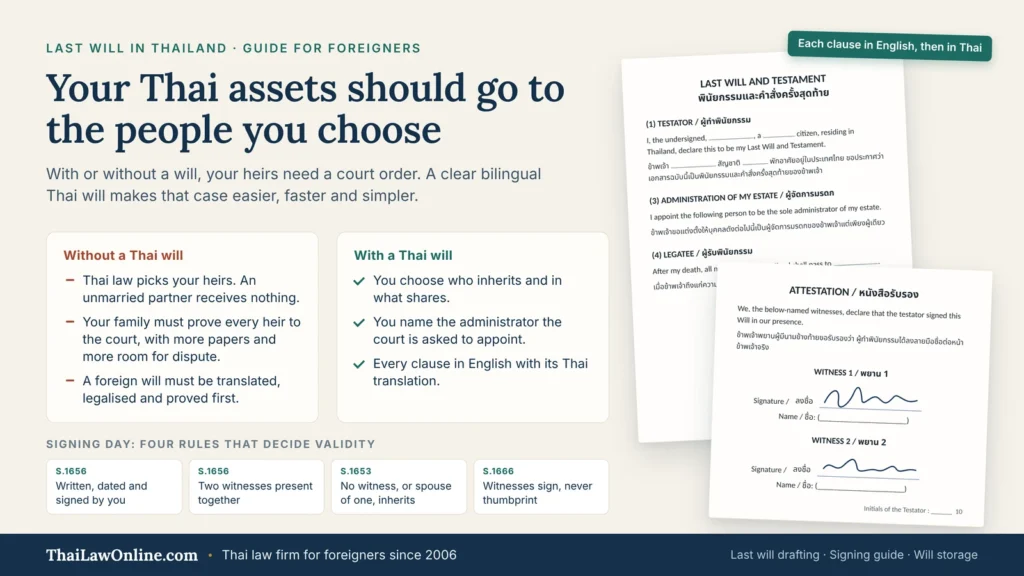
Yes, a foreigner can make a valid will in Thailand. The usual form is a written will, dated and signed by the testator in front of two witnesses who sign at the same time (section 1656 of the Civil and Commercial Code). A Thai will normally covers only assets in Thailand, so it works alongside your will at home rather than replacing it. Without one, your Thai assets pass to statutory heirs under section 1629. ThaiLawOnline drafts bilingual Thai and English wills for 3,900 THB.
Reviewed by Wichuda Atthamethakon, LL.M., Thai Bar Licence 3149/2556, for ThaiLawOnline, a Thai law firm acting for foreigners since 2006.
Update log
- 2 November 2026: Moved the answer and video to the top, shortened the page, added a section on dying without a Thai will and moved the detail to the related guides
- 31 October 2026: Added the statute and case law box with Thai, English and French text
Free downloads: bilingual sample will (PDF) and the signing guide for Last Wills and Living Wills (PDF, English then Thai). No email required.
A clear Thai will identifies who should receive your Thai assets and whom you want to administer the estate. It can simplify the court and administrative work after death, but it does not automatically remove every court, bank or Land Office step. You can also prepare one yourself from our free bilingual Thai will template.
Also download our official client guide: Instructions for Signing Your Last Will and Testament (PDF, English & Thai, 2027 edition).Table of Contents
New in 2026: since 24 March 2026 the Ministerial Regulation on the Making of Wills or Declarations Concerning Inheritance B.E. 2569 has governed wills made at the district office, replacing the regulation that had stood since B.E. 2503. You may now file at any district or khet office in the country. The Department of Provincial Administration says so in its own operating manual, which instructs officers that an applicant for a public document will (clause 5(1)) or a secret document will (clause 4) “shall file the application on form Phor.Kor. 1 at any District Office or Khet Office”. Your registered address no longer decides where you go. See what changed.
Key Takeaways about Last Wills in Thailand
- Age & Capacity Rules: Anyone aged 15 and older who is mentally capable can make a Thai will. Witnesses must be adults, competent, and cannot benefit from the will.
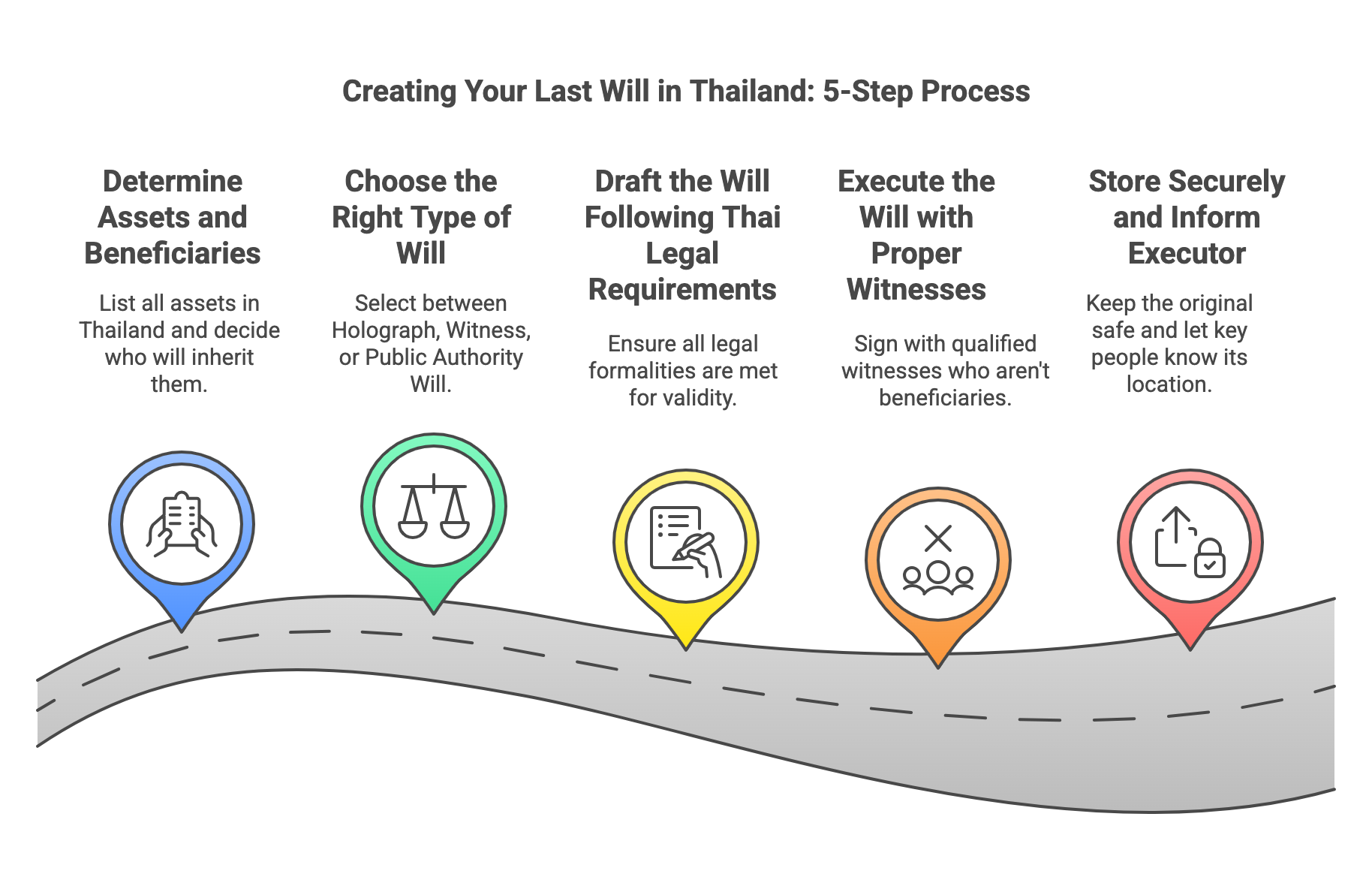
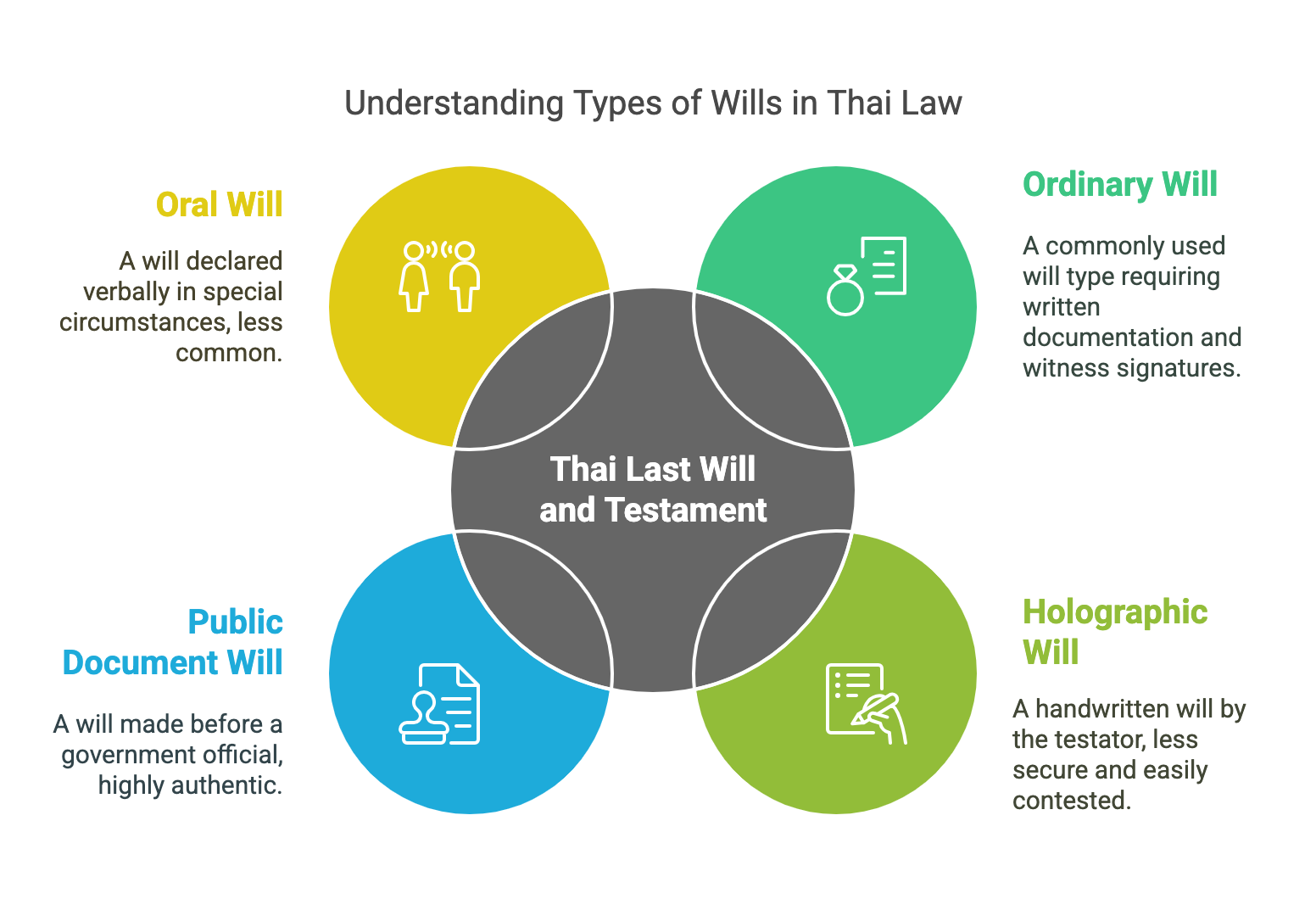
- Five forms, not three: Thai law recognises five, and under Section 1705 a will that fits none of them is void. They are the ordinary witnessed will (Section 1656), the holographic will written entirely by hand (Section 1657), the public document will made at the district office (Section 1658), the secret document will (Section 1660), and the oral will in special circumstances (Section 1663). The witnessed written form is the one most expats use.
- Formalities matter: A typical written will must include the date and state it is your “Last Will.” You must sign it in front of two witnesses who also sign right away. It is best if the will is in Thai, with an English version for clarity. Minor mistakes can void the document.
- What happens without a will: If you die without a will, Thai law decides who gets your property. The order is: descendants → parents → full-blood siblings → half-blood siblings → grandparents → uncles and aunts. The surviving spouse shares depending on who else is alive.
- Why create a draft of a Thai Last Will now: A clear and well-made Thai Will can save your family time, stress, and money. It speeds up the probate process, lets you choose your executor, and helps protect mixed-nationality families from complications. It also avoids the delays and costs of translating or legalizing a foreign Will in Thailand. At ThaiLawOnline, our Will services are affordable and designed with your peace of mind in mind. Take the step to protect the people you love.
This article is written by Mr. Sébastien Brousseau, LL.B., B.Sc., 30 years in law and 20 years practising in Thailand. ThaiLawOnline has drafted hundreds of Thai wills since 2006, and not one has ever been invalidated by a Thai court. Co-written by Khun Wichuda Atthamethakon, Thai lawyer and notary.
Understanding Last Wills in Thailand
What is a Last Will in Thailand?
The Thai Last Will and Testament follows the Civil and Commercial Code of Thailand. This code explains how to create and execute wills in the country. A will is a legal document. In it, a person called the testator shares their wishes. This is about how to distribute their assets in Thailand after they die.
Unless rare exceptions, a valid will must be in writing and dated when it is made. The testator must sign it in front of at least two witnesses. These witnesses must also sign their names. This ensures that the will is executed according to the legal standards set by the Thai legal system.
Why Is Making a Will in Thailand Important?
Drafting a last will in Thailand is crucial for several reasons. First, it gives clear information about how your assets in Thailand will be shared. This helps reduce possible disputes among heirs. If you do not have a valid Thai last will, inheritance law will decide how your estate is shared. This may not match what you want.
Does a Thai Will avoid probate?
Not automatically. A Will identifies your beneficiaries, their shares and the person you want to administer the estate. This usually makes the application clearer and reduces uncertainty among the family.
Depending on the assets and the institution holding them, the family may still need a Thai court order or other formal evidence of authority. Registered land and condominiums also involve Land Office procedures.
A properly prepared Will makes estate administration clearer. It does not make every official procedure disappear. Read our Thai probate and estate-administrator guide for the steps after death.
Any person who is 15 years old or older can write a valid Last Will in Thailand. This is stated in section 25 of the Civil and Commercial Code.
What Makes a Will Valid in Thailand?
Four things, and each one is a separate provision of the Civil and Commercial Code.
- It must take one of the five prescribed forms. Section 1655 allows a will to be made only in a form set out in that Chapter, and Section 1705 makes a will or a clause void if it is contrary to Sections 1652, 1653, 1656, 1657, 1658, 1660, 1661 or 1663. There is no residual category for a document that is nearly a will.
- You must be old enough and capable. Under Section 1703 a will made by a person who has not completed fifteen years of age is void. Under Section 1704 a will made by someone the court has adjudged incompetent is void, and a will made by someone alleged to be of unsound mind but not so adjudged is void only if it is proved that the testator was actually of unsound mind when it was made.
- Your witnesses must qualify. Section 1670 disqualifies three groups: people who have not reached majority, people of unsound mind or whom the court has adjudged quasi-incompetent, and people who are deaf, or dumb, or blind in both eyes. Note also Section 1666: the usual rule allowing a mark or thumbprint in place of a signature does not apply to witnesses signing under Sections 1656, 1658 and 1660, so your witnesses have to actually sign.
- Your witnesses must not inherit. Under Section 1653 the writer of a will, and any witness to it, cannot be a beneficiary under it, and the same bar applies to the spouse of the writer or witness. The gift fails; the rest of the will stands. This is the single most common defect in wills that expats prepare themselves.
The witness age trap: it is not twenty
Most English guides say a will witness in Thailand must be at least twenty. That is a reasonable guess and it is not what the Code says. Section 1670(1) is a test of legal majority, not of age. Majority is reached at twenty under Section 19, but Section 20 also makes a minor sui juris on marriage, provided the marriage complies with Section 1448. Since Section 1448 was replaced by the Civil and Commercial Code Amendment Act (No. 24) B.E. 2567, in force on 23 January 2025, marriage requires both parties to have completed eighteen years. A married eighteen-year-old is therefore of full legal capacity and is a lawful witness to your will. An unmarried nineteen-year-old is not.
The law behind this page
English
Section 1646
Any person may make a will directing what is to happen to their property, and other matters, on their death. This section fixes no minimum age: testamentary capacity comes from s.25 and s.1703, under which a will made by a person who has not completed fifteen years of age is void.
Full text
Any person may, in contemplation of death, declare his intention by will as to the disposition of his property or as to other matters, to take legal effect upon his death.
ThaiLawOnline translation
Section 1653
A person who writes a will, or who witnesses it, cannot take a benefit under that will, and the same bar applies to that person's spouse. Where a will is made orally under Section 1663, the competent official who records what the witnesses declare counts as the writer for this purpose. This is the rule most often overlooked when a family member writes out or witnesses a will: doing so defeats the gift intended for them or for their spouse.
Full text
The writer of a will, or a witness to it, cannot be a beneficiary under that will. The preceding paragraph applies equally to the spouse of the writer of, or a witness to, the will. The competent official who records the terms of a will notified to him by witnesses under Section 1663 is deemed to be the writer of the will for the purposes of this Section.
ThaiLawOnline translation
Section 1655
A will may be made only in one of the forms prescribed in this Chapter. There is no valid will outside those forms, so a document expressing testamentary wishes but not complying with any prescribed form has no effect as a will. The forms are set out in Sections 1656 to 1663.
Full text
A will may be made only in one of the forms prescribed in this Chapter.
ThaiLawOnline translation
Section 1656
An ordinary written will must be made in writing, dated at the time it is made, and signed by the testator before at least two witnesses present at the same time, who must then and there sign to certify the testator's signature. An erasure, addition or other alteration is valid only if made in the same form.
Full text
A will may be made in the following form, namely: it must be made in writing, dated at the time of its making, and the testator must sign it before at least two witnesses present at the same time, who must then and there sign their names certifying the signature of the testator. No erasure, omission, addition or other alteration to such a will is valid unless it is made in the same form as is required by this Section for the making of the will itself.
ThaiLawOnline translation
Section 1657
A holographic will must be written entirely in the testator's own hand: the whole text, the date and the signature. No witnesses are required, and an alteration is valid only if the testator makes it by hand and signs beside it.
Full text
A will may be made as a document written entirely by the testator, namely: the testator must write with his own hand the whole of its text, the date, and his signature. No erasure, omission, addition or other alteration to such a will is valid unless the testator has made it with his own hand and has signed his name beside it. Section 9 of this Code does not apply to a will made under this Section.
ThaiLawOnline translation
Section 1658
A will may be made as a public document at the District Office. The testator declares the terms to the district officer before at least two witnesses present at the same time; the officer records the declaration and reads it back to the testator and the witnesses; when all are satisfied that the record matches what was declared, the testator and the witnesses sign; and the officer signs, dates and certifies in his own hand that these steps were followed, and affixes the official seal. No erasure, addition or other alteration is valid unless the testator, the witnesses and the district officer all sign beside it.
Full text
A will may be made as a public document, namely: (1) the testator must declare to the district officer, before at least two other witnesses present at the same time, the terms he wishes to have included in his will; (2) the district officer must record the terms so declared by the testator, and must read that record to the testator and the witnesses; (3) when the testator and the witnesses are satisfied that the terms recorded by the district officer correspond with those declared by the testator, they must sign their names in evidence of it; (4) the district officer must sign and date the record with his own hand, and must certify in his own hand that the will has been made in accordance with paragraphs (1) to (3) above, and must affix his official seal. No erasure, omission, addition or other alteration to such a will is valid unless the testator, the witnesses and the district officer have signed their names beside it.
ThaiLawOnline translation
Section 1660
A secret will must be signed by the testator, sealed, and signed across the seal, then produced to the district officer and at least two witnesses with a declaration that it is the testator's will (naming the writer and the writer's domicile if the testator did not write it all). The officer records the declaration and the date on the envelope and affixes the official seal, and the officer, the testator and the witnesses sign the envelope. An alteration is valid only if the testator signs beside it.
Full text
A will may be made as a secret document, namely: (1) the testator must sign the will; (2) the testator must seal the will and sign across the seal; (3) the testator must produce the sealed will to the district officer and at least two other witnesses, and must declare to all of them that it is his will. If the will was not written throughout by the testator himself, he must also state the name and domicile of the writer; (4) after the district officer has recorded on the envelope the testator's declaration and the date on which the will was produced, and has affixed his official seal, the district officer, the testator and the witnesses must sign the envelope. No erasure, omission, addition or other alteration to such a will is valid unless the testator has signed his name beside it.
ThaiLawOnline translation
Section 1663
Where special circumstances make it impossible to use any other form, such as imminent danger of death, an epidemic or a war, a will may be made orally. The testator must declare its terms before at least two witnesses present at the same time and place. Those witnesses must without delay go to the district officer and declare what the testator ordered, together with the date, the place and the special circumstances. The district officer records the declaration and the two witnesses sign; a thumbprint certified by two witnesses' signatures will serve instead of a signature.
Full text
Where there are special circumstances in which a person is unable to make a will in any of the other prescribed forms, such as being in imminent danger of death, or during an epidemic or a war, that person may make a will orally. For this purpose, the testator must declare the terms of his will before at least two witnesses present at the same time and place. Those two witnesses must, without delay, present themselves to the district officer and declare the terms the testator ordered orally, together with the date and place of the making of the will and the special circumstances. The district officer must record what the witnesses declare, and the two witnesses must sign their names. Failing a signature, a thumbprint certified by the signatures of two witnesses is equivalent.
ThaiLawOnline translation
Section 1670
Full text
The following persons cannot be witnesses to the making of a will: (1) persons who have not yet reached majority; (2) persons of unsound mind, or persons whom the court has adjudged quasi-incompetent; (3) persons who are deaf, or dumb, or blind in both eyes.
ThaiLawOnline translation
Section 1703
A will made by a person who has not completed his fifteenth year of age is void. Fifteen is therefore the age of testamentary capacity in Thai law, and it is lower than the age of majority: a person aged fifteen or over may make a valid will even though still a minor.
Full text
A will made by a person who has not completed his fifteenth year of age is void.
ThaiLawOnline translation
Section 1705
A will, or any clause in it, is void if it contravenes Section 1652, 1653, 1656, 1657, 1658, 1660, 1661 or 1663. The list is closed and covers the bar on a ward making a will in favour of the guardian or the guardian's close relatives before the guardianship account is rendered (Section 1652), the bar on the writer, the witnesses and their spouses taking a benefit (Section 1653), and the formal requirements for each type of will. Because the section applies to a clause as well as to a whole will, a single offending gift can fail while the rest of the will stands.
English translation of this section is being verified. The Thai text is authoritative.
ไทย
มาตรา 1646
ข้อความเต็ม
บุคคลใดจะแสดงเจตนาโดยพินัยกรรม กำหนดการเผื่อตายในเรื่องทรัพย์สินของตนเอง หรือในการต่าง ๆ อันจะให้เกิดเป็นผลบังคับได้ตามกฎหมายเมื่อตนตายก็ได้
ตรงตามข้อความในราชกิจจานุเบกษา / สำนักงานคณะกรรมการกฤษฎีกา (Verbatim from the Royal Gazette / Office of the Council of State)
มาตรา 1653
ข้อความเต็ม
ผู้เขียน หรือพยานในพินัยกรรมจะเป็นผู้รับทรัพย์ตามพินัยกรรมนั้นไม่ได้ ให้ใช้บทบัญญัติในวรรคก่อนบังคับแก่คู่สมรสของผู้เขียนหรือพยานในพินัยกรรมด้วย พนักงานเจ้าหน้าที่ซึ่งได้จดข้อความแห่งพินัยกรรมที่พยานนำมาแจ้งตามมาตรา ๑๖๖๓ ให้ถือว่าเป็นผู้เขียนพินัยกรรมตามความหมายแห่งมาตรานี้
ตรงตามข้อความในราชกิจจานุเบกษา / สำนักงานคณะกรรมการกฤษฎีกา (Verbatim from the Royal Gazette / Office of the Council of State)
มาตรา 1655
ข้อความเต็ม
พินัยกรรมนั้น จะทำได้ก็แต่ตามแบบใดแบบหนึ่งดังที่บัญญัติไว้ในหมวดนี้
ตรงตามข้อความในราชกิจจานุเบกษา / สำนักงานคณะกรรมการกฤษฎีกา (Verbatim from the Royal Gazette / Office of the Council of State)
มาตรา 1656
ข้อความเต็ม
พินัยกรรมนั้น จะทำตามแบบดังนี้ก็ได้ กล่าวคือต้องทำเป็นหนังสือลงวัน เดือน ปี ในขณะที่ทำขึ้น และผู้ทำพินัยกรรมต้องลงลายมือชื่อไว้ต่อหน้าพยานอย่างน้อยสองคนพร้อมกัน ซึ่งพยานสองคนนั้นต้องลงลายมือชื่อรับรองลายมือชื่อของผู้ทำพินัยกรรมไว้ในขณะนั้นการขูดลบ ตก เติม หรือการแก้ไขเปลี่ยนแปลงอย่างอื่นซึ่งพินัยกรรมนั้นย่อมไม่สมบูรณ์ เว้นแต่จะได้ปฏิบัติตามแบบอย่างเดียวกับการทำพินัยกรรมตามมาตรานี้
ตรงตามข้อความในราชกิจจานุเบกษา / สำนักงานคณะกรรมการกฤษฎีกา (Verbatim from the Royal Gazette / Office of the Council of State)
มาตรา 1657
ข้อความเต็ม
พินัยกรรมนั้น จะทำเป็นเอกสารเขียนเองทั้งฉบับก็ได้ กล่าวคือผู้ทำพินัยกรรมต้องเขียนด้วยมือตนเองซึ่งข้อความทั้งหมด วัน เดือน ปี และลายมือชื่อของตน การขูดลบ ตก เติม หรือการแก้ไขเปลี่ยนแปลงอย่างอื่นซึ่งพินัยกรรมนั้นย่อมไม่สมบูรณ์ เว้นแต่ผู้ทำพินัยกรรมจะได้ทำด้วยมือตนเอง และลงลายมือชื่อกำกับไว้ บทบัญญัติมาตรา ๙ แห่งประมวลกฎหมายนี้ มิให้ใช้บังคับแก่พินัยกรรมที่ทำขึ้นตามมาตรานี้
ตรงตามข้อความในราชกิจจานุเบกษา / สำนักงานคณะกรรมการกฤษฎีกา (Verbatim from the Royal Gazette / Office of the Council of State)
มาตรา 1658
ข้อความเต็ม
พินัยกรรมนั้น จะทำเป็นเอกสารฝ่ายเมืองก็ได้ กล่าวคือ (๑) ผู้ทำพินัยกรรมต้องไปแจ้งข้อความที่ตนประสงค์จะให้ใส่ไว้ในพินัยกรรมของตนแก่กรมการอำเภอต่อหน้าพยานอีกอย่างน้อยสองคนพร้อมกัน (๒) กรมการอำเภอต้องจดข้อความที่ผู้ทำพินัยกรรมแจ้งให้ทราบนั้นลงไว้ และอ่านข้อความนั้นให้ผู้ทำพินัยกรรมและพยานฟัง (๓) เมื่อผู้ทำพินัยกรรมและพยานทราบแน่ชัดว่าข้อความที่กรมการอำเภอจดนั้นเป็นการถูกต้องตรงกันกับที่ผู้ทำพินัยกรรมแจ้งไว้แล้ว ให้ผู้ทำพินัยกรรมและพยานลงลายมือชื่อไว้เป็นสำคัญ (๔) ข้อความที่กรมการอำเภอจดไว้นั้น ให้กรมการอำเภอลงลายมือชื่อและลงวัน เดือน ปี ทั้งจดลงไว้ด้วยตนเองเป็นสำคัญว่า พินัยกรรมนั้นได้ทำขึ้นถูกต้องตามบทบัญญัติอนุมาตรา ๑ ถึง ๓ ข้างต้น แล้วประทับตราตำแหน่งไว้เป็นสำคัญ การขูดลบ ตก เติม หรือการแก้ไขเปลี่ยนแปลงอย่างอื่นซึ่งพินัยกรรมนั้นย่อมไม่สมบูรณ์ เว้นแต่ผู้ทำพินัยกรรม พยาน และกรมการอำเภอจะได้ลงลายมือชื่อกำกับไว้
ข้อความจากฐานข้อมูลประมวลกฎหมายของเรา โปรดตรวจสอบกับข้อความทางการ (Thai text from our annotated code. Check it against the official text.)
มาตรา 1660
ข้อความเต็ม
พินัยกรรมนั้น จะทำเป็นเอกสารลับก็ได้ กล่าวคือ(๑) ผู้ทำพินัยกรรมต้องลงลายมือชื่อในพินัยกรรม(๒) ผู้ทำพินัยกรรมต้องผนึกพินัยกรรมนั้น แล้วลงลายมือชื่อคาบรอยผนึกนั้น(๓) ผู้ทำพินัยกรรมต้องนำพินัยกรรมที่ผนึกนั้นไปแสดงต่อกรมการอำเภอ และพยานอีกอย่างน้อยสองคน และให้ถ้อยคำต่อบุคคลทั้งหมดเหล่านั้นว่าเป็นพินัยกรรมของตน ถ้าพินัยกรรมนั้นผู้ทำพินัยกรรมมิได้เป็นผู้เขียนเองโดยตลอด ผู้ทำพินัยกรรมจะต้องแจ้งนามและภูมิลำเนาของผู้เขียนให้ทราบด้วย(๔) เมื่อกรมการอำเภอจดถ้อยคำของผู้ทำพินัยกรรมและวัน เดือน ปี ที่นำพินัยกรรมมาแสดงไว้บนซองนั้นและประทับตราตำแหน่งแล้ว ให้กรมการอำเภอผู้ทำพินัยกรรมและพยานลงลายมือชื่อบนซองนั้นการขูดลบ ตก เติม หรือการแก้ไขเปลี่ยนแปลงอย่างอื่นซึ่งพินัยกรรมนั้นย่อมไม่สมบูรณ์ เว้นแต่ผู้ทำพินัยกรรมจะได้ลงลายมือชื่อกำกับไว้
ตรงตามข้อความในราชกิจจานุเบกษา / สำนักงานคณะกรรมการกฤษฎีกา (Verbatim from the Royal Gazette / Office of the Council of State)
มาตรา 1663
ข้อความเต็ม
เมื่อมีพฤติการณ์พิเศษซึ่งบุคคลใดไม่สามารถจะทำพินัยกรรมตามแบบอื่นที่กำหนดไว้ได้ เช่น ตกอยู่ในอันตรายใกล้ความตาย หรือเวลามีโรคระบาด หรือสงคราม บุคคลนั้นจะทำพินัยกรรมด้วยวาจาก็ได้เพื่อการนี้ ผู้ทำพินัยกรรมต้องแสดงเจตนากำหนดข้อพินัยกรรมต่อหน้าพยานอย่างน้อยสองคนซึ่งอยู่พร้อมกัน ณ ที่นั้นพยานสองคนนั้นต้องไปแสดงตนต่อกรมการอำเภอโดยมิชักช้าและแจ้งข้อความที่ผู้ทำพินัยกรรมได้สั่งไว้ด้วยวาจานั้น ทั้งต้องแจ้งวัน เดือน ปี สถานที่ที่ทำพินัยกรรมและพฤติการณ์พิเศษนั้นไว้ด้วยให้กรมการอำเภอจดข้อความที่พยานแจ้งนั้นไว้ และพยานสองคนนั้นต้องลงลายมือชื่อไว้ หรือมิฉะนั้น จะให้เสมอกับการลงลายมือชื่อได้ก็แต่ด้วยลงลายพิมพ์นิ้วมือ โดยมีพยานลงลายมือชื่อรับรองสองคน
ตรงตามข้อความในราชกิจจานุเบกษา / สำนักงานคณะกรรมการกฤษฎีกา (Verbatim from the Royal Gazette / Office of the Council of State)
มาตรา 1670
ข้อความเต็ม
บุคคลต่อไปนี้จะเป็นพยานในการทำพินัยกรรมไม่ได้(๑) ผู้ซึ่งยังไม่บรรลุนิติภาวะ(๒) บุคคลวิกลจริตหรือบุคคลซึ่งศาลสั่งให้เป็นผู้เสมือนไร้ความสามารถ(๓) บุคคลที่หูหนวก เป็นใบ้ หรือจักษุบอดทั้งสองข้าง
ตรงตามข้อความในราชกิจจานุเบกษา / สำนักงานคณะกรรมการกฤษฎีกา (Verbatim from the Royal Gazette / Office of the Council of State)
มาตรา 1703
ข้อความเต็ม
พินัยกรรมซึ่งบุคคลที่มีอายุยังไม่ครบสิบห้าปีบริบูรณ์ทำขึ้นนั้น เป็นโมฆะ
ตรงตามข้อความในราชกิจจานุเบกษา / สำนักงานคณะกรรมการกฤษฎีกา (Verbatim from the Royal Gazette / Office of the Council of State)
มาตรา 1705
ข้อความเต็ม
พินัยกรรมหรือข้อกำหนดพินัยกรรมนั้น ถ้าได้ทำขึ้นขัดต่อบทบัญญัติแห่งมาตรา ๑๖๕๒ ๑๖๕๓ ๑๖๕๖ ๑๖๕๗ ๑๖๕๘ ๑๖๖๐ ๑๖๖๑ หรือ ๑๖๖๓ ย่อมเป็นโมฆะ
ข้อความจากฐานข้อมูลประมวลกฎหมายของเรา โปรดตรวจสอบกับข้อความทางการ (Thai text from our annotated code. Check it against the official text.)
Français
Article 1646
Toute personne peut, par testament, disposer pour cause de mort de ses biens ou d'autres matières, ces dispositions devant produire effet légal à son décès.
résumé non officiel
Article 1653
Le rédacteur ou un témoin du testament, ainsi que leur conjoint, ne peuvent en être bénéficiaires. L'agent qui a consigné les dispositions rapportées par les témoins selon l'article 1663 est réputé rédacteur.
résumé non officiel
Article 1655
Le testament ne peut être fait que dans l'une des formes prévues au présent chapitre.
résumé non officiel
Article 1656
Testament écrit, daté au moment de sa confection, signé par le testateur devant au moins deux témoins présents ensemble, qui signent aussitôt pour attester sa signature. Grattage, ajout ou autre modification est sans effet s'il ne respecte pas cette même forme.
résumé non officiel
Article 1657
Testament entièrement écrit de la main du testateur : texte, date et signature. Grattage, ajout ou autre modification est sans effet s'il n'est écrit de sa main et contresigné par lui. L'article 9 ne s'applique pas à ce testament.
résumé non officiel
Article 1658
Testament public : le testateur déclare ses volontés à l'officier de district devant au moins deux témoins présents ensemble ; l'officier les consigne et les leur lit ; après vérification, testateur et témoins signent ; l'officier signe, date, atteste de sa main la régularité, scelle. Modification valable si tous signent.
résumé non officiel
Article 1660
Testament secret : signé, scellé, signé sur le scellé par le testateur, présenté à l'officier de district et à deux témoins au moins, déclaré sien, avec nom et domicile de tout autre rédacteur. L'officier annote, date et scelle l'enveloppe ; tous la signent. Modification valable si le testateur signe.
résumé non officiel
Article 1663
En circonstances spéciales empêchant les autres formes (notamment danger de mort, épidémie, guerre), testament oral devant au moins deux témoins présents ensemble, qui déclarent sans délai à l'officier de district les volontés, date, lieu et circonstances ; il consigne, ils signent ou apposent leur empreinte digitale, certifiée par deux témoins.
résumé non officiel
Article 1670
Ne peuvent être témoins d'un testament : celui qui n'a pas atteint la majorité, l'aliéné ou la personne déclarée quasi incapable par le tribunal, et la personne sourde, muette ou aveugle des deux yeux.
résumé non officiel
Article 1703
Le testament fait par une personne n'ayant pas quinze ans révolus est nul.
résumé non officiel
Article 1705
Le testament ou la disposition testamentaire fait en violation des articles 1652, 1653, 1656, 1657, 1658, 1660, 1661 ou 1663 est nul.
résumé non officiel
Supreme Court decisions
- 1396/2518 (1975): Secret Document Will: Validity Requirements
Sources
- Civil and Commercial Code, Office of the Council of State, retrieved 31 October 2026
- deka.supremecourt.or.th, Supreme Court of Thailand decisions database (copy held in our library), retrieved 19 February 2026
How to Write a Will in Thailand: Step by Step
To write a valid will in Thailand, put it in writing, date it, and sign it in front of at least two witnesses who are present at the same time and sign it then and there (Civil and Commercial Code, Section 1656). The one exception is a will you write entirely in your own hand, including the date and your signature, which needs no witnesses (Section 1657). Any later erasure, addition or change is valid only if it is made with the same formalities. In practice, work through these six steps:
- List your Thai assets. Bank accounts, a condominium unit, vehicles, company shares, insurance policies, leases and usufructs.
- Choose your heirs and their shares. Name every beneficiary precisely (full name, passport or ID number, relationship) and name alternates in case an heir dies first.
- Appoint an executor. The court formally appoints the estate administrator, but the person you name in the will is normally the person the court appoints.
- Have it drafted in English and Thai. Thai courts work in Thai. A bilingual will avoids a translation fight after your death.
- Sign in front of two witnesses. You and both witnesses sign the same document, at the same time, in the same place (Section 1656). Never use a beneficiary, or a beneficiary’s spouse, as a witness: that gift is void (Section 1653).
- Store it where it will be found. A will nobody can produce is a will that does not exist. See our secure storage service (1,000 THB, unlimited time).
Hiring a law firm like ThaiLawOnline can give you helpful advice. They can make sure your document meets all legal rules. Remember that we have experience and we only ask 3,900 baht, a fraction of other law firms. Many law firms in Thailand still ask 10,000 or 20,000 baht or more. We learned to use technology and stream our work. This helps us offer better prices without lowering quality.
Get Your Thai Will: Three Ways
There is no single right way to make a will in Thailand. Pick the one that matches your estate.
In Pattaya? See last will in Pattaya.
Whichever route you choose, the signing rules are identical, and they are where most wills fail. Read the common mistakes before you sign anything.
Can Foreigners Draft a Will in Thailand?
Yes, foreigners can draft a will in Thailand to cover their assets located in the country. Foreigners should make a separate will for their Thai assets. This will be different from their will in their home country. Doing this can help avoid problems during probate. Hiring a law firm that knows international estate planning can help make sure the will meets Thai laws and the person’s wishes. Good lawyers can do more than write great documents; they can assist in drafting last will and testament to ensure your wishes are honored. They can help you save on taxes. They can also give advice about children and other important matters. This includes funerals and what a “Thailand Living Will” is.
The Five Types of Wills Under Thai Law
Thai law recognises five forms of will. For a foreigner, the choice is almost always the ordinary written will, but the other four matter when circumstances are unusual.
Read more: last will meaning, the holographic will.
Ordinary Will (พินัยกรรมแบบธรรมดา)
This is the most common form. It requires the will to be in writing, dated, and signed by the testator. The testator must sign in front of at least two witnesses. These witnesses must also sign to confirm the testator’s signature (Civil and Commercial Code, Section 1656). Warning: Wills have specific rules that must be followed. If these rules are not respected, the document may be declared void.
Holographic Will (พินัยกรรมแบบเขียนเองทั้งฉบับ)
This form needs the whole document. It must include the date and signature. The testator must handwrite it (Civil and Commercial Code, Section 1657). It does not need witnesses. This is the weakest form of Last Will in Thailand and can be contested in Court more easily.
Public Document Will (พินัยกรรมแบบเอกสารมหาชน)
Made at a district office or khet office before the officer and two witnesses. How a public document will works.
Secret Document Will (พินัยกรรมแบบเอกสารลับ)
A sealed will whose contents stay private, lodged with the district office. How a secret document will works.
Oral Will (พินัยกรรมแบบด้วยวาจา)
Allowed only in special circumstances in which no other form is possible, such as imminent danger of death, an epidemic or a war. The governing provision is Section 1663, not the whole run of Sections 1655 to 1672. You must declare the terms before at least two witnesses present at the same time and place, and those two must then present themselves to the district officer without delay and state what you ordered, together with the date, the place and the special circumstances. The officer records what they say and the two witnesses sign.
Inheritance and assets distribution under Thai Law
Who Can Be an Heir Under Thai Inheritance Laws
In Thailand, a person can inherit in two ways after someone dies. They can be named in a Last Will, called a ‘legatee.’ Or, they can inherit automatically under Thai law. The second type is called a statutory heir, and we’ll explain that more below.
Understanding the Six Classes of Statutory Heirs
In Thailand, there are six classes of statutory heirs. Each class has the right to inherit in a specific order. This is outlined in section 1629 of the Civil and Commercial Code (CCC)
- Descendants
- Parents
- Brothers and Sisters of full blood
- Brothers and Sisters of half blood
- Grandfathers and Grandmothers
- Uncles and Aunts
The surviving spouse is also a statutory heir (Section 1635 CCC). It must be a legal and registered marriage. These classes include descendants, parents, full-blood siblings, half-blood siblings, grandparents, and uncles and aunts, as well as the legal spouse.
What happens if you die without a Thai will
Without a valid will, your Thai assets go to your statutory heirs under section 1629 of the Civil and Commercial Code, in six classes: descendants, parents, brothers and sisters of full blood, brothers and sisters of half blood, grandparents, and uncles and aunts. A surviving spouse is also a statutory heir (section 1635). An unregistered partner inherits nothing, and an administrator usually has to be appointed by a court before a bank or Land Office will release anything.
If a person dies in Thailand without a will, their assets are shared based on Thai inheritance law. This means that legal heirs will automatically inherit the estate as per the effect according to the law. They will do so in the order set by the Civil and Commercial Code. While this provides a clear framework for asset distribution, it may not align with the deceased’s personal wishes. Therefore, drafting a will is crucial to ensure that your estate is managed and distributed as you desire.
See our inheritance guide for foreigners and what happens to your assets if you die without a will in Thailand, and the statutory heir.
How Can Foreigners Inherit Land in Thailand?
A foreigner can inherit Thai land as a statutory heir, but owning it is a different matter, and the land usually has to be sold. See inheriting property in Thailand as a foreign heir and can a foreigner inherit land in Thailand.
Managing your Thai Will
How to Update or Revoke a Thai Last Will?
To update or revoke a last will in Thailand, you must create a new will that explicitly states the revocation of all previous wills. Alternatively, a formal revocation document can be created and similarly witnessed. It is wise to talk to a law firm. This will help make sure that any updates or changes are legal. They will also ensure that these changes match your current wishes.
Secure Will Storage Services in Thailand
District-office wills and private will storage serve different purposes. Foreign nationals are not excluded from making a public-document or secret-document will at an amphur or khet office. The formalities and the 2026 district-office procedure are explained above. For a privately signed will, keep the original safe and tell your executor where to obtain it. ThaiLawOnline offers storage of the original for 1,000 baht; ask us to confirm the deposit, retrieval and release arrangements before handing over your documents.
How Much Does a Will Cost in Thailand? (2026 Fees)
A bilingual Thai-English Last Will costs 3,900 THB for one person. Thai-only drafting is 2,500 THB per person. These are separate drafting options.
A Living Will costs 1,900 THB on its own. A bilingual Last Will and Living Will together cost 5,000 THB for one person. Storage of your signed original is a separate, one-time charge of 1,000 THB, with no annual storage charge.
| Service | Fixed fee | What it covers |
|---|---|---|
| Last Will, Thai only | 2,500 THB per person | Thai drafting without an English version. |
| Last Will, bilingual English and Thai | 3,900 THB | Personalised clauses, heirs and shares, executor, guardianship provisions, signing checklist |
| Living Will (advance medical directive), on its own | 1,900 THB | Advance refusal of burdensome treatment, comfort-care instructions, witness wording compliant with the 2010 Regulation |
| Living Will added to a Last Will order | 1,100 THB | Same document, discounted when ordered together |
| Last Will and Living Will together | 5,000 THB | Both documents, one signing session |
| Secure will storage | 1,000 THB | Unlimited storage of the original, retrievable by your executor |
| Paid consultation, complex estates | 2,000 THB | Company shares, cross-border assets, contested family situations |
Full breakdown on our will cost page for 2026, and every published fee on the legal fees page.
Your Thai Will, prepared around your instructions
Our individual Last Will drafting service costs 3,900 THB and includes Thai and English wording, personalised provisions, and written signing instructions in both languages. The first draft is usually ready within three to five working days after payment and receipt of all required information. This is the drafting period, not a promise that review, revisions, and signing will all be completed within the same period.
Available now: Thai-only Last Will, 2,500 THB per person. The document is in Thai only, without an English version. Our bilingual Thai-English service remains available at 3,900 THB. Contact us to confirm availability, required information and the delivery timetable before paying.
- Last Will and Testament, drafted by our lawyers฿3,900Personalised Thai-English Last Will drafting with written signing instructions. First draft usually within three to five working days after payment and complete information. Review the draft and request corrections before signing.See what is included
- Last Will and Living Will bundle฿5,000Your Last Will and your advance medical directive, drafted together. Saves 800 baht against buying them separately.See what is included
- International Estate Will, assets in more than one country฿15,000For clients who own assets in Thailand and abroad. Includes a consultation on how your Thai will interacts with your foreign estate, and written coordination notes for your lawyer at home.See what is included
What happens after I receive the draft?
Check every name, identification number, address, asset description, beneficiary’s share, and executor appointment. Confirm that the document reflects your wishes and tell us about corrections before signing.
We provide written signing instructions with the final documents. Read those instructions before arranging the signing. If your intended signing date changes, contact us before proceeding.
To begin, use our Will drafting service. Have your identification, current address, beneficiary and executor details, and instructions for your Thai assets ready.
Not sure which one fits? Book a 2,000 baht consultation and we credit it against your fee if you go ahead.
Comprehensive estate planning solution in Thailand
Last Will & Living Will in Thailand (complete package)
If you already plan to prepare a Last Will, consider adding a Living Will Thailand at the same time. A Living Will (advance medical directive) states your wishes for medical care if you lose capacity. Your Last Will tells how to distribute your estate. Together, they create a stronger estate-planning strategy. This strategy protects your assets and healthcare choices in every province of Thailand.
Read more: living will in Thailand, the will and living will bundle.
Get Started: Secure Your Legacy in Thailand
A Last Will is too important for generic, AI-generated, or copy-paste forms. Our Last Will templates are drafted and maintained by Thai lawyers, and for complex estates our lawyers also provide full custom drafting and review. Ensure your final wishes are legally binding, clearly drafted to your needs, and provide peace of mind for your loved ones.
You can email us directly (info@thailawonline.com) to begin the process.
Fixed fee service: 3,900 THB, bilingual English and Thai.
Hundreds of wills drafted since 2006, and not one has ever been invalidated by a Thai court. Every clause is checked against our database of more than 84,000 Thai Supreme Court decisions.
We have a simple refund policy. You can get a full refund within 7 days of receiving your order if you are not happy with our service.
Making a Will in Thailand: FAQ
What are the inheritance rules in Thailand?
Thai law lets you leave your estate by will. Without a will, the estate goes to the statutory heirs in the six classes of section 1629, with the surviving spouse sharing under section 1635. A closer class excludes the classes after it, except that descendants and parents share. A married person can only leave their own share of marital property. Read our inheritance guide.
What happens if there is no last will and testament?
If there is no will in Thailand, the estate will be divided by the civil code rules. This might not align with the deceased’s wishes, highlighting the importance of making a last will in Thailand.
Does a Thai Will let my family avoid court?
A Thai Will does not automatically eliminate court or administrative procedures. It identifies your chosen beneficiaries and preferred estate administrator, which can make the process clearer and reduce disputes. A court order or other formal evidence may still be required depending on the estate’s assets and the institution dealing with them.
Can a Thailand last will and testament include assets outside Thailand?
A Thailand last will and testament can include assets from other countries. It is best to get legal advice. This helps address any international legal issues. It also ensures the will is recognized in other places.
How much does it cost to make a will in Thailand?
Our bilingual Thai-English Last Will costs 3,900 THB for one person. Thai-only drafting is 2,500 THB per person, without an English version. A Living Will costs 1,900 THB separately, or 5,000 THB together with a bilingual Last Will. Original-document storage is a separate, one-time charge of 1,000 THB. See the fee table.
Can I write my own will in Thailand without a lawyer?
Yes. Thai law allows a holographic will under Section 1657: you write the entire document by hand, date it, and sign it. No witnesses are needed. It is legally valid, and it is also the weakest form of will in Thai practice. It fails when the handwriting is disputed, when the date is missing, when the wording is ambiguous, or when nobody can find it. Our Supreme Court research shows handwriting and signing defects, not unfair distributions, are what actually void wills. If you write your own, at minimum have it reviewed.
Does a Thai will need to be notarized?
No. Thai law does not require notarisation of a will. What it requires is the correct signing formality: for an ordinary will, your signature in front of two witnesses who sign as well (Section 1656). Notarisation is sometimes useful for a separate purpose, such as proving your signature to a foreign bank or a foreign court, and our notarial services attorney can do that. But a will is not invalid for lack of a notary.
Is my foreign will valid in Thailand?
Often yes. Which country’s law decides whether your foreign will is valid is settled by Thailand’s Act on Conflict of Laws B.E. 2481, and Thai courts do apply it to foreign estates (see, for example, Supreme Court decision 4027/2545, on the powers of the administrator of a British national’s estate). Note that Civil and Commercial Code Section 1667, often cited on this point, is about Thai nationals making a will abroad, not foreigners. The problem is practical, not legal: the foreign will has to be produced, translated, legalised, and proved to a Thai court before the estate can be distributed, which routinely adds months and legal fees. A short separate Thai will covering only your Thai assets avoids all of that. See which country’s law governs which asset. See probate of a foreign will in Thailand.
Do I need both a Thai will and a will in my home country?
Usually yes, and they must be drafted to work together. The standard trap is the revocation clause: a later will at home saying “I revoke all previous wills” can wipe out your Thai will without anyone intending it. Each will should be expressly limited in scope, so the Thai will covers your Thai assets and the home-country will covers everything else, with each acknowledging the other. Full analysis: do you need a Thai will and a will at home.
Can my Thai wife, husband or partner be a witness to my will?
Not if they inherit under it. Section 1653 makes a gift to a witness, or to the spouse of a witness, void, even though the rest of the will stands. This is the single most common defect we see in wills that expats prepared themselves: the beneficiary spouse signs as a witness, and the gift to that spouse fails. Use two neutral witnesses aged 20 or over who receive nothing under the will.
Other links
- Last Will in Thailand by the Amphur at the Bureau of Regional Administration (Thai language)
- Free signing guide for Last Wills and Living Wills: witnesses, presence, signatures and storage (PDF, 2026)
- Inheritance for Foreigners in Thailand : Full Guide by ThaiLawOnline
- Thai will template: free bilingual sample and clause-by-clause walkthrough
- Thai will and foreign will: which law applies, and the revocation trap
- Updated Regulation for Public Wills from 2026
How much does a Thai will cost? A bilingual Last Will is a fixed 3,900 THB, a living will 1,900 THB. See the full will cost breakdown (2026) or all our fixed fees on the legal fees page.
What the Thai Supreme Court Says About Last Wills
Statutes tell you how a will should be made. The Supreme Court of Thailand (ศาลฎีกา) tells you how wills actually fail. We analyzed more than 75 Supreme Court (Dika) decisions on wills and succession from our in-house database of more than 77,000 Supreme Court decisions spanning 1936 to 2026: and eight rules decide most disputes:
- The one-sitting rule kills more wills than forgery does. The testator and both witnesses must sign together, in one ceremony. A will signed in instalments is void and can never be ratified afterwards (Dika 997/2549; Dika 11034/2553).
- A beneficiary, or a beneficiary’s spouse, who witnesses the will loses the gift (Dika 4001/2545). Being present in the room is fine (Dika 5404/2533); signing is fatal.
- A married testator can only give away half. A will reaches only the testator’s own share of marital property, whatever it says (Dika 899-900/2509).
We published the full stories, including why your foreign heirs can inherit Thai land (Dika 7200/2540), the new 2026 district-office rules, and why trusts are void in Thai wills (Section 1686), in 10 Thai Supreme Court decisions every foreigner making a will should know. To our knowledge it is the only case-law resource of its kind in English, drawn from our own database of Supreme Court judgments. Every will we draft is checked against this case law, not just the Civil and Commercial Code. That is the difference between a template and legal work.
Our fees for a Thai will
| Service | Fixed fee | What is included | Timeline |
|---|---|---|---|
| Last Will and Testament | 3,900 THB 5,000 THB Last Will + Living Will together | Bilingual Thai and English will, drafted by a lawyer to comply with Thai inheritance law. 5,000 THB if taken together with a Living Will. | 3 to 5 business days |
| Will safekeeping at our office | 1,000 THB | Your signed original held at the firm, retrievable by your administrator. | Immediate |
Government disbursements are charged at cost unless the service says they are included.
Book a consultation Answer within 24 to 48 hours EN · FR · TH
These fees come from one source and are the same everywhere on this site. See all our fees.
Try it yourself first, free
You do not have to book anything to get started. These run in your browser, and you only pay us if you decide you want a lawyer involved.
Legal Document Maker Gold members
Ten bilingual documents from a guided questionnaire, in the firm's own wording.
Open the toolLiving Will Generator Free
Build a bilingual advance directive for Thailand under s.12 of the National Health Act.
Open the toolAsk our AI assistant Free
Trained on Thai law and 77,000+ Supreme Court decisions. Ask anything, free.
Expat Legal Health Check Free
Ten minutes on your property, family, visa and will. You get a written report naming the exact gaps and what each one costs to fix.
Take the Legal Health CheckThai Law Updates, free by email
Plain-English updates on Thai law changes that affect foreigners: property, visas, marriage, business and wills. One short email a month from a firm practicing since 2006. No spam, unsubscribe anytime.