


Reviewed by ThaiLawOnline, a licensed Thai law firm practising in Thailand since 2006. Thai lawyer of record: Wichuda Atthamethakon, LL.M., Thai Bar Licence 3149/2556.
Last updated on September 5, 2026
Key Takeaways
We maintain the most detailed database of Thai Supreme Court decisions on usufruct (สิทธิเก็บกิน). It contains 64 decisions from 1936 to 2022 and updated in 2026. These cases are organized into 12 themes. They cover usufructuary power, registration, gift law, lease interaction, wills, co-ownership, owner’s rights, duration, tax issues, temple property, marital property, and procedures. No other law firm in Thailand provides this much English-language case analysis on usufruct.
Written by Sebastien H. Brousseau and Wichuda Atthamethakon | ThaiLawOnline.com. Practicing usufruct law since 2006.
Table of Contents
Why Court Decisions Matter for Your Usufruct
Thailand operates under a civil law system. Supreme Court decisions are not binding precedent like they are in common law countries. However, they carry strong persuasive authority.
Lower courts and provincial courts routinely follow patterns from Supreme Court cases. When deciding similar disputes, they use these decisions as guides.
Understanding case law reveals how courts will treat your usufruct in practice. A Supreme Court decision on Section 1417 power establishes a pattern. Provincial courts follow it when deciding comparable cases. You can predict outcomes and strengthen your position by knowing how courts have ruled before.
The 64 decisions in our database reflect usufruct law’s evolution over nearly 90 years. Early decisions (1936-1950) clarified whether registration is required. Mid-period decisions (1950-1990) established relationships with leases, gifts, and marital property. Recent decisions (1990-2022) address modern scenarios: tax withholding, condominium usufruct, fraudulent transfers.
Landmark Decisions by Legal Principle
1. Power of the Usufructuary (Section 1417)
The Civil Code grants usufructuaries broad “management” powers. Supreme Court decisions clarify the scope of these powers. They show when owners retain standing to act.
Decision 15033/2555 (2012): Usufructuary Controls Tenant Eviction
An owner registered two individuals as lifetime usufructuaries of the land. When a dispute arose with an occupant, the owner sued to evict. The Court held that ending a lease or evicting an occupant is the usufructuary’s power of management under Section 1417 paragraph one, and that while the usufruct subsists the owner has none of those rights. The owner had no standing to sue, and the claim was dismissed. This establishes that owners cannot bypass the usufruct.
Decision 2428/2518 (1975): Usufructuary Can Evict Without Juvenile Court Permission
A usufructuary sued to evict an occupant who lived on the land by permission. The land belonged to a minor, and it was argued that the suit needed Juvenile Court permission first. The Supreme Court held no such permission was necessary: Section 1417 paragraph two gives the usufructuary power to manage the property, and suing to evict is an act of management. Usufructuary standing does not depend on owner capacity, and no prior warning to the occupant was required.
Decision 3019/2528 (1985): Eviction Counts as Property Management
A usufructuary sued to evict the occupants of a house and land let to a tenant who had since died. The Court confirmed that eviction is “property management” expressly granted under Section 1417, so the usufructuary had standing, and the owner was not a party to the case. It then held that once the reciprocal ten year arrangement expired the tenant held on a monthly tenancy, which ended on the tenant’s death, and it ordered the occupants out.
Decision 807/2503 (1960): Lifetime Usufruct Gives Rent Collection Rights
An owner transferred land and a building to her three children but kept a lifetime usufruct, and leased the building through an agent. The tenant resisted eviction on the ground that she was not the owner and so could not sue. The Court held that during the usufruct the usufructuary alone may possess, use and take the benefit of the property, and the owner has none of those rights, so she could lease it and collect the rent in her own name. The children were not parties and the dispute was with the tenant.
Decision 7341/2542 (1999): Usufruct Over a Registered Portion Covers Its Buildings
Three people co-owned titled land, and they registered one of them as lifetime usufructuary over his own portion. Two shophouses stood on it, and another co-owner had leased them to a tenant. When that lease expired the usufructuary sued to evict. The Court held that a usufruct registered over a specific portion covers any structure that is a component part of that land, and that the usufructuary could evict even though he had not signed the lease as lessor.
Decision 4470/2528 (1985): Owner Can Still Sue for Damage to the Building
A contractor excavating and driving piles for a shopping centre next door caused the soil beneath a shophouse to give way and damaged the building. The shophouse was subject to a registered usufruct. The Court held that ownership stays with the owner, so the owner keeps standing to sue in tort for damage to the property, and the usufructuary’s management rights do not displace that claim. The managing partner of the contracting partnership was liable without limit alongside it.
2. Registration vs. Personal Right (Section 1299)
A major question in Thai usufruct law is whether unregistered agreements are valid. Decisions clarify the distinction between registered (real) and unregistered (personal) rights.
Decision 4446/2543 (2000): Oral Usufruct Creates Valid Personal Right
An owner verbally agreed to grant a lifetime usufruct but never registered it. The owner later attempted eviction. The Supreme Court held that an oral agreement creates a valid personal right under Section 1299. The unregistered usufruct prevents eviction. However, this personal right cannot bind third parties. If the land is sold, the new owner is not obligated to recognize the unregistered usufruct.
Decision 2380/2542 (1999): Right to Demand Registration
A parent transferred land and buildings to a child in exchange for an oral agreement that the parent would keep a lifetime usufruct, the child taking the key money and the parent the rent. The child never registered it. The Court held that this reciprocal arrangement creates a personal right to demand registration, and that the parent could sue to compel it for as long as the child had not transferred the property to anyone else. That limit is the point: the right does not survive a transfer to a third party.
Decision 679/2514 (1971): Compromise Agreement and Limitation Period
A parent and child settled by compromise agreement, and the settlement gave the parent a lifetime usufruct that was never registered. Sued years later to register it, the child pleaded that more than ten years had passed. The Court held that a claim founded on a compromise carried a ten year period under what was then Section 168, and that time had not begun to run at all, because the child’s own pleading admitted letting the parent exercise the right throughout, which is an implied acknowledgment. The case went back to the trial court for hearing.
Decision 1256/2519 (1976): Unregistered Usufruct Remains Valid
An owner signed a written agreement giving the other party a right of habitation and a usufruct for life, in exchange for that party not opposing his application to administer an estate. It was never registered. When he set about selling the property, the Court held that Section 1299 makes an unregistered acquisition imperfect, not void: it is not a real right good against the world, but it is a personal right enforceable between the parties, and it was enough to obtain an order forbidding the sale. Registration would perfect it at once.
Decision 1013/2485 (1942): Earliest Decision on Usufruct as Real Right
This 1942 decision is one of the earliest Supreme Court cases on usufruct. A party who had agreed to transfer land claimed a usufruct over it, but the agreement laid down no such condition and nothing had been registered. The Court held that a usufruct is a real right which the law requires to be registered, so he had not acquired it completely. It is the starting point for the registration line of cases that follows, which later softened it: see Decisions 4446/2543 and 1256/2519 above.
3. Gift with Encumbrance (การให้โดยมีค่าภาระติดพัน)
When a parent gifts land but keeps a usufruct, a question arises: is it a true gift or a gift with an encumbrance? This affects whether the gift can be revoked for ingratitude.
Decision 1516/2525 (1982): Gift with Encumbrance Cannot Be Revoked
A parent gifted land and kept a lifetime usufruct. The parent also received 30 bags of rice annually. Years later, the parent claimed the child was ungrateful and sought revocation. The Court held this was a gift with encumbrance. Under Sections 528-529, such gifts cannot be revoked for ingratitude. The parent received adequate consideration.
Decision 2651/2543 (2000): A Retained Usufruct Bars Revocation for Ingratitude
A donor gave two adjoining parcels to the defendant and the defendant registered a lifetime usufruct back to him over them. The donor sued to revoke the gift for ingratitude after being shut out of the land. The Court held that a gift made on those terms carries an encumbrance, and that Section 535 (2) does not allow such a gift to be revoked for ingratitude. It added the point that decides what to do instead: a usufructuary who is being obstructed can go to court to stop the obstruction, and does not need to revoke the gift to do it. The judgment records no family relationship between the two men.
Decision 10344/2551 (2008): Oral Agreement to Harvest Fruit
Parents divided land among heirs but kept an unregistered, oral right to collect rent and harvest fruit. Children later tried to prevent this. The Court held that the parents’ oral agreement constituted a gift with encumbrance. Even though unregistered, the usufruct-like right to harvest was binding and prevented revocation.
Decision 3020/2537 (1994): Gift vs. Remuneration Distinction
A parent registered a gift of land to a child, keeping the right to let it and collect the rent for life, and the child undertook to pay the parent’s funeral costs. The parent later sought to revoke the gift for ingratitude. The Court held that the appellate court was entitled to find, within the issues the parties had actually pleaded, that this was a gift as true remuneration rather than a gift with an encumbrance. On either footing it was not a simple gift and could not be revoked.
4. Usufruct and Lease Interaction
Usufruct grants broad management rights similar to a lease. Decisions establish how usufructs interact with registered leases. They show what happens when parties die or circumstances change.
Decision 2297/2541 (1998): LANDMARK. Lease Survives Usufructuary’s Death
An owner registered a lifetime usufruct in favour of a woman, who then leased the land and shophouse to two tenants for 30 years, in writing and registered. She died during the term. The Supreme Court held that she had power to lease under Section 1417 paragraph two, and that although her death ended the usufruct under Section 1418 last paragraph, that did not touch the tenants, who were third parties. The lease stayed alive and bound the owner who had granted the usufruct in the first place, so she could not evict. The judgment below was reversed and her claim dismissed.
Decision 6278/2537 (1994): Both Usufructuary and Owner Death
A father granted a lifetime usufruct over land and a shophouse, and the usufructuary leased the shophouse for seven years. Both the father and the usufructuary died during the term and the father’s children inherited. The children did not attack the lease; they relied on it. The Court held that they took the land together with the rights and duties under the lease the usufructuary had granted, so they could sue the tenant, and it held the tenant liable under Sections 552 and 562 for a fire, having stored large quantities of cardboard contrary to the agreed business use and kept neither extinguishers nor a watchman.
Decision 498/2536 (1993): Pre-Existing Lease Binds Later Owners
A landowner leased a building for 11 years and 5 months and applied to register the lease the same day. Before the registration went through he gave the land and building to his wife and children, who registered a usufruct back to him. The Court held that the lease dated from the day it was made, not the day the registrar entered it, and that under Section 569 each later owner, first the wife and children and then the purchaser, took subject to it. His death did not end the lease and the purchaser could not evict.
Decision 1077/2540 (1997): Lease Use Change and Agricultural Law
A tenant began a lease for rice farming under the Agricultural Land Lease Act. The tenant changed use to fish farming. Does the Act still apply? The Court held that changing use from rice to fish ponds means the Act no longer applies. The lease falls under ordinary provisions, not agricultural protections.
5. Usufruct Created by Will
Wills frequently grant usufructs, often with habitation rights. Decisions clarify how courts interpret testamentary language and the effect on an estate’s powers.
Decision 7199/2552 (2009): Will Grants Habitation and Usufruct
A holograph will granted the defendant the right of habitation and the right of usufruct over the testator’s house and land for life, and provided that on her death the property would pass in full ownership, in equal shares, to the children of another named person. The life beneficiary applied to have the property registered in her own name as an heir. The Court held that the will gave her those limited rights and not ownership, so she possessed the property on behalf of the children named to take it, could not plead prescription against them, and could not register the transfer. Ownership was left to pass to them on her death, under a condition precedent, by sections 1673 and 1674 paragraph two.
Decision 305/2489 (1946): Estate Manager Cannot Lease After Delivery
A will created a usufruct over a shophouse. After delivery to the usufructuary, the estate manager tried to lease the property. The Court held that once usufruct is delivered, the manager’s power ceases. Only the usufructuary can grant leases. The manager cannot subsequently lease property over which a usufruct has been transferred.
Decision 1516/2503 (1960): Temple’s Failure to Assert Rights Within 10 Years
A landowner willed land to a temple, subject to a lifetime usufruct for her grandmother and her mother. The temple then did nothing: it let the mother possess the land and register the inheritance into the mother’s own name, for more than ten years. The Court held that the temple’s claim as legatee was barred by Section 1754 last paragraph and that the temple had lost its rights under the will. The temple lost, and the judgment below was reversed.
6. Co-Ownership and Usufruct
When land is owned by multiple co-owners, can one co-owner grant usufruct? Decisions clarify consent requirements.
Decision 283/2498 (1955): Co-Owner Cannot Bind the Other Co-Owners
One co-owner burdened jointly owned land with a usufruct in favour of an outsider, by compromise agreement and without the consent of the other co-owners. The Court held that the agreement does not bind them. That is the correct way to read it: a co-owner may deal with their own share, so the grant is ineffective against the others rather than void against everybody. To burden the whole of the land, all co-owners must agree.
Decision 887/2538 (1995): Land Department Opinion Is Advisory, and Cannot Be Sued Over
The Land Department advised a district land office that a usufruct cannot be registered where the intended usufructuary is himself one of the co-owners. The would-be usufructuary sued the Department. The Court held that the advice only assisted the officer, and that whether to register is the land officer’s own power under Section 71 of the Land Code. The Department had therefore not infringed anyone’s rights and the claimant had no standing to sue it, a point the Court raised of its own motion as one of public order.
7. Owner’s Rights During Active Usufruct
A usufruct grants broad management rights but does not transfer ownership. What rights does the owner keep?
Decision 2783/2516 (1973): Owner Can Sell During Active Usufruct
Land and two houses belonged to five children who were minors, and their father applied to the court for leave to sell on their behalf. It was the usufructuary who objected, not a buyer. The Court held that a usufructuary has only the rights of possession, use, benefit and management under Section 1417 and no power to stop the owner selling, so long as the sale does not prejudice the usufruct. A usufruct is a real right good against everyone, so a purchaser cannot cut it down, and selling subject to it is not bad faith. Leave to sell was given.
8. Duration, Non-Exercise, and Limitation
If a usufruct is not exercised, does it lapse? Decisions establish the distinction between general limitation and specific periods for usufruct.
Decision 1548/2503 (1960): Non-Exercise Does Not Cause Lapse
A usufructuary never exercised the right for 7-8 years. The owner claimed it had lapsed through non-exercise. The Court held that a usufruct does not lapse from non-exercise, and that the relevant limitation is the 10-year general limitation. Section 1428 was not in point: it bars any action between owner and usufructuary, or their transferee, in connection with the usufruct, but only once one year has run from the day the usufruct ends, and this usufruct had not ended.
Decision 4074/2536 (1993): Mining Usufruct Fails Where Its Contractual Condition Was Never Met
A landowner contracted to give a mining company a usufruct for 30 years, on terms requiring the company to notify him within a set time if it wanted the right. The company never gave notice and nearly 20 years passed. It was the company’s successor who sued. The Court held that the contractual right could no longer be relied on, and that the successor could not assert it either, because a transferee takes no better right than the transferor. The case turns on an unperformed condition in a contract, not on non-exercise of a registered usufruct, and no statute was breached.
9. Tax and Revenue Issues
Modern decisions address the treatment of usufruct for tax withholding and income allocation.
Decision 575/2560 (2017): Tax Withholding and Actual Income Earner
An owner leased land to a company for 30 years and, on the same day, agreed to give a usufruct to her three grandchildren, who were minors, but the usufruct was registered only after the lease had been made. The company paid the key money and the rent to the grandchildren and issued withholding tax certificates in their names. The grandchildren, not the owner, sued the Revenue Department for a refund. The Court held that the income under the lease belonged to the owner, because she was the contracting party under it, and that the grandchildren merely received the money on her behalf, so the certificates named the wrong taxpayer and no refund was due. The sequence is what decided it.
10. Temple and Religious Property
Thai courts apply special rules when usufruct involves temple property (ที่ธรณีสงฆ์).
Decision 5528/2533 (1990): Temple Land Cannot Be Lost by Possession
A donor gave untitled land to a temple, providing that his wife should have a usufruct for life, and the temple took possession. The land became temple land from the moment of the gift, and the wife held it on the temple’s behalf. She later sold it, and it was the buyer who fought the temple, not the wife. The Court held that the buyer could not plead prescription against a temple over temple land under Section 34 of the Sangha Act B.E. 2505, so the temple kept its possessory right. The temple’s failure to enter the acquisition in its register did not cost it anything.
Decision 1906/2519 (1976): Estate Management Committee Can Sue the Tenant
A donor gave land to a temple by deed, keeping a right of habitation and usufruct for himself and providing that after his death a committee would collect the income and divide it between the temple and others. After he died the committee sued a tenant to recover the land. The Court held that the committee, acting as administrators of the estate, had authority to sue even though the complaint named the temple, because the complaint set out the committee’s power, and that the temple could not obstruct the committee’s management. The tenant was evicted.
11. Marriage and Spousal Rights
Usufruct can interact with marital property regimes. Decisions clarify how spousal rights are affected.
Decision 818/2546 (2003): Husband’s Gift to Wife During Marriage
A husband registered gifts of seven plots of land to his wife during the marriage, keeping a usufruct over each. He later moved to undo them. The Court held that a gift between spouses during marriage is a contract concerning property made between husband and wife, so Section 1469, which lets either spouse avoid such a contract, is the provision that governs it, and not the general revocation of gifts rule in Section 535. The gifts were set aside.
Decision 6552/2538 (1995): Marital Property Under the Pre-1976 Book V
This is an estate case about how property acquired during a marriage is classified. The Court held that property the deceased received by inheritance or gift during the marriage, while Book V of the Code as it stood before the 1976 revision was in force, is marital property under the old Section 1466, and that the revised Sections 1471 and 1474 do not turn it retrospectively into separate property. Only the deceased’s half therefore passed to the heirs. A usufruct enters the case only as one line of the estate inventory, and the judgment decides nothing about transferring a usufruct or about spousal consent.
12. Procedural and Miscellaneous
Decisions address court jurisdiction, res judicata, court fees, and other procedural matters.
Decision 7956/2557 (2014): Usufruct Claim as No-Property-Value Case
A claimant sued seven defendants for a declaration that he held a usufruct and an order registering it. He lost on the facts: the courts found the right had never been granted to him. On costs, the Court held that because he had not claimed the land itself, which stayed part of the estate, the case carried no property value, so the ad valorem court fees charged at all three levels were wrong, and it ordered the excess refunded.
Decision 8458/2558 (2015): The Same Usufruct Question Cannot Be Tried Twice
The second defendant here had already sued these same plaintiffs over the same land, and that case reached the Supreme Court as Decision 7956/2557 above, which held the usufruct had never been granted to him. Both cases were in the same court of first instance. The Supreme Court held that deciding the question again was a repetition of proceedings barred by Section 144 of the Civil Procedure Code, and that this applied even though the present case had been filed before judgment was given in the earlier one. It raised the point of its own motion as a matter of public order.
Decision 2775/2565 (2022): Check Enforceability When Underlying Lease Fails
This is a criminal case. A landowner prosecuted a tenant under the Bad Cheque Act B.E. 2534 over cheques given for rent and for the fee to register a usufruct. An element of that offence is that the cheque must be issued for a debt that is both real and legally enforceable. The Court held that the backdated part of the lease had no written evidence signed by the party liable, so under Section 538 it could not be sued on, and that the contract in any event showed the cheques were handed over as security rather than in payment. The element was missing, the conviction was reversed and the tenant was acquitted. This is the most recent Supreme Court decision in our database (2022).
Complete Index of All 64 Decisions
Below is the complete chronological index of all 64 Supreme Court decisions on usufruct in the ThaiLawOnline database (1936-2022):
| # | Decision No. | Year (BE/CE) | Primary Category |
|---|---|---|---|
| 1 | 754/2479 | 1936 | Criminal/Mining |
| 2 | 1283/2480 | 1937 | Registration |
| 3 | 1013/2485 | 1942 | Registration/Real Right |
| 4 | 305/2489 | 1946 | Will/Probate |
| 5 | 283/2498 | 1955 | Co-ownership |
| 6 | 1243/2499 | 1956 | Procedural |
| 7 | 807/2503 | 1960 | Usufructuary Power/Rent |
| 8 | 1516/2503 | 1960 | Will/Temple Property |
| 9 | 1548/2503 | 1960 | Duration/Limitation |
| 10 | 223/2507 | 1964 | Gift/Encumbrance |
| 11 | 597/2508 | 1965 | Inheritance |
| 12 | 984/2509 | 1966 | Tenant Rights |
| 13 | 1628/2511 | 1968 | Will/Probate |
| 14 | 2004/2511 | 1968 | Marital Property/Gift |
| 15 | 679/2514 | 1971 | Registration/Limitation |
| 16 | 2783/2516 | 1973 | Owner’s Rights/Sale |
| 17 | 2498/2516 | 1973 | Criminal |
| 18 | 299/2518 | 1975 | Boundary Dispute |
| 19 | 2428/2518 | 1975 | Usufructuary Power/Eviction |
| 20 | 1256/2519 | 1976 | Registration/Validity |
| 21 | 1906/2519 | 1976 | Temple Property |
| 22 | 2440/2520 | 1977 | Building/Breach |
| 23 | 1516/2525 | 1982 | Gift with Encumbrance |
| 24 | 3019/2528 | 1985 | Usufructuary Power/Eviction |
| 25 | 4470/2528 | 1985 | Owner’s Tort Rights |
| 26 | 539/2532 | 1989 | Will Validity |
| 27 | 4156/2532 | 1989 | Divorce/Gift |
| 28 | 5528/2533 | 1990 | Temple Property |
| 29 | 342/2534 | 1991 | Estate Management |
| 30 | 5952/2534 | 1991 | Gift/Ingratitude |
| 31 | 422/2535 | 1992 | Eviction Standing |
| 32 | 3545/2535 | 1992 | Construction |
| 33 | 498/2536 | 1993 | Lease Transfer |
| 34 | 4074/2536 | 1993 | Mining/Lapsed Right |
| 35 | 1188/2537 | 1994 | Water Rights |
| 36 | 3020/2537 | 1994 | Gift Characterization |
| 37 | 6278/2537 | 1994 | Lease Survives Death |
| 38 | 887/2538 | 1995 | Co-owner Registration |
| 39 | 6552/2538 | 1995 | Marital Property |
| 40 | 1077/2540 | 1997 | Agricultural Lease |
| 41 | 8342/2540 | 1997 | Sale Agreement |
| 42 | 2297/2541 | 1998 | Lease Survives Death (LANDMARK) |
| 43 | 1463/2542 | 1999 | Condominium |
| 44 | 2380/2542 | 1999 | Registration Demand |
| 45 | 3247/2542 | 1999 | Incompetent Person |
| 46 | 3602/2542 | 1999 | Lease/Usufruct |
| 47 | 5334/2542 | 1999 | Appeal Standing |
| 48 | 7341/2542 | 1999 | Structures/Components |
| 49 | 2651/2543 | 2000 | Gift/No Revocation |
| 50 | 4446/2543 | 2000 | Oral/Personal Right |
| 51 | 6627/2544 | 2001 | Rent Collection |
| 52 | 7688/2544 | 2001 | Procedural |
| 53 | 818/2546 | 2003 | Spousal Gift |
| 54 | 5672/2546 | 2003 | Easement |
| 55 | 9131/2551 | 2008 | Gift Conditions |
| 56 | 10344/2551 | 2008 | Oral Gift/Encumbrance |
| 57 | 7199/2552 | 2009 | Will/Habitation |
| 58 | 15033/2555 | 2012 | Usufructuary Power (LANDMARK) |
| 59 | 7956/2557 | 2014 | Court Fees |
| 60 | 5537/2558 | 2015 | School Transfer |
| 61 | 8458/2558 | 2015 | Res Judicata |
| 62 | 575/2560 | 2017 | Tax/Revenue |
| 63 | 1074/2560 | 2017 | Fraudulent Transfer |
| 64 | 2775/2565 | 2022 | Check/Lease (MOST RECENT) |
How ThaiLawOnline Uses These Decisions
Our database is regularly updated (each week). When we drafted this article, we held 64 Supreme Court decisions spanning 86 years of usufruct law, from 1936 to 2022. It is the most detailed English-language collection available. No other law firm in Thailand maintains this depth of case analysis on usufruct (สิทธิเก็บกิน) to our knowledge. We have more than 84,000 decisions and documents from the Supreme Court of Thailand.
When we advise clients on structuring usufruct, we draw on this database. We identify relevant precedents and anticipate potential challenges. For example, if a client wants to gift land while keeping a lifetime usufruct, we reference Decision 1516/2525 (1982). This confirms that the usufruct prevents gift revocation. If a client leases land as a usufructuary, we consult Decision 2297/2541 (1998). That case holds the lease survives their death and continues to bind the landowner who granted the usufruct.
Sebastien H. Brousseau built the ThaiLawOnline decision database. He brings civil law training and 20+ years of practice in usufruct and Thai property law. Co-author Wichuda Atthamethakon provides local expertise and Thai court knowledge. Together, they have translated and analyzed each decision. They extract actionable legal principles for English-speaking clients, practitioners, and scholars.
Last reviewed: 3 September 2026. This page is a reference table, so what was checked is whether each description matches the judgment it cites. All 64 case numbers were checked against the Supreme Court corpus and every one is real and producible, so nothing here is a fabricated citation, and the count itself is exact: 64 distinct decisions, from 754/2479 in 1936 to 2775/2565 in 2022. The 33 decisions that carry a written description were then read in Thai to their final disposition, each checked on four points: who brought the claim, what property was in dispute, what the court held, and who won. Twenty-seven of the 33 descriptions were corrected and six stand as they were published. Most corrections name the right party: the published text repeatedly gave the wrong claimant or invented an adversary who was never in the case. Six stated a rule the judgment does not contain. The largest is Decision 6552/2538, whose published summary had no basis in the judgment at all and has been replaced with what the case decides. The category labels on the 29 decisions that appear only in the chronological index were checked against each judgment and hold, three of them loosely: 984/2509, 1463/2542 and 6627/2544.
What this review does not cover, said rather than implied. The 29 index-only decisions were read far enough to confirm the case number and the subject matter, not analysed in full. The English section headings and the arrangement into 12 themes were left as they are, as were the two decisions corrected earlier the same day under a separate review, 7199/2552 and 1548/2503. The claim that the database is updated each week, and the account of how the firm uses it, are the firm’s own description of its practice and were not audited. Where a Thai term is given, the Thai controls.
Second pass, same day. Ten of these judgments were read again in Thai for a review of five other pages that cite them, and the descriptions here were checked against that independent reading: 575/2560, 679/2514, 2380/2542, 818/2546, 1516/2525, 6278/2537, 2297/2541 and 305/2489 all hold, and 2004/2511 appears here only as an index row whose label holds. Two things were corrected. 2651/2543 was described as a gift from a parent to a child, and the judgment records no family relationship between the two men; its ground of decision, Section 535 (2), and the remedy the court pointed to instead of revocation were also missing. And the account of 2297/2541 called the plaintiff owner “he”, where she is นางสาว สุจิราย์ อิงคะวณิช. The count of decisions was also corrected: 1936 to 2022 is 86 years, not 85.
Frequently Asked Questions
How many Supreme Court decisions exist on usufruct in Thailand?
As of 2022, we maintain a database of 64 Supreme Court decisions on usufruct from 1936 to 2022. That is 86 years of case law. This is the most detailed collection available in English. The decisions are organized into 12 themes. They cover usufructuary power, registration, gift law, lease interaction, wills, co-ownership, owner’s rights, duration, tax issues, temple property, marital property, and procedures.
Are Thai Supreme Court decisions binding on lower courts?
Thailand uses a civil law system derived from Swiss law. Supreme Court decisions are not formally binding precedent like in common law countries. However, they carry strong persuasive authority. Lower courts and provincial courts routinely follow patterns from Supreme Court cases. In practice, a Supreme Court decision on usufruct law will guide parallel cases in provincial courts across Thailand.
What is the most important usufruct case in Thai law?
Decision 2297/2541 (1998) is widely considered a landmark case. It definitively established that a registered lease granted by a usufructuary does not terminate when the usufructuary dies. The owner who granted the usufruct stays bound by the lease. This decision fundamentally reshaped how courts treat usufruct and third-party lease obligations. It created predictability for tenants and encouraged usufructuaries to make long-term leases.
Can I access these Supreme Court decisions myself?
Thai Supreme Court decisions are public record. You can access the original Thai texts through the Thai Courts database at deka.supremecourt.or.th (ศาลไทย). However, the decisions are published in Thai legal language. They require expertise to interpret. We maintain English translations and analysis of all 64 usufruct decisions. They are organized by legal principle. This makes case law accessible to English-speaking practitioners and international clients.
How do these decisions affect my usufruct registration?
Supreme Court decisions guide how Land Department officials interpret registration requirements. They show how courts will enforce your usufruct if disputed. For example, Decision 4446/2543 (2000) confirms that even an unregistered oral usufruct creates enforceable personal rights. Decision 1256/2519 (1976) confirms that unregistered usufruct remains valid. It can be registered later and becomes a real right. Understanding case law helps you structure your usufruct correctly. It helps you anticipate challenges from owners or other parties.
What is the most recent Supreme Court decision on usufruct?
Decision 2775/2565 (2022) is the most recent in our database. It addresses the enforceability of cheques for usufruct fees when the underlying lease is unenforceable. The Court held that a cheque given for a debt that cannot be sued on lacks an element of the offence under the Bad Cheque Act, and it acquitted the drawer. This decision provides clarity for practitioners handling fee collection in modern usufruct arrangements. That is what we had for information in March 2026.
Related Articles in the ThaiLawOnline Usufruct Series
Article 1: Usufruct Agreement in Thailand
Article 2: Usufruct for Foreigners
Article 3: How to Register Usufruct
Article 4: Cancel or Revoke Usufruct
Article 5: Usufruct vs. Lease vs. Superficies
Article 6: Usufruct for Married Couples
Article 7: Usufruct and Inheritance
Article 10: Usufruct on Condominiums
Need Help With Your Usufruct?
ThaiLawOnline has registered hundreds of usufruct agreements since 2006. We know the law, the Land Office process, and the Supreme Court decisions that protect your rights.
Call us today: +66 (0) 87 225 1340 or email info.thailaw@gmail.com
Book a Consultation
Getting Your Usufruct Agreement: Three Routes
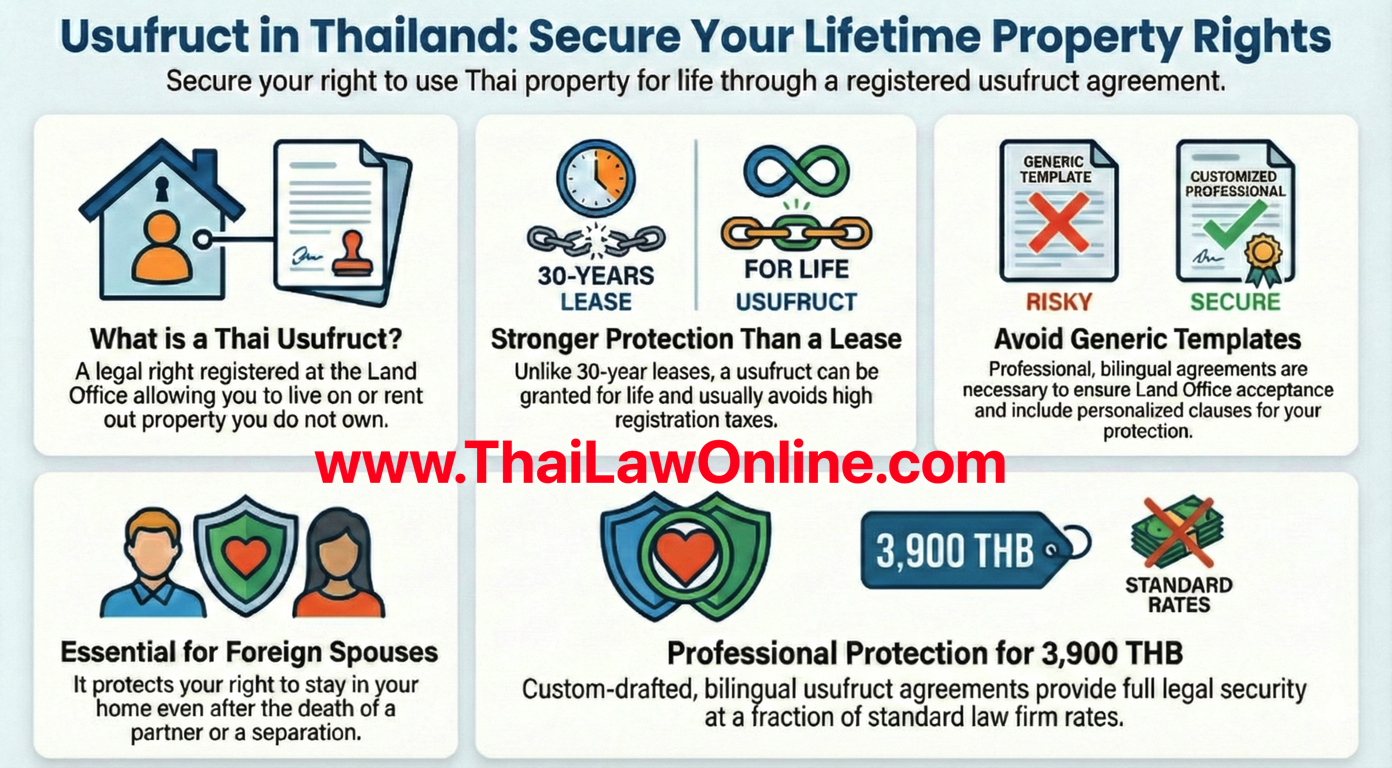
All three produce the same underlying document, the bilingual usufruct agreement this firm uses for its own clients. Download the editable template at 890 THB and complete it yourself, let the Document Maker build a finished personalised version if you are a Gold member, with translation available, or send us your details and we draft it around your facts in English and Thai for a fixed 3,900 THB, guiding you through registration at the Land Office. They are compared side by side in our complete guide, with our published fees.
Thai Law Updates, free by email
Plain-English updates on Thai law changes that affect foreigners: property, visas, marriage, business and wills. One short email a month from a firm practicing since 2006. No spam, unsubscribe anytime.