


Reviewed by ThaiLawOnline, a licensed Thai law firm practising in Thailand since 2006. Thai lawyer of record: Wichuda Atthamethakon, LL.M., Thai Bar Licence 3149/2556.
Last updated on
DBD filing becomes fully online on 1 November 2026
From 1 November 2026, every application concerning a partnership or private limited company must be submitted through DBD Biz Regist. Paper walk-in filing will end for incorporations and later registrations, including changes to directors or signing authority, registered office, capital and objects, plus dissolution and liquidation. This is an official filing-procedure change, not a change to the substantive company or foreign-ownership rules. See the official DBD announcement and the DBD Biz Regist portal.
2026 changed the rules. If you’ve been thinking about setting up a company in Thailand as a foreigner, or if you already have one, the changes that came into force on January 1, 2026 affect you directly.
Table of Contents
This guide is about what changed in 2026 and how to stay compliant. For the standard registration service, fees and timelines, see business setup and company registration in Thailand.
Last reviewed: 3 September 2026. Sections 4, 8 and 36 of the Foreign Business Act B.E. 2542 were read in the Thai original: section 4 defines when a company registered in Thailand counts as a foreigner, section 8 sets out the three schedules of restricted businesses, and section 36 sets the penalty for holding shares on a foreigner’s behalf. Our fixed fee for company registration and what it covers were confirmed against the firm’s own fee record on the same date. The proposal to allow asset seizure for nominee violations was re-checked and is still a proposal; that was established from legal reporting rather than from a register of Acts, so treat it as a status note and not as a citation. The registration process, detection system and timeline figures on this page are practice guidance and were not re-verified against a primary source in this review. Re-read on 5 October 2026: the penalty list now states section 36 as the Act does (no director disqualification or dissolution, and no doubling); an annual “beneficial owner declaration” with a 500,000 baht fine, for which we found no instrument, was replaced by the annual shareholder list under Civil and Commercial Code section 1139; the later DBD announcement extends online-only filing to every partnership and private limited company application from 1 November 2026; a Treaty of Amity company still needs a Foreign Business Certificate.
For comparison: our own fixed fee is THB 45,000 all-inclusive: it covers the government registration fees, the company stamp, translation of the main documents and advice on the preferred shareholding structure, which the cheaper quotes above usually bill separately. Some firms charge up to THB 75,000 for the same package.
The Department of Business Development moved new-company registration online on 1 July 2026. From 1 November 2026, the online-only rule expands to every application concerning partnerships and private limited companies, including amendments, director and signing-authority changes, registered-office changes, capital and object changes, dissolution and liquidation. Read the official DBD announcement. Thai shareholders in companies with foreign involvement must also prove their capital contributions with three months of bank statements. The nominee offence itself is unchanged, and asset seizure remains a proposal.
None of this is a reason to panic. But it is a reason to get your structure right before you register, and to audit your existing company if you set it up some years ago.
We’ve been advising foreign investors on Thai business law for 20 years. This guide explains what changed, what your legal options are, and what the right structure looks like for your situation.
Understanding the Foreign Business Act: The Starting Point
The Foreign Business Act B.E. 2542 (1999) (the “FBA”) is the law that governs what foreigners can and cannot do in business in Thailand. Every foreign investor needs to understand it before they do anything else.
Under the FBA, a “foreigner” is anyone who is not a Thai national. A company is classified as “foreign” if 50% or more of its shares are held by non-Thai nationals or foreign companies.
The FBA divides restricted business activities into three schedules:
- Schedule 1 (Absolute prohibitions): Foreigners may never engage in these businesses, regardless of license or structure. Examples include newspaper publication, rice farming, forestry, and land trading.
- Schedule 2 (National interest restrictions): Foreigners may apply for Cabinet approval to operate. Includes activities related to Thai culture, history, and natural resources.
- Schedule 3 (Competitive balance): The most commercially relevant list. Includes service businesses such as accounting, law, architecture, retail, and wholesale trade. A Foreign Business License (FBL) from the DBD is required. This process takes 3 to 4 months.
The practical result: most foreigners wanting to run a business in Thailand are limited to 49% ownership under the standard Thai limited company structure. Thai shareholders must hold the majority.
This is where the nominee problem begins.
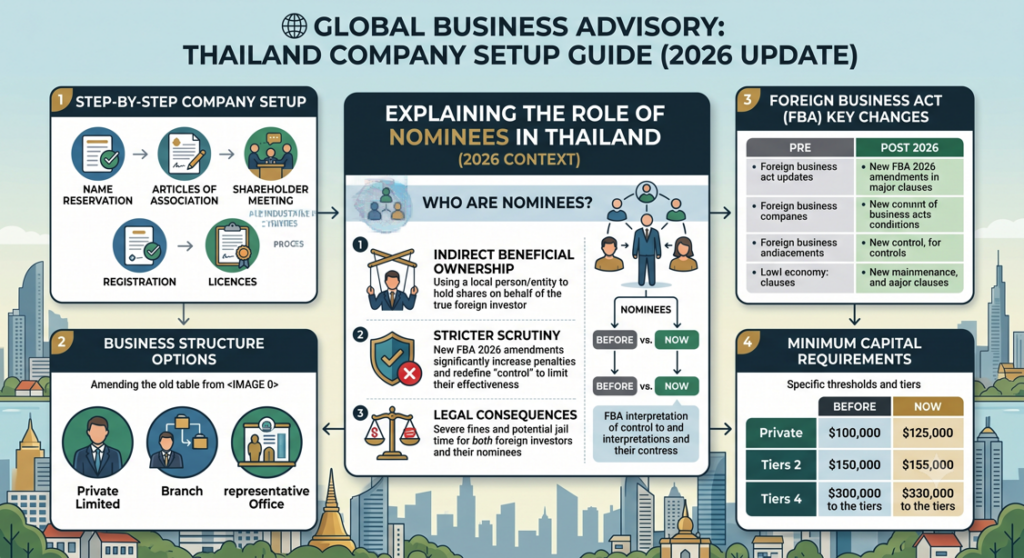
Nominee Shareholders: Why the Old Approach Is Now a Serious Risk
HIGH RISK 2026
For years, a common workaround was to put Thai nominees on the shareholder register. The foreigner would hold 49%, and the remaining 51% would go to Thai nationals who had no real financial stake and no real voting control. Power of attorney documents, undated share transfer forms, and voting agreements would effectively give the foreigner full control.
This structure violates Section 36 of the FBA. It always did. But enforcement was inconsistent, and many investors considered it a calculated risk.
That calculus has changed sharply in 2026.
What the 2026 Enforcement Changes Mean
1. IBAS: The AI Nominee Detection System. Since October 2025, the DBD operates the Intelligence Business Analytic System (IBAS). This AI platform cross-references the corporate registry against government databases, bank records, social security filings, and immigration data. It flags companies showing statistical indicators of nominee ownership.
2. The 3-Month Bank Statement Rule, now under Order 2/2569 (in force 1 August 2026). Where aliens hold less than 50% of the capital, or a company with no alien shareholder has an alien authorised director, registration requires each Thai shareholder to provide three months of personal bank statements covering the period before the payment date. The statements must show a withdrawal or transfer matching the exact share subscription amount and date. This began under Central Registrar Order 2/2568 on 1 January 2026, but that order and Order 1/2569 were both repealed by Central Registrar Order 2/2569, signed 15 July 2026 and in force since 1 August 2026. Order 2/2569 is the instrument that applies today, and it asks for two documents the earlier regime did not.
3. Amendments that admit a foreigner, and what replaced the April 2026 rule. Order 1/2569, issued 16 March 2026 and in force 1 April 2026, required in-person verification at the DBD for any amendment admitting a foreigner as a partner or as a director with signing power. That order was repealed on 1 August 2026 by Order 2/2569, so it is no longer the rule and you should disregard guidance that still states it. What replaced it is a document: clause 4 of Order 2/2569 requires an Investment Confirmation Letter on the annexed form for exactly those amendments. That is a different form from the Investment Explanation Letter in the next paragraph, which belongs to establishment, and the two are easy to confuse.
Do not read the repeal as the end of identity checking. The Department’s own published channel list states that identity verification cannot be delegated by anybody, Thai or foreign, so the check survives the order that carried it. What we cannot tell you from any instrument is whether a person must still attend a DBD office or whether verifying inside the DBD e-Service app now satisfies it, because Order 1/2569’s text is not published anywhere we can read it. Ask the office handling your filing before you book travel.
4. What Order 2/2569 added (1 August 2026). Two further documents now accompany the filing. The first is a statement for the receiving account, and note whose account that is: it belongs to the managing partner or director, not to the company, and it must evidence money arriving from every partner or shareholder. The second is a signed Investment Explanation Letter, a prescribed form annexed to the Order, tracing the flow of funds from each Thai shareholder into that account transfer by transfer. It stays on the registrar’s file.
The Order also catches a case most foreign investors do not expect. It applies where an alien holds less than half the capital, and equally where there is no alien shareholder at all but an alien authorised director can bind the company. Structuring around the shareholding alone does not take you outside it.
One thing the Order does not do is worth stating plainly, because a good deal of commentary gets it wrong. It prescribes the documents that must accompany an application and attaches no rejection or referral consequence of its own. Reports that the registrar rejects filings describe practice at the counter, not anything the Order says. The primary text is published by the DBD as a scanned PDF of Order 2/2569.
The Penalties
- Criminal fines for the foreign investor and the Thai nominees
- Imprisonment of up to three years, or a fine of 100,000 to 1,000,000 baht, or both, for the Thai nominee and for the foreigner (FBA section 36)
- A court order to end the shareholding or joint business, with a daily fine of 10,000 to 50,000 baht while it is defied
- Proposed asset seizure for nominee violations (still a proposal, not law, checked September 2026)
Clear legal position: Using Thai nationals as nominee shareholders to circumvent the Foreign Business Act is a criminal offence under Section 36 of the FBA. The DBD’s AI system is actively looking for these structures.
Legal Pathways to Foreign Business Ownership in Thailand
| Structure | Max Foreign Ownership | Timeline | Best For |
|---|---|---|---|
| Standard Thai Ltd. Company | 49% | 2-4 weeks | Genuine Thai partnerships |
| BOI Promoted Company | 100% | 60-90 days | Tech, manufacturing, digital, healthcare, clean energy |
| US Treaty of Amity | 100% (US only) | 3-6 months | US citizens and US-incorporated companies |
| Foreign Business License (FBL) | 100% | 3-4 months | Schedule 3 service businesses |
| Regional Operating Headquarters | 100% | Varies | Multinationals managing Asia-Pacific from Thailand |
BOI Promotion: The Cleanest Route for Most Foreign Investors
BOI promotion is the most commercially attractive option for the right business. The benefits are substantial, the legal standing is unambiguous, and the range of qualifying activities has expanded significantly in recent years.
What You Get with BOI Promotion
- 100% foreign ownership, fully legal, without FBA restrictions
- Corporate income tax exemptions of up to 13 years
- Import duty exemptions on machinery and raw materials
- Land ownership rights for the promoted activity
- Streamlined work permit processing for foreign staff
- No requirement for a Foreign Business License
Who Qualifies in 2026
- Digital technology, software development, data centers, cloud services, and AI platforms
- Advanced manufacturing, automation, and robotics
- Electric vehicles and clean energy
- Medical devices, biotechnology, and healthcare services
- Smart agriculture and food technology
- Logistics and distribution (with conditions)
- Quantum computing, generative AI, and advanced robotics
Pure retail, trading, and most service businesses do not qualify for BOI promotion.
The US-Thailand Treaty of Amity: An Underused Option for American Investors
The US-Thailand Treaty of Amity and Economic Relations (signed 1966, in effect 1968) allows US citizens and US-incorporated companies to own up to 100% of a Thai business in most sectors. It does not bypass the Foreign Business Act: the company still needs a Foreign Business Certificate from the DBD before it operates.
Who Qualifies
- US citizens (individual ownership)
- Companies incorporated in the United States with majority US ownership
Excluded Sectors
- Communications and telecommunications
- Domestic transportation (land, air, and water)
- Banking, financial services, and securities trading
- Exploitation of natural resources
- Domestic trade in agricultural products
- Land ownership
The Standard Thai Limited Company: Still a Valid Option
The 49%/51% structure works fine when the Thai shareholders are genuine business partners with real capital, real decision-making roles, and genuine skin in the game. What the 2026 rules demand is that the Thai majority ownership be real, documented by three months of bank statements showing the source of their investment.
How to Register a Thai Company in 2026: The New Online Process
NEW 2026
New private limited companies have been registered only through DBD Biz Regist since 1 July 2026. From 1 November 2026, every application concerning a partnership or private limited company must use the same platform. Paper walk-in filing will also end for later amendments, changes to directors or signing authority, registered office, capital and objects, and for dissolution and liquidation registrations. See the official DBD announcement, the DBD Biz Regist portal, and our detailed company-registration guide.
- Name reservation: Check name availability and reserve online. Approval takes 1 to 3 business days.
- Statutory meeting: At least 2 promoters must convene (reduced from 3 by the Civil and Commercial Code Amendment (No. 23) B.E. 2565, in force since 7 February 2023) and approve the memorandum of association. Video conference with digital signatures accepted.
- Registration submission: Upload the memorandum of association, articles of association, shareholder/director list, and bank statements for Thai shareholders in foreign-involved companies.
- DBD review and approval: Standard applications approved within 5 to 7 business days.
- Tax registration: Register for VAT at the Revenue Department if annual revenue will exceed THB 1.8 million.
- Work permit and visa processing: THB 2 million paid-up capital required per foreign employee, maximum 10 foreign employees.
The 3-Month Bank Statement Requirement in Practice
For each Thai shareholder in a company with foreign involvement, the bank statement must cover the three months before the payment date and show a specific withdrawal or transfer matching the share subscription amount and date. Statements where money appeared in a lump sum one week before registration will be questioned.
2026 FBA Compliance Checklist
- Thai shareholders’ capital contributions documented by 3 months of personal bank statements
- No power of attorney documents giving the foreigner control over Thai shareholders’ voting rights
- No undated share transfer agreements held by the foreigner
- Thai shareholders appear in meeting minutes and directors’ records with actual involvement
- Annual list of shareholders sent to the DBD within 14 days of the annual general meeting (Civil and Commercial Code section 1139)
- Company registered via DBD Biz Regist platform (if incorporated after 1 July 2026)
- Any amendment admitting a foreign partner (partnership) or a foreign authorised director (company) supported by an Investment Confirmation Letter under clause 4 of Order 2/2569 (in force 1 August 2026)
- Paid-up capital meets the THB 2 million per foreign employee requirement
- Business activity covered by FBL, BOI, or Treaty of Amity if in a restricted FBA schedule
- Business address registered correctly under the 2026 DBD address registration rules
Costs and Timelines at a Glance
| Item | Approximate Cost | Timeline |
|---|---|---|
| Thai limited company registration (fees at other firms, often excluding government fees and translations) | THB 15,000 to THB 75,000 | 2-4 weeks |
| BOI application preparation and filing | THB 40,000 to THB 120,000 | 60-90 days for approval |
| US Treaty of Amity certification | THB 30,000 to THB 80,000 | 3-6 months |
| Foreign Business License application | THB 50,000 to THB 150,000 | 3-4 months |
| Work permit (per foreign employee, per year) | THB 3,000 to THB 3,750 | 7 business days |
| Nominee restructuring advice | Contact us for a quote | Case dependent |
On minimum capital: There’s no universal minimum paid-up capital for a Thai limited company in most sectors. But remember the work permit rule: you need THB 2 million in paid-up capital per foreign employee. If you plan to hire two foreign staff, you need at least THB 4 million paid up.
If You Already Have a Company in Thailand: What to Do Now
Step 1: Audit your shareholder structure. Who actually owns the shares? Is their capital documented? Do they play any real role in the company?
Step 2: Assess your business activity. Does your current activity fall under a restricted FBA schedule? Do you have an FBL, BOI promotion, or Treaty of Amity certification?
Step 3: Get a restructuring plan. If you need to restructure, do it proactively. The DBD’s IBAS system is running 24 hours a day. A voluntary restructuring before a DBD inquiry will always result in a better outcome than a forced one.
Frequently Asked Questions
Can a foreigner own 100% of a company in Thailand?
Yes, but only through specific legal channels. BOI-promoted companies can be 100% foreign-owned in eligible sectors. US citizens and US-incorporated companies can own 100% through the Treaty of Amity. Otherwise 49% is the usual ceiling in practice, because at half or more foreign shareholding the company is itself a foreigner under section 4 and needs permission for the businesses the Act lists.
Are Thai nominee shareholders legal in 2026?
No. Using Thai nationals as nominee shareholders to bypass the Foreign Business Act is illegal under Section 36 of the FBA. The DBD’s IBAS system actively detects nominee structures.
What changed for Thailand company registration in 2026?
New companies have been registered only through DBD Biz Regist since 1 July 2026. From 1 November 2026, every application concerning a partnership or private limited company must be filed online, including amendments, director and signing-authority changes, registered-office changes, capital and object changes, dissolution and liquidation. Thai shareholders in foreign-involved companies must also provide three months of bank statements showing genuine capital contributions.
What is the Foreign Business Act (FBA) in Thailand?
The Foreign Business Act B.E. 2542 (1999) restricts foreigners from operating in certain business sectors in Thailand. It does not cap foreign shareholding directly: section 4 treats a company registered in Thailand as a foreigner once non-Thais hold half or more of its capital shares, and section 8 then restricts a foreigner from the businesses listed across its three schedules.
How long does it take to register a company in Thailand in 2026?
It depends on who is in the company rather than on the platform. Section 1111/1 of the Civil and Commercial Code lets the memorandum and the company be registered on the same day the promoters sign it, on four conditions. A company with a foreign shareholder or a foreign authorised director takes longer, because Order 2/2569 requires the Investment Explanation Letter and three months of bank statements to be uploaded with the application, so allow 2 to 4 weeks. BOI promotion takes 60 to 90 days. A Foreign Business License takes 3 to 4 months.
What is the BOI in Thailand and how does it help foreign investors?
The Board of Investment (BOI) promotes investment in priority industries. BOI-promoted companies enjoy 100% foreign ownership, corporate income tax exemptions of up to 13 years, import duty exemptions, and land rights.
Who qualifies for the US-Thailand Treaty of Amity?
US citizens and companies incorporated in the United States with majority US ownership. The treaty allows 100% US ownership in most business sectors. Excluded sectors include communications, domestic transportation, banking, natural resource exploitation, and domestic trade in agricultural products.
Need Help Structuring Your Thai Company?
Whether you’re starting fresh or cleaning up an existing structure, our licensed Thai business lawyers can advise on the right approach for your situation.
Key Takeaways
- The Foreign Business Act limits foreigners to 49% ownership in most Thai companies. Nominee shareholders are illegal under Section 36 and are now actively detected by the DBD’s IBAS AI system.
- Three legal routes to 100% foreign ownership: BOI promotion, US Treaty of Amity, and Foreign Business License.
- New companies have been online-only through DBD Biz Regist since 1 July 2026. From 1 November 2026, all partnership and private limited-company application types must be filed through the platform. Thai shareholders must also back their share subscriptions with three months of personal bank statements where Order 2/2569 applies.
- Since 1 August 2026, adding a foreign authorised director to a company, or a foreign partner to a partnership, requires an Investment Confirmation Letter under clause 4 of Order 2/2569. The in-person verification rule of 1 April 2026 went with Order 1/2569, which that order repealed.
- The company must send the DBD its list of shareholders every year, within 14 days of the annual general meeting (section 1139 of the Civil and Commercial Code).
- If your existing company uses nominees, get legal advice now.
- BOI promotion is the best option for technology, digital, manufacturing, healthcare, and clean energy businesses.
Legal disclaimer: This article provides general information about Thai business law and registration procedures. It does not constitute legal advice. Laws and regulations change. Always consult a licensed Thai lawyer before making decisions about company structure in Thailand.
How much does company registration cost? See the full company registration cost breakdown (2026), legal fees, government fees and timelines, or all our fixed fees on the legal fees page.
Thai Law Updates, free by email
Plain-English updates on Thai law changes that affect foreigners: property, visas, marriage, business and wills. One short email a month from a firm practicing since 2006. No spam, unsubscribe anytime.