


Révisé par ThaiLawOnline, un cabinet d'avocats thaïlandais agréé exerçant en Thaïlande depuis 2006. Avocate thaïlandaise en charge du dossier : Wichuda Atthamethakon, LL.M., licence du barreau thaïlandais 3149/2556.
Dernière mise à jour :
Réponse courte : if your Thai off-plan condo is late, defective or smaller than the contract says, you have real statutory rights. Your contract must follow the mandatory standard form under section 6/2 of the Loi sur les copropriétés, and developer-friendly deviations from it do not bind you. Late handover earns a daily penalty. Termination triggers a full refund with interest. You sue as a consumer, which means no frais de justice, and your lawyer can run the case by procuration while you stay abroad.
Still buying? Everything below is avoidable. See what a condo lawyer checks before you sign, or read the guide to buying a condo in Thailand.
FREE DOWNLOAD, READ IT BEFORE YOU PAY A DEPOSIT
Buying a Condo in Thailand: Checklist for Foreign Buyers (Word + PDF, English & Thai)
The 49% foreign quota, how to bring the money in so the Land Office accepts it (FET form), what to check before the deposit, taxes and fees, transfer day, six red flags and a purchase record sheet. Complete English text first, then the complete Thai text. Checked 3 October 2026.
Télécharger gratuitement Want us to run the checks? Condominium Package ฿19,900 →
You bought an off-plan condo in Thailand two years ago. The brochure promised a rooftop pool and handover last March. Today the site is a concrete shell, the sales office won’t return calls, and your money is sitting in the developer’s account. Not in compte séquestre. Not protected. Just gone, unless you act.
We’ve handled these cases for 20 years, and here’s the good news most buyers never hear: Thai law is unusually kind to condo purchasers. Your contract is backed by a mandatory government form. Delay penalties accrue daily. You can sue as a consumer, without court fees, and claim your money back with interest.
This guide covers what most articles skip. The exact statutes. The Cour suprême decisions. The step-by-step lawsuit process, realistic timelines, and what happens when the developer goes broke.
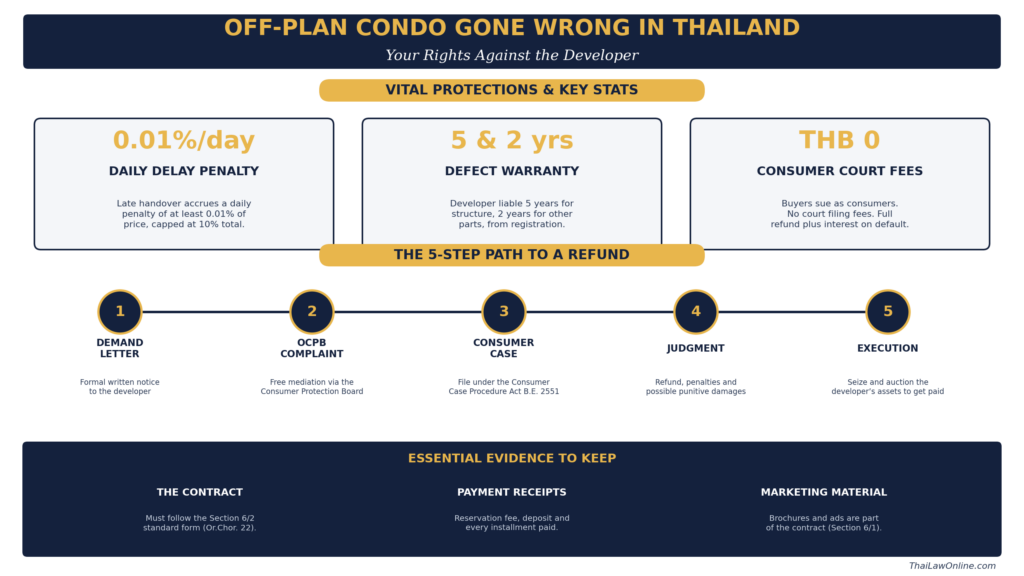
Table des matières
Pourquoi les achats de condos sur plans en Thaïlande tournent mal
Off-plan means you pay for a promise. A reservation fee books the unit. A contract deposit follows, usually 10% to 20% of the price. Then monthly installments run through construction, with the balance due at transfer.
Your money funds the construction
Understanding Your Off-Plan Condo in Thailand
Here’s the structural problem. Thai developers typically use buyer payments to build the project. Your installments go straight into the developer’s own bank account. If sales slow down or financing collapses, construction stalls. Your money is already spent.
We’ve seen this pattern in Pattaya, Phuket and Bangkok for twenty years. The project that “pauses for redesign” rarely restarts on its own. Buyers who move early recover far more than buyers who wait politely.
Escrow exists but almost nobody uses it
Thailand has an escrow law: the Escrow Act B.E. 2551 (2008). It lets a licensed escrow agent, usually a bank, hold your payments until the developer delivers. Funds held this way sit outside the developer’s faillite succession.
The catch? Escrow is voluntary. Developers prefer direct payment because they need your cash to build. In our experience, genuine escrow arrangements appear in only a small fraction of off-plan sales. If a developer agrees to escrow, that alone says something about their financial health.
Your Contract Is Stronger Than You Think: Section 6/2 of the Condominium Act
Most buyers assume they’re stuck with whatever the developer’s lawyers drafted. Not in Thailand. Since the 2008 amendment, Section 6/2 of the Condominium Act B.E. 2522 (1979) requires every developer’s sale contract to follow a standard form prescribed by ministerial regulation (the Or.Chor. 22 form).
Any clause that deviates from the standard form and favors the developer is unenforceable. The court simply ignores it. Think of it like a consumer bill of rights baked into your contract, whether the developer typed it in or not.
What the standard form guarantees you
The prescribed terms include real teeth. The developer must complete and transfer the unit by the contractual date. Late handover triggers a daily penalty of at least 0.01% of the purchase price, capped at 10%. Once that cap is reached and the unit still isn’t ready, you may terminate and demand a full refund with interest.
The form also makes the developer responsible for its own income tax, taxe professionnelle spécifique and stamp duty at transfer. And you can assign your rights to another buyer without paying the developer an assignment fee.
The brochure is part of the contract
Section 6/1 of the Condominium Act goes further. Advertising materials, brochures and show-room promises form part of the sale contract. Where the brochure and the contract conflict, the version more favorable to you prevails. That “infinity pool and 2,000 sqm garden” in the glossy render isn’t marketing fluff. It’s an enforceable term. The Supreme Court applied exactly this in Dika 5352/2553: a developer advertised a large shopping centre next to the building and a large pool on the car park roof, built neither, and argued that none of it appeared in the contract. The court held the advertising leaflet and scale model were part of the sale and purchase agreement, and the developer was bound by them. See six décisions de la Cour suprême que tout acheteur de condo devrait connaître.
Conseil pratique : Keep every brochure, screenshot, LINE chat and email from the sales team. In our practice, advertising evidence has repeatedly turned a weak delay case into a strong one, especially where facilities were downgraded or never built.
Late Handover: Penalties, Termination and Interest
Delay is the most common off-plan complaint we see. Thai law gives you two paths, and choosing correctly matters.
Path one: wait and collect the daily penalty
If you still want the unit, keep the contract alive. The delay penalty accrues at no less than 0.01% of the purchase price per day. On a THB 5,000,000 condo, that’s THB 500 per day, about THB 15,000 per month. The cap is 10% of the price, THB 500,000 in this example.
Send a written notice reserving your penalty claim. Silence can be read as waiver. Where both sides simply let the completion date pass without acting on it, that date stops being of the essence, and the shortcut in CCC Section 388, which lets you rescind without any notice where time is essential, closes. You are then back on Section 387: fix a fresh reasonable period, notify the developer in writing to perform within it, and only rescind if it does not.
Path two: terminate and demand your money back
If the project is clearly failing, terminate. Under Sections 386 to 391 of the Code civil et commercial (CCC), termination for the developer’s breach restores both parties to their original positions. The developer must refund every baht you paid, with interest from the date it received each payment.
Thai courts back this up consistently. In Supreme Court Decision No. 6474/2541 (1998), construction had been abandoned for over a year. The buyer was entitled to terminate and recover all payments with interest. In Decision No. 1188/2549 (2006), the Court held that when the developer plainly cannot finish on time, the buyer may terminate immediately, no grace period required.
No completion date in the contract? You’re still protected
Some older or non-compliant contracts omit a completion date. Developers argue they can finish “when ready”. The Supreme Court disagrees. Decision No. 277/2553 (2010) holds that the developer must start and finish within a reasonable time, applying the good-faith principles of CCC Sections 203 and 368.
And if the developer has fallen behind, you can lawfully suspend your own installments. Decision No. 6746/2547 (2004) confirms this under CCC Section 369, the rule on reciprocal contracts. A defaulting developer can’t declare you in breach for withholding payments while it isn’t ready to perform itself.
Delay, Defect and Refund Rights at a Glance
| Problem | Your right | Base juridique | Key numbers |
|---|---|---|---|
| Handover later than contract date | Daily penalty while you wait, or terminate and refund | Standard form under Condominium Act s.6/2; CCC s.391 | Penalty at least 0.01%/day, capped at 10% of price |
| Construction abandoned or hopeless | Immediate termination, full refund plus interest | CCC s.386 to 391; Dika No. 6474/2541, 1188/2549 | Interest on the refund 3% per year since 11 April 2021 (7.5% in older cases) |
| Structural defects after transfer | Repair or damages from developer | Standard form warranty; CCC s.472 | 5-year warranty from registration |
| Defects in other components | Repair or damages from developer | Standard form warranty; CCC s.472 | 2-year warranty; sue within 1 year of discovery (CCC s.474) |
| Unit area differs from contract | Reject the unit, or accept with price adjustment | CCC s.466 | Over 5% difference: right to reject |
| Project halted by force majeure | Refund of all payments with interest | Standard form under s.6/2 | Interest at Krung Thai Bank’s highest fixed deposit rate |
Construction Defects and Area Shortfalls
Not every off-plan disaster is a delay. Plenty of projects finish on time and hand over badly built units. Cracked walls, leaking bathrooms, missing fittings, a floor plan that shrank between brochure and transfer.
Two warranty periods, counted from registration
The standard contract form makes the developer liable for structural defects for 5 years from the date ownership is registered. That covers foundations, columns, beams and load-bearing elements. For everything else, fittings, tiles, equipment, the warranty runs 2 years.
Don’t confuse the warranty window with the deadline to sue. Under CCC Section 474, a defect claim prescribes one year from the date you discovered the defect. Found water penetration in month three? The clock is already running. Notify the developer in writing immediately and keep photographic evidence with dates.
The shrinking condo: area discrepancies
Developers measure final unit areas after construction, and the registered area often differs from the contract. CCC Section 466 draws the line at 5%. Within 5%, the price adjusts pro rata. Beyond 5%, you may refuse to take the unit entirely, or take it with a proportional price cut.
Watch for contract clauses forcing you to accept any size difference at the original price. Under Section 6/2, terms less favorable than the law are unenforceable. And in Supreme Court Decision No. 2493/2553 (2010), a serious discrepancy between the contract and reality made the contract annulable as a material mistake.
Getting Your Deposit and Installments Back
Refund cases turn on two things: proving the developer’s breach, and calculating what comes back to you. Thai law splits your payments into categories, and the difference matters if the developer tries to keep your money.
Termination means full restitution
Once you validly terminate for the developer’s default, CCC Section 391 applies. Each party must restore the other to its original position. The developer returns your reservation fee, contract deposit and every installment. Interest runs from the date the developer received each payment, not from the date you sued.
What interest rate applies?
This is where many older articles mislead readers. Before 2021, statutory default interest was 7.5% per year, and you’ll see that rate in older judgments. A 2021 amendment to the Civil and Commercial Code changed the numbers. From 11 April 2021, the statutory rate under Section 7 is 3%, and default interest under Section 224 is 5% per year. Money returned on termination carries the Section 7 rate, not the Section 224 default rate, because Section 391 fixes no rate of its own: in Supreme Court Decision 129/2566 the Court ordered a returned down payment repaid with 7.5% a year up to 10 April 2021 and 3% from 11 April 2021, while the separate award of damages carried 5%. The contract or the standard form may provide a better rate. For force majeure refunds, the standard form applies Krung Thai Bank’s highest fixed deposit rate.
Deposits versus installments: why the label matters
If the dispute flips and the developer accuses you of default, it will try to keep everything. It can’t. The Supreme Court separates earnest money from installments. Earnest money is a true deposit given at signing: Section 377 is what makes it a deposit, and Section 378(2) is what lets the seller keep it when the buyer defaults. Installments are simply part payments of the price.
Decision No. 3301/2547 (2004) shows what that is worth in money. The buyer had paid 30,000 baht on booking and 120,000 on signing, then twelve instalments totalling 840,000. The Court held the first 150,000 was a deposit the seller could keep, but the 840,000 was part payment of the price and not a deposit; a clause forfeiting everything paid is a penalty under Section 379, which a court may reduce. It cut the seller’s retention to 440,000 baht and ordered 400,000 returned to the buyer, who was the party in default. Even a genuine deposit can be reduced if it is disproportionately high, under Section 7 of the Unfair Contract Terms Act B.E. 2540 (1997).
Dernière révision : 17 septembre 2026. This was a targeted review of the case citations on this page rather than of the page as a whole. The Supreme Court decisions cited above were read in Thai against the published judgments. Decisions 277/2553 (a contract silent on dates still requires the developer to begin at once and finish within a reasonable time, under Sections 203 and 368, and the buyer may stop paying instalments meanwhile) and 6746/2547 (a developer not ready to transfer cannot put the buyer in default, and on termination the money paid must be returned with interest) stand as published. The account of 3301/2547 was corrected: forfeiture of a deposit rests on Section 378(2), and that decision’s figures are now given. The other decisions cited on this page, the penalty rates and the practice guidance were not re-checked in this review.
Last reviewed: 30 September 2026 (interest only). The refund interest rate was corrected from 5% to 3% after reading Civil and Commercial Code sections 7, 224 and 391 in Thai and Supreme Court Decision 129/2566 to its disposition (returned down payment at 3% from 11 April 2021; damages at 5%).
Step-by-Step: How to Sue a Thai Developer
Here’s the process we run for clients, from first letter to money in hand.
- Build the file. Contract, receipts, brochures, ads, chat records, photos of the site, and a payment schedule. Get a company affidavit on the developer from the Department of Business Development to confirm who you’re suing and whether it’s still active.
- Send a formal demand letter. A Thai-language notice by registered mail, stating the breach, the amount claimed, the interest, and a deadline (commonly 15 or 30 days). If you’re terminating, include a clear notice of termination. This letter fixes the developer’s default and starts the pressure.
- Complain to the OCPB (optional but useful). The Office of the Consumer Protection Board takes complaints against developers, investigates and mediates. It’s free. Some developers settle here to avoid regulatory attention. Don’t let mediation drag past your limitation periods.
- File a consumer case. A condo buyer suing a developer is a consumer under the Consumer Case Procedure Act B.E. 2551 (2008). You file where the developer is domiciled or where the project sits. Claims up to THB 300,000 go to the Kwaeng (district) court; larger claims go to the Civil or Provincial Court.
- Use the consumer-case advantages. No court fees for the consumer plaintiff. Simplified, judge-driven procedure with case officers helping frame the complaint. The burden of proving facts within the developer’s exclusive knowledge, construction status, financing, permits, shifts to the developer. Courts aim to take evidence in continuous, compact hearings.
- Ask for punitive damages where they fit. Section 42 of the Act covers developers who acted with knowing dishonesty or gross disregard for your rights. The court may add punitive damages of up to twice the actual damages. Where actual damages don’t exceed THB 50,000, the multiplier rises to five. Selling units in a project the developer knew was doomed is exactly the fact pattern this section targets.
- Judgment and appeal. First-instance consumer cases typically run 6 to 12 months in our experience, longer if heavily contested. Appeals go to the Court of Appeal; further review by the Supreme Court requires permission.
- Execute the judgment. A judgment isn’t a bank transfer. If the developer doesn’t pay, the Legal Execution Department seizes and auctions its assets: unsold units, land, bank accounts. Move fast. Other creditors are usually racing you.
Suing from abroad
You don’t need to live in Thailand to litigate here. A notarized power of attorney lets a avocat immobilier thaïlandais file and run the case. Plan one trip for the witness hearing if the court wants your testimony; some courts now allow video testimony. Judgment money can be repatriated through your bank with the judgment and evidence of the original transfer.
Many buyers, same project? Consider a class action
Since the class action chapter was added to the Civil Procedure Code in B.E. 2558 (2015), groups of buyers with common claims against one developer can sue together. Stalled projects produce dozens of near-identical claims, which is what the mechanism was built for. A group also shares costs and gets the developer’s attention faster than one buyer alone.
Costs, Timelines and What You Can Recover
| Élément | Typical position in a consumer case |
|---|---|
| Honoraires d'enregistrement des tribunaux | Exempt for the consumer plaintiff under the Consumer Case Procedure Act |
| Lawyer’s fees | Privately agreed; fixed-fee and staged arrangements are common for refund claims |
| Demand letter stage | 1 to 4 weeks, including the response deadline |
| OCPB mediation | Roughly 1 to 3 months, depending on caseload and the developer’s attitude |
| First-instance judgment | Often 6 to 12 months; contested cases can run longer |
| Principal recovery | All payments made: reservation, deposit, installments |
| Intérêts | 3% per year (Section 7) on refunded payments since 11 April 2021, from the date the developer received each payment; damages carry the 5% default rate |
| Delay penalty (if not terminating) | At least 0.01% of price per day, capped at 10% |
| Punitive damages | Up to 2x actual damages under Section 42, in cases of bad faith |
| Execution of judgment | Weeks to many months, driven by what assets the developer still owns |
One honest caveat from twenty years of doing this: winning the judgment is the predictable part. Collecting depends on the developer’s remaining assets. That’s why we check the developer’s land holdings and litigation history before filing, and why acting before other buyers file first genuinely improves recovery.
When the Developer Goes Under
The nightmare scenario: the project is abandoned and the company is insolvent. Your options narrow, but they don’t vanish.
Bankruptcy and rehabilitation claims
If creditors push the developer into bankruptcy, you must file a proof of debt with the official receiver. The statutory window starts running once the receiving order is published, so don’t sit on it. You’ll stand as an unsecured creditor behind banks holding mortgages over the land. Recovery percentages are modest, we won’t pretend otherwise, but buyers who file claims recover something; buyers who don’t, recover nothing.
Sometimes a white knight buys the stalled project and offers existing buyers new contracts. Have those reviewed before signing away your original claims. The replacement terms are often worse than the Section 6/2 standard form you already hold.
Protect yourself before the next purchase
If you buy off-plan again, treat developer risk as the main risk. Check the company’s registered capital, its track record of completed buildings, the construction permit and the environmental approval before paying more than a reservation fee. Our guide to vérification préalable des biens immobiliers en Thaïlande walks through the full checklist. Our overview of buying a condo in Thailand covers the foreign ownership quota and transfer process. Push for escrow under the Escrow Act. Most developers will refuse. The ones that accept are usually the ones you can trust.
Before You Sign: The Off-Plan Checks That Prevent All of This
Everything above is a remedy. Remedies are slow, and a refund with interest is still years of your money sitting in someone else’s project. These are the checks that keep you out of court in the first place, and they all happen before the reservation fee is paid.
- The developer, not the building. Registered capital, shareholders and directors at the Department of Business Development, plus a litigation search against the company and its directors. A developer with a history of defended delay claims will have another one.
- The construction permit, and the EIA where the project size requires one. A project selling units before it holds these is selling you a planning application.
- The project mortgage. Most projects are built on land mortgaged to a lender. Ask in writing how and when your specific unit is released from that mortgage, and what happens to your unit if the developer defaults on the loan.
- The contract against the standard form. Compare clause by clause with the section 6/2 form. Every departure that reduces your rights is a clause the developer knows is unenforceable and is hoping you will honour anyway.
- The completion date and the penalty clause. A contract with no completion date, or one that lets the developer extend at will, is the single loudest warning sign in this market.
- Escrow, under the Escrow Act B.E. 2551. Ask for it. Most developers refuse, and the refusal itself is information. See how escrow works in Thailand.
- The foreign quota on your specific unit, confirmed in writing by the juristic person, in square metres. Off-plan buyers often discover at transfer that the quota filled while their building went up.
We run all of these as a fixed fee. A full condominium package, including the developer search, the contract review against the standard form and the transfer, is THB 19,900, or THB 34,900 with us at the Land Office on the day.
Foire aux questions
Can I get my deposit back if my condo is delayed in Thailand?
Yes, if the developer missed the contractual transfer date. You can terminate and claim everything back with interest. The Supreme Court confirmed in Decision No. 1188/2549 that no grace period is needed when the developer clearly can’t deliver.
How long do I have to sue a Thai condo developer?
Refund and breach-of-contract claims generally prescribe in 10 years under CCC Section 193/30. Defect claims are far shorter: one year from discovery under Section 474. When in doubt, get advice early.
Do I pay court fees when suing a developer in Thailand?
No. Condo buyers sue as consumers under the Consumer Case Procedure Act B.E. 2551, and consumer plaintiffs are exempt from court fees. Your main cost is your own lawyer.
Can I sue a Thai developer without coming to Thailand?
Mostly, yes. A power of attorney lets your Thai lawyer file and manage the case. Budget for one appearance at the witness hearing, though courts increasingly allow remote testimony.
What interest rate applies to my refund?
3% per year from 11 April 2021 on money refunded after termination, because Section 391 sets no rate and Section 7 applies (Supreme Court Decision 129/2566). The 5% default rate under Section 224 applies to damages. Older cases applied 7.5%. Force majeure refunds under the standard form carry Krung Thai Bank’s highest fixed deposit rate.
What if my finished unit is smaller than the contract says?
CCC Section 466 governs. A difference over 5% lets you reject the unit or take it at a reduced price. Within 5%, the price adjusts proportionally. Clauses forcing you to swallow any shortfall at full price are unenforceable.
Is my off-plan payment protected by escrow in Thailand?
Almost certainly not. Escrow under the Escrow Act B.E. 2551 is voluntary and rarely offered. Unless your contract names a licensed escrow agent, your payments sit in the developer’s own account.
Comment ThaiLawOnline peut vous aider
We’ve been litigating against Thai developers since before most current projects broke ground. Our team reviews your contract against the Section 6/2 standard form and drafts the demand letter in Thai. We file the consumer case and pursue execution until you’re paid. We act for clients worldwide by power of attorney.
Facing a stalled project or a silent developer? Contactez un avocat thaïlandais for a case assessment. You can also explore our bilingual database of Thai Supreme Court decisions and our guide on consumer law in Thailand. Planning another purchase? Start with acheter un bien immobilier en Thaïlande en tant qu'étranger.
Points clés à retenir
- Your off-plan contract must follow the government’s standard form under Section 6/2 of the Condominium Act. Developer-friendly deviations are unenforceable.
- Late handover earns you a daily penalty of at least 0.01% of the price, capped at 10%. Terminate instead, and you get a full refund with interest.
- Defect warranties run 5 years for structure and 2 years for other components, but you must sue within 1 year of discovering a defect.
- You sue as a consumer: no court fees, a simplified procedure, a shifted burden of proof, and possible punitive damages under Section 42.
- Interest on refunds is currently 3% per year (Section 7), counted from the date the developer received your money.
- Speed matters. Early claimants recover from developers with assets; late claimants queue in bankruptcy.
Actualités juridiques thaïlandaises, gratuites par courriel
Des informations claires et concises sur les changements législatifs thaïlandais concernant les étrangers : propriété, visas, mariage, affaires et testaments. Un court courriel par mois, envoyé par un cabinet d’avocats établi depuis 2006. Zéro spam, désabonnement possible à tout moment.