


Évalué par Wichuda Atthamethakon, LL.M., titulaire de la licence de l’Ordre des avocats thaïlandais 3149/2556, pour ThaiLawOnline, un cabinet d’avocats thaïlandais œuvrant pour des étrangers depuis 2006.
Dernière mise à jour :
It’s 2 a.m. The karaoke next door is still going. Or the condo unit above yours turned into a weekend party room with a new group of guests every Friday. You’ve knocked. You’ve smiled. Nothing changed.
Noisy neighbors in Thailand are one of the most common complaints we hear from expats. And most people don’t know that Thai law gives them real tools. Some are civil. Some are administrative. One is criminal.
This guide explains each one in plain English. You’ll learn what the Civil and Commercial Code says, who to call, what a local official can order, and when a court case makes sense. We’ve practised law in Thailand for over 30 years. So we’ll also tell you which routes actually work, and which ones mostly waste your time.
What Thai law says about noisy neighbors
There’s no single “noise law” in Thailand. Instead, four sets of rules overlap. Each one gives you a different lever.
Section 1337: the nuisance rule in the Civil and Commercial Code
Section 1337 of the Civil and Commercial Code is the heart of it. A person who uses their own property in a way that causes an owner of immovable property damage or trouble beyond what is normal and reasonable can be stopped. The owner may act to end the disturbance. And the owner keeps the right to claim compensation.
The test is “beyond what could reasonably be expected.” The court looks at the nature and location of the property. A bar street in Pattaya isn’t a quiet soi in Chiang Mai. Some noise is part of city life. The law protects you only from the excess.
If you come from a common law country, think of the tort of private nuisance. The idea is the same: living next to someone means tolerating some noise, but not unlimited noise.
Sections 420 and 421: wrongful acts and abuse of rights
Section 1337 speaks of the owner of the affected property. If you rent, you’ll usually rely on the general tort rules too.
Article 420 makes a person who unlawfully injures another’s life, body, health, property or rights liable for damages. Sleep loss and health effects from noise can fit here. Article 421 adds that exercising a right in a way that can only harm others is unlawful. A neighbor who blasts music to punish you falls squarely under it.
The Public Health Act: noise as a “nuisance”
The Public Health Act B.E. 2535 (1992) is the route most people miss. And it’s often the most effective one.
Section 25(4) treats any act that causes noise, light, heat, vibration or similar problems as a nuisance (het ramkhan) when it harms or may harm the health of people nearby. That brings in the local official: the district office in Bangkok, or the municipality or subdistrict administration elsewhere.
Under Section 28, when the nuisance happens on private premises, the local official can issue a written order. It tells the owner or occupier to stop the nuisance within a set time. It can also say how. If the order is ignored, the official can step in and charge the costs. In serious cases, the official can bar use of all or part of the premises until the problem is fixed.
Ignoring that order has teeth. Section 74 punishes non-compliance with up to three months in prison, a fine of up to 25,000 baht, or both.
Section 370 of the Penal Code: the criminal offence
Section 370 of the Penal Code covers anyone who makes noise or causes a disturbance without reasonable cause, so as to alarm or annoy the public. The penalty is a fine of up to 1,000 baht.
That’s a small fine. But it’s what lets the police act on the night. An officer can warn the neighbor, record the complaint and fine them. For a one-off party, that’s often enough.
The national noise standard
Notification No. 15 (B.E. 2540) of the National Environment Board sets the general noise standard. The maximum level is 115 dBA. The 24-hour average must not exceed 70 dBA.
Most neighbor noise never reaches those numbers. So don’t build your case on decibels alone. Under Section 1337 and the Public Health Act, the question is whether the noise is unreasonable and harms health, not whether it breaks a meter limit.
Noisy neighbors in a Thai condo: extra rules that help you
Condos add a second layer. Under the Condominium Act B.E. 2522 (1979), every building has registered regulations, and a juristic person manages it. Those regulations bind every co-owner, and owners must make their tenants follow them. Most include quiet hours and rules on parties, pets and renovation work.
So your first formal complaint in a condo goes to the juristic person manager, in writing. Ask them to enforce the regulations. Ask them to log the complaint and check the CCTV. A manager who has a written complaint on file is far more likely to act than one who heard about it in the lift.
If you’re still choosing a building, read the regulations before you buy. Our guide to achat d'un condominium en Thaïlande explains what to check. The personne morale de copropriété entry explains who runs the building.
When the noise comes from daily rentals
Short-stay guests are a big source of condo noise. They don’t know the rules, and they leave before anyone can enforce them.
Renting a unit by the day or week can breach the Hotel Act B.E. 2547 (2004) when the owner has no hotel licence. Running an unlicensed hotel is punishable by up to one year in prison, a fine of up to 20,000 baht, and a further fine of up to 10,000 baht for each day it continues. Many condo regulations ban short-term rentals outright. Either point gives the juristic person a reason to act, and gives you a stronger complaint. Our page on Airbnb and Thai law covers the licensing rules in more detail.
Step by step: how to deal with noisy neighbors in Thailand
Start at the bottom and climb only if you must. Every step you skip weakens the next one. Courts and officials want to see that you tried the reasonable route first.
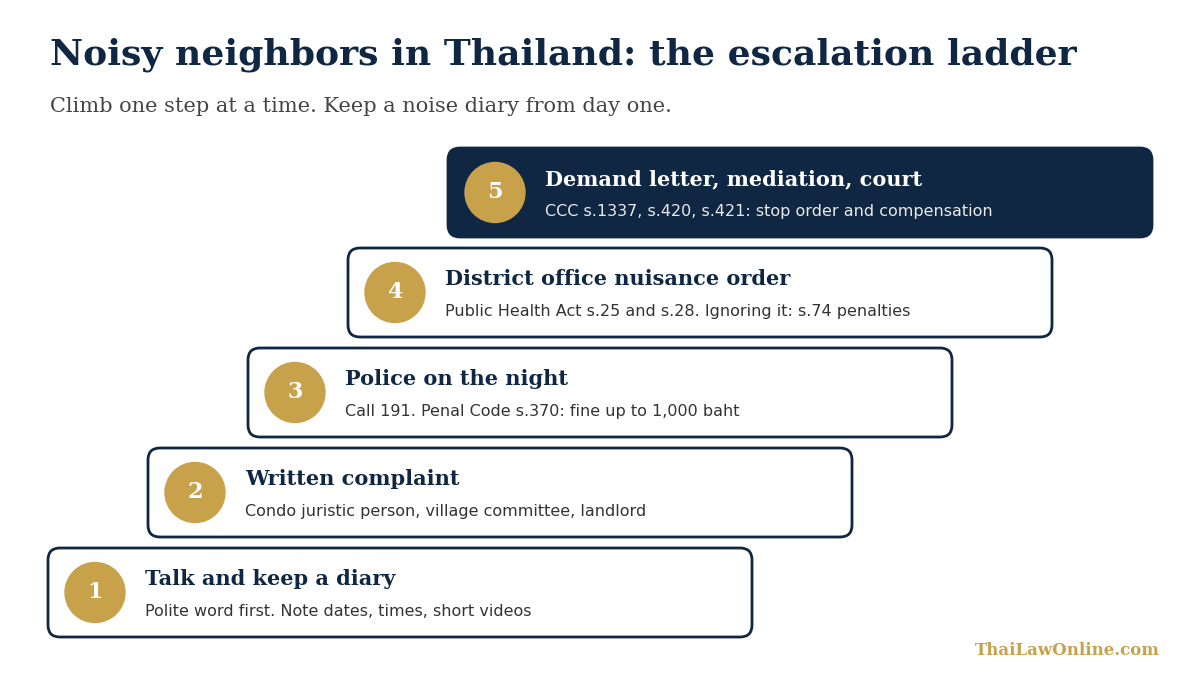
- Talk first, and keep it friendly. In Thailand, saving face matters. A calm word, or a short note in Thai, solves more cases than any lawyer. Don’t argue in front of others.
- Keep a noise diary. Write down dates, times and what you heard. Record short videos with sound. Note who else was disturbed. This is your evidence for every later step.
- Complain in writing. In a condo or village, write to the juristic person or the village committee. If you rent, tell your landlord in writing too.
- Call the police during the noise. Use 191 or the local station. Ask the officers to record the complaint under Section 370. Get the station name and the date of the report.
- File a nuisance complaint with the local official. In Bangkok, go to the district office or use the city’s 1555 line. Elsewhere, go to the municipality or subdistrict office. Ask for an inspection and a written order under the Public Health Act.
- Try mediation. The Dispute Mediation Act B.E. 2562 (2019) supports mediation at district offices and community centres. It’s free or cheap. And a signed settlement can be enforced.
- Send a lawyer’s demand letter. A formal letter citing Sections 1337, 420 and 421 changes the tone. Many neighbors stop at this point.
- Go to court. You can ask the civil court for an order to stop the nuisance and for damages. In urgent cases, Section 254 of the Civil Procedure Code lets you ask for a temporary order while the case runs.
Your options compared
| Tracé | Base juridique | Qui agit | What you can get | Vitesse |
|---|---|---|---|---|
| Police call | Penal Code s.370 | Local police | Warning, fine up to 1,000 baht | Same night |
| Condo or village complaint | Condominium Act B.E. 2522, building regulations | Juristic person or committee | Warnings, enforcement of house rules | Days to weeks |
| Nuisance complaint | Public Health Act B.E. 2535 s.25, s.28 | District office or municipality | Inspection, written order; failure to comply risks up to 3 months, 25,000 baht or both (s.74) | Semaines |
| Médiation | Dispute Mediation Act B.E. 2562 | District or community mediator | Signed settlement | Semaines |
| Civil lawsuit | CCC s.1337, s.420, s.421 | Civil court | Order to stop, compensation, temporary order (CPC s.254) | Mois |
Can you sue a neighbor for noise in Thailand?
Yes. A civil claim under Section 1337 can lead to a court order that the noise stop, plus compensation. Claims under Sections 420 and 421 can add damages for harm to your health or your property’s use.
Evidence wins these cases. The court needs to see that the noise goes beyond what’s normal for the area. A diary, recordings, a police report, the juristic person’s log and an official inspection report together make a strong file. One angry email does not.
Watch the time limit. Under Section 448, a tort claim must be filed within one year of the day you knew of the wrongful act and the person liable, and no later than ten years after the act. With noise that keeps happening, each new disturbance is a fresh act. But don’t sit on a case for years.
Our honest view: a lawsuit is the last step, not the first. It costs money, takes months, and you still live next door afterwards. In our experience, a well-drafted demand letter backed by an official nuisance order settles most cases without a hearing.
Common mistakes expats make
Escalating too fast
Calling the police on the first night, or posting about the neighbor online, can backfire. Thai defamation law is strict. Never name or shame a neighbor on social media.
Taking matters into your own hands
Cutting power, blocking a door or damaging equipment turns you into the wrongdoer. Section 1337 lets you act to end a nuisance, but self-help that damages property or threatens people can expose you to civil and criminal claims. Get advice before you do anything physical.
Relying on decibels alone
A phone app reading is useful as a note. It isn’t proof on its own. The legal test is reasonableness and harm, so record the whole picture.
Ignoring the lease
Tenants often forget their lease. A landlord’s duty to let you enjoy the property may give you a claim against the landlord as well. Check the clauses before you act.
Questions fréquentes
Can I call the police about noisy neighbors in Thailand?
Yes. Call 191 or the local station while the noise is happening. Making noise without reasonable cause is an offence under Section 370 of the Penal Code, with a fine of up to 1,000 baht.
What are quiet hours in Thailand?
Thai law sets no single national quiet hour. Condo and village regulations usually do. The legal test is whether the noise is unreasonable for the area and the time.
Who handles a noise nuisance complaint in Bangkok?
The district office (khet) handles nuisance complaints under the Public Health Act. You can also use the Bangkok 1555 line. The official can inspect and issue a written order.
Can a foreigner sue a Thai neighbor for noise?
Yes. Thai courts hear civil claims from foreigners on the same footing as Thais. As an owner, you can rely on Section 1337. As a tenant, Sections 420 and 421 are the usual basis.
What can I do about Airbnb guests making noise in my condo?
Complain in writing to the juristic person. Many condo regulations ban daily rentals. Unlicensed short-term rentals can also breach the Hotel Act B.E. 2547.
How long do I have to file a noise claim?
A tort claim under Section 448 must be filed within one year of knowing the wrongful act and who did it. It can’t be filed more than ten years after the act.
Comment ThaiLawOnline peut vous aider
We help expats and property owners deal with noisy neighbors in Thailand at every step. We draft Thai-language complaint letters to juristic persons and district offices. We send formal demand letters. And when a case can’t be settled, we take it to court.
You don’t need to be in Thailand to start. Prendre rendez-vous pour une consultation and send us your noise diary. We’ll tell you which route fits your situation, and what it’s likely to cost.
Points clés à retenir
- Section 1337 of the Civil and Commercial Code protects you from noise beyond what’s normal for the area. You can stop it and claim compensation.
- The Public Health Act lets the local official order a noise nuisance to stop. Ignoring the order risks up to three months in prison, a 25,000 baht fine, or both.
- Police can act on the night under Section 370 of the Penal Code. The fine is up to 1,000 baht.
- In a condo, the juristic person enforces the building regulations. Complain in writing.
- Keep a noise diary from day one. Evidence decides every route, from the district office to the court.
This article is general information about Thai law. It isn’t legal advice for your situation.
Actualités juridiques thaïlandaises, gratuites par courriel
Des mises à jour en anglais simple sur les changements législatifs thaïlandais concernant les étrangers : propriété, visas, mariage, affaires et testaments. Un court courriel par mois, envoyé par un cabinet d’avocats établi depuis 2006. Zéro spam, désabonnement possible à tout moment.