


Révisé par ThaiLawOnline, un cabinet d'avocats thaïlandais agréé exerçant en Thaïlande depuis 2006. Avocate thaïlandaise en charge du dossier : Wichuda Atthamethakon, LL.M., licence du barreau thaïlandais 3149/2556.
Dernière mise à jour :
Update, 31 August 2026: it is now law. The Ministry of Interior announcements were published in the Royal Gazette on 31 August 2026 and take effect on 15 septembre 2026. From that date the visa-exemption period referenced below drops from 60 to 30 days for a final list of 60 countries and territories (tourism only, one 30-day extension), and Visa on Arrival narrows to Azerbaijan, Belarus and Serbia (not India, which made the exemption list). The announcement also writes the border-run limit into the exemption itself: a maximum of deux entrées terrestres sans visa par année civile, with nationals of Malaysia, Brunei, Indonesia and Singapore excepted. Travelers admitted before 15 September 2026 keep their 60-day stamp, and immigration can still refuse anyone who appears to be living in Thailand on tourist stamps. Full details in our article on the nouvelles règles de visa en Thaïlande et notre Guide des visas touristiques.
Si vous comptez sur des entrées répétées, un forfait longue durée approprié est généralement moins cher : comparez-les avec notre outil de recherche de visa pour la Thaïlande.
If you have been using “sorties de visa” to stay in Thailand, you need to pay attention. Since late 2024 Thai Immigration has run a sustained crackdown on what it calls “visa abuse.” The rules that set the border-run limits are the ones published in November 2025, and they are set out below. Understanding the new Border Runs Limits in Thailand is essential for maintaining your stay legally.
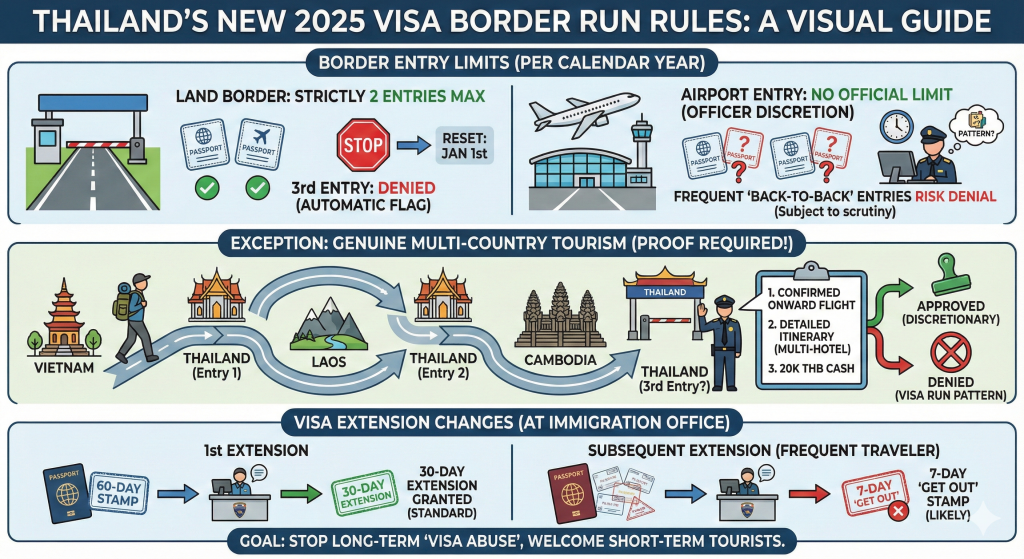
In July 2024, Thailand ouvert aux ressortissants de 93 pays qui peuvent venir en Thaïlande pour un séjour de 60 jours. and can extend to 30 days (that scheme ends on 14 September 2026; from 15 September 2026 the stamp is 30 days for 60 countries). Sometimes, they will deny your 30 days if they think you exaggerated and you get only 7 days (denied extension), not 30. Most blogs still say you can extend 30 days every time. However, in November 2025 the government announced that this would be limited. The Thai Examiner explique la situation ici and here’s the site web gouvernemental où il est indiqué que cela est limité à deux. Cependant, les expatriés expérimentés savent que c'est le cas. Ce n'est pas un phénomène nouveau.. Il s'agit de la mise en application la plus récente et la plus stricte de lois qui existent depuis plus d'une décennie.
The November 2025 announcement worried travelers. They are used to the more relaxed entry rules from before. Understanding the rules about border runs in Thailand is important. This is especially true for anyone planning to visit or stay for a long time. Be aware of how the Border Runs Limits in Thailand are evolving as regulations tighten. This history illuminates the reasoning behind current Border Runs Limits in Thailand.
Avertissement Poipet
According to recent posts, Poipet (Cambodia) border has the highest rejection rate for “valid reason” claims.
Last reviewed: 3 September 2026. The two-entry land-border cap and the 15 September 2026 change are stated as the Ministry of Interior announcements published in the Royal Gazette on 31 August 2026 record them, consistent with the rest of this site’s visa cluster. The proof-of-funds figure was aligned to 10,000 THB per person or 20,000 THB per family. Police Order 327/2557 is named here as the instrument behind the valid-reason refusals as a matter of record. ⚠️ It was repealed on 26 September 2023 by Order of the Royal Thai Police No. 542/2566, and the criteria passed to the Commissioner of the Immigration Bureau, first under Immigration Bureau Order No. 242/2566 from 30 September 2023 and now under Immigration Bureau Order No. 12/2568 of 23 January 2025, both of which we have read. The refusal power an officer exercises at the border comes from the Immigration Act itself, not from that order, so the account below is unaffected; what is corrected is the citation.
This review does not certify the border-specific practice described below, including the refusal rates at particular crossings and the seven-day extension reports, which are traveller accounts rather than published rules, nor the discretionary criteria an officer applies, which are by definition not fixed.
Comprendre les limites du franchissement des frontières en Thaïlande
1. This Has Happened Before: A History of “Crackdowns”
Pour comprendre pourquoi cela se produit maintenant, il faut se pencher sur le contexte juridique. La Thaïlande ne crée pas de nouvelles lois pour ces répressions ; elle se contente d’appliquer les arrêtés de police existants. Ces arrêtés sont souvent ignorés en période de relâchement, comme après la pandémie de COVID-19, lorsque le tourisme se redresse.
- 2014: The “Out-In” Ban (Police Order 327/2557) After the 2014 coup, the “Out-In” practice was officially banned. This practice involved walking across a border and then turning back right away. Police Order 327/2557, which started on August 29, 2014, gave immigration officers the power to deny entry. They can refuse anyone who does not have a “valid reason” for their stay. This change ended the practice of unlimited monthly border runs.
- In December 2016, a new rule was introduced. It limits you to two land entries each year. It wasn’t invented in 2025. It was designed specifically to stop foreigners from living in Thailand on visa-exempt stamps while working illegally.
- 2018: “Good Guys In, Bad Guys Out”Under previous immigration leadership, a massive sweep saw thousands of overstayers arrested. The current 2025 crackdown is a return to this strict strictness after the “relaxed” COVID years (2020-2023).
À retenir : This is not a sudden change; it is the “pendulum swinging back.” If you argue with an officer that “it was fine last year,” you are flagging yourself as someone who doesn’t understand Thai law. Please note that the latest changes are not part of the immigration Act. They are just rules, and rules can change easily. They can also be applied differently in different borders. We know that some people have been refused to get out in Nong Khai by land. They normally had an exemption of visa of 60 days and an extension of 30 days. That is not the law but policies and application can vary. Be aware.
2. The Core Rule: The “Two-Entry” Limit (UNLESS VALID REASONS)
Comprendre les limites des passages frontaliers en Thaïlande vous permet de franchir l'immigration sans encombre.
La règle la plus importante pour les voyages terrestres reste la plafond strict pour les entrées exemptées de visa.
- Land Borders: You can enter without a visa at land checkpoints only 2 times each year. This applies to borders with Cambodia, Laos, Malaysia, and Myanmar. From 15 September 2026 this cap is written into the Ministry of Interior announcement itself, with nationals of Malaysia, Brunei, Indonesia and Singapore excepted.
- Aéroports : Technically, there is no written “number” limit for air arrivals. However, under Section 12 of the Immigration Act B.E. 2522 (1979), officers can deny entry to anyone. They can do this if they think a person “has no means of support” or is “entering for purposes other than tourism.”
The “Calendar Year” Reset
Le compteur est remis à zéro le 1er janvier de chaque année. Si vous avez utilisé deux entrées de territoire en 2024, vous en obtenez théoriquement deux nouvelles en 2025. Les agents peuvent toujours consulter votre historique complet. Ils peuvent vous refuser l'entrée si la durée totale de votre séjour en Thaïlande est assimilable à une résidence.
3. Pouvez-vous entrer plus de deux fois avec un “ motif légitime ” ?
Prenons l'exemple d'un itinéraire à entrées multiples classique : Voyage au Vietnam → Thaïlande → Laos → Thaïlande → Cambodge → Thaïlande.
Cet itinéraire comprend 3 entrées. According to the law for Exemption de visa, the land border computers automatically flag a third entry.
Pourquoi cela peut être refusé :
- The “Out-In” Red Flag: If you spend only 1-2 days in Laos or Cambodia, you may be a “visa runner.” This is a group targeted by the 2014 Order.
- The “Cumulative Stay” Risk: If you have spent 4 to 5 months in Thailand this year, you may face a risk. A third entry into the country suggests that you are living there, not just visiting.
How to Get Approved (The “Genuine Tourist” Defense):
You can be granted a 3rd entry, but it is discretionary. You must build a case that overrides the officer’s suspicion:
- Preuve de continuation de voyage : A confirmed flight ticket out of Thailand within 30 or 60 days. A bus ticket is rarely accepted as “proof” at strict borders like Poipet.
- Itinéraire détaillé : Afficher les réservations d'hôtel dans différent Cela prouve qu'il s'agit d'un voyage touristique (par exemple, confirmation à Bangkok, puis à Chiang Mai, puis à Krabi). Une seule réservation dans une seule ville suggère une résidence.
- Preuve de fonds : the requirement is 10 000 THB par personne, ou 20 000 THB par famille, and at a land border you should expect to show it in cash. Credit cards are often rejected as proof during interrogation.
Mais si vous voulez éviter tout problème, procurez-vous le VISA TOURISTIQUE À DOUBLE ENTRÉE (Multiple)C'est tout simplement préférable à prendre des risques. Avec les nouvelles restrictions concernant les passages frontaliers en Thaïlande, les voyageurs doivent s'adapter à l'évolution des politiques.
4. The New 2025 Twist: “30 Days + 7 Days”
Un changement majeur, constaté fin 2024, concerne les prolongations de visa.
Previously, you could enter visa-exempt (60 days, or 30 days for entries from 15 September 2026), extend at immigration (30 days), leave, and repeat.
La nouvelle réalité : Immigration offices are applying the tourist-extension rule more strictly. That rule is now clause 2.4 of the table annexed to Immigration Bureau Order No. 12/2568 (it carried the same number in the repealed Police Order 327/2557), and it allows a tourist one extension only, of not more than 30 days counted from the end of the permitted stay.
- 1ère prolongation : Une prolongation standard de 30 jours est généralement accordée.
- 2nd Extension (after a new entry): Many border runners are saying they are not getting a full 30-day extension. Instead, they receive a 7-day “denied/get out” stamp.
- Restrictions d'entrée terrestre : Certains bureaux refusent désormais catégoriquement les prolongations de visa pour les entrées terrestres si le passeport fait état d'abus antérieurs.
Liste récapitulative des vérifications pour les voyageurs
| If you are… | Le niveau de risque | Recommandation |
| Un véritable touriste | Faible | La limite de 2 entrées par terrain s'applique sauf motif valable. Stratégie: Planifiez votre itinéraire pour entrer par air for your 3rd entry (e.g., fly Siem Reap to Bangkok instead of taking the bus). Air entries do not count toward the “2 land entry” limit. |
| Un expatrié sans visa | Critique | Ne comptez pas sur un passage frontalier. Postulez pour le DTV (Visa de destination Thaïlande) or LTR Visa. The “good old days” of monthly runs are over. Any other visa. |
| Voyage en sac à dos en Asie du Sud-Est | Moyen | If your route requires 3+ Thailand entries, ensure your stays in neighboring countries are at least 3-4 days long. “Same day” returns are the #1 reason for refusal. |
Ressources officielles
En comprenant les limites de franchissement des frontières en Thaïlande, vous pouvez garantir leur conformité et éviter les sanctions.
- Royal Thai Bureau de l'immigration: immigration.go.th
- Loi sur l'immigration BE 2522 (1979) : La loi applicable à tous les refus d'entrée.
- Système officiel de visa électronique thaïlandais : thaievisa.go.th
Prochaine étape pour vous
If you are planning a trip to multiple countries, I suggest flying from Cambodia to Thailand. This route goes through Vietnam, Thailand, Laos, and Cambodia. It avoids the land-border count limit and the “Poipet trap.” The Poipet trap is a border crossing known for rejecting travelers with too many stamps.
Adaptez vos projets de voyage en fonction des dernières restrictions concernant le franchissement des frontières en Thaïlande. Il est essentiel de bien vous renseigner sur ces restrictions pour un voyage réussi.
Foire aux questions
Qu'est-ce qu'un « border run » en Thaïlande ?
Un passage frontalier consiste à quitter la Thaïlande puis à y revenir pour obtenir une nouvelle période de séjour, une pratique souvent utilisée par les voyageurs bénéficiant d'une exemption de visa.
Combien de passages frontaliers puis-je effectuer en Thaïlande ?
There is a published number for land borders: a maximum of two visa-exempt land-border entries per calendar year, written into the Ministry of Interior announcements published in the Royal Gazette on 31 August 2026 and in force from 15 September 2026, with nationals of Malaysia, Brunei, Indonesia and Singapore excepted. Air arrivals carry no numeric cap, but an officer may still refuse entry under the Immigration Act where it appears you are living in Thailand on tourist stamps.
Les allers-retours pour obtenir un visa sont-ils toujours autorisés en Thaïlande ?
Ces procédures restent possibles, mais font l'objet d'un contrôle de plus en plus strict. Compter sur des allers-retours répétés risque d'entraîner un refus d'entrée ; un visa de long séjour en bonne et due forme est donc plus sûr.
Quelle est la différence entre un passage de frontière et un renouvellement de visa ?
Un passage rapide à la frontière consiste à sortir et à rentrer rapidement pour obtenir un nouveau tampon de séjour, tandis qu'un passage rapide pour obtenir un visa signifie quitter le pays pour obtenir un nouveau visa auprès d'une ambassade à l'étranger.
Puis-je me voir refuser l'entrée en Thaïlande après un trop grand nombre de vols ?
Oui. Les agents d'immigration ont le pouvoir discrétionnaire de refuser l'entrée aux voyageurs qui semblent résider en Thaïlande lors d'entrées touristiques successives.
Essayez-le vous-même d'abord, gratuitement
Vous n'avez rien à réserver pour commencer. Ceux-ci s'exécutent dans votre navigateur, et vous ne nous payez que si vous décidez de faire appel à un avocat.
Trouveur de visa thaïlandais Gratuit
Répondez à quelques questions et découvrez quel visa thaïlandais correspond réellement à votre situation.
Ouvrir l'outilInterroger notre assistant IA Gratuit
Entraîné sur le droit thaïlandais et plus de 84 000 arrêts de la Cour suprême. Posez vos questions, gratuitement.
Actualités juridiques thaïlandaises, gratuites par courriel
Des informations claires et concises sur les changements législatifs thaïlandais concernant les étrangers : propriété, visas, mariage, affaires et testaments. Un court courriel par mois, envoyé par un cabinet d’avocats établi depuis 2006. Zéro spam, désabonnement possible à tout moment.