


รีวิวโดย วิชุฑา อัตตะมัธคอน, LL.M., ใบอนุญาตประกอบวิชาชีพทนายความ 3149/2556 จาก ThaiLawOnline ซึ่งเป็นบริษัทกฎหมายในประเทศไทยที่ให้บริการด้านกฎหมายแก่ชาวต่างชาติมาตั้งแต่ปี 2006.
ปรับปรุงล่าสุดเมื่อ
You order a survey before selling your house in Hua Hin. The surveyor walks the line twice. Then he tells you the neighbour’s kitchen extension sits 1.2 metres inside your chanote.
Land encroachment in Thailand is more common than most foreign owners expect. Old boundary pegs vanish. Builders measure from the wrong post. Some neighbours simply push their luck. The good news: the Civil and Commercial Code has precise rules for this, and they’re older and clearer than most people think.
This guide explains who keeps an encroaching building, who pays, when you can demand demolition, and the deadlines that quietly kill claims. We’ve handled Thai property disputes for foreign clients since 2006.
What Thai law says about land encroachment
Your starting point is ownership. Under Section 1336, an owner can recover the property from anyone with no right to hold it. The owner can also stop any unlawful interference with it.
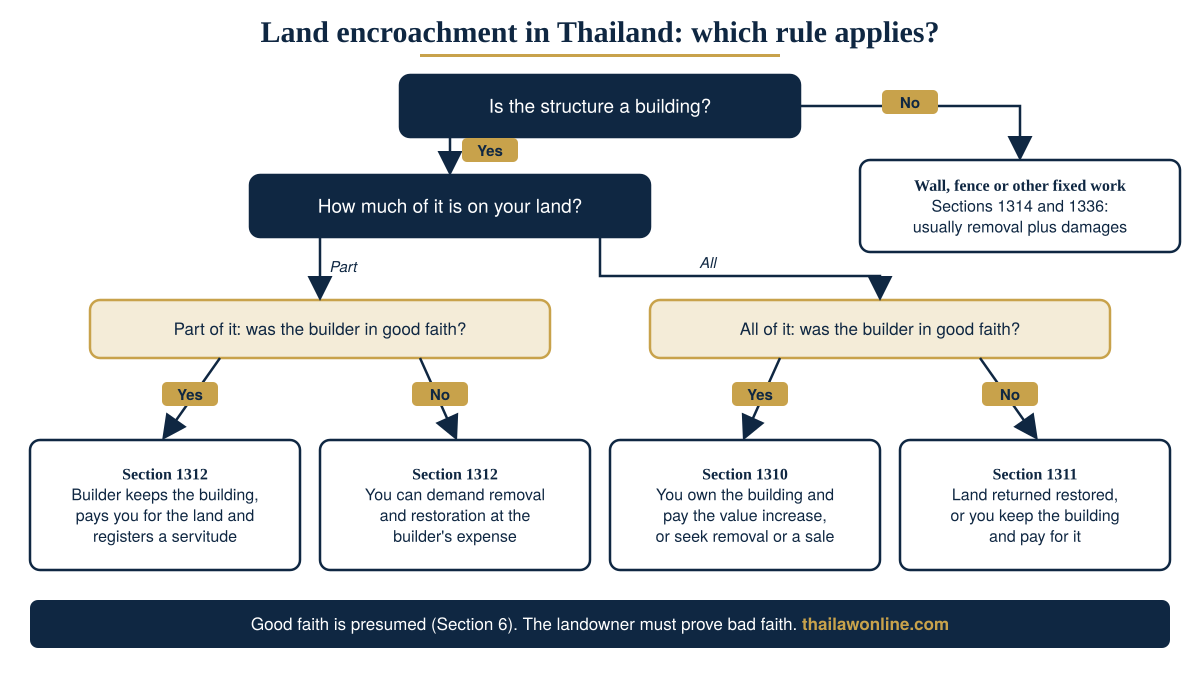
But buildings are special. Thai law doesn’t simply order every encroaching structure torn down. Sections 1310 to 1314 sort cases by two facts. How much of the building sits on your land? And did the builder act in good faith?
Section 1312: part of a building crosses the line
This is the classic encroachment case. The neighbour’s house stands mainly on his own plot, but a wall, a room or a roof overhang crosses onto yours.
ตาม Section 1312, a builder who acted in good faith keeps ownership of the building. In return, he must pay you for the use of the land he occupies. His right over the strip is registered as a ภาระจำยอม on your title deed. If the building is later totally destroyed, you can ask for that registration to be cancelled.
A builder in bad faith gets no such protection. You can require him to remove the building and restore your land, at his own expense.
Sections 1310 and 1311: the whole building is on your land
Sometimes the error is bigger. A house goes up on the wrong plot entirely. It happens more than you’d think on unfenced land subdivisions.
ตาม Section 1310, if the builder was in good faith, you become the owner of the building. You must pay the builder the amount by which your land increased in value. If you can show you weren’t negligent, you may instead require removal. And if removal can’t be done at reasonable cost, you can make the builder buy the land at market price.
ตาม Section 1311, a builder in bad faith must hand the land back restored. You can choose to keep the building instead. If you do, you pay either the price of the building or the increase in land value, at your option.
Section 1314: walls, fixed works, trees and crops
Section 1314 applies Sections 1310, 1311 and 1313 to any work fixed to land, and to trees and crops. Notice what it leaves out. It doesn’t mention Section 1312.
Section 1312 speaks of a “building” (rong ruean in the Thai text). Thai commentators read it narrowly. A stray boundary wall, fence or driveway is usually argued under Section 1336 and the general rules. The softer Section 1312 regime doesn’t apply. That matters, because it often means the neighbour can’t claim a paid servitude for a wall.
Good faith: the question that decides most cases
Everything turns on good faith. And the law starts on the builder’s side. มาตรา 6 presumes every person acts in good faith. So you, the landowner, carry the burden of proving bad faith.
Good faith is judged at the time of construction. A builder who honestly relied on old pegs is in good faith. A builder who carried on after you objected, or after a survey showed the line, is not. Extensions added after he learned the truth can be judged separately from the original structure.
Evidence that typically proves bad faith:
- A written objection from you, sent while the work was going on.
- A land office survey that showed the true line before construction started.
- Boundary marks that were moved or removed. Under Section 67 of the Land Code, only the land official can move official boundary marks without permission.
- Building plans that show a different footprint from what was built.
Here’s the practical lesson. If you see a neighbour building near your line, object in writing now. A dated letter or LINE message can turn a Section 1312 case (he keeps it and pays) into a removal case.
Which rule applies to your case?
| สถานการณ์ | Civil Code rule | Who owns the structure | What you can demand |
|---|---|---|---|
| Part of a building on your land, builder in good faith | Section 1312 | The builder | Payment for use of the land, plus a registered servitude |
| Part of a building on your land, builder in bad faith | Section 1312 | The builder, subject to your claim | Removal and restoration at his cost |
| Whole building on your land, good faith | Section 1310 | You, the landowner | Keep it and pay the value increase, or (if you weren’t negligent) removal or a forced sale of the land |
| Whole building on your land, bad faith | Section 1311 | Depends on your choice | Return of the land restored, or keep the building and pay |
| Wall, fence, driveway or other fixed work | Section 1314 and Section 1336 | Argued case by case | Usually removal, plus damages under Section 420 |
| Overhanging branches or roots | Section 1347 | The neighbour (the tree) | Cut roots yourself. Cut branches after reasonable notice is ignored |
The boundary survey: proving where the line is
You can’t argue encroachment on a hunch. You need the land office to verify the boundary. Under Section 69 bis of the Land Code, an owner files an application with the land office together with the title deed. A surveyor then measures the plot against the cadastral map.
Your neighbours are called to watch the line and sign. If a neighbour can’t be contacted, doesn’t show up, or refuses to sign without objecting, the officer sends a written notice. The neighbour then has 30 days to sign or object.
If the neighbour objects, the land official investigates and tries to broker a compromise using the map. If that fails, the parties are told to go to court within 90 days. Miss that window and the law treats you as having dropped the application. So diarise it.
The process only works on land with a proper title deed and map. Before you start, read our guide to โฉนดที่ดินในประเทศไทย. If you’re buying, a title deed check before transfer is far cheaper than a lawsuit after it.
Step-by-step: what to do when you find an encroachment
- Don’t knock anything down yourself. Self-help can expose you to a criminal complaint for damage to property. If the builder was in good faith, the structure may legally be his.
- Collect the paperwork. Get a certified copy of your chanote and the neighbour’s from the land office. Photograph the structure with dates.
- Object in writing. If work is still going on, send a clear written objection at once. This is your best bad-faith evidence.
- Order a boundary verification survey. Apply under Section 69 bis. Watch the 30-day and 90-day deadlines.
- Negotiate from the survey. Common outcomes: the neighbour buys the strip, pays for a registered servitude, or moves the wall.
- Sue if you must. A civil claim can seek removal, payment for the land and damages. A criminal trespass complaint is a separate lever.
Criminal trespass: when encroachment is a crime
Deliberately building on someone’s land can also be criminal. Section 362 of the Penal Code punishes entering another’s immovable property to take possession of it, wholly or partly. The penalty is up to one year in prison, a fine of up to 20,000 baht, or both. Section 365 adds heavier penalties for aggravated forms, such as using force or acting at night.
Simple trespass is a compoundable offence. That means you can settle and withdraw. In Supreme Court Decision No. 1185/2561, a defendant who had built on the complainant’s land was convicted of trespass. The Supreme Court still let the complainant withdraw during the appeal period, and the charge was struck out.
Watch the clock. Under Section 96 of the Penal Code, a compoundable offence has a short fuse. The complaint must be filed within three months of learning of the offence and the offender. In our experience, a well-timed police complaint brings neighbours to the table faster than a civil writ.
Deadlines that kill encroachment claims
One year for possession claims
If the neighbour disturbs your possession, Section 1374 gives you an action to stop it. It must be filed within one year of the disturbance. If you’ve been pushed off part of the land, มาตรา 1375 gives one year from dispossession to sue for its return.
These limits bite hardest on land held under a possessory document such as a Nor Sor 3, rather than a chanote. There, the fight is about possession, and a year passes quickly.
Ten years for adverse possession
The longer deadline is quieter and more dangerous. Under มาตรา 1382, someone who possesses another’s immovable property peacefully, openly and as an owner for ten years acquires ownership. A neighbour whose wall has enclosed your strip for a decade may argue exactly that. See our glossary entry on การครอบครองปรปักษ์.
There’s one shield for buyers. Under มาตรา 1299, rights acquired by prescription need registration. Until then, they can’t be set up against a buyer who paid, acted in good faith and registered. But don’t rely on it. Neighbours often argue the buyer could see the wall.
One year for damages
Damages for the wrongful act fall under มาตรา 420. มาตรา 448 bars the claim one year after you knew of the act and who did it. The outer limit is ten years from the act.
ข้อผิดพลาดทั่วไปที่เราพบเห็น
The first mistake is waiting. Owners abroad see a new wall in photos and plan to “deal with it next visit”. Months pass, and the bad-faith evidence never gets created.
The second is relying on the developer. On a housing estate, the developer’s site plan isn’t the title deed. Only the land office survey binds anyone.
The third is forgetting who owns the land. Foreigners usually hold Thai land through a lease, a usufruct or a Thai spouse. The rights above belong to the owner on the chanote. Make sure that person signs the survey application and the complaint. Our คู่มืออสังหาริมทรัพย์สำหรับชาวต่างชาติ explains these structures.
The last is selling with the problem unresolved. A buyer’s lawyer will find it. Fix the line, or register the servitude, before you list the property.
คำถามที่พบบ่อย
My neighbour built on my land in Thailand. Can I make him demolish it?
Only if he built in bad faith, or the structure isn’t a building. A good-faith builder keeps a partly encroaching building under Section 1312 and pays you for the land instead.
Who has to prove good faith in a Thai encroachment case?
Section 6 presumes good faith. So the landowner must prove the builder acted in bad faith, for example by showing a written objection during construction.
Does Section 1312 apply to a boundary wall or fence?
Section 1312 refers to a building. Walls and fences are usually argued under Section 1336 and Section 1314, which can lead to a removal order.
How do I get a boundary survey in Thailand?
Apply to the land office with your title deed under Section 69 bis of the Land Code. If a neighbour objects and no compromise is reached, you have 90 days to go to court.
Can my neighbour gain ownership of the strip he occupies?
Yes, possibly. Ten years of peaceful, open possession as owner can give him ownership under Section 1382. Act well before that.
Is building on someone else’s land a crime in Thailand?
It can be trespass under Section 362 of the Penal Code. The complaint must be made within three months of learning of the offence and the offender.
ThaiLawOnline สามารถช่วยเหลือคุณได้อย่างไร
We order and attend land office boundary surveys. We send demand letters in Thai and English, negotiate strip sales and servitudes, and take encroachment cases to court. If you’re abroad, we can act under a power of attorney. For construction-side disputes, see our page on กฎหมายการก่อสร้างในประเทศไทย.
ติดต่อเรา with your chanote, photos and any survey you already have. We’ll tell you which rule applies and what your claim is worth.
ประเด็นสำคัญ
- Section 1312 lets a good-faith builder keep a partly encroaching building, but he must pay and register a servitude.
- Bad faith means removal at the builder’s cost. You must prove it, because Section 6 presumes good faith.
- Walls and fences are generally outside Section 1312.
- Verify the line through a Section 69 bis survey and watch the 30-day and 90-day deadlines.
- One year for possession claims, three months for a trespass complaint, ten years before adverse possession.
ข่าวสารกฎหมายไทย ฟรีทางอีเมล
อัปเดตข่าวสารเป็นภาษาอังกฤษที่เข้าใจง่ายเกี่ยวกับการเปลี่ยนแปลงของกฎหมายไทยที่ส่งผลกระทบต่อชาวต่างชาติ: อสังหาริมทรัพย์, วีซ่า, การสมรส, ธุรกิจ และพินัยกรรม จดหมายข่าวสั้นเพียงฉบับเดียวต่อเดือน จากสำนักงานกฎหมายที่ดำเนินงานมาตั้งแต่ปี 2549 ไม่มีการส่งสแปม ยกเลิกรับได้ทุกเมื่อ.