


Révisé par ThaiLawOnline, un cabinet d'avocats thaïlandais agréé exerçant en Thaïlande depuis 2006. Avocate thaïlandaise en charge du dossier : Wichuda Atthamethakon, LL.M., licence du barreau thaïlandais 3149/2556.
Dernière mise à jour :
Short answer: drink driving is a criminal offence in Thailand, and the limit is 50 mg% (0.05%) blood alcohol for most drivers, or 20 mg% (0.02%) if you are under twenty, on a probationary licence, driving without a valid licence for that vehicle, or driving while suspended. The limits come from Ministerial Regulation No. 21 (B.E. 2560) under the Land Traffic Act, which prohibits driving while intoxicated in section 43(2). A first offence carries up to one year in prison, a fine of 5,000 to 20,000 baht, or both, and the court must suspend your licence for at least six months or revoke it (section 160 ter). A repeat offence within two years, or causing injury or death, is punished far more heavily, as set out below.
Arrest, caution and trial all follow the same route, set out in our overview of droit pénal en Thaïlande.
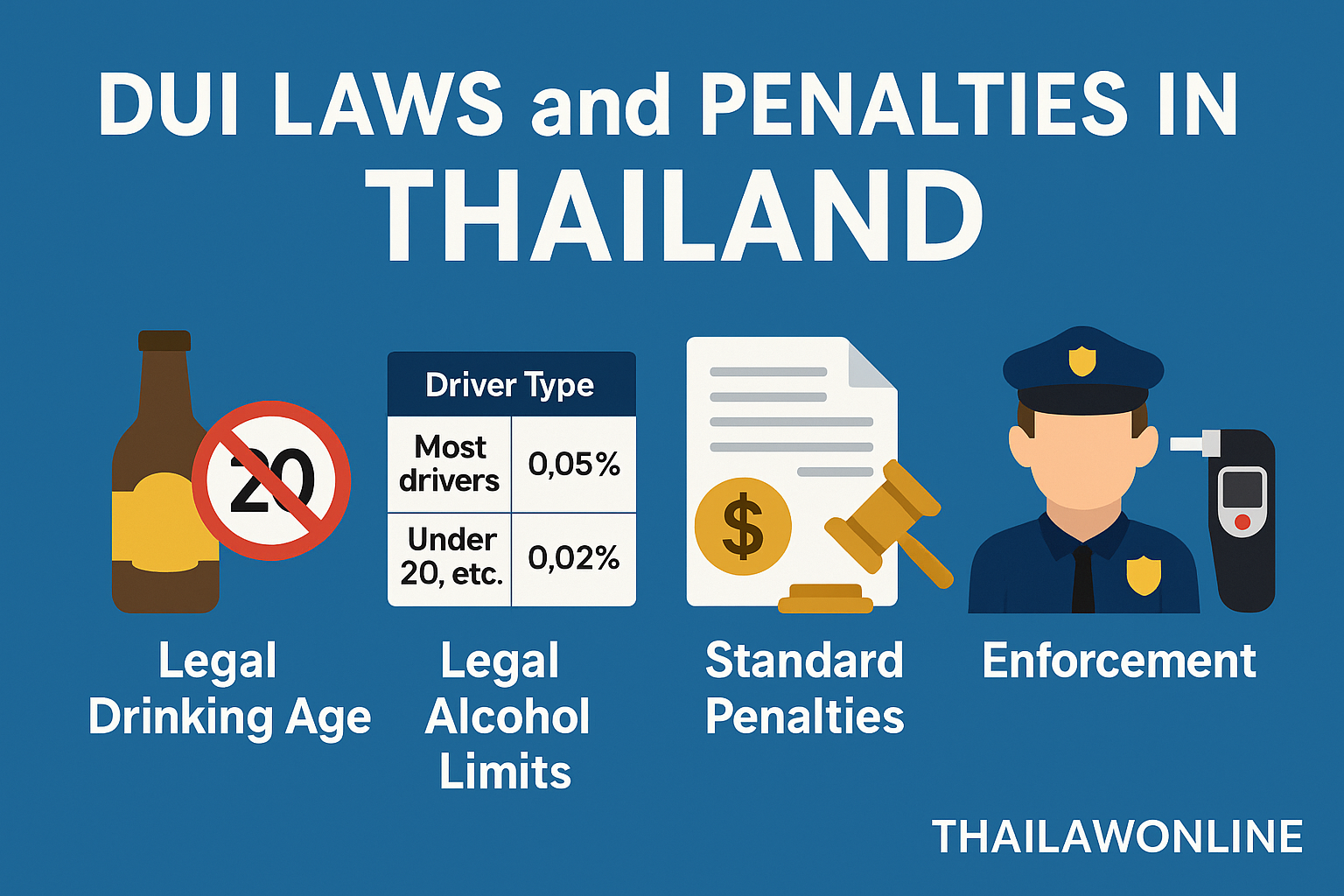
Table des matières
Dernière révision : 3 septembre 2026. Every figure and every section number on this page was read in Thai from the primary text. Section 160 ter of the Land Traffic Act B.E. 2522 was read in the consolidation as at 2017, paragraph by paragraph, and it is the source of the first-offence range, the three harm tiers and the mandatory licence orders. Sections 160 ter/1, 160 ter/2 and 160 ter/3, and the fifth paragraph of section 160 ter, were read in the Royal Gazette text of the Land Traffic Act (No. 13) B.E. 2565 itself, which also supplied its own commencement clause (in force when one hundred and twenty days from publication have elapsed) and its savings clause for existing regulations. Article 142 was read for the power to detain, the presumption on refusal and the delegation to a ministerial regulation, in both the pre-2022 and the 2022 wording. The blood alcohol limits come from Ministerial Regulation No. 21 (B.E. 2560) and the regulation it amends, No. 16 (B.E. 2537), read in full, including the testing order and the conversion coefficients. Cour suprême Décision 8990/2568 was read in full in Thai, to its disposition, and every particular stated about it here is in the judgment. The drinking age limb was checked against sections 29 and 40 of the Alcoholic Beverage Control Act B.E. 2551.
What this review does not cover, said rather than implied. No penalty figure is published for the alcohol sales offence, because the Alcoholic Beverage Control Act (No. 2) B.E. 2568 revised both sections and we have not read that amending Act in the Gazette itself, only a transcription of it; the structure described here, that the prohibition and the penalty fall on the seller, is what both versions say. Checkpoint and enforcement practice throughout, including what officers do with a licence at the roadside and how courts treat a challenge to a breath reading, is practice and not statute. And this review confirms that Ministerial Regulation No. 21 remains in force by the savings clause of the 2022 Act, not that no later regulation exists: it is the most recent one we can find, and absence from a corpus is not proof of absence.
Lois et sanctions relatives à la conduite en état d'ivresse en Thaïlande : Comprendre l'âge légal pour boire
Thailand’s alcohol age rule is a rule about selling, and it is worth being exact about who breaks it. Section 29 of the Alcoholic Beverage Control Act B.E. 2551 forbids any person to sell alcohol to someone under twenty years of age, or to someone so drunk that they have lost control of themselves, and section 40 puts the penalty on the person who sold. It bites everywhere alcohol is sold: bars, restaurants, convenience stores and entertainment venues. There is no offence of drinking under twenty. Someone under twenty who drinks is not fined under that Act; the shop, the bar or the member of staff who sold or served is the one at risk. Both sections were revised by the Alcoholic Beverage Control Act (No. 2) B.E. 2568, which left the age of twenty and the seller’s liability where they were, so no figure is quoted here.
Il est crucial pour toute personne souhaitant conduire en Thaïlande de comprendre les lois et les sanctions liées à la conduite en état d'ivresse dans ce pays dynamique.
Limites d'alcoolémie pour conduire en Thaïlande
Le taux légal d'alcoolémie (TA) dépend de votre situation :
| Driver | Blood alcohol limit |
|---|---|
| Every driver, unless one of the categories below applies | Plus de 50 mg% (0.05%) |
| (a) Driver under twenty years of age | Plus de 20 mg% (0.02%) |
| (b) Holder of a temporary (probationary) driving licence under the motor vehicle law | Plus de 20 mg% |
| (c) Holder of a licence for a different class of vehicle that cannot be used for the one being driven | Plus de 20 mg% |
| (d) Driver with no licence, or whose licence is suspended or revoked | Plus de 20 mg% |
These limits are not in the Act itself. Section 142 paragraph five leaves the testing criteria to a ministerial regulation, and the operative one is Ministerial Regulation No. 21 (B.E. 2560) issued under the Land Traffic Act, which replaced clause 3(1) of Ministerial Regulation No. 16 (B.E. 2537). It was made on 4 May 2017 and published in the Royal Gazette, volume 134, part 59 Kor, page 1, on 31 May 2017. It survived the 2022 overhaul of the Act: section 39 of the Land Traffic Act (No. 13) B.E. 2565 keeps every regulation made under the 1979 Act in force, so far as it is not inconsistent with the Act as amended, until a replacement is made.
Those are blood figures, and the test at the roadside is not a blood test. Ministerial Regulation No. 16 (B.E. 2537), the one No. 21 amends, fixes the order: breath first, with urine or blood only where a breath test cannot be done, and a blood sample must be taken at the nearest hospital under the supervision of a licensed physician. The same regulation fixes the conversion, 2,000 for a breath reading and one over 1.3 for urine, which is why a breathalyser at a checkpoint reads out in mg% at all: the number it shows you is already the blood-equivalent figure that gets compared with the 50 and the 20.
Two categories that circulate widely in English are pas in the regulation: there is no separate limit for “commercial or professional drivers” as such, and the reduced limit does not turn on holding a licence for less than five years. What triggers the 20 mg% limit is a probationary licence, the wrong class of licence, no licence at all, or a licence under suspension or revocation. A professional driver on a full, valid, correct-class licence is on the ordinary 50 mg% limit like everyone else.
Police have the right to stop any driver and request a breathalyzer test. You don’t have to swerve or cause trouble. Checkpoints are often random, especially during festivals like Songkran or New Year. Refusing the test is not a way out, and the mechanism is worth knowing exactly. Under section 142 paragraph three, an officer may detain you for as long as the case requires in order to carry the test out. Under paragraph four, where there is reasonable cause to believe you were driving while intoxicated and you still refuse without reasonable cause, it is presumed that you contravened section 43(2). That presumption was added by the Land Traffic Act (No. 10) B.E. 2557. If you take the test and it is clean, paragraph three requires that you be released immediately.
Being unconscious is not a way out either, and this is new law that predates most English-language write-ups. The Land Traffic Act (No. 13) B.E. 2565 added a sixth paragraph to section 142 for the case where an accident has happened, there is reason to believe the driver, or someone who may have been the driver, contravened section 43(2), and that person is unconscious or too badly hurt to consent to the test. It applies section 43 bis/1, so the enquête officielle may ask a physician to carry out the examination and take blood, urine or other samples by medical means, limited to what is necessary and reasonable, by the least painful method available, and at the expense of the police budget rather than the patient.
Driving under the influence of drugs is prohibited separately, by section 43 bis, which covers driving after taking a narcotic under the narcotics law or a psychotropic substance under the psychotropic substances law. It is a different prohibition from section 43(2), not a variety of it, so do not assume the drink-driving figures above apply to it.
What Happens If You’re Caught with a DUI in Thailand?
Penalties vary with what happened, not with what you were driving. Section 160 ter draws no distinction between a car and a motorcycle, and the only vehicle-based increase anywhere in it is paragraph five, which raises every penalty by one third where the drink-driver was at the wheel of a public car or public motorcycle, or of a vehicle carrying passengers for hire. What moves the figures is the harm caused and whether it is a repeat. The Supreme Court case set out below was a motorcycle, and it drew the full repeat-offender treatment.
The two provisions that do the work. Driving while intoxicated is prohibited by section 43(2) of the Land Traffic Act B.E. 2522, and the penalty is section 160 ter. The figures below are that section, paragraph by paragraph.
Première infraction
- Bien of 5,000 to 20,000 baht
- Up to one year in jail, or the fine, or both
- Licence suspension is not discretionary. Section 160 ter paragraph one requires the court to suspend the licence for not less than six months, or to revoke it. It is a court order the statute mandates, not something the officer decides at the roadside.
Repeat Offence Within Two Years
A repeat offence is dealt with by separate provisions, and it is worth being precise about which one does what. Sections 160 ter/1, 160 ter/2 and 160 ter/3 were inserted by section 33 of the Land Traffic Act (No. 13) B.E. 2565, published in the Royal Gazette on 7 May 2022 (vol. 139, part 28 Kor, p.5) and in force since 5 September 2022.
- Section 160 ter/1 sets the penalty. Where a person commits an offence under section 160 ter paragraph one and offends again within two years of the date of the first offence: imprisonment of up to two years and a fine of 50,000 to 100,000 baht, and the court must suspend the licence for not less than one year or revoke it. Read the wording closely: at this tier the fine no longer stands as an alternative to the jail term.
- Section 160 ter/3 removes the court’s discretion. Where the offender repeats within two years, the court must impose imprisonment ET a fine, always. It does not apply to an offender who was eighteen or younger on the date of the later offence.
- Section 160 ter/2 raises the figure again if you had no licence. If the drink-driver was unlicensed, or was driving while suspended or revoked, the penalty goes up by one third. Where that same conduct injures or kills someone, the court adds one half to the sentence it would otherwise have passed.
Supreme Court Decision 8990/2568 shows section 160 ter/3 biting. The Cour d'appel Region 6 sentenced a repeat drink-driver to imprisonment without also imposing a fine. The Supreme Court held that this was wrong and raised the point of its own motion, because it goes to public order. It could not add the fine itself: the prosecution had not appealed on that ground, and increasing a defendant’s sentence in those circumstances is barred. The lesson for a defendant is the opposite of reassuring, because the next court will impose both.
Si vous provoquez un accident
- Injury to body or mind (s.160 ter para 2): 1 to 5 years ET a fine of 20,000 to 100,000 baht, and the court must suspend the licence for at least one year or revoke it.
- lésions corporelles graves (s.160 ter para 3): 2 to 6 years ET a fine of 40,000 to 120,000 baht, and suspension for at least two years or revocation.
- Death (s.160 ter para 4): 3 to 10 years ET a fine of 60,000 to 200,000 baht, and the court must revoke the licence. There is no suspension option at this tier.
- Driving a public vehicle (s.160 ter paragraph five, added by the 2022 amendment): if the drink-driver was at the wheel of a public car or public motorcycle, or of a vehicle carrying passengers for hire, every penalty above rises by one third.
Si vous êtes reconnu coupable, vous pourriez également devoir verser des dommages et intérêts à la victime ou à sa famille. Votre compagnie d'assurance pourrait refuser de couvrir l'accident si l'alcool ou les stupéfiants étaient impliqués.
Points de contrôle et application de la loi par la police
La police effectue régulièrement des contrôles routiers dans tout le pays. Elle utilise des éthylotests, et les résultats de ces tests sont recevables devant les tribunaux. Votre permis peut être immédiatement confisqué, et vous pourriez être convoqué au tribunal dans les jours qui suivent. La plupart des conducteurs reçoivent une amende, et certains sont tenus de suivre un stage de sensibilisation à la sécurité routière.
Contester un test d'alcoolémie positif est très difficile en vertu de la loi thaïlandaise. Il est beaucoup plus simple d'éviter les problèmes en s'abstenant de boire si vous comptez conduire.
Conseils de sécurité rapides
- Plan ahead, use a taxi or ride app if you’re going out drinking.
- Ne surestimez pas votre limite. Même un seul verre peut vous faire dépasser la limite.
- Gardez une copie de votre permis de conduire et de votre assurance sur vous lorsque vous conduisez.
- Soyez poli et coopératif aux points de contrôle.
Réflexions finales
DUI laws in Thailand are strict for a reason. Drunk driving has caused far too many injuries and deaths. Whether you’re here for a short visit or you’ve made Thailand your home, it’s not worth taking the risk.
Besoin d'aide pour une affaire de conduite en état d'ivresse ?
Si vous avez été inculpé ou si vous avez des questions sur la législation relative à la conduite en état d'ivresse en Thaïlande, nous pouvons vous aider. ThaiLawOnline, Nous offrons des conseils juridiques clairs et une représentation partout au pays. Contactez-nous dès aujourd'hui parler avec un avocat qui comprend à la fois la loi et son application pratique.
- Ministère de la Santé publique de Thaïlande
- Mission conjointe d’évaluation pour examiner les politiques et les stratégies relatives à l’alcool en Thaïlande (2020)
Actualités juridiques thaïlandaises, gratuites par courriel
Des informations claires et concises sur les changements législatifs thaïlandais concernant les étrangers : propriété, visas, mariage, affaires et testaments. Un court courriel par mois, envoyé par un cabinet d’avocats établi depuis 2006. Zéro spam, désabonnement possible à tout moment.