


Évalué par Wichuda Atthamethakon, LL.M., titulaire de la licence de l’Ordre des avocats thaïlandais 3149/2556, pour ThaiLawOnline, un cabinet d’avocats thaïlandais œuvrant pour des étrangers depuis 2006.
Journal des mises à jour
- 4 novembre 2026: Added the statute box with Thai, English and French text and checked the page against the official text
À partir du 1er janvier 2026, la Thaïlande a relevé le plafond salarial du Fonds de Sécurité sociale Plafond salarial du Fonds utilisé pour le calcul des cotisations en vertu de l’article 33. L’ancien plafond de 15 000 bahts par mois était en vigueur depuis des décennies, en décalage avec le niveau réel des salaires. Un nouveau règlement ministériel, le règlement ministériel fixant les salaires minimum et maximum servant de base au calcul des cotisations des assurés en vertu de l’article 33 B.E. 2568, signé le 11 décembre 2025, a été publié dans la Gazette royale le 12 décembre 2025 (volume 142, partie 81 Kor) et remplace le règlement ministériel n° 7 (B.E. 2538). La base salariale minimale reste à 1 650 bahts, et la base salariale maximale augmente en trois phases.
Le droit applicable à cette page
English
Section 46 Social Security Act B.E. 2533
Full text
The Government, employers and insured persons under section 33 shall pay contributions to the Fund, for the payment of benefits in cases of injury or sickness, invalidity, death and childbirth, in equal shares at the rate prescribed in a Ministerial Regulation, but not exceeding the contribution rate annexed to this Act. The Government, employers and insured persons under section 33 shall pay contributions to the Fund, for the payment of benefits in cases of child allowance, old age and unemployment, at the rate prescribed in a Ministerial Regulation, but not exceeding the contribution rate annexed to this Act. For insurance under section 39, the Government and the insured person shall pay contributions to the Fund, the Government paying 1 times and the insured person 2 times the contribution rate each party must pay as prescribed in paragraph one and paragraph two. The contribution rates under paragraph one and paragraph two shall be fixed having regard to the benefits and the administrative expenses of the Office under section 24. The minimum and maximum wages used as the base for calculating the contribution of each insured person under section 33 shall be as prescribed in a Ministerial Regulation. In calculating each insured person's contribution, a fraction of a contribution of 50 satang or more counts as 1 baht, and a lesser fraction is disregarded. Where the insured person works for several employers, the contribution shall be calculated from the wages received from each employer.
ThaiLawOnline translation
Section 33 Social Security Act B.E. 2533
Full text
An employee who is not less than 15 full years of age and not more than 60 full years of age shall be an insured person. An employee who is already an insured person under paragraph one and who, on reaching 60 full years of age, remains an employee of an employer subject to this Act shall be deemed to continue as an insured person.
ThaiLawOnline translation
Section 47 Social Security Act B.E. 2533
Full text
The employer shall deduct from the insured person's wages, at every payment of wages, the amount to be remitted as the insured person's contribution under section 46, and the insured person is deemed to have paid the contribution from the date the wages fall due. The employer shall remit the insured person's contribution so deducted under paragraph one, and the employer's contribution, to the Office within the fifteenth day of the month following the month of deduction, and shall file a contribution remittance statement, in the form and manner announced by the Secretary-General. If the employer does not pay wages when due, the employer shall remit the contributions as provided in paragraph two as if the wages had been paid. Where the employer remits to the Office the insured person's contribution or the employer's contribution in excess of the amount payable, the employer or the insured person may file a request for a refund of the excess in accordance with the rules set by the Secretary-General. If the employer or the insured person does not claim the money back within 1 year from the date of remittance, or does not collect the refund within 1 year from the date of being notified to collect it, the money shall belong to the Fund.
ThaiLawOnline translation
Section 57 Social Security Act B.E. 2533
Full text
The daily wage for the payment of compensation for loss of income to an insured person under section 33 shall be calculated by adding together the wages used as the basis for calculating contributions for the three highest months within the fifteen months before the month in which entitlement arises, as the basis of calculation, and dividing the total by ninety. Where the insured person has wages for fewer than three months, the calculation shall be made from the average daily wage. The daily wage for the payment of compensation for loss of income to an insured person under section 39 shall be calculated as an average from the amount used as the basis for calculating contributions under section 39, paragraph two.
ThaiLawOnline translation
ไทย
มาตรา 46 พระราชบัญญัติประกันสังคม พ.ศ. 2533
ข้อความเต็ม
ให้รัฐบาล นายจ้าง และผู้ประกันตนตามมาตรา ๓๓ ออกเงินสมทบเข้ากองทุนเพื่อการจ่ายประโยชน์ทดแทนในกรณีประสบอันตรายหรือเจ็บป่วย กรณีทุพพลภาพ กรณีตายและกรณีคลอดบุตร ฝ่ายละเท่ากันตามอัตราที่กำหนดในกฎกระทรวง แต่ต้องไม่เกินอัตราเงินสมทบท้ายพระราชบัญญัตินี้ ให้รัฐบาล นายจ้าง และผู้ประกันตนตามมาตรา ๓๓ ออกเงินสมทบเข้ากองทุนเพื่อการจ่ายประโยชน์ทดแทนในกรณีสงเคราะห์บุตร กรณีชราภาพ และกรณีว่างงานตามอัตราที่กำหนดในกฎกระทรวง แต่ต้องไม่เกินอัตราเงินสมทบท้ายพระราชบัญญัตินี้ สำหรับการประกันตนตามมาตรา ๓๙ ให้รัฐบาลและผู้ประกันตนออกเงินสมทบเข้ากองทุนโดยรัฐบาลออกหนึ่งเท่าและผู้ประกันตนออกสองเท่าของอัตราเงินสมทบที่แต่ละฝ่ายต้องออกตามที่กำหนดในวรรคหนึ่งและวรรคสอง การกำหนดอัตราเงินสมทบตามวรรคหนึ่งและวรรคสอง ให้กำหนดโดยคำนึงถึงประโยชน์ทดแทนและค่าใช้จ่ายในการบริหารงานของสำนักงานตามมาตรา ๒๔ ค่าจ้างขั้นต่ำและขั้นสูงที่ใช้เป็นฐานในการคำนวณเงินสมทบของผู้ประกันตนตามมาตรา ๓๓ แต่ละคน ให้เป็นไปตามที่กำหนดในกฎกระทรวง ในการคำนวณเงินสมทบของผู้ประกันตนแต่ละคนสำหรับเศษของเงินสมทบที่มีจำนวนตั้งแต่ห้าสิบสตางค์ขึ้นไปให้นับเป็นหนึ่งบาท ถ้าน้อยกว่านั้นให้ปัดทิ้ง ในกรณีที่ผู้ประกันตนทำงานกับนายจ้างหลายรายให้คำนวณเงินสมทบจากค่าจ้างที่ได้รับจากนายจ้างแต่ละราย
ตรงตามข้อความในราชกิจจานุเบกษา / สำนักงานคณะกรรมการกฤษฎีกา (Verbatim from the Royal Gazette / Office of the Council of State)
มาตรา 33 พระราชบัญญัติประกันสังคม พ.ศ. 2533
ข้อความเต็ม
ให้ลูกจ้างซึ่งมีอายุไม่ต่ำกว่าสิบห้าปีบริบูรณ์และไม่เกินหกสิบปีบริบูรณ์เป็นผู้ประกันตน ลูกจ้างซึ่งเป็นผู้ประกันตนอยู่แล้วตามวรรคหนึ่ง เมื่อมีอายุครบหกสิบปีบริบูรณ์ และยังเป็นลูกจ้างของนายจ้างซึ่งอยู่ภายใต้บังคับแห่งพระราชบัญญัตินี้ ให้ถือว่าลูกจ้างนั้นเป็นผู้ประกันตนต่อไป
ตรงตามข้อความในราชกิจจานุเบกษา / สำนักงานคณะกรรมการกฤษฎีกา (Verbatim from the Royal Gazette / Office of the Council of State)
มาตรา 47 พระราชบัญญัติประกันสังคม พ.ศ. 2533
ข้อความเต็ม
ให้นายจ้างหักค่าจ้างของผู้ประกันตนทุกครั้งที่มีการจ่ายค่าจ้างตามจำนวนที่จะต้องนำส่งเป็นเงินสมทบในส่วนของผู้ประกันตนตามมาตรา ๔๖ และให้ถือว่าผู้ประกันตนได้จ่ายเงินสมทบแล้วตั้งแต่วันถึงกำหนดจ่ายค่าจ้าง ให้นายจ้างนำเงินสมทบในส่วนของผู้ประกันตนที่ได้หักไว้ตามวรรคหนึ่ง และเงินสมทบในส่วนของนายจ้างส่งให้แก่สำนักงานภายในวันที่สิบห้าของเดือนถัดจากเดือนที่มีการหักเงินสมทบไว้ พร้อมทั้งยื่นแบบรายการแสดงการส่งเงินสมทบ ทั้งนี้ ตามแบบและวิธีการที่เลขาธิการประกาศกำหนด ถ้านายจ้างไม่จ่ายค่าจ้างตามกำหนดเวลาที่ต้องจ่าย ให้นายจ้างมีหน้าที่นำส่งเงินสมทบตามที่บัญญัติไว้ในวรรคสอง โดยถือเสมือนว่ามีการจ่ายค่าจ้างแล้ว ในกรณีที่นายจ้างนำเงินสมทบในส่วนของผู้ประกันตนหรือเงินสมทบในส่วนของนายจ้างส่งให้แก่สำนักงานเกินจำนวนที่ต้องชำระ ให้นายจ้างหรือผู้ประกันตนยื่นคำร้องขอรับเงินในส่วนที่เกินคืนได้ตามระเบียบที่เลขาธิการกำหนด ถ้านายจ้างหรือผู้ประกันตนมิได้เรียกเอาเงินดังกล่าวคืนภายในหนึ่งปีนับแต่วันที่นำส่งเงินสมทบหรือไม่มารับเงินคืนภายในหนึ่งปีนับแต่วันที่ได้รับแจ้งให้มารับเงิน ให้เงินนั้นตกเป็นของกองทุน
ตรงตามข้อความในราชกิจจานุเบกษา / สำนักงานคณะกรรมการกฤษฎีกา (Verbatim from the Royal Gazette / Office of the Council of State)
มาตรา 57 พระราชบัญญัติประกันสังคม พ.ศ. 2533
ข้อความเต็ม
การคำนวณค่าจ้างรายวันในการจ่ายเงินทดแทนการขาดรายได้ให้แก่ผู้ประกันตนตามมาตรา ๓๓ ให้คำนวณโดยนำค่าจ้างที่ใช้เป็นฐานในการคำนวณเงินสมทบสูงสุดสามเดือนภายในระยะเวลาสิบห้าเดือนก่อนเดือนที่มีสิทธิมารวมกันเป็นฐานในการคำนวณแล้วหารด้วยเก้าสิบ ในกรณีที่ผู้ประกันตนมีค่าจ้างไม่ครบสามเดือนให้คำนวณจากค่าจ้างเฉลี่ยเป็นรายวัน สำหรับการคำนวณค่าจ้างรายวันในการจ่ายเงินทดแทนการขาดรายได้ให้แก่ผู้ประกันตนตามมาตรา ๓๙ นั้น ให้คำนวณโดยเฉลี่ยจากจำนวนเงินที่ใช้เป็นฐานในการคำนวณเงินสมทบตามมาตรา ๓๙ วรรคสอง
ตรงตามข้อความในราชกิจจานุเบกษา / สำนักงานคณะกรรมการกฤษฎีกา (Verbatim from the Royal Gazette / Office of the Council of State)
Français
Article 46 Social Security Act B.E. 2533
L'État, l'employeur et l'assuré de l'article 33 cotisent aux taux réglementaires plafonnés, à parts égales pour accident, maladie, invalidité, décès et maternité. Pour l'article 39, l'État verse une part et l'assuré deux. L'assiette est réglementaire; à plusieurs employeurs, le calcul se fait par employeur.
résumé non officiel
Article 33 Social Security Act B.E. 2533
Tout salarié âgé de 15 à 60 ans révolus est assuré. Le salarié déjà assuré qui atteint 60 ans et reste employé par un employeur soumis à la loi est réputé demeurer assuré.
résumé non officiel
Article 47 Social Security Act B.E. 2533
L'employeur prélève la cotisation à chaque paie et la verse avec la sienne au plus tard le 15 du mois suivant, même si le salaire est impayé. Tout trop-versé est remboursable sur demande, mais revient au Fonds faute de réclamation ou de retrait sous un an.
résumé non officiel
Article 57 Social Security Act B.E. 2533
Pour l'assuré visé à l'article 33, le salaire journalier servant au calcul de l'indemnité pour perte de revenu s'obtient en additionnant les salaires soumis à cotisation des trois mois les plus élevés dans les quinze mois précédant le mois d'ouverture du droit, puis en divisant par quatre-vingt-dix; si l'assuré a moins de trois mois de salaire, on retient le salaire journalier moyen. Pour l'assuré visé à l'article 39, il est calculé en moyenne sur la base de cotisation prévue à l'article 39, alinéa 2.
résumé non officiel
Sources
- Social Security Act B.E. 2533, consulté le 31 octobre 2026
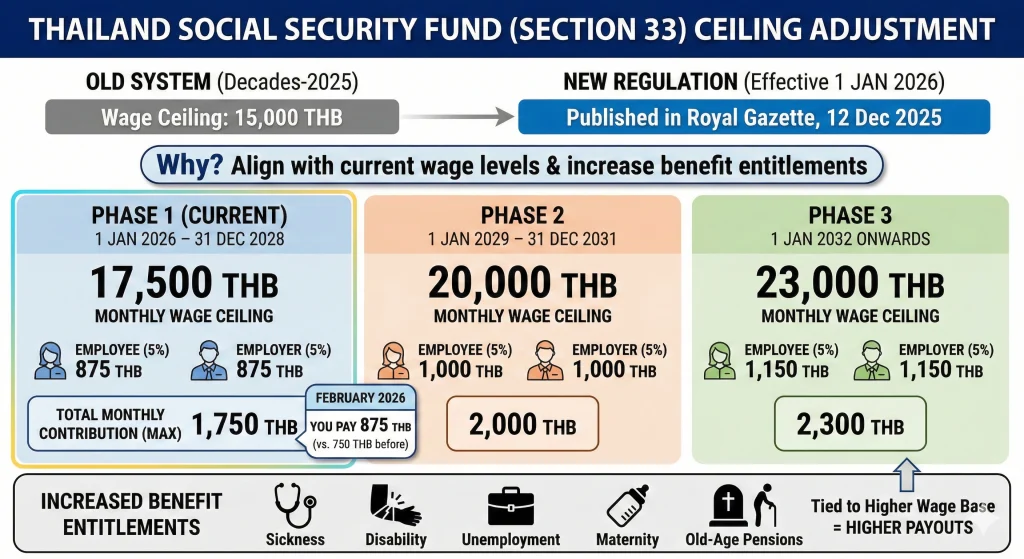
Pour la première phase (1er janvier 2026 - 31 décembre 2028), le plafond salarial mensuel est de 17 500 bahts. Le taux de cotisation sur les salaires reste à 5 pour cent tant pour l'employeur que pour le salarié. Cependant, le nouveau plafond fait passer la cotisation mensuelle maximale de 750 bahts à 875 bahts pour chaque partie. Les cotisations totales combinées de sécurité sociale s'élèveront à 1 750 bahts par mois pour les salariés gagnant 17 500 bahts ou plus.
Les phases suivantes sont déjà programmées :
Du 1er janvier 2029 au 31 décembre 2031, la limite passera à 20 000 bahts. Chaque partie pourra contribuer à hauteur de 1 000 bahts maximum par mois, pour un total de 2 000 bahts.
À compter du 1er janvier 2032, la limite passera à 23 000 bahts. Chaque partie pourra verser un maximum de 1 150 bahts par mois, pour un total de 2 300 bahts.
La dernière modification formelle remonte à plus de 30 ans. Le règlement ministériel n° 7 (B.E. 2538) a fixé le plafond de 15 000 bahts en 1995. Le nouveau règlement aligne la base de cotisation sur les niveaux actuels des salaires. Il augmente également les prestations. Ces prestations comprennent les indemnités de maladie, d’invalidité, de chômage, de maternité, de décès et de retraite. Ces prestations sont liées à la base de salaire.
Dernière révision : 27 septembre 2026. Les plafonds, les phases et la base minimale ont été lus en thaïlandais dans le texte du règlement ministériel publié à la Gazette royale (articles 1 à 3). Le taux de cotisation de 5 % est fixé séparément et n’a pas été relu ici.
Voici notre article principal sur la sécurité sociale en Thaïlande.
Questions fréquentes
Quel est le plafond des salaires de la sécurité sociale à compter du 1er janvier 2026 ?
17 500 bahts par mois à compter du 1er janvier 2026 jusqu’au 31 décembre 2028. Il remplace le plafond de 15 000 bahts fixé par le règlement ministériel n° 7 (B.E. 2538). Le montant minimum du salaire reste à 1 650 bahts.
Combien paient chaque mois l’employeur et le salarié ?
Chacun verse 5 % des salaires. Avec le nouveau plafond, le maximum est de 875 baht chacun, contre 750 baht auparavant ; donc un total de 1 750 baht pour un employé gagnant 17 500 baht ou plus.
Le plafond va-t-il redevenir élevé ?
Oui. De janvier 2029 à décembre 2031, le prix est de 20 000 bahts, un maximum de 1 000 bahts par personne. À partir du 1er janvier 2032, le prix est de 23 000 bahts, un maximum de 1 150 bahts par personne.
Quel règlement a apporté ce changement ?
Le règlement ministériel prescrivant les salaires minimum et maximum servant de base pour calculer les cotisations des personnes assurées en vertu de l’article 33 de la loi de 2025, signé le 11 décembre 2025 et publié dans le Journal officiel le 12 décembre 2025.
Actualités juridiques thaïlandaises, gratuites par courriel
Des mises à jour en anglais simple sur les changements législatifs thaïlandais concernant les étrangers : propriété, visas, mariage, affaires et testaments. Un court courriel par mois, envoyé par un cabinet d’avocats établi depuis 2006. Zéro spam, désabonnement possible à tout moment.