


Révisé par ThaiLawOnline, un cabinet d'avocats thaïlandais agréé exerçant en Thaïlande depuis 2006. Avocate thaïlandaise en charge du dossier : Wichuda Atthamethakon, LL.M., licence du barreau thaïlandais 3149/2556.
Dernière mise à jour :
Mise à jour, 13 septembre 2026. Utilisez la liste de contrôle actuelle de l'ambassade ou du consulat de Thaïlande responsable de votre demande. Les justificatifs de domicile, l'historique bancaire, les certificats de police et les frais payables diffèrent d'une mission à l'autre. Voir le Liste de contrôle pour Londres ET Liste de contrôle pour Washington.
This is the DTV filing guide. Use it for document preparation, e-Visa steps and how to put the application together. For current eligibility rules, the 500,000 THB financial test, stay limits and 2026 rule changes, read our main DTV requirements guide.
You’re sitting in a Bangkok coffee shop at 8 AM, working on your laptop while sipping Thai iced coffee. Your calendar shows meetings with clients in New York and London. Thailand feels like home, but your visa situation is uncertain. You’ve been on tourist visas, sorties de territoire pour visa, and ED visas. None of them were designed for someone like you.
Then in July 2024, Thailand launched something different: the Digital Nomad Visa, or DTV.
La télévision numérique terrestre (DTV) a changé la donne pour les télétravailleurs, les indépendants et tous ceux qui souhaitent travailler à distance. vivre en Thaïlande à long terme. It’s the visa the Thai government created specifically for digital nomads. It’s legal, affordable, and comes with real protections under Thai law. In this article, you will learn the DTV Application steps and everything you need to know about the Destination Thailand Visa.
At ThaiLawOnline, we’ve worked in Thai law for 20 years. We’ve helped thousands of foreign professionals understand visas, residency rules, and tax implications. We’ve seen visa systems change, immigration rules tighten, and policies shift unexpectedly. We know what works and what doesn’t.
This guide covers everything you need to know about the DTV visa in 2026. We’ll explain the legal basis, walk through the application process, break down the costs, and address the tax rules that affect you. We’ll also show you how the DTV compares to other visa options, because it’s not always the best choice for everyone.
Whether you’re thinking about applying now or considering your options, use our Recherche de visa thaïlandais pour comparer les alternatives, ou poursuivez votre lecture pour obtenir une analyse complète de la télévision numérique terrestre.
Table des matières
Qu’est-ce que le visa de destination pour la Thaïlande (DTV) ?
Le visa Destination Thaïlande est une nouvelle catégorie de visa légal créée par le gouvernement thaïlandais. Il est destiné aux nomades numériques, aux télétravailleurs et aux personnes effectuant des voyages d'affaires ou de développement du soft power. Approuvé par décret du Conseil des ministres le 28 mai 2024, il est entré en vigueur le 15 juillet 2024.
Le fondement juridique se trouve dans la loi sur l'immigration BE 2522 (1979). L'article 35 confère au directeur général de la Bureau de l'immigration Le DTV (Dispositif de Télédétection de Visas) confère au gouvernement le pouvoir de fixer les durées de séjour pour les différentes catégories de visas. Ce dispositif a été créé grâce à l'utilisation par le gouvernement de ce pouvoir.
Fondements juridiques essentiels
Quatre notifications ministérielles ont été publiées dans la Gazette royale le 15 juillet 2024, établissant le DTV comme une catégorie de visa officielle en vertu de la Loi sur l'immigration.
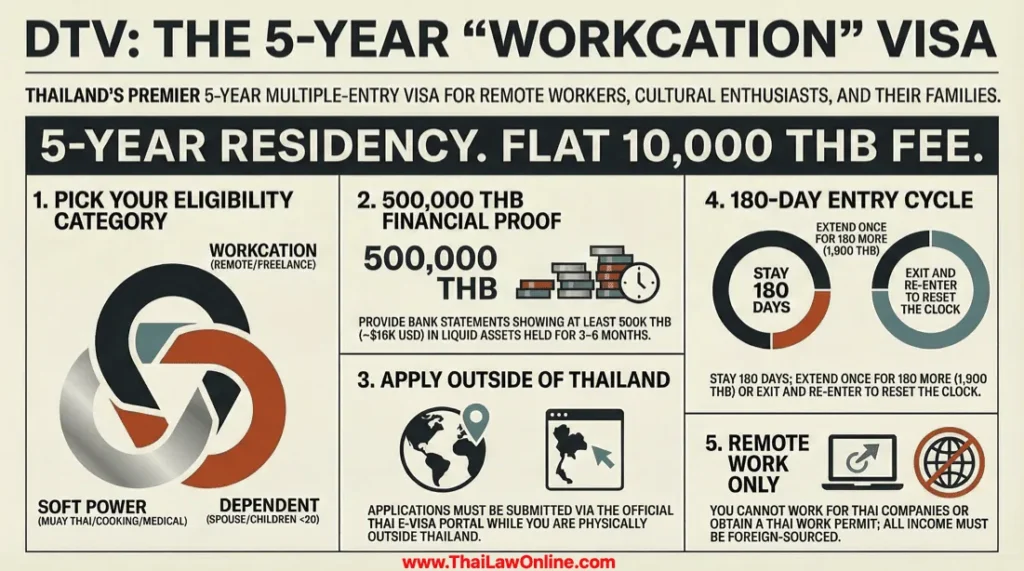
Here’s what makes the DTV unique: it’s a 5-year multiple entry visa. Each entry allows you to stay for 180 days. After 180 days, you can extend once for another 180 days. That is up to 360 days per entry, subject to extension approval if you use the extension.
The DTV base fee is THB 10,000; pay the amount and currency published by the deciding mission. Local fees are fixed by the mission and should not be calculated simply from today’s exchange rate: London publishes £300, Washington USD 400 and Vientiane 10,000 baht in cash. Helsinki publishes EUR 350 and Ho Chi Minh City USD 340. The residence evidence, statement period and police-certificate age also differ by post: see the mission-by-mission comparison in our requirements guide before you order documents. Apply from outside Thailand, at the mission covering a country where you are a national or a permanent resident, with the residence evidence that mission accepts.
The DTV permits multiple entries during its five-year validity. Each admission remains subject to immigration control. The land-border visa-exemption limit is a separate rule and is not a DTV entry cap.
One critical point: the DTV does not include a permis de travail. We’ll explain what that means and how it affects you in the work permit section below.
Qui peut demander un visa de nomade numérique pour la Thaïlande ?
DTV applications use three groups: workcation; Thai soft-power activities, including medical treatment; and the spouse and children under 20 of a DTV holder. Select the category shown on the responsible mission’s checklist. Medical applicants provide hospital or medical-centre evidence within the activity group. See our Guide des exigences DTV.
Voie 1 : Télétravail et vacances
Voici le morceau pour nomades numériques and remote workers. You qualify if you’re a freelancer, you work remotely for an overseas company, or you’re a business owner with clients outside Thailand. The government calls this the “Workcation” or remote work track.
Vous devez avoir au moins 20 ans et posséder un passeport valide dont la validité est d'au moins six mois. Vous devez justifier de 500 000 THB (environ 14 500 USD) d'économies. Un compte bancaire étranger convient parfaitement. Les fonds doivent être à votre nom et vos relevés bancaires doivent attester d'un solde régulier. Les candidats de moins de 20 ans peuvent, par exemple, être pris en compte par leurs parents.
Your background matters. You can’t have a history of long visa overstays. The immigration system checks your records. If you’ve dépassé la durée de son séjour visas in the past, your DTV application will likely be rejected.
Piste 2 : Activités de soft power
The soft power track is for people coming to Thailand for activities that don’t involve work. These include Muay Thai training, cooking classes, music festivals, sports training, seminars, or art classes. The government created this track to attract people who want to stay longer for these specific purposes. Medical treatment is included in the DTV2 activity group and requires evidence from the hospital or medical centre.
Choose a genuine programme and obtain a confirmation letter identifying the provider, activity, duration and schedule. Course length alone does not guarantee approval. Confirm the deciding mission’s current activity requirements before paying a provider.
Vous remplissez les mêmes conditions d'âge (20 ans) et de validité du passeport (au moins six mois). Le montant des fonds requis est également de 500 000 THB, et une vérification des antécédents est également effectuée.
Règles d'admissibilité importantes
Language schools no longer qualify for the DTV. The government closed this pathway in 2025. If you’re planning to study Thai language, you’ll need a different visa type, like the ED visa.
You can’t work for Thai employers or Thai companies on a DTV. We’ll cover the work rules in detail later, but this is a hard line. The DTV is only for remote work with overseas clients.
You must be 20 years old. There’s no exception for younger applicants. If you’re 19, you’ll need to wait or choose a different visa option. Children under 20 peut piggyback on their parent’s visa under the “Spouse/Children” track.
DTV Visa Requirements: Documents You’ll Need
The documents you need depend on which track you’re applying under. Below is a complete breakdown for each track.
| Type de document | Parcours de travail à domicile/télétravail | Voie de puissance douce |
|---|---|---|
| Copie de passeport valide | Obligatoire (validité de 6 mois et plus) | Obligatoire (validité de 6 mois et plus) |
| relevé bancaire | Requis (économies de 500 000 THB) | Requis (économies de 500 000 THB) |
| Contrat de travail ou lettre d'offre | Requis (de l'employeur étranger) | Non requis |
| Preuve de propriété de l'entreprise | Obligatoire pour les travailleurs indépendants | Non requis |
| Inscription aux activités | Non requis | Document requis (preuve d'activité) |
| Lettre de soutien du prestataire d'activités | Non requis | Obligatoire (provenant de la salle de sport, de l'école, de la clinique, etc.) |
| Assurance maladie | Ce n'est pas une exigence pour le document DTV : aucune liste de contrôle officielle d'ambassade (y compris les États-Unis, le Royaume-Uni et la Finlande) n'exige d'assurance maladie pour le DTV en août 2026. Fortement recommandé pour votre propre protection, et les agents consulaires peuvent toujours demander des documents supplémentaires au cas par cas. | Ce n'est pas une exigence pour le document DTV : aucune liste de contrôle officielle d'ambassade (y compris les États-Unis, le Royaume-Uni et la Finlande) n'exige d'assurance maladie pour le DTV en août 2026. Fortement recommandé pour votre propre protection, et les agents consulaires peuvent toujours demander des documents supplémentaires au cas par cas. |
| vérification des antécédents criminels | Required at every mission since 31 August 2026; the accepted issuer and maximum age are set by the mission | Required at every mission since 31 August 2026; the accepted issuer and maximum age are set by the mission |
| Proof of nationality or permanent residence | Required since 31 August 2026. An address in the country is no longer enough: you must be a national or a permanent resident of the country where you apply, and the mission sets the accepted document | Required since 31 August 2026. An address in the country is no longer enough: you must be a national or a permanent resident of the country where you apply, and the mission sets the accepted document |
Let’s break down the most important documents.
Relevés bancaires et justificatifs financiers
The THB 500,000 requirement is the most common reason applications get rejected. You need to show the equivalent of THB 500,000 in a bank account in your name. This can be a foreign bank account. You don’t need a Thai bank account to apply. In fact, opening a Thai bank account on a DTV is difficult (most banks still require a work permit).
Show financial evidence meeting the deciding mission’s THB 500,000-equivalent requirement. Prepare a clear funds history and explain unusual deposits. The required statement period and acceptance of joint, sponsored or family accounts depend on the mission; a recent deposit is not a published universal ground for automatic refusal.
Dependents are not exempt from the money rule: official checklists ask each spouse or child’s file for a bank statement with an ending balance of no less than 500 000 THB. Some posts accept one family statement covering the combined amount with proof of relationship, and an extra 500,000 THB per dependent on top of that is not a published nationwide rule. For a family of three, plan on roughly 1,500,000 THB across your accounts, and use the checklist of the embassy that will decide the file.
Documentation de travail pour le programme Workcation Track
If you’re applying under the remote work track, you need proof that you actually work for an overseas company. This could be a work contract, an offer letter, or documentation of your freelance clients. The document needs to show the company or client is overseas, not in Thailand.
If you’re self-employed, you’ll need proof of your business. This could be a business registration certificate, tax returns, or copies of invoices from overseas clients.
Documentation d'activité pour le volet Soft Power
If you’re applying under the soft power track, you need to prove enrollment or registration in your activity. If you’re training Muay Thai, get a letter from the gym confirming your enrollment. If you’re taking cooking classes, get a document from the school. If you’re getting medical treatment, get a letter from the clinic.
Justificatif de domicile
Two different address questions come up, and applicants often confuse them.
1. Where you are when you apply. Since 31 August 2026 this is not about where you are, it is about where you belong: the deciding mission must cover a country where you are a national or a permanent resident, and a short visit to a neighbouring country no longer establishes eligibility. The document that proves it is set by the mission, and the missions differ: Los Angeles lists a valid driving licence, a valid U.S. visa or a Permanent Resident Card, while Ho Chi Minh City accepts only a Vietnamese Temporary or Permanent Residence Card.
2. Your address in Thailand after arrival. This is not part of the visa application. You give a Thai address on the arrival card (TDAC), your landlord or hotel files the TM30 notification within 24 hours of your arrival, and you will need a lease, utility bill or condo purchase agreement in your name later, when you apply for the 180-day extension or file a rapport de 90 jours. Keep those documents from day one.
Comment faire une demande de visa de nomade numérique pour la Thaïlande (étape par étape)
Since January 2025, the DTV application process has been fully online through the Thai e-visa system. You can’t submit a paper application at an embassy anymore. Everything happens on thaievisa.go.th.
Where You Can Apply: The 31 August 2026 Rule Change
Since 31 August 2026 a Thai mission accepts a DTV application only from a national or a permanent resident of the country where it is submitted, and the file must include a certificate of criminal record clearance issued by the authorities of your country of nationality or of the country where you apply. The Royal Thai Embassy in Vientiane published the change on its page de demande de visa on 28 August 2026, and the Royal Thai Consulate-General in Los Angeles publishes the same effective date. It is a mission notice, not a Royal Gazette instrument. Applications submitted and paid in full before 31 August 2026 are decided under the old rules, and payment rather than submission is the cut.
What each mission accepts as residence evidence differs, and some of it falls short of permanent residence: Los Angeles lists a valid driving licence, a valid U.S. visa or a Permanent Resident Card; London requires proof of permanent residence in the UK, Ireland or the British Overseas Territories, such as indefinite leave to remain; Ho Chi Minh City accepts only a Vietnamese Temporary or Permanent Residence Card and refuses a temporary residence declaration in terms. The criminal record certificate has its own mission rules: London specifies one issued within six months, such as an ACRO certificate, Washington and Los Angeles an FBI certificate within three months, and Ho Chi Minh City Vietnamese Criminal Record Certificate No. 2. Read the checklist of the mission that will decide your file.
Étape 1 : Vérifiez votre admissibilité
Before you start, confirm you meet all eligibility requirements. You’re 20 years old or older. Your passport has 6+ months of validity. You have or can access THB 500,000. You have no history of long visa overstays. You’ve identified which track you’re applying under (Workcation or Soft Power).
Étape 2 : Rassemblez tous les documents requis
Rassemblez tous les documents mentionnés dans le tableau ci-dessus et relatifs à votre dossier. Numérisez-les entièrement. Le système accepte les fichiers PDF, les images JPG et les images PNG. Les numérisations de mauvaise qualité sont rejetées. Assurez-vous que les documents sont nets et lisibles.
Étape 3 : Créez votre compte sur thaievisa.go.th
Visit the official Thai e-visa website. Create an account using your email address. You’ll receive a confirmation email. Click the link to activate your account. Save your login credentials somewhere safe.
Étape 4 : Remplissez le formulaire de demande en ligne
Log in and select “Digital Nomad Visa (DTV)” as your visa type. Choose your track (Workcation or Soft Power). Fill in all required information accurately. Your name needs to match your passport exactly. Your email and phone number should be current. You’ll use these for status updates and payment confirmation.
Étape 5 : Téléchargez vos documents
Upload each document according to the system’s requirements. The system clearly labels what goes where. Don’t skip anything marked as required. If your document is in a language other than English or Thai, you may need to provide a certified translation.
Étape 6 : Payer les frais de dossier
The DTV base fee is THB 10,000; pay the amount and currency published by the deciding mission. Local fees are fixed by the mission and should not be calculated simply from today’s exchange rate. Follow the payment methods displayed by the mission or e-Visa portal and retain the receipt.
Étape 7 : Attendre le traitement
Processing typically takes 5 to 15 business days. During this time, immigration may request additional documents or information. Check your email frequently. If they ask for something, respond quickly. Delays often happen because applicants don’t respond to requests in time.
Étape 8 : Vérification de la localisation
In 2026, the immigration system has introduced location verification at Thai embassies and consulates for some applicants. If you’re selected, you’ll receive an email with instructions. You’ll need to appear at the embassy in your jurisdiction for a brief interview or document verification. This step isn’t required for all applicants, but it’s becoming more common.
Étape 9 : Recevez votre approbation de visa électronique
Once approved, you’ll receive an email with your e-visa document. Download and print this document. It’s a PDF that shows your visa number, validity dates, and entry conditions. You can also save the digital copy to your phone.
Étape 10 : Entrer en Thaïlande pendant la validité de votre visa
Vous devez entrer en Thaïlande pendant la période de validité indiquée sur votre visa électronique. À votre arrivée à l'immigration, à l'aéroport ou à la frontière terrestre, présentez votre visa électronique imprimé ainsi que votre passeport. Les agents d'immigration apposeront un tampon sur votre passeport. Il se peut que vous deviez présenter votre passeport.DAC (Carte d'arrivée numérique de Thaïlande) qui remplaceront TM6 en 2025).
One thing this does not change: the DTV is issued abroad. You cannot obtain or convert one inside Thailand, and since 31 August 2026 the mission that decides your file must be the one covering a country where you are a national or a permanent resident.
DTV Visa vs Thailand Privilege vs Other Options
The DTV isn’t the only option for staying in Thailand long-term. Let’s see how it stacks up against the main alternatives.
| Fonctionnalité | DTV | Thailand Privilege | Tourist visa | Non-Immigrant B |
|---|---|---|---|---|
| But | Workcation, qualifying activities or eligible dependants | Membership-based long stay | Tourisme | Business or employment-related purposes |
| Rester | 180 days per entry; one extension up to 180 days subject to approval | Normally one year per admission; follow visa and membership conditions | Normally 60 days; possible 30-day extension | Normally 90 days initially; extension conditions depend on purpose |
| Work permission | No Thai employment authorization from the visa alone | No work authorization from membership alone | No ordinary employment authorization | A work permit or applicable exemption is separate |
| Financial evidence and fees | THB 500,000-equivalent evidence; mission checklist and local visa fee apply | Current package price and membership terms apply | Mission-specific visa fee and financial evidence | Mission and extension-category requirements; no universal THB 800,000 rule |
| Résidence permanente | No automatic entitlement | No automatic entitlement | No automatic entitlement | Separate eligibility and application; approval is not automatic after five years |
DTV vs Thailand Privilege
Thailand Privilege is a membership-based long-stay programme with package-specific fees and benefits. Check the current Privilege guide before comparing costs. Membership assistance does not make an immigration extension automatic.
Compare the deciding mission’s DTV fee with the current Privilege membership package. The programmes have different purposes, eligibility rules and benefits; neither guarantees every later immigration decision.
The DTV is better for digital nomads on a budget. The Privilege visa is better if you want maximum convenience and don’t mind the cost.
DTV vs Visa touristique
A single-entry tourist visa normally permits a 60-day stay, with a possible 30-day extension subject to approval. Visa validity, permission to stay and visa exemption are different concepts. The limit on visa-exempt land entries is not a general limit on tourist visas or DTV entries.
The DTV gives you 180 days per entry, and you can extend for another 180 days. That is up to 360 days without leaving Thailand, subject to extension approval. You don’t need visa runs. It’s more stable and costs less over time.
DTV vs Visa de travail non-immigrant B
Le visa Non-Imm B exige un employeur thaïlandais. Vous devez obtenir une offre d'emploi d'une entreprise thaïlandaise. Cette entreprise doit faire une demande pour vous. permis de travail. It’s much more complicated than the DTV.
A Non-Immigrant B visa does not itself authorize employment. A work permit or applicable exemption is a separate requirement. Confirm both immigration status and work authorization before starting work for a Thai employer.
Pour les nomades numériques travaillant pour des entreprises étrangères, le visa DTV est plus simple et plus rapide. Pour ceux qui envisagent de travailler en Thaïlande pour des employeurs thaïlandais, le visa Non-Imm B est la solution idéale.
Détail des coûts du visa de nomade numérique pour la Thaïlande
Here’s what the DTV actually costs you, year by year. We’ve included all the fees and expenses you’re likely to encounter.
| Poste de dépense | Frais (THB) | Frais (USD) | Fréquence |
|---|---|---|---|
| Application DTV | 10,000 | ~$275 | Initial uniquement |
| Prolongation du séjour (une fois par entrée) | 1,900 | ~$52 | Par entrée (facultatif) |
| Rapport sur 90 jours | 0 | Gratuit | Tous les 90 jours |
| Assurance maladie (annuelle) | 20 000 à 100 000 | ~$550 à $2 700 | Recommandé |
Coût total de la première année
Your first year will cost you the application fee (THB 10,000) plus optional expenses. If you extend your stay once in year one and buy health insurance, you’re looking at roughly THB 32,000 to THB 112,000 (about $875 to $3,050). The exact amount depends on which health insurance plan you choose.
Années suivantes
The DTV remains valid for multiple entries during its five-year validity. A fresh admission using the valid multiple-entry visa does not require buying a separate re-entry permit. An in-country extension has its own fee; budget separately for insurance, travel and any document costs.
Rapport sur 90 jours
Every 90 days, you need to report to immigration. This is free. Many people do it online now. You just need to notify immigration of your address and confirm you’re still in Thailand. It takes 10 minutes online.
Considérations relatives à l'assurance maladie
Health insurance isn’t technically required by law yet. But it’s strongly recommended. Thailand has excellent healthcare, but it’s not free for foreigners. A decent expat health insurance policy costs THB 20,000 to THB 100,000 per year depending on coverage and age.
Some health insurers specifically cover DTV visa holders. Others don’t. Ask before you buy.
To be clear about a common myth: no official DTV checklist requires health insurance. We checked the MFA e-visa checklist and the embassy pages in Washington, London and Helsinki (August 2026): none lists insurance as a DTV document. The $50,000 insurance figure you may see elsewhere belongs to the O-A and O-X visas de retraite, not the DTV. Insurance is still strongly recommended, and any consulate can request additional documents, so check the checklist of the post where you apply.
Explication des permis de rentrée
A valid multiple-entry DTV is used for a fresh admission when you return to Thailand. A separate re-entry permit is not normally needed for that purpose. Check your visa expiry and admission stamp before travelling.
Do not include optional re-entry permit costs as a routine DTV charge. Seek case-specific advice if travel falls near visa expiry or involves a different immigration status.
Conséquences fiscales pour les titulaires de visa DTV
C'est crucial. règles fiscales La réglementation a considérablement évolué en 2024 et affecte directement les détenteurs de télévision numérique. De nombreux nomades numériques interprètent mal les règles et rencontrent des difficultés majeures.
Résidence fiscale thaïlandaise et règle des 180 jours
Under section 41 paragraph three of the Thai Revenue Code, anyone who stays in Thailand for periods totalling 180 days or more in any tax year is a resident of Thailand for tax purposes. For individuals the Thai tax year runs from 1 January to 31 December, so what counts is the number of days you are physically present in Thailand across that year. It makes no difference which visa you hold, or whether you entered on a visa exemption. The test is the same for everyone.
Being a tax resident does not mean Thailand taxes your worldwide income. A resident is taxed on Thai-sourced income, and on foreign income only when that income is brought into Thailand. Our guide to Impôt sur le revenu des personnes physiques en Thaïlande covers the rates and how filing works.
Les revenus étrangers sont désormais imposables.
This is where most of the confusion sits, and one point is worth getting right: the Revenue Code was not amended in 2024. Section 41 paragraph two has long provided that a resident who earns income from employment, from a business carried on abroad or from property situated abroad pays Thai tax on it upon bringing that income into Thailand, and that remittance trigger is still the law. What changed on 1 January 2024 is the Revenue Department’s own reading of it, issued as Departmental Instruction Por. 161/2566, with Por. 162/2566 exempting foreign income earned before that date. Under the earlier practice, foreign income remitted in a later tax year than the one in which it was earned fell outside the charge; under Por. 161/2566 it is assessable in the year it is remitted, whenever it was earned. Foreign income you do not bring into Thailand is not assessable under section 41.
So the practical question for a tax resident is not whether you earn overseas income but whether you bring it into Thailand. If you do, assume it is assessable and report it. A departmental instruction is the Revenue Department’s interpretation rather than an Act of Parliament, so it can be revised the way it was made; we track the current position, including the proposed exemption, on our Thailand remittance tax exemption status page.
Titulaires d'une carte DTV séjournant moins de 180 jours
If you spend fewer than 180 days in Thailand in a calendar year, you’re not a tax resident. Non-residence does not itself remove filing obligations: Thai-sourced assessable income remains relevant, subject to the applicable thresholds and exemptions. That follows from section 41 itself, whose second paragraph applies only to a resident of Thailand. Revenue Department Departmental Instructions Por. 161/2566 and Por. 162/2566 bite only once you are a tax resident: they treat foreign income earned from 1 January 2024 onwards as assessable when a tax resident brings it into Thailand.
De nombreux nomades numériques prévoient de quitter la Thaïlande quelques semaines ou quelques mois chaque année, en veillant à ne pas dépasser 180 jours de séjour. C'est tout à fait légal. Il est possible de renouveler son visa à tout moment, de voyager à l'étranger ou de travailler depuis un autre pays pendant une partie de l'année.
La question des conventions de double imposition
La Thaïlande a conclu des conventions fiscales avec de nombreux pays afin d'éviter la double imposition. La convention entre la Thaïlande et les États-Unis (ou votre pays de résidence) peut vous permettre de déduire les impôts thaïlandais payés de vos impôts dus dans votre pays de résidence. Toutefois, vous devez déclarer vos impôts dans les deux pays.
We recommend talking to a tax accountant familiar with both Thai and your home country’s tax systems. The rules are complex, and a mistake can cost you significantly.
Que faire maintenant ?
If you’re on a DTV and earning overseas income, you need to track your days in Thailand accurately. Keep records of dates you left and dates you returned. If you hit 180 days in the calendar year, you’re approaching tax residency. If you hit 180 days, you’re a tax resident and need to file Thai taxes.
Consultez un expert-comptable fiscaliste thaïlandais. Il pourra vous aider à comprendre votre situation personnelle. Certains nomades numériques restructurent leur année pour rester moins de 180 jours en Thaïlande. D'autres choisissent de payer leurs impôts en Thaïlande. Le choix le plus judicieux dépend de votre situation.
Référence interne : Pour plus d'informations, consultez notre guide sur Impôt sur le revenu des personnes physiques en Thaïlande.
Règles relatives aux permis de travail et limites légales
This is where many DTV holders get confused. Let’s be absolutely clear: the DTV does not include a work permit.
Que pouvez-vous faire sans permis de travail ?
On a DTV, you can work remotely for an overseas employer. You can work for an overseas client if you’re a freelancer. You can run an overseas business. The key word is “overseas.” The work is not performed in Thailand for a Thai employer or Thai client.
You’re not physically working in a Thai office. Your clients are outside Thailand. Your paycheck comes from outside Thailand. This is legal on the DTV without a work permit.
Ce que vous ne pouvez pas faire
You cannot work for Thai employers. You cannot work for Thai companies. You cannot provide services to Thai clients for payment. You cannot work at a job location in Thailand. All of this requires a work permit, and the DTV doesn’t come with one.
The instrument that governs this is the Décret d'urgence sur la gestion du travail des étrangers de B.E. 2560 (2017), as amended by the Emergency Decree (No. 2) B.E. 2561 (2018). It is what creates the work permit and what defines, in section 5, the work that requires one. The Loi sur les entreprises étrangères BE 2542 (1999) is a different statute with a different subject: it governs which businesses a foreigner may operate, through its three annexed lists and its licensing regime, and it does not decide whether an individual may take a job. Violation can result in fines, deportation, and blacklisting from re-entering Thailand.
Les zones grises
Some activities live in gray areas. If you consult with Thai clients online about strategy, is that “working for a Thai client”? If you attend meetings at a co-working space in Bangkok with clients from your overseas company, is that “working in Thailand”? These edge cases are technically restricted but rarely enforced.
Immigration enforcement of work permit violations is inconsistent. Some expats work in gray areas for years without problems. Others face sudden enforcement action. The safest approach is to stay clearly on the legal side: work for overseas clients only, don’t take a job with a Thai company, and don’t work from a Thai office for Thai bosses.
Comment obtenir un permis de travail si vous en avez besoin
If you want to work for a Thai employer legally, you need to switch visas. You’d apply for a Non-Immigrant B visa (work visa) while in your home country. Your Thai employer would apply for a work permit on your behalf once you arrive. If you’re thinking of créer une entreprise en Thaïlande, you’ll also need proper corporate registration. It takes time and involves immigration paperwork, but it’s the legal way to do it.
Références internes : Pour plus d'informations, consultez nos guides sur permis de travail à Bangkok ET emplois interdits aux étrangers en Thaïlande.
Mises à jour réglementaires 2025-2026 à connaître
Le paysage de la télévision numérique terrestre a évolué rapidement. Voici les principales mises à jour réglementaires qui vous concernent actuellement.
Exigences relatives à la carte d'arrivée numérique en Thaïlande (TDAC)
À compter du 1er mai 2025, tous les voyageurs arrivant en Thaïlande doivent remplir la Carte d'arrivée numérique thaïlandaise (TDAC) dans les 72 heures suivant leur arrivée. Ce formulaire en ligne remplace le formulaire papier TM.6. Vous recevrez un numéro d'enregistrement TDAC que vous devrez présenter aux services d'immigration ou à la police si nécessaire. dans les 72 heures d'arrivée.
The TDAC is free. It takes about 10 minutes to complete online. You’ll receive a QR code via email. It’s very straightforward.
Répression des fraudes aux visas (novembre 2025)
The two-entry restriction concerns visa-exempt entries through land borders, with nationality exceptions under the applicable scheme. It is not a universal annual visa-run limit, a DTV entry cap or a general waiting period between all entries. See the border-entry guide.
Use the entry basis recorded on your admission stamp. A DTV admission and a visa-exempt admission have different conditions. Do not assume the exemption rules determine the stay granted on a valid DTV.
Visa Exemption: the 30-Day Cut Applies from 15 September 2026
Les annonces du ministère de l’Intérieur ont été publiées dans la Gazette royale le 31 août 2026. Les informations officielles thaïlandaises destinées aux voyageurs fixent au 15 septembre 2026 le début du nouveau régime d’exemption de visa. Pour organiser votre voyage, retenez la date de votre admission en Thaïlande, et non la date de réservation ou de départ de votre vol.
Pour une admission jusqu’au 14 septembre 2026 inclus, l’ancien régime d’exemption de 60 jours reste applicable aux voyageurs admissibles. À compter du 15 septembre 2026, la nouvelle exemption touristique prévoit un séjour maximal de 30 jours pour les 60 pays et territoires inscrits sur la liste, dont le Canada, la France et l’Inde. D’autres régimes s’appliquent aux autres nationalités. Vérifiez la date limite de séjour inscrite dans votre passeport et respectez les conditions de votre admission.
Consultez l’annonce officielle et notre guide actualisé.
None of this changes a DTV entry itself, which is stamped for 180 days on its own terms. It matters if you plan to bridge a gap between DTV entries on a visa exemption stamp, because that stamp is 30 days for entries from 15 September 2026.
Parcours d'école de langues fermé
Language schools are no longer an acceptable primary reason for the DTV soft power track. The government closed this pathway in 2025. If you’re studying Thai language, you need an ED visa instead. The ED visa is designed for full-time students.
Vérification de localisation auprès des ambassades
In 2026, Thai embassies have started requiring location verification appointments for some DTV applicants. When you apply, you may be asked to appear at the embassy in your jurisdiction for an in-person verification. This could be a brief interview or just document verification. It’s becoming standard practice.
If you’re selected, respond quickly. Delays in showing up for your verification appointment can result in application rejection.
Faire venir votre famille avec un visa DTV
You can bring family members on a DTV, but they need their own visas. The DTV isn’t a family visa like some other countries offer. Each family member applies individually.
Qui est considéré comme membre de la famille ?
Your spouse can apply for a DTV. Children under 20 can apply. Adult children (20 and older) can apply if they meet the standard DTV eligibility requirements. Spouses and children under 20 apply under the DTV dependent category, as the family of a DTV applicant or holder, with proof of relationship. Adult children qualify on their own merits under their own category.
Besoins financiers des membres de la famille
A spouse and children under 20 apply separately as dependants, with the principal holder’s DTV and evidence of relationship. Follow the mission’s financial and supporting-document checklist for each family member. Do not assume every child needs a separate personal account containing THB 500,000.
Prepare the family’s applications together so names, relationship documents and financial evidence are consistent. Obtain mission-specific advice if a spouse or child relies on the principal applicant’s funds.
Documents pour les conjoints
A spouse applies under the dependant category, using the principal holder’s DTV, a marriage certificate and the remaining documents required by the deciding mission. A dependant spouse does not need to qualify independently as a remote worker.
Documentation pour enfants
Children under 20 of a DTV holder apply under the dependant category, with birth or adoption records and the mission’s other required documents. Enrolling a child in a course is not required for this dependant route.
Le défi pratique
Accompagner toute une famille dans les démarches liées à la télévision directe est un processus long et fastidieux. Chaque personne doit déposer une demande séparément, fournir des justificatifs financiers et obtenir une approbation. Coordonner quatre ou cinq demandes simultanément est complexe.
Consider the dependant DTV route for an eligible spouse and children before arranging separate study visas. Compare alternatives where a family member does not meet the dependant criteria.
Foire aux questions
Puis-je travailler pour des clients thaïlandais avec un visa DTV ?
Non. Le visa DTV exclut expressément le travail pour des employeurs ou des clients thaïlandais. Vous pouvez uniquement travailler à distance pour des entreprises ou des clients étrangers. Travailler pour des entités thaïlandaises requiert un visa non-immigrant B et un permis de travail. Si les services d'immigration découvrent que vous travaillez pour un client thaïlandais, votre visa peut être annulé et vous risquez l'expulsion. La loi thaïlandaise est très stricte à ce sujet.
De combien d'argent ai-je besoin pour un visa de nomade numérique en Thaïlande ?
You need to show the equivalent of THB 500,000 (roughly USD 14,500) in a bank account in your name. A foreign account is fine and is what most applicants use. You do not need a Thai bank account, and most Thai banks will not open one for a DTV holder. The required bank-statement history depends on the deciding mission; follow its current checklist. Each dependent’s file generally needs to show 500,000 THB as well; some posts accept one family statement with proof of relationship, so follow the checklist of the embassy deciding the file.
Puis-je prolonger mon visa DTV au-delà de 180 jours ?
Yes. Each 180-day entry can be extended once for another 180 days. That is up to 360 days per entry, subject to extension approval. After the extension period ends, you can leave Thailand and re-enter on the same DTV to get another 180-day entry. The DTV itself is valid for 5 years, so you can do this multiple times.
Puis-je ouvrir un compte bancaire thaïlandais avec un visa DTV ?
C'est difficile, voire impossible pour certains. La plupart des banques thaïlandaises exigent un permis de travail ou un visa de long séjour (comme un visa non-immigrant B ou un visa de retraite) pour ouvrir un compte. Le DTV est encore récent. En 2025, certaines banques ont commencé à refuser l'ouverture de comptes aux titulaires de DTV et nous espérons que cela changera, mais personne ne sait quand. La loi ne l'interdit pas, mais les banques ne le font pas depuis 2025.
Que se passe-t-il si je dépasse la durée de validité de mon visa DTV ?
Le dépassement de la durée de validité d'un visa de tourisme (DTV) est une infraction grave. Vous vous exposez à des amendes (500 THB par jour, jusqu'à un maximum de 20 000 THB pour le premier dépassement). Vous serez fiché par les services d'immigration. Vous risquez l'expulsion et une interdiction de séjour en Thaïlande pour une durée déterminée. Vos futures demandes de visa seront plus difficiles. Même un seul jour de dépassement peut compliquer les choses. Ne laissez pas votre visa expirer par inadvertance. Programmez un rappel et anticipez.
Puis-je convertir un DTV en un autre type de visa pendant mon séjour en Thaïlande ?
Non. Un visa DTV ne peut être converti en un autre type de visa pendant votre séjour en Thaïlande. Si vous avez besoin d'un autre visa (par exemple, un visa non-immigrant B pour travailler), vous devrez quitter la Thaïlande, faire une demande de nouveau visa depuis l'étranger, puis revenir. Le visa DTV doit rester valide ou expirer pendant votre séjour en Thaïlande avec un autre type de visa.
Is the DTV visa the same as the Thailand Privilege (formerly Elite) Visa?
No. They’re completely different programs. The DTV is a government immigration visa that costs THB 10,000 and requires proof of overseas work or specific activities. Thailand Privilege, formerly the Thailand Elite Visa, is a private membership program costing the current package price and offering package-specific benefits and immigration assistance. The DTV is for remote workers. Thailand Privilege is for wealthy individuals who want premium service and convenience.
Comment ThaiLawOnline peut vous aider
The DTV is a significant decision. You’re committing to a visa that will define your legal status in Thailand for the next 5 years. Getting it right matters.
ThaiLawOnline has practised Thai immigration law since 2006. We know what embassies accept, what they refuse, and why, because we see both outcomes every month.
If you’re considering the DTV, we can help you evaluate whether it’s the right fit for your situation. We can review your eligibility, identify potential problems in your application, and help you gather the right documents. We can explain the tax implications specific to your circumstances. We can answer your questions about work restrictions and legal boundaries. Since 2006 we have handled visa and immigration work for thousands of foreign clients, and every DTV application we have prepared since the visa launched in July 2024 has been approved. Our DTV service is 10,000 THB and comes with a refund guarantee: if an application we prepared and reviewed is refused, we reimburse our fee in full. The government visa fee is paid at the deciding mission’s published rate and is separate from our service fee and refund terms.
Nous tenons également à jour des guides sur des sujets connexes qui concernent les détenteurs de droits de télévision numérique terrestre : Guide juridique pour les nomades numériques en Thaïlande, Outil de recherche de visa thaïlandais, Impôt sur le revenu des personnes physiques en Thaïlande, et Guide pour déménager en Thaïlande.
Pour une assistance juridique complète concernant votre demande de télévision numérique terrestre ou toute question juridique en Thaïlande, consultez notre site web. page des services juridiques ou contactez-nous via notre site web.
Points clés à retenir
- Le DTV est un visa légal à entrées multiples de 5 ans destiné aux nomades numériques et aux travailleurs à distance, lancé le 15 juillet 2024, en vertu de la loi sur l'immigration BE 2522 (1979).
- Chaque entrée donne droit à 180 jours en Thaïlande, prolongeable une fois pour 180 jours supplémentaires, pour un coût de seulement 10 000 THB (~$275).
- You must be 20+ years old, have a valid passport with 6+ months validity, and show liquid funds equivalent to THB 500,000, usually on a personal bank account in your home country (a Thai bank account is not required).
- Apply online through thaievisa.go.th. You can’t apply from inside Thailand. Processing typically takes 5-15 business days.
- Le DTV ne comprend pas de permis de travail. Vous pouvez travailler à distance uniquement pour des employeurs étrangers, et non pour des entreprises ou des clients thaïlandais.
- Si vous passez plus de 180 jours en Thaïlande au cours d'une année civile, vous devenez résident fiscal et devez déclarer vos revenus étrangers en vertu de l'article 41 du Code des impôts.
- Compare the mission’s DTV fee and evidence requirements with current Thailand Privilege packages and tourist-visa conditions.
- Check the mission’s current residence and document requirements and complete TDAC when required. The visa-exempt land-entry cap is separate from DTV admissions.
- Eligible family members apply separately as dependants, with relationship and financial evidence accepted by the deciding mission.
- Consultez un expert-comptable pour comprendre votre situation fiscale personnelle. Le dépassement de la durée de séjour autorisée entraîne de graves conséquences. Demandez conseil à un professionnel avant de déposer votre demande.
DTV document guidance updated 13 September 2026 against the linked London and Washington mission checklists. Requirements vary by mission; use the checklist applicable to your application. This date records the corrections described above, not a fresh verification of every statutory and tax proposition on this page.
Actualités juridiques thaïlandaises, gratuites par courriel
Des informations claires et concises sur les changements législatifs thaïlandais concernant les étrangers : propriété, visas, mariage, affaires et testaments. Un court courriel par mois, envoyé par un cabinet d’avocats établi depuis 2006. Zéro spam, désabonnement possible à tout moment.