



Évalué par Wichuda Atthamethakon, LL.M., titulaire de la licence de l’Ordre des avocats thaïlandais 3149/2556, pour ThaiLawOnline, un cabinet d’avocats thaïlandais œuvrant pour des étrangers depuis 2006.
Journal des mises à jour
- 2 novembre 2026: Added the statute box with Thai, English and French text and checked the page against the official text
Un contrat de travail est un contrat juridiquement contraignant qui définit les termes et conditions de la relation de travail entre un employeur et un employé en Thaïlande. En vertu de la Loi sur la protection du travail B.E. 2541 (1998), tous les contrats de travail doivent respecter des normes minimales concernant les salaires, les heures de travail, les droits à congé et les conditions de licenciement, que l'accord soit écrit ou verbal.
Un accord écrit protège les deux parties. Il réduit le risque de litiges, clarifie les obligations dès le premier jour et garantit la conformité avec le droit du travail thaïlandais. Les modèles ci-dessous sont rédigés par avocats thaïlandais inscrits au barreau et sont inclus avec l'adhésion Silver et supérieure. Ils ont été utilisés par des employeurs, des propriétaires d'entreprises étrangères et des expatriés dans toute la Thaïlande.
Table des matières
8 clauses essentielles que tout contrat de travail thaïlandais doit inclure
Pour être juridiquement valable et utile en pratique, un contrat de travail bien rédigé en Thaïlande doit clairement aborder les huit points suivants :
- Informations des parties: Noms et prénoms complets, nationalités et adresses de l'employeur et de l'employé, permettant d'identifier clairement les deux parties.
- Poste et fonctions: Intitulé précis du poste, étendue des tâches, hiérarchie et attentes en matière de performance.
- Durée de l'emploi: Indiquez si le contrat est à durée indéterminée ou à durée déterminée, y compris la date de début et (le cas échéant) la date de fin. Les contrats à durée déterminée en Thaïlande sont soumis à des règles de résiliation différentes.
- Rémunération et avantages sociaux: Salaire de base, calendrier de paiement, primes, assurance maladie, caisse de prévoyance, congé annuel, congé de maladie et toutes les indemnités. Doit être conforme à salaire minimum Règlementations. À compter du 1er janvier 2027, si l’employeur compte dix ou plus d’employés, le contrat doit également autoriser le prélèvement mensuel pour Fonds de prévoyance des salariés (0,25 pour cent du salaire, avec une contribution égale de l’employeur), sauf si l’employeur dispose d’une caisse de prévoyance couvrant chaque salarié.
- Horaires de travail et jours fériés: Heures régulières (au maximum 8 heures par jour et 48 par semaine, ou 7 et 42 pour les travaux dangereux, en vertu de l'article 23 de la loi sur la protection du travail), temps de pause, organisation des weekends, jours fériés thaïlandais et taux de majoration pour heures supplémentaires (au moins 1,5 fois le taux horaire un jour ouvrable et 3 fois pour les heures supplémentaires un jour férié, articles 61 et 63).
- Confidentialité et non-divulgation: Protection des secrets commerciaux, des données clients et des informations confidentielles pendant et après l'emploi.
- Conditions de résiliation: Obligatoire délais de préavis (avis écrit d'au moins une période de paie en vertu de l'article 17), les motifs de licenciement sans préavis ni indemnité de départ prévus à l'article 119, et indemnité de licenciement dues en vertu de la législation thaïlandaise.
- Règlement des différends: Les litiges découlant d'un contrat de travail individuel sont examinés en Thaïlande par le Tribunal du travail, qui doit d'abord essayer de régler l'affaire par voie de conciliation (article 38 de la loi sur la création du tribunal du travail et la procédure devant le tribunal du travail B.E. 2522). Un employé à qui l'on doit de l'argent en vertu de la loi sur la protection du travail peut également déposer une réclamation auprès d'un inspecteur du travail (article 123). La loi sur les relations de travail B.E. 2518 régit les revendications collectives concernant les conditions d'emploi, et non un litige découlant du contrat d'un seul employé.
Le droit applicable à cette page
English
Section 575
A hire of services is a contract by which an employee agrees to work for an employer for the duration of the services, in exchange for remuneration. It is distinguished from a hire of work (Section 587) in that the employee's obligation is to provide ongoing services, not to produce a defined end result.
Full text
Hire of services is a contract whereby a person, called the employee, agrees to render services to another person, called the employer, and the employer agrees to pay remuneration for the duration of the services.
ThaiLawOnline translation
Section 5 Labour Protection Act B.E. 2541
Full text
In this Act: "Employer" means a person who agrees to take on an employee to work in return for wages, and includes: (1) a person entrusted to work on behalf of the employer; (2) where the employer is a juristic person, a person authorised to act on behalf of the juristic person and a person entrusted by that authorised person to act on its behalf. "Employee" means a person who agrees to work for an employer in return for wages, by whatever name called. "Hirer" means a person who agrees to engage another person to carry out all or part of any work for the hirer's benefit, and who will pay remuneration in return for the result of the work done. "Prime contractor" means a person who agrees to carry out all or part of any work until completion for the benefit of the hirer. "Subcontractor" means a person who contracts with a prime contractor to carry out all or part of any work within the prime contractor's responsibility for the benefit of the hirer, and includes a person who contracts with a subcontractor to take on work within that subcontractor's responsibility, however many tiers of subcontracting there may be. "Employment contract" means a contract, whether written or oral, express or implied, under which one person, called the employee, agrees to work for another person, called the employer, and the employer agrees to pay wages throughout the period of work. "Working day" means a day fixed for an employee to work normally. "Holiday" means a day fixed for an employee to take a weekly holiday, a traditional holiday or annual leave. "Leave day" means a day on which an employee takes sick leave, leave for sterilisation, leave for necessary business, leave for military service, leave for training or for developing knowledge and ability, or maternity leave. "Wages" means money that the employer and the employee agree to pay as remuneration for work under the employment contract for a normal working period, by the hour, day, week, month or other period, or calculated according to the output the employee produces during the normal working hours of a working day, and includes money the employer pays the employee for holidays and leave days on which the employee does not work but is entitled to receive payment under this Act. "Wages on a working day" means wages paid for work for the full normal working hours. "Minimum wage rate" means the wage rate set by the Wage Committee under this Act. "Basic minimum wage rate": (repealed). "Skill standard wage rate" means the wage rate set by the Wage Committee for each occupational field according to skill standards. "Overtime work" means work outside or in excess of normal working hours, or in excess of the daily working hours agreed by the employer and the employee under section 23, on a working day or a holiday, as the case may be. "Overtime pay" means money the employer pays the employee in return for overtime work on a working day. "Holiday pay" means money the employer pays the employee in return for work on a holiday. "Holiday overtime pay" means money the employer pays the employee in return for overtime work on a holiday. "Severance pay" means money the employer pays the employee on termination of employment, in addition to other types of money the employer has agreed to pay the employee. "Special severance pay" means money the employer pays the employee when the employment contract ends because of a special case prescribed in this Act. "Accumulated contribution" means money the employee pays into the Employee Welfare Fund. "Matching contribution" means money the employer pays on the employee's behalf as a contribution to the Employee Welfare Fund. "Labour inspector" means a person appointed by the Minister to act under this Act. "Director-General" means the Director-General of the Department of Labour Protection and Welfare. "Minister" means the Minister in charge of this Act.
ThaiLawOnline translation
Section 17 Labour Protection Act B.E. 2541
Full text
An employment contract ends upon expiry of its term, without advance notice being required. Where an employment contract has no fixed term, the employer or the employee may terminate it by giving the other party written advance notice on or before any wage payment date, so that the termination takes effect on the next following wage payment date, but advance notice of more than 3 months is not required. A probationary employment contract shall also be deemed an employment contract with no fixed term. In terminating an employment contract under paragraph two, the employer may pay wages in the amount that would be payable up to the time of termination under the notice and have the employee leave work immediately. Advance notice under this section does not apply to termination of employment under section 119 of this Act and section 583 of the Civil and Commercial Code.
ThaiLawOnline translation
Section 118 Labour Protection Act B.E. 2541
Full text
The employer shall pay severance pay to an employee whose employment is terminated, as follows: (1) an employee who has worked continuously for 120 days but less than 1 year shall be paid not less than 30 days' wages at the latest rate, or, for an employee paid by results calculated per unit, not less than the wages for the last 30 days of work; (2) an employee who has worked continuously for 1 year but less than 3 years shall be paid not less than 90 days' wages at the latest rate, or, for an employee paid by results calculated per unit, not less than the wages for the last 90 days of work; (3) an employee who has worked continuously for 3 years but less than 6 years shall be paid not less than 180 days' wages at the latest rate, or, for an employee paid by results calculated per unit, not less than the wages for the last 180 days of work; (4) an employee who has worked continuously for 6 years but less than 10 years shall be paid not less than 240 days' wages at the latest rate, or, for an employee paid by results calculated per unit, not less than the wages for the last 240 days of work; (5) an employee who has worked continuously for 10 years but less than 20 years shall be paid not less than 300 days' wages at the latest rate, or, for an employee paid by results calculated per unit, not less than the wages for the last 300 days of work; (6) an employee who has worked continuously for 20 years or more shall be paid not less than 400 days' wages at the latest rate, or, for an employee paid by results calculated per unit, not less than the wages for the last 400 days of work. Termination of employment under this section means any act by which the employer does not allow the employee to continue working and does not pay wages, whether because the employment contract has ended or for any other reason, and includes the case where the employee does not work and does not receive wages because the employer is unable to continue operating its business. Paragraph one does not apply to an employee employed for a definite period whose employment is terminated in accordance with that period. Employment for a definite period under paragraph three may be made only for employment on a specific project that is not the normal work of the employer's business or trade and that must have a definite start and end, or for work of an occasional nature with a set end or completion, or for seasonal work where the employment is during that season, and the work must be completed within a period not exceeding 2 years, with the employer and the employee having made a written contract from the start of the employment.
ThaiLawOnline translation
Section 119 Labour Protection Act B.E. 2541
Full text
The employer is not required to pay severance pay to an employee whose employment is terminated in any of the following cases: (1) dishonesty in the performance of duty, or intentionally committing a criminal offence against the employer; (2) wilfully causing damage to the employer; (3) negligence causing serious damage to the employer; (4) violating work rules, regulations or orders of the employer that are lawful and fair, after the employer has given a written warning, except that in a serious case the employer need not give a warning. A written warning remains effective for not exceeding 1 year from the date of the employee's violation; (5) abandoning duty for 3 consecutive working days, whether or not there is an intervening holiday, without reasonable cause; (6) being sentenced to imprisonment by a final judgment of imprisonment. In the case of (6), if the offence was committed through negligence or is a petty offence, it must be one that caused damage to the employer. Where employment is terminated without severance pay under paragraph one, if the employer did not state the facts constituting the reason for termination in the termination letter, or did not inform the employee of the reason at the time of termination, the employer may not raise that reason afterwards.
ThaiLawOnline translation
Section 23 Labour Protection Act B.E. 2541
Full text
The employer shall announce normal working hours to employees, setting the start and end times of each employee's work each day at not exceeding the working hours for each type of work as prescribed in a ministerial regulation, but not exceeding 8 hours a day. Where the working hours on any day are fewer than 8, the employer and the employee may agree that the remaining hours be added to the working hours on another normal working day, but not exceeding 9 hours a day, and the total working hours shall not exceed 48 hours a week, except that work which may be dangerous to the health and safety of employees, as prescribed in a ministerial regulation, shall have normal working hours not exceeding 7 hours a day, and the total working hours shall not exceed 42 hours a week. Where the employer and the employee agree under paragraph one to add the remaining hours to the working hours on another normal working day so that they exceed 8 hours a day, the employer shall pay compensation of not less than 1.5 times the hourly wage rate on a working day for the number of excess hours worked, for daily and hourly employees, or not less than 1.5 times the unit wage rate on a working day for the output produced in the excess hours, for employees paid by results. Where the employer cannot announce the start and end times of work each day because of the nature or conditions of the work, the employer and the employee shall agree on working hours each day not exceeding 8 hours, and the total working hours shall not exceed 48 hours a week.
ThaiLawOnline translation
Section 5 Unfair Contract Terms Act B.E. 2540
Full text
An agreement restricting the right or liberty to engage in an occupation or to enter into juristic acts relating to the conduct of a business, trade or profession, which is not void but which places the person whose right or liberty is restricted under a burden greater than could normally be anticipated, shall be enforceable only to the extent that is fair and reasonable in the circumstances. In deciding whether an agreement under paragraph one places the person whose right or liberty is restricted under a burden greater than could be anticipated, regard shall be had to the geographical area and duration of the restriction, as well as the ability and opportunity of the person whose right or liberty is restricted to engage in an occupation or enter into juristic acts in another form or with other persons, together with all the lawful interests of the contracting parties.
ThaiLawOnline translation
Section 14/1 Labour Protection Act B.E. 2541
Full text
Where an employment contract between an employer and an employee, or the employer's work rules, regulations or orders, give the employer an excessive advantage over the employee, the court has power to order that the employment contract, work rules, regulations or orders take effect only to the extent that is fair and reasonable in the circumstances.
ThaiLawOnline translation
ไทย
มาตรา 575
ข้อความเต็ม
อันว่าจ้างแรงงานนั้น คือสัญญาซึ่งบุคคลคนหนึ่ง เรียกว่าลูกจ้าง ตกลงจะทำงานให้แก่บุคคลอีกคนหนึ่ง เรียกว่านายจ้าง และนายจ้างตกลงจะให้สินจ้างตลอดเวลาที่ทำงานให้
ตรงตามข้อความในราชกิจจานุเบกษา / สำนักงานคณะกรรมการกฤษฎีกา (Verbatim from the Royal Gazette / Office of the Council of State)
มาตรา 5 พระราชบัญญัติคุ้มครองแรงงาน พ.ศ. 2541
ข้อความเต็ม
ในพระราชบัญญัตินี้ “นายจ้าง” หมายความว่า ผู้ซึ่งตกลงรับลูกจ้างเข้าทำงานโดยจ่ายค่าจ้างให้และหมายความรวมถึง (๑) ผู้ซึ่งได้รับมอบหมายให้ทำงานแทนนายจ้าง (๒) ในกรณีที่นายจ้างเป็นนิติบุคคลให้หมายความรวมถึงผู้มีอำนาจกระทำการแทนนิติบุคคลและผู้ซึ่งได้รับมอบหมายจากผู้มีอำนาจกระทำการแทนนิติบุคคลให้ทำการแทนด้วย “ลูกจ้าง” หมายความว่า ผู้ซึ่งตกลงทำงานให้นายจ้างโดยรับค่าจ้างไม่ว่าจะเรียกชื่ออย่างไร “ผู้ว่าจ้าง” หมายความว่า ผู้ซึ่งตกลงว่าจ้างบุคคลอีกบุคคลหนึ่งให้ดำเนินงานทั้งหมดหรือแต่บางส่วนของงานใดเพื่อประโยชน์แก่ตน โดยจะจ่ายสินจ้างตอบแทนผลสำเร็จแห่งการงานที่ทำนั้น “ผู้รับเหมาชั้นต้น” หมายความว่า ผู้ซึ่งตกลงรับจะดำเนินงานทั้งหมดหรือแต่บางส่วนของงานใดจนสำเร็จประโยชน์ของผู้ว่าจ้าง “ผู้รับเหมาช่วง” หมายความว่า ผู้ซึ่งทำสัญญากับผู้รับเหมาชั้นต้นโดยรับจะดำเนินงานทั้งหมดหรือแต่บางส่วนของงานใดในความรับผิดชอบของผู้รับเหมาชั้นต้นเพื่อประโยชน์แก่ผู้ว่าจ้าง และหมายความรวมถึงผู้ซึ่งทำสัญญากับผู้รับเหมาช่วงเพื่อรับช่วงงานในความรับผิดชอบของผู้รับเหมาช่วง ทั้งนี้ ไม่ว่าจะรับเหมาช่วงกันกี่ช่วงก็ตาม “สัญญาจ้าง” หมายความว่า สัญญาไม่ว่าเป็นหนังสือหรือด้วยวาจาระบุชัดเจน หรือเป็นที่เข้าใจโดยปริยายซึ่งบุคคลหนึ่งเรียกว่าลูกจ้างตกลงจะทำงานให้แก่บุคคลอีกบุคคลหนึ่งเรียกว่านายจ้างและนายจ้างตกลงจะให้ค่าจ้างตลอดเวลาที่ทำงานให้ “วันทำงาน” หมายความว่า วันที่กำหนดให้ลูกจ้างทำงานตามปกติ “วันหยุด” หมายความว่า วันที่กำหนดให้ลูกจ้างหยุดประจำสัปดาห์ หยุดตามประเพณี หรือหยุดพักผ่อนประจำปี “วันลา” หมายความว่า วันที่ลูกจ้างลาป่วย ลาเพื่อทำหมัน ลาเพื่อกิจธุระอันจำเป็น ลาเพื่อรับราชการทหาร ลาเพื่อการฝึกอบรมหรือพัฒนาความรู้ความสามารถ หรือลาเพื่อคลอดบุตร “ค่าจ้าง” หมายความว่า เงินที่นายจ้างและลูกจ้างตกลงกันจ่ายเป็นค่าตอบแทนในการทำงานตามสัญญาจ้างสำหรับระยะเวลาการทำงานปกติเป็นรายชั่วโมง รายวัน รายสัปดาห์ รายเดือน หรือระยะเวลาอื่น หรือจ่ายให้โดยคำนวณตามผลงานที่ลูกจ้างทำได้ในเวลาทำงานปกติของวันทำงาน และให้หมายความรวมถึงเงินที่นายจ้างจ่ายให้แก่ลูกจ้างในวันหยุดและวันลาที่ลูกจ้างมิได้ทำงาน แต่ลูกจ้างมีสิทธิได้รับตามพระราชบัญญัตินี้ “ค่าจ้างในวันทำงาน” หมายความว่า ค่าจ้างที่จ่ายสำหรับการทำงานเต็มเวลาการทำงานปกติ “อัตราค่าจ้างขั้นต่ำ” หมายความว่า อัตราค่าจ้างที่คณะกรรมการค่าจ้างกำหนดตามพระราชบัญญัตินี้ “อัตราค่าจ้างขั้นต่ำพื้นฐาน” (ยกเลิก) “อัตราค่าจ้างตามมาตรฐานฝีมือ” หมายความว่า อัตราค่าจ้างที่คณะกรรมการค่าจ้างกำหนดขึ้นในแต่ละสาขาอาชีพตามมาตรฐานฝีมือ “การทำงานล่วงเวลา” หมายความว่า การทำงานนอกหรือเกินเวลาทำงานปกติหรือเกินชั่วโมงทำงานในแต่ละวันที่นายจ้างลูกจ้างตกลงกันตามมาตรา ๒๓ ในวันทำงานหรือวันหยุด แล้วแต่กรณี “ค่าล่วงเวลา” หมายความว่า เงินที่นายจ้างจ่ายให้แก่ลูกจ้างเป็นการตอบแทนการทำงานล่วงเวลาในวันทำงาน “ค่าทำงานในวันหยุด” หมายความว่า เงินที่นายจ้างจ่ายให้แก่ลูกจ้างเป็นการตอบแทนการทำงานในวันหยุด “ค่าล่วงเวลาในวันหยุด” หมายความว่า เงินที่นายจ้างจ่ายให้แก่ลูกจ้างเป็นการตอบแทนการทำงานล่วงเวลาในวันหยุด “ค่าชดเชย” หมายความว่า เงินที่นายจ้างจ่ายให้แก่ลูกจ้างเมื่อเลิกจ้าง นอกเหนือจากเงินประเภทอื่นซึ่งนายจ้างตกลงจ่ายให้แก่ลูกจ้าง “ค่าชดเชยพิเศษ” หมายความว่า เงินที่นายจ้างจ่ายให้แก่ลูกจ้างเมื่อสัญญาจ้างสิ้นสุดลงเพราะมีเหตุกรณีพิเศษที่กำหนดในพระราชบัญญัตินี้ “เงินสะสม” หมายความว่า เงินที่ลูกจ้างจ่ายเข้ากองทุนสงเคราะห์ลูกจ้าง “เงินสมทบ” หมายความว่า เงินที่นายจ้างจ่ายสมทบให้แก่ลูกจ้างเพื่อส่งเข้าสมทบกองทุนสงเคราะห์ลูกจ้าง “พนักงานตรวจแรงงาน” หมายความว่า ผู้ซึ่งรัฐมนตรีแต่งตั้งให้ปฏิบัติการตามพระราชบัญญัตินี้ “อธิบดี” หมายความว่า อธิบดีกรมสวัสดิการและคุ้มครองแรงงาน “รัฐมนตรี” หมายความว่า รัฐมนตรีผู้รักษาการตามพระราชบัญญัตินี้
ตรงตามข้อความในราชกิจจานุเบกษา / สำนักงานคณะกรรมการกฤษฎีกา (Verbatim from the Royal Gazette / Office of the Council of State)
มาตรา 17 พระราชบัญญัติคุ้มครองแรงงาน พ.ศ. 2541
ข้อความเต็ม
สัญญาจ้างย่อมสิ้นสุดลงเมื่อครบกำหนดระยะเวลาในสัญญาจ้างโดยมิต้องบอกกล่าวล่วงหน้า ในกรณีที่สัญญาจ้างไม่มีกำหนดระยะเวลา นายจ้างหรือลูกจ้างอาจบอกเลิกสัญญาจ้างโดยบอกกล่าวล่วงหน้าเป็นหนังสือให้อีกฝ่ายหนึ่งทราบในเมื่อถึงหรือก่อนจะถึงกำหนดจ่ายค่าจ้างคราวหนึ่งคราวใด เพื่อให้เป็นผลเลิกสัญญากันเมื่อถึงกำหนดจ่ายค่าจ้างคราวถัดไปข้างหน้าก็ได้ แต่ไม่จำต้องบอกกล่าวล่วงหน้าเกินสามเดือน ทั้งนี้ ให้ถือว่าสัญญาจ้างทดลองงานเป็นสัญญาจ้างที่ไม่มีกำหนดระยะเวลาด้วย การบอกเลิกสัญญาจ้างตามวรรคสอง นายจ้างอาจจ่ายค่าจ้างให้ตามจำนวนที่จะต้องจ่ายจนถึงเวลาเลิกสัญญาตามกำหนดที่บอกกล่าวและให้ลูกจ้างออกจากงานทันทีได้ การบอกกล่าวล่วงหน้าตามมาตรานี้ไม่ใช้บังคับแก่การเลิกจ้างตามมาตรา ๑๑๙ แห่งพระราชบัญญัตินี้ และมาตรา ๕๘๓ แห่งประมวลกฎหมายแพ่งและพาณิชย์
ตรงตามข้อความในราชกิจจานุเบกษา / สำนักงานคณะกรรมการกฤษฎีกา (Verbatim from the Royal Gazette / Office of the Council of State)
มาตรา 118 พระราชบัญญัติคุ้มครองแรงงาน พ.ศ. 2541
ข้อความเต็ม
ให้นายจ้างจ่ายค่าชดเชยให้แก่ลูกจ้างซึ่งเลิกจ้างดังต่อไปนี้ (๑) ลูกจ้างซึ่งทำงานติดต่อกันครบหนึ่งร้อยยี่สิบวัน แต่ไม่ครบหนึ่งปี ให้จ่ายไม่น้อยกว่าค่าจ้างอัตราสุดท้ายสามสิบวัน หรือไม่น้อยกว่าค่าจ้างของการทำงานสามสิบวันสุดท้ายสำหรับลูกจ้างซึ่งได้รับค่าจ้างตามผลงานโดยคำนวณเป็นหน่วย (๒) ลูกจ้างซึ่งทำงานติดต่อกันครบหนึ่งปี แต่ไม่ครบสามปี ให้จ่ายไม่น้อยกว่าค่าจ้างอัตราสุดท้ายเก้าสิบวัน หรือไม่น้อยกว่าค่าจ้างของการทำงานเก้าสิบวันสุดท้ายสำหรับลูกจ้างซึ่งได้รับค่าจ้างตามผลงานโดยคำนวณเป็นหน่วย (๓) ลูกจ้างซึ่งทำงานติดต่อกันครบสามปี แต่ไม่ครบหกปี ให้จ่ายไม่น้อยกว่าค่าจ้างอัตราสุดท้ายหนึ่งร้อยแปดสิบวัน หรือไม่น้อยกว่าค่าจ้างของการทำงานหนึ่งร้อยแปดสิบวันสุดท้ายสำหรับลูกจ้างซึ่งได้รับค่าจ้างตามผลงานโดยคำนวณเป็นหน่วย (๔) ลูกจ้างซึ่งทำงานติดต่อกันครบหกปี แต่ไม่ครบสิบปี ให้จ่ายไม่น้อยกว่าค่าจ้างอัตราสุดท้ายสองร้อยสี่สิบวัน หรือไม่น้อยกว่าค่าจ้างของการทำงานสองร้อยสี่สิบวันสุดท้ายสำหรับลูกจ้างซึ่งได้รับค่าจ้างตามผลงานโดยคำนวณเป็นหน่วย (๕) ลูกจ้างซึ่งทำงานติดต่อกันครบสิบปี แต่ไม่ครบยี่สิบปี ให้จ่ายไม่น้อยกว่าค่าจ้างอัตราสุดท้ายสามร้อยวัน หรือไม่น้อยกว่าค่าจ้างของการทำงานสามร้อยวันสุดท้ายสำหรับลูกจ้างซึ่งได้รับค่าจ้างตามผลงานโดยคำนวณเป็นหน่วย (๖) ลูกจ้างซึ่งทำงานติดต่อกันครบยี่สิบปีขึ้นไป ให้จ่ายไม่น้อยกว่าค่าจ้างอัตราสุดท้ายสี่ร้อยวัน หรือไม่น้อยกว่าค่าจ้างของการทำงานสี่ร้อยวันสุดท้ายสำหรับลูกจ้างซึ่งได้รับค่าจ้างตามผลงานโดยคำนวณเป็นหน่วย การเลิกจ้างตามมาตรานี้ หมายความว่า การกระทำใดที่นายจ้างไม่ให้ลูกจ้างทำงานต่อไปและไม่จ่ายค่าจ้างให้ ไม่ว่าจะเป็นเพราะเหตุสิ้นสุดสัญญาจ้างหรือเหตุอื่นใด และหมายความรวมถึงกรณีที่ลูกจ้างไม่ได้ทำงานและไม่ได้รับค่าจ้างเพราะเหตุที่นายจ้างไม่สามารถดำเนินกิจการต่อไป ความในวรรคหนึ่งมิให้ใช้บังคับแก่ลูกจ้างที่มีกำหนดระยะเวลาการจ้างไว้แน่นอนและเลิกจ้างตามกำหนดระยะเวลานั้น การจ้างที่มีกำหนดระยะเวลาตามวรรคสามจะกระทำได้สำหรับการจ้างงานในโครงการเฉพาะที่มิใช่งานปกติของธุรกิจหรือการค้าของนายจ้างซึ่งต้องมีระยะเวลาเริ่มต้นและสิ้นสุดของงานที่แน่นอน หรือในงานอันมีลักษณะเป็นครั้งคราวที่มีกำหนดการสิ้นสุด หรือความสำเร็จของงาน หรือในงานที่เป็นไปตามฤดูกาลและได้จ้างในช่วงเวลาของฤดูกาลนั้น ซึ่งงานนั้นจะต้องแล้วเสร็จภายในเวลาไม่เกินสองปี โดยนายจ้างและลูกจ้างได้ทำสัญญาเป็นหนังสือไว้ตั้งแต่เมื่อเริ่มจ้าง
ตรงตามข้อความในราชกิจจานุเบกษา / สำนักงานคณะกรรมการกฤษฎีกา (Verbatim from the Royal Gazette / Office of the Council of State)
มาตรา 119 พระราชบัญญัติคุ้มครองแรงงาน พ.ศ. 2541
ข้อความเต็ม
นายจ้างไม่ต้องจ่ายค่าชดเชยให้แก่ลูกจ้างซึ่งเลิกจ้างในกรณีหนึ่งกรณีใด ดังต่อไปนี้ (๑) ทุจริตต่อหน้าที่หรือกระทำความผิดอาญาโดยเจตนาแก่นายจ้าง (๒) จงใจทำให้นายจ้างได้รับความเสียหาย (๓) ประมาทเลินเล่อเป็นเหตุให้นายจ้างได้รับความเสียหายอย่างร้ายแรง (๔) ฝ่าฝืนข้อบังคับเกี่ยวกับการทำงาน ระเบียบ หรือคำสั่งของนายจ้างอันชอบด้วยกฎหมายและเป็นธรรม และนายจ้างได้ตักเตือนเป็นหนังสือแล้ว เว้นแต่กรณีที่ร้ายแรง นายจ้างไม่จำเป็นต้องตักเตือน หนังสือเตือนให้มีผลบังคับได้ไม่เกินหนึ่งปีนับแต่วันที่ลูกจ้างได้กระทำผิด (๕) ละทิ้งหน้าที่เป็นเวลาสามวันทำงานติดต่อกันไม่ว่าจะมีวันหยุดคั่นหรือไม่ก็ตามโดยไม่มีเหตุอันสมควร (๖) ได้รับโทษจำคุกตามคำพิพากษาถึงที่สุดให้จำคุก ในกรณี (๖) ถ้าเป็นความผิดที่ได้กระทำโดยประมาทหรือความผิดลหุโทษต้องเป็นกรณีที่เป็นเหตุให้นายจ้างได้รับความเสียหาย การเลิกจ้างโดยไม่จ่ายค่าชดเชยตามวรรคหนึ่ง ถ้านายจ้างไม่ได้ระบุข้อเท็จจริงอันเป็นเหตุที่เลิกจ้างไว้ในหนังสือบอกเลิกสัญญาจ้างหรือไม่ได้แจ้งเหตุที่เลิกจ้างให้ลูกจ้างทราบในขณะที่เลิกจ้างนายจ้างจะยกเหตุนั้นขึ้นอ้างในภายหลังไม่ได้
ตรงตามข้อความในราชกิจจานุเบกษา / สำนักงานคณะกรรมการกฤษฎีกา (Verbatim from the Royal Gazette / Office of the Council of State)
มาตรา 23 พระราชบัญญัติคุ้มครองแรงงาน พ.ศ. 2541
ข้อความเต็ม
ให้นายจ้างประกาศเวลาทำงานปกติให้ลูกจ้างทราบ โดยกำหนดเวลาเริ่มต้นและเวลาสิ้นสุดของการทำงานแต่ละวันของลูกจ้างได้ไม่เกินเวลาทำงานของแต่ละประเภทงานตามที่กำหนดในกฎกระทรวง แต่วันหนึ่งต้องไม่เกินแปดชั่วโมง ในกรณีที่เวลาทำงานวันใดน้อยกว่าแปดชั่วโมง นายจ้างและลูกจ้างจะตกลงกันให้นำเวลาทำงานส่วนที่เหลือนั้นไปรวมกับเวลาทำงานในวันทำงานปกติอื่นก็ได้ แต่ต้องไม่เกินวันละเก้าชั่วโมงและเมื่อรวมเวลาทำงานทั้งสิ้นแล้ว สัปดาห์หนึ่งต้องไม่เกินสี่สิบแปดชั่วโมง เว้นแต่งานที่อาจเป็นอันตรายต่อสุขภาพและความปลอดภัยของลูกจ้างตามที่กำหนดในกฎกระทรวงต้องมีเวลาทำงานปกติวันหนึ่งไม่เกินเจ็ดชั่วโมง และเมื่อรวมเวลาทำงานทั้งสิ้นแล้วสัปดาห์หนึ่งต้องไม่เกินสี่สิบสองชั่วโมง ในกรณีที่นายจ้างและลูกจ้างตกลงกันให้นำเวลาทำงานส่วนที่เหลือไปรวมกับเวลาทำงานในวันทำงานปกติอื่นตามวรรคหนึ่งเกินกว่าวันละแปดชั่วโมงให้นายจ้างจ่ายค่าตอบแทนไม่น้อยกว่าหนึ่งเท่าครึ่งของอัตราค่าจ้างต่อชั่วโมงในวันทำงานตามจำนวนชั่วโมงที่ทำเกินสำหรับลูกจ้างรายวันและลูกจ้างรายชั่วโมงหรือไม่น้อยกว่าหนึ่งเท่าครึ่งของอัตราค่าจ้างต่อหน่วยในวันทำงานตามจำนวนผลงานที่ทำได้ในชั่วโมงที่ทำเกินสำหรับลูกจ้างซึ่งได้รับค่าจ้างตามผลงาน ในกรณีที่นายจ้างไม่อาจประกาศกำหนดเวลาเริ่มต้นและเวลาสิ้นสุดของการทำงานแต่ละวันได้เนื่องจากลักษณะหรือสภาพของงาน ให้นายจ้างและลูกจ้างตกลงกันกำหนดชั่วโมงทำงานแต่ละวันไม่เกินแปดชั่วโมง และเมื่อรวมเวลาทำงานทั้งสิ้นแล้วสัปดาห์หนึ่งต้องไม่เกินสี่สิบแปดชั่วโมง
ตรงตามข้อความในราชกิจจานุเบกษา / สำนักงานคณะกรรมการกฤษฎีกา (Verbatim from the Royal Gazette / Office of the Council of State)
มาตรา 5 พระราชบัญญัติว่าด้วยข้อสัญญาที่ไม่เป็นธรรม พ.ศ. 2540
ข้อความเต็ม
ข้อตกลงจำกัดสิทธิหรือเสรีภาพในการประกอบอาชีพการงาน หรือการทำนิติกรรมที่เกี่ยวกับการประกอบธุรกิจการค้าหรือวิชาชีพซึ่งไม่เป็นโมฆะ แต่เป็นข้อตกลงที่ทำให้ผู้ถูกจำกัดสิทธิหรือเสรีภาพต้องรับภาระมากกว่าที่จะพึงคาดหมายได้ตามปกติ ให้มีผลบังคับได้เพียงเท่าที่เป็นธรรมและพอสมควรแก่กรณีเท่านั้น ในการวินิจฉัยว่าข้อตกลงตามวรรคหนึ่งทำให้ผู้ถูกจำกัดสิทธิหรือเสรีภาพต้องรับภาระมากกว่าที่จะพึงคาดหมายได้หรือไม่ ให้พิเคราะห์ถึงขอบเขตในด้านพื้นที่และระยะเวลาของการจำกัดสิทธิหรือเสรีภาพ รวมทั้งความสามารถและโอกาสในการประกอบอาชีพการงานหรือการทำนิติกรรมในรูปแบบอื่นหรือกับบุคคลอื่นของผู้ถูกจำกัดสิทธิหรือเสรีภาพ ประกอบกับทางได้เสียทุกอย่างอันชอบด้วยกฎหมายของคู่สัญญาด้วย
ตรงตามข้อความในราชกิจจานุเบกษา / สำนักงานคณะกรรมการกฤษฎีกา (Verbatim from the Royal Gazette / Office of the Council of State)
มาตรา 14/1 พระราชบัญญัติคุ้มครองแรงงาน พ.ศ. 2541
ข้อความเต็ม
สัญญาจ้างระหว่างนายจ้างกับลูกจ้าง ข้อบังคับเกี่ยวกับการทำงาน ระเบียบ หรือคำสั่งของนายจ้างที่ทำให้นายจ้างได้เปรียบลูกจ้างเกินสมควร ให้ศาลมีอำนาจสั่งให้สัญญาจ้าง ข้อบังคับเกี่ยวกับการทำงาน ระเบียบ หรือคำสั่งนั้นมีผลใช้บังคับเพียงเท่าที่เป็นธรรมและพอสมควรแก่กรณี
ตรงตามข้อความในราชกิจจานุเบกษา / สำนักงานคณะกรรมการกฤษฎีกา (Verbatim from the Royal Gazette / Office of the Council of State)
Français
Article 575
Le louage de services est le contrat par lequel une personne, l'employé, s'engage à travailler pour une autre, l'employeur, qui s'engage à lui verser une rémunération pendant la durée du travail.
résumé non officiel
Article 5 Labour Protection Act B.E. 2541
Cet article définit les termes de la loi, dont employeur (représentants inclus), salarié, donneur d'ordre, entrepreneur principal, sous-traitant à tout niveau, contrat de travail, salaire, heures supplémentaires, indemnité de licenciement, inspecteur du travail, directeur général et ministre.
résumé non officiel
Article 17 Labour Protection Act B.E. 2541
Le contrat à terme prend fin sans préavis; sans terme, ou à l'essai: préavis écrit au plus tard à une échéance de paie, effet à la suivante, 3 mois au plus, l'employeur pouvant payer ce délai et congédier aussitôt. Exclus: article 119, et article 583 du Code civil et commercial.
résumé non officiel
Article 118 Labour Protection Act B.E. 2541
Indemnité minimale: 30, 90, 180, 240, 300 ou 400 jours de salaire selon l'ancienneté, dès 120 jours; le licenciement inclut toute fin sans salaire, terme du contrat ou arrêt d'activité. Exclus: contrats à terme écrits dès l'embauche, projet hors activité normale, travail occasionnel ou saisonnier, 2 ans maximum.
résumé non officiel
Article 119 Labour Protection Act B.E. 2541
Aucune indemnité pour malhonnêteté ou infraction intentionnelle envers l'employeur, dommage volontaire, négligence causant un dommage grave, violation de règles licites et justes après avertissement écrit (non requis si grave), abandon injustifié de 3 jours ouvrables consécutifs, ou emprisonnement définitif. Un motif non indiqué au licenciement ne peut être invoqué ensuite.
résumé non officiel
Article 23 Labour Protection Act B.E. 2541
L'employeur annonce les horaires normaux, 8 heures par jour et 48 par semaine au plus. Les heures restantes peuvent être reportées par accord, jusqu'à 9 heures par jour, l'excédent sur 8 heures payé au moins 1,5 fois le taux; travaux dangereux: 7 heures par jour et 42 par semaine.
résumé non officiel
Article 5 Unfair Contract Terms Act B.E. 2540
Un accord non nul restreignant la liberté d'exercer un métier ou de conclure des actes commerciaux ou professionnels, imposant une charge excédant le normalement prévisible, vu sa portée territoriale et temporelle, les possibilités de l'intéressé et les intérêts légitimes des parties, ne vaut que dans la mesure juste et raisonnable.
résumé non officiel
Article 14/1 Labour Protection Act B.E. 2541
Si un contrat de travail, un règlement intérieur, un règlement ou un ordre de l'employeur lui donne un avantage excessif sur le salarié, le tribunal peut ordonner qu'il ne produise effet que dans la mesure juste et raisonnable selon les circonstances.
résumé non officiel
Sources
- Code civil et commercial, Office of the Council of State, consulté le 31 octobre 2026
- Labour Protection Act B.E. 2541, consulté le 2 novembre 2026
- Unfair Contract Terms Act B.E. 2540, consulté le 2 novembre 2026
Modèles de contrats de travail pour la Thaïlande
Tous les modèles sont inclus dans l'abonnement Silver et les abonnements supérieurs. Les fichiers Word (.doc / .docx) sont téléchargés directement sur votre appareil. Sur iPhone, ils apparaissent dans Fichiers, sur Mac dans Téléchargements. Personnalisez-les en ajoutant ou en supprimant des clauses en fonction de votre secteur d'activité, de la taille de votre entreprise et de votre rôle.
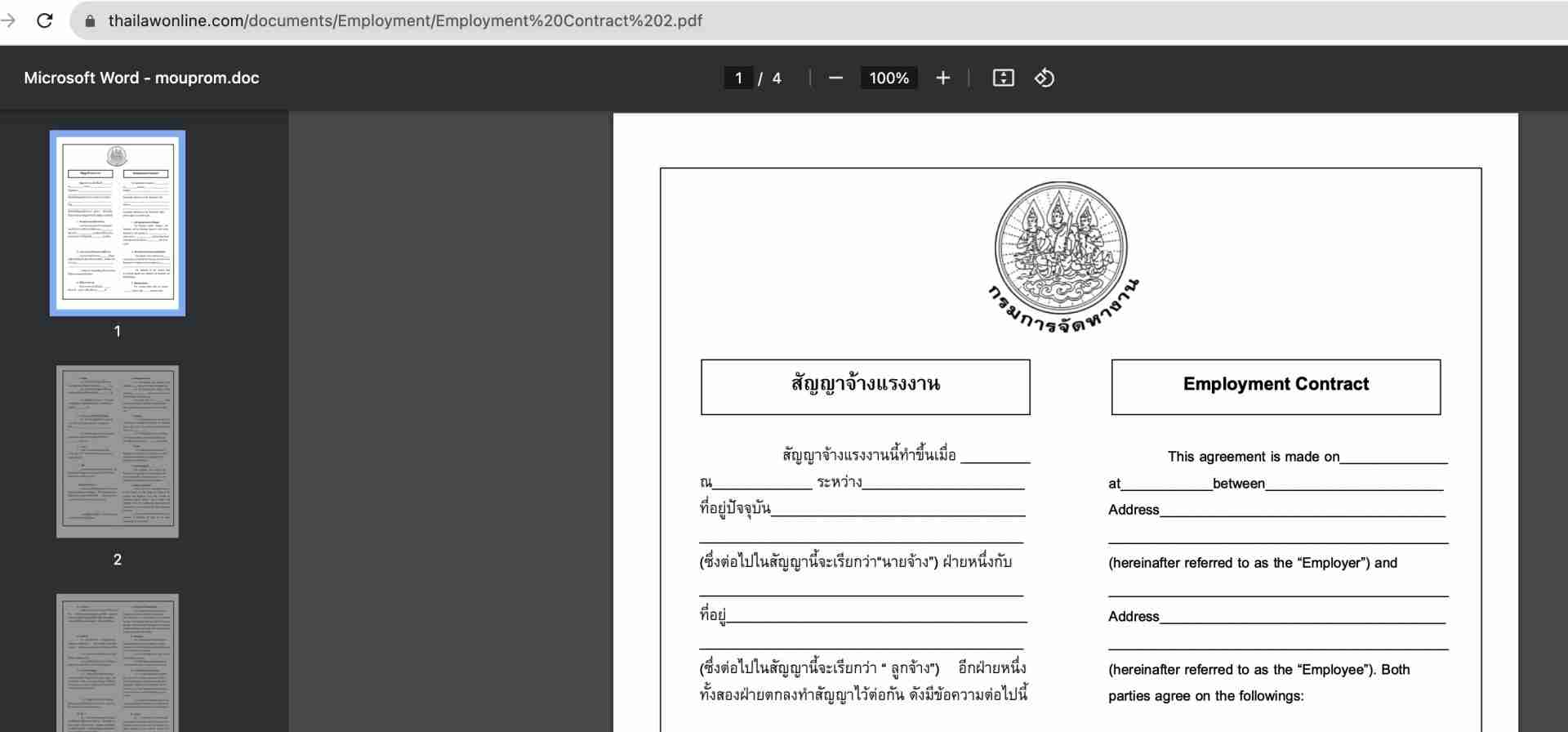
- Rejoignez Silver · สมัคร SilverAcheter le Pack Emploi ฿1,290 · ซื้อครั้งเดียว1 290 ฿ unique · ครั้งเดียวCes modèles sont téléchargeables gratuitement pour les membres Silver et au-delà · ดาวน์โหลดฟรีสำหรับสมาชิก Silver ขึ้นไปLe Pack Emploi est le pack complet comprenant trois documents : contrat de travail, lettre de mise en garde et lettre de licenciement, en thaï et en anglais. Téléchargement instantané après paiement (Word + PDF prêt à imprimer). Paiement par PayPal ou carte via PayPal, ou par virement bancaire thaïlandais. · ดาวน์โหลดทันทีหลังชำระเงิน(Word · 4 pages), Contrat bilingue court pour un emploi simple. Couramment utilisé par les petites entreprises et pour embaucher formellement un conjoint au sein d'une entreprise.
- (Word · 3 pages), Accord bilingue concis adapté aux arrangements de travail à temps partiel ou domestique.
- (Word · 3 pages), mis en forme pour répondre aux exigences du Département de l'Emploi thaïlandais pour les demandes de permis de travail . Format bilingue thaï/anglais, accepté par les agents de l'immigration.
Contrats de travail complexes pour la Thaïlande
- (Word · 9 pages), Contrat bilingue complet comprenant des clauses de non-concurrence, de non-sollicitation, de confidentialité et de propriété intellectuelle. Idéal pour les cadres supérieurs, les managers ou les postes impliquant des informations commerciales sensibles.
Dernière révision : 25 septembre 2026, dans deux dispositions (le 17 et le 25 septembre). Loi sur la protection du travail B.E. 2541, articles 5, 17, 17/1, 23, 61, 63, 118, 119, 123, 130 et 131, Loi sur les tribunaux du travail B.E. 2522, article 38, Loi sur les relations du travail B.E. 2518, article 13, Loi sur les conditions contractuelles abusives B.E. 2540, article 5 et Article 46 du Code de procédure civile Chacun d’entre eux a été lu dans la version thaïlandaise. Les descriptions des modèles et la pratique des documents du Département de l’emploi n’ont pas été examinés en regard d’un instrument. Re-luis le 5 octobre 2026 en regard de cette date : aucune déclaration ne contredit les sections énumérées, la date de début du Fonds de protection des salariés (alors le 1er octobre 2026, depuis déplacée au 1er janvier 2027) et le taux de 0,25 % sont conformes au guide juridique du site, aucune modification n’a été apportée. Encore non vérifiée : les descriptions des modèles et la pratique des documents du Département de l’emploi.
Questions fréquentes concernant les contrats de travail en Thaïlande
Un contrat de travail écrit est-il obligatoire en Thaïlande ?
Le droit thaïlandais n'exige pas que les contrats de travail soient écrits, mais la loi sur la protection du travail BE 2541 (1998) impose certaines conditions minimales. Un contrat écrit est fortement recommandé, il fournit des preuves claires des termes convenus et protège à la fois l'employeur et l'employé en cas de litige devant le tribunal du travail.
Un contrat de travail thaïlandais doit-il être rédigé en thaï ?
Il n'existe aucune obligation légale que le contrat soit rédigé en thaï, mais tout accord soumis dans le cadre d'une demande de permis de travail est traité par des fonctionnaires thaïlandais ; préparez donc une version en thaï. Les procédures judiciaires se déroulent en thaï, et le tribunal ordonne à la partie qui se fonde sur un document rédigé dans une autre langue de déposer une traduction certifiée en thaï (article 46 du Code de procédure civile) ; un contrat bilingue ou en thaï est donc vivement recommandé. Tous les modèles téléchargeables ci-dessus sont bilingues thaï/anglais.
Quel est le délai de préavis requis par le droit du travail thaïlandais ?
En vertu de l'article 17 de la loi sur la protection du travail, l'une ou l'autre des parties à un contrat à durée indéterminée, y compris un contrat de période d'essai, peut y mettre fin en donnant avis écrit au moment ou avant une date de paie, prenant effet à la date de paie suivante. Il n'est jamais exigé plus de trois mois de préavis. Avec un salaire mensuel représentant au moins une période de paie complète, le préavis donné juste après un jour de paie court sur près de deux mois. L'employeur, mais non le salarié, peut à la place verser les salaires dus jusqu'à cette date et mettre fin au contrat immédiatement (article 17/1). Aucun préavis n'est requis en cas de licenciement pour l'un des motifs graves visés à l'article 119. Un contrat à durée déterminée prend fin à sa date d'échéance sans préavis, mais une indemnité de départ reste due à son expiration, sauf s'il s'agit d'un contrat écrit pour un projet spécifique, un travail occasionnel ou saisonnier d'une durée maximale de deux ans (article 118).
Puis-je inclure une clause de non-concurrence dans un contrat de travail thaïlandais ?
Oui. Les clauses de non-concurrence peuvent être appliquées en Thaïlande si elles sont raisonnables quant à leur portée, leur durée et leur zone géographique. En vertu de l’article 5 de la loi sur les clauses contractuelles abusives de l’année 2540, une restriction à l’exercice d’une activité qui impose à l’employé une charge plus lourde que ce qui pourrait normalement être attendu ne peut être appliquée que dans la mesure où cela est équitable et raisonnable. Le tribunal prend en considération la durée et la portée de la clause, la capacité de l’employé à travailler autrement ou pour un autre, ainsi que les intérêts légitimes des deux parties, de sorte qu’une clause qui empêcherait l’employé de travailler pourrait être supprimée ou non appliquée. Le modèle d’accord de travail complexe ci-dessus comprend une clause de non-concurrence standard élaborée pour résister à l’examen par les tribunaux thaïlandais.
Quels documents sont requis pour obtenir un permis de travail thaïlandais ?
Une demande de permis de travail nécessite, entre autres documents, un contrat de travail signé spécifiant le poste, le salaire et la durée de l'emploi. Le contrat doit être conclu entre l'employeur en Thaïlande et le ressortissant étranger. Notre modèle est mis en forme pour répondre exactement à ces exigences.
Quel est le montant de l'indemnité de licenciement prévue par la loi thaïlandaise ?
L’indemnité de départ prévue par la loi sur la protection du travail dépend de la durée du service : 30 jours (120 jours à moins d'un an) · 90 jours (1-3 ans) · 180 jours (3 à 6 ans) · 240 jours (6-10 ans) · 300 jours (10 à 20 ans) · 400 jours (20+ ans). L'indemnité de départ n'est pas payable lorsqu'un employé est licencié pour motif valable en vertu de l'article 119 de la loi sur la protection du travail. Une clause contractuelle renonçant à l'indemnité de départ est nulle ; seule une quittance signée après la fin de l'emploi peut régler la question, comme l'explique notre guide sur renonciations aux indemnités de licenciement en Thaïlande.
Ressources supplémentaires
- Droit du travail thaïlandais, guide complet pour les employeurs
- Permis de travail en Thaïlande, Guide complet (2026)
- Salaire minimum en Thaïlande (2025-2026)
- Être son propre parrain pour un permis de travail en Thaïlande
Besoin d'un contrat de travail personnalisé rédigé par un avocat thaïlandais agréé? Prendre rendez-vous pour une consultation avec notre équipe juridique bilingue, disponible en anglais, en thaï et en français.
Essayez d'abord par vous-même, gratuitement
Vous n'avez rien à réserver pour commencer. Ces outils fonctionnent dans votre navigateur, et vous ne nous payez que si vous décidez de faire appel à un avocat.
Générateur de documents juridiques Membres Gold
Dix documents bilingues à partir d'un questionnaire guidé, dans la rédaction propre au cabinet.
Ouvrir l'outilInterroger notre assistant IA Gratuit
Entraîné sur le droit thaïlandais et plus de 77 000 arrêts de la Cour suprême. Posez vos questions, gratuitement.
Actualités juridiques thaïlandaises, gratuites par courriel
Des mises à jour en anglais simple sur les changements législatifs thaïlandais concernant les étrangers : propriété, visas, mariage, affaires et testaments. Un court courriel par mois, envoyé par un cabinet d’avocats établi depuis 2006. Zéro spam, désabonnement possible à tout moment.