


Évalué par Wichuda Atthamethakon, LL.M., titulaire de la licence de l’Ordre des avocats thaïlandais 3149/2556, pour ThaiLawOnline, un cabinet d’avocats thaïlandais œuvrant pour des étrangers depuis 2006.
Dernière mise à jour :
You’re walking back from the 7-Eleven. A dog shoots out of an open gate and sinks its teeth into your calf. The owner shrugs. Or worse, nobody claims the dog at all.
A dog bite in Thailand is more than a medical problem. It’s also a legal one, and Thai law is more on your side than most expats think. The Civil and Commercial Code puts the burden on the owner, not on you.
This guide explains who is liable, what you can claim, when the police can act, and what to do in the first 48 hours. We’ve acted for foreigners in Thailand since 2006. We’ll also tell you which steps actually move an owner to pay.
First things first: what to do right after a dog bite
Health comes before law. Rabies is still present in Thailand, and it is almost always fatal once symptoms start. So go to a hospital or clinic the same day.
- Wash the wound with soap and running water for several minutes. Then get to a doctor.
- Ask about rabies and tetanus shots. Doctors usually start the rabies course at once and ask you to watch the dog for 10 days. Tell them whether the dog is known and vaccinated.
- Identify the dog and its owner. Photograph the dog, the gate, the house number and the owner. Get a phone number or LINE ID.
- Find witnesses. Neighbours, a security guard, a motorbike taxi driver. Write down names and numbers.
- Keep every receipt. Hospital bills, medicine, taxis, the medical certificate. These are your damages.
- Signalez-le. Go to the local police station and ask for the incident to be recorded. A police record helps even if you never press charges.
Ask the hospital for a medical certificate that states the injury and the days of rest. You’ll need it for the police, the insurer and any claim.
What Thai law says about dog bites
Thailand has no single “dog bite law”. Three sets of rules work together. One is civil, one is criminal, and one is about public health.
Section 433: the owner pays unless they prove proper care
Section 433 of the Civil and Commercial Code is the key rule. When an animal causes damage, its owner must compensate the injured person. So must a person who keeps or looks after the animal for the owner.
Here’s the part that matters. You don’t have to prove the owner was careless. The owner escapes only by proving one of two things. Either they took proper care for that kind of animal and its nature. Or the damage would have happened anyway, despite that care.
Lawyers trained in the common law will recognise this. It’s close to a reversed burden of proof, and much stronger for victims than the old “one free bite” idea. An open gate or a dog off its leash in a soi rarely counts as proper care.
Section 420: the general rule for wrongful acts
Article 420 is the general tort rule. Anyone who wilfully or negligently injures another person’s body or health must pay compensation. It matters when someone other than the owner caused the attack, for example a person who set the dog on you.
The criminal side: Sections 377, 390 and 300 of the Penal Code
Section 377 of the Penal Code punishes a person in charge of a fierce or dangerous animal who lets it go about alone in a way that may harm people. The penalty is up to one month in prison, a fine of up to 10,000 baht, or both.
If you were hurt, negligence offences may also apply. Negligently causing bodily harm carries up to one month or 10,000 baht (Article 390). Grievous harm is much more serious. Negligently causing it carries up to three years or 60,000 baht (Article 300).
“Grievous” is wider than it sounds. Under Article 297, it includes permanent facial disfigurement. It also includes an injury that stops you working for more than 20 days. A bad bite to the face or hand can qualify.
Rabies and local rules
The Rabies Act B.E. 2535 requires owners to vaccinate their dogs. An owner who sees rabies symptoms must report them to an official within 24 hours. If the owner can’t show a vaccination record, tell your doctor and the police.
Bangkok has its own ordinance on keeping and releasing animals. It requires registration and microchips and restricts certain breeds in public. Its start date was pushed back to 10 January 2027. Other cities and provinces have local rules made under the Public Health Act. Breaking these rules doesn’t decide your claim. But it’s strong evidence that the owner didn’t take proper care.
Who is liable for a dog bite in Thailand?
Everything starts with one question: who owned or kept the dog? The answer decides who you claim from.
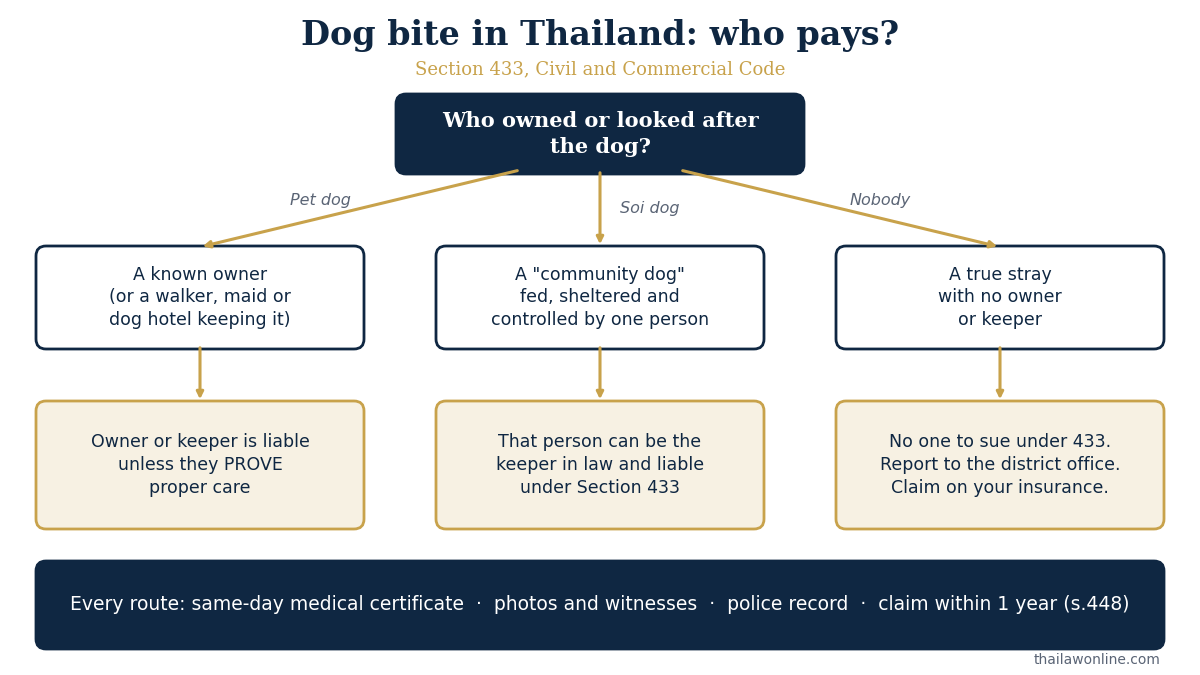
A pet dog with a known owner
This is the easy case. The owner is liable under Section 433 unless they prove proper care. A dog walker, a housekeeper or a dog hotel looking after the dog can be liable too, as the keeper.
A “community dog” fed by the neighbourhood
Many Thai sois have dogs that nobody officially owns. Someone feeds them every day. The dog sleeps outside that person’s shop. In our experience, that person often turns out to be the keeper in law. Thai courts look at the facts, not at paperwork. Regular feeding, shelter and control point to a keeper.
A tourist who once tossed a dog some rice is not a keeper. Don’t waste time chasing occasional feeders.
A true stray
If no owner or keeper exists, Section 433 has nobody to bite back. You can still report the dog to the district office or municipality, which has powers to control animals. Suing a local authority is a separate administrative route, and it’s hard. Your own travel or health insurance is often the practical answer here.
A dog in a condo or housing estate
The owner is still the first target. But the building rules matter. Many condos ban dogs or require leashes in common areas. A juristic person that ignores repeated complaints about a known aggressive dog may face a claim of its own under Section 420. Complain in writing and keep a copy.
What compensation can you claim?
The court decides the amount based on the circumstances and how serious the wrong was (Article 438). For bodily injury, the Code lists what you can recover.
| Head of claim | Base juridique | Evidence you need |
|---|---|---|
| Medical costs: hospital, rabies and tetanus shots, follow-up visits | CCC s.444 | Receipts, medical certificate |
| Lost earnings, now and in the future | CCC s.444 | Payslips, contracts, doctor’s rest days |
| Pain, suffering and scarring (non-money loss) | CCC s.446 | Photos of the injury over time, medical notes |
| Damaged property: clothes, phone, glasses | CCC s.438 | Photos, purchase receipts |
| Travel to treatment | CCC s.444 | Taxi or Grab receipts |
| Funeral costs and loss of support (fatal attacks) | l’article 443 du Code civil et commercial | Funeral bills, proof of dependency |
If the full effect of the injury isn’t clear at trial, the court can reserve the right to revise its judgment for up to two years (Article 444).
Be realistic about pain and suffering. Thai courts award it, but the sums are modest by Western standards. Medical bills and proven lost income usually make up most of a successful claim.
Did you provoke the dog?
The owner will often say you did. If your own fault contributed, the court can reduce your compensation (Article 223). Teasing the dog, climbing a fence or ignoring a clear warning sign can all count. A witness who saw you simply walking past is worth a lot.
If someone else provoked the dog, the owner still pays you first. The owner can then recover from the provoker under Section 433.
How to get paid: from a demand letter to court
Step 1: ask the owner directly, in writing
Most dog bite cases in Thailand settle. Send the owner a short message with your medical bills attached. Ask for a specific amount by a specific date. Keep it polite. Many owners pay once they see real receipts.
Step 2: the police station
Go to the station that covers the place of the bite. Ask the inquiry officer to record the incident and, if you want, to take a criminal complaint. Police often call both sides in to settle. Bring a Thai speaker if you can.
A settlement at the station should be in writing and signed. Say clearly what it covers. Don’t sign a full release before you know your total medical costs. Our guide to a audition par la police en Thaïlande explique à quoi s'attendre.
Step 3: a lawyer’s demand letter
If the owner stalls, a formal letter from a Thai lawyer often ends it. It sets out Section 433, your losses and a deadline. It also shows you’re ready to go to court.
Step 4: a civil claim, or a claim inside the criminal case
You can sue in the civil court. Small money claims run under a simpler small claims procedure (Civil Procedure Code, Section 189). If the public prosecutor brings a criminal case, you can also ask that court to order compensation (Criminal Procedure Code, Section 44/1). That saves you a second case.
Foreigners can sue in Thai courts on the same terms as Thais. You don’t need a visa of any particular type. Read more about Les étrangers dans les tribunaux thaïlandais.
The deadline: one year, sometimes longer
A civil claim for a wrongful act expires one year after you knew of the injury and who must pay. There’s an outer limit of ten years (Article 448). If the facts are also a crime with a longer criminal limitation period, that longer period applies.
That last rule helps victims of serious bites. Negligent grievous harm carries up to three years in prison. Its criminal limitation period is ten years under Section 95 of the Penal Code. But don’t rely on it. Start within the year.
Common mistakes after a dog bite in Thailand
Skipping the hospital
No medical record, no claim. And the rabies risk is real. Get treated the same day, even for a small wound.
Letting the owner walk away unidentified
Without a name, a phone number or an address, Section 433 is useless. Photograph the house and the dog before you leave.
Hitting back at the dog
Defending yourself during an attack is one thing. Harming the dog afterwards is another. It can expose you to a complaint under the animal welfare law and weaken your position.
Signing a release too early
A quick 2,000 baht at the police station feels like a win. It isn’t, if the rabies course and follow-up cost five times that. Settle once you know the full bill.
Questions fréquentes
Who pays for a dog bite in Thailand?
The dog’s owner, or the person keeping it, under Section 433 of the Civil and Commercial Code. They avoid liability only by proving they took proper care.
Can I report a dog bite to the Thai police?
Yes. Report it at the station covering the place of the bite. Letting a dangerous dog roam is an offence under Section 377 of the Penal Code, and injury can bring negligence charges.
Who is liable if a stray dog bites me in Thailand?
A person who regularly feeds, shelters and controls a “community dog” can be its keeper in law. With a true stray, there is often nobody to sue, so check your insurance.
Can a foreigner sue a dog owner in Thailand?
Yes. Foreigners have the same right to sue in Thai courts as Thai citizens. Many claims settle after a demand letter.
How long do I have to claim for a dog bite in Thailand?
One year from when you knew of the injury and the owner. Serious injuries can carry a longer period, but don’t wait.
Does my claim cover rabies shots?
Yes. Medical expenses, including the rabies and tetanus course, are recoverable under Section 444. Keep every receipt.
Comment ThaiLawOnline peut vous aider
We help foreigners recover their losses after injuries in Thailand. We write Thai-language demand letters to owners, keepers and juristic persons. We can attend the police station with you. And when an owner refuses to pay, we take the claim to court.
If your injury came from a road crash rather than a dog, see our legal guide after an accident in Thailand. Trouble with a neighbour’s dog that barks all night? Read noisy neighbors in Thailand.
Vous n’avez pas besoin d’être en Thaïlande pour commencer. Prendre rendez-vous pour une consultation and send us your medical certificate and receipts. We’ll tell you what the claim is worth and the fastest route to payment.
Points clés à retenir
- Section 433 makes the owner or keeper liable for a dog bite unless they prove proper care.
- Get medical treatment the same day. The medical certificate is the backbone of any claim.
- Letting a dangerous dog roam is a crime under Section 377. Serious injuries can bring negligence charges carrying up to three years.
- You can claim medical costs, lost income, pain and suffering, and damaged property.
- File within one year. Don’t sign a release until you know your total costs.
Cet article présente des informations générales concernant le droit thaïlandais. Il ne constitue pas un avis juridique concernant votre situation.
Actualités juridiques thaïlandaises, gratuites par courriel
Des mises à jour en anglais simple sur les changements législatifs thaïlandais concernant les étrangers : propriété, visas, mariage, affaires et testaments. Un court courriel par mois, envoyé par un cabinet d’avocats établi depuis 2006. Zéro spam, désabonnement possible à tout moment.