


Révisé par ThaiLawOnline, un cabinet d'avocats thaïlandais agréé exerçant en Thaïlande depuis 2006. Avocate thaïlandaise en charge du dossier : Wichuda Atthamethakon, LL.M., licence du barreau thaïlandais 3149/2556.
Dernière mise à jour :
In the past, a man could marry a woman by sneaking into her room at night and announcing it in the morning. In Thailand, there are two types of marriages: civil and traditional/pseudo-religious. A Buddhist marriage in Thailand is not a legal marriage. Dowries are given to the women’s families, not the men’s. The wedding party usually starts early in the morning so guests can rest in the afternoon.
Les mariages thaïlandais sont empreints de traditions, de joie et parfois de confusion. Cet article s'intéresse aux mariages bouddhistes en Thaïlande. Ces unions ne sont pas reconnues légalement. Cependant, de nombreux couples sont également mariés civilement.
A ceremony and a legal marriage are two separate things in Thailand, which we explain in our guide to droit de la famille en Thaïlande.
Last reviewed: 8 September 2026. This page was telling readers that a same-sex couple could not yet marry in Thailand and that this would change during 2025. Same-sex couples have been able to marry here since 23 January 2025, and that passage has been corrected. The legal statements on this page were read against the Thai text in our own annotated Civil and Commercial Code: sections 1435 and 1437 on betrothal, khong man and sin sod, 1448 and 1458 on who may marry and on consent, 1457 on registration being what creates a marriage, and 1466 on prenuptial agreements. What this review did NOT check, said rather than implied: none of the money amounts on this page comes from a source we hold, including the photography, gift and dowry figures, and the gold weight in the engagement section was corrected as arithmetic only, because how much gold the custom calls for is not something we can verify. The ceremony, procession and reception sections are cultural description rather than law and were not part of this review.
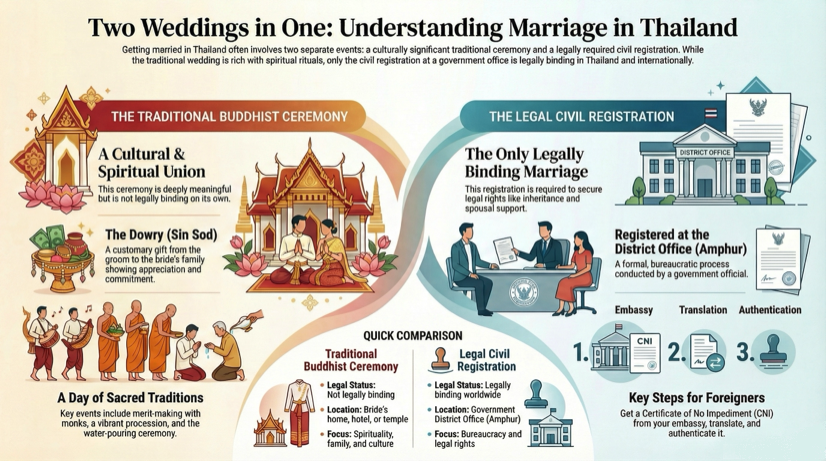
Table des matières
Aspects techniques du mariage bouddhiste en Thaïlande
1. Engagements
As marriage leads to babies, so does marriage spring forth from engagements, which are also a part of Thai tradition. In Thailand, couples do not use engagement or promise rings like in the West. Instead, they have a thong mun ceremony. During this ceremony, the groom promises to marry his sweetheart. He does this by offering gold, usually weighing 2 baht, which is about 30.4 grams: one baht of gold weighs about 15.2 grams.
A Buddhist marriage in Thailand is very important. It often shows the couple’s commitment to cultural traditions and family values. Each part of the ceremony honors the families of both the bride and groom. It shows how important community is in a Buddhist marriage in Thailand.
In many cases, a Buddhist marriage in Thailand includes rituals. These rituals show the couple’s love for each other, their families, and the community. This deep-rooted respect for tradition is what makes a Buddhist marriage in Thailand unique and meaningful.
In practice, the parents of the bride and groom would meet before the ceremony. They would discuss the couple’;s suitability and start planning the dowry and wedding. Nowadays, this formal engagement is often skipped. Couples may simply ask for their parents’ blessings. Contrats prénuptiaux Ces formalités ne sont pas nécessaires s'il s'agit d'un mariage bouddhiste, car il ne s'agit pas d'un mariage légal.
Divorce rates are rising in Asia. More money is also flowing into Thai households. Many couples now choose contrats de mariage. These prenups are binding under Thai law. They can outline rights and ownership in case of divorce. It’s just like lawyers to spoil the romance! Prenups are still rare among most people. However, they are becoming a new tradition for Thai-foreigner couples. This change is likely due to worries about differences in money and language barriers. A Buddhist marriage is not a legal marriage in Thailand. Prenuptial agreements are only for the legal registration, which is the legal marriage.
Mariage bouddhiste traditionnel en Thaïlande vs mariage civil
In Thailand, there are two types of marriage. Only one type is legally binding. The other type is enforced by social norms. The state requires couples to register their marriage to have it recognized by Thai courts. This is very important for finances and child garde à vue. You can register easily by bringing the right paperwork to the local district office. This is called Amphoe or Khet in Bangkok. An officer will help you create a certificat de mariage. These civil marriages are respected around the world. They may be enough for the local community to recognize the couple’s union.
In every part of the world, marriage is a traditional act. It gives couples social status and acceptance in their community. This status aligns with the values of that community. In Thailand, it is common to have a traditional wedding ceremony along with a civil marriage. Sometimes, people have the traditional ceremony instead of the legal one.
Mariage entre personnes de même sexe
Same-sex marriage is widely accepted in Thailand, and since 23 January 2025 it has also been lawful. The Civil and Commercial Code Amendment Act (No. 24) B.E. 2567 replaced the Code’s references to a man and a woman with two persons, so section 1458 now reads that a marriage may be made when two persons consent to be spouses of each other, and any couple may register at a district office on the same terms as any other. Traditional ceremonies for these unions are common, and, exactly as for an opposite-sex couple, the ceremony is not the marriage: only the registration is. Another quirk is that monks cannot marry. However, many events in a many’s life may lead him to become a monk for a short time. These events include the death of a parent, atonement for sins, or fulfilling promises to spirits. Here’s an article that goes deeper into Le mariage homosexuel en Thaïlande.
In these cases, a man’s marriage is seen as ended when he becomes ordained. Many Thai couples choose to re-marry in a small ceremony after the man returns to lay life. This does not affect the legal standing of the marriage, however. Confusing!
Le reste de cet article traitera du mariage traditionnel thaïlandais : nous laisserons les unions civiles aux bureaucrates !
Comprendre les nuances entre un mariage civil et un mariage bouddhiste en Thaïlande peut aider les couples à faire un choix éclairé. Si le mariage civil est juridiquement contraignant, le mariage bouddhiste en Thaïlande revêt une dimension spirituelle et culturelle plus importante.
À l'avance
Preparations for weddings in Thailand are in some ways similar to those in the rest of the globe. Who to invite, what food to prepare, times, locations, and the other standard questions unite couples worldwide. However, Thais have some unique differences. The most obvious is a trip to a fortune teller, or maw doo. They go to find the best (lucky) date for the ceremony. Generally couples will decide to marry and then ask for dates within a few months, so that things get over and done with quickly.
Another oddity is wedding photography, with studios currently cropping up like weeds across the country. Wedding pictures are not new. However, many couples now pose in their full wedding outfits for portraits before the big day. These pictures are often shown on invitations and at the wedding hall. They are like movie posters that advertise upcoming films. Portraits usually cost between $3,000 and $5,000. So, it might be a good idea to buy a nice camera and some online Photoshop tutorials!
2. Le dot en Thaïlande (Il ne s'agit pas d'une obligation légale, mais d'une coutume.)
La dot, qui représente sans doute la part la plus importante des préparatifs, n'est jamais prise à la légère, du moins pour le marié. Dans un mariage bouddhiste en Thaïlande, ce sont les parents des époux qui fixent le montant de la dot. Ce montant témoigne de la valeur de la femme et de l'engagement de l'homme envers le mariage bouddhiste.
Many families see the dowry as an important part of a successful Buddhist marriage in Thailand. It helps strengthen the bonds between the families. No Thai law requires a dowry and no court will order anyone to pay one, but the Civil and Commercial Code does regulate what becomes of it: section 1437 defines sin sod as property given to the parents, adoptive parent or guardian of the betrothed person in return for that person agreeing to marry, and it can be reclaimed only where the marriage does not take place for an important cause attributable to that person, or because of circumstances that side is responsible for. Our page on le Sin Sod en Thaïlande sets out when it can and cannot be recovered.
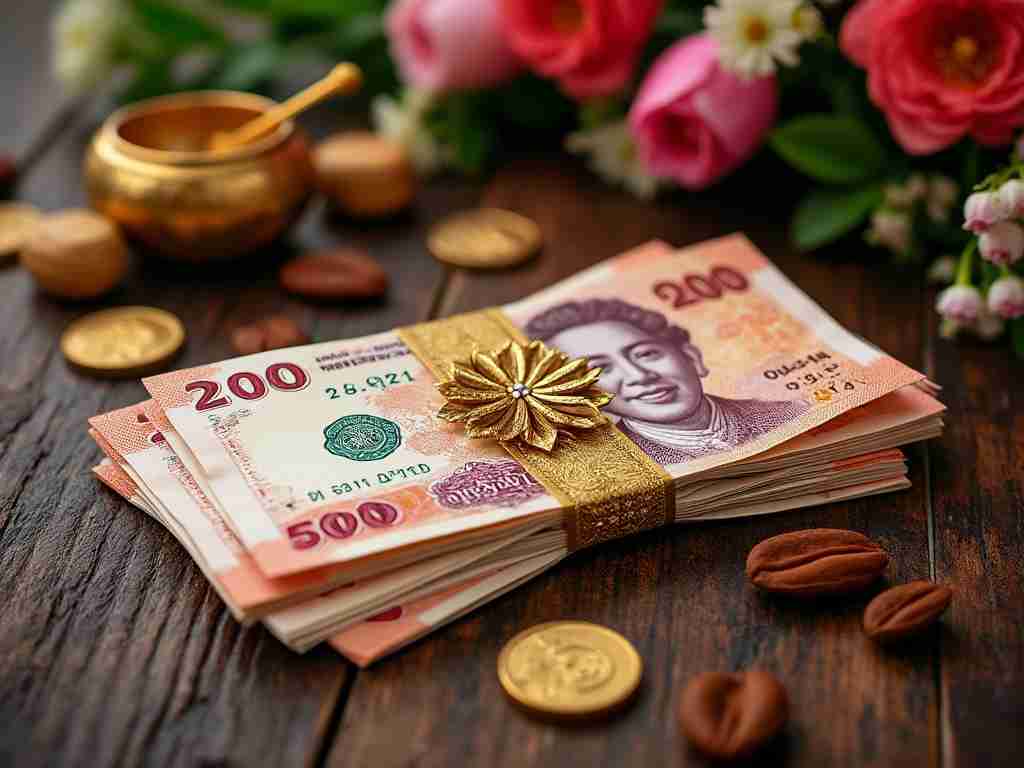
N'ayez crainte, il ne s'agit pas de vrai argent. Soyez assurés qu'il sera bien réel lors de votre mariage bouddhiste en Thaïlande !
The reason for this tradition is that the dowry shows appreciation to the bride’s family for raising her. This likely comes from a time when working sons were seen as their parents’ retirement plans. Daughters had few other ways to thank and support their parents. In modern times, it’s becoming very common for the bride’s family to keep a piece of gold jewellery. They will often return the rest of the dowry to the young couple to help them start off their married life.
Finally, costume, one of the highlights of the Thai wedding. Thai bridal dresses usually range from white to gold and are beautifully flattering 1-shoulder dresses down to the ankle. The groom usually wears a lightly embroidered Thai-style jacket and trousers that match the bride’s color. The best part is that they often rent the outfits together from the same shop! The practical Thais know you won’t wear the costume again. This is true even if you marry again. They have thrown out the “dress in a box in the attic” sadness!
Le mariage bouddhiste traditionnel standard en Thaïlande
Les mariages thaïlandais traditionnels suivent généralement un schéma précis. Cependant, chaque village possède ses propres coutumes. Vous ne risquez donc pas de vous ennuyer lors de vos premières cérémonies !
3. Levez-vous tôt pour nourrir les moines
Bride and groom to be will make merit by feeding a lavish meal to monks on the morning of their wedding day. The bride usually wakes up early to get her hair and makeup done. The groom, on the other hand, often gets out of bed feeling a bit hung-over. He quickly puts on his suit. Then, he takes on the main job of feeding the monks. This is because women cannot touch monks or hand things to them directly.
Male relatives also help with setting out the meal. Monks are invited in odd numbers, usually between 3 and 9. Before they eat, the monks pray and chant with a male village elder. They then offer blessings to the couple.
Les moines offrent également des symboles de beauté. Ils dessinent des motifs sur le front des époux avec une pâte blanche. Ils leur mettent des guirlandes de fleurs autour du cou. Ils posent sur leur tête des couronnes de fil de coton blanc.
Following the blessings, the monks eat their meal in silence, bringing merit to the couple for their donation. Monks also receive money in envelopes (as they’re not supposed to touch money directly) as thanks for their role.
Voici le marié lors d'un mariage bouddhiste en Thaïlande
Traditionally, Thai weddings take place at the bride’s family home. Whether she still lives with her parents or not, this shows her family and where she comes from. The groom’s family comes to take her away to a new life. Today, many Thais, especially in cities, are choosing to have their weddings at hotels. They like the good prices, convenience, and organization. In the case of the hotel, the hall is first for the bride’s family. The groom’s family has to enter later.
And parade in they do! The kabun mak, or betel nut procession, is a fun part of the wedding. The groom is danced to the bride’s location. His friends and family sometimes carry him on their shoulders or even on an elephant’s back! The procession includes drummers and wailers (Oh-e-oh-e-oh-e-oh-e-ohhhhhhhhhh! Whew!), and possibly a whole band.
Family and friends bring cadeaux of fruit, candy, liquor, and always banana trees and sugar cane cuttings. These will be planted at the couple’s new home. In the past, fancy betel nut processing sets were the centerpiece gifts, giving the procession its common name. Be careful, the procession can take a while if people are enjoying themselves. Thais often call this party train “walking forward 2 steps and back 3”!
When the groom arrives at the bride’s family home, he will meet her family. They will hold thin chains to block his way. He will pay them to let him pass. He usually has envelopes of money, often 100 baht, in his jacket. Depending on local traditions there may be a lot of bribing to do for the determined groom.
Inside the bride’s room
Une fois à l'intérieur de la maison de la mariée, les cadeaux sont disposés devant sa famille. Tout le monde se réunit et les festivités commencent. La cérémonie proprement dite
We call it confusion because no two weddings are ever the same. The only person who knows what to do is the male elder. He is invited to run the show. The bride and groom also each have a family member to be their helpers. They are told to hurry this way and that. They help the couple with many Buddhist prayers. They also do spirit-pleasing rituals. They bow and scrape to parents and grandparents. There are many more confusing activities. This part usually has the couple kneeling for up to 30 minutes. They kneel in front of parents and elders. The parents and elders may sit on the floor or in chairs.
Mais la partie que tout le monde observe attentivement, c'est la présentation de la dot., péché sot, which the groom pays to the bride’s family. This is laid out nicely with a fan of stacks of cash and velvety bags of gold jewellery. The bride’s mother makes big show of accepting the dowry and then carrying it away hunching under such a heavy burden.
Des bénédictions sont données, des marques de respect sont exprimées, et à un moment donné, le couple se marie, bien que personne ne semble savoir exactement quand.
4. Dans la chambre !
If the wedding is at the bride’s home, a special bridal chamber is set up and decorated. Near the end of the ceremony, the couple is guided to the bed. There, they receive advice from older women. On how spouses should behave in the union. Nothing too racy though!
The couple lies down and closes their eyes. The man goes first, while the woman stays up to care for the home. Money is hidden in the bed, including coins and a 1000-baht bill. When told to open their eyes, the couple rushes to grab the money. The partner who finds the biggest bill is likely to control the finances in the future.
La cérémonie de mariage se termine par la remise des cadeaux et les remerciements aux invités. Des remerciements particuliers sont adressés aux aînés pour leur présence à la célébration.
5. La fête
A typical Thai reception begins in the early morning. It continues through the ceremony and into the afternoon. Recently, a separate evening reception has become more common. However, it is still usual for guests to arrive around 8 AM. They often sit at tables under the house and in the yard. Then, they start drinking whisky and beer.
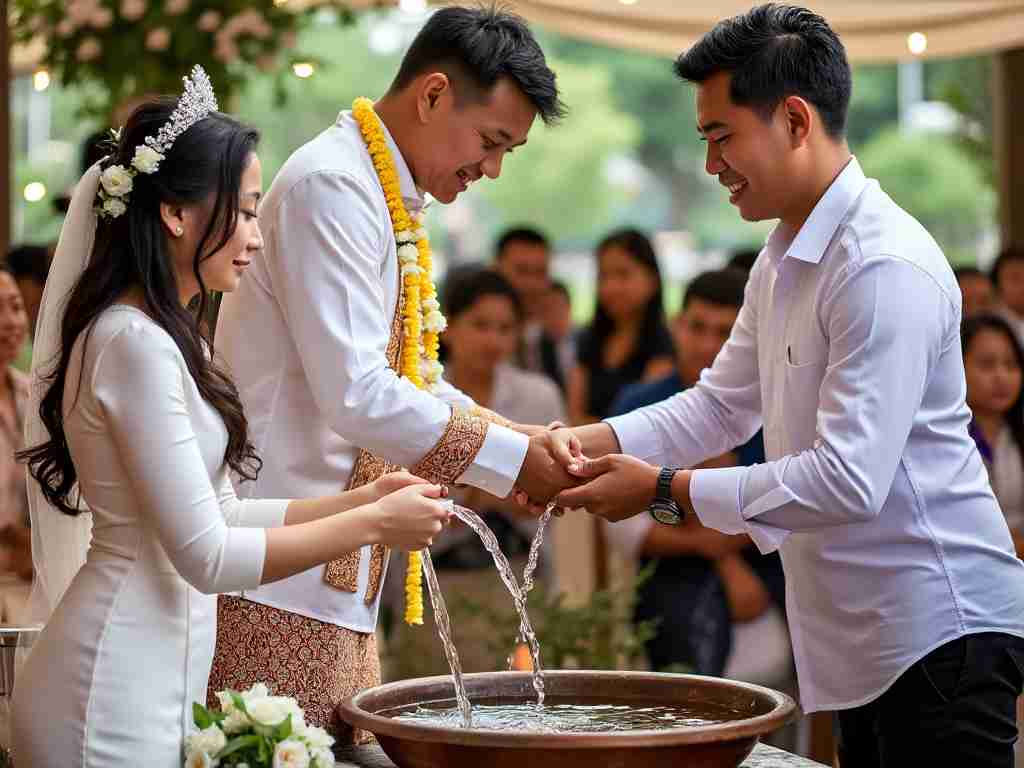
To connect these guests to the ceremony, which family and close friends usually attend, we do several extra activities. Speeches are often given to everyone after the ceremony. Guests can tie lucky cotton strings around the couple’s wrists. They can also pour water over their hands while they wai and offer blessings. During this time, the couple’s cotton string crowns are tied together to show their bond. Afterward, the couple will visit each table to greet guests and take photos together.
Un festin et un karaoké en abondance sont les éléments caractéristiques d'une soirée réussie, et les invités ont tendance à rentrer chez eux en milieu d'après-midi.
Le reste de la journée est consacré au rangement. Cependant, les jeunes mariés peuvent s'éclipser pour profiter d'un moment à deux et se détendre.
As a Guest, Your Presence and Appearance
Le meilleur moyen de découvrir les mariages thaïlandais est d'y assister. Si vous n'avez pas de mariage prévu prochainement, envisagez d'accepter les nombreuses invitations que vous recevrez sans doute. C'est particulièrement vrai pendant la saison sèche, d'octobre à mai.
In fact it’s poor form to turn down an invitation unless you really have a good excuse, like out of town business. This doesn’t mean that you have to go for very long however. Even if you pop in and show your face, this counts as having attended. You can stay longer if you want. You can join the guests who are partying, eating, and drinking. You don’t have to watch the ceremonial parts if you don’t want to.
As a guest, you’re expected not to outshine the bride and groom, and what you wear is determined by where the wedding is. Hotels usually mean you have to dress up a bit, while at a home wedding you can get away with jeans and a clean shirt. Older guests still wear their finest, usually Thai silk shirts for men and dress suits for women, plus gold jewellery.
Les cadeaux et le déroulement d'un mariage bouddhiste en Thaïlande
It’s common to give a gift at weddings around the world. In Thailand, many guests now choose to sai song. This means they put money in an envelope for the new couple. In small towns neighbours will toss in 20-100THB while more ‘high-so’ guests, especially at hotel weddings, will give 500-1000THB. This is a common practice. Most weddings have a large, heart-shaped paper box for envelopes. The presents table is often empty.
If being entertained, wined, and dined isn’t enough for you, guests receive a small thank you gift when they leave. These are normally small and useless collectables to be kept in a showcase memorial to all those good times.
Voilà donc un aperçu du mariage thaïlandais ! À moins d'être un ex blessé, les mariages sont des événements joyeux, empreints de bonheur et de gaieté. Lors d'un mariage bouddhiste en Thaïlande, une petite cérémonie est organisée. Cette cérémonie rappelle à tous l'importance de cette nouvelle union. Souhaitez à vos amis une vie heureuse et épanouie ensemble. Vous pouvez aussi envisager le mariage vous-même. Assurez-vous simplement de bien comprendre ce que cela implique !
Si vous souhaitez vous marier en Thaïlande, ThailawOnline.com peut vous aider. Ils proposent des tarifs raisonnables et vous expliquent l'ensemble de la procédure.
- Autres informations concernant Mariage bouddhiste en Thaïlande
Foire aux questions
Une cérémonie de mariage bouddhiste est-elle légalement valable en Thaïlande ?
Non. Une cérémonie bouddhiste ou religieuse n'est pas juridiquement contraignante en soi ; seul l'enregistrement au bureau de district (Amphur) crée un mariage légal.
Comment les étrangers peuvent-ils enregistrer légalement un mariage en Thaïlande ?
Vous obtenez une attestation de liberté de mariage auprès de votre ambassade, vous la faites traduire et légaliser, puis vous enregistrez le mariage auprès d'un bureau d'état civil.
Peut-on avoir à la fois une cérémonie bouddhiste et un mariage légal ?
Oui. De nombreux couples célèbrent la cérémonie bouddhiste par tradition et font enregistrer séparément leur mariage à l'Amphur pour lui donner une valeur légale.
Un mariage enregistré en Thaïlande est-il reconnu à l'étranger ?
Un mariage dûment enregistré en Thaïlande est généralement reconnu internationalement, bien que des traductions légalisées du certificat de mariage puissent être nécessaires.
Faut-il un contrat prénuptial avant de se marier en Thaïlande ?
C'est facultatif, mais conseillé. Pour être valable, un contrat prénuptial thaïlandais doit être enregistré en même temps que le mariage auprès du bureau de district.
Actualités juridiques thaïlandaises, gratuites par courriel
Des informations claires et concises sur les changements législatifs thaïlandais concernant les étrangers : propriété, visas, mariage, affaires et testaments. Un court courriel par mois, envoyé par un cabinet d’avocats établi depuis 2006. Zéro spam, désabonnement possible à tout moment.