


Révisé par ThaiLawOnline, un cabinet d'avocats thaïlandais agréé exerçant en Thaïlande depuis 2006. Avocate thaïlandaise en charge du dossier : Wichuda Atthamethakon, LL.M., licence du barreau thaïlandais 3149/2556.
Dernière mise à jour :
Un client nous a appelé de Phuket l’année dernière. Sa villa avait été construite sur 70% m². Le constructeur avait arrêté les travaux. Il exigeait 4 millions de THB supplémentaires pour des “ variations ” que personne n’avait approuvées. Il détenait également permis de construire sous son propre nom. Notre client avait payé 80% du prix du contrat. Il n’avait pas de clause de rétention, ni de garantie de bonne exécution, et un contrat de deux pages en thaïlandais qu’il n’avait jamais eu traduit.
Il n'a rien d'inhabituel. Le droit de la construction en Thaïlande n'est pas hostile aux promoteurs étrangers. Il est simplement impitoyable envers ceux qui supposent qu'il fonctionne comme chez eux. La Thaïlande ne dispose pas de loi spécifique à la construction, ni de régime d'arbitrage, ni de tribunal spécialisé en la matière. Votre projet repose sur des règles contractuelles générales rédigées en 1925 ainsi que sur une loi de sécurité publique datant de 1979.
Ce guide explique ce qui régit réellement votre construction : les dispositions sur le louage d’ouvrage du Code civil et commercial, la loi sur le contrôle des bâtiments B.E. 2522, les limites de propriété prévues par la Loi sur les activités commerciales des étrangers, et les trois voies possibles pour un différend. Nous citons les passages. Nous citons des faits réels Cour suprême les décisions. Et nous vous indiquons où se trouvent les pièges.
Ce que ce guide couvre
- Comment la loi thaïlandaise qualifie votre contrat de construction
- Les articles du Code civil et commercial qui régissent votre affaire
- Responsabilité pour vices, retard et résiliation
- Permis de construire et loi sur le contrôle de la construction
- Limites de participation étrangère pour les entreprises de construction
- Les tribunaux, arbitrage, et la médiation comparée
- Le projet de loi sur l'arbitrage des paiements
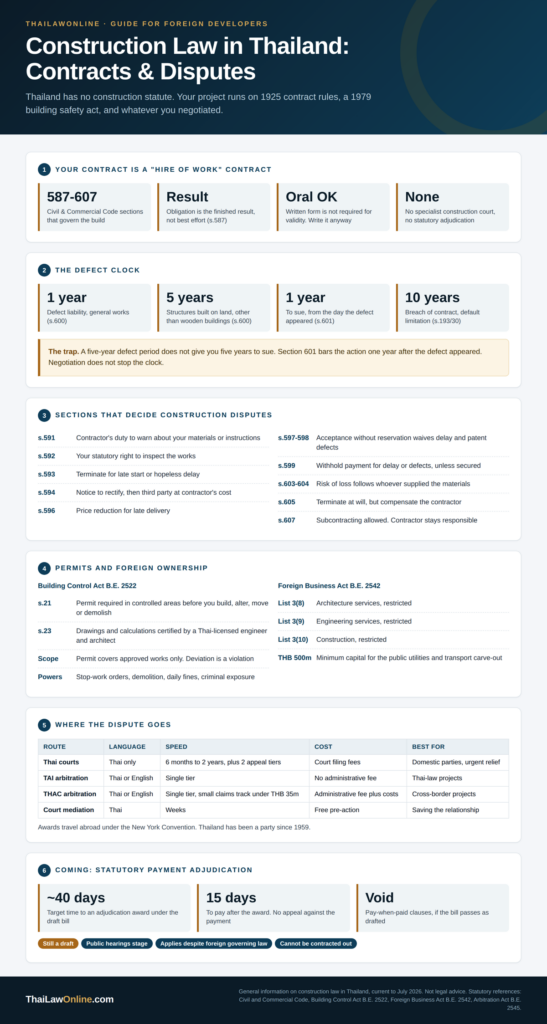
Table des matières
Comment la loi thaïlandaise qualifie un contrat de construction
Il n'y a pas de loi sur la construction en Thaïlande. Votre contrat de construction est un contrat de “ louage d'ouvrage ”, régi par les articles 587 à 607 du Code civil et commercial. C'est le même chapitre qui s'applique à un tailleur confectionnant un costume. Le Code se moque bien que votre projet soit un condominium de 37 étages.
Cela importe plus qu'il n'y parait. Les juristes de l'immobilier attendent des doctrines spécifiques à la construction : prolongation du délai, principe de prévention, prétentions globales, dommages-intérêts liquidés La jurisprudence. La loi thaïlandaise ne vous offre aucune de ces choses par défaut. Ce que vous obtenez, ce sont un petit ensemble de règles par défaut, et tout ce que vous avez écrit dans le contrat.
Ce que signifie réellement le “ louage d'ouvrage ”
L'article 587 le définit. L'entrepreneur s'engage à réaliser un ouvrage déterminé. L'employeur s'engage à payer une rémunération pour le résultat. Le mot clé est résultat. Il s'agit d'une obligation de résultat, et non de moyens. Votre entrepreneur ne s'acquitte pas de son devoir en faisant de son mieux.
Le contrat n'a pas besoin d'être écrit pour être exécutoire. Les contrats de construction verbaux sont valables en Thaïlande. C'est un piège, pas une commodité. Sans un périmètre, un programme et un mécanisme de prix écrits, vous litigez sur ce dont deux personnes se souviennent.
Matériaux, outils et obligation de mise en garde
L'article 588 met les outils et l'équipement à la charge de l'entrepreneur. L'article 589 stipule que si l'entrepreneur fournit les matériaux, ils doivent être de bonne qualité. L'article 590 couvre le cas inverse. Si vous fournissez les matériaux, l'entrepreneur doit les utiliser avec soin et restituer le surplus.
L'article 591 est celui que les promoteurs étrangers devraient lire deux fois. L'entrepreneur n'est pas responsable des vices ou des retards causés par la nature des matériaux que vous avez fournis, ou par vos propres instructions. Mais cette protection tombe si l'entrepreneur savait que les matériaux étaient impropres ou que l'instruction était inadéquate et n'a rien dit.
Point pratique. L'article 591 est une obligation de mise en garde. Incluez-la explicitement dans le contrat, avec un mécanisme de notification écrite et un délai. Selon notre expérience, les entrepreneurs gardent le silence sur un mauvais détail de conception pour ensuite rejeter la faute sur l'architecte. Il est beaucoup plus facile de les coincer lorsque le contrat précise le moment où ils devaient se manifester.
Votre droit d'inspection pendant les travaux
L'article 592 vous confère un droit légal d'inspecter les travaux à tout moment pendant leur exécution. Vous pouvez l'exercer par l'intermédiaire de votre ingénieur ou de votre chef de projet. Utilisez-le. Des inspections de chantier hebdomadaires documentées constituent la preuve la moins chère que vous achèterez jamais.
Un morceau de papier signé n'est pas toujours un contrat
Les règles thaïlandaises de formation des contrats s'appliquent de plein fouet aux marchés publics. Si vous faites une contre-offre sur le prix, vous avez rejeté l'offre initiale et en avez fait une nouvelle. L'article 359, alinéa deux, le dispose ainsi. Et entre parties distantes, le contrat ne se forme que lorsque l'acceptation parvient effectivement à l'auteur de l'offre, en vertu de l'article 361, alinéa premier, et de l'article 169.
Arrêt de la Cour suprême n° 670/2566. Un employeur a envoyé une lettre négociant à la baisse le prix d'un contrat de pose de tuyaux en acier. L'entrepreneur n'a jamais répondu. Le tribunal a jugé qu'il n'y avait aucun contrat. La lettre de l'employeur constituait un rejet suivi d'une nouvelle offre, et sans acceptation parvenant à l'employeur, rien n'a été formé. L'employeur était libre de se retirer.
Vous avez donc émis une lettre d'intention. Ou révisé un prix d'appel d'offres par e-mail. Ou “ convenu en principe ” lors d'une réunion de chantier. Ne présumez pas que vous êtes lié. Et ne présumez pas non plus que votre entrepreneur l'est. Bouclez la boucle par écrit.
Principaux articles du Code civil et commercial applicables aux contrats de construction
| Section | Ce qu'il fait | Pourquoi c'est important pour vous |
|---|---|---|
| 587 | Contrat d'entreprise | Votre création est jugée sur le résultat, pas sur l'effort |
| 588 à 590 | Outils, qualité des matériaux, entretien de vos matériaux | Établit la référence si le contrat est muet |
| 591 | Entrepreneur exonéré pour vos matériaux ou instructions | À moins qu'il ne sût et ait omis de vous avertir |
| 592 | Droit de l'employeur d'inspecter les travaux | Accès réglementaire pour votre technicien |
| 593 | Résilier pour retard de démarrage ou retard irrémédiable | Vous n'avez pas besoin d'attendre la date d'achèvement |
| 594 | Mise en demeure de remédier, puis recours à un tiers | Travaux de reprise aux frais de l'entrepreneur |
| 596 | Réduction de prix pour livraison tardive | Résolution pour manquement au délai essentiel |
| 597 | Acceptation sans réserve | Dégage l'entrepreneur de sa responsabilité en cas de retard |
| 598 | Réception de travaux défectueux | Les vices cachés subsistent encore |
| 599 | Retenir la rémunération en cas de retard ou de vices | À moins que l'entrepreneur ne fournisse une garantie adéquate |
| 600 | Responsabilité pour vices : un an, ou cinq ans pour les ouvrages immobiliers | S'applique uniquement si le contrat ne stipule rien d'autre |
| 601 | Un an pour intenter une action en justice à compter de l'apparition du défaut | Le délai le plus manqué dans la construction en Thaïlande |
| 602 | Paiement à la livraison ou par tranche acceptée | Jalon de référence pour votre calendrier de jalons |
| 603 et 604 | Risque de perte avant la livraison conforme | Suivez celui qui a fourni les matériaux |
| 605 | L'employeur peut résilier ad nutum, moyennant indemnisation | Une sortie puissante et coûteuse |
| 606 | Le contrat prend fin si l'expertise personnelle du contractant était essentielle | Payez pour la partie utile réalisée |
| 607 | Sous-traitance autorisée | Votre entrepreneur reste responsable des sous-traitants |
Responsabilité pour vices en Thaïlande : un an ou cinq
L'article 600 établit la règle par défaut. Si le contrat ne stipule rien d'autre, l'entrepreneur est responsable des défauts qui apparaissent dans l'année suivant la livraison. Ce délai passe à cinq ans lorsque l'ouvrage est une construction sur un terrain, autre qu'en bois. Ainsi, votre villa en béton, votre immeuble commercial en maçonnerie et votre tour en copropriété bénéficient tous de cinq ans.
Deux choses à ce sujet. Premièrement, il s'agit d'une règle par défaut. Votre contrat peut la raccourcir ou la prolonger, et la plupart des contrats bien rédigés le font. Deuxièmement, la limitation ne s'applique pas du tout lorsque l'entrepreneur a dissimulé le défaut. La dissimulation remet tout en cause.
Le piège de l'article 601
C'est ici que les promoteurs étrangers perdent de bons recours. L'article 601 interdit toute action contre l'entrepreneur un an après le jour où le malfaçon est apparue. Pas un an après la fin de la garantie. Un an après que le défaut s'est manifesté.
Examinez cela à la lumière de l'article 600. Vous bénéficiez peut-être d'un délai de garantie de cinq ans. Mais si une fissure apparaît la deuxième année et que vous passez dix-huit mois à négocier, votre réclamation est caduque. Nous l'avons vu arriver à des clients qui pensaient faire preuve de bonne foi.
Arrêt de la Cour suprême n° 3612/2560. La Cour a tracé une limite qui a de la valeur pour vous. Le délai de prescription d'un an prévu à l'article 601 ne s'applique qu'à la situation visée à l'article 600. Cela signifie un vice apparaissant après que l'entrepreneur a livré un travail correct et complet lors de la réception des travaux. Il ne s'applique pas lorsque l'entrepreneur a mal construit dès le départ. Des matériaux inappropriés ou un travail inférieur aux normes du métier ne relèvent pas de l'article 601. Il s'agit là d'une action directe pour rupture de contrat.
Arrêt de la Cour suprême n° 22850/2555. Même principe, faits différents. Une installation d'alimentation électrique par le rivage a mal fonctionné. La Cour a jugé que la réclamation portait sur l'exécution défectueuse du contrat, et non sur des défauts de la chose au titre de l'article 601. Le délai de prescription général de dix ans prévu à l'article 193/30 s'est donc appliqué, et une réclamation introduite neuf ans après la livraison a été jugée recevable.
La conséquence pratique : la manière dont vous plaidez a une importance capitale. Présentez la réclamation comme un travail qui n'a jamais été conforme au contrat, et vous disposez d'un délai de dix ans. Présentez-la comme un vice apparu après la réception des travaux, et vous vous trouvez dans une fenêtre d'un an. Prenez conseil avant d'envoyer la mise en demeure.
| Type de sinistre | Période | Fonctionne à partir de | Source |
|---|---|---|---|
| Malfaçons, travaux généraux | Garantie d'un an | Livraison | art. 600 du CCC |
| Défauts, structure sur terre (pas en bois) | responsabilité de 5 ans | Livraison | art. 600 du CCC |
| Action corrective | 1 an | Le jour où le défaut est apparu | art. 601 du CCC |
| Rupture de contrat, aucun délai particulier | 10 ans | Lorsque le droit pouvait être invoqué | CCC art. 193/30 |
| Entrepreneur, ingénieur ou architecte poursuivant en justice pour le paiement d'honoraires | 2 ans | Quand les frais sont devenus exigibles | CC art. 193/34 |
| Vice caché | Aucune limite pour l'article 600 | Non applicable | CC art. 600, dernière clause |
L'acceptation est un événement juridique, et non une formalité
L'article 597 dispose que si vous acceptez l'ouvrage sans réserve, l'entrepreneur est dégagé de sa responsabilité pour retard de livraison. L'article 598 stipule que si vous acceptez, sans objection, un travail dont vous savez qu'il est défectueux, l'entrepreneur est disculpé. L'acceptation expresse compte, de même que l'acceptation tacite, y compris le fait d'emménager.
L'article 598 maintient deux choses en vie : les vices qui ne pouvaient raisonnablement pas être découverts lors de la réception des travaux, et les vices que l'entrepreneur a activement dissimulés. Tout le reste, vous y avez renoncé.
Point pratique. N’acceptez jamais un certificat de remise en état. Ajoutez une liste des problèmes. Écrivez “ accepté sous réserve de la liste des défauts jointe et sans renonciation à toute réclamation de retard ”. Demandez aux deux parties de signer la liste. Prenez des photos le même jour. Ce seul paragraphe a permis à nos clients de récupérer sept chiffres de dommages-intérêts.
Risque de perte avant la livraison
Les articles 603 et 604 attribuent une perte en cas de destruction ou de dommages aux ouvrages avant leur livraison. Si le contractant a fourni les matériaux, la perte est de sa responsabilité et aucun paiement n’est exigible, sauf si vos actes y ont contribué. Si vous avez fourni les matériaux, la perte vous incombe.
Les inondations, les incendies et les tempêtes sont de réels risques en Thaïlande. N’hésitez pas à consulter le Code ici. Établissez une police d’assurance couvrant tous les risques auprès d’un assureur, identifiez les deux parties comme assurées et précisez qui assume le montant de la franchise.
Retard et résiliation : vos sorties en droit thaïlandais
Résiliation pour retard
L’article 593 vous donne trois motifs de résiliation. Le entrepreneur ne commence pas dans un délai raisonnable. Ou il retarde en violation du contrat. Ou il retarde tellement que c’est déjà évident qu’il ne pourra pas terminer dans les délais, sans faute de votre part. Dans l’un de ces cas, vous pouvez résilier immédiatement. Vous n’avez pas à attendre jusqu’à la date de fin.
L’article 594 vous offre la deuxième option. Si, au cours des travaux, il apparaît que le résultat sera défectueux en raison de la faute du contractant, vous pouvez lui adresser un avis de rectification dans un délai raisonnable. Si il ne se conforme pas, vous pouvez faire appel à un tiers pour procéder à la réparation ou à l’achèvement des travaux, à ses frais et risques.
L’article 596 ajoute la possibilité d’obtenir une réduction du prix. Le retard dans la livraison vous donne droit à une réduction du prix. Si le délai était essentiel dans votre contrat, vous pouvez résilier le contrat sans tarder.
Résiliation à volonté en vertu de l'article 605
C’est la clause que la plupart des développeurs étrangers ignorent exister. Tant que le travail n’est pas terminé, vous pouvez résilier le contrat pour n’importe quelle raison ou aucune raison. Le prix correspond à une indemnisation versée au contractant pour la perte causée par votre résiliation.
Décision de la Cour suprême n° 857/2567. Un contrat de construction d’une maison clé en main. Les employeurs ont demandé au entrepreneur de s’arrêter pendant la phase sept et ont payé cette phase en totalité. Le tribunal a considéré que c’était une pratique du droit de section 605 de résilier le contrat à la discrétion de l’entrepreneur, de sorte que des dommages-intérêts devaient être versés. Les parties ont ensuite négocié un règlement postérieur à la résiliation d’un montant de 250 000 THB, payable en cinq versements. Le tribunal a considéré que ce n’était pas une mesure de compensation convenue, mais une sanction contractuelle. Il était donc exécutoire en sa totalité, sans réduction judiciaire.
Deux leçons. Premièrement, demander à un entrepreneur de cesser ses activités est un acte juridique qui a des conséquences financières, même si vous n’avez jamais utilisé le mot “ résiliation ”. Deuxièmement, il vaut mieux conclure un accord de règlement après la résiliation. Lorsqu’il sera interprété comme une indemnisation convenue plutôt qu’une sanction contractuelle, les tribunaux l’appliqueront en vertu de la loi.
Ce que signifie “ valeur du travail effectué ” en cas de résiliation
Lorsqu’un contrat est résilié, l’article 391, paragraphe 1, remet les parties dans leur position initiale. Les travaux déjà effectués ne peuvent pas être annulés, de sorte que le troisième paragraphe exige le paiement du prix de ces travaux.
Décision de la Cour suprême n° 2835/2566. La Cour n’a accordé aucune indemnisation pour les travaux préparatoires du contractant, car l’employeur n’avait pas pu en tirer profit. Des formulations avaient été élaborées mais gardées secrètes, de sorte que l’employeur n’avait pas pu les transmettre à un autre fournisseur. Les travaux qui ne rapportent aucun avantage transférable à l’employeur ne sont pas des “ travaux exécutés ” pour lesquels il faut payer.
Transférer cela à un chantier de construction. Si votre entrepreneur construit à 40% km/h, la valeur que vous devez correspond à ce que vous pouvez réellement utiliser. Des travaux installés vérifiés, des matériaux transférables, des dessins transférables et des autorisations. Pas ses frais de mobilisation, pas ses frais généraux, pas ses pertes de profit liées à ce que lui-même n’a jamais construit.
Permis de construire et loi sur le contrôle des bâtiments de 2522 (BE)
La loi sur la réglementation des bâtiments de 1979 est la couche de droit public qui s’applique à votre contrat privé. Elle est appliquée par les autorités locales et elle est appliquée rigoureusement.
L'obligation de permis
L’article 21 interdit la construction, l’aménagement, le déménagement ou la démolition d’un bâtiment dans une zone contrôlée sans permis de construire ou sans notification au responsable local en vertu de l’article 39 bis. La demande doit contenir les plans, les spécifications et les calculs structurels, et, pour les types de bâtiments contrôlés, la conception doit être préparée et certifiée par des ingénieurs et architectes thaïlandais agréés. Le responsable local doit accorder ou refuser le permis dans un délai de 45 jours, et peut le proroger deux fois, d’un maximum de 45 jours chacune, avec des motifs écrits (article 25).
Votre permis ne couvre que le domaine approuvé. Changez la hauteur, ajoutez un étage, déplacez le plancher et vous construirez sans permis pour cet élément. Un permis est valide uniquement pour la période indiquée dans celui-ci, et une demande de renouvellement doit être déposée avant son expiration (article 35), donc n’attendez pas d’obtenir un permis avant de trouver un financement.
Zonage, marges de recul et limites de hauteur
Les réglementations ministérielles prévues par la loi restreignent ce que l’on peut construire en fonction de l’emplacement. Dans les zones côtières, les restrictions sont sévères. Les zones de Koh Samui limitent la hauteur des bâtiments et la superficie des surfaces construites en fonction de la distance de la plage, avec une bande totalement inconstructible au plus près de la mer. À Phuket, la construction est interdite au-dessus d’une certaine hauteur sur les collines, peu importe ce que stipule votre titre de propriété.
Ce dernier point mérite d'être souligné. Le maintien d'une Acte de propriété de chanote Il vous indique qui possède le terrain. Cela ne vous dit rien quant à la possibilité de construire sur celui-ci. Les acheteurs confondent constamment ces deux concepts.
Application de la loi
Les autorités locales peuvent délivrer des ordonnances de suspension des travaux et exiger la rectification dans un délai fixé. Dans les cas où un bâtiment ne peut être remis en conformité, elles peuvent ordonner sa démolition partielle ou totale. La poursuite des violations entraîne des amendes journalières, et des poursuites pénales peuvent être engagées en cas de non-respect, qui peut entraîner des dommages structurels ou des blessures. À Bangkok et dans d’autres centres urbains, les inspecteurs agissent sans avoir besoin d’un ordre de justice préalable.
Point pratique. Ne laissez jamais le permis circuler sous le nom du contractant. Un permis ne peut pas être transféré sans l’autorisation écrite du fonctionnaire local (article 36), donc le nom qui y figure importe. Il doit appartenir au propriétaire foncier ou à la partie ayant le droit enregistré de construire. Cela signifie que bail enregistré ou un droit de superficie. Si vous vous trompez, un litige avec l’entrepreneur devient une prise d’otage. Notre vérification préalable de la propriété Les contrôles repèrent tout cela avant que l’argent ne soit déplacé.
Un étranger peut-il posséder une entreprise de construction en Thaïlande ?
Pour l'essentiel non, sans licence. La construction apparaît à l'article 3(10) de la Loi sur les activités commerciales des étrangers B.E. 2542, dans l’annexe des activités pour lesquelles les ressortissants thaïlandais “ ne sont pas encore prêts à affronter la concurrence ”. Une société dont la participation étrangère atteint 50 % ou plus est considérée comme étrangère et doit obtenir une licence d’entreprise étrangère du Département du développement des entreprises.
La liste 3(10) prévoit deux exceptions. La première concerne les travaux de construction assurant des services publics de base dans le cadre d’utilités publiques ou de transports. Ces travaux doivent nécessiter des outils, machines, technologies ou compétences spécifiques. Et le capital minimum requis pour les étrangers doit être de 500 millions de baht ou plus. La deuxième exception concerne toute autre catégorie de travaux prévue par un règlement ministériel.
Notez ce que l’exception ne couvre pas. Une société à majorité étrangère construisant des villas, des condominiums, des hôtels ou des locaux commerciaux tombe intégralement dans le cadre de cette restriction.
L'architecture et l'ingénierie font l'objet de restrictions distinctes
La liste 3(8) couvre les services d’architecture. La liste 3(9) couvre les services d’ingénierie. Ces éléments sont distincts de la construction, et chaque branche d’activité nécessite sa propre autorisation. Une licence pour fournir des services d’architecture ne vous permet pas de réaliser des travaux d’ingénierie.
De plus, l’ingénierie et l’architecture sont des professions réglementées. Les documents de conception soumis pour un permis de construire doivent être certifiés par un professionnel agréé en Thaïlande. Les ressortissants étrangers ne peuvent pas exercer ici en tant qu’ingénieurs ou architectes agréés. En pratique, une entreprise de ces secteurs doit disposer de professionnels thaïlandais agréés. Le personnel étranger sur le chantier doit obtenir des permis de travail avant de faire quoi que ce soit.
Comment les projets sont généralement structurés
- Société majoritairement thaïlandaise. La route habituelle. Regardez prête-nom Évitez de faire des investissements en Thaïlande sans prendre le temps de bien examiner les règles relatives aux participations et de documenter les véritables investissements thaïlandais.
- Promotion du BOI. Le Conseil de promotion de l’investissement peut assouplir les limites relatives aux participations étrangères dans les activités qualifiées. Une entreprise promue conserve toujours le certificat d’entreprise étrangère délivré par le Département du développement des entreprises, et les travaux de conception doivent toujours être certifiés par des ingénieurs et architectes agréés en Thaïlande.
- Diviser les contrats. Standard dans les projets EPC. Les travaux d’approvisionnement et d’ingénierie offshore sont inclus dans un seul contrat, tandis que les travaux de construction onshore sont couverts par un accord global. L’entité onshore doit disposer des licences requises ou faire appel à un sous-traitant thaïlandais agréé pour certifier l’ingénierie.
Garantir que le véhicule soit correct est une structuration d'entreprise Une activité physique, pas une activité de construction. Fais-le avant de signer quoi que ce soit.
Règlement des litiges de construction en Thaïlande
La Thaïlande n’a pas de tribunal spécialisé en construction et aucune procédure d’arbitrage légal n’existe. Votre litige est soumis aux tribunaux civils généraux, à l’arbitrage ou à la médiation. Choisissez dans le contrat avant que tout ne dégénère.
tribunaux thaïlandais
Les demandes de dommages-intérêts sont déposées devant le tribunal civil général ayant compétence territoriale sur l’accusé ou sur le lieu où la cause de l’action a surgi. Les procédures sont menées en thaïlandais. Tous les documents en langue étrangère doivent être traduits en thaïlandais et vos témoins étrangers doivent témoigner par un interprète.
Un jugement de première instance prend généralement entre six mois et deux ans. Il existe trois niveaux : le tribunal de première instance, la cour d’appel et la Cour suprême. Toute partie peut faire appel devant la cour d’appel, dont le jugement est définitif à moins que la Cour suprême n’autorise un recours supplémentaire (articles 244/1 et 247 du Code de procédure civile), donc prévoir au moins deux niveaux.
Le fardeau de la preuve des défauts, de la causalité et de la valeur réside sur le patron. Cela signifie presque toujours des rapports d’experts indépendants. Les tribunaux thaïlandais acceptent les preuves d’experts et c’est une pratique courante dans les affaires techniques. Commencez à rassembler ces éléments sur place, et non après l’émission de l’ordonnance.
Arbitrage : TAI et THAC
L’arbitrage est régi par la Loi sur l’arbitrage de 2545, qui est conforme à la Loi type de la CNUDCI. La Thaïlande est partie à la Convention de New York depuis 1959 et n’a pas fait de réserves quant à son adhésion. Les sentences étrangères sont exécutoires ici, à moins qu’elles ne soient contraires à la législation thaïlandaise ou ne relèvent des motifs strictement réglementaires. Une sentence rendue à son siège ne sera pas exécutoire.
Si vous détenez un prix et devez le retirer auprès d’un contrevenant thaïlandais, notre guide l'exécution d'un jugement étranger ou d'une sentence arbitrale en Thaïlande Il couvre la requête, la période de trois ans et les motifs pour lesquels un tribunal thaïlandais peut encore refuser l’autorisation.
TAI, L’Institut thaïlandais d’arbitrage, créé en 1989 par le Bureau judiciaire, est financé par le gouvernement et ne facture aucune taxe administrative. Vous payez uniquement les coûts réels de la procédure, principalement les honoraires des arbitres. Ses pratiques sont bien connues des tribunaux thaïlandais. Les procédures se déroulent en thaïlandais ou en anglais.
THAC, Le Thailand Arbitration Center, qui relève du ministère de la Justice depuis 2015, est conçu pour les utilisateurs transfrontaliers. Il facture des frais administratifs, propose des procédures bilingues et offre un service de justice minière pour les litiges d’une valeur inférieure à 35 millions de THB.
Deux limites à connaître. Vous ne pouvez pas renoncer aux droits légaux de contester ou de faire appel d’un jugement. Ces clauses sont nulles pour des raisons d’ordre public. De plus, le financement des litiges par des tiers n’est pas accepté en Thaïlande, donc n’établissez pas de stratégie de recours en fonction de cette pratique.
Comprendre le droit de la construction en Thaïlande
Médiation
La médiation annexée à la cour est disponible avant ou pendant la procédure. La médiation préalable n’entraîne aucune taxe judiciaire et suspend la prescription. Une médiation réussie devient une décision de consentement, immédiatement exécutoire et valable pendant dix ans. Si elle échoue, vous bénéficiez d’une prolongation de 60 jours de la prescription.
La médiation extrajudiciaire est régie par la loi sur la médiation des litiges et ses limites sont limitées. La Thaïlande n’a pas adopté la Convention de Singapour sur la médiation. Ainsi, les parties convertissent un accord en une sentence consensuelle ou en un jugement consensuel afin de le rendre exécutoire.
| tribunaux thaïlandais | Arbitrage TAI | Arbitrage THAC | Médiation judiciaire | |
|---|---|---|---|---|
| Langue | Thaï uniquement | Thais ou anglais | Thais ou anglais | thaïlandais |
| Durée typique | 6 mois à 2 ans en première instance, plus les recours | Plus rapide, avec un seul niveau | Plus rapide, avec un seul niveau | Semaines |
| Frais institutionnels | Honoraires d'enregistrement des tribunaux | Aucune, seuls les coûts réels | Taxe administrative plus frais | Pas de pré-action |
| Éléments d'appel | Trois étages | Contest limité uniquement | Contest limité uniquement | Non applicable |
| Application transfrontière | Ça dépend du traité et de la réciprocité | Convention de New York | Convention de New York | Doit être converti en jugement ou en sentence |
| Idéal pour | Parties internes, injonction d’urgence | Des projets de loi thaïlandais souhaitant une procédure plus adaptée à la Cour | Projets transfrontaliers, conseils internationaux | Conserver la relation commerciale |
Notre avis, après vingt ans de ces dossiers : pour un projet financé par des fonds étrangers de toute taille, faire des arbitrages. Insérer une clause à plusieurs niveaux dans le contrat. Négociation avec un haut cadre dirigeant, puis médiation, puis arbitrage devant un tribunal basé à Bangkok selon les règles de la THAC ou de la TAI, en anglais. Si vous souhaitez comprendre d’abord l’alternative au litige, lisez notre note sur Qu’attendre avant de se présenter devant un tribunal en Thaïlande.
Sécurité des contrats : garanties, retenues et éléments à exiger
La Thaïlande n’a pas de formulaire standard obligatoire pour les travaux privés. Les projets publics doivent utiliser l’accord standard délivré en vertu de la loi sur l’administration des marchés publics B.E. 2560, et les entrepreneurs ne peuvent généralement pas modifier des clauses importantes sans l’autorisation de l’Office du Procureur général. Les projets privés sont un marché libre. Vous rédigez ce que vous pouvez négocier.
Les formulaires FIDIC sont utilisés pour des projets plus importants et financés à l’échelle internationale. Mais le mécanisme de règlement des litiges au cœur de la FIDIC n’est pas une voie de recours provisoire fonctionnelle en Thaïlande. Si les discussions amicales échouent, il faut passer directement devant un tribunal ou une instance d’arbitrage. Traitez les clauses DAB comme des éléments à adapter, et non à imposer.
Instruments de sécurité en usage normal :
- Garantie financière. Vous protège lors d'une vente aux enchères si l'enchère gagnante refuse de signer.
- Garantie de bonne performance. Garantie bancaire pendant la durée du contrat, généralement de 5% à 10% du montant du contrat. Une formulation sur demande vaut la peine d’être défendue.
- Conservation. La pratique courante consiste généralement à verser 5% à 10% de chaque paiement, répartis en plusieurs tranches après la remise des travaux et à la fin de la période de garantie. L’article 599 vous confère un droit légal de retenue sur les honoraires en cas de retard ou de livraison défectueuse, à moins que le contractant n’assure une garantie adéquate. La rétention permet de concrétiser ce droit.
- Garantie de paiement anticipé. Si vous financez une mobilisation, obtenez une garantie bancaire pour l’intégralité de l’avance, la réduction étant opérée au fur et à mesure que l’avance sera recouvrée.
- Garantie de la société mère. Utilisable lorsque l’entité contractante dispose d’un capital faible. Commençant dans la Thaïlande, et souvent constituant la seule clause contractuelle valable.
Point pratique. Consultez qui est réellement l’entité contractante. Les groupes de construction thaïlandais font souvent appel à des filiales plus petites. Effectuez une recherche sur les sociétés, consultez le capital social et les états financiers déposés, puis établissez un prix en fonction du risque. La décision du Tribunal suprême n° 1471/2564 concernait un entrepreneur qui avait signé un contrat de construction alors qu’il était personnellement en faillite et l’avait caché. La vérification est peu coûteuse ; la récupération n’en coûte pas autant.
Le projet de loi sur les paiements dans la construction : ce qui vous attend
À compter de septembre 2026, la Thaïlande n’a pas de régime de garantie de paiement légal. Les clauses de paiement après la livraison des prestations dans les sous-traitants sont valables en vertu de la liberté contractuelle. Le résultat est connu : l’argent final revient à la tête de la chaîne et la souffrance tombe sur les sous-traitants.
Un projet de loi sur le règlement des litiges relatifs au paiement des contrats de construction existe, mais il est bloqué. Le Centre thaïlandais d’arbitrage l’a élaboré et le lui a soumis aux autorités compétentes en décembre 2023. Le ministère de la Justice n’a pas poursuivi son élaboration. Ses raisons, rapportées dans le journal Nitisarn (vol. 2 n° 1, 2025), dans la lettre du ministère du 24 janvier 2024, étaient que les travaux de construction relèvent d’un contrat de travaux relevant du titre VII du Code civil et commercial et sont donc déjà régis par cette loi, que les parties souhaitant une procédure plus rapide disposent déjà de la loi sur l’arbitrage B.E. 2545 et de la loi sur la médiation des litiges B.E. 2562, et que l’évaluation d’impact manquait de la substance nécessaire pour justifier une loi distincte. Le projet de loi n’a pas été promulgué et n’a jamais été soumis à une consultation publique : vérifié en septembre 2026, le système juridique central du gouvernement sur law.go.th n’en tient aucune audition. Si il est relancé dans sa forme actuelle, ses effets seraient considérables :
- Il s’applique aux contrats de construction écrits, y compris les accords de consultation, dans lesquels les travaux sont réalisés entièrement ou partiellement en Thaïlande. Le choix de la loi étrangère applicable n’en supprimera pas l’application.
- Les clauses visant à en déroger sont nulles.
- Les clauses de paiement à la livraison sont interdites, tout comme les conditions qui font que le paiement dépend du financement du propriétaire.
- Un droit légal de soumettre les litiges de paiement à une procédure d’arbitrage, avec un délai de règlement estimé à environ 40 jours.
- Paiement dans les 15 jours suivant la décision, sans recours contre l’obligation de paiement. La décision est contraignante mais non définitive, ce qui permet encore de saisir un tribunal ou un tribunal arbitral.
- Un créancier non payé peut suspendre les travaux proportionnellement au montant non remboursé pendant une durée maximale de 30 jours.
Si vous rédigez un contrat de longue durée, incluez un mécanisme de révision. Un régime de paiement qui annule les conditions de votre sous-traitance en cours de projet n’est pas quelque chose que vous voulez découvrir tardivement.
Protéger un projet de construction en Thaïlande : une séquence pratique
- Confirmer que vous pouvez construire avant d’acheter. Zones de construction, contraintes d’implantation, limites d’élévation, déclencheurs d’évaluation environnementale. Le titre n’est pas une autorisation.
- Réparer le véhicule appartenant à la personne concernée. Le terrain, la structure et le droit de construire peuvent être détenus par des personnes différentes. Une droit de superficie ou un bail enregistré confèrent à la partie étrangère un droit réel sur le bâtiment.
- Gardez le permis vous-même. Propriétaire foncier ou titulaire du droit d’aménagement bâti. Jamais le contractant.
- Contrat écrit, bilingue. Indiquez la langue officielle. Si le thaï est la langue officielle, obtenez votre propre traduction avant de signer, pas après.
- Définir l’acceptation. Disons ce que signifie la conformité, quels documents l’accompagnent et que cette occupation n’est pas une acceptation. L’article 598 en fait une condition essentielle.
- Fixer le prix du programme. Des jalons liés à des progrès physiques vérifiés, des dommages intérêts en cas de retard et une procédure de variation écrite sans instructions verbales.
- Prenez la sécurité. Prêt de garantie, garantie de rétention, garantie de paiement anticipé, garantie parentale lorsque le contrat est faible.
- Assurez-vous bien d’être couvert. Responsabilité des entrepreneurs, responsabilité civile des tiers, toutes les parties sont nommées. Les articles 603 et 604 ne vous protégeront pas.
- Documentez tout. Des journaux de bord, des photos datées, des instructions écrites, des réunions récapitulées. Vous prouverez plus tard la causalité.
- Agissez dans les limites du temps imparti. Au moment où un défaut apparaît, notez la date prévue au titre 601 et demandez conseil. La négociation n’arrête pas le déclin du temps.
Dernière mise à jour : 26 septembre 2026. Lire en thaïlandais : Articles 193/34, 359, 361, 391 et 587 du Code civil et commercial ; articles 21, 23 (abrogés), 25, 35, 36, 39 bis et 65 de la Loi sur la réglementation des bâtiments ; article 857 de la Loi sur les entreprises étrangères B.E. 2542, liste 3 (8) à (10). Décisions de la Cour suprême : les décisions 670/2566, 3612/2560, 22850/2555, 857/2567, 2835/2566, 1471/2564 et 4269/2565 ont été vérifiées par rapport à leurs notes explicatives, et 857/2567 en entier. L’état de la Convention de New York pour la Thaïlande a été vérifié sur la table des statuts de la CNUDCI. Le 6 octobre 2026 : les articles 244/1 et 247 du Code de procédure civile ont été lus en thaïlandais : un nouvel appel devant la Cour suprême nécessite son autorisation. Non vérifié : les descriptions de TAI et THAC ainsi que le projet de facture de paiement.
Foire aux questions
Est-ce qu'un contrat de construction en Thaïlande doit être écrit ?
Non. Un contrat de louage d'ouvrage est valable même s'il est verbal. Mais vous aurez du mal à prouver la portée, le prix et le programme sans document écrit. Mettez-le toujours par écrit.
Combien de temps un entrepreneur est-il responsable des malfaçons en Thaïlande ?
L'article 600 accorde un délai d'un an à compter de la livraison pour les travaux généraux. Il accorde cinq ans pour un ouvrage bâti sur un terrain, à moins qu'il ne s'agisse d'un bâtiment en bois. Votre contrat peut fixer un délai différent.
Combien de temps ai-je pour poursuivre mon entrepreneur après l'apparition d'un défaut ?
L'article 601 interdit toute action intentée un an après l'apparition du vice. Ce délai commence à courir lorsque le vice se manifeste, et non à l'expiration de la garantie. Le manqué de le respecter ne vous sauvera pas, même si le délai de cinq ans prévu à l'article 600 s'applique.
Puis-je annuler un contrat de construction en Thaïlande si je change d'avis ?
Oui. L'article 605 vous permet de résilier à tout moment avant que les travaux ne soient terminés. Vous devez indemniser l'entrepreneur pour la perte que votre résiliation occasionne.
Un étranger peut-il posséder une entreprise de construction en Thaïlande ?
La construction est restreinte en vertu de la liste 3(10) de la loi sur les entreprises étrangères de B.E. 2542 (1999). Une société à majorité étrangère a besoin d'une licence d'entreprise étrangère, ou d'un capital minimum de 500 millions de THB pour les travaux d'infrastructure publique éligibles.
L'arbitrage est-il préférable au tribunal pour un litige de construction en Thaïlande ?
Généralement oui pour les projets transfrontaliers. L'arbitrage peut se dérouler en anglais et les sentences circulent en vertu de la Convention de New York. Les procédures judiciaires thaïlandaises se déroulent en thaï et passent par trois degrés de juridiction.
Les clauses de type « payer quand payé » sont-elles exécutoires en Thaïlande ?
Pour l'instant, oui. Il n'y a pas de régime légal de sécurité des paiements en vigueur. Un projet de loi sur les paiements dans la construction annulerait ces clauses, mais il n'a pas été promulgué.
Qui fait la demande de permis de construire, moi ou mon entrepreneur ?
Le permis doit rester entre les mains du propriétaire terrien ou de la partie détenant le droit de construire enregistré. Ne le laissez pas au contractant. Si la relation se détériore, votre permis s'en ira.
Et si les travaux de mon voisin endommagent mon bâtiment ?
Il s'agit d'une action en responsabilité délictuelle au titre de l'article 420, et non d'une action en responsabilité contractuelle. Dans l'arrêt de la Cour suprême n° 4269/2565, une école a obtenu gain de cause contre un promoteur immobilier dont les travaux de battage de pieux et de démolition avaient endommagé ses bâtiments.
Puis-je refuser de payer si le travail est défectueux ?
Oui. L'article 599 vous permet de retenir la rémunération en cas de livraison tardive ou défectueuse. L'entrepreneur peut la débloquer en fournissant une garantie appropriée à la place.
Comment ThaiLawOnline peut vous aider
Nous exerçons en Thaïlande depuis 20 ans, et les dossiers de construction figurent parmi les plus lourds de documents que nous traitons. Ce qui les détermine n’est rarement qu’un argument juridique intelligent. Il dépend de savoir si les formalités étaient conformes avant que les problèmes ne commencent.
Nous rédigeons et examinons les contrats de construction et de design bilingues. Nous procédons à Préalisation de la diligence préalable à l'achat et à la construction. Nous structurons la propriété de manière à ce que l’investisseur étranger détienne un droit réel sur le bâtiment. Et nous agissons en litiges civils et Litiges commerciaux Lorsqu'un projet tourne mal. Notre équipe en droit immobilier gère la partie terrestre, depuis vérification de la titrisation à acheter ou construire une maison en Thaïlande.
Si un défaut est déjà apparu, n'attendez pas. Prendre rendez-vous pour une consultation ou contactez-nous Et nous vous indiquerons où vous en êtes par rapport au chronomètre.
Points clés à retenir
- La Thaïlande n’a pas de code de la construction. Votre construction est régie par les règles d’embauche figurant aux articles 587 à 607 du Code civil et commercial.
- L’article 600 prévoit cinq ans de garantie en cas de défaut pour les structures construites sur le sol, un an pour tout le reste, sauf si votre contrat prévoit autre chose.
- L’article 601 interdit votre réclamation un an après la découverte du défaut. C’est la date limite que les développeurs étrangers oublient le plus souvent.
- La manière dont vous qualifiez une réclamation modifie le délai de prescription. Les défauts de fabrication invoqués comme violation du contrat peuvent être considérés comme des manquements mineurs selon l'article 193/30.
- L’acceptation d’un travail sans réserve dispense de toute réclamation de retard ou de défaut de brevet aux termes des articles 597 et 598 ; la loi n’exige pas que la réserve soit écrite ; mais l’écriture de celle-ci constitue la preuve de cette acceptation.
- L'article 605 vous permet de vous retirer à tout moment, mais vous en payez le prix.
- La loi sur la réglementation des bâtiments de l’année 2522 exige une autorisation pour l’aménagement exact, conformément aux limites de zone, de retrait et d’élévation spécifiques à chaque lieu.
- La construction est restreinte en vertu de l’article 3(10) de la loi sur les entreprises étrangères, et les études techniques et l’architecture sont séparément restreintes et doivent être autorisées séparément.
- Il n’existe pas encore de régime d’arbitrage. Un projet de loi de paiement modifierait cette situation et annulerait les clauses de paiement à la livraison.
- Pour les projets transfrontaliers, recourir à l’arbitrage. Les arbitrages sont régis par la Convention de New York. Les procédures judiciaires thaïlandaises ne sont pas tenues en anglais.
Actualités juridiques thaïlandaises, gratuites par courriel
Des informations claires et concises sur les changements législatifs thaïlandais concernant les étrangers : propriété, visas, mariage, affaires et testaments. Un court courriel par mois, envoyé par un cabinet d’avocats établi depuis 2006. Zéro spam, désabonnement possible à tout moment.