


Last updated on
Reviewed by ThaiLawOnline, a licensed Thai law firm practising in Thailand since 2006. Thai lawyer of record: Wichuda Atthamethakon, LL.M., Thai Bar Licence 3149/2556.
The short answer. The Thailand ED visa new rules that people search for are three separate instruments, and most pages blend them into one “crackdown”. First, clause 2.9 of the table annexed to Immigration Bureau Order No. 12/2568 sets the extension ceilings: up to one year per extension for university and formal-school students, and for language schools, Muay Thai gyms and every other non-formal school, 90 days per extension and no more than one year in total, counted from the date you entered Thailand or from the date you were permitted to change your visa type inside the country. Second, the Ministry of Higher Education’s announcement in force since 14 May 2025 caps university short courses at 180 days, requires at least 60% onsite teaching and monthly attendance reporting, and led to nearly 10,000 student permits being revoked in August 2025. Third, the ED Plus visa, from the Cabinet resolution of 28 May 2024, gives degree students re-entry without a permit and a one-year extension after graduation. The rest of this guide tells you which of the three applies to you, what it costs, and how the visa ends.
If study is only one of your options, our Thai visa finder will show the alternatives.
What changed in 2025 and 2026, in one table
| Date | Instrument or event | Who it applies to | What it does |
|---|---|---|---|
| 28 May 2024 | Cabinet resolution on visa measures (Ministry of Foreign Affairs proposal) | Students at bachelor’s level and above | Creates ED Plus: leave and re-enter without a re-entry permit, one-year extension after graduation, change of visa type in Thailand if hired. |
| 1 May 2025 | Thailand Digital Arrival Card (TDAC) | Every foreign traveller, including ED holders | Replaces the paper TM6. File online within 72 hours before arrival. See our TDAC guide. |
| 14 May 2025 | MHESI announcement on short non-degree courses for foreign students, B.E. 2568 | Higher-education institutions only (universities and their short courses) | Course no longer than 180 days, at least 60% onsite, every course filed with the Ministry, the student reported within 30 days of the stay being granted, monthly attendance reports to a shared database. |
| 22 August 2025 | Joint MHESI and Immigration Bureau meeting | Students in non-compliant short courses | The Bureau reported that it had revoked the permission to stay of nearly 10,000 students under section 36 of the Immigration Act. |
| 7 August 2026 | MHESI orders a probe into one university’s international admissions | Degree and non-degree students at that university | Confirms that the Ministry now checks enrolment, immigration records and visa files together, not course paperwork alone. |
| 15 September 2026 | 30-day visa exemption (Royal Gazette, 31 August 2026) | Anyone planning to convert a visa-free entry into an ED visa inside Thailand | The 60-day exemption ends. With 30 days, and 15 days needed on the permit at the first immigration visit, the in-country conversion window is two weeks. See the 30-day exemption explained. |
Nothing in that table changes the one rule that has governed language-school students since 2014, and which no other English page on this subject cites. That rule comes next.
Which rules apply to you: university, formal school or language school
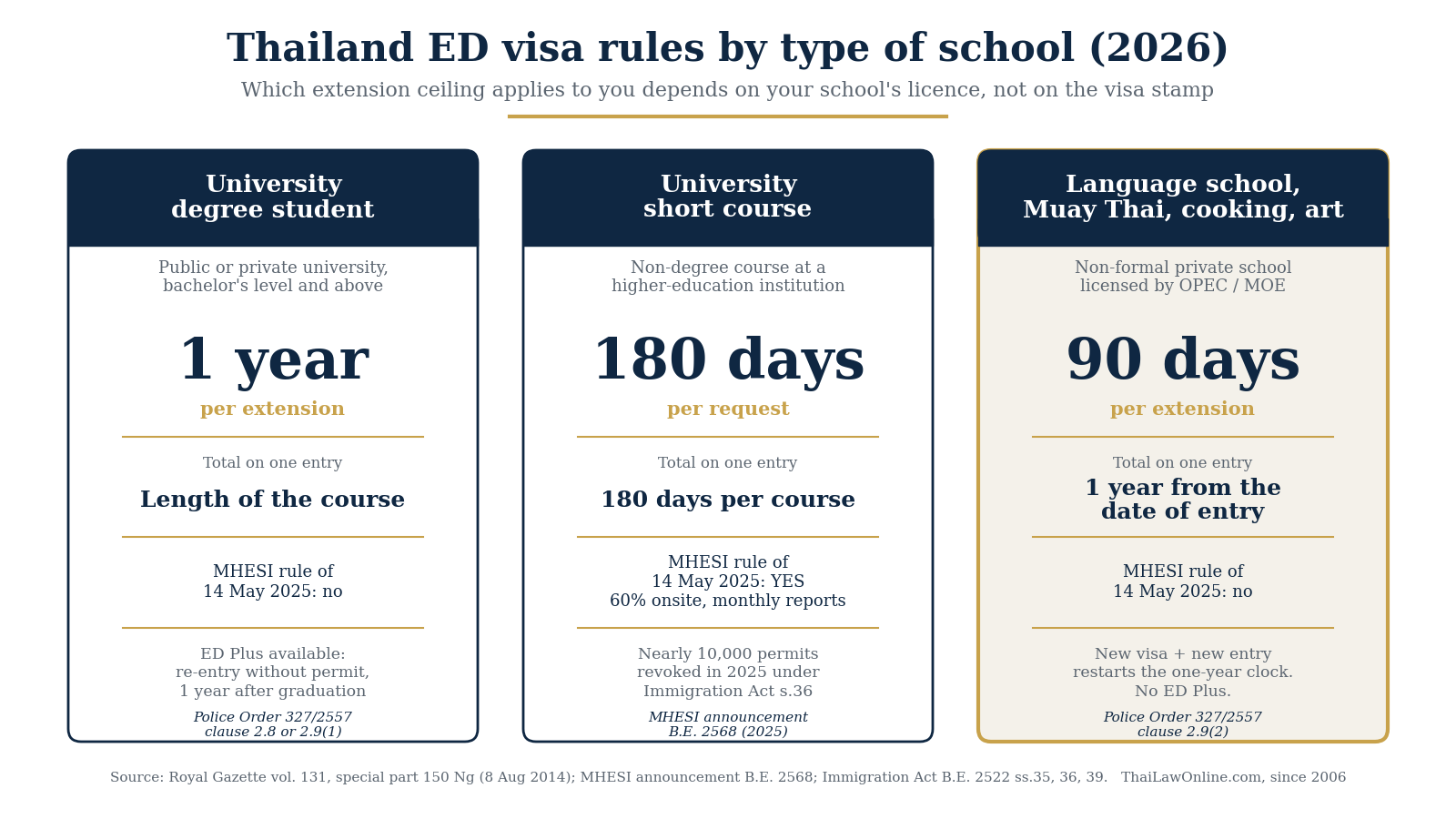
Thai immigration law does not have one “student visa”. Section 34(10) of the Immigration Act B.E. 2522 (1979) admits a foreigner for study, and section 35 lets the Immigration Bureau extend that stay for up to one year at a time. The Royal Thai Police then fixes the actual ceilings in a criteria order, and that order sorts students by the licence their school holds.
| Where you study | Regulator and licence | Clause of the table annexed to IB Order 12/2568 | Ceiling per extension | Total ceiling | MHESI rule of 14 May 2025 applies? |
|---|---|---|---|---|---|
| State university or state school | MHESI (universities) or Ministry of Education | 2.8 | 1 year | Length of the course | Only to its short non-degree courses (180-day cap) |
| Private university, degree programme | MHESI, Private Higher Education Institution Act | 2.9(1) | 1 year | Length of the course | No |
| Private university, short non-degree course | MHESI | 2.9(1) | 1 year on paper, 180 days per request under the 2025 announcement | 180 days per course | Yes |
| Private formal school (international school and similar) | Ministry of Education, Private School Act B.E. 2550, “in-system” school | 2.9(1) | 1 year | Length of the course | No |
| Private language school, Muay Thai gym, cooking, massage or art school | Ministry of Education through the Office of the Private Education Commission (OPEC), Private School Act B.E. 2550, “non-formal” school | 2.9(2) | 90 days | 1 year from the date of entry | No. A language school is not a higher-education institution. |
Most readers of this page are in the last row. If you are, the two numbers that govern your stay are 90 days and one year, and the year runs from the day you entered Thailand on the visa, or from the day Immigration approved your change to an ED visa if you converted inside Thailand.
The 90-day extension and the one-year clock: clause 2.9
The instrument in force is the criteria-and-documents table annexed to Immigration Bureau Order No. 12/2568 of 23 January 2025, which we have read in Thai. Its clause 2.9 covers study at a private institution. The clause number and the figures are unchanged from Royal Thai Police Order No. 327/2557 (Royal Gazette, volume 131, special part 150 Ng, 8 August 2014), which carried them until it was repealed on 26 September 2023. Clause 2.9(2), for non-formal schools, reads:
๒.๙ กรณีเพื่อศึกษาในสถานศึกษาของเอกชน (๒) กรณีโรงเรียนนอกระบบให้อนุญาตตามระยะเวลาที่สถานศึกษารับรอง ครั้งละไม่เกิน ๙๐ วัน แต่รวมแล้วไม่เกิน ๑ ปี นับแต่วันที่เดินทางเข้ามาในราชอาณาจักร หรือนับแต่วันที่ได้รับอนุญาตให้เปลี่ยนประเภทการตรวจลงตราหรือได้รับการตรวจลงตรา แล้วแต่กรณี
In English: for study at a private institution, in the case of a non-formal school, permission is granted for the period the school certifies, not exceeding 90 days each time, and not exceeding one year in total, counted from the date of entry into the Kingdom or from the date permission to change the visa type, or the visa itself, was granted, as the case may be. Elsewhere in the same table, in the rows on teaching at private schools, “non-formal school” is defined by reference to the Private Education Commission Board’s notification of 12 February 2009 (B.E. 2552): religious teaching, arts and sports, vocational, tutoring, life skills, and two types of Islamic school (mosque Tadika centres and Pondok institutes). A Thai language school, a Muay Thai gym and a cooking school all hold that kind of licence.
Clause 2.9 then sets four conditions for both kinds of private school, and together they are the document list every school sends you: the applicant holds a non-immigrant visa; the school holds a licence from the relevant government agency; the school certifies the enrolment and requests the extension; and the relevant government agency certifies the school. That fourth certification is the “Ministry of Education approval letter” that competitor pages mention without saying where it comes from. For language schools it comes from OPEC or the Provincial Education Office. The clause waives it for international schools and for higher education, which is why university students never chase that letter.
What the clause settles, and what the forums get wrong
Immigration officers often grant 60 days, or 30, instead of 90. That is discretion inside the 90-day ceiling, usually because the school’s letter certified a shorter period. It is not a separate rule. Our own page used to say you extend “every 60 to 90 days depending on your school’s paperwork”; the accurate statement is that each extension can run up to 90 days.
The one-year total is counted from your entry date (or from an in-country change of visa type), not from the day your course started. If you entered on 1 October 2026 and enrolled in November, the clock still ran from 1 October. Our own page used to say a language course could support “12 to 15 months”; fifteen months on one entry is not possible under clause 2.9(2).
The “one-language rule” you read on forums, the idea that Immigration makes you switch from Thai to English after a year, is not in the Order. Schools invented it as a way to write a fresh certification letter. The Order asks for a fresh entry. A new visa and a new entry restart the one-year count, which is what a border run does in legal terms. Whether a consular officer will issue a second ED visa to someone who has just spent a year “studying” is a separate question, and since 2025 the answer is often no.
⚠️ Currency correction, 15 September 2026, and it replaces the reasoning that used to sit here. This paragraph previously argued that clause 2.9 was current because no later order we had read touched it. That test does not establish currency, and it was wrong here: Order 327/2557 and its amendments were repealed on 26 September 2023 by Order of the Royal Thai Police No. 542/2566, and the criteria passed to the Commissioner of the Immigration Bureau: first Immigration Bureau Order No. 242/2566, in force 30 September 2023, and then Immigration Bureau Order No. 12/2568 of 23 January 2025, whose clause 2 carries the criteria and supporting-document table that governs today. We have read both. We have now read clause 2.9 of the current table, and the ceilings above are unchanged: a formal-system (in-system) school gives up to one year per extension as certified by the school, and a non-formal school, which is the language-school case, gives not more than 90 days per extension and not more than one year in total from the day you entered the Kingdom or, as the case may be, from the day permission to change the visa category was granted or the day the visa was issued. So what was wrong here was the citation, not the rule. Cite it as Immigration Bureau Order 12/2568, clause 2.9.
MHESI’s announcement of 14 May 2025: what a university short course must now look like
The second instrument is the announcement of the Ministry of Higher Education, Science, Research and Innovation on the criteria and guidelines for teaching short-term (non-degree) courses to foreign students at higher-education institutions, B.E. 2568, in force from 14 May 2025. The Minister summarised it in six rules the following day, and the text confirms them:
- The institution must have real expertise, teachers and learning outcomes for the course.
- Every course is filed with the Office of the Permanent Secretary: name, responsible unit and teacher, objectives, structure, delivery format with at least 60% onsite and at most 40% online, a course duration of no more than 180 days, daily and weekly timetables, attendance records, student qualifications, intake period, number of foreign students, language, venue and assessment.
- The institution certifies the student and requests the stay “as appropriate and necessary for the course”, not exceeding 180 days per request, and checks whether the student has already studied in another institution’s short course.
- Once Immigration grants the stay, the institution reports the student to the Ministry within 30 days.
- The institution sets an attendance-checking procedure and files a monthly progress report through the Ministry’s foreign-student tracking database: who is studying, who has been terminated, who has completed.
- If the institution does not comply, the Office of the Permanent Secretary notifies the institution’s council to consider cancelling the course.
The “80% attendance” rule is not in the announcement
Almost every English page on this subject, including an earlier version of this one, says you need 80% attendance. The figure appears in no instrument we have read. What the Immigration Bureau’s table does require, for non-formal schools only, is that each extension application include the course outline, the timetable and the number of hours you have attended so far (document 7 under clause 2.9). The announcement sets a 60% onsite floor for the course design and a monthly reporting duty; the attendance threshold that triggers a report is the institution’s own procedure under rule 5. Your school may well set 80%. If it does, that is your contract with the school, and the school reports you to the database when you fall below it. The Ministry then has the data it needs to ask Immigration to act.
The announcement binds universities, not language schools
Read the title again: “higher-education institutions”. A private language school is licensed under the Private School Act B.E. 2550 and answers to the Ministry of Education through OPEC. It is outside the announcement. Its ceiling is still the 90-day, one-year rule in clause 2.9(2). The reason the two regimes get blended is that the Immigration Bureau’s enforcement in 2025 hit both: the Bureau said it had revoked the permission to stay of nearly 10,000 students in short courses that did not meet the Ministry’s criteria, at a joint meeting reported on 22 August 2025, and the same year it tightened its scrutiny of language-school extensions in practice. The legal bases are different, and knowing which one you are under tells you which paperwork can end your stay.
The enforcement has not slowed. On 7 August 2026 the Deputy Prime Minister and MHESI Minister ordered an investigation into one university’s international student admissions, covering degree and non-degree programmes, enrolment data, immigration records and visa files together.
ED Plus explained: who gets it and what the university must do
The Non-Immigrant ED Plus visa comes from the Cabinet resolution of 28 May 2024 on visa measures proposed by the Ministry of Foreign Affairs, the same package that produced the Destination Thailand Visa. Thai embassies describe it in identical terms: it is granted to international students currently studying at a university or institution in Thailand at bachelor’s degree level or above. It is single-entry, valid for 90 days from issue, with an initial stay of up to 90 days, and the university then applies for the extension.
Four things make it worth having:
- During the course of study, the holder can leave and re-enter Thailand without a re-entry permit. Under section 39 of the Immigration Act an ordinary ED holder who leaves without one loses the permission to stay, so this is a real benefit and not a convenience.
- The university submits the extension application on the student’s behalf, so the student does not queue at Chaeng Wattana every year.
- After graduation, the holder may extend for one year to seek employment, travel or take part in other activities.
- If hired during that year, the holder may change visa type inside Thailand, to a Non-B, without leaving.
Three limits matter as much. ED Plus does not permit work during studies; the Emergency Decree on Managing the Work of Aliens applies unchanged. It is not available to language-school, Muay Thai or any other non-degree student. And the post-graduation year is an extension the university must apply for, not a right that attaches to the stamp. If your university’s international office will not file it, you have a paperwork problem and no visa.
Who is eligible for a Thai student visa?
Language school students
This is the most common route for people under 50 who cannot yet use the retirement route. There is no statutory age limit; language schools set their own floor, and 12 is the norm. The course must be at a licensed school, and the school, not you, requests each extension. Under clause 2.9(2) the stay on one entry cannot exceed one year.
University students
You need acceptance into a recognised university. Universities have an international relations office that handles the extension requests, and since 14 May 2025 that office also files the monthly reports that keep your stay alive. Degree students extend under clause 2.8 or 2.9(1), up to one year at a time, and may hold ED Plus.
Criminal record checks
Since the 2025 enforcement, applicants from some regions face extra requirements. Embassies commonly ask applicants from African countries for two criminal record checks (home country and Thailand), and applicants from India, China and parts of the Middle East for a Thai check. These add three to four weeks. Our guide to the Thai police clearance certificate covers cost, timing and how long it stays valid.
How to apply for a student visa
Option A: applying outside Thailand (e-visa or embassy)
- Enrolment. Apply to your school and pay tuition. The school sends its file to the relevant education authority for the certification letter (one to three weeks for language schools; universities are exempt under condition 4 of clause 2.9).
- Application. Apply on the Thai e-visa portal at thaievisa.go.th if your country is covered, or at the embassy. Upload your passport, photo, the education authority’s letter, the school’s acceptance letter and proof of funds (often 20,000 THB or the equivalent).
- Processing. Three to ten working days as a rule. The e-visa arrives by email.
- Entry. Present the e-visa and your TDAC confirmation at the border. Your one-year clock under clause 2.9(2) starts on that day.
Option B: converting a visa exemption or tourist visa inside Thailand
Many students arrive on a 60-day tourist visa or on a visa exemption and convert at the Immigration Bureau (Chaeng Wattana in Bangkok, or the provincial office for your school’s location). From 15 September 2026 the visa exemption for most Western nationals is 30 days, and you must still have at least 15 days remaining on your permit at the first immigration visit. That leaves two weeks to enrol, pay, obtain the school’s letter and get to the counter. Plan it before you fly, or enter on a tourist visa instead.
- Enrol and pay. The school prepares the file for the education authority.
- Authority letter. Ten to fifteen days for a language school.
- Immigration visit 1. Documents checked, 2,000 THB conversion fee paid. You need 15 days left on your permit.
- Immigration visit 2. The Non-Immigrant ED stay is stamped, usually for an initial 90 days. For a language-school student, the one-year limit under clause 2.9(2) runs from the date this change was approved.
A word on agents. A school that promises a visa without attendance, or an agent who offers to “handle Immigration” for a fee, is selling you exposure to the revocations described above. Our guide to visa agents explains where the legal line runs.
Can you work on an ED visa?
The rule: no employment of any kind
Employment is prohibited on an ED visa. That includes unpaid work, volunteering that looks like a job, and freelance work for Thai clients. Under section 101 of the Emergency Decree on Managing the Work of Aliens B.E. 2560, as amended in B.E. 2561, a foreigner who works without a permit is fined 5,000 to 50,000 baht, is deported once the fine is paid, and cannot apply for a work permit for two years. The permission to stay is cancelled with it, and deportation leaves a re-entry bar with no published schedule; practitioners report entries in the immigration system running as long as 100 years. The often-quoted 100,000 baht figure is section 102, the penalty on the employer, 10,000 to 100,000 baht for each foreigner taken into work, so a Thai client who pays you is exposed too. Our work permit penalties page goes through both sections.
Remote work
Working from a Thai condo for a foreign employer is work in Thailand without a permit. Enforcement against real students who quietly serve clients abroad is inconsistent, and since 2025 the risk has shifted: the monthly attendance database, not a knock on the door, is what now exposes the “student” who never attends. If your purpose is remote work, the Destination Thailand Visa is the lawful route. It is valid for five years and admits you for 180 days per entry.
How permission to stay ends: sections 39, 36, and the 7-day notice
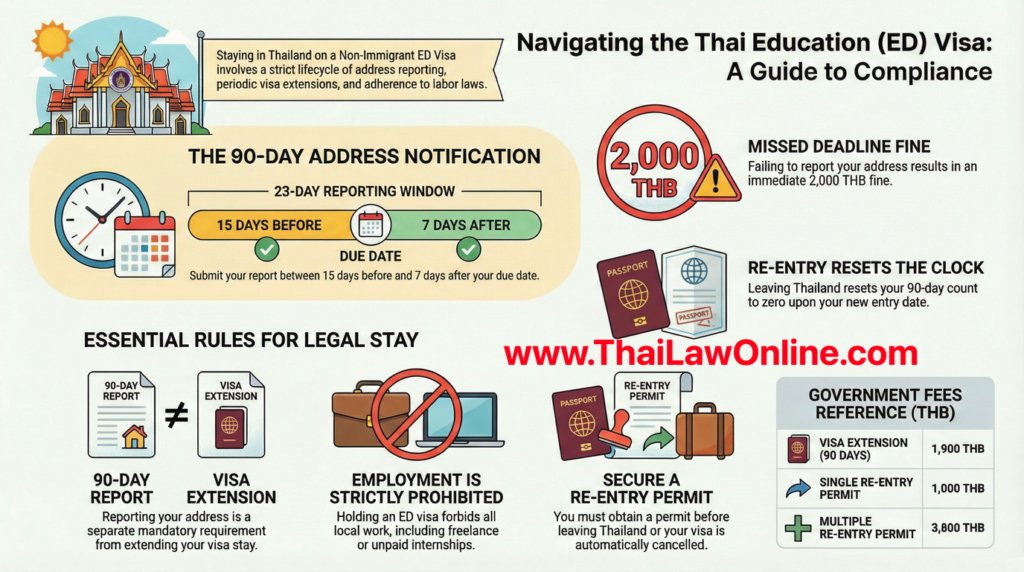
Leaving without a re-entry permit (section 39). Under section 39 of the Immigration Act, once you leave the Kingdom your permission to stay is deemed to have expired, unless you obtained a re-entry permit before leaving. A weekend in Penang without one ends your ED stay, and you come back in as a tourist. A single re-entry permit costs 1,000 THB, a multiple 3,800 THB, at the airport before passport control or at your immigration office. ED Plus holders are exempt. Our re-entry permit guide has the forms and the timing.
Revocation (section 36). Where there is a proper reason, the Director-General or the Immigration Commission may revoke a permission to stay. Section 4 of the Immigration Act defines “Director” as the Director-General of the Police Department; that force is now the Royal Thai Police, constituted under section 6 of the Royal Thai Police Act B.E. 2547 and headed by a Commissioner-General, and section 14 of that Act gives a Bureau Commissioner the powers a law assigns to the Director-General so far as the matter falls to that Bureau. For a revocation of stay, that Bureau is Immigration. This is the power behind the 2025 mass revocations: the Ministry supplied the data, the Bureau signed the orders. When the Director-General orders the revocation, you may appeal to the Immigration Commission within 48 hours of being notified, and the Commission’s order is final. When the Commission itself revokes, there is no further appeal in the Act. The notice is served in writing; if it cannot be delivered, a notice posted at your last notified address counts as served after 48 hours. Those 48 hours are the whole window, so a student who receives a revocation notice needs a lawyer that day, not that week.
Refusal of an extension. If an extension is refused, the officer stamps a short period, in practice seven days, to leave the Kingdom. Overstaying that stamp puts you under section 81 (up to two years’ imprisonment, a fine of up to 20,000 baht, or both, on the statute; in practice a 500 baht per day settlement capped at 20,000 baht) and, past 90 days, on the blacklist tariff. Our overstay page sets out the bans, and the 2026 deportation rules explain what happens after a revocation.
The real cost of a student visa (2026 breakdown)
| Expense item | Cost (THB) | Notes |
|---|---|---|
| Visa application fee | 2,000 | Paid to the embassy, or to Immigration on an in-country conversion (one-time). |
| Tuition (language school) | 25,000 to 30,000 | Per term or level; varies by school. |
| Extension fee | 1,900 per extension | Each extension runs up to 90 days under clause 2.9(2), so up to four in the year one entry allows. Universities: one extension of up to a year. |
| Re-entry permit | 1,000 (single) or 3,800 (multiple) | Needed for any trip abroad unless you hold ED Plus. |
| 90-day report | Free | Late filing: section 76, up to 5,000 baht plus up to 200 baht per day; 2,000 baht is the usual settlement. |
| Photos and copies | About 500 | For the forms. |
| Estimated annual total | 45,000 to 60,000 | Tuition plus all government fees, language-school track. |
Government fees and school fees move and are not re-verified on every review of this page; the legal figures (sections 76, 81, 101 and 102) are.
Mandatory compliance: 90-day report, TM30, TDAC
90-day report (TM47). Section 37(5) of the Immigration Act requires every foreigner staying beyond 90 days to notify their address, then every 90 days. The window runs from 15 days before to 7 days after the due date; file online, in person or by post. Section 76 sets the penalty at up to 5,000 baht plus up to 200 baht for every further day until you file. In practice a late self-report settles at 2,000 baht and 5,000 is common when the lapse is found at a checkpoint or during an application.
TM30. Your landlord or hotel must notify Immigration of your arrival at the address within 24 hours (section 38). Ask for the receipt; officers request it at extension time.
TDAC. Since 1 May 2025 every traveller files the Digital Arrival Card online within 72 hours before arrival, free of charge. The THIM app that circulated in 2026 is optional and does not replace it; we checked.
Extensions. Language-school students extend up to every 90 days at 1,900 THB; officers may test your Thai at the counter. University students extend once a year through the international office.
ED visa vs the alternatives (DTV, retirement)
ED vs Destination Thailand Visa (DTV)
The DTV costs about 10,000 THB for five years against roughly 30,000 THB a year on the ED track, permits remote work, and requires proof of 500,000 THB in funds. The ED visa has no fixed financial requirement for language students but forbids work of any kind. If you have the lump sum and your purpose is remote work, the DTV is the honest visa for it. If you lack the funds or your purpose is study, ED is the accessible choice.
ED vs retirement (Non-O)
Retirement needs age 50 and either 800,000 THB in a Thai bank, 65,000 THB a month in income, or a combination of the two; ED has no age ceiling. Many people under 50 use one or two ED years to reach 50 and then move to the retirement extension. That plan still works, but under clause 2.9(2) each ED year needs a fresh entry, and since 2025 a consular officer may decline a second or third ED visa to an applicant with a year of “study” behind them. Budget for the possibility.
Bringing a spouse or children? Clause 2.11 of the same table lets the family of a student under clauses 2.8 or 2.9 (father, mother, spouse, children, adopted children and the spouse’s children) extend for up to a year at a time; a parent must show 500,000 THB held in a Thai bank. Our dependant visa guide explains that route.
Frequently asked questions
What are the new ED visa rules in Thailand for 2026?
Three instruments: clause 2.9 of the table annexed to Immigration Bureau Order 12/2568 (90 days per extension and one year in total from entry, or from an in-country change of visa type, for language-school students; one year per extension for university and formal-school students), the MHESI announcement in force since 14 May 2025 (university short courses capped at 180 days, at least 60% onsite, monthly attendance reporting to a shared database), and the ED Plus visa from the Cabinet resolution of 28 May 2024 (degree students: re-entry without a permit and a one-year extension after graduation). From 15 September 2026 the 30-day visa exemption also shortens the window for converting to an ED visa inside Thailand.
Can I stay more than one year on a language-school ED visa?
Not on one entry. Clause 2.9(2) caps the total at one year counted from the date you entered Thailand, or from the date an in-country change to an ED visa was approved. A new visa and a new entry restart the count, subject to the consular officer agreeing to issue it.
How long is each ED visa extension?
Up to 90 days for a language school or other non-formal school; up to one year for a university or a formal school such as an international school. Officers may grant less than the ceiling if the school’s letter certifies a shorter period.
Is the 80% attendance rule real?
Not as a legal rule. No instrument we have read sets 80%. The MHESI announcement requires at least 60% of a university short course to be taught onsite and requires monthly attendance reporting; the threshold that triggers a report is each institution’s own procedure. Your school may set 80% in its own rules and report you when you fall below it.
What is the ED Plus visa and who can get it?
A category created under the Cabinet resolution of 28 May 2024 for students at bachelor’s level or above at a Thai university or institution. Holders can leave and re-enter without a re-entry permit, the university files the extensions, and after graduation the holder may extend for one year to look for work and change visa type in Thailand if hired. Language-school and other non-degree students cannot get it.
Can I work on an ED visa or an ED Plus visa?
No, on either. Working without a permit is section 101 of the Emergency Decree on Managing the Work of Aliens: a fine of 5,000 to 50,000 baht, deportation and a two-year bar on work permits. ED Plus adds a post-graduation year in which to find an employer who then applies for your work permit and Non-B visa.
Is there an age limit for a Thai student visa?
No statutory limit. Language schools set their own minimum, usually 12, and there is no upper age. Retirees who want to learn Thai before switching to a retirement extension use it for that reason.
What happens if my extension is refused or my visa is revoked?
A refused extension comes with a short stamp, usually seven days, to leave. A revocation under section 36 is served in writing and, when the Director-General ordered it, can be appealed to the Immigration Commission within 48 hours; the Commission’s decision is final. Overstaying either puts you under section 81 and, past 90 days, on the blacklist tariff.
Can I convert a 30-day visa exemption to an ED visa inside Thailand after 15 September 2026?
Yes, but the arithmetic is tight. You need at least 15 days remaining on your permit at the first immigration visit, so you have about two weeks after arrival to enrol, pay, obtain the school’s letter and reach the counter. Entering on a 60-day tourist visa, or applying for the ED visa at an embassy before you travel, removes that pressure.
Can I open a Thai bank account on an ED visa?
Usually, once you hold the first extension or a letter from your school. It is easier than on a tourist visa; each bank sets its own list.
Can I change schools without cancelling my visa?
Generally no. The extension is tied to the school that certified you. To change schools you cancel the current stay and apply again, which for a language-school student usually means a fresh entry.
ED visa คืออะไร
วีซ่า ED (Non-Immigrant ED) คือการตรวจลงตราประเภทคนอยู่ชั่วคราวเพื่อการศึกษาตามมาตรา 34(10) แห่งพระราชบัญญัติคนเข้าเมือง พ.ศ. 2522 ผู้ถือวีซ่านี้ที่เรียนในโรงเรียนนอกระบบ (เช่น โรงเรียนสอนภาษา) ขอขยายเวลาได้ครั้งละไม่เกิน 90 วัน แต่รวมแล้วไม่เกิน 1 ปีนับแต่วันที่เดินทางเข้ามาในราชอาณาจักรหรือนับแต่วันที่ได้รับอนุญาตให้เปลี่ยนประเภทการตรวจลงตรา ตามคำสั่ง สตม. ที่ 12/2568 ข้อ 2.9(2) อ่านฉบับภาษาไทยได้ที่ วีซ่านักเรียนในประเทศไทย
Conclusion
The Non-Immigrant ED visa remains a lawful way to live in Thailand for a year while you learn the language, train, or study for a degree. What changed in 2025 and 2026 is that the paperwork now talks: the school’s monthly report, the Ministry’s database and the Bureau’s section 36 power are connected, and nearly 10,000 people found that out in one month. The rules themselves are older and simpler than the SERP suggests. For a language-school student, they are 90 days and one year from entry. For a degree student, they are one year at a time, plus ED Plus. Know which row of the table you sit in, attend the classes you paid for, and keep the 90-day report and the re-entry permit in order.
If your extension has been refused, if you have received a section 36 notice, or if you want to move from an ED stay to a work permit, a marriage extension or a retirement extension without a gap, book a consultation with our team. Plan any application at least 45 days before your current permit runs out.
Last reviewed: 17 September 2026. The immigration rules on this page were read in Thai against the Immigration Act B.E. 2522 (sections 34, 35, 36, 37, 38, 39, 76 and 81) and clauses 2.8, 2.9, 2.11 and 2.22 of the table annexed to Immigration Bureau Order No. 12/2568. Not verified in this review: the MHESI announcement text and the enforcement reports, government fees, DTV terms, embassy practice, and the work-permit penalties (checked on 5 September 2026). Always confirm the current requirements with the Royal Thai Embassy or the Immigration Bureau.
Thai Law Updates, free by email
Plain-English updates on Thai law changes that affect foreigners: property, visas, marriage, business and wills. One short email a month from a firm practicing since 2006. No spam, unsubscribe anytime.