


Reviewed by ThaiLawOnline, a licensed Thai law firm practising in Thailand since 2006. Thai lawyer of record: Wichuda Atthamethakon, LL.M., Thai Bar Licence 3149/2556.
Last updated on
Thailand’s volunteer visa system offers foreigners the opportunity to contribute meaningfully to Thai society through unpaid volunteer work with registered organizations. The Volunteer Visa in Thailand process is heavily regulated and requires strict legal compliance to avoid serious consequences including deportation and permanent blacklisting.
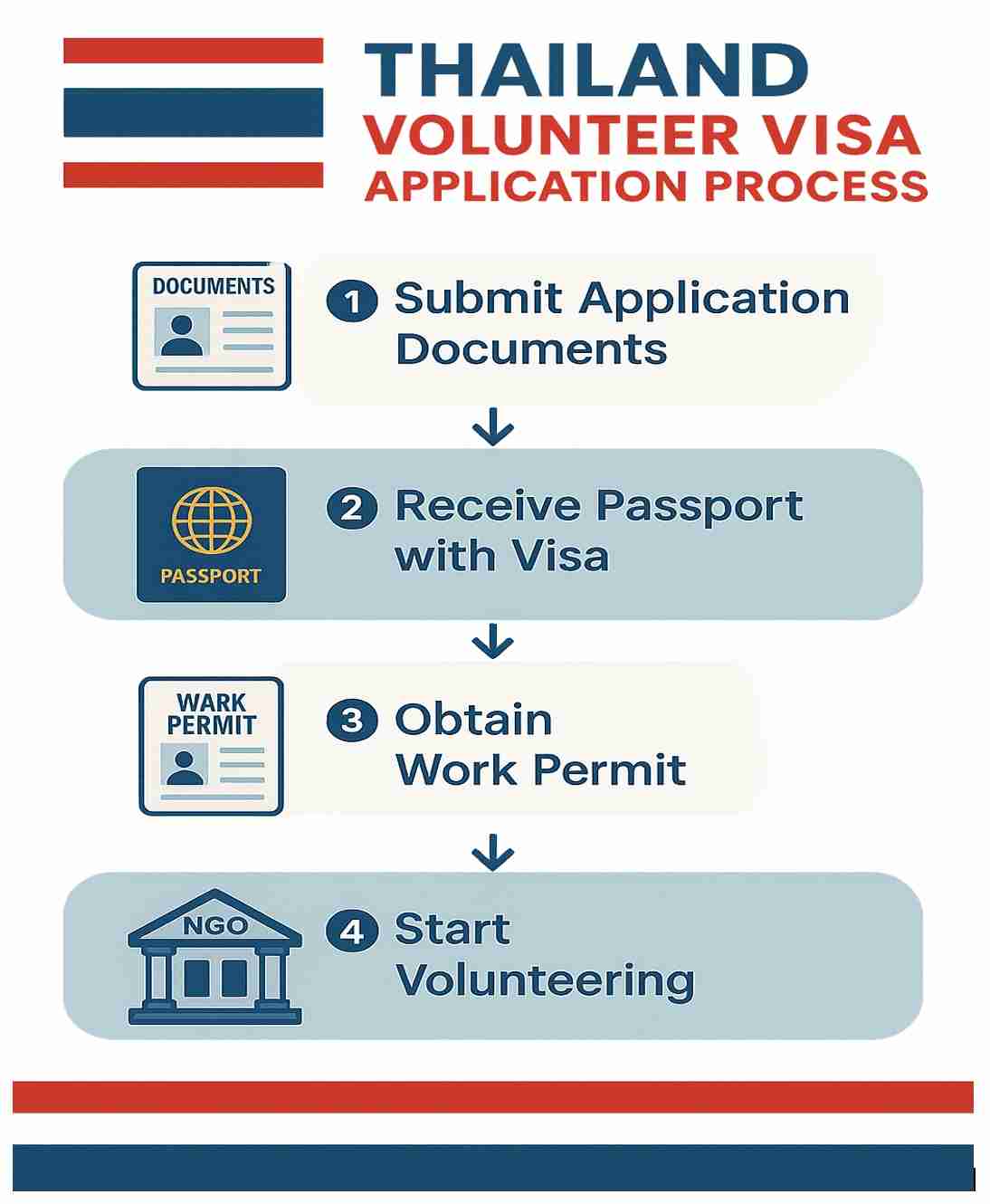
Table of Contents
Understanding Thailand’s Volunteer Visa Framework
What is a Volunteer Visa?
A volunteer visa in Thailand is a Non-Immigrant O visa. It is given for volunteer work with approved organizations. This visa system is for foreigners who want to do unpaid work with registered NGOs, charities, and social welfare groups. The visa lets you stay for up to 90 days. You can extend it for up to one year.
The Volunteer Visa in Thailand is for people who want to help others. It also lets them enjoy Thailand’s rich culture and beautiful scenery.
Critical Legal Requirements
Volunteering is governed by the Emergency Decree on Managing the Work of Aliens B.E. 2560, not by immigration law alone. Section 8 of that Decree forbids a foreigner to work without a work permit, or to work outside what the permit allows. The starting point for a volunteer is therefore a Non-Immigrant O visa and a work permit arranged by the host organisation.
The penalty on the volunteer is set by section 101 as replaced by the No. 2 Emergency Decree B.E. 2561: a fine of 5,000 to 50,000 baht, and once the fine is paid the foreigner is sent out of the Kingdom. There is no prison sentence. The five year prison term still quoted on many websites is the original 2017 wording of section 101, which was replaced in 2018 and is no longer the law.
The organisation carries the heavier exposure. Under section 102, taking on a foreigner who holds no work permit costs 10,000 to 100,000 baht for each foreigner taken on. A repeat offence carries up to one year in prison, or 50,000 to 200,000 baht per foreigner, or both, and a three year bar on employing foreigners at all.
Being unpaid does not put the activity outside the Decree. Section 5 defines work as engaging in any occupation, whether or not there is an employer. That wording replaced the 2017 definition, which turned expressly on whether wages or another benefit were intended. Neither version creates an exemption for unpaid help, so a volunteer who cannot show the activity falls outside the definition needs the permit.
Visa Types and Validity Periods
Available Categories
The volunteer visa system offers single-entry visas valid for 90 days from the date of issue. Embassies usually issue the single-entry version for volunteering; check with the one you apply to before assuming a multiple-entry visa is available. When you enter, you get permission to stay for up to 90 days. After that, you can extend your stay with the right documents and by following the rules.
Duration Structure
The usual volunteer visa timeline has a first-year structure. It starts with a 3-month initial stay. Under clause 2.21 of Immigration Bureau Order 12/2568, an extension can then be granted for up to one year at a time only where the head of a government department (or of a state enterprise or other state agency connected with the organisation) certifies the organisation and asks for the stay; without that certification each extension is up to 90 days and the total may not exceed one year from the date of entry. Later years need the same certification and continued organisational support. Throughout the entire period, holders must comply with 90-day reporting requirements to immigration authorities.
Comprehensive Eligibility Requirements
Personal Qualifications
Applicants must have a valid passport. It should be valid for at least 6 months. The passport must also have at least two blank pages for visa stamps. The minimum age requirement is 18 years, though some programs may accept younger applicants with proper supervision. Clean criminal background checks are required for certain nationalities, particularly those from countries deemed higher risk by Thai authorities.
Financial Requirements
Thai immigration needs proof of financial ability. You must show bank statements with a minimum balance of 20,000 THB for each person or 40,000 THB for a family. These financial documents must be recent (within 30 days of application) and properly authenticated by banking institution. Some embassies require higher amounts, with certain locations requiring equivalent to 6,000 euros in deposits.
Educational and Professional Standards
Applicants must provide copies of educational degrees or certificates, professional resumes detailing relevant experience, and demonstrate basic English language proficiency. Formal qualifications in the volunteer field are preferred. However, they are not always required. This depends on the organization and the type of volunteer work.
Required Documentation Framework
Core Visa Application Documents
The application process needs original passports that are valid. You must also complete visa application forms and sign them. Additionally, provide two recent passport-size photos. The photos should be 3.5 x 4.5 cm and have a white background. Additionally, applicants must provide invitation letters from registered Thai organizations detailing volunteer roles and responsibilities.
Organizational Documentation
Important organizational documents include registration certificates for the NGO or charity. They also include copies of licenses from Thai authorities. Additionally, there are Thai government approval letters. These letters confirm the organization’s ability to sponsor volunteer visas. These documents must be certified true copies with proper authentication.
Supporting Documentation
Additional requirements include flight booking confirmations, accommodation proof for the entire stay duration, and medical certificates for work permit applications. Family members require marriage certificates for spouses and birth certificates for children. The TM.30 address notification must be filed within 24 hours of the volunteer taking up residence at the address, and under section 38 of the Immigration Act B.E. 2522 the duty is the house master’s, the owner’s or possessor’s, or the hotel manager’s, not the volunteer’s. Confirm the host organisation or landlord has actually filed it, because immigration will ask for the receipt.
Step-by-Step Application Process
Phase 1: Organization Verification and Selection
The critical first step involves researching and verifying legitimate NGOs and charitable organizations with proper Thai government registration. Prospective volunteers must confirm the organization’s legal status with Thai authorities and ensure they can legitimately sponsor volunteer visas. Organizations should provide clear scope definitions for volunteer work and expected duration commitments.
Phase 2: Documentation Preparation and Submission
Applicants must secure invitation letters from verified organizations, obtain all necessary registration documents, and acquire Thai government approval letters. You must submit the visa application at Thai Embassies or Consulates outside of Thailand. The visa regulation does let Immigration change a tourist visa to a Non-Immigrant visa inside Thailand, but whether an office will do so for volunteering is at its discretion. Processing times typically range from 3-10 working days depending on the specific embassy or consulate.
Phase 3: Work Permit Application Upon Arrival
After getting the volunteer visa and entering Thailand, applicants must start the work permit application process right away. They should do this through the Department of Employment, the Ministry of Labour department whose Director General is the registrar for work permits under section 5 of the Decree. This process typically requires 2-4 weeks for completion and must be finished before beginning any volunteer activities. The work permit application requires medical certificates, educational document translations, and detailed organization sponsorship paperwork.
Phase 4: Extension and Renewal Procedures
Apply for each extension before your current permission to stay expires. This requires new organizational documents and updated financial proof. The extension process requires maintaining continuous organizational sponsorship and demonstrating ongoing legitimate volunteer activities. Extensions cannot be processed for applicants who have overstayed their authorized period.
Financial Costs and Budget Planning
Official Government Fees
Visa application fees range from 2,000 to 5,000 THB depending on the specific embassy or consulate. The work permit fee is fixed by ministerial regulation under the Emergency Decree and scales with the period the permit covers, so confirm the current figure with the Department of Employment office handling the file rather than budgeting a single number. Visa extensions require payment of 1,900 THB, while 90-day reporting is free when completed on time.
Service and Processing Costs
Legitimate visa service providers charge between 35,000 to 55,000 THB for complete volunteer visa processing. Document processing and translation services usually cost between 2,000 and 5,000 THB. Professional translation and notarization services range from 1,000 to 5,000 THB. Additional costs include medical certificates (500-1,500 THB), passport photos (200-500 THB), and travel expenses to embassies or consulates.
Identifying Legitimate Organizations
Types of Approved Organizations
You can find real volunteer opportunities with registered NGOs that have Thai government approval. You can also volunteer with social welfare organizations overseen by the right ministries and educational institutions that offer specific volunteer programs. Religious organizations operate under separate visa categories, while government-supervised charitable foundations provide another avenue for legitimate volunteer work.
Verification and Due Diligence
Prospective volunteers should verify organization registration with Thai authorities, check a Thai foundation’s or association’s registration with the Department of Provincial Administration (Ministry of Interior) or, for a foreign NGO, its permission under the Ministry of Labour Regulation on the Operation of Foreign Private Organisations B.E. 2541, and request references from previous volunteers. Legitimate organizations maintain physical office addresses in Thailand, provide clear volunteer program descriptions, and offer direct communication with organizational leadership.
Warning Signs of Fraudulent Operations
Major red flags include promises of guaranteed visa approval for a fee. Other signs are few volunteer work requirements, high fees for “fast processing,” and agents asking to keep passports for a long time. Legitimate organizations never guarantee visa approval, as this decision rests solely with Thai immigration authorities.
Work Permit Requirements and Restrictions
Mandatory Work Authorization
The permit requirement comes from section 8 of the Emergency Decree, read with the section 5 definition of work as engaging in any occupation whether or not there is an employer. Being unpaid does not take volunteering outside it. The work permit must specify exact volunteer activities, designated work locations, and specific organizational affiliations. Permits are location-specific and employer-specific, meaning volunteers cannot work outside designated areas or change organizations without obtaining new authorization.
Application and Compliance Requirements
Work permit applications require valid Non-Immigrant O visas, medical certificates, organizational sponsorship, educational qualifications, and criminal background checks for certain nationalities. They cannot work in banned jobs or activities outside their permit.
Extension, Renewal, and Ongoing Compliance
Annual Extension Process
First-year extensions require an application before the current permission to stay expires, continued organizational sponsorship, updated medical certificates, and compliance with 90-day reporting requirements. Renewal beyond the first year depends on the government-agency certification described above, together with continued organisational support and updated documentation.
90-Day Reporting Obligations
Section 37(5) of the Immigration Act B.E. 2522 requires a foreigner who stays more than ninety days to notify Immigration of their address without delay at the end of each ninety day period, and to do the same every ninety days after that. The familiar window of fifteen days before to seven days after is set by Immigration Bureau regulation, not by the Act. The statutory penalty sits in section 76: a fine of up to 5,000 baht, plus a further fine of up to 200 baht a day until the report is made. In practice Immigration compounds a late report filed voluntarily at 2,000 baht and applies the higher figure when the failure surfaces in other proceedings. You can report in person at Immigration Offices, online on official websites, or by registered mail in some cases.
Avoiding Scams and Fraudulent Operations
Recent Immigration Crackdowns
Thai Immigration authorities have significantly increased scrutiny of volunteer visa operations, conducting regular investigations of fraudulent agents and organizations. Recent arrests have targeted corrupt immigration officers and fake volunteer visa operations, resulting in permanent blacklisting for individuals involved in fraudulent schemes. Enhanced verification procedures now include stricter background checks and regular audits of volunteer activities.
Consequences of Fraudulent Visas
Getting involved with fake volunteer visas can lead to immediate deportation. It can also result in permanent bans from Thailand. You may face arrest and detention, along with heavy fines and possible legal action. These consequences create criminal records affecting future international travel and can result in confiscation of travel documents.
Success Stories and Positive Experiences
Legitimate Volunteer Impact
Successful volunteer programs in Thailand have made a real difference. Organizations like the Karen Hilltribes Trust have led these efforts. Volunteers have helped with clean water projects and English education in northern Thailand. Other registered foundations run long-standing education programmes that host volunteers. Volunteers working with elephant care projects report transformative experiences despite challenging conditions, emphasizing the rewarding nature of ethical wildlife conservation work.
Long-term Volunteer Benefits
Experienced volunteers report significant personal and professional development through legitimate programs, gaining international experience while contributing to meaningful community development projects. Successful programs emphasize proper preparation, cultural sensitivity, and realistic expectations about the challenges and rewards of volunteer work in Thailand.
Alternative Options and Considerations
Short-Term Volunteer Alternatives
There is no exemption for short unpaid volunteering on a tourist visa, and treating one as available is how people end up paying a fine. Section 37(1) of the Immigration Act B.E. 2522 bars a foreigner admitted for a temporary stay from engaging in an occupation or taking employment unless authorised under the foreign business law or the law on managing the work of aliens, so a tourist entry adds nothing.
The one short route the Decree does provide is section 61, and it is narrow. A foreigner admitted temporarily may do work that is necessary or urgent, or a specific one off assignment, that can be finished within fifteen days, and only after giving written notice to the registrar. If it is not finished in time, a single extension of no more than a further fifteen days may be requested by notifying the registrar before the first period expires. Which work counts as necessary, urgent or specific is fixed by notification of the Director General of the Department of Employment. Regular volunteering with an organisation over weeks or months does not fit, and the written notice is compulsory even where the work does.
Long-Term Residency Options
Foreigners who want to stay long term in Thailand have other options, but none of them is a licence to work. Those aged 50 and over can apply for a retirement extension. A marriage based extension of stay does not authorise work by itself; a work permit is still required. Thailand Privilege membership, formerly the Elite visa, buys long stay and airport handling and carries no right to work at all, so volunteering on it needs exactly the same permit as volunteering on any other status. A student visa covers study, and community service forming part of a course is done under the institution rather than on the student’s own account. What these routes change is the stability of the stay, not the work permit requirement.
Critical Warnings and Final Recommendations
The volunteer visa process in Thailand requires extensive preparation, substantial financial investment (typically 40,000-60,000 THB minimum), and strict ongoing compliance with immigration requirements. The application and approval process typically spans 2-3 months, requiring careful planning and timeline management.
Most importantly, foreigners must understand that consequences for visa violations or fraud involvement are severe and permanent. Working with unverified organizations or attempting to circumvent legal requirements can result in life-altering penalties including permanent exclusion from Thailand.
For the latest information and legal requirements, potential volunteers should talk to Royal Thai Embassies in their home countries. They can also consult qualified Thai immigration lawyers before starting any application process. The investment in proper legal guidance and legitimate organizational partnerships is essential for successful volunteer experiences in Thailand.
Frequently Asked Questions
What is a volunteer visa for Thailand?
It is a Non-Immigrant O visa granted to foreigners doing volunteer work with a registered Thai foundation, NGO or charity.
Can I volunteer in Thailand on a tourist visa?
No. Genuine volunteer work generally requires the correct visa and, in most cases, a work permit, even when the work is unpaid.
Do I need a work permit to volunteer in Thailand?
In most cases yes. Volunteering is treated as work under Thai law, so a work permit arranged through the host organisation is usually required.
How long is a Thai volunteer visa valid?
The initial visa is usually 90 days and can often be extended to one year at immigration with supporting documents from the sponsoring organisation.
Which organisations can sponsor a volunteer visa in Thailand?
Registered Thai foundations, associations, NGOs and charities that are legally permitted to host volunteers can sponsor both the visa and the work permit.
A volunteer visa is one of several long stay routes into Thailand. Our Thai immigration overview compares it with the alternatives.
Last reviewed: 6 September 2026. The legal statements on this page were read against the primary instruments in Thai, not against secondary summaries. Specifically: the Emergency Decree on Managing the Work of Aliens B.E. 2560 as consolidated, sections 4, 5, 8, 9, 61, 101 and 102; and the Immigration Act B.E. 2522 as consolidated, sections 37, 38 and 76. Two statements were corrected because acting on them would have been unlawful or would have misled a reader about their own exposure. The page had put the volunteer at risk of five years in prison and a 100,000 baht fine, which is the original 2017 wording of section 101; that provision was replaced by the No. 2 Emergency Decree B.E. 2561 and the penalty is now a 5,000 to 50,000 baht fine and removal from the Kingdom, with the 10,000 to 100,000 baht per head exposure falling on the organisation under section 102. The page had also said that volunteering for under thirty days needs no work permit on a tourist visa; no such exemption exists, section 37(1) of the Immigration Act says the opposite, and the only short route is the fifteen day notified route in section 61. One figure was removed rather than replaced: the work permit fee is set by a ministerial regulation we could not read from a primary source at the time of review, so the page now describes how the fee is fixed instead of publishing a number we cannot show you. Re-read on 5 October 2026: the penalty, permit and reporting statements were re-read and stand; one unsourced line saying multiple-entry volunteer visas are never issued was softened to embassy practice.
Thai Law Updates, free by email
Plain-English updates on Thai law changes that affect foreigners: property, visas, marriage, business and wills. One short email a month from a firm practicing since 2006. No spam, unsubscribe anytime.