


Reviewed by ThaiLawOnline, a licensed Thai law firm practising in Thailand since 2006. Thai lawyer of record: Wichuda Atthamethakon, LL.M., Thai Bar Licence 3149/2556.
Last updated on
If you’re considering closing a company in Thailand, the process involves more than just ceasing operations. Thai law requires businesses to follow a formal dissolution and liquidation process, ensuring all financial and legal obligations are properly settled. Failing to meet these requirements can lead to penalties or even personal liability for company directors.
Closing follows the obligations created at formation, described in our guide to setting up a business in Thailand.
Table of Contents
Understanding the Company Dissolution Process in Thailand
The dissolution of a company in Thailand is not automatic. It needs official approval from shareholders. You also need tax clearance from the Revenue Department. Settlements with creditors are required too. Finally, you must complete deregistration with the Department of Business Development, especially if there are outstanding debts. DBD. Depending on the situation, dissolution can be voluntary, court-ordered, or administrative.

Types of Company Dissolution in Thailand
The most common type is voluntary dissolution, where shareholders decide to close the company. This needs at least 75% approval at a general meeting. It also requires the appointment of a liquidator and proper notice to the Ministry of Commerce.
A court-ordered dissolution occurs when legal issues such as fraud, insolvency, or regulatory violations arise. In these cases, the court may require liquidation to protect creditors and stakeholders.
For companies that fail to comply with filing obligations, an administrative dissolution may be imposed by the DBD. This usually happens when annual financial statements or corporate filings have been neglected for several years.
Legal Requirements for Closing a Company in Thailand
The process begins with a shareholder resolution approving the dissolution. This decision must be officially recorded and reported to the Ministry of Commerce and the DBD. A liquidator must be appointed to manage the process. They will make sure all assets are distributed correctly. They will also settle debts and meet legal obligations, including those for social security.
One of the most critical steps is obtaining tax clearance from the Revenue Department. Before a company can be fully deregistered, it must submit all unpaid tax returns. It also needs to settle any remaining debts and get formal approval from tax authorities. Without this clearance, the dissolution cannot be completed.
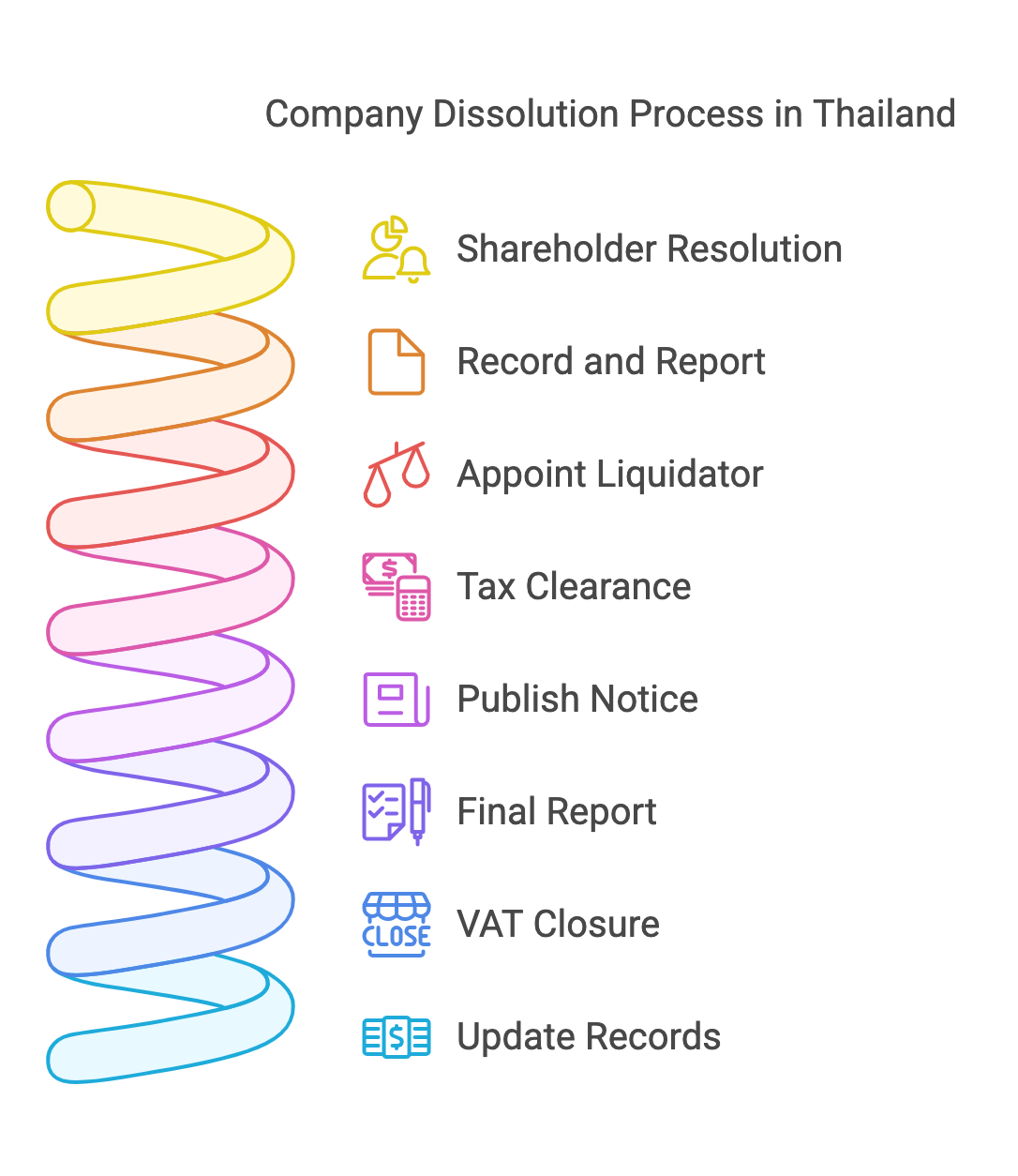
Additionally, companies must publish a formal dissolution notice in a local newspaper to inform creditors and other interested parties. Once all debts and taxes are resolved, the final liquidation report is submitted to the DBD, leading to official company deregistration.
If the company is registered for Value-Added Tax (VAT), it must be considered when closing a Thai company. the VAT registration must also be closed with the Revenue Department. Before doing so, all past due VAT returns must be filed and any outstanding VAT liabilities settled.
Companies must also make sure that all past financial statements and accounting records are current. This includes any missing reports from earlier years. Even if the company has not been actively trading, failure to submit required filings can delay the dissolution process. A final financial audit is usually required before obtaining tax clearance.
Step-by-Step Guide to Closing a Company in Thailand
The process starts with a formal shareholder meeting. At least 75% approval is needed to pass the dissolution resolution. This decision is then filed with the DBD, along with the appointment of a liquidator.
Once appointed, the liquidator takes over company affairs, ensuring that all financial matters, including debts and taxes, are settled. The Revenue Department plays a key role in this stage, conducting audits and verifying that all outstanding tax obligations are met before issuing a tax clearance certificate.
After financial and tax matters are resolved, a liquidator will oversee the distribution of remaining assets. public notice of dissolution must be published in a newspaper. Creditors can submit claims before the liquidation process is complete. This ensures that all unpaid debts are handled.
Finally, the liquidator prepares a closing report detailing the settlement of all assets and liabilities. This report is sent to the DBD with the needed legal papers. Once approved, the company is officially deregistered. This completes the closure process.
There is no single timetable for every company closure. We provide a case-specific estimate after reviewing the company records, accounting position, outstanding liabilities and proposed work. Do not treat registration of dissolution and completion of the entire closure as the same milestone.
Challenges When Closing a Company in Thailand
Many business owners do not realize how long it takes to get tax clearance. This can be the hardest and longest part of the process. The Revenue Department looks closely at a company’s tax history. Any mistakes or unpaid taxes can delay the process for a long time.
Unresolved debts and creditor claims can also slow down the company liquidation process. Even minor compliance issues, such as missing corporate filings, can create additional hurdles. Employee pay, including severance and social security, must be fully paid to avoid legal issues after closure.
Legal Basis for the 75% Shareholder Approval Requirement
The requirement that at least 75% of shareholders must approve the dissolution of a company is stated in the Thai Civil and Commercial Code outlines the procedures for company liquidation in a Thai limited company. (CCC), Section 1194.
Section 1194 of the Civil and Commercial Code states:
“A limited company may be dissolved by a special resolution of a general meeting.”
A special resolution in a Thai limited company requires approval. At least 75% of the votes from shareholders at the meeting must agree. This is defined in the Civil and Commercial Code for Thai companies. Section 1178 of the Civil and Commercial Code.
These provisions establish the legal basis for the shareholder approval required for company dissolution.
Company closure: our service, fees and documents
Before quoting for a company closure, we review the company records, assets, debts and accounting position. Tell us whether you want to close the company completely or change its directors, shareholders or capital. These are different instructions.
An initial consultation costs 2,000 THB per hour. Further corporate work is quoted after reviewing the records. The consultation fee is not a fixed-price company-closure package. We confirm availability, the agreed work and the total payable before accepting the instruction.
Send the current company affidavit, shareholder list, latest accounts and details of outstanding filings. Identify the directors and authorised signatories, the company’s province, its assets and debts, any employees, and any current disputes. Explain your preferred completion date.
Accounting and tax filing are separate. ThaiLawOnline does not provide those services. An accountant must handle the accounting and tax-compliance work. Our written quote identifies the legal work included; do not assume accounting, tax filings or company-asset transfers are included.
We confirm the timetable after reviewing the records and proposed route. Missing accounts, unresolved liabilities and additional work identified during review affect the estimate. We do not promise a completion date before assessing the file.
Book an initial consultation, or compare our published legal fees. When booking, state “company closure” and identify the records already available.
Faqs about closing a company in Thailand:
What is the process for closing a Thai company through liquidation?
To close a Thai company through liquidation, you must follow several steps. First, hold a meeting to pass a resolution to dissolve the company. Next, appoint a liquidator. Then, notify creditors. Finally, settle debts and distribute the company’s assets. Legal and accounting services in Thailand must be enlisted to ensure compliance with company law.
Q: What are the reasons a limited company in Thailand might need to close?
A limited company in Thailand may need to close for several reasons. These can include ongoing financial losses, trouble running the business, or a choice to shut down. Voluntary liquidation is often pursued when the company directors decide that it’s no longer feasible to continue business operations.
How can outstanding debts affect the liquidation and dissolution process?
Outstanding debts must be settled before the liquidation and dissolution process can be completed. Creditors have the right to claim the assets of the company to satisfy any outstanding debts. If a company cannot pay its debts, the court will choose a liquidator. The liquidator will manage the distribution of assets.
What role does a liquidator play in closing a company in Thailand?
A liquidator must be appointed to wind up the affairs of the company. The liquidator’s responsibilities include collecting and liquidating the company’s assets, paying off debts, and distributing any remaining assets to the shareholders. They ensure that the company closure complies with all legal requirements.
Are there any obligations for company directors during the company closure process?
Company directors have important duties during the company closure process. They must hold a meeting to pass a resolution for dissolution. They also need to notify all creditors. Finally, they must accurately report the company’s financial affairs. Directors must also ensure compliance with Thai company law throughout the process.
What is the difference between voluntary liquidation and court-ordered liquidation?
Voluntary liquidation starts when the company directors decide to close the company. This often happens for financial or strategic reasons. Court-ordered liquidation happens when a creditor asks the court for help because the company can’t pay its debts. The court then appoints a liquidator to handle the process.
How does closing down a business in Thailand affect company employees?
To close a business in Thailand, you must honor all employee contracts. This includes severance payments and other legal rights. A full and final release signed by each employee after the employment has ended can settle those claims; see the rules on severance pay waivers and exit releases in Thailand. Employees must be notified in advance of the company closure, and all obligations towards them must be settled before the business operations are fully terminated.
Does ThaiLawOnline’s company-closure service include accounting and tax filing?
No. We assess and quote for the agreed legal work. Accounting and tax filing must be handled by an accountant. Send your latest accounts and filing status at the outset so the legal scope and timetable reflect the work still outstanding.
How does the decision to close a business in Thailand impact its shareholders?
Closing a business in Thailand affects shareholders. It may lead to distributing any leftover assets after paying all debts. Shareholders should be part of the decision-making process. They need to vote on the resolution to dissolve the company.
What steps must be followed to officially notify the closure of a Thai company?
To officially close a Thai company, the company must inform the Department of Business Development. It must also notify other relevant authorities. All outstanding tax obligations must be settled. Finally, all creditors need to be informed. These steps are crucial for legally completing the company closure process.
Links:
Thai Law Updates, free by email
Plain-English updates on Thai law changes that affect foreigners: property, visas, marriage, business and wills. One short email a month from a firm practicing since 2006. No spam, unsubscribe anytime.