


Reviewed by ThaiLawOnline, a licensed Thai law firm practising in Thailand since 2006. Thai lawyer of record: Wichuda Atthamethakon, LL.M., Thai Bar Licence 3149/2556.
Last updated on
To renew a retirement extension in Thailand you file form TM.7 at your immigration office before your current permission to stay expires (most offices accept the application 30 days ahead, Chaeng Watthana in Bangkok up to 45 days), with your passport, TM.30 receipt, a bank letter and statement showing 800,000 THB for the required months, or proof of 65,000 THB monthly income, and you pay 1,900 THB. You must be 50 or older; you do not need to be retired at home. This guide covers the first extension and every yearly renewal after it.
Last reviewed: 31 August 2026. Clause 2.22 of the annex to Order of the Royal Thai Police No. 654/2564 was read criterion by criterion from the Government Gazette text (volume 139, special part 17 Ngor, page 16, 24 January 2022; the order sets its own commencement at 1 October 2022): the age condition, the 65,000 THB income route, the 800,000 THB deposit route with its two-month and three-month periods and its 400,000 THB floor, the combined route, and the insurance condition that applies to Non-Immigrant O-A holders only. That order was repealed on 26 September 2023, and the criteria it carried now sit in clause 2.22 of the table annexed to Immigration Bureau Order No. 12/2568 of 23 January 2025, read in Thai on 15 September 2026; this paragraph records what was read on 31 August and is left as it was written. Sections 37(5) and 76 of the Immigration Act B.E. 2522 were read in Thai from the consolidated text. Penal Code sections 137, 144, 251, 252, 264, 265 and 267 were each read against the Thai text in our own annotated Code, on the rates as amended in 2017. Supreme Court Decisions 2752/2519, 1047/2514, 4048/2528, 1430/2537, 2141/2532 and 1955/2546 were read in full in Thai, to the final disposition. On 3 October 2026 sections 37, 38 and 77 of the Immigration Act were read in Thai for the TM.30 and 90-day passages; the 15-day and 7-day reporting window is Immigration Bureau practice, not a figure in the Act. Re-checked on 6 October 2026: Immigration Act sections 76 and 77 and Penal Code sections 137, 144, 251, 252, 264, 265, 267 and 268 re-read in Thai; every penalty stated matches; nothing changed.
Download the official TM.7 form (PDF, 2 pages, Thai and English), the Immigration Bureau’s “Application for extension of temporary stay in the Kingdom”, mirrored here and checked August 2026. It is the same form for a retirement, marriage, work or study extension.
Two words are used loosely and it matters: a visa is issued abroad (or online through the Thai e-Visa portal) and gets you into Thailand; an extension of stay is granted inside Thailand, at an immigration office, and is what you renew every year.
Retirement is one of several extensions available; compare them with our Thai visa finder.
Retirement extension renewal checklist 2026
This is what immigration offices ask for when you renew a one-year extension of stay based on retirement. Individual offices add items (a hand-drawn map, extra photocopies, a Thai phone number), so confirm with your own office a few weeks before you file.
| Item | Detail |
|---|---|
| Form TM.7 | Completed and signed, with one passport-size photo (4 x 6 cm) glued to it. Download the official PDF above. |
| Fee | 1,900 THB, paid in cash at the counter when the application is accepted. |
| Passport | Original, plus signed photocopies of the photo page, current visa or extension stamp, latest entry stamp and TDAC or TM.6 record. |
| Financial proof, deposit route | Thai bank book and a bank letter dated within a few days of filing, showing 800,000 THB held for at least 2 months before filing, and a statement covering that period. The balance must then stay at 800,000 THB for 3 months after permission is granted. |
| Financial proof, income route | Evidence of at least 65,000 THB a month: an embassy income letter where your embassy still issues one, or 12 months of Thai bank statements showing monthly transfers from abroad. |
| Financial proof, combined route | Deposit plus annual income totalling at least 800,000 THB, documented as above. |
| TM.30 receipt | The notification of residence filed by your landlord or by you as owner. Bring the receipt or the printout from the online system. |
| Proof of address | Lease, house book (tabien baan) or ownership document, and at many offices a hand-drawn map to your home. |
| Health insurance | Only if your entry was on a Non-Immigrant O-A visa: cover of at least 3,000,000 THB or USD 100,000. Not required for an extension following a Non-Immigrant O entry. |
| When to file | Up to 30 days before your current stamp expires at most offices, 45 days at Chaeng Watthana in Bangkok. The new year runs from the old expiry date, so filing early costs you nothing. |
| After approval | Buy a re-entry permit (1,000 THB single, 3,800 THB multiple) before any trip abroad, and keep filing the 90-day report with the TM.47 form. |
Renewing a retirement extension in Pattaya or Jomtien
If you live in Pattaya, Jomtien or elsewhere in Bang Lamung, you renew at the Chonburi Provincial Immigration office on Soi 5, Jomtien Beach Road, not in Bangkok. You file at the immigration office responsible for the address on your TM.30, so a Pattaya address means the Jomtien office. The financial criteria are the national ones in the table above: 800,000 THB held for 2 months before filing and 3 months after approval, 65,000 THB a month, or a combination. What the Jomtien office sets for itself is the checklist around those criteria, such as how recently the bank letter must be dated and how many signed photocopies it wants, and it changes from time to time. Ask at the counter or check a recent local report before you go, and bring every item in the table, because a missing photocopy usually means a second trip.
Staying in Thailand for more than 90 days has special rules. You must notify your address when you arrive. The building owner must also inform the authorities that you are there (TM 30). If you need to leave Thailand during your visa or extension, you may need a multiple entry visa or a re-entry permit.
Table of Contents
Written by Sébastien Brousseau, with help from the "Expats in Isaan" group on Facebook and some Thaivisa members. (Many rules were changed in 2019 and we invite you to read this article to be familiar with these new rules)
For many visitors to Thailand, a short holiday simply isn’t enough to enjoy all the country has to offer. If you want to stay longer than 3 months, you can extend your visa. You must meet the requirements from the Royal Thai Immigration. A retirement visa might be the right choice for you. You don’t have to move to Thailand for good. However, renewing your visa each year lets you stay in the Kingdom for many years. Here’s how to do it. You also do not need to be officially retired in your country but you must be 50 years-old or older.
Which Visa Do You Need Before a Retirement Extension in Thailand?
There are several ways to apply for a retirement visa. This text aims to help you. Immigration rules can be confusing and may differ from one office to another.
If you have not chosen a route yet, our guide to the financial requirements of the three retirement routes compares the Non-Immigrant O extension, the O-A and the O-X on how much money each one locks up and for how long. That comparison is the decision most people get wrong before they ever reach this page.
1. Applying for Non-Immigrant O-A (long stay) your home-country
From your home country or where you live, you can apply for a Non-Immigrant O-A visa. This visa allows you to stay in Thailand for one year. You need to show proof that you are 50 years old or older. You also need to meet the financial eligibility criteria.
The rules for extending an OA Visa for retirement and an O-retirement Visa are the same. The only difference is the new health insurance requirement.
An OA Visa is valid for a full year (Visa validity date). When you enter Thailand on an OA Visa you will be stamped in for a full year. Each time you re-enter Thailand before your visa expires, you will get a new stamp. This stamp allows you to stay for a full year. It is therefore recommended to exit and re-enter Thailand just before your Visa validity expires.
In the second year after your Visa expires, you need a re-entry permit. This permit is required when you leave and come back to Thailand. It helps keep your permission to stay valid until your current date. And it is only at the end of the permission to stay, that you need to apply for an extension of stay.
What Documents Do You Need for a Retirement Extension in Thailand (TM7 Form)?
What is mentioned below is typically required, but requirements differ dependent on country of application. Be careful: many people talk about “retirement visa Thailand”. In Thailand, you will need to “extend your visa” every year, extend the first visa or permission you had when you entered. The following documents are required:
1. Passport with at least 18 months’ validity
2. Three copies of the completed visa application form (TM 7 form)
3. Three passport-sized photos (4x6cm) taken within the past 6 months
4. Personal information form (Curriculum Vitea or resume, I never seen that in the rules but immigration can ask you any “relevent” document)
5. Copy of your bank statement showing an amount of 800,000THB or more, OR a certificate proving that you have a monthly income
You need a pension of 65,000 THB or more. Alternatively, you can show a mix of bank deposits and monthly income. This total must be at least 800,000 THB. Certain consulates or embassies can ask to notarize your bank account again verify with them.
6. Letter of guarantee from your bank (to guarantee bank statement accuracy)
IMPORTANT: The letter of guarantee for the funds deposited and relevant bank statements must be certified by a commercial bank in Thailand and should be recent (normally few days old only) This is not necessary everywhere, and would actually be difficult when applying from abroad for the OA Visa.
7. Notarized letter from your home country (or official country of residence) stating that you have no criminal record.
8. Medical certificate from a hospital in the country where you submit your application
it should show that you have no prohibitive diseases. The certificate should be recent (valid for not more than 3 months) and might have to be notarized. A letter or statement signed by your doctor is also acceptable in some countries.
9. Insurance
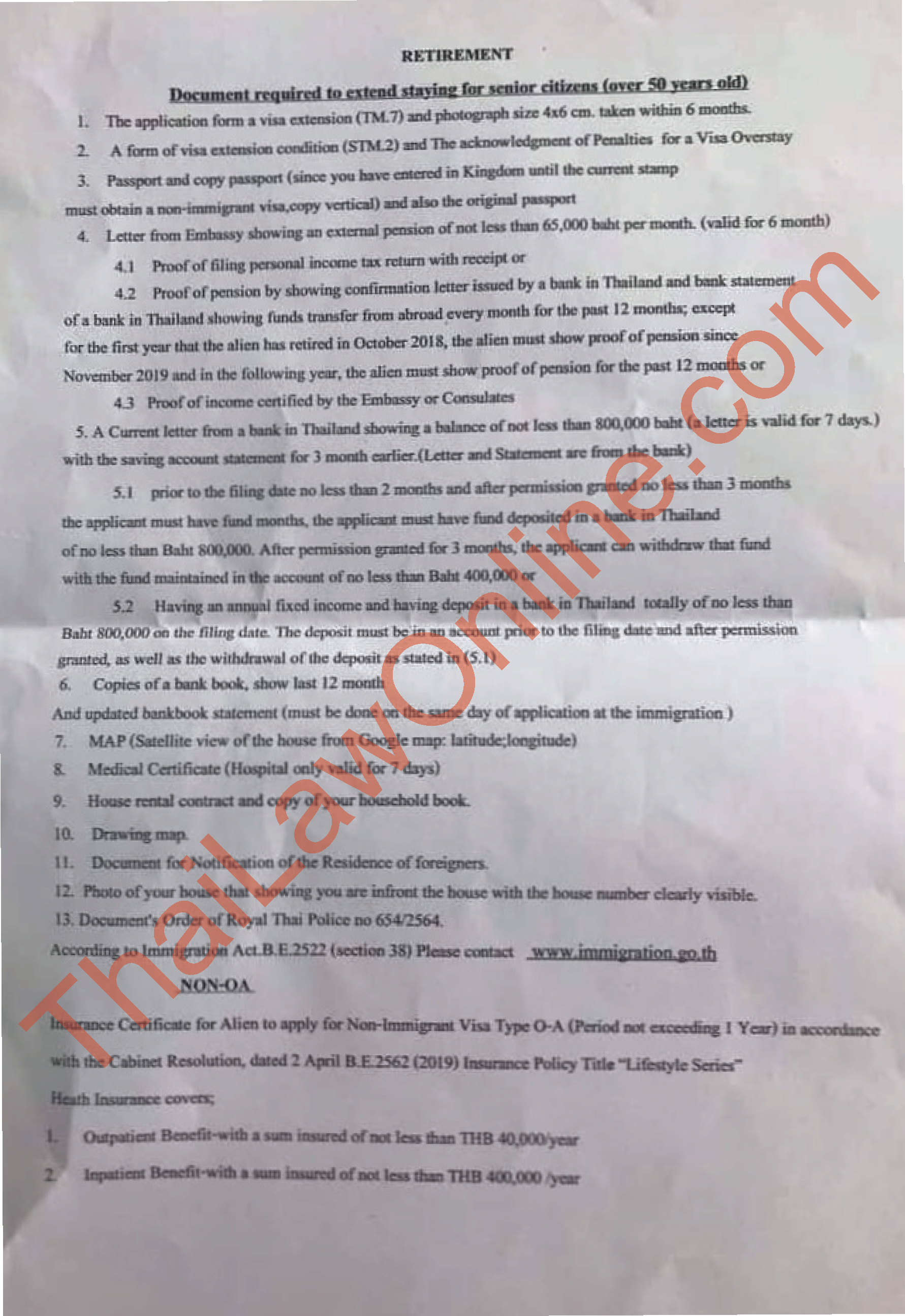
Health insurance is mandatory for the Non-Immigrant O-A visa. It is not a statutory requirement for a retirement extension based on a Non-Immigrant O entry, though we recommend cover regardless. The requirement runs on two tracks: at issuance abroad the Ministry of Foreign Affairs has accepted Thai or non-Thai insurers since 31 October 2019, with the 3,000,000 THB / USD 100,000 COVID layer added from 1 October 2021; at extension inside Thailand, criterion 2.22(6) of the table annexed to Immigration Bureau Order No. 12/2568 of 23 January 2025 permits Thai or non-Thai cover of not less than USD 100,000 or 3,000,000 THB. A foreign policy needs either a certification from the embassy of that country in Thailand or a notarised certificate of the signature on the document from your own Ministry of Foreign Affairs, in the form the Ministry of Public Health prescribes: item 5.2 of the same table gives both routes, and the embassy route is usually the shorter one for someone already in Thailand. That condition first applied inside Thailand on 1 October 2022, under Order of the Royal Thai Police No. 654/2564 (signed 27 December 2021, Government Gazette volume 139, special part 17 Ngor, page 16, 24 January 2022), which was repealed with its parent order on 26 September 2023. Criterion 2.22(6.1) requires a Thai policy to be bought online through the website below, and item 5.1 makes the same site the place to verify an approved Thai policy. Approved Thai insurers are listed at:
https://longstay.tgia.org/
The policy must cover the entire stay in Thailand. It must provide total coverage of at least 3,000,000 THB, or USD 100,000. This replaced the old split requirement of 40,000 THB outpatient and 400,000 THB inpatient, for new applications from 1 October 2021 and, at extension inside Thailand, from 1 October 2022 under Order of the Royal Thai Police No. 654/2564.
Who the O-A insurance requirement applies to
This only applies to people who have a 1-year Non-Immigrant O-A visa. You will be permitted to stay only for the length of the insurance coverage and not exceeding one year.
Overseas insurance is accepted. However, your insurer must give you a filled-in and signed Foreign Insurance Certificate. This visa is granted for 1 year.
2. Non-Immigrant O for reason of retirement (if available in your country)
The second option is to apply for a Non-Immigrant ‘O’ visa. You must apply online since 1st January 2025. There are many reasons to apply for a non-O visa. For example, being married to a Thai person can change your financial obligations. It can also affect the documents you need to submit.
You must be over 50 years old. You also need bank statements that show an income of more than 65,000 THB per month. Alternatively, you can show a total account balance of 800,000 THB when you apply.
If you are already in Thailand and want to stay, you can change your visa. You can apply to change your 30-day visa exemption or 60-day Tourist Visa. Just go to the Immigration Center in Bangkok. This can be done at any local immigration office in Thailand that provides the service.
The same requirements will apply. When applying in Thailand, you also need to prove that the funds on your Thai bank-account originated from abroad >
Be careful, changing a visa is not easy and must be done at least 15 days before your visa expires.
3. Extending Your Visa (see the immigration link below) or what we call extension based on retirement in Thailand
It is advisable to apply for an extension one month before your visa expires. You should check with your local immigration office. They will tell you when to apply for an extension. Some offices (e.g. Chiang Wattana, government complex in Bangkok) allow up to 45 days.
However, you can apply up to actual permission to stay expiry date. It is best to do this a few days before the expiry date. This way, if your application is incomplete, you can provide any extra documents needed.
To do this, you need to file a TM7 Extension of Stay form just like you would for the Non-Immigrant O visa above. This time, you need to show 800,000 THB in a Thai bank account. Criterion (4) says the deposit must sit in a commercial bank account located in Thailand, and criterion (5) says the same of the deposit part of the combined route, so money held abroad does not satisfy an extension. Showing funds in your home country is only an option when you apply for the visa itself at an embassy or consulate. Alternatively, you can prove a monthly income of 65,000 THB. You can also use a mix of both to reach 800,000 THB or more. This is what we call an “Extension based on retirement in Thailand”.
You need to submit to extend your visa based on retirement:
1) TM.7 application form, which is the form for an extension based on retirement in Thailand or any other extension of stay.
2) Application fee of 1,900 THB
3) Original passport with signed photocopies of each page (2 copies outside of Bangkok)
4) 1 passport-sized photo (2 outside Bangkok)
5) Map to your residence (must be hand-drawn)
6) Financial proof (as discussed above)
Furthermore, when showing 800,000 THB in a Thai bank account, the funds must be seasoned before you file. The Immigration Bureau publishes that figure, and we have now read it. Its bilingual criteria sheet for clause 2.22, Criteria for Consideration of Granting an Alien’s Extension of Stay in the Kingdom for Retirement, states at criterion (4) that the 800,000 THB must sit in a commercial bank account in Thailand for not less than 2 months before the filing date, and for not less than 3 months after permission is granted. The Thai text says the same: ก่อนยื่นคำขอไม่น้อยกว่า ๒ เดือน และหลังจากได้รับอนุญาตไม่น้อยกว่า ๓ เดือน. After those three months you may draw on the account, provided the balance never falls below 400,000 THB.
So the two-month figure is not a rumour; it is what the Bureau itself publishes. We previously told readers to plan on three months because we had not read the primary text, and that reason has gone. Two months before filing is the published requirement. Three months is still the safer margin where your dates allow it, because offices apply the criteria with some latitude and an older three-month-before-filing reading of Order No. 327/2557 is still widely repeated.
⚠️ Currency note, 15 September 2026: both police orders named below are repealed. Order 327/2557 and its amendments, which is the wording Immigration Bureau Order No. 242/2566 uses in its own recital, were repealed on 26 September 2023 by Order of the Royal Thai Police No. 542/2566, so Order 654/2564 went with the parent order. The criteria then passed to Immigration Bureau Order No. 242/2566 (30 September 2023) and now sit in the table annexed to Immigration Bureau Order No. 12/2568 of 23 January 2025. We have read clause 2.22 of that table and the two-month and three-month periods and the 800,000 and 400,000 baht figures are unchanged, so what this page describes still stands and only the citation has moved. The Immigration Bureau sheet described below remains the practical document your office works from.
Source note: this is not only an administrative sheet. The criteria for clause 2.22 were re-issued as the annex to Order of the Royal Thai Police No. 654/2564, published in the Government Gazette at volume 139, special part 17 Ngor, page 16, on 24 January 2022, and criterion (4) of that annex sets the same 2 month and 3 month periods and the same 800,000 and 400,000 THB figures. The Immigration Bureau’s own bilingual sheet, document 7-6 NON-O, states it in Thai and English to the same effect; immigration.go.th refuses requests that arrive from other websites, so that sheet cannot be linked from here and we read it as archived on 4 August 2024. Confirm the current sheet at your own immigration office before you move money.
After 3 months, some money can be withdrawn. But you have to keep at least 400,000THB throughout the duration of permitted stay.
For a monthly income of 65,000THB, you must obtain a Letter for Proof of Income. Sadly, the embassies of the United States, the United Kingdom, Australia, and other countries no longer offer this service. You will need to obtain Proof of Income from your home country. Please consult your embassy as to whether or not they can provide you with a Proof of Income letter.
There are 3 ways of proving that you meet the financial requirements for an Extension based on retirement in Thailand:
- Money-in-bank method (800,000 THB before filing, 400,000 THB kept afterwards, as described)
- Monthly deposits (minimum 65,000 THB every single month with proof that it originated from abroad)
- Income statement or income certificate (with no need to prove money in a Thai bank), for example if you work in Thailand, or whatever document the immigration bureau requires at its discretion.
On top of that there is the combination method (money at bank + incomes)
Some offices ask to see twelve months of bank statements. That is office practice rather than what the Order requires, and the difference matters if you are on the deposit route. Criterion (4) sets periods, not a deposit history: the 800,000 THB must stand in the account for not less than 2 months before you file and for not less than 3 months after permission is granted. The twelve-month frame belongs to the other two routes, where an annual figure is what you are proving.
Criterion (3) is evidence of income of not less than 65,000 THB a month. Criterion (5) is income over the year together with a deposit in a commercial bank in Thailand, calculated together at not less than 800,000 THB as at the date you file. On that combined route the deposit must stand before you file and after permission is granted, exactly as on the deposit-only route. 🔴 What is NOT the same is how far you may draw it down. Criterion (4), the deposit-only route, sets a flat floor of 400,000 THB. Criterion (5), this combined route, requires the account to keep not less than half of the deposit (กึ่งหนึ่งของจำนวนเงินฝาก), which is a proportion and not a fixed sum. On a 700,000 THB deposit that is 350,000, so a retiree who drew down to 400,000 on the strength of the other route would be comfortably above it; on a 300,000 THB deposit it is 150,000. ⚠️ The order this page used to cite was silent on the point: Order 654/2564 states a residual figure only in criterion (4), and the half-the-deposit rule is express in the current table, not inherited from it.
7) Purchase a health insurance policy (Only for Non-OA visa) to cover your extension of stay for up to one year from one of the participating companies.
Overseas insurance can be accepted, but you will need to complete the form at this link:
https://longstay.tgia.org/document/overseas_insurance_certificate.pdf
4. Applying for Extension based on retirement in Thailand when you are already here:
4.1 You can apply for a Non Imm O visa. Please note that starting January 1, 2025, you cannot apply at embassies or consulates. You apply online at the Thai website : https://www.thaievisa.go.th/ and you will get the answer by email.
You can must follow the rules and requirements.
The non-O visa does not require insurance like the Non-OA visa. However, most other requirements are similar. So if you do not wish to meet the requirement for insurance, you should switch your Non-OA visa for Non-O.
5. Staying in Thailand on a valid Visa or permission to stay
5.1 90-day reporting requirement
If you have a visa or extension in Thailand, you must report to Immigration every 90 days. This rule applies unless you leave Thailand before the 90 days are up. You file the TM.47 form for the 90-day report, which shows that you are still in Thailand and living at the same address.
There is no fee for these check-ins. You can also file the TM47 form at an immigration office from 15 days before your 90-day due date until 7 days after it, or online only within the 15 days before it. Report later than that and you are fined under section 76. There are several options to report your 90 days notice, and the Thai immigration website described them
5.2 Need for re-entry permits in Thailand
If you want to leave Thailand and come back after your visa has expired, you need a permit. This applies if you have a one-entry visa or are on an extension of stay. If you are on an extension, you must buy a single re-entry permit for 1,000 THB. A multiple re-entry permit will cost you 3,800 THB.
You can do this at any local IO or in the departure halls of major Thai airports. Make sure to complete it before leaving Thailand. The single and multiple re-entry permits are done with the TM8 form. When you return to Thailand after your Visa has expired, you need a re-entry permit. This permit allows you to keep the permission to stay that your Visa gave you.
5.3 TM30 requirement
Separately from the 90-day report, the place where you live must be notified to immigration on form TM.30. This has nothing to do with the 90 days: it is due when you move in.
The duty is not yours but your host’s. Under section 38 of the Immigration Act the householder, the owner or occupier of the dwelling, or the hotel manager who takes you in must notify the immigration office for that area within 24 hours of your moving in (in Bangkok, the Immigration Bureau); it can be filed in person or online. Section 77 fines a householder or owner up to 2,000 THB for failing to do so, and a hotel manager from 2,000 to 10,000 THB. Whether a fresh TM.30 is needed each time you come back from another province is office practice and varies.
After the property owner submits the form they will receive a receipt regarding your residence. This receipt must be kept safe with you. You can easily staple it into your passport.
This receipt is very IMPORTANT. DO NOT LOSE IT. You will need it for re-entering the kingdom or for when you need another Non-Immigrant O-A visa extension.
Do note that local immigration office do not follow the same rules for TM30.
In addition to the 1-year Non-Immigrant O-A visa based on retirement, there is a 5-year option as well.
6. FIVE YEARS NON-IMMIGRANT O-X VISA
The Non-Immigrant O-X visa for retirees runs for 10 years, issued as an initial 5 years and renewable for a further 5. It is open to nationals of 14 specified countries. It shares much with the 1-year O-A visa but carries materially different financial and insurance obligations.
They are as follows:
- A deposit of 3,000,000 THB in a Thai bank account, or a deposit of 1,800,000 THB plus annual income of not less than 1,200,000 THB. The official texts express the income limb as an annual figure of 1,200,000 THB, which works out at 100,000 THB a month. Once you have entered Thailand, the full 3,000,000 THB must be accumulated in a Thai bank account within one year.
- Health insurance. The O-X base requirement is a Thai policy approved by the Office of Insurance Commission at not less than 40,000 THB outpatient and 400,000 THB inpatient per policy year. Since 1 October 2021 several consular posts have additionally applied the 3,000,000 THB / USD 100,000 COVID layer to O-X, and at least one post accepts foreign insurers using the Foreign Insurance Certificate. The base instrument has not been amended to match the O-A figure: the O-X category was created by a Ministry of Interior Notification made under the Cabinet resolution of 22 November 2016, published in the Government Gazette at volume 134, special part 157 Ngor, page 33, on 12 June 2017, and clause 1(5) of that notification still reads 40,000 THB outpatient and 400,000 THB inpatient. Official sources are not uniform, so confirm with the post handling your application. Do not assume the O-X and O-A thresholds are identical.
An additional requirement is that you must obtain a re-entry permit after the visa has been approved.
Watch the O-X revocation conditions, which are rarely written about. Permission is revoked if the balance falls below 3,000,000 THB at the end of the first year, or below 1,500,000 THB at the end of the second year, or if the money is spent outside Thailand. That third limb is an independent trigger, not a gloss on the balance test. Withdrawals after the first year are expected to be for domestic expenses such as medical treatment, housing, a vehicle or children’s education.
Likewise, you may need to provide a police clearance certificate in Thailand or background check, and/or a medical certificate as well.
This is a new class of Non-Immigrant visa and not much is currently well-understood about the entire process.
Helpful Hints
You must now apply online for your visa and once in Thailand, you extend your visa. Do understand the difference between a visa and an extension.
Some offices may require you submit a copy of your passport legalized by the Thai Ministry of Foreign Affairs. That is rare but each immigration office has discretion to require some documents. Before you submit any paperwork be sure to get a current list of requirements from your local immigration office.
To be exact, because this one is often garbled: a retirement extension lets you stay a year at a time, and the 90 day rule is a reporting duty, not a limit on your stay. Section 37(5) of the Immigration Act B.E. 2522 requires an alien who is permitted to stay temporarily and who remains in the Kingdom beyond 90 days to notify the immigration officer of their address once the 90 days are complete, and again every 90 days after that. Permanent residents are outside this duty. The penalty is in section 76: a fine of not more than 5,000 THB, and a further fine of not more than 200 THB for each day until you report.
Employment is prohibited on the retirement visa and Extension based on retirement in Thailand.
For over-50s, the retirement visa and extensions based on retirement are great options. They help you stay in Thailand long-term and enjoy this beautiful country. If you have the money and keep your paperwork organized, you can use the retirement extension. This will help you create a great life after work in Thailand.
For policy updates and announcements please check https://www.immigration.go.th/announce
While they are in the Thai language, many often have an English translation in the PDF reader. Look for announcements with the words “non-immigrant” in the heading.
=================================
If you never did an extension of visa and live in Bangkok, Phuket, Pattaya, there are tons of agencies doing that. But once you do it once by yourself, think that each year will be similar. We encourage you to learn the process so you will save money. The first time is the most difficult but after, it should be exactly the same. Do not wait the last day to apply for your extension.
You can apply 30 days in advance so if something is missing, you have plenty of time to correct the problem. If you really want us to help, we can do extensions in Bangkok and several other places for about 20,000 baht. Contact us at info@thailawonline.com
- Immigration Bureau, Visa Extension, item 22 In the case of retirement. The Bureau refuses requests that arrive from other websites, so it cannot be linked directly; search for Visa Extension on immigration.go.th, or read the archived copy of 4 August 2024
Agents, borrowed bank balances, and what the Penal Code actually says
Every year some applicants are offered a shortcut: an agent who will “season” a bank account, or lend a balance for the weeks the rule requires, or simply file paperwork that says the money was there. It is worth being precise about what that is, because the exposure is not the visa. It is the criminal code, and it attaches to the applicant, not only to the agent.
Three provisions do the work, and the figures below are the current ones as amended in 2560 (2017). Many Thai-language summaries still quote the pre-amendment fines of 1,000 and 6,000 baht.
- Penal Code section 137, giving a false statement to an official where it may cause damage: imprisonment not exceeding six months, or a fine not exceeding 10,000 baht, or both.
- Penal Code section 267, causing an official to record a falsehood in a public or official document intended to be used as evidence: imprisonment not exceeding three years, or a fine not exceeding 60,000 baht, or both.
- Penal Code section 144, offering money or a benefit to an official to induce them to act improperly: imprisonment not exceeding five years, or a fine not exceeding 100,000 baht, or both.
The form and the interview can be two offences, not one. In Decision 2752/2519 a candidate wrote a false military rank on an election application handed to the provincial governor, and then repeated it when the governor took his statement on qualifications. The Supreme Court held these were separate acts: submitting the false form was one offence, and causing the false entry in the record of the investigation was another. Assume a false financial declaration and the questions asked across the counter are treated the same way.
What section 267 needs, and where it fails. Section 267 bites when the official actually records the falsehood in the document. In Decision 1430/2537 a director filed a report of a shareholders meeting that had never taken place so the registrar would record a change of directors, and that was section 267. Decision 4048/2528 shows both sides of that line in a single case. The defendant, a Vietnamese national, had a false entry made in a house registration saying he was of Thai nationality and had moved from an address where he had never been registered: that was section 267, because the falsehood was written into the register. The same defendant also told a district registrar he was Thai in order to obtain an identity card, and there section 267 failed, because the card the official issued carried no statement of nationality at all, leaving only the section 137 offence. The distinction is whether the lie ends up written into the document. The same decision adds a point worth knowing if you are ever questioned: a denial given in the capacity of an accused person is not a false statement to an official, even if what you say is untrue.
Belief matters, and so does timing. In Decision 1047/2514 a village headman relayed to the police what a villager had told him, in the course of his duties and believing it true, and was acquitted: honest belief defeats the intent these offences require. That case was charged under sections 172 and 174, which cover a false report of an offence rather than section 137, but the point about intent is the same. That is genuinely useful to the applicant who miscalculates a pension in a moving exchange rate rather than setting out to deceive. It will not help the applicant who knows better. In Decision 1955/2546 defendants who knew perfectly well their father had sold the land reported the title document lost so they could obtain a replacement, and the court found intent, not its absence. And under Decision 2141/2532 the offence is complete on the day the false statement is made, not on the day anyone discovers it.
Forgery is the heavier charge, and it is the one being laid. Sections 137, 267 and 144 are about what you say. A bank letter or statement that an agent manufactures is a forged document, and that is a different and heavier set of offences. Making one is section 264: imprisonment not exceeding three years, or a fine not exceeding 60,000 THB, or both. Using or citing it is section 268, which carries the penalty of the section forged, so filing the document is punished like making it. Forgery of an official document or a document of right is section 265, six months to five years and a fine of 10,000 to 100,000 THB. Where an official seal is faked, section 251 covers making it and section 252 using it, at one to seven years and a fine of 20,000 to 140,000 THB. Read those last two carefully: the prison terms are minimums rather than maximums, and the fine is additional to the term, not an alternative to it. The Immigration Bureau has publicised raids on agencies preparing forged bank paperwork, most recently in August 2026, and the offences announced in those cases are these forgery sections rather than the false statement ones.
The practical rule is short. Meet the test with your own money, on your own timeline, or use a route you actually qualify for. If the numbers do not work this year, the honest options above are cheaper than a criminal record and a blacklist.
Frequently Asked Questions
How much money do I need in the bank for a Thai retirement extension?
You must show 800,000 THB in a Thai bank account, OR proof of a monthly income of at least 65,000 THB, OR a combination of deposit and annual income totalling 800,000 THB. On the seasoning period, the Immigration Bureau publishes the criteria for clause 2.22(4) in Thai and English: the deposit must sit in the account for not less than 2 months before the filing date and not less than 3 months after permission is granted, after which you may draw on it but must keep at least 400,000 THB. We have read that sheet. An older three-month-before-filing reading of Order No. 327/2557 is still widely repeated, so allow three months if your dates permit.
What do I need to renew my Thai retirement extension?
Form TM.7 with a photo, your passport and photocopies, the 1,900 THB fee, your TM.30 receipt and proof of address, and financial proof: 800,000 THB seasoned in a Thai bank, 65,000 THB a month of income, or a combination totalling 800,000 THB. File up to 30 days before your stamp expires (45 days at Chaeng Watthana), then buy a re-entry permit before you travel.
What is the minimum age for a retirement visa extension in Thailand?
You must be 50 years of age or older on the date you apply for the extension of stay based on retirement.
Can I work in Thailand on a retirement extension?
No. An extension of stay based on retirement does not authorise employment. To work legally you need the correct visa category and a separate work permit.
How often do I need to renew a Thailand retirement extension?
The extension is granted for one year at a time and must be renewed annually at your local immigration office before it expires.
Do I still need to do 90-day reporting on a retirement extension?
Yes. You must report your current address to immigration every 90 days. This is separate from, and in addition to, your annual extension of stay.
What is the difference between a retirement visa and a retirement extension?
A Non-Immigrant O or O-A visa is obtained from a Thai embassy or consulate abroad, while the annual extension of stay based on retirement is processed inside Thailand at an immigration office once you are already in the country.
| Requirement | Amount | Notes |
|---|---|---|
| Bank deposit route | 800,000 THB in a Thai bank account | At least 400,000 THB must stay in the account throughout the permitted stay |
| Monthly income route | 65,000 THB per month | Needs a Letter for Proof of Income |
| Combined route | Deposit plus income totalling 800,000 THB | Same seasoning as the deposit route, but the drawdown floor is half the deposit, not 400,000 THB |
| Health insurance | Non-Immigrant O extension: none. O-A: at least 3,000,000 THB, or USD 100,000 | The extension of stay itself carries no insurance condition. The requirement attaches to the O-A visa, and applies at extension inside Thailand under criterion 2.22(6) of the table annexed to Immigration Bureau Order No. 12/2568, a condition that has applied inside Thailand since 1 October 2022 |
| Re-entry permit, single | 1,000 THB | Needed to keep the extension alive when leaving Thailand |
| Re-entry permit, multiple | 3,800 THB |
Try it yourself first, free
You do not have to book anything to get started. These run in your browser, and you only pay us if you decide you want a lawyer involved.
Thai Visa Finder Free
Answer a few questions and see which Thai visa actually fits your situation.
Open the toolAsk our AI assistant Free
Trained on Thai law and 77,000+ Supreme Court decisions. Ask anything, free.
A retirement extension brings ongoing obligations with it, starting with the 90 day report. Our Thai immigration overview explains how the extension sits alongside the rest of them. Need advice on your situation? Book a one-hour online consultation for 2,000 THB or see our fixed-fee services. Meetings are by appointment only.
Thai Law Updates, free by email
Plain-English updates on Thai law changes that affect foreigners: property, visas, marriage, business and wills. One short email a month from a firm practicing since 2006. No spam, unsubscribe anytime.