Last updated on April 12, 2026
If you are acquiring real estate or developing property in Thailand, understanding the legal framework governing land rights is essential. One of the most important real rights under the Thai Civil and Commercial Code (CCC) is the right of servitude, commonly known in common law jurisdictions as an easement. Governed by Sections 1387 through 1401 of the CCC, a servitude (in Thai : ภาระจำยอม (phara cham yom) determines how landowners may utilize or restrict adjacent properties to maximize land utility, secure access, and safeguard property values.
This guide provides a comprehensive analysis of Thai servitude law for property buyers, foreign investors, real estate developers, and legal practitioners, drawing directly from the statutory provisions, Supreme Court decisions, and official registration procedures at the Department of Lands (กรมที่ดิน).
This article is co-written by Sebastien H. Brousseau (LL.B., B.Sc.) and Wichuda Atthamethakon (LL.M., B.Sc.) Thai lawyer and notary.
Table of Contents
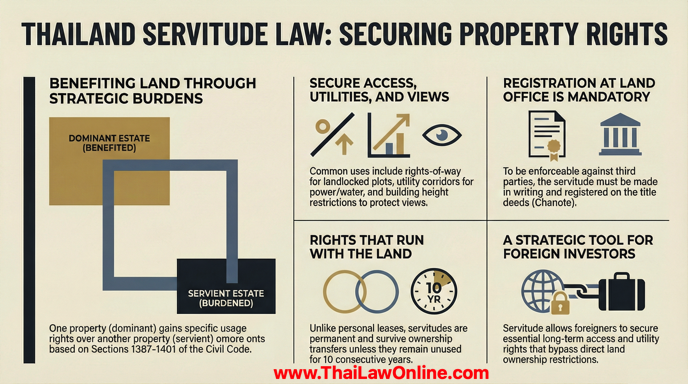
1. What Is a Servitude in Thailand?Under Section 1387 of the Civil and Commercial Code , a servitude is a real right (สิทธิเหนือทรัพย์สิน) whereby an immovable property is subjected to a burden for the benefit of another immovable property belonging to a different owner. The law provides:
Section 1387 CCC: “An immovable property may be subjected to a servitude by virtue of which the owner of such property is bound, for the benefit of another immovable property, to suffer certain acts affecting his property or to refrain from exercising certain rights inherent in his ownership.”
This legal relationship always involves two distinct parcels of land:
The Servient Property (ทรัพย์ภาระ): The land that bears the burden and is legally bound to suffer a certain act or refrain from exercising certain ownership rights.
The Dominant Property (ทรัพย์อันได้ประโยชน์): The land that benefits from the servitude.
Because a servitude is a “real right” (jus in re), it is attached to the land itself rather than the individual owner. This permanence ensures that when either the dominant or servient property is sold, the servitude automatically transfers to the new owners (Section 1393 CCC). This distinguishes it from a mere personal contractual right, which binds only the original contracting parties.
Key Takeaway
A properly registered servitude cannot be cancelled by selling the servient property. The new owner inherits both the land and the burden — making it one of the most secure property rights available in Thailand.
2. Legal Framework: CCC Sections 1387–1401
The entire law of servitudes in Thailand is contained in Title IV of Book IV of the Civil and Commercial Code. Below is a summary of each key provision:
| CCC Section | Subject Matter | Summary |
|---|---|---|
| 1387 | Definition | Defines a servitude as a real right subjecting one property to a burden for the benefit of another. |
| 1388 | Dominant Owner Restrictions | The dominant owner may not make changes that increase the burden on the servient property. |
| 1389 | No Additional Burden | Changes in the dominant owner’s requirements do not entitle additional burdens on the servient property. |
| 1390 | Servient Owner Obligations | The servient owner must refrain from acts that diminish the servitude’s utility or convenience. |
| 1391 | Maintenance | The dominant owner may maintain the servitude at their own expense, causing minimal damage. If the servient owner also benefits, costs are shared proportionally. |
| 1392 | Relocation | The servient owner may request relocation of the servitude to another part of the property if it benefits them and they bear the cost. |
| 1393 | Transfer | A servitude follows the dominant property when sold; it cannot be transferred apart from the dominant property. |
| 1394 | Division of Servient Property | If the servient property is divided, the servitude continues to burden each part (unless it cannot be exercised on a particular part). |
| 1395 | Division of Dominant Property | If the dominant property is divided, the servitude continues for each new plot. |
| 1396 | Co-Owners | Servitudes acquired by one co-owner of the dominant property are deemed acquired by all co-owners. |
| 1397 | Destruction | A servitude is extinguished by total destruction of the servient or dominant property. |
| 1398 | Merger of Ownership | If both properties come under the same owner, the owner may cancel the registration; the servitude continues to exist with respect to third persons until cancelled. |
| 1399 | Non-Usage | A servitude is extinguished by non-usage for 10 consecutive years. |
| 1400 | Cessation of Benefit | Extinguished if it ceases to benefit the dominant property, but revives if conditions permit enjoyment again (within the 10-year prescription period). |
| 1401 | Acquisitive Prescription | A servitude may be acquired by prescription (10 years of peaceful, open, and continuous use). |
3. Types of Servitudes in Thailand
Servitudes can be tailored to a wide range of socio-economic and property needs. The most common types registered in Thailand include:
3.1 Right of Way (Access Servitudes)
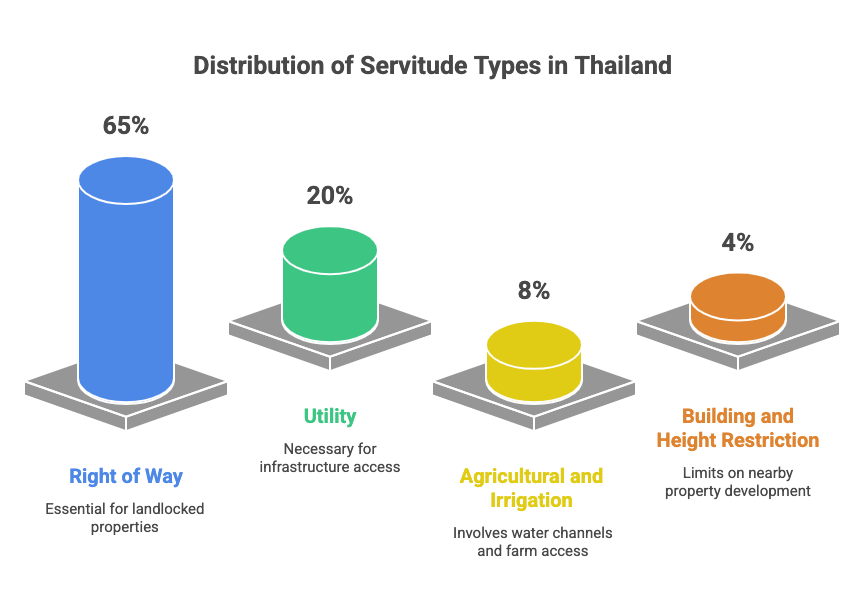
These are among the most common servitudes (often estimated to comprise a majority of registrations based on legal practice), allowing the dominant estate to pass over the servient estate — whether by pedestrian or vehicular access — to reach a public road. This is by far the most frequently litigated type of servitude in Thai courts.
3.2 Utility Easements
These are also prevalent (often estimated at around 20% of registrations based on anecdotal data from land offices), granting the right to lay water pipes, drainage systems, electricity lines, and telecommunications cables across a neighbor’s land. Section 1352 CCC provides a statutory right for a landowner to lay conduits, pipes, or cables through a neighboring property when no alternative route exists and the work is technically necessary.
The owner exercising this right must cause the least possible damage to the neighboring land and must pay fair compensation to the affected owner. Unlike a contractual servitude, this statutory right arises by operation of law, but it is still advisable to register it at the Land Department to ensure enforceability against future purchasers of the neighboring property.
3.3 Negative Servitudes (Building and Aesthetic Restrictions)
These prohibit the servient owner from performing certain acts, such as building a structure above a specific height to preserve the dominant property’s sea view, or restricting the property from generating industrial noise. These are particularly valuable in condominium developments and luxury residential areas.
3.4 Agricultural and Drainage Servitudes
The right to channel irrigation water or natural runoff through the servient property. Related provisions in Sections 1339–1340 CCC govern natural water flow between properties.
4. How to Establish a Servitude in Thailand
Under Thai law, a servitude can be created through three primary mechanisms:
4.1 By Agreement (Juristic Act) — Section 1299 CCC
This is the most secure and common method. The owners of both properties execute a written agreement specifying the rights, restrictions, location, and any compensation. To be enforceable against third parties, the agreement must be registered in writing at the Department of Lands.
Section 1299 CCC: “Subject to a provision of this Code or other laws, no acquisition by juristic act of immovable property or of real right appertaining thereto is complete unless the juristic act is made in writing and the acquisition is registered by the competent official.”
An unregistered servitude agreement is only a personal contractual obligation between the original signatories. It cannot be enforced against good-faith purchasers of the servient property.
4.2 By Prescription (Long-Term Use) — Section 1401 CCC
A servitude may be acquired by acquisitive prescription if a person peacefully, openly, and continuously uses another’s property for a specific benefit (such as a pathway) for an uninterrupted period of 10 years (applying Section 1382 CCC by analogy). The use must be:
- Peaceful — without force or threat
- Open — not concealed
- Continuous — uninterrupted for the full 10-year period
- As of right — not by permission (permissive use does not create prescription)
How? You must file a civil case at the Provincial Court (ศาลแพ่ง), serve all neighboring owners, and present evidence of peaceful/open/continuous use over 10 years. The average timeline is about 1 year and costs 20,000–100,000 THB in court fees plus legal fees.
4.3 By Operation of Law / Court Order
In certain situations, Thai courts may impose a servitude to ensure a property remains accessible and usable. This commonly arises in:
- Landlocked parcels — where Section 1349 (Way of Necessity) may lead to a formal servitude registration
- Land subdivision developments — where under the Land Subdivision Act B.E. 2543 (2000) and earlier Revolutionary Council Announcement No. 286, roads and utilities within a subdivision become servitudes by operation of law
5. Rights and Obligations: Dominant vs. Servient Owners
The Thai Civil and Commercial Code meticulously balances the rights of both parties. This table summarizes the legal framework:
| Legal Aspect | Dominant Property Owner (Beneficiary) | Servient Property Owner (Burdened) |
|---|---|---|
| Usage Limits | Cannot make any changes that increase the burden on the servient property (Sec. 1388, 1389) | Must refrain from any act that diminishes the utility of the servitude or makes it less convenient (Sec. 1390) |
| Maintenance | Entitled to do what is necessary to preserve and use the servitude at their own expense, causing minimal damage (Sec. 1391) | If the servient owner also benefits from the maintenance or work, they must bear a proportional share of the expenses (Sec. 1391) |
| Relocation | Must accept relocation if it provides the same convenience | Can request the servitude be moved to another part of the property if it benefits them and they bear the cost (Sec. 1392) |
| Property Subdivision | If the dominant land is divided, the servitude continues to benefit each new plot (Sec. 1395) | If the servient land is divided, the servitude continues to burden each new plot (Sec. 1394) |
| Transfer | The servitude follows the dominant property when sold (Sec. 1393) | Cannot cancel the servitude by selling the property; it passes to the new owner |
| Co-Ownership | Servitudes acquired by one co-owner benefit all co-owners (Sec. 1396) | N/A |
6. Servitude vs. Way of Necessity (ทางจำเป็น — Thang Jumpen)
It is crucial to distinguish a registered servitude from a “Way of Necessity” governed by Section 1349 CCC. While both deal with access rights, they differ fundamentally in origin, scope, and legal protection.
Section 1349 CCC: “If a piece of land is surrounded by other pieces of land such that it has no access to public ways, the owner may pass over the surrounding land to reach a public way. […] The person entitled to passage must pay compensation for any damage suffered by the landowner.”
| Feature | Servitude (ภาระจำยอม) | Way of Necessity (ทางจำเป็น) |
|---|---|---|
| Legal Basis | Section 1387–1401 CCC | Section 1349–1350 CCC |
| How It Arises | By agreement, prescription (10 years), or court order | Automatically by law when land is landlocked |
| Scope | Broad: includes access, utilities, building restrictions, drainage | Narrow: limited to access to a public road only |
| Registration | Registered at the Land Department on both title deeds | Not registered; exists by operation of law |
| Compensation | Not mandatory unless agreed upon | Mandatory: the landlocked owner must pay compensation |
| Route | As agreed by the parties or as registered | Must cause least damage to surrounding land (Sec. 1349 para. 2) |
| Duration | Typically indefinite (perpetual unless extinguished), but may be time-limited if explicitly stated in the creating agreement or act. | Exists only as long as the land remains landlocked |
| Subdivision Rule | Survives subdivision of either property (Sec. 1394, 1395) | If landlocked by subdivision, passage only through subdivided land; no compensation needed (Sec. 1350) |
Practical Tip: If you have a Way of Necessity, consider formalizing it as a registered servitude for greater legal certainty. A Way of Necessity can be challenged or rerouted more easily than a registered servitude.
7. Registration Process and Costs at the Land Department
To formalize a servitude, both landowners must personally appear (or send a designated representative with an official Power of Attorney) at the local Department of Lands office where the servient property is located.
7.1 Required Documents
- Original title deeds (e.g., Chanote / Nor Sor 4) for both properties
- National ID cards or passports of both owners
- House registration books (Tabien Baan)
- Written servitude agreement (specifying exact location, nature, and extent of the servitude)
- Survey map indicating the servitude area
- Power of Attorney (if represented by an agent)
- Company documents (if either party is a juristic person)
7.2 Title Deed Notation
The Land Officer will record the servitude on the reverse side of both title deeds. It is noted as a “benefit” (สิทธิ) on the dominant property’s deed and as an “encumbrance” (ภาระผูกพัน) on the servient property’s deed. This notation is critical — it provides constructive notice to all future purchasers.
7.3 Government Fees
| Scenario | Fee |
|---|---|
| Gratuitous servitude (no compensation) | Approximately 50–100 THB per plot (nominal registration fee) |
| Servitude with compensation | 1% of the total compensation amount (or declared value) + 0.5% stamp duty if compensation exceeds 200,000 THB |
| Survey fee (if required) | 500–10,000 THB, varying by land area, complexity, and province (higher in urban areas like Bangkok) |
For a detailed overview of related property transfer costs, see our guide on Property Taxes in Thailand.
8. Termination and Extinction of a Servitude
Although servitudes are generally perpetual, the CCC provides specific grounds for their extinction:
8.1 Non-Usage (Section 1399)
A servitude is automatically extinguished if it is not exercised for 10 consecutive years. This is the most common ground for termination.
8.2 Total Destruction (Section 1397)
If either the dominant or servient property is completely destroyed (e.g., by natural disaster), the servitude ceases to exist.
8.3 Merger of Ownership (Section 1398)
If both properties are acquired by the same owner, the owner may apply for cancellation of the registration. Importantly, the servitude continues to exist with respect to third parties until formally cancelled at the Land Department.
8.4 Cessation of Benefit (Section 1400)
If the servitude ceases to benefit the dominant property entirely, it may be extinguished. However, it revives if conditions permit enjoyment again, provided the 10-year prescription period has not elapsed. Additionally, if the benefit has become insignificant compared to the burden, the servient owner may obtain total or partial relief by paying compensation.
8.5 Mutual Agreement
Both parties may agree in writing to cancel the servitude and deregister it at the Land Office.
9. Implications for Foreign Investors
Foreigners cannot directly own land in Thailand (per the Land Code B.E. 2497), but they can benefit from servitudes or do long-term leases (up to 30 years, renewable), or buy condominiums (where servitudes may apply to common areas under the Condominium Act B.E. 2522). For example:
- In leasehold scenarios, a servitude can be incorporated into the lease agreement, but it must be registered separately for permanence.
- Key risk: If a servitude is unregistered, it’s unenforceable against third-party buyers (Section 1299 CCC). Foreigners should engage a licensed Thai lawyer for due diligence, including title searches at the Department of Lands. Practical tip: For Phuket or Pattaya developments, verify servitudes in the Environmental Impact Assessment (EIA) under the Enhancement and Conservation of National Environmental Quality Act B.E. 2535, as they may affect beach access or drainage.
10. Enforcement and Dispute Resolution
If a servitude is violated (e.g., servient owner blocks a right of way), the dominant owner can seek:
- Injunctions or damages via civil lawsuit (Sections 420–452 CCC on wrongful acts).
- Court-ordered enforcement, with penalties up to 10,000 THB per day for non-compliance (Civil Procedure Code). Recent Supreme Court cases:
- Dika 5678/2564: Upheld relocation of a utility servitude under Section 1392, emphasizing “least inconvenience.”
- Dika 9101/2567: Confirmed 10-year non-usage extinction (Section 1399) even during COVID-19 lockdowns, as “continuous” use requires active exercise. Mediation at the Department of Lands is recommended first, costing 500–2,000 THB.
11. Tax and Financial Considerations
- Registration fees (full details): For gratuitous servitudes, 50–100 THB per plot; for compensated ones, 1% of compensation value (capped at 200,000 THB) plus survey fees (500–10,000 THB). Stamp duty: 0.5% if compensation exceeds 200,000 THB.
- Property taxes: Servitudes do not directly affect land and building tax (per Local Maintenance Tax Act), but may increase the assessed value of the dominant property by 5–15% (Revenue Department guidelines).
- Withholding tax: If compensation is paid to a non-resident servient owner, 15% withholding applies (Revenue Code Section 70). No capital gains tax on servitude creation, but transfer via sale of dominant property triggers 12.5% on gains.
12. Key Supreme Court Decisions on Servitudes
Thai Supreme Court (ศาลฎีกา) decisions provide essential guidance on the interpretation and application of servitude law. Below are significant rulings found in our legal database:
Supreme Court Decision No. 4470/2566 (ภาระจำยอม ขับไล่ ละเมิด)
Subject: Servitude, Eviction, and Tort
Key Issue: The Court examined the intersection of servitude rights with eviction claims and tortious conduct, clarifying the scope of a dominant owner’s rights when the servient owner obstructs the servitude.
Supreme Court Decision No. 1552/2568
Subject: Servitude in Land Subdivision (Statutory Servitude)
Key Ruling: A concrete boundary wall constructed by the subdivision developer as part of public utilities fell under a servitude by operation of law under the Land Subdivision Act B.E. 2543 (Section 43). The wall did not become a component part of the land on which it stood (per Section 146 CCC), but belonged to the juristic person of the housing estate that received the transfer of public utilities from the developer.
Supreme Court Decision No. 891/2568
Subject: Non-Extinction of Statutory Servitude by Non-Usage
Key Ruling: Even though the plaintiff had not used the disputed servitude land for more than 10 years, the Supreme Court held that a servitude arising under Revolutionary Council Announcement No. 286 (a special law for land subdivision) cannot be extinguished by applying Section 1399 CCC (the general 10-year non-usage rule). The special law prevails over the general Code provisions, and the servitude remains intact to protect the interests of subdivision purchasers and the general public.
Supreme Court Decision No. 4240/2565
Subject: Land Subdivision Servitude and Maintenance Obligations
Key Ruling: A road created as public utility infrastructure in a land subdivision constitutes a servitude by operation of law. The developer (or subsequent owner) has a legal obligation to maintain it in its original condition and cannot take any action that diminishes or makes the servitude less convenient, per Announcement No. 286, Clause 30.
Supreme Court Decision No. 4907/2566
Subject: Way of Necessity (Section 1349 CCC)
Key Ruling: The Court reaffirmed that Section 1349 applies when land is surrounded by other plots with no access to a public way. The landlocked owner may request passage through any surrounding land, but the route must cause the least damage. The focus is on the physical condition of the land, not the identity of the surrounding owners.
Supreme Court Decision No. 5163/2566
Subject: Servitude Arising from Family Land Division
Key Ruling: When parents divided their land among eight children and designated a shared access road, all children signed an acknowledgment of the pathway. The Court held this constituted a valid servitude arrangement, as the divided plots lacked independent access to a public road.
Supreme Court Decision No. 8003/2567
Subject: Way of Necessity After Land Subdivision
Key Ruling: When land originally held under a single title (Nor Sor 3 Gor) was subdivided, leaving one parcel without access to a public road, the Court applied Section 1349–1350 to establish a right of passage through the subdivided parcels, with no compensation required under Section 1350.
Supreme Court Decision No. 3024/2556
Subject: Private Road vs. Public Way
Key Ruling: A road on private land used by local residents does not automatically become a public way under Section 1304(2) CCC unless the owner has dedicated it to the public. Even long-term use by neighbors does not convert a private servitude road into a public asset unless formally donated.
For more Thai Supreme Court decisions, visit our Supreme Court Decisions page.
13. Comparison: Servitude vs. Other Thai Property Rights
Understanding how a servitude fits within Thailand’s broader system of property rights is essential for making informed decisions:
| Feature | Servitude | Usufruct | Lease | Superficies |
|---|---|---|---|---|
| CCC Sections | 1387–1401 | 1417–1428 | 537–571 | 1410–1416 |
| Duration | Perpetual (no max) | Life of usufructuary (max 30 yr if fixed term) | Max 30 years (renewable) | Max 30 years or life of owner/superficiary |
| Nature | Burden on land for benefit of another land | Right to possess, use, and enjoy another’s property | Contractual right to use property | Right to own buildings/structures on another’s land |
| Transferable | Follows the dominant property (not independently) | Exercise may be transferred (Sec. 1422) | With landlord’s consent | Yes, unless restricted |
| Survives Owner’s Death | Yes (perpetual real right) | No (ends at usufructuary’s death unless fixed term) | Yes (during lease term) | Depends on creation terms |
| Registration Required | Yes (Section 1299) for enforceability against third parties | Yes (Section 1299) | Yes (for leases > 3 years) | Yes (Section 1299) |
| Available to Foreigners | Yes | Yes | Yes | Yes |
For a detailed comparison, see our article on Lease, Usufruct, and Sap Ing Sith in Thailand.
14. Frequently Asked Questions (FAQs)
Does a servitude expire if the property is sold?
No. A servitude is a “real right” attached to the immovable property itself under Section 1393 CCC. It automatically transfers to new owners when either the dominant or servient property is sold, inherited, or otherwise transferred. The new owner takes the property subject to the existing servitude.
Can the servient property owner unilaterally cancel a registered servitude?
No. A registered servitude cannot be unilaterally cancelled by the servient owner. It can only be extinguished by: (1) mutual agreement, (2) merger of ownership (Section 1398), (3) total destruction of either property (Section 1397), (4) non-usage for 10 consecutive years (Section 1399), or (5) cessation of benefit (Section 1400). Importantly, Supreme Court Decision No. 891/2568 held that statutory servitudes in land subdivisions cannot be extinguished even by 10-year non-usage.
What happens if a servitude agreement is not registered at the Land Department?
Under Section 1299 CCC, an unregistered servitude is only a personal contractual obligation between the original parties. It cannot be enforced against third parties, such as a new buyer who purchases the servient land in good faith. This makes registration at the Department of Lands essential.
Can a servitude be used to block a neighbor from building a tall structure?
Yes. This is known as a “negative servitude.” Both owners can register an agreement where the servient property owner agrees to specific building restrictions — such as height limits — to preserve the dominant property’s natural light, ventilation, or sea view. The restriction is recorded on both title deeds and binds all future owners.
Do I have to pay compensation to create a servitude?
Compensation is not legally mandatory for creating a servitude; it depends entirely on the agreement between the two landowners. However, if compensation is agreed upon, the Land Department charges a registration fee of 1% of the compensation amount plus stamp duty.
Can a foreigner register a servitude in Thailand?
Yes. There is no restriction on foreigners being the beneficiary of a servitude (i.e., holding the dominant property interest). Since a servitude is a right over land (not ownership of land), foreign investors can and frequently do register servitudes to secure access to roads and utilities in conjunction with a lease or usufruct agreement.
What is the difference between a servitude acquired by prescription and one by agreement?
A servitude by agreement (Section 1299) requires both parties to sign a written contract and register it at the Land Department. A servitude by prescription (Section 1401) is acquired through 10 years of peaceful, open, and continuous use without the owner’s permission. While both create a valid real right, a prescriptive servitude requires a court judgment for formal recognition and registration, which can be time-consuming and costly.
How does a servitude affect property due diligence?
When conducting due diligence on a Thai property, it is essential to check the reverse side of the title deed for any registered servitude notations. An existing servitude can significantly affect the property’s value, development potential, and permitted use. Always verify servitude details by requesting a title deed inspection at the Land Department.
Can a servitude be relocated to a different part of the servient property?
Yes. Under Section 1392 CCC, the servient owner may request relocation of the servitude to another part of their property, provided: (1) it benefits the servient owner, (2) the servient owner bears the cost, and (3) the new location is not less convenient for the dominant property owner.
Is a servitude subject to any tax in Thailand?
The registration of a gratuitous servitude involves only a nominal fee (50–75 THB per plot). If compensation is paid, the Land Department charges 1% registration fee and stamp duty. There is no recurring annual tax on a servitude itself, though the underlying land is subject to the Land and Building Tax Act B.E. 2562 (2019).
Can a servitude be cancelled voluntarily?
Yes, by mutual agreement and deregistration at the Land Department (Section 1398), but third-party rights persist until cancelled.
Updates 2026:
Thai property law and land registration procedures continue to evolve. The following developments are relevant to servitude practice as of early 2026:
- DOL e-Land System (ระบบ e-Land): The Department of Lands has progressively expanded its digital infrastructure since 2023. The e-Land platform now allows landowners and legal representatives to verify title deed status, check registered encumbrances (including existing servitudes), and submit pre-registration documentation online before attending the Land Office in person. This reduces processing time and minimizes errors in registration documents. Visit dol.go.th for the latest portal access.
- Supreme Court Decisions 2567–2568: Several important rulings were issued in 2024–2025 clarifying servitude law in land subdivision contexts (see Section 12). Notably, Decision No. 891/2568 confirmed that statutory servitudes in housing estates cannot be extinguished by 10-year non-usage, providing stronger protection for subdivision purchasers.
- The CCC servitude provisions have been untouched since 1932 and there is no recent modifications. It is remarkably stable for nearly a century. The legal evolution has happened through the Land Subdivision Act framework and, critically, through Supreme Court jurisprudence interpreting how these old provisions apply to modern situations.
Need Legal Assistance with a Servitude in Thailand?
If you require help establishing, reviewing, or defending a servitude right in Thailand, the experienced multilingual legal team at ThaiLawOnline can assist you. We provide comprehensive property legal packages, due diligence services, and representation at the Land Department and Thai courts.
Book an Online Consultation | Contact Us
Links:
Disclaimer
Important InformationThis guide is provided for general informational and educational purposes only and is not intended to constitute legal, financial, or professional advice. The content is based on the authors’ understanding of Thai law as of July 22, 2025. It may not show the latest legal changes, court decisions, or administrative updates. Thai laws can change over time. This includes the Civil and Commercial Code, Land Code, and other rules.
Changes can come from amendments, Supreme Court decisions, or policies from the Department of Lands. In Thailand, servitudes and property rights are complex. They involve legal, tax, and regulatory issues. This is especially true for foreign investors. They face restrictions under the Foreign Business Act, Land Code, and other laws. This information does not cover your specific situation. Do not use it to make decisions about property deals, investments, or disputes. We highly recommend talking to a qualified lawyer in Thailand. Make sure they are registered with the Lawyers Council of Thailand.
You can also consult other professionals, like notaries, surveyors, or tax advisors, for personalized help. This is very important for due diligence, registration, or enforcement actions. The authors, publishers, and partners of ThaiLaw Online are not responsible for mistakes or missing information in this content. They also do not take responsibility for any actions taken based on this information. Statistics, estimates (like value increases or registration percentages), and examples are just for illustration. They can change based on the case, location, or market conditions. Always check with official sources like the Department of Lands or the Royal Gazette. If you have questions or need updates, reach out to a legal expert. This disclaimer does not create an attorney-client relationship.