


Last updated on April 12, 2026
Thailand attracts many new expatriates every year. They come for its warm climate, lower cost of living, and unique culture. For those considering a permanent move rather than an extended vacation, proper preparation proves essential. Thai administrative systems work differently than those in the West. What is good for a two-week holiday often does not work for long-term living. Understanding visa requirements, housing regulations, healthcare systems, and cultural expectations before arrival saves considerable time, money, and frustration.

For many people, Moving to Thailand represents a significant life change filled with exciting opportunities and challenges.
Table of Contents
Why People Choose Thailand for Expatriation
Thailand offers tangible lifestyle advantages that appeal to different demographics. The climate provides year-round warmth, particularly attractive to retirees from cold regions. The cost of living is much lower than in North America or Western Europe. This helps pensioners and remote workers live comfortably on small budgets.
Healthcare infrastructure ranks among Southeast Asia’s best. Private hospitals in major cities meet international standards, with many doctors trained abroad. Medical procedures cost a fraction of Western prices while maintaining quality care. The food culture—both street-level and fine dining—provides variety and value unavailable elsewhere.
Culturally, Thailand balances tradition with modern convenience. Buddhist values emphasize respect and patience, creating a social environment many find less stressful than Western consumer culture. Infrastructure in major cities rivals developed nations, with reliable internet, modern transportation, and international amenities.
Choosing Where to Live in Thailand
Location determines lifestyle, cost structure, and administrative complexity. Each region presents distinct advantages and challenges.
Bangkok
Thailand’s capital functions as the economic and administrative center. International schools, multinational corporations, and specialized medical facilities concentrate here. Public transportation (BTS, MRT) makes car ownership optional. English penetration exceeds other regions, easing initial adjustment.
The trade-off involves higher costs and urban intensity. Central Bangkok rents command premium prices. Traffic congestion remains severe. The fast-paced environment contradicts the relaxed Thailand many seek. Bangkok suits professionals requiring international connectivity and those comfortable with metropolitan living.
Chiang Mai and Northern Thailand
Chiang Mai has emerged as the preferred destination for digital nomads and retirees seeking balance. The city offers cooler temperatures, mountain scenery, and a lower cost of living while maintaining quality infrastructure. The expat community is extensive and well-organized, providing support networks for newcomers.
Smaller northern cities like Chiang Rai or Pai offer even lower costs but reduced services and limited English usage. The north attracts those prioritizing lifestyle over career opportunities, though remote work makes the region increasingly viable for professionals.
Phuket and Southern Islands
Phuket combines beach lifestyle with modern amenities. International schools, quality hospitals, and diverse dining options support comfortable living. The island’s tourism infrastructure means English is widely understood.
Costs approach Bangkok levels, particularly for beachfront property. Infrastructure struggles during high season, and the tourism economy creates seasonal fluctuations. The rainy season brings periodic flooding. Phuket suits those prioritizing coastal living and willing to pay the premium.
Hua Hin, and Coastal Towns
These mainland coastal towns offer beach access without island isolation. Hua Hin is Thailand’s oldest beach resort town. It offers many services and has a large expat community. The town also receives royal support, which helps keep its infrastructure strong. Cha-Am offers quieter alternatives at lower cost.
Both locations sit within two hours of Bangkok, simplifying visa runs and administrative tasks. The communities skew older, attracting retirees rather than young professionals. Limited career opportunities exist, making these locations ideal for pensioners or remote workers.
Isaan and Provincial Life
Northeastern Thailand (Isaan) and other rural provinces offer the lowest cost of living and most authentic cultural immersion. Cities like Khon Kaen or Udon Thani provide basic infrastructure while maintaining traditional Thai lifestyles.
English usage is minimal. Western amenities are scarce. The cultural adjustment is substantial. However, for those seeking genuine integration and maximum financial efficiency, provincial Thailand rewards the effort. Housing costs drop dramatically, and local communities welcome committed residents.
Understanding Thai Visas Before Arrival
Visa misunderstandings cause more expatriation failures than any other factor. Thailand distinguishes clearly between tourists and residents. You can have a look at the official Immigration Bureau website and we summarize some options for you below. Also check our “interactive visa tool for Thailand” = easy to use.
Tourist Visa vs Long-Term Stay
Tourist visas allow 60 days, extendable once for 30 additional days. Visa exemption stamps provide 30 days (extendable 7 days). These options suit genuine tourists, not aspiring expatriates. Using tourist visas for long-term residence violates immigration policy and risks denial of entry.
Immigration officers increasingly scrutinize frequent tourist visa users. Those attempting to live in Thailand on tourist visas face detention, fines, and deportation. Long-term residence requires appropriate long-term visas.
Retirement Visa
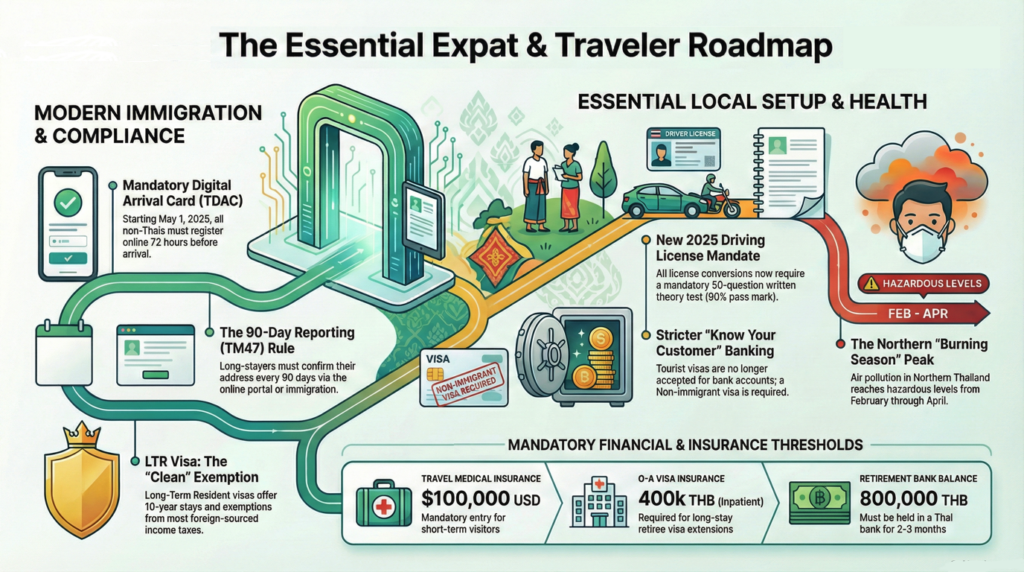
The Non-Immigrant O-A (Retirement) visa provides one-year stays for those aged 50 or older. Requirements include:
- Age 50 or older
- 800,000 THB deposited in a Thai bank account for at least two months before application
- Or monthly income of 65,000 THB from pensions or overseas sources
- Or combination of bank deposit and income totaling 800,000 THB annually
- Health insurance with minimum 100,000 USD coverage from approved providers
- No criminal record
- Cannot work in Thailand
The visa renews annually without leaving the country. The financial requirements test continues ability to support oneself without working. Embassy income letters have become increasingly difficult to obtain, making the bank deposit method most reliable.
Marriage Visa
Foreigners married to Thai nationals qualify for Non-Immigrant O visas based on marriage. Financial requirements are lower: 400,000 THB in Thai bank or 40,000 THB monthly income. Unlike retirement visas, marriage visa holders may apply for work permits.
The couple must demonstrate genuine marital relationship through documentation, joint assets, and sometimes interviews. Divorce terminates the visa immediately. This visa demands more administrative maintenance but provides greater flexibility.
Work Visa and Business Options
Working legally requires both a Non-Immigrant B visa and work permit. The employer sponsors the visa and must meet Thai employment ratio requirements (four Thai employees per foreign worker). Salary minimums apply based on nationality.
Starting a Thai company allows self-sponsorship but requires 2 million THB capital and hiring Thai staff. The company must generate revenue and pay taxes. The Thailand Board of Investment offers incentives for specific industries, but requirements are substantial.
Other visas
The LTR visa is a good option for wealthy citizens as it allows a tax exemptions in Thailad.
Digital Nomad and Remote Work Reality
Thailand has no legal framework for digital nomads. Working remotely for foreign companies in Thailand can break labor laws. However, enforcement is rare for those not taking Thai jobs. Immigration officers show increasing awareness of this practice.
The Smart Visa program targets specific high-tech industries but excludes most remote workers. The practical approach involves using tourist visas or obtaining proper long-term visas through marriage, retirement, or business ownership. The “digital nomad visa” remains a misconception, not a legal reality.
Cost of Living and Daily Expenses
Monthly costs vary dramatically by location and lifestyle. The following estimates reflect moderate Western comfort standards for a single person.
| Location | Housing (1-Bedroom) | Food & Groceries | Transport | Healthcare | Utilities | Total Monthly |
|---|---|---|---|---|---|---|
| Bangkok (City Center) | 22,000 THB | 12,000 THB | 3,000 THB | 2,500 THB | 2,500 THB | 42,000 THB |
| Bangkok (Suburban) | 11,000 THB | 10,000 THB | 2,500 THB | 2,000 THB | 2,000 THB | 27,500 THB |
| Chiang Mai (City) | 14,500 THB | 8,500 THB | 2,000 THB | 2,000 THB | 1,500 THB | 28,500 THB |
| Chiang Mai (Suburban) | 7,500 THB | 7,000 THB | 1,500 THB | 1,500 THB | 1,200 THB | 18,700 THB |
| Phuket (Beach Area) | 20,000 THB | 10,000 THB | 3,500 THB | 2,500 THB | 2,500 THB | 38,500 THB |
| Phuket (Inland) | 14,500 THB | 8,000 THB | 2,500 THB | 2,000 THB | 2,000 THB | 29,000 THB |
| Provincial Thailand | 6,500 THB | 6,000 THB | 1,500 THB | 1,500 THB | 1,000 THB | 16,500 THB |
These figures assume moderate restaurant dining, occasional imported foods, and private health insurance. Luxury lifestyles or frequent Western imports increase costs substantially. Local markets and Thai cuisine reduce food expenses significantly.
Healthcare and Insurance in Thailand
Healthcare quality varies between public and private sectors. Understanding the system prevents financial and medical crises.
Private vs Public Hospitals
Private hospitals in Bangkok, Chiang Mai, and Phuket meet international standards. Doctors often train abroad. Facilities feature modern equipment. English fluency is common. Wait times are minimal. Costs remain reasonable compared to Western countries—specialist consultations average 1,500-3,000 THB.
Public hospitals provide care under the Universal Coverage Scheme but face overcrowding. English proficiency is limited. Non-citizens must register at specific facilities. While technically free, the practical experience often disappoints those accustomed to Western standards.
Insurance Expectations
Retirement visas mandate health insurance from approved providers with minimum 100,000 USD coverage. Even without visa requirements, comprehensive insurance proves essential. Medical evacuation from Thailand to Singapore or home countries costs 500,000-2,000,000 THB.
International insurers (Cigna Global, Allianz, AXA, Aetna International) offer policies specifically designed for Thai expatriates. Local providers (Pacific Cross, Luma Health, Thai Health Insurance) provide competitive alternatives. Premiums for healthy 50-year-olds range from 50,000-150,000 THB annually, depending on coverage.
Pre-existing condition coverage requires careful policy selection. Many insurers exclude conditions for the first two years. Full disclosure during application prevents claim denial later. The industry has grown sophisticated in detecting non-disclosure.
Realistic Standards
Medical tourism has elevated Thailand’s private hospital standards. Complex procedures (cardiac surgery, joint replacement) cost 30-50% of US prices with comparable outcomes. However, chronic condition management requires consistent care relationships that can be difficult to establish.
Dental care is excellent and affordable. Routine procedures cost 20-30% of Western prices. Many expatriates postpone major dental work until arrival in Thailand.
Mental health services remain underdeveloped. While Bangkok offers English-speaking therapists, quality varies. Medication availability differs from Western formularies. Those requiring psychiatric care should research providers thoroughly before relocation.
Housing and Renting Property
Securing accommodation presents one of the first practical challenges. Thai rental law differs substantially from Western systems.
Leases and Contracts
Standard lease terms run one year, though shorter periods are negotiable. The Civil and Commercial Code governs rentals, but enforcement remains inconsistent. Maximum lease duration is 30 years; longer agreements automatically reduce to this term. Usufruct Agreements are also another possibility like sap-ing-sith.
Leases exceeding three years require Land Department registration to be legally enforceable against property buyers. Most expatriates sign one-year leases that don’t require registration. This creates risk if the landlord sells the property.
Deposits and Payments
Landlords typically require two months’ rent as security deposit plus first month’s rent in advance. Some request additional advance payment for the final month. Deposits should be returned within 30 days of lease termination, minus documented damages.
Receipts for all payments are essential. Thailand’s cash economy complicates proof of payment disputes. Bank transfers provide better documentation than cash payments.
Common Traps
Verbal agreements are unenforceable. Every term must be written in the lease. Disputes over utility payments, maintenance responsibilities, and early termination clauses commonly arise when contracts are vague.
“Company leases” where foreigners pay Thai nationals to sign for them break foreign business rules and create dependency. If the Thai partner becomes uncooperative, the foreigner has no legal standing.
Utility costs vary significantly. Some landlords mark up electricity 50-100% above government rates. The lease should specify whether utilities are billed at actual cost or a fixed rate.
Furniture quality often disappoints. Fully-furnished units typically include minimal, low-quality items. Testing all appliances before signing prevents later disputes. Photographing existing damage protects deposit refunds.
Cultural and Practical Adjustments
Successful expatriation requires adapting to Thai cultural norms and bureaucratic processes.
Thai Culture and Communication
Thai communication emphasizes indirectness and preserving harmony. Direct confrontation causes loss of face and typically produces unhelpful responses. Learning to phrase requests politely and accepting initial “yes” answers that mean “maybe” prevents frustration.
The wai gesture (palms together, slight bow) shows respect. Foreigners aren’t expected to master nuanced usage but should respond when Thais wai first. Status matters—those higher in age or position receive greater deference.
Saving face dominates interactions. Public criticism, anger, or frustration causes embarrassment and closes doors. Private, calm discussion achieves better results. Thai colleagues and officials respond to patience and respect, not pressure.
Bureaucracy and Patience
Thai administrative systems operate on their own timeline. Processes that take one day in Western countries may require five visits over three weeks in Thailand. Each visit requires different documents. Requirements change based on the officer’s interpretation.
Maintaining complete document files—multiple copies of passports, visas, bank statements, lease agreements—saves repeated trips. Thai bureaucracy rewards those who anticipate requests rather than those who argue logic.
Immigration queues begin forming before offices open. Arriving early reduces wait times from hours to minutes. Dressing professionally (collared shirt, long pants) influences officer attitudes.
Adaptation Strategies
Learning basic Thai phrases demonstrates respect and unlocks better service. Even minimal effort produces disproportionate goodwill. Language schools abound, and online options make study accessible.
Building relationships with Thai neighbors and colleagues provides cultural translation. Expatriate communities offer practical advice but can isolate newcomers from authentic integration. Balancing both networks prevents expat bubble formation.
Accepting that Thailand won’t change to accommodate individual preferences marks the psychological turning point. Those who adapt thrive; those who resist exhaust themselves fighting inconsequential battles.
Legal and Administrative Setup After Arrival
Initial arrival tasks establish legal compliance and practical functionality.
Residency Reporting
Thai law requires foreigners staying over 90 days to report their address every 90 days. This can be done at immigration offices, by mail, or online. Hotels and serviced apartments often handle this for short stays. Private landlords rarely assist.
Missing the 90-day report incurs fines of 2,000 THB. Multiple violations increase penalties. The requirement seems bureaucratic but is strictly enforced.
Address Registration
The TM30 form requires property owners to report foreign residents within 24 hours of arrival. Immigration offices increasingly enforce this on visa renewal applicants. Renters should confirm landlords will comply before signing leases.
Bank Accounts
Opening Thai bank accounts requires long-term visas. Tourists cannot establish accounts. Banks require passport, visa, lease agreement, and sometimes reference letters. Different banks have different requirements.
The bank account is essential for meeting visa financial requirements. International transfers must show clear origin from overseas. Maintaining detailed transfer records proves funds came from abroad, not Thai sources.
Driving Licenses
International Driving Permits are valid for 60 days after arrival. Long-term residents must obtain Thai licenses. The process requires passport, visa, residency certificate, medical certificate, and passing written and practical tests.
Many hire agents to navigate the process, which costs 3,000-5,000 THB. The medical certificate requires a basic health check at any clinic. Vision tests are mandatory. Those over 65 face additional requirements.
Legal Structure Importance
Operating without proper legal status creates cascading problems. Banks may freeze accounts. Landlords can terminate leases. Hospitals may refuse non-emergency treatment. Police stops become high-stress events. The initial effort to establish proper status prevents ongoing vulnerability.
Common Mistakes First-Time Expats Make
Experience teaches expensive lessons. Learning from others’ errors saves time and money.
Underestimating Visa Complexity Many arrive assuming visa extensions are routine. They discover strict financial requirements, insurance mandates, and changing policies only when facing deadlines. Research visa options thoroughly before arrival. Have backup plans.
Renting Before Understanding Areas Online photos misrepresent neighborhoods. Noise levels, traffic patterns, and community character become apparent only after signing one-year leases. Short-term accommodation for the first month allows exploration before committing.
Bringing Insufficient Funds Thailand is affordable but not free. Initial setup costs—visa fees, housing deposits, insurance, furniture—exceed expectations. Bringing 300,000-500,000 THB ensures comfortable establishment without financial stress.
Ignoring Language Barriers English works in expat bubbles. Outside them, communication breaks down. Learning Thai transforms daily life quality. Those who make no effort often develop resentment toward locals who “won’t speak English.”
Failing to Maintain Financial Documentation Visa renewals require proving funds came from abroad. Scattered records create crises. Systematic documentation from day one prevents panic later.
Choosing Partners Poorly Romantic relationships formed quickly often end expatriations. Cultural differences, financial expectations, and family obligations differ dramatically. Rushed marriages for visa purposes frequently end in expensive divorce and deportation.
Overlooking Exit Strategies Thailand’s political stability, while generally good, can shift. Personal circumstances change. Maintaining bank accounts, property, and investments in home countries provides security. Those who sink all resources into Thailand find themselves trapped.
Trusting Verbal Agreements Thai culture values relationship over contract. Westerners interpret friendly assurances as binding commitments. Every agreement—especially with landlords, business partners, and romantic interests—must be documented in writing.
Neglecting Health Maintenance Tropical diseases, different food safety standards, and age-related conditions require proactive care. Those who skip regular checkups face serious conditions discovered too late. Preventive care costs little; emergency treatment costs much.
Social Isolation Expat communities provide comfort but can become ghettos. Those who interact only with other foreigners miss integration opportunities and develop distorted views of Thailand. Balancing expat friendships with Thai relationships creates sustainable happiness.
Frequently Asked Questions (FAQ)
Is Thailand cheap to live in?
Thailand offers lower costs than Western countries but is not universally cheap. Bangkok and Phuket match mid-tier European city prices. Chiang Mai and provincial areas provide genuine savings. Quality Western food, imported goods, and international schools cost Western prices. Local products and services remain affordable. Most expatriates live comfortably on 40,000-60,000 THB monthly outside prime areas.
Can foreigners own property?
Foreigners cannot own land directly. Condominium ownership is permitted if foreign ownership in the building remains below 49%. Leasehold arrangements provide 30-year terms, renewable. Some structure ownership through Thai companies, but recent crackdowns make this risky. Most expatriates rent rather than own.
Is English widely spoken?
English proficiency concentrates in tourist areas, international schools, and multinational companies. Bangkok, Chiang Mai, and Phuket offer reasonable English access for daily needs. Provincial Thailand requires Thai language skills. Older Thais and those in traditional occupations rarely speak English. Learning basic Thai transforms the experience.
Is Thailand safe?
Thailand ranks as one of Southeast Asia’s safest countries for violent crime. Petty theft and scams target tourists in busy areas. Traffic accidents pose the greatest risk—Thailand has among the world’s highest road fatality rates. Food safety concerns exist but serious illness is uncommon. Political stability is generally good, though occasional protests occur. Most expatriates report feeling safer than in their home countries.
How long can I stay legally?
Tourist visas allow 60-90 days. Retirement, marriage, and work visas provide one-year stays, renewable annually. Proper long-term visas allow continuous residence for decades. Those who maintain visa compliance face no time limits. Those attempting to live on tourist visas risk detention and blacklisting after 6-12 months of back-to-back entries.
Do I need a lawyer?
Legal assistance proves valuable for visa applications, business registration, property transactions, and family matters. Thai law differs substantially from Western systems. While not required for basic retirement or marriage visas, professional guidance prevents costly errors in complex situations. Most expatriates benefit from establishing relationships with reputable law firms before problems arise.
What about banking and money transfers?
Thai banks require long-term visas for account opening. International transfers must come from overseas accounts to meet visa requirements. TransferWise (now Wise) and similar services offer better rates than traditional banks. ATM fees for foreign cards run 220 THB per transaction. Carrying large cash amounts risks theft and declaration requirements. Digital banking is advanced but requires Thai phone numbers for verification.
Can I bring my pets?
Thailand allows pet imports if you have the right documents. You need health certificates, vaccination records, and import permits from the Department of Livestock Development. Quarantine periods vary by country of origin. Some breeds face restrictions. The process requires advance planning and typically costs 20,000-50,000 THB including agent fees.
How reliable is internet service?
Bangkok, Chiang Mai, and Phuket offer fiber optic connections with speeds reaching 1 Gbps. Reliability is high, with brief outages during storms. Provincial areas have slower but functional service. Mobile data is inexpensive and widely available. Co-working spaces provide backup connectivity for critical work. Internet censorship exists but rarely affects expatriates.
What about schooling for children?
International schools in big cities provide Western curricula like IB, British, and American. The costs range from 300,000 to 800,000 THB each year. Quality varies significantly. Local Thai schools teach in Thai and follow different pedagogical approaches. Homeschooling exists in legal gray areas. Educational costs substantially impact family budgets and should be researched thoroughly before relocation.
Final Thoughts
Thailand rewards preparation and punishes improvisation. Those who research visa requirements, understand cultural norms, and maintain realistic expectations find the expatriation experience enriching. Those who treat Thailand as an extended vacation discover administrative and financial consequences.
The country offers genuine opportunities for improved quality of life, particularly for retirees and remote workers. Infrastructure quality, healthcare standards, and cost advantages are real. However, these benefits require investing time in learning systems, building relationships, and adapting perspectives.
Patience emerges as the essential virtue. Processes take longer than expected. Cultural misunderstandings occur regularly. Language barriers frustrate. Those who accept these as part of the experience rather than defects to be fixed enjoy Thailand. Those who fight the differences exhaust themselves.
Maintaining connections to home countries provides psychological and practical security. Complete immersion without backup plans creates vulnerability. The most successful expatriates balance integration into Thai society with preservation of options.
Thailand changes people. The emphasis on social harmony, respect for hierarchy, and acceptance of circumstance contrasts sharply with Western individualism. Many find this shift liberating. Others find it constraining. Understanding your own values before arrival helps determine whether Thailand suits long-term residence.
The decision to expatriate deserves the same serious consideration as any major life change. Visit multiple times, research thoroughly, and speak with long-term residents. Thailand offers different experiences to different people. Your success depends on alignment between your expectations and Thailand’s reality.
Professional legal guidance transforms potential pitfalls into manageable processes. Before committing resources to Thai residence, consult experienced immigration and business lawyers who understand both Thai administrative systems and expatriate needs. The modest investment in proper consultation prevents costly errors, visa denials, and legal complications that end expatriations prematurely.
ThaiLawOnline provides comprehensive legal services specifically designed for expatriates establishing long-term residence in Thailand. Expert help is important for your Thai adventure. It covers visa applications, business registration, family issues, and property deals. This support ensures you start on solid legal ground. Contact qualified legal professionals to discuss your specific situation before making irreversible commitments. Just as reference, Mr. Brousseau lives in Asia since 2002 and has been in Thailand since 2004. He has more than two decades of experience and can help you to integrate to Thailand easily. Do not hesitate.