


Last updated on
Reviewed by ThaiLawOnline, a licensed Thai law firm practising in Thailand since 2006. Thai lawyer of record: Wichuda Atthamethakon, LL.M., Thai Bar Licence 3149/2556.
Thailand has changed how it checks criminal backgrounds in recent years, and that has created a complicated picture for foreigners who want a visa or a job here. A criminal record check now sits in the middle of hiring, work permits and long stay visa applications. This guide covers both sides of it: how you get a certificate, and what a Thai employer is allowed to do with one once it has it.
Table of Contents
- Understanding Thai Police Clearance Certificates
- Legal Framework and Recent Developments
- Application Process and Requirements
- Visa Application Requirements
- Employment Implications and Workplace Consequences
- Can a Thai employer legally run a criminal record check on you?
- What an employer must do, and what it costs to get wrong
- Processing Timelines and Associated Costs
- Immigration Enforcement and Entry Denial
- Sector-Specific Requirements and Industry Variations
- Recent Policy Changes and Future Developments
- FAQs about Criminal Record Checks in Thailand
Understanding Thai Police Clearance Certificates
Criminal Record Checks in Thailand
A Thai Police Clearance Certificate, also called a Certificate of Good Conduct, is an official document issued by the Royal Thai Police. It states whether a person has a criminal history in Thailand, and it is now a routine requirement in immigration, hiring and licensing.
The Police Clearance Service Center’s published document sheet sets no expiry date for the certificate, so it does not lapse of its own accord. What decides matters in practice is the recency rule of the authority you submit it to: embassies, employers and licensing bodies each set their own, and some will not accept a certificate issued more than a few months earlier. Check that requirement before you apply, because it governs when you should apply rather than whether the certificate is still good. The document reports criminal activity that occurred inside Thailand only. If you have lived in several countries, each of them may need to issue its own clearance before an employer or a consulate treats your file as complete.
The Royal Thai Police issues these certificates through the Police Clearance Service Center, which sits under the Special Branch Bureau. Its address, from the Centre’s own published document sheet, is the Public Service Centre building, 2nd floor, 27/40 Soi Vibhavadi Rangsit 27, Thung Song Hong, Lak Si, Bangkok 10210, telephone 0 2551 1999. The centre handles criminal background checks for Thai citizens and foreign residents alike.
Legal Framework and Recent Developments
The Immigration Act does not govern the certificate. A criminal record can matter at the border under the Immigration Act B.E. 2522 (1979), and an overstay can lead to blacklisting, but the police clearance certificate itself is an administrative document issued under the Royal Thai Police’s own regulations. No statute creates a right to one. That distinction decides what you can argue: a refusal to issue is an administrative matter with the Centre, not an immigration appeal. Our page on how to get a Thai police clearance certificate sets out the issuing procedure in full.
The biggest change in recent years is Thailand’s connection to international crime databases. In practice this means screening against Thai records and cooperation through Interpol channels with foreign police forces, rather than direct access to any one country’s domestic database. A conviction abroad is therefore more likely to surface through police cooperation or through the certificate your own country issues than through an automatic lookup at the border. Immigration officers can refuse entry to anyone they judge a threat to public safety, morality or public order, and they pay particular attention to people with a criminal record in Thailand.
An Electronic Travel Authorization (ETA) was announced for December 2024 and would pre-screen visa-exempt travellers before arrival, in the manner of similar schemes in Europe and North America. It has been postponed repeatedly and has still not launched, so it changes nothing for travellers today. What did launch is the Thailand Digital Arrival Card (TDAC), which every non-Thai national has had to submit online at tdac.immigration.go.th within three days before arrival since 1 May 2025. It replaces the paper TM6 card and asks for passport, travel, accommodation and health details. It is an arrival card, not a visa and not a pre-screening authorisation, and it asks nothing about criminal history. Treat any date you are quoted for it with caution until it is actually in force.
Application Process and Requirements
The process for obtaining a Thai Police Clearance Certificate varies with the applicant’s nationality, current location, and intended use of the document. The system separates Thai nationals from foreign applicants, and each category carries its own documentation requirements and procedural steps.
Thai Police Clearance Certificate: Key Requirements and Processing
| Applicant Type | Documents Required | Processing Time | Costs |
|---|---|---|---|
| Foreign nationals in Thailand | Passport copy, Thai entry and exit stamps, non-immigrant visa or work permit copies, fingerprint card | The Centre publishes no processing time for this route. Its 15 and 25 working day figures come from the sheet for Thai nationals, and 15 to 25 working days is the figure it gives for applicants residing abroad. Plan on at least that long | 100 THB government fee, plus service fees if you use an agent |
| Thai nationals | Passport, national ID, house registration, military certificate (men over 20), name or marital status change documents if applicable | 15 working days where the papers are complete and no record is found; 25 working days where a record exists | 100 THB plus minor stamp fees |
| Applicants abroad | Certified passport copies, Thai visa and permit history, fingerprints from a police station or embassy with seal, purpose of use statement | 15 to 25 working days, longer if records are found | 100 THB plus mailing and legalization fees; 4,000 to 7,900 THB if using service providers |
| Agent-assisted filing (Thailand only) | Same as above | No faster than the Centre’s own processing: an agent can prepare and lodge the papers but cannot shorten the queue, and the Centre publishes no separate timetable for agent-assisted files | Higher service fees, which vary by provider |
Foreign nationals applying from inside Thailand need valid passport copies showing all Thai entry and exit stamps, copies of any Non-Immigrant visas or work permits held, and certified fingerprints. You can have fingerprints taken at the Police Clearance Service Center or at a Thai Embassy or Consulate, and they must carry the official seal and signature of the authority that took them.
Eligibility for foreign nationals turns on having kept legal status in Thailand, whether through a short stay visa, a non-immigrant visa or an extension of stay. Someone with no lawful immigration record here cannot obtain a certificate, because the official systems hold no record of their presence.
Thai nationals need a current passport, copies of the national identity card and house registration documents. Men over twenty add the military service certificate. Anyone who changed name or marital status while abroad should expect to file the supporting documents for that too.
Applicants living abroad face a longer route. You post the application with certified copies, add fingerprints taken at a local police station or a Thai diplomatic mission, and state in detail how you will use the certificate. Processing from overseas usually runs 15 to 25 working days, and it runs longer if a record surfaces or the file is incomplete.
Visa Application Requirements
The link between criminal record checks and visa applications in Thailand is not uniform. Requirements change with the visa category, with what the applicant plans to do here, and with the mission deciding the file.
Non-Immigrant B visas for employment draw the closest scrutiny, particularly for teaching positions. After several incidents involving foreign teachers, consulates tightened their background check requirements, and some now ask for both a clearance from your home country and a Thai police certificate from anyone who has lived here for a long period.
Teaching faces the most demanding screening of any sector. Schools and government agencies commonly make a full background check a condition of employment, which reflects how much of the work is unsupervised contact with children.
Retirement visas (Non-Immigrant O-A and O-X) require a criminal record clearance from your country of nationality or residence, alongside the medical certificate and the financial evidence. How recent that clearance has to be is set by the embassy or consulate deciding your file, not by a published national rule, and the missions differ. Check the checklist of the mission you will apply to before you order one, because a certificate that is too old is a refusal you pay for twice.
Non-Immigrant O visas for family reasons often carry no criminal background check when you apply inside Thailand. Thai embassies and consulates abroad can add their own requirements, so the same visa can demand different papers depending on where you file.
Tourist visas and visa-exempt entries generally involve no criminal background check at the application stage. That is not the same as no check at all: immigration officers can still refuse entry at the checkpoint on what the databases show, whatever your visa status.
Employment Implications and Workplace Consequences
The link between criminal background checks and jobs in Thailand runs past hiring into work permit applications and promotion. Employers treat these certificates as a risk management tool, particularly where the job carries money, children, or public trust.
Teaching and education sit at the strict end. Many schools ask for clearances from both the home country and Thailand before they make an offer, which follows government directives on protecting students. A teacher who cannot produce the documents is usually shut out of formal employment whatever the qualifications say.
Corporate employment in multinationals and financial institutions now folds criminal background checks into standard hiring. Screening is not a free choice, and this is the part most employers in Thailand get wrong. A criminal record is sensitive personal data under the Personal Data Protection Act, so an employer that collects one is inside a statutory scheme with its own consent rules, notification duties, retention limit and penalties. The two sections below set out what the Act actually requires. Companies in regulated industries such as banking or securities also carry compliance obligations of their own that can make screening mandatory.
Work permit implications. A police clearance certificate is a real consideration for foreign employees, though criminal background checks are not always required for work permit applications. Labour authorities may still request one, usually for sensitive roles or where something in the file prompts a closer look. Failing to produce it on request can cost you the permit or see an existing one revoked.
The consequences of working without proper documentation have grown more severe. The Royal Emergency Decree on Managing the Work of Foreigners, made in 2017 and amended since, replaced small fines with heavy penalties, deportation and multi-year entry bans.
Can a Thai employer legally run a criminal record check on you?
Yes, within limits, and the limits are stricter than the consent form most Thai employers use. Almost every English language guide to a background check in Thailand reduces the rule to one line: get the candidate’s consent and you may collect the record. That is not what the statute says. Consent answers one requirement and leaves a second one standing.
A criminal record is sensitive personal data under PDPA section 26
Section 26 of the Personal Data Protection Act B.E. 2562 (2019) lists criminal records (ประวัติอาชญากรรม) alongside race, political opinion, religious belief, sexual behaviour, health data, disability, trade union membership, genetic data and biometric data. Collecting any of it without the data subject’s explicit consent is prohibited, subject to five exceptions. Two of them matter to employers: collection necessary to establish, comply with, exercise or defend a legal claim, and collection necessary to comply with a law on labour protection, social security or social welfare. A general wish to screen candidates is neither of those, so an ordinary private employer is relying on consent.
Why the candidate’s consent is necessary but not sufficient
Section 26 has three paragraphs. The consent rule everyone quotes is paragraph one. Paragraph three is separate, and it applies specifically to criminal record data:
ในกรณีที่เป็นการเก็บรวบรวมข้อมูลส่วนบุคคลเกี่ยวกับประวัติอาชญากรรมต้องกระทำภายใต้การควบคุมของหน่วยงานที่มีอำนาจหน้าที่ตามกฎหมาย หรือได้จัดให้มีมาตรการคุ้มครองข้อมูลส่วนบุคคลตามหลักเกณฑ์ที่คณะกรรมการประกาศกำหนด
Where personal data relating to criminal records is collected, the collection must be carried out under the control of a competent official authority, or personal data protection measures must be provided in accordance with the criteria prescribed by the Committee.
Read it as two limbs. A private employer is not a competent official authority, so the first limb is closed to it and it must be on the second: it has to have protective measures in place that meet the criteria the Personal Data Protection Committee has published. Paragraph three is drafted as a standing condition on the act of collecting, not as another exception to consent, so satisfying paragraph one does nothing for it. An employer holding a signed consent form and nothing else is on the wrong side of paragraph three, and section 84 prices a breach of paragraph one or paragraph three at an administrative fine of up to THB 5,000,000.
We have found no Thai court decision applying paragraph three to a hiring case, so treat this as the reading the text supports rather than a settled point. It is the reading an employer should plan around, because the cost of being wrong sits with the employer.
The three purposes the Committee’s criteria allow
The criteria come from the Notification of the Personal Data Protection Committee on Protective Measures for the Collection of Personal Data Relating to Criminal Records Not Carried Out Under the Control of Authorities Empowered by Law, B.E. 2566. It was published in the Royal Gazette on 8 January 2024 and takes effect ninety days after publication, which practitioners in Thailand count as 7 April 2024.
The Notification permits collection for three purposes:
- considering a person for employment, or checking qualifications, disqualifying characteristics or suitability to hold a position;
- checking qualifications or disqualifying characteristics for the issue of a licence, where a state agency or a controller exercising delegated state authority does it;
- checking qualifications or disqualifying characteristics for other permissions, by a controller other than in point 2.
Each still needs explicit consent or another supporting legal basis. Hiring falls squarely inside the first purpose, so a Thai employer screening a candidate is doing something the Act contemplates. What the Act does not contemplate is collecting the record for curiosity, for an existing employee with no live decision attached, or for a purpose the candidate was never told about.
What counts as a criminal record, and why a pending case counts
The Notification defines ประวัติอาชญากรรม as personal data concerning the investigation of a criminal offence, the prosecution of a criminal case, or the serving of a criminal sentence, where that data is official or certified by a state agency with authority over the process, whether or not the proceedings are final.
That definition is wider than a conviction. An open investigation is criminal record data. An HR file that records “there is a case pending against him” holds sensitive personal data and carries every duty in this section, even though no court has decided anything. For what the underlying proceedings involve, see our guide to criminal law in Thailand.
What an employer must do, and what it costs to get wrong
Four duties do most of the work: tell the candidate early, collect only for a permitted purpose, secure what you hold, and delete it on time.
Tell the candidate in the job advertisement, not at the offer stage
The Notification requires the employer to tell candidates that a criminal record check will be run from the first step: the job advertisement, the sourcing stage or the selection stage. Most Thai employers raise it far later, in the offer letter or the onboarding pack, and that is already too late. Where consent is the legal basis, the employer must also state what follows from giving consent and what follows from refusing it or withdrawing it, at the moment consent is requested. A consent form that says only “I agree to a background check” does not meet that.
Employers drafting these documents should read this next to the ordinary hiring paperwork. Our employment agreement template for Thailand and our guide for employers cover what else belongs in the file.
Delete it within six months of finishing with it
This is the only hard number in the subject. Once the processing or use is complete, the employer may keep criminal record data for no more than six months, counted from the date it finished using the data, not from the date it collected it. After that the data must be erased, destroyed or rendered non-identifying.
Three things extend it, and nothing else does:
- a specific law requiring longer retention;
- another legal basis under section 26, of which defending a legal claim is the worked example;
- separate explicit consent to keep it longer.
In practice this means the unsuccessful candidate’s file is the exposure. The employer finished using that record the day it made the hiring decision, so the clock started then, and six months later the copy sitting in a shared drive is data the employer has no right to hold.
The fine for collecting it wrongly: section 84 and THB 5,000,000
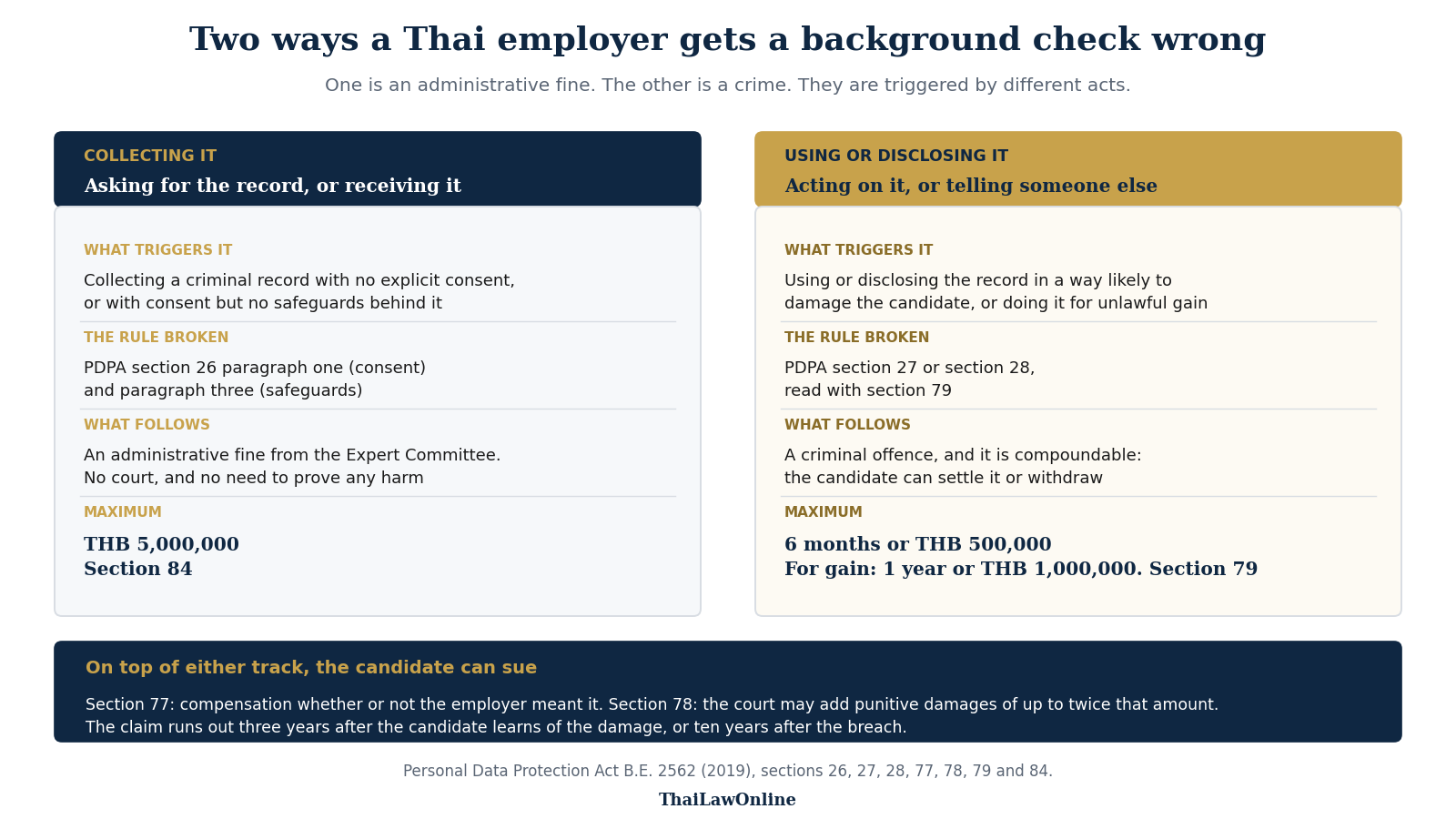
Sensitive data sits on the higher administrative tariff. Section 83 covers most breaches of the Act at up to THB 3,000,000. Section 26 is not on that list. Section 84 covers it instead, and sets an administrative fine of up to THB 5,000,000 for a data controller who breaches section 26 paragraph one or paragraph three, or breaches sections 27 or 28 in relation to sensitive data.
An administrative fine needs no court and no proof that anyone was harmed. The Expert Committee imposes it.
When it becomes a criminal offence: section 79, and why it is compoundable
The criminal provision is keyed to use and disclosure, not to collection. Section 79 punishes a data controller who breaches section 27 paragraph one or two, or fails to comply with section 28, in relation to sensitive data, and only where the conduct is likely to cause another person damage, loss of reputation, contempt, hatred or humiliation. That carries imprisonment of up to six months, a fine of up to THB 500,000, or both. Where the same breach is committed to obtain an unlawful benefit for the employer or anyone else, it rises to up to one year, up to THB 1,000,000, or both.
Two consequences follow, and neither is in the vendor guides:
- An employer that quietly collects a criminal record with no consent and no safeguards commits no criminal offence on that fact alone. Its exposure is the section 84 fine.
- Offences under section 79 are compoundable, which means the candidate can settle or withdraw. That changes the negotiating position on both sides of the desk.
Thai HR commentary often flattens this into “get it wrong and you could go to prison”. That is true only of the use and disclosure limb, and only with the aggravating element on top. The realistic risk for most employers is the administrative fine and the civil claim.
What a candidate can do if an employer got it wrong
Two routes, and they run in parallel. A candidate can complain to the Personal Data Protection Committee’s office, which is what triggers the administrative fine. A candidate can also sue. Section 77 makes a controller liable to compensate damage caused by a breach of the Act whether or not the breach was intentional or negligent, and leaves the controller only two defences: force majeure or the data subject’s own act, and compliance with an official’s lawful order. Section 78 lets the court add punitive damages of up to twice the actual damages, weighing how severe the damage was, what the employer gained, its financial position, whether it put things right, and what the candidate contributed.
The claim runs out three years after the candidate learns of both the damage and the person liable for it, or ten years after the breach, whichever comes first. Employees weighing a claim will also want our guide to employee rights in Thailand and to Thai labour law, because a data complaint often travels with a dismissal or a withdrawn offer.
Processing Timelines and Associated Costs
The cost of a Thai Police Clearance Certificate varies with where you file and whether you use help. The government fee is the small part of it.
Government fees stay modest at 100 Thai Baht for the certificate, plus minimal stamp and processing charges. The Centre’s sheet states the 100 baht fee as in force since 1 October 2012.
Service provider options run from filing it yourself to full legal assistance. Filing it yourself saves money and costs time in document preparation, office visits and follow up. ThaiLawOnline’s normal service is 4,400 THB per person outside Thailand or 6,400 THB in Thailand. Fast-track is 8,400 THB, with availability, document requirements and estimated issue date confirmed before payment. See our Police Clearance service scope, fees and delivery instructions.
Processing timelines come from the Police Clearance Service Center’s published sheet: 15 working days where the documents are complete and no record or security concern is found, and 25 working days where a record exists, in which case a copy of the court judgment and a certified copy confirming the case is final must be filed as well. Overseas applications take longer because the papers travel through a Thai embassy or consulate.
Geography drives both cost and convenience. Applicants in Thailand can attend the Police Clearance Service Center in person. Applicants abroad post the file or appoint a representative, which adds steps, cost and time.
Immigration Enforcement and Entry Denial
Thailand’s immigration enforcement has tightened for anyone with a criminal record, whatever their visa status or reason for travelling. Information sharing between Thai immigration systems and foreign police forces means a record from another country can influence an entry decision here.
Discretionary authority is the largest single risk factor. An immigration officer can refuse entry to a traveller holding a valid visa if the officer judges them a threat to public safety, morality or order, and that discretion reaches minor offences from decades ago.
Thai immigration authorities conduct background checks and assess admissibility under immigration law. The availability of overseas criminal record information depends on lawful information sharing arrangements. This page does not claim direct access to any named foreign database.
Blacklisting now follows fairly mechanically from overstay and other immigration offences. Exclusion can run for one year or permanently, depending on how serious the violation was.
Appeal and rectification routes exist for someone who believes a refusal was wrong. They are slow and expensive, and they need legal representation and documented evidence of rehabilitation or changed circumstances.
Sector-Specific Requirements and Industry Variations
Sectors screen differently, and the differences track the risk each one carries. Everything in this section still sits under the PDPA duties set out above: a stricter industry practice does not create a legal basis the Act does not give.
Education and childcare screen hardest, because the people they serve are vulnerable. International schools commonly ask for clearances from the applicant’s home country, from Thailand, and from anywhere else the applicant lived for a long period.
Financial services and banking screen for regulatory and risk reasons. Roles touching customer funds, financial data or compliance functions usually carry a full criminal check as a condition of employment.
Healthcare and medical employers increasingly screen for hiring and for licensing, particularly for patient facing roles and roles with access to controlled substances. International hospitals often screen beyond the local requirement to hold their accreditations.
Technology and digital services face no sector specific rule, and screen anyway as part of security practice. Positions touching sensitive data, intellectual property or customer information may carry a clearance requirement written into a client contract rather than into law.
Recent Policy Changes and Future Developments
Thailand keeps adjusting how it screens, in response to security concerns, better technology and pressure from partner countries.
The data protection layer is the real recent change for employers. Before April 2024 there was no published set of criteria for a private employer collecting criminal record data. There is now, and it carries a retention cap, a notification duty and a penalty. Most employers in Thailand have not adjusted their hiring paperwork to it.
Legislative updates on the immigration side have widened the grounds for visa denial and entry prohibition and streamlined enforcement.
Technology integration is the pending piece. The Electronic Travel Authorization would automate pre-arrival screening, and it has not launched. Nothing changes for travellers until it does.
International cooperation arrangements with European Union countries, Australia and other major source countries continue to widen the information available to Thai authorities.
FAQs about Criminal Record Checks in Thailand
What is a Thai Police Clearance Certificate (Certificate of Good Conduct) and why is it required?
A Thai Police Clearance Certificate, also called a Certificate of Good Conduct or a Royal Thai Police clearance, is an official document from the Royal Thai Police confirming whether you have a criminal history in Thailand. It is used for immigration, employment screening, work permits and certain licensing processes. The issuing office sets no expiry date for the certificate. The authority you give it to sets its own recency rule, so check theirs before you apply. It covers offences that happened in Thailand only, so if you have lived elsewhere you will need separate clearances from those countries for a complete background check.
How do I apply for a Thai Police Clearance in Bangkok vs. from overseas?
In Thailand you apply at the Police Clearance Service Center of the Special Branch Bureau, at 27/40 Soi Vibhavadi Rangsit 27, Thung Song Hong, Lak Si, Bangkok 10210. Foreign applicants usually need a passport biodata page, copies of all Thai entry and exit stamps, any non-immigrant visas or work permits, and fingerprint cards taken at the Service Center or another qualified authority. Applicants from other countries apply by post, sending certified copies, officially sealed fingerprints from a local police station or Thai embassy or consulate, and a clear statement of purpose. Processing from abroad takes longer and may involve document verification if records are found or paperwork is incomplete.
Do I need a criminal background check for my Thai visa?
Requirements vary by category and by where you apply. Non-Immigrant B for employment is checked closely, especially for teaching jobs, so expect a check from your home country and a Thai police certificate if you have lived here for a long period. Retirement visas (Non-Immigrant O-A and O-X) require a criminal record clearance, and how recent it has to be is set by the embassy or consulate deciding your file rather than by a published national rule, so check that mission’s own checklist before you order one. Non-Immigrant O visas for family reasons usually carry no background check when you apply inside Thailand, though missions abroad may set their own rules. Tourist visas and visa-exempt entries usually need no certificate at the application stage, but immigration can still refuse entry at the border.
How can a criminal record impact Thai immigration decisions, entry denial, or blacklisting?
Thai immigration officers assess admissibility under immigration law and conduct background checks. A valid visa does not guarantee admission. This page does not claim direct access to the FBI NCIC database or to comprehensive overseas criminal record data. Disclose relevant history accurately and prepare the court or case outcome documents in case they are requested.
What are the costs, processing times, and expedited options for a Thai police certificate?
Government fees are modest at about 100 THB for the certificate plus minor stamps and processing. The Centre’s published sheet gives 15 working days where the papers are complete and no record is found, and 25 working days where a record exists. Applications filed from overseas take longer because the papers travel through a Thai embassy or consulate, and cases involving a record or an incomplete submission take longer still. Full service providers handling fingerprints, legalization and follow up usually charge between 4,000 and 7,900 THB depending on nationality, residence and urgency. Nothing in the Centre’s published sheet offers a faster route, so expect the 15 or 25 working days whichever way you file. A paid provider can prepare and lodge the papers but cannot shorten the Centre’s own processing.
Can I obtain a Thai Police Clearance if I’m out of status or previously overstayed?
Not while you are out of status. A past overstay does not by itself bar you if you are now lawfully in Thailand. Foreign nationals must show they are lawfully present, through a valid short stay or non-immigrant status or an extension of stay. Someone with no lawful immigration record in Thailand cannot obtain a police clearance, because the official systems do not recognise their presence. Past overstays or illegal work also make future entries harder and can lead to blacklisting, which affects both visas and jobs.
What do Thai employers and work-permit authorities expect regarding criminal background checks?
Employers use background screening as a risk management standard, particularly in education, finance, healthcare and roles of trust. Teaching is the strictest: many schools want a criminal check from your home country and a Thai police certificate before hiring or processing a work permit. Regulated industries such as banking and hospitals screen comprehensively to meet compliance and accreditation standards. A work permit does not always require a police clearance, but labour authorities may ask for one, and being ready avoids delays, denials or revocation. Whatever the practice, the employer’s own duties under the PDPA still apply to anything it collects.
Can my employer in Thailand check my criminal record without asking me?
No. A criminal record is sensitive personal data under section 26 of the Personal Data Protection Act, so an employer needs your explicit consent unless it can point to another basis in the Act, such as defending a legal claim or complying with a labour protection law. Consent on its own is also not enough: section 26 paragraph three requires the employer to have protective measures in place meeting the criteria the Personal Data Protection Committee published in its B.E. 2566 Notification. An employer with a signed form and nothing behind it is in breach.
How long can a Thai employer keep my criminal background check?
Six months at most, counted from the date the employer finished using the data rather than the date it collected it. After that it must erase, destroy or anonymise the record. It can hold it longer only where a specific law requires that, where another section 26 basis applies such as defending a legal claim, or where you gave separate explicit consent to the longer period.
Is it illegal for an employer to run a background check in Thailand?
Running the check is lawful when it is done for a permitted purpose, with explicit consent or another basis, and with the required protective measures. Getting it wrong splits two ways. Collecting the record improperly is an administrative matter: the Expert Committee can impose a fine of up to THB 5,000,000 under section 84. Using or disclosing it improperly can be a criminal offence under section 79, punishable by up to six months’ imprisonment or a fine of up to THB 500,000, rising to one year or THB 1,000,000 where it was done for unlawful gain.
Does a Thai employer need my written consent for a police clearance certificate?
It needs your explicit consent, and it must tell you about the check from the first stage of recruitment, meaning the job advertisement or the sourcing stage, not the offer letter. When it asks for consent it must also tell you what follows from giving it and what follows from refusing or withdrawing it. A single line in an onboarding pack saying you agree to a background check does not meet that standard.
What can I do if a Thai employer shared my criminal record with someone else?
You can complain to the office of the Personal Data Protection Committee, which can lead to an administrative fine, and you can sue. Section 77 makes the employer liable to compensate your damage whether or not it acted intentionally or negligently, and section 78 lets the court add punitive damages of up to twice the actual damages. You have three years from learning of both the damage and who is liable, or ten years from the breach. Where the disclosure was likely to damage your reputation, it may also be an offence under section 79, which is compoundable, so you can settle it.
Does a pending case count as a criminal record in Thailand?
Yes. The Committee’s Notification defines criminal record data as data concerning the investigation of an offence, the prosecution of a case, or the serving of a sentence, where it is official or certified by a state agency, whether or not the proceedings are final. An open investigation is therefore sensitive personal data, and an employer that records it carries the same duties as one holding a conviction.
Thailand’s criminal record check system now has two halves that rarely appear on the same page. The first is procedural: where you apply, what you file, what it costs, how long it takes. The second is the data protection layer that governs what an employer may do with the result, and since April 2024 that layer has a published set of criteria, a six month retention cap and a five million baht ceiling behind it. Candidates should know that consent is not a blank cheque. Employers should know that a signed form is not compliance.
If you are hiring in Thailand and your consent paperwork predates April 2024, it is worth a look. If you have been refused a job or had a record disclosed, you have more standing than most people realise. Book a consultation and we will tell you which of the two halves your problem sits in.
Links: Immigration Bureau of Thailand
Last reviewed: 18 September 2026.
Correction log. On 18 September 2026 two sections on the Personal Data Protection Act were added, because the page previously described employers screening candidates without naming the Act that regulates it. A sentence stating that background checks are “not required by law for most jobs” was removed: it read as though screening were unregulated, which is the opposite of section 26. The FAQ statement that retirement visa clearances “are usually issued within 3 months of submission” was removed, because the body of this page had already corrected that on 14 September and the FAQ still restated it as a national rule. On 14 September 2026 the processing periods were re-attributed to the sheet each one is printed on, after all four of the Centre’s published documents were read: its 15 working days where the papers are complete and no record is found, and 25 working days where a record exists, are printed on the sheet for Thai nationals; its sheet for a foreign applicant residing in Thailand states no processing period at all; and its English sheet for applicants residing abroad gives 15 to 25 working days. The sheets describe no expedited route, and the sheet sets no expiry for the certificate. On 12 September 2026 three facts were corrected against the Police Clearance Service Center’s own published document sheet at pcscenter.sbpolice.go.th: the issuing office is the Centre of the Special Branch Bureau at Lak Si, not Building 24 of the Royal Thai Police Headquarters on Rama I Road, and the 7 to 10 day figure was removed. On 5 September 2026 the claim that Thai immigration queries the United States National Crime Information Center was removed, the NCIC being a domestic United States system, and the Electronic Travel Authorisation was restated as announced and repeatedly postponed rather than arriving.
Jurisdiction: Thailand. Written and reviewed by ThaiLawOnline, a licensed Thai law firm practising since 2006.
Thai Law Updates, free by email
Plain-English updates on Thai law changes that affect foreigners: property, visas, marriage, business and wills. One short email a month from a firm practicing since 2006. No spam, unsubscribe anytime.